






 Back
Back
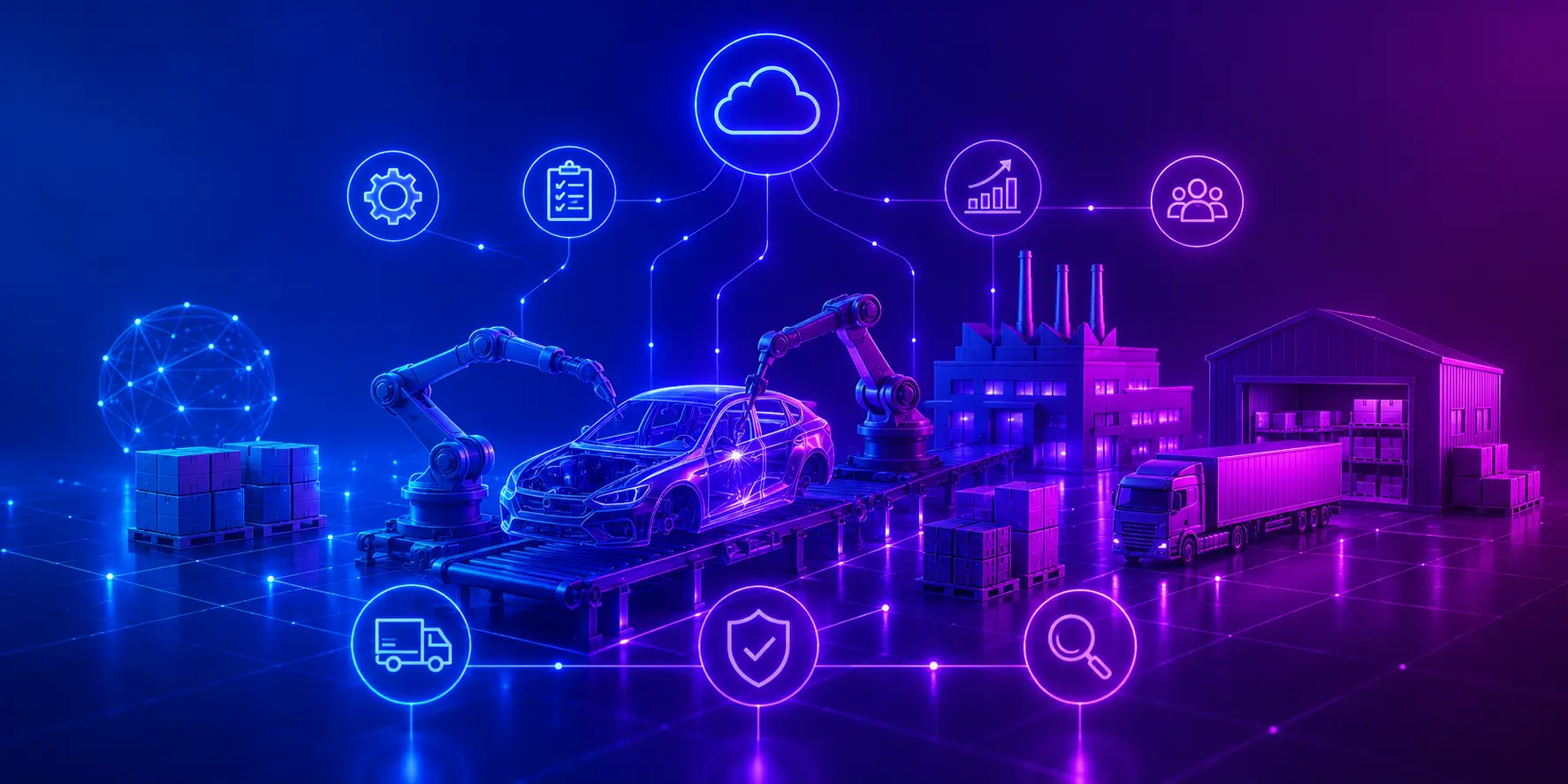

Experion can approach automotive ERP as more than a back-office system, aiming instead to give manufacturers a genuine advantage in how they operate and compete.
The automotive industry is shifting toward CASE (Connected, Autonomous, Shared, Electric) vehicles and lean manufacturing. Traditional management systems are thus unable to cope with globally distributed supply chains. Spreadsheets, disconnected point tools, and generic business software can’t keep up with the demands of the automotive industry, which focuses on sequenced deliveries, zero-defect quality mandates, and constant cost pressure. Modern automotive ERP solutions solve this challenge by unifying planning, procurement, production, quality, and finance into one system. This blog covers what these systems do, why they matter, how to choose one, and where the industry is heading.
Key Takeaways
- Automotive ERP solutions connect the entire value chain from BOM management, JIT scheduling, and quality compliance to financials, all in one platform.
- What sets custom automotive ERP solutions apart from generic ERP is their industry-specific capabilities: built-in EDI, IATF 16949 compliance, and full lot/serial traceability.
- Various automotive industry segments such as OEMs, Tier 1 and Tier 2 suppliers, parts manufacturers, EV makers, and aftermarket businesses all have varying needs from their ERP.
- The best ERP software for the automotive industry shows up in the numbers: Less downtime, better OEE, faster recall response, and better margins.
- A rollout succeeds or fails on phased execution, clean data, and an experienced implementation partner. The software brand matters less than people assume.
- When off-the-shelf software can’t match your process, a custom automotive ERP solution is worth the investment.
What are Automotive ERP Solutions?
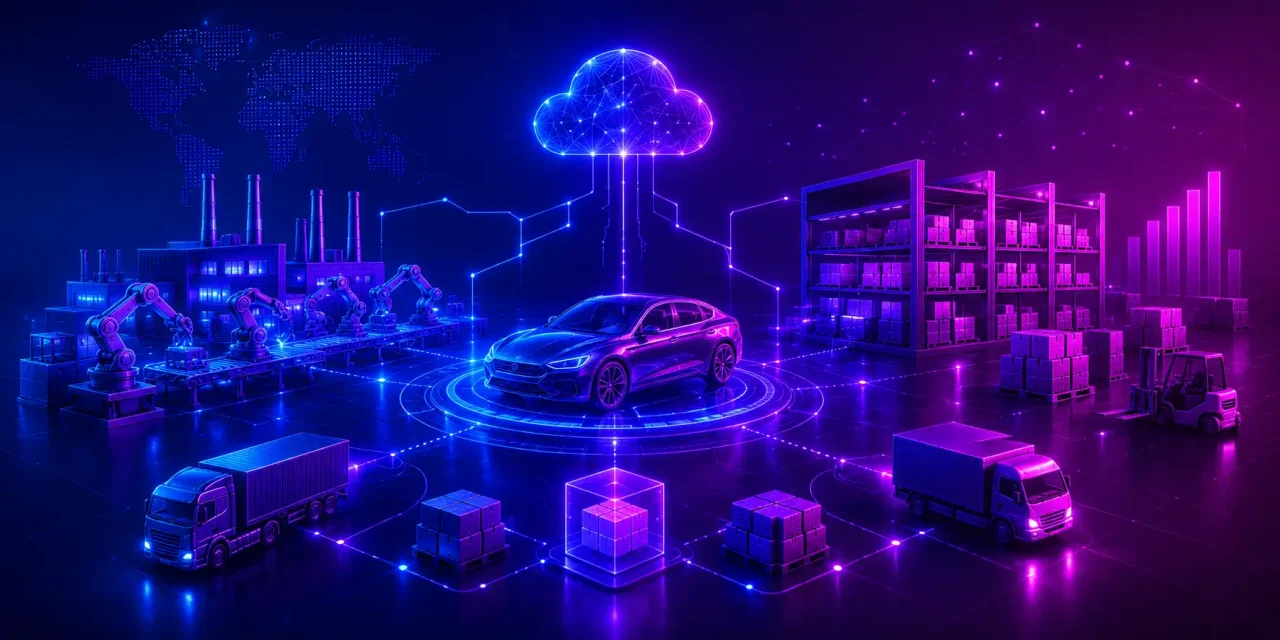
An automotive ERP is an Enterprise Resource Planning (ERP) platform built specifically for the requirements of vehicle and component manufacturing.
An ERP can integrate all the functions of an organization—from finance, procurement, inventory, production, quality, sales, and HR. This integration matters more in automotive than in any other industry, primarily because this industry runs on thin margins, sequenced deliveries, and quality standards.
Generic ERP can handle accounting and basic inventory. What sets ERP software solutions for automotive apart is a handful of built-in capabilities that match how the industry actually works.
- Built-in EDI (Electronic Data Interchange) allows manufacturers to exchange purchase orders, shipping notices, and delivery schedules with OEMs and suppliers automatically. This exchange can be in whichever format each trading partner requires.
- Just-In-Time (JIT) scheduling synchronizes production and material flow, so auto parts show exactly when needed, without a warehouse full of buffer stock.
- IATF 16949 (IATF is the global quality management system standard for the automotive industry) compliance features build the automotive quality standard directly into daily workflows. Some features include traceability, documented process control, and audit-ready records.
Automotive ERP earns its merit by converting multi-tier and multiple-site manufacturing from a complexity into a measurable and manageable system.
Why the Automotive Industry Needs ERP?
The automotive industry is unique since it carries more moving parts than any other industry. This is exactly the reason why it requires Automotive ERP solutions.
- Bills of materials (BOMs) are deeply nested and constantly changing. A single vehicle can contain thousands of parts across multiple engineering revisions, and tracking multi-level BOMs by hand invites expensive mistakes.
- Production often spans multiple plants and countries, which means planning, transfers, and reporting all need to stay in sync across facilities.
- Traceability is of prime importance. When a defect turns up, manufacturers need to trace every affected lot or serial number through the supply chain within hours.
- Quality control means proving continuous conformance to OEM and regulatory standards, with documentation at every step.
- Supplier coordination refers to keeping hundreds of trading partners updated with accurate and timely schedules.
Automotive ERP systems handle this by connecting the dots. Keeping BOMs accurate and version-controlled, coordinating multi-site production from a single plan, delivering end-to-end traceability, automating quality gates, and running supplier communication through EDI.
Not sure whether your current system can keep up with where your production is headed?
Talk to Experion’s automotive ERP team and find out what’s actually possible
How Automotive ERP Systems Support the Entire Automotive Value Chain?
No two players in the automotive ecosystem operate the same way, so a good ERP system for automotive industry needs to flex to fit each role.
OEMs
Original Equipment Manufacturers run enormous, globally distributed production networks. ERP gives them master production scheduling, demand forecasting, plant-to-plant coordination, and visibility into supplier performance. This is the control tower that keeps assembly lines updated and vehicles moving from order to delivery.
Tier 1 & Tier 2 Suppliers
For suppliers, achieving their OEM release schedules precisely is of utmost importance. Here, automotive ERP centers on EDI-driven order management, JIT and sequenced delivery, capacity planning, and traceability tight enough to prove conformance and respond instantly when a customer’s schedule changes.
Automotive Parts Manufacturers
Parts makers produce high volumes across many SKUs with strict tolerances. ERP helps them manage complex BOMs, get more out of their machines, control scrap, and keep the documentation customers and auditors ask for.
EV Manufacturers
Electric vehicle (EV) producers combine traditional manufacturing with battery management, new supplier relationships, and fast design iteration. Modern automotive ERP software supports flexible BOM structures, integration to PLM and IoT platforms, and enough scalability to keep pace with a dynamic product roadmap.
Aftermarket Parts Businesses
Most aftermarket operators are concerned only about catalog breadth, multi-channel distribution, and fast fulfillment. Here, ERP focuses on inventory optimization, order management across channels, returns handling, and demand forecasting, keeping the right parts in stock without tying up cash in inventory.
How ERP Software Helps Automotive Companies Make Data-Driven Decisions?
Most decisions on a shop floor get made on incomplete information — a planner guessing at supplier lead times, a plant manager reacting to a stockout instead of seeing it coming.
ERP fixes this by pulling production, inventory, procurement, and quality data into one place, so decisions rest on what’s actually happening rather than what someone assumes is happening.
- Real-Time Production Visibility: When a machine slows down or a shipment runs late, the schedule reflects it immediately, letting planners adjust before it becomes a missed delivery instead of after.
- Smarter Inventory Decisions: Teams see current stock across every plant and warehouse instead of working off last week’s cycle count, which usually means fewer emergency orders and less cash tied up in parts nobody needs yet.
- Early Quality Detection: Tracing which lot went where and which batch used which supplier’s parts lets a pattern surface early—not three months later after a customer complaint forces someone to trace it backward.
- Shared Financial Visibility: Scrap rates, labor hours, and downtime feed the same numbers finance uses for margin reporting, so a plant manager and a CFO are finally looking at the same data instead of reconciling two versions of it.
- Sharper Forecasting: An ERP holding a few years of sales, production, and supplier data predicts demand more reliably than a spreadsheet built off last quarter alone.
Key Features to Look for in Automotive ERP Software
When you are evaluating automotive ERP systems, a few capabilities separate it from the industry-grade platforms.
- Bill of materials and product lifecycle management: BOMs are a list of components required to manufacture a product. Automotive products comprise thousands of interconnected components. When an engineer changes one part, the BOM should be updated. Thus, maintaining multi-level BOMs at an accurate range and in sync with engineering is critical.
- Real-time inventory and warehouse management: Provides real-time stock visibility across locations so you can run lean without risking stockouts. Maintain optimal stock levels while minimizing costs.
- Production planning and shop floor control: Turns demand into work orders and captures real progress from the floor.
- Advanced scheduling: Sequences operations to hit throughput targets and honor JIT commitments.
- Supplier and procurement management: Built on EDI, automates purchasing and keep hundreds of trading partners aligned.
- Quality management and compliance tracking: Many automotive OEMs require their suppliers to comply with numerous certifications. Quality management enforces inspections, manages non-conformances, and keeps audit trails for standards like IATF 16949.
- IoT/Industry 4.0 readiness: An operator need not manually update production every few hours. This feature lets an ERP pull in machine and sensor data directly from the equipment.
- Financial management and reporting: Allows manufacturing and other units to integrate with finance to provide real-time visibility into profitability.
- Multi-site/multi-company support: Consolidates operations across plants and legal entities.
- Analytics, dashboards, and forecasting: Turns raw data into decisions leaders can act on. For eg: ERP can analyze the previous year’s sales and forecast a similar increase for the next year.
Want to see which of these features your current ERP is missing?
Get a free automotive ERP assessment from Experion
Business Benefits of Implementing Automotive ERP Software
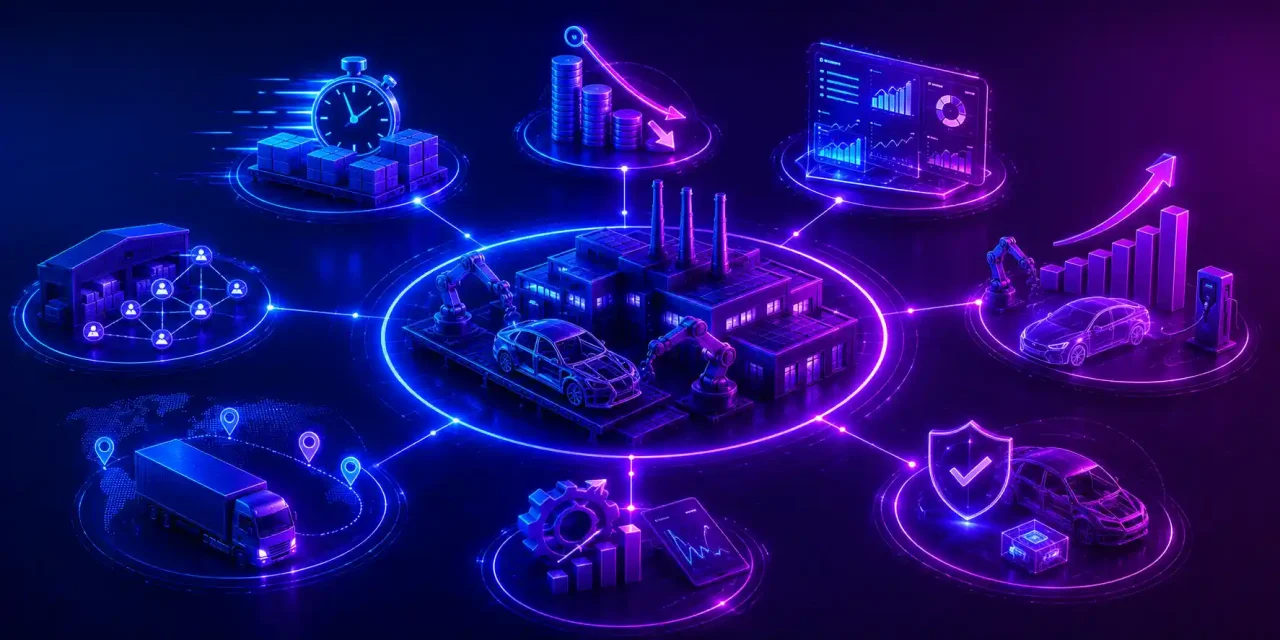
Implementing automotive ERP software provides great business value. Streamlining operations, product efficiency and enabling data driven decision making are some of the outcomes.
- Reduced Downtime: Materials show up when the line needs them; machine performance gets tracked in real time, and stockouts or breakdowns cause fewer stoppages.
- Cost Reduction & Margin Improvement: Comes from tighter scrap control, less wasted material, right-sized inventory, and labor that’s actually allocated to where it’s needed.
- Real-Time Data Visibility: Live dashboards across production, inventory, finance, and the supply chain mean decisions don’t wait on a weekly report.
- Scalability for EV & Smart Factory Trends: Plugs into IoT devices, CAD, and PLM systems, so shifting toward electric vehicle production or smart-factory setups doesn’t mean starting over.
- Faster Recall Response: Components and batches are tracked through the supply chain, so if something goes wrong, you can pinpoint which products are affected instead of guessing.
- Improved Overall Equipment Effectiveness (OEE): Availability, performance, and quality get monitored as they happen, so machines run more, downtime shrinks, and output goes up.
Experion can help automotive manufacturers tackle challenges such as multi-tier BOM management, multi-plant coordination, and audit-ready traceability by developing ERP solutions that align with their unique manufacturing processes.
Types of Automotive ERP Systems
Attaining the correct architecture matters just as much as choosing the vendor.
Cloud vs. On-Premise vs. Hybrid
Cloud ERP deploys fast, costs less upfront, updates itself, and makes multi-site access easy. This is a good fit if agility is your priority.
- On-premise gives you more control over data and customization, which some manufacturers need for regulatory or latency reasons.
- Hybrid models split the difference, keeping sensitive workloads locally while using the cloud for analytics and collaboration. Which one fits depends on your security posture, IT capacity, and growth plans.
ERP for OEMs vs. Tier 1/Tier 2 Suppliers vs. Aftermarket
Beyond deployment, the functional focus differs by role:
- OEM-oriented systems lean into master scheduling and network orchestration
- Supplier-oriented systems lean into EDI, sequencing, and traceability
- Aftermarket systems lean into catalog management, distribution, and multi-channel fulfillment.
Match the platform to your position in the value chain, or you’ll end up paying for capabilities you’ll never touch or finding the gaps after go-live.
Pricing Models and Total Cost of Ownership
While evaluating automotive ERP software, look beyond the initial price. Total cost depends on several factors.
- Licensing Model: Solutions are either offered as a perpetual license, which needs a large upfront purchase plus annual maintenance, or a subscription-based model, where businesses pay recurring monthly fees.
- Implementation Costs: This involves configuring the ERP, migration of legacy data, integration with existing systems, and training users. Implementation costs represent a huge portion of the overall investment.
- Customization and Integrations: The ERP needs to be tailored to support the unique workflows of manufacturing. Integration with CAD, PLM, MES, or IoT platforms can deliver greater operational efficiency.
- Maintenance and Support: Certain maintenance expenses include software updates, technical support, and security patches. For on-premises deployments, infrastructure maintenance also becomes a necessity. For cloud ERP solutions, many of these services are bundled into the subscription fee.
The smarter approach is to model total cost of ownership over three to five years instead of fixating the year-one number. A slightly higher upfront investment in a platform that fits often beats a cheap system that needs constant workarounds.
Core Capabilities of Top ERP Software Solutions for Automotive
The best ERP software for automotive industry tends to excel in four areas:
1. Supply Chain & EDI Automation
Order processing and communication across global supplier networks, automated. The best platforms translate schedules, POs, and shipping notices into partner-specific EDI formats without manual entry — and without the errors manual entry brings.
2. Production Planning & Material Requirements Planning (MRP)
Multi-level Bill of Materials management and real-time shop-floor scheduling. A strong MRP engine explodes demand through complex BOMs, nets it against inventory and open orders, and produces purchase and production plans you can run on.
3. Quality Control & Industry Compliance
Full lot/serial traceability, audit trail management, and adherence to standards like ISO/IATF 16949. Quality gates sit inside the workflow, non-conformances get tracked to resolution, and every action gets documented.
4. Inventory & Multi-Warehouse Tracking
Less buffer stock, lower carrying costs, no production line stops. Real-time visibility across warehouses lets planners run lean without gambling on availability.
Common Implementation Challenges and How to Avoid Them
ERP projects succeed or fail execution. The usual problems usually include:
- Complex customizations that increase cost and timelines
- Legacy system integration that turns up hidden data and process dependencies nobody documented
- Change management resistance from teams used to the old way
- Data quality issues that undermine trust in the new system
- Supplier onboarding friction as trading partners adjust to new EDI and portal requirements.
The fixes are well known even if they’re not always followed:
- Favor a phased rollout over a big-bang launch.
- Standardize processes before you automate them, so you’re not baking inefficiency into the new system.
- Set up strong project governance with clear ownership and executive sponsorship.
- Use industry templates and pre-built accelerators instead of custom-building everything.
An experienced partner who’s hit these problems before is often the single biggest predictor of whether the project works.
5 Essential Steps to Successfully Choose and Deploy Your Automotive ERP
- Audit Your Current Workflows: Map how work happens today (including the workarounds) so you know what the new system needs to support and what you can finally retire.
- Define Non-Negotiable Modules: Separate requirements (EDI, traceability, and MRP) from your negotiables and use that list to filter vendors honestly.
- Prioritize Cloud vs. On-Premises: Base it on security, IT capacity, and growth—this shapes your shortlist and your budget.
- Plan for System Integrations: Identify every system the ERP needs to talk to — MES, PLM, CRM, IoT — and confirm connectivity before you sign anything.
- Phase the Rollout & Train Teams: Sequence go-live by site or module, invest in training, and give people time to adapt before adding complexity.
Integration with Industry 4.0 and Emerging Technology
Modern automotive ERP systems are now at the heart of the connected factory solutions
- MES (Manufacturing Execution Systems) integration links production planning with real-time execution on the floor. It allows manufacturers to monitor work orders and production progress.
- PLM integration keeps engineering changes flowing into BOMs and production schedules.
- Telematics and IoT sensors feed machine health, energy, and process data into the ERP, where AI models can turn it into predictive maintenance alerts before a machine fails.
These features are what transforms ERP from a manual record into a system of intelligence. The availability of production, quality, and maintenance data in one place helps feed the models. Manufacturers can thus schedule maintenance before failures and catch quality issues beforehand.
Real Life Use Cases
Toyota
Toyota pioneered lean manufacturing and the Toyota Production System. Its approach to JIT and continuous improvement is close to what modern automotive ERP is built to enable — integrated planning and material flow that let a Toyota-style operation run on minimal inventory without sacrificing reliability.
Ford Motor Company
Ford runs a global manufacturing footprint that depends on coordinated multi-site planning, supplier integration, and quality management , the kind of coordination ERP platforms make possible at scale.
General Motors
General Motors manages a complex supply network across numerous plants and product lines. Streamlining automotive manufacturing workflows and thousands of suppliers at scale is the exact orchestration problem ERP is built to solve.
Why the Right Automotive ERP Solution is a Competitive Advantage?
Choosing well pays off well beyond tidier operations. Innovation takes place when engineering, production, and supply data can move freely. This shortens the path from design to launch. Material shortages, demand swings, and plant events are all disruptions that frequently take place in a manufacturing plant. The right automotive ERP solution grants operational resilience to overcome these disruptions.
Supply chain visibility turns a black box into something you can actually view. Leaders identify risks and act before they become crises. Better profitability follows from less wastage, better utilization, and sharper decisions. And long-term scalability means the platform grows with you into new plants, new products, and new territory like EVs and connected factories. In an industry with extremely thin margins and no patience for delay, the right ERP platform is a big advantage.
How to Choose the Best ERP Software for Automotive Industry?
Picking the best ERP software for the automotive industry comes down to evaluating your specific situation.
- Start with your business size and role in the supply chain: Your requirement for an ERP will vary depending on whether you are an OEM, a Tier 2 supplier, or an aftermarket distributor. Each will have genuinely different requirements.
- Prioritize industry-specific functionality over generic breadth: Search for a platform with built-in support for automotive processes such as native EDI, traceability, and IATF compliance. Industry-specific functionality delivers a greater value than a generic ERP platform.
- Evaluate Scalability: You would need to ascertain that the ERP can support future business growth. Then evaluate scalability, integration readiness (MES, CRM, IoT), and vendor domain expertise.
A vendor who understands automotive will anticipate what you need; one who doesn’t will learn on your budget.
Questions to Ask a Vendor Before You Buy
- Does the system include native EDI, and does it support our OEM/customer formats out of the box?
- How does it handle multi-level BOMs, engineering change management, and PLM integration?
- What traceability and IATF 16949 compliance capabilities are built in?
- Can it scale across multiple sites, entities, and currencies?
- Which integrations to MES, CRM, and IoT platforms are pre-built versus custom?
- What does the implementation methodology look like, and what’s a realistic timeline?
- Can you share automotive references similar to our size and role?
- What’s the total cost of ownership over five years, including support and upgrades?
When to Consider a Custom Automotive ERP Solution?
Off-the-shelf platforms cover most needs, but sometimes a custom automotive ERP solution is the smarter path. If your competitive advantage lives in a proprietary process no standard system supports, forcing it into a rigid package can erode the edge that sets you apart. The same goes if you run an unusual business model, a highly specialized product mix, or need deep integration with legacy or customized systems — a tailored solution can fit in ways packaged software won’t.
It comes down to a trade-off: custom development costs more upfront and needs an experienced engineering partner, but it can produce a platform that maps to how you actually win. Customize where it creates real advantage, and standardize everywhere else.
Automotive ERP Implementation Best Practices
The playbook for a smooth deployment doesn’t vary much across successful projects.
- Commit to a phased rollout that limits risk and lets teams build confidence.
- Get genuine stakeholder buy-in from the shop floor to the boardroom—adoption, not installation, is what determines value.
- Invest early in clean data, since migrating garbage guarantees frustration.
- Prioritize real, role-specific training so people become fluent, not just functional.
- Choose an experienced implementation partner who’s delivered automotive ERP before and can steer you around the pitfalls that sink less-guided projects.
Emerging Future Trends Shaping Automotive ERP Solutions

The future of automotive ERP solutions involves intelligent technologies to make data-driven decisions across the manufacturing system.
- AI-powered production planning: This trend weighs demand, inventory, machine availability, and who’s on shift, then re-shuffles the plan itself when a machine goes down or an order changes.
- Predictive maintenance: Machines and sensors feed in data that flags a likely breakdown ahead of time — you schedule the fix instead of scrambling after the fact.
- IoT-enabled manufacturing: IoT devices show equipment status and inventory as it’s happening, not after someone walks the floor and writes it up.
- Digital twins: A virtual copy of a product or production line means you can test a design change or a new process before it touches the real thing.
- Industry 4.0 and connected factories: ERP now plugs into MES, robotics, and other platforms directly—no more separate systems that don’t share data.
- Low-code customization: Low-code development tools let businesses customize workflows, reports, and dashboards with minimal coding. This reduces reliance on the development team.
- Advanced analytics: Forecasting, dashboards, AI-generated insights—not bolted on, just part of how the system runs.
- Sustainability reporting: Energy use, emissions, waste — regulators and customers are asking, so ERP is starting to track it.
- Generative AI copilots: The copilots in automotive ERP systems transform resource planning. Reports, summaries, root-cause digging — these are things that the system drafts for you first.
Conclusion
The automotive industry’s shift toward electrification, connected vehicles, and lean, resilient supply chains has made one thing clear: generic tools can’t carry the load anymore. A purpose-built platform that unifies BOM management, JIT scheduling, EDI, quality compliance, and real-time analytics is the operational foundation for competing, not a luxury add-on. The right automotive ERP solution cuts downtime, sharpens margins, speeds up recall response, and scales across OEM, supplier, EV, and aftermarket contexts.
Choosing and deploying that platform well takes automotive domain expertise, disciplined execution, and a partner who's done it before. Experion brings engineering capability and industry insight to help you select, customize, and implement a solution that fits how your business runs.
