






 Back

Experion helps oil and gas companies build secure, connected software that brings field, plant and finance data together, while giving operations, engineering and finance teams the clarity to act faster and work safer.
In most oil and gas companies, what happens in the field reaches the office too late or too manual to guide the decisions that depend on that information. Oil and gas software closes that gap between the field and the boardroom. This guide explains what oil and gas software is, the systems that matter most, and how they work together across the energy lifecycle. Along the way, it shares practical advice on choosing ERP and accounting tools, controlling costs, modernizing legacy systems and deciding when custom software is worth the investment.
Key Takeaways
Keep these ideas in mind as you read; they shape almost every software decision in this industry.
- Connected beats complicated: The real value comes from linking field, plant and finance data, not from adding more standalone tools.
- Fit the software to the segment: Upstream, midstream and downstream operations need different capabilities, even within the same company.
- Accounting is where complexity hides: Joint ventures, royalties and production allocation need industry-specific logic that general finance tools rarely handle.
- Modernize without starting over: Legacy systems can be connected and upgraded in phases while operations keep running.
- Build where you are different: Custom software pays off where your workflows, assets or markets go beyond what standard products support.
- Resilience is now a requirement: After the supply shocks of 2026, real-time visibility is a business necessity, not a nice-to-have.
What is Oil and Gas Software?
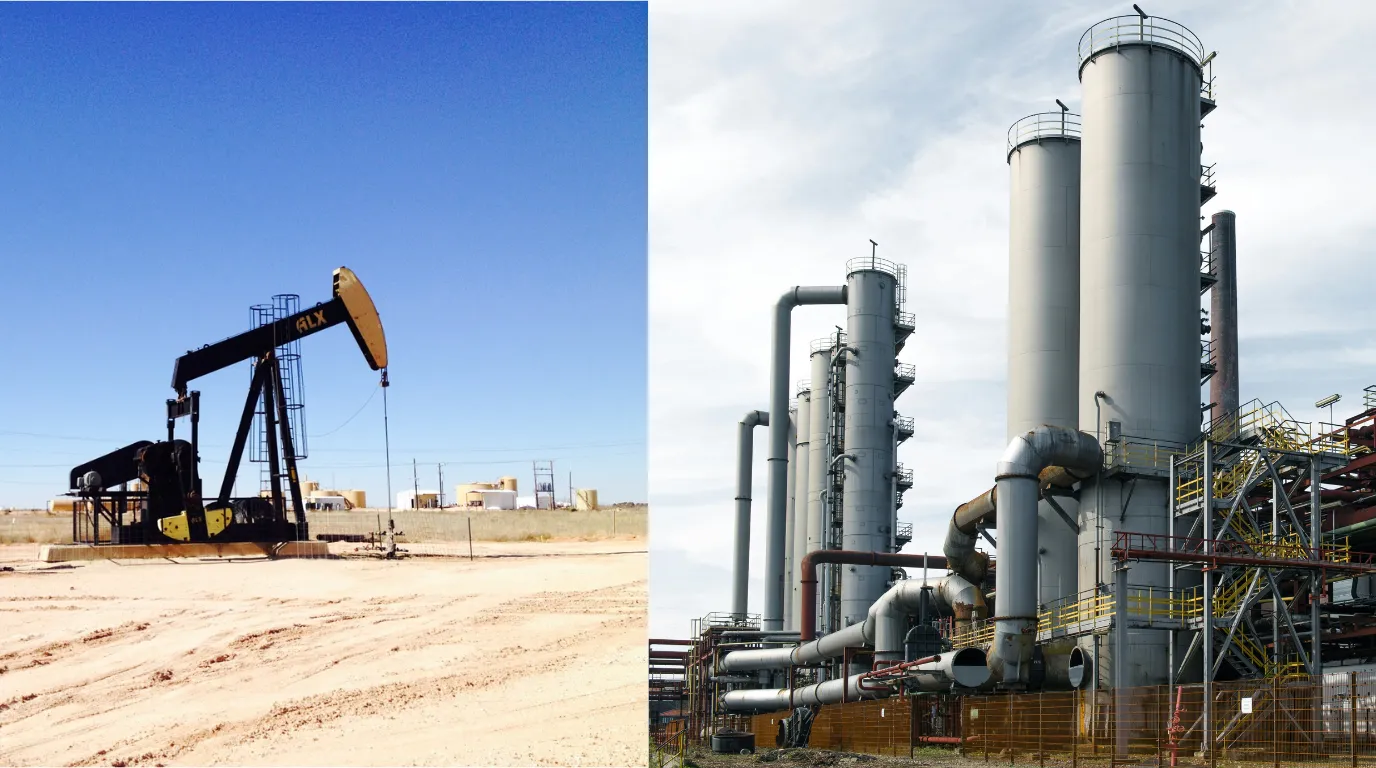
Before choosing a system, it helps to be clear on what the category covers and why it differs from everyday business software.
Oil and gas software is the set of digital tools companies use to find, produce, move, process, sell and account for oil and natural gas. It covers everything from well and reservoir data to pipeline monitoring, maintenance, safety, procurement, revenue allocation and regulatory reporting.
In practice, oil and gas software systems connect three worlds that have traditionally worked apart: the field, where equipment and crews operate; the plant or terminal, where products are processed, stored and moved; and the office, where costs, revenues and compliance are managed.
What Business Problems Does Oil and Gas Software Solutions Solve?
Most challenges in this industry come down to information that arrives late, sits in silos or cannot be fully trusted.
| Problem | What it looks like day to day | How software helps |
| Disconnected data | Field readings, maintenance logs and financial records live in separate systems | One shared source of operational and financial truth |
| Unplanned downtime | Equipment fails before anyone spots the warning signs | Condition monitoring and predictive maintenance |
| Safety and compliance risk | Permits, inspections and incidents tracked on paper | Digital safety workflows with full audit trails |
| Complex partner and revenue accounting | Manual allocation errors and partner disputes | Automated allocation, billing and reconciliation |
| Cost overruns | Spending becomes visible only after month-end | Real-time cost tracking against budgets |
| Slow reporting | Regulators and partners wait on spreadsheets | Automated, consistent reports |
| Remote operations | Sites with limited connectivity and small crews | Mobile and offline-capable field apps |
Behind each of these problems is the same story: data that does not travel well across the energy lifecycle. A single barrel passes through many hands on its journey. Exploration data shapes drilling plans, production volumes feed transport schedules and revenue calculations, and refinery output drives sales, inventory and invoicing. When oil and gas software connects these stages, every team works from the same numbers instead of rebuilding them.
This is also why general business software often falls short. It is built for common processes, while oil and gas software is built for the industry’s physical and commercial realities, as the comparison below shows.
| Area | General enterprise software | Oil and gas software |
| Assets | Office equipment and fleets | Wells, pipelines, compressors, tanks and refineries |
| Accounting | Standard revenue and cost | Joint ventures, royalties, production allocation |
| Data sources | Business transactions | Sensors, control systems, field logs and geological data |
| Safety | General workplace safety | High-hazard operations and strict environmental rules |
| Locations | Offices and stores | Remote, offshore and low-connectivity sites |
Who Uses Oil and Gas Software?
Almost every part of the energy value chain relies on software, though each group uses it for different reasons.
- Oil and gas operators: Run day-to-day production, maintenance and safety across their fields and facilities.
- Exploration and production (E&P) companies: Manage exploration data, drilling programs, production volumes and partner obligations.
- Oilfield service providers: Schedule crews and equipment, track jobs and bill clients accurately.
- Refining and petrochemical companies: Plan production, manage plant maintenance and track product quality.
- Pipeline and transportation companies: Monitor flows and pipeline integrity, and schedule shipments.
- Oil and gas distributors and traders: Manage inventory, pricing, contracts, deliveries and market risk.
- Finance, accounting and procurement teams: Handle partner billing, royalties, spending, suppliers and financial reporting.
What are the Different Types of Oil and Gas Software by Industry Segment?
The industry is usually described in three segments, and each one asks something different of its software.
- Upstream oil and gas software: Upstream covers finding and producing oil and gas. Software here manages geological and well data, drilling programs, production monitoring, field maintenance, lease obligations and partner accounting, often across remote or offshore sites.
- Midstream oil and gas software: Midstream moves and stores what upstream produces. Software supports pipeline monitoring and integrity, terminal and storage management, gas processing, scheduling, measurement and the commercial contracts that govern transport.
- Downstream oil and gas software: Downstream turns crude into products and sells them. Software helps plan refinery production, manage plant maintenance, track quality, run distribution and retail fuel networks, and handle pricing, orders and invoicing.
| Segment | What happens here | Software priorities |
| Upstream | Exploration, drilling and production | Well data, production tracking, field maintenance, joint venture accounting |
| Midstream | Transport, processing and storage | Pipeline integrity, flow measurement, scheduling, contract management |
| Downstream | Refining, distribution and retail | Plant planning, quality, inventory, logistics, pricing and billing |
Downstream software increasingly reaches the end customer too. Experion built the digital backbone for an on-demand fuel delivery service, with a customer portal, a delivery agent app that validates vehicles, payments and fuel quantities in real time, auto-payment with digital invoicing, and admin reports on fueling and transaction patterns.
What are the Core Types of Oil and Gas Software and Systems?
Most companies run a combination of these systems, and the real value comes from how well they work together.
- ERP for oil and gas: Enterprise resource planning (ERP) systems bring finance, procurement, inventory, projects and people into one platform adapted to industry needs.
- Accounting and financial management: Manages the general ledger, payables, receivables, budgets and reporting, with support for industry-specific accounting.
- Production accounting and revenue allocation: Calculates how much was produced, who owns which share and how revenue should be split among partners and royalty owners.
- Joint interest billing (JIB): Bills partners in a joint venture for their share of operating and capital costs, with clear supporting detail.
- Land and lease management: Tracks leases, mineral rights, ownership interests, expiry dates and obligations so no right or payment is missed.
- Asset management and maintenance (EAM/CMMS): Enterprise asset management (EAM) and computerized maintenance management systems (CMMS) plan inspections, repairs and spare parts across the life of each asset. This is the heart of most oil and gas asset management software.
- HSE and compliance management: Health, safety and environment (HSE) software manages permits, inspections, incidents, emissions and regulatory obligations.
- Supply chain and procurement: Manages suppliers, contracts, purchase orders, materials and logistics for field and plant operations.
- Data management and analytics platforms: Bring operational, financial and geological data together and turn it into dashboards and insights.
- SCADA, IoT and field automation: Supervisory control and data acquisition (SCADA) systems and Internet of Things (IoT) sensors monitor and control equipment in real time.
- Digital twin software: Creates a live virtual model of a well, pipeline or plant to test scenarios and predict problems.
- Document and regulatory reporting systems: Store engineering drawings, procedures and certificates, and prepare reports for regulators and partners.
What are the Key Features of Oil and Gas Software?
The key features of oil and gas software connect what happens on site with what the business needs to know. These include real-time monitoring of production and equipment, asset and maintenance tracking, partner and royalty accounting, and digital safety and compliance workflows. Mobile, offline-ready field apps and secure integration with existing ERP and control systems make sure data is captured once and trusted everywhere. On top of these foundations, advanced capabilities such as predictive maintenance, AI analytics and digital twins help teams act before problems grow, rather than after.
Essential Features of Oil and Gas Management Software
These are the foundations every platform should get right before anything else.
- Real-time operational dashboards: Show production, equipment status and key metrics in one view.
- Asset and maintenance tracking: Records the history, condition and maintenance schedule of every critical asset.
- Production and inventory tracking: Captures volumes, stock levels and movements accurately and on time.
- Financial and partner accounting: Supports joint ventures, royalties, cost allocation and audit-ready records.
- Safety and compliance workflows: Digitizes permits, inspections, incident reporting and corrective actions.
- Mobile field apps: Let crews capture data, photos and inspections on site, even with weak connectivity.
- Role-based access and audit trails: Protect sensitive data and show who changed what, and when.
- Integration capability: Connects with existing ERP, SCADA, finance and partner systems through secure APIs.
Advanced Features in Modern Oil and Gas Software Solutions
Advanced capabilities turn data into foresight, helping teams act before problems grow.
| Feature | What it makes possible |
| Predictive maintenance | Spots early signs of equipment failure so repairs can be planned |
| AI-driven analytics | Finds patterns in production, cost and safety data that people might miss |
| Digital twins | Tests changes on a virtual model before touching real assets |
| Emissions monitoring | Tracks methane and other emissions for reporting and reduction |
| Edge computing | Processes data at remote sites when connectivity is limited |
| Geospatial mapping | Shows wells, pipelines and assets on interactive maps |
| Automated reporting | Prepares regulatory, partner and management reports with less manual effort |
| Scenario planning | Models the impact of price, supply or demand changes on operations and finances |
How Does Oil and Gas Software Support the Energy Lifecycle?
Oil and gas software supports the energy lifecycle by carrying data from one stage to the next, so exploration insights shape drilling, production volumes drive transport and revenue, and refinery output feeds sales and invoicing. The result is one consistent picture of every barrel, from the well to the customer, that operations, engineering and finance can all act on.
Oil and Gas Software Across the Upstream, Midstream, and Downstream Sectors
Each segment hands something to the next, and software makes sure the handover is clean.
Upstream, exploration and well data guide where to drill, while production systems record what each well delivers. Those volumes become the starting point for midstream, where pipeline, processing and storage systems track every movement and measure what changes hands. Downstream, refinery planning, inventory and distribution systems turn those inputs into products, prices and invoices. When volumes, quality data and costs pass cleanly from one stage to the next, the whole chain can plan with confidence instead of reconciling numbers after the fact.
How Do Oil and Gas Software and Systems Connect Different Business Functions?
The clearest way to see the value is to follow a single event through the business. Imagine a sensor on a compressor showing rising vibration. In a connected setup, the monitoring system flags the reading and creates a maintenance work order. The maintenance system checks spare parts and raises a purchase request if stock is low. The safety team sees that a work permit is needed, while production planners adjust expected volumes for the downtime. Finance sees the repair cost against budget, and partner billing reflects the shared cost later. One reading, six teams, no phone calls or spreadsheets needed to keep everyone in step.
What are the Benefits of Using a Software for Oil and Gas Industry?
Using software built for the oil and gas industry means fewer surprises and faster, better-informed decisions, because problems surface early and every team works from the same trusted data. The benefits show up across operations, finance, safety and strategy, and they compound as more of the business is connected.
Operational Benefits
Operations run better when teams see problems early and spend less time chasing information.
Real-time monitoring and planned maintenance reduce unplanned downtime, while mobile apps let crews record inspections and readings once, at the source. Experion has seen the difference field data capture makes in a different industry. An asset tracking and field sales solution that let teams photograph and record asset status during inspections helped a client cut back-office effort by 50% and improve delivery timelines by 33%.
Financial Benefits
Finance teams gain accuracy, speed and confidence when numbers flow automatically from the field. Automated allocation, billing and reconciliation reduce errors and disputes, close the books faster and show costs against budget as they happen. Better maintenance planning also lowers repair costs and extends the life of expensive equipment.
Safety and Compliance Benefits
In a high-hazard industry, digital safety processes protect people as well as the business. Digital permits, inspections and incident reporting make sure no step is skipped, and every action leaves an audit trail. Emissions tracking and automated reporting help companies keep pace with tightening environmental rules without adding manual workload.
Business and Strategic Benefits
With trusted data, leaders can make bigger decisions faster and with less guesswork. Connected data supports scenario planning when prices or supply routes change, clearer reporting for partners and investors, and a stronger foundation for AI and automation. It also makes it easier to integrate acquisitions, enter new regions and scale operations without rebuilding systems each time.
Experion brings product engineering, data and AI expertise to oil and gas software, building solutions that connect field operations with finance and compliance so teams spend less time chasing data and more time acting on it.
Oil and Gas ERP Systems
An ERP is often the backbone of an oil and gas company’s digital estate, so the choices made here ripple through everything else.
The first decision is usually between one broad platform and several specialist tools, and many companies end up with a mix of both.
| Factor | Single oil and gas ERP software | Best-of-breed point solutions |
| Data consistency | One shared database | Depends on integration quality |
| Depth of features | Broad, sometimes shallow in niche areas | Deep in each specialist area |
| Implementation | One large program | Several smaller projects |
| Flexibility | Changes tied to vendor roadmap | Swap or upgrade tools individually |
| Integration effort | Lower inside the ERP | Higher, but more targeted |
Choosing the ERP route brings a second decision. An industry-specific ERP comes ready for partner accounting, production volumes and lease obligations, which saves configuration time. A general ERP with oil and gas add-ons can suit companies already invested in a major platform, but the add-ons need careful checks for depth and long-term support. Whichever route you take, most oil and gas ERP systems are built from a familiar set of modules.
- Financials: General ledger, payables, receivables, budgeting and multi-entity consolidation.
- Joint venture accounting: Partner billing, cost allocation and ownership tracking.
- Production and revenue: Volumes, allocation, royalties and revenue distribution.
- Procurement and inventory: Purchasing, contracts, materials and warehouse management.
- Asset and maintenance: Equipment records, work orders and maintenance plans.
- Projects and capital: Budgets, costs and progress for drilling and construction projects.
- Human resources and payroll: Crews, certifications, time and payroll.
- HSE and compliance: Incidents, permits and regulatory reporting.
These modules are only as accurate as the data that reaches them, which makes integration with field systems and legacy platforms the deciding factor in an ERP’s success. Field data from SCADA, sensors and mobile apps must flow in reliably, and older systems that cannot be replaced overnight need secure connectors so old and new can run side by side during the transition.
How do Oil and Gas Accounting Software Solutions Improve Financial Operations?
Oil and gas accounting software improves financial operations by automating the industry’s most error-prone work, from joint venture billing and royalty payments to production revenue allocation and reconciliation. Finance teams close the books faster, resolve fewer partner disputes and report with confidence, because every number traces back to verified field data.
Common Accounting Challenges in the Oil and Gas Industry
These challenges are familiar to almost every oil and gas finance team, whatever the company’s size.
| Challenge | Why it is hard |
| Complex joint venture and partner accounting | Several partners share costs and revenues in different proportions across many assets |
| Royalty and revenue calculation discrepancies | Ownership interests, prices and deductions change often, and small errors multiply |
| Manual production data reconciliation | Field, measurement and sales volumes rarely match without careful checking |
| Inaccurate cost allocation | Shared costs must be split fairly across wells, fields and partners |
| Complex lease and asset accounting | Leases, rights, depletion and retirement obligations follow specific rules |
| Delayed financial reporting | Manual steps and late field data push back month-end close |
| Compliance with changing accounting standards | Rules and reporting requirements evolve across countries and regulators |
What Can Oil and Gas Accounting Software Automate?
Automation takes over the repetitive, rule-based work so finance teams can focus on review and judgment.
- Production revenue calculations: Turns measured volumes and prices into revenue for each well and owner.
- Joint interest billing: Produces partner bills with supporting detail on schedule.
- Royalty calculations and payments: Applies ownership interests and deductions, then pays owners accurately.
- Cost allocation and expense tracking: Splits shared costs by agreed rules and tracks spending against budgets.
- Accounts payable and receivable: Matches invoices, schedules payments and follows up on collections.
- Financial reconciliation: Matches records across field, bank and accounting systems and flags exceptions.
- Depreciation and asset accounting: Calculates depreciation, depletion and asset values consistently.
- Financial statements and reporting: Produces management, partner and regulatory reports from verified data.
Experion has built this kind of automation at scale. For one of the world’s largest flexible workspace providers, Experion delivered a financial process automation solution that handles more than 170,000 transactions a day, with AI-based matching and reconciliation, automated supplier payments and consolidated business intelligence reporting for close to 500 accounting users. The same capabilities can be applied to the high-volume partner, royalty and payment flows of oil and gas finance.
What Should Organizations Look for in Oil and Gas Accounting Software?
The best choice fits your partnerships, assets and growth plans, whether you are a global operator or looking for oil and gas accounting software for small business needs.
| What to look for | Why it matters |
| Support for industry-specific accounting requirements | Handles joint ventures, royalties and production allocation without workarounds |
| Integration with production and ERP systems | Keeps volumes and costs consistent from field to ledger |
| Automated financial workflows | Reduces manual entry and speeds up month-end close |
| Multi-entity and multi-currency support | Supports operations across companies, countries and partners |
| Accurate data reconciliation | Catches mismatches before they become disputes |
| Audit trails and financial controls | Shows who changed what, supporting audits and partner reviews |
| Customizable financial reports | Gives each stakeholder the view they need |
| Scalability for growing operations | Grows with new wells, assets and acquisitions |
When Should an Organization Invest in Custom Oil and Gas Software?
An organization should invest in custom oil and gas software when standard products start shaping how it operates instead of supporting it: when teams rely on spreadsheets and workarounds, when critical systems cannot talk to each other, or when field conditions and partnership structures fall outside what packaged tools were built for. At that point, a tailored solution can cost less over time than living with the gaps.
When is Custom Oil and Gas Software Development the Right Choice?
Custom software earns its place when your operations are distinctive enough that standard tools hold you back.
- Unique workflows: Your processes, contracts or partnership structures do not fit packaged templates.
- Complex integrations: You need to connect SCADA, legacy systems, ERP and partner platforms that standard connectors cannot handle.
- Remote or harsh environments: Field teams need apps that work offline, on rugged devices or with limited connectivity.
- Competitive differentiation: Your way of operating is part of your advantage, and software should protect it.
- Multiple regions and regulations: You must meet different reporting rules across countries.
- Legacy modernization: Old systems hold valuable data but block progress, and replacing them outright is too risky.
Experion has engineered for exactly these conditions in a related heavy industry. For a global truck manufacturer supplying fleets to mining operations, the team built a GPS-independent IoT fleet management solution, with custom IoT hardware and long-range wireless connectivity that works where standard tracking fails. Fleet utilization improved by 23% and turnaround time by 18%. The same engineering approach can be applied to remote wells, pipelines and offshore assets.
Custom Oil and Gas Software vs. Off-the-Shelf Software
Both paths can succeed; the right one depends on how closely each fits the way you work.
| Factor | Off-the-shelf software | Custom oil and gas software |
| Time to launch | Faster for standard needs | Longer upfront, with phased releases possible |
| Workflow fit | Teams adapt to the product | Software adapts to your operations |
| Integration | Limited to supported connectors | Built around your SCADA, ERP and legacy systems |
| Field conditions | General mobile support | Designed for offline, remote and rugged use |
| Cost profile | Lower entry cost, ongoing licences | Higher build cost, more long-term control |
| Ownership | Vendor controls roadmap and data terms | You own the product, data and roadmap |
| Differentiation | Same tools as competitors | A capability competitors cannot copy |
Many companies choose a hybrid: a proven core platform, extended with custom apps, integrations and analytics where they matter most.
How to Choose the Best Oil and Gas Software for Your Organization?
The best oil and gas software is the one that fits your operations, your people and your growth plans, not the one with the longest feature list.
A simple test works well: pick one real process, such as a monthly partner billing cycle or a maintenance job on a critical pump and ask each option to show it end to end, including what happens when data is late or wrong.
| What to evaluate | Question to ask |
| Segment fit | Does it support our upstream, midstream or downstream processes without heavy customization? |
| Integration | Can it connect reliably with our SCADA, ERP, finance and partner systems? |
| Field usability | Can crews use it on site, offline and on rugged devices? |
| Accounting depth | Does it handle joint ventures, royalties and production allocation correctly? |
| Security | How does it protect operational technology and sensitive commercial data? |
| Compliance | Can it adapt to emissions, safety and financial reporting rules in our regions? |
| Scalability | Will it support new assets, regions and acquisitions? |
| Total cost of ownership | What are the licence, integration, support and change costs over five years? |
| Partner capability | Does the oil and gas software company have the engineering depth to support us long term? |
If capital projects are central to your business, the best oil and gas project management software should also link schedules and budgets to procurement and finance, so project overruns show up early rather than at month-end.
What is the Oil and Gas Software System Development Process?
The oil and gas software development process takes a system from a clear understanding of the business problem through design, build, integration and testing to a phased rollout and ongoing support. Each step is shaped by the industry’s realities, such as remote sites, safety-critical equipment and complex partner data, so the finished software holds up under real operating conditions.
Key Stages in Developing Custom Oil and Gas Software
Each stage reduces risk for the next, so the final system works in the field, not just in a demo.
- Discovery and assessment: Understand goals, map current workflows and systems, and identify where data breaks down.
- Requirements and architecture: Define features, integrations, security and performance needs, and design a scalable architecture.
- Experience design: Design screens and workflows with field crews, engineers and finance users so the software feels natural to them.
- Agile development: Build in short cycles, sharing working software regularly for feedback.
- Integration and data migration: Connect SCADA, ERP and legacy systems, and move historical data accurately.
- Testing and validation: Test functionality, performance, security and offline behavior under realistic field conditions.
- Deployment, training and support: Roll out in phases, train users, and keep improving based on feedback and performance data.
What Technologies are Used to Develop Oil and Gas Software?
Modern oil and gas software solutions combine several technologies, each solving a specific part of the challenge.
- Cloud computing platforms: Provide scalable, secure infrastructure that teams can reach from anywhere.
- Artificial intelligence and machine learning: Predict failures, optimize production and automate document-heavy tasks.
- Internet of Things (IoT): Connects sensors on wells, pipelines and equipment to stream live data.
- Big data analytics: Processes large volumes of operational and geological data to reveal trends.
- Digital twin technology: Mirrors physical assets virtually to test changes and predict problems.
- Geographic information systems (GIS): Map wells, pipelines, leases and assets for planning and response.
- Industrial automation and SCADA integration: Brings control-room data into business systems safely.
- Enterprise application integration (EAI): Connects ERP, accounting, maintenance and partner systems so data flows automatically.
- Cybersecurity and data encryption technologies: Protect operational technology and sensitive commercial data from growing threats.
How Can Organizations Modernize Legacy Oil and Gas Software?
Modernization works best as a series of careful steps rather than a single risky switch.
Most oil and gas companies rely on older systems that still hold years of valuable data. Instead of replacing everything at once, a phased approach connects legacy systems through APIs, moves functions one module at a time, migrates data with validation at each step and runs old and new systems side by side until the new platform proves itself. This keeps operations running while the technology improves underneath.
Experion has taken this approach in another data-heavy, compliance-driven domain. For a US sustainability startup, Experion re-engineered an environmental, social and governance (ESG) reporting platform into a modular, high-performance architecture with automated data ingestion and validation, improving efficiency by 70% and aligning with major international sustainability reporting frameworks. Oil and gas companies facing growing emissions reporting can apply the same modernization approach to their own platforms.
How Much Does Oil and Gas Software Cost?
There is no single price tag, because cost depends on what you need the software to do and how much of it already exists. A small accounting tool for a single operator and an enterprise platform spanning dozens of fields are very different investments. The factors below have the biggest influence on the final figure.
| Cost factor | How it affects the budget |
| Scope and number of modules | More functions mean more design, development and testing |
| Off-the-shelf, custom or hybrid | Licences cost less upfront; custom builds cost more upfront but avoid recurring fees and workarounds |
| Integrations | Each connection to SCADA, ERP, legacy or partner systems adds effort |
| Data migration | Volume, quality and age of historical data affect time and cost |
| Field and offline requirements | Rugged, offline-capable apps need extra engineering and testing |
| Security and compliance | Stronger protection for operational technology and audit needs adds work |
| Users, sites and regions | More users and locations increase licensing, infrastructure and training |
| Ongoing support | Maintenance, upgrades and new regulations continue after launch |
The most reliable way to control cost is to start with one high-value use case, prove the return, and expand in phases. Always compare total cost of ownership over several years, not just the initial price.
How are AI and Digital Transformation Changing the Oil and Gas Industry?
AI and digital transformation are shifting the oil and gas industry from reacting to problems to anticipating them. Connected sensors, cloud platforms and AI models now help teams predict equipment failures, optimize production, detect leaks and automate paperwork, while digital twins let engineers test decisions virtually before they touch a real asset.
AI Use Cases in Oil and Gas Software
The most valuable AI use cases solve specific, costly problems that teams face every day.
- Predictive maintenance: Learns the warning signs of equipment failure so repairs happen before breakdowns.
- Production optimization: Recommends settings that improve output from wells and plants.
- Reservoir and subsurface analysis: Speeds up the interpretation of large geological datasets.
- Leak and emissions detection: Analyzes sensor and image data to spot methane leaks quickly.
- Document intelligence: Reads contracts, invoices, permits and reports to extract key data and flag issues.
- Demand and price forecasting: Helps traders and planners respond to market changes.
- Safety monitoring: Uses video and sensor data to identify unsafe conditions on site.
- AI assistants for field and office teams: Answer questions from manuals, procedures and records in plain language.
What is a Digital Twin in the Oil and Gas Industry?
A digital twin is a living virtual copy of a physical asset, kept up to date with real data. It might represent a single compressor, a pipeline network or an entire refinery. Because it receives live data from sensors and control systems, engineers can see how an asset is performing right now, test changes safely, predict when parts will wear out and train teams without stepping into a hazardous area. Digital twins work best when built step by step, starting with the most critical assets and the data already available.
What are the Challenges of Digital Transformation in Oil and Gas?
Transformation is as much about people and data as it is about technology, and each challenge has a practical answer.
| Challenge | Practical response |
| Legacy systems and data silos | Connect systems through an integration layer and modernize in phases |
| Poor data quality | Set data ownership and validation rules before scaling analytics |
| Cybersecurity risk to operational technology | Separate networks, control access and monitor connected systems closely |
| Remote sites and limited connectivity | Use edge computing and offline-capable apps |
| Workforce adoption | Involve field teams early and design simple, mobile-first tools |
| Unclear return on investment | Start with focused pilots that track measurable outcomes |
| Skills gaps | Partner with experienced engineering teams while building internal capability |
Recent Oil and Gas Industry Developments and Their Impact on Software Requirements
Three developments are reshaping what oil and gas companies need from their software in 2026. They are supply disruptions that have put energy security back at the top of the agenda, a surge in natural gas investment, and new exploration in emerging producing regions. Each one raises the bar for real-time visibility, faster planning and systems that can scale quickly to new assets and markets.
How are Rising Energy Security Concerns Driving Oil and Gas Digitalization?
When supply routes and facilities are at risk, visibility and fast decisions become a company’s best protection.
The conflict that began in the Middle East at the end of February 2026 led to the de facto closure of the Strait of Hormuz and damaged energy infrastructure across the region. Data from the International Energy Agency (IEA) shows the scale of the shock. The IEA’s World Energy Investment 2026 report noted that more than 30 energy facilities had been damaged, including refineries, petrochemical plants and upstream production sites, and described the situation as the largest energy security threat in history. By November, markets were starting to stabilize: the IEA’s November 2026 Oil Market Report found that global oil supply had overtaken demand for the first time since the war began, while forecasting that oil demand will fall by 2.7 million barrels a day in 2026.
For software, the lesson is clear. Companies need real-time views of production, inventory and logistics, the ability to model price and supply scenarios quickly, and resilient systems that keep working when conditions change overnight.
How is the Growing Demand for Natural Gas and LNG Changing Oil and Gas Software Requirements?
Gas is gaining strategic weight, and its fast-moving, contract-heavy trade needs sharper digital tools. The IEA’s World Energy Investment 2026 report expects natural gas investment to rise by more than 10% to around USD 330 billion in 2026, its highest level in a decade. The year has also shown how quickly liquefied natural gas (LNG) flows can shift. The IEA’s Q3 2026 Gas Market Report forecasts that LNG supply from Qatar and the United Arab Emirates will fall by about 45% in 2026, offset by close to 50 billion cubic meters of new supply from North America, Africa and Australia. Since March, three major US liquefaction projects have also reached final investment decisions.
This puts new demands on software: tracking cargoes and contracts across more suppliers, scheduling terminals and storage more dynamically, managing price and trading risk, and bringing new liquefaction assets online with digital maintenance and monitoring from day one.
How are New Exploration and Production Projects Increasing the Need for Advanced Software?
New projects must deliver more with tighter budgets, so they are being built with digital foundations from the start.
Investment is shifting toward new producing regions. According to the IEA’s World Energy Investment 2026 report, upstream oil and gas investment in sub-Saharan Africa is set to rise by 12% to almost USD 24 billion in 2026, with growth concentrated in emerging producers such as Mozambique, Namibia, Senegal and Uganda. The same report noted that exploration remains risky, with a global commercial success rate of 27%.
With every exploration dollar under scrutiny, new projects benefit from integrated data platforms, remote monitoring for distant sites, joint venture accounting built in from the start and analytics that help teams make better drilling and development decisions.
Conclusion: Building Smarter, More Connected Oil and Gas Operations
Every barrel, asset and decision in this industry depends on information, and the companies that move it fastest will lead. The biggest gains will come from integrated oil and gas software and systems that let field readings, maintenance plans, partner accounts and board reports draw on the same trusted data. That is what turns a vibration alert into a planned repair instead of a shutdown, and a month-end scramble into a routine close.
Choosing the right path starts with your own operations: the segment you work in, the partners you report to, the sites you run and the business outcomes you need. Standard products serve common needs well, while custom software development fills the gaps where your workflows, assets or regions are unique. In a year that has tested the industry’s resilience, modern, scalable and intelligent oil and gas software solutions are what help companies respond to change instead of being caught out by it.
Ready to connect your field, plant and finance teams?
From first assessment to long-term support, Experion can help oil and gas companies connect field, asset and finance data into custom software that turns every reading into a faster, safer decision.
Frequently Asked Questions (FAQs)
What is oil and gas software used for?
It helps companies manage exploration, production, transport, refining, sales and accounting. Common uses include production tracking, maintenance planning, safety and compliance, partner billing, royalties and reporting.
What are the different types of oil and gas software?
The main types include ERP, accounting and production accounting, joint interest billing, land and lease management, asset management and maintenance, health, safety and environment (HSE) management, supply chain, data analytics, SCADA and IoT, digital twins, and document and regulatory reporting systems.
What is the difference between oil and gas ERP software and oil and gas accounting software?
Oil and gas ERP software covers the wider business, including finance, procurement, inventory, projects, people and assets. Oil and gas accounting software focuses on financial processes such as joint venture accounting, royalties, revenue allocation and reporting. Many companies use both, connected so data flows between them.
How does oil and gas software help improve production efficiency?
It gives teams real-time visibility into wells and equipment, predicts failures before they happen and highlights where output can be improved. Less downtime and faster decisions mean more production from the same assets.
What is the difference between upstream, midstream, and downstream software?
Upstream software supports exploration, drilling and production. Midstream software manages transport, processing and storage. Downstream software supports refining, distribution, retail and sales.
What are the benefits of custom oil and gas software development?
Custom software fits your exact workflows, integrates with your existing systems and works in your field conditions, including offline and remote sites. You own the product and its roadmap, and it can become a capability competitors cannot easily copy.
Is cloud-based oil and gas software better than on-premises software?
Cloud software is easier to scale, update and access from anywhere, which suits most business functions. Some control systems and remote sites still need on-premises or edge components for speed, security or connectivity reasons, so many companies use a hybrid model.
How does AI improve oil and gas operations?
AI predicts equipment failures, optimizes production, detects leaks and emissions, reads documents automatically and supports forecasting. The best results come from focused use cases built on reliable, well-governed data.
How can oil and gas companies integrate their existing software systems?
Through APIs, middleware and an integration layer that connects ERP, accounting, maintenance, SCADA and partner systems. A phased approach lets legacy and new systems run side by side while data quality is checked at each step.
How do organizations choose an oil and gas software development company?
Look for proven engineering depth, experience with complex integrations and regulated industries, strong security practices and a clear process from discovery to long-term support. Ask for relevant case studies and how the partner would handle one of your real workflows.