





 Back
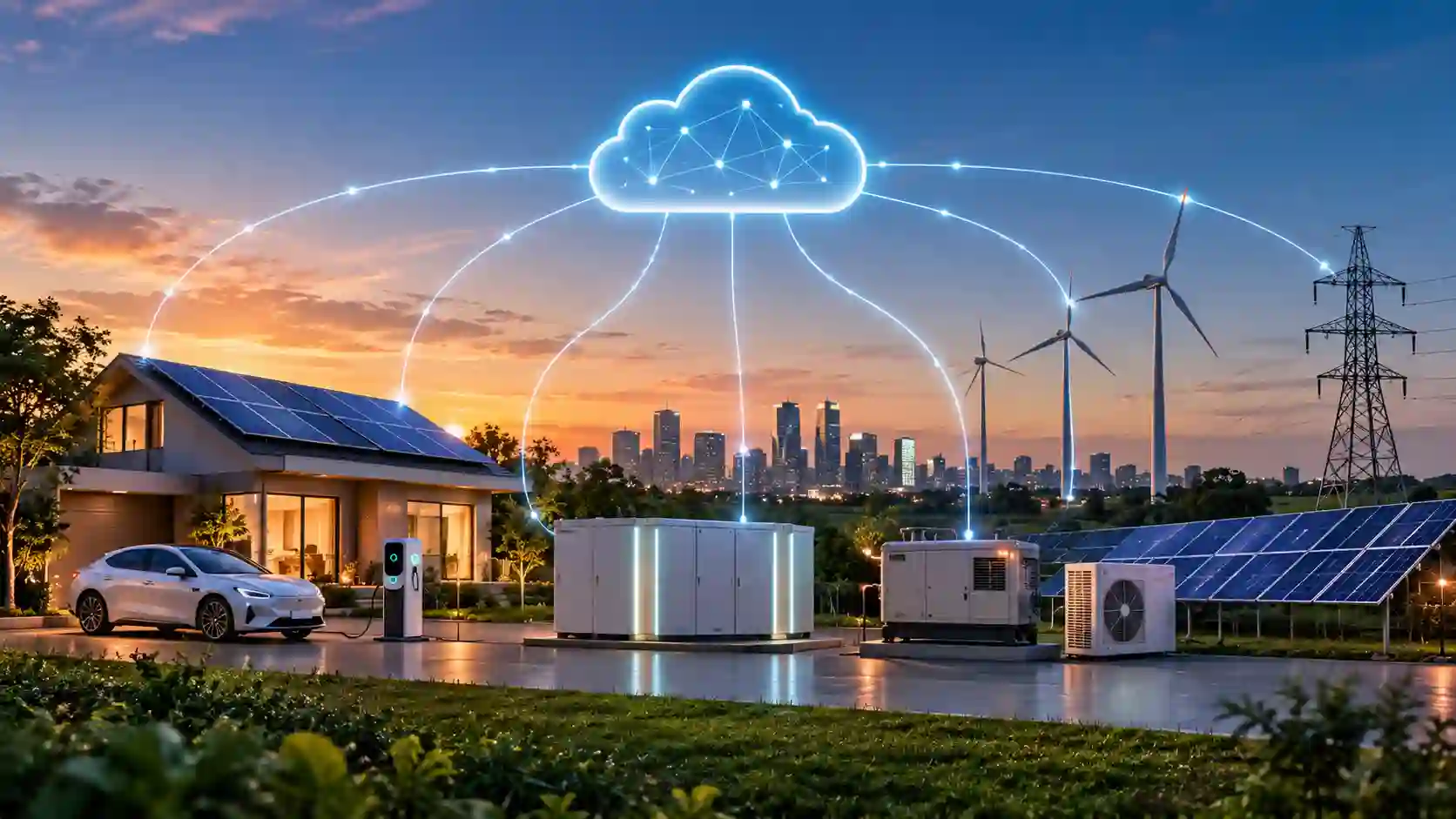
At Experion, we can help energy and utility companies turn distributed energy into dependable, revenue-generating assets through custom software engineering.
The electricity grid has always been unidirectional. Power is generated by large plants, which are then distributed to consumers. But with the rising electricity demand, the traditional form of electricity is being reconsidered. Solar rooftops, electric vehicles, and even smart thermostats can also be considered as power sources. A virtual power plant can coordinate all these sources.
Key Takeaways
- A virtual power plant harnesses the power of all Distributed Energy Sources (DERs)
- Virtual Power Plant software acts as the brain, handling forecasting and optimization
- A smart grid and a VPP do not compete with each other, instead, the smart grid is the intelligent infrastructure. The VPP is just a way of orchestrating all the resources on top of it.
- VPPs can help in grid reliability and enable lowering in energy costs. Overall, it speeds up capacity additions as well as plays a major role in decarbonization.
- Virtual plants that are AI-driven leverage Machine Learning for forecasting demand. Battery cycles are optimized in real time.
- The main challenges include interoperability, data privacy and difficulties in enrolling customers. Each of these hurdles can be managed with the apt development partner.
What is a Virtual Power Plant (VPP)?
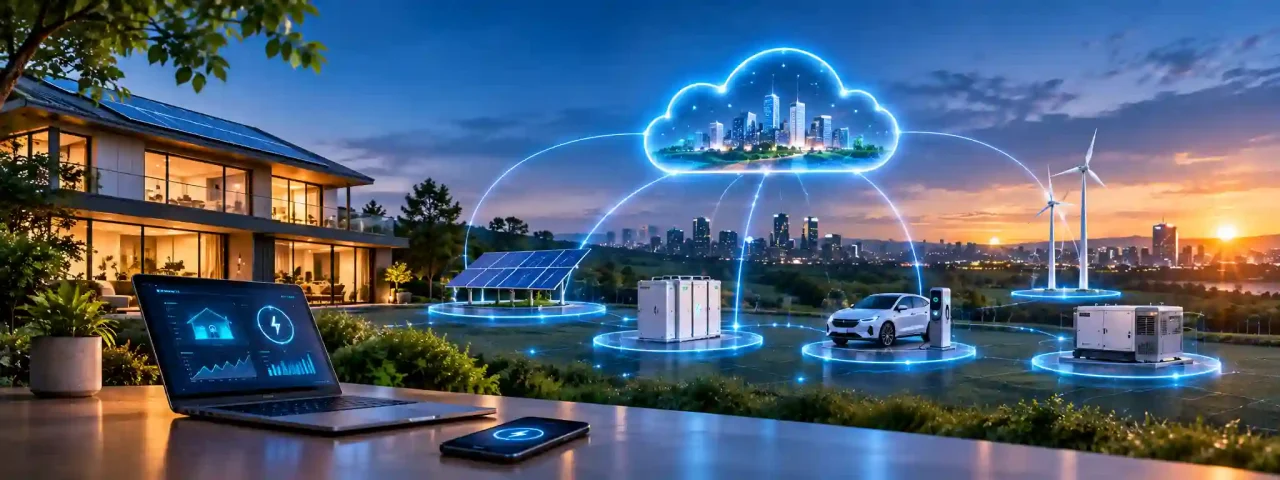
Virtual Power Plant Definition
A Virtual Power Plant is a cloud-based network that comprises decentralized energy resources. It is then aggregated and managed through software where they operate as a single power plant. In actuality, a virtual power plant has no single physical site. Its output is the flexibility of many small assets. For e.g.: EV chargers, water heaters and other household appliances,on-site generators and HVAC systems.
How a Virtual Power Plant VPP Works?
- Step 1: Beginning with the connection (in step one) of DERs to the VPP through various means such as inverter, IoT gateway, smart meter, or APIs provided by the manufacturer.
- Step 2: Then followed by monitoring where the VPP’s algorithm receives data in near real time about DER’s (generation/consumption/SoC/battery availability).
- Step 3: Then forecasting where an algorithm forecasts short term load/demand/solar/wind/price.
- Step 4: Then optimization where the algorithm determines how best to utilize all of the assets available to the participant (e.g., if there is excess energy being generated then store it in the battery and sell it back into the grid at a later date).
- Step 5: Followed by dispatching signals to DERs to increase/decrease/shifting production/consumption within predetermined parameters established by the owner of the DER.
- Step 6: Finally verifying/settling where the VPP tracks what was produced by each individual resource, submits this information to the relevant utility/market and settles payment with each participant.
Virtual Power Plant vs. Traditional Power Plant
| Feature | Virtual Power Plant | Traditional Power Plant |
| Structure | Network of distributed assets | Single centralised facility |
| Fuel / source | Solar, storage, EVs, flexible loads, mixed | Coal, gas, nuclear, hydro |
| Build time | Months, scaled incrementally | Years to decades |
| Capital cost | Lower, uses existing customer assets | Very high |
| Flexibility | Can scale up or down quickly | Limited ramp rates |
| Emissions | Low or zero | Often high |
| Resilience | Distributed, no single point of failure | Concentrated risk |
Planning a VPP initiative?
Talk to Experion’s energy software team to explore the right architecture for your portfolio
What Are Virtual Power Plant Solutions?
Virtual Power Plant (VPP) Solutions combine Software, Hardware Integrations & Operating Models that enable Energy Providers & Businesses to manage distributed resources as a Managed Asset that can be dispatched. The VPP Solution provides Utilities with the means to meet peak demand & defer costly grid upgrades. It also presents energy retailers & aggregators with new revenue streams. Commercial/Industrial Customers benefit through reduced energy costs and monetization of flexibility.
The VPP Solution works in three interconnected layers:
- First Layer: Connecting a broad range of Assets, regardless if they were sourced from multiple vendors and utilize different communication protocols.
- Second Layer: Continuously monitoring each asset for status/capability.
- Third Layer: Coordinating all fleet assets to respond as one.
This is an example of how this approach facilitates:
- Optimization of energy consumption by shifting load & storage to the cheapest & cleanest hours of operation.
- Demand Response, by reducing or moving consumption during peak event periods.
- Supplying Grid Services, i.e., Frequency Regulation, Voltage Support, Reserve Capacity.
Common Applications of Virtual Power Plants
- Home Energy Management: With home energy systems (batteries, solar panels, smart thermostats, electric vehicle charging stations) you are able to manage your energy use so that it does not peak on the grid and still meet the needs of your home occupants.
- Corporate/Industrial Energy Management: The same way that your residential system can be managed during the day to avoid high rates from utilities, your commercial or industrial facility can also manage its systems (heating/cooling, lighting, etc.) to prevent high rates on its energy usage. In addition, this can provide a revenue stream as your company earns money by reducing its consumption during periods of high demand.
- Smoothing Renewable Energy Variability: A Virtual Power Plant (VPP) will capture excess renewable energy (e.g., solar/wind) and store that energy. When the generating capacity falls off due to cloud cover, sunset, etc. the VPP releases the stored energy to help stabilize the grid. This helps to mitigate the variability of renewables.
- Frequency Regulation & Grid Balancing: Battery systems and other flexible loads can respond quickly enough to regulate grid frequency stability.
- EV fleet and battery storage management:
Michigan’s First Virtual Power Plant exists in the Net-zero energy community at Veridian. In the community, most homes combine solar and smart controls. The community’s energy resources are continuously coordinated to support the grid. A VPP, can thus, work at neighborhood scale and keep resident’s bills low.
Smart Grid vs Virtual Power Plant : What’s the Difference?
Smart grids and virtual power plants solve different problems.
A smart grid is an electric network that is complete with sensors, smart meters, and automation. It gives utilities better control and visibility over the grid itself. Common advantages include detection of faults, better grid control, reduced outages, and an integrated two-way power flow.
A VPP varies in the fact that it does not update the wires. It simply makes decentralized assets behave similar to a disputable power plant. In essence, both a smart grid and VPP complement each other. The smart grid forms the communication and data backbone that a VPP depends on.
Types of Virtual Power Plants
- Demand response VPPs– Typical assets include water heaters and industrial loads. Peak periods of usage are identified and the focus lies in shifting customer consumption during that time.
- Supply-side VPPs:These aggregate generation sources such as rooftop solar, small wind, combined heat and power units and backup generators, and dispatch them like a conventional plant.
- Mixed asset VPPs: Such VPPs offer the widest range of options for balancing the grid. It combines generation, storage and flexible loads.
- Commercial and industrial vs residential VPPs: Commercial VPPs have fewer and larger assets that are predictable in nature. Residential VPPs comprise of smaller assets that rely on strong enrolment and customer experience.
Types of Virtual Power Plant Programs
Aggregators often package VPP as programs that are easily identifiable and one that customers can join. Most common programs include:
- Smart thermostat programs: These programs are simple to join. Consumers who enroll in these programs must allow brief temperature adjustments to their thermostat during peak events. In exchange, they would get bill credits or rewards.
- Multi-device programs: It brings numerous electric appliances such as thermostats, EV chargers and batteries all under one program for maximum flexibility.
- Flexible-load programs: Mainly aimed at businesses. Through this program, they curtail defined loads such as refrigeration or pumps.
- Battery and solar-plus-storage programs: Operators are allowed to dispatch stored energy from batteries during peak hours and they get paid for it.
- Managed EV charging programs: For low-cost and low demand hours, charging is automatically timed. It also has the option of slowing down during grid stress.
VPP Software: The Brain Behind a Virtual Power Plant
Key Features of VPP Software
- DER Management System (DERMS) integration: This includes the control for registering, grouping and dispatching various types of DER. Also, it will connect with other utility systems.
- Load and generation forecasting: The demand, solar, and wind energy production as well as asset availability are forecasted in advance of making an operating decision.
- Real-time monitoring dashboards: Real-time views of fleet status and performance and alarm and event results provide real-time insight for operators.
- Market and trading integration: Connection to wholesale, capacity and ancillary service markets allows flexibility to be bid and sold.
- Billing, settlement, and reporting: Participant payment calculation, validation of performance as well as all regulatory and customer reports.
- API and open protocol support (OpenADR, IEEE 2030.5, etc.): Using standards such as OpenADR and IEEE 2030.5, the platform provides communication capabilities with both devices and utility systems regardless of vendor.
Build vs Buy: Custom VPP Software vs Off-the-Shelf Platforms
Off-the shelf Platforms
- Pros: Off the shelf platforms are faster to launch and are maintained by vendor hence they have proven functionality
- Cons: These have a limited amount of customisation, vendor lock-in as well as recurring license fees.
Custom VPP software
- Pros: Built around your assets, markets and business model; full ownership of IP; flexible integration; and the ability to differentiate.
- Cons: Higher initial investment, longer time to first release, and the need for a skilled engineering partner.
Experion’s engineering teams are well positioned to build secure energy platforms, from DER integration layers to forecasting and optimisation engines, so you can launch a VPP that fits your market and grow it as your portfolio expands.
Virtual Power Plant Solutions by Use Case
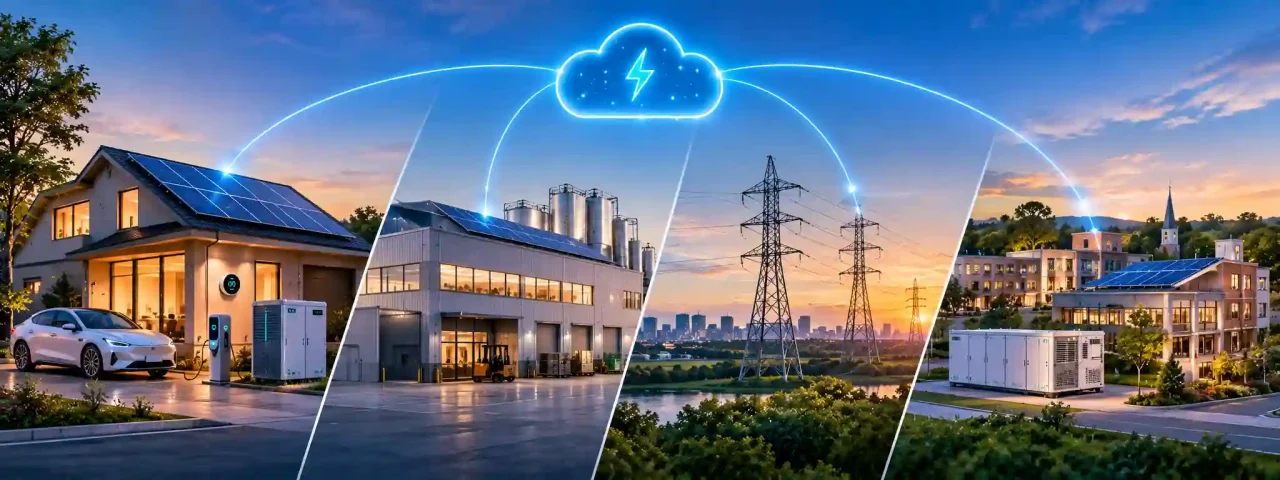
Residential VPPs
The residential VPP will be composed of coordinating home battery systems with rooftop PV, electric vehicle charging stations, smart thermostats, and smart water heaters. The homeowner typically joins a utility’s demand response program or an energy retailer to participate. When there is a peak event, their devices will respond automatically. For participating homeowners, they can expect to receive either bill credits, cash back, or reduced tariff rates. The reason for the relatively low contribution per household is due to scale issues; therefore, having a very easy enrollment process becomes key.
Commercial and Industrial VPPs
The C/I VPP uses flexible load types, on-site power generation, on-site power storage, HVAC control systems, and industrial process control. A cold storage facility may cool down prior to a peak event. Similarly, a manufacturing plant may delay a batch production process by a couple of hours. Both of these scenarios provide support for peak shaving programs to reduce peak demands and associated demand charges. Additionally, both of these examples represent new opportunities for earning revenue through participation in demand response programs and/or capacity market programs.
Utility and Grid-Operator VPPs
Utilities and grid operators utilize VPPs to help manage capacity, congestion on the transmission system, distribution grid flexibility, resource adequacy, and emergency response. In place of developing a peaking plant or strengthening a substation/feeder, utilities and grid operators have the ability to call upon existing distributed resources. Typically, using existing distributed resources is a lower-cost option than constructing a traditional peaking plant. Furthermore, the development process of a traditional peaking plant is much longer than calling upon existing distributed resources.
Microgrid and Community VPPs
Community VPPs utilize local resources (e.g., battery banks, rooftop PV, and/or critical facilities) to create “island” capability during outages allowing for continued operation of essential services. The same local resources also provide capabilities that allow for community-based energy sharing and grid-related services.
Want to see how a VPP could work for your utility, portfolio or community?
Speak with Experion’s energy experts
Benefits of Virtual Power Plants
The benefits of a VPP are far-reaching, benefiting utilities, customers and the energy system.
Grid Reliability and Resilience
Capacity is spread across multiple locations hence, VPPs remove singular points of failure. Frequency dips are responded to quickly and backup is often offered during outages.
Lower Energy Costs and New Revenue
Peak demand is shortened, which greatly reduces expensive peaking power. Paticipants get rewarded in credits and operators earn from capacity and service markets.
Faster, Lower-Cost Grid Capacity
Building a traditional plant can take many years. A VPP adds capacity in a matter of months by enrolling existing assets. Utilities can thus meet growing demand from data centers.
Decarbonisation and Cleaner Energy
VPPs enable the storing of renewable energy to be used as and when needed. This speeds up the transition to clean power and reduces curtailment.
Customer Control and Energy Flexibility
Consumers can determine how and when their devices will participate, turning energy users into active rather than passive participants.
Electricity trading and market participation
Aggregated flexibility can be bid into wholesale, capacity and balancing markets where regulations allow. This gives smaller assets access to markets that would otherwise be out of reach.
Challenges in Implementing a Virtual Power Plant
Problems caused during the process of establishing a virtual power plant.
- Several protocols: DERs are from different companies with different communications. Therefore, we need an open standard or a plug-in integration layer.
- Regulatory barriers: Regulation concerning aggregate distributed energy resources is highly location-dependent, with some areas strongly favoring traditional power generation over distributed energy resources. You need to be aware of all regulation change to be successful.
- Privacy issues: For instance, virtual power plants should encrypt data, abide by the respective consumer protection laws of data, and also obtain informed consent about personal data on energy usage by consumers to ensure that the user privacy is protected for power plants.
- Enrolling customers: The rate of growth of the VPP depends on the speed at which customers get registered. Clear and consistent incentives, an easy sign-up process, and transparency from the company about control build trust and bring customers back.
- Integration costs: Engineering-intensive work required to interface with existing infrastructures such as utilities, meters, and billing systems. Phased implementation of a new system will help amortize costs and provide a proof-of-concept at the beginning of the implementation process.
How Are AI-Driven Virtual Power Plants Transforming Energy Management?
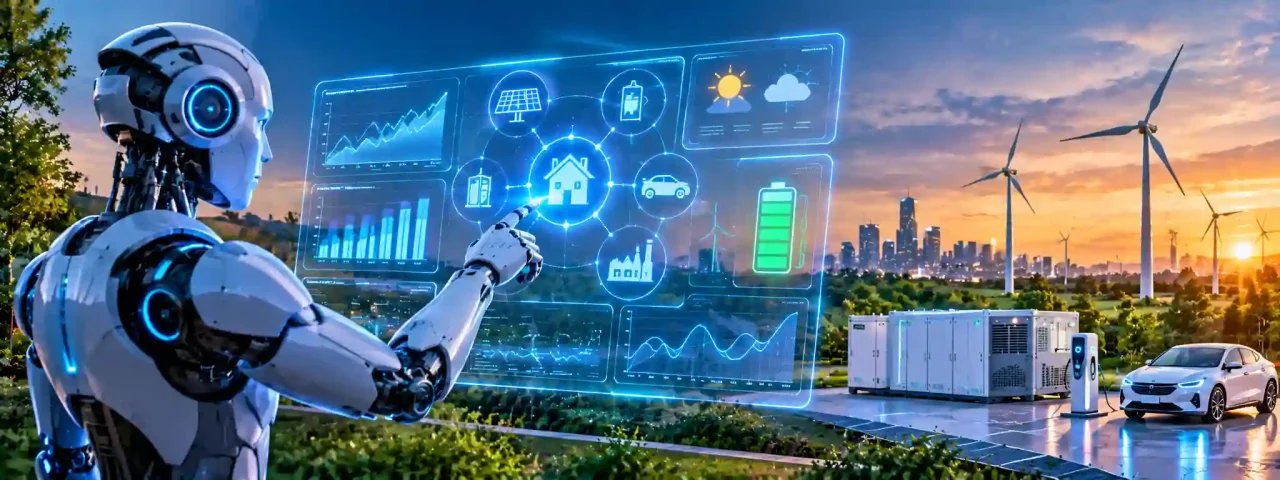
Are AI Driven Virtual Power Plants changing the way we manage our energy?Virtual Power Plant (VPP) orchestration is moving from being based upon rules, to predictive and optimizing through AI.
AI: The use of Artificial Intelligence in managing a Virtual Power Plant improves performance due to the ability to process enormous amounts of device, weather, price and grid data much faster than a human operator.
Predictive Demand Modeling and Predictive Renewable Generation Model – Machine Learning models are able to predict future energy usage and renewable generation. Historical consumption, weather and consumer behavior can be used to model and predict energy usage at a feeder or individual household level as well as predict solar and wind generation. Improved forecasting reduces uncertainty and provides better reliability for commitments to the grid.
Optimizing Battery Charging and Discharging Using Artificial Intelligence – The algorithms will determine if it should charge using low-cost or surplus power, or discharge for maximum value, taking into account multiple factors such as Price Signals, Battery Health, Customer Preferences and Grid Needs. Optimizing the time spent charging/discharging with artificial intelligence prolongs the overall life of batteries while maximizing revenue.
In addition to optimizing battery charging/discharging, Anomaly Detection, Predictive Maintenance, Automated Participant Segmentation and Real-Time Bidding also utilize artificial intelligence that increase profitability and dependability of a Virtual Power Plant.
What Does the Future Hold for Virtual Power Plants?
- Growing use of decentralized energy resources (i.e., rooftop solar, community renewables). The growing number of rooftop solar and community-based renewable projects increases the total amount of available VPP resource.
- The increasing use of batteries, electric vehicles: Declining cost of batteries combined with growth of electric vehicles (V2G) will provide an enormous level of flexible capacity.
- Increased use of Artificial Intelligence (AI), Predictive Energy Management. Forecasting and optimization will be becoming normal and VPPs will be operating independently at this time.
- More development of Decentralized Electricity Markets: P2P Trading, New Market Products etc. provide more opportunities for aggregated flexibility to earn.
- Role of VPPS within more resilient and sustainable electricity systems: VPPS will be one of the most important mechanisms by which grids can address increased demand, extreme weather events and long term decarbonization goals.
Existing VPP programs
Tesla’s South Australia VPP
Tesla has a VPP in South Australia, which is the largest in the world. Millions of homes have solar panels and Powerwall batteries that can act as a single resource. This program has successfully supplied grid services like frequency control and lowered energy costs for all the households that participated. This VPP program proved that residential batteries can easily support an entire state’s grid.
Sunrun and Utility Programs in California
Sunrun CalReady is a utility grid program in California. The program has enrolled thousands of solar plus storage homes. Their basic methodology is to discharge batteries during evenings and support grid reliability whenever demand spikes. VPPs are slowly moving into the mainstream arena. Utilities, device makers and technology companies are participating.
Get in touch with our team to develop your use case
How Experion Can Help You Build a Virtual Power Plant Solution?
Developing a VPP needs more expertise than connecting Distributed Energy Resources. We understand that VPPs are both a technology challenge as well as a business one. Our team has deep expertise building software for energy and utilities. With our industry experience in intelligent energy management , we are well adept at developing custom platforms, AI/ML modules, IoT solutions along with cloud solutions.
Glossary
- VPP- A virtual power plant is a software managed network of distributed energy resources that works like a single power plant.
- DER (Distributed Energy Resource)- It refers to a small scale energy source like a battery, an EV or even a flexible load connected near the point of usage.
- Demand Response- The adjustment of electricity consumption in response to prices or signals of the grid.
- Peak Shaving- Overall demand is reduced during the peak times to lower overall costs and grid strain.
- Frequency Regulation- Regulates grid frequency by rapidly adjusting power supply and demand.
- V2G (Vehicle to Grid)- Allows EVs to send their stored energy back to the grid.
- DERMS (Distributed Energy Management System)- A type of software that can monitor and control DERs.
- OpenADR- It is an open standard used to communicate demand-response signals between both utilities and devices.
With Experion as your technology partner, building a virtual power plant becomes a clear, phased roadmap , from first pilot to a fully scaled, AI-powered energy platform.
Frequently Asked Questions (FAQs)
What role does software play in a virtual power plant?
Software allows all components of a VPP to interact and function together. This includes connecting different devices , forecasting supply & demand, managing asset deployment, interacting with local utility companies and wholesale markets and facilitating billing and reporting. If there were no software, individual distributed resources would simply act independently.
How does AI improve virtual power plant operations?
Yes. AI provides improved accuracy in forecasting. AI manages optimal battery cycle usage. AI automates the bidding process. AI monitors equipment for potential failures before they occur. Improved reliability and financial performance are the end results of these processes.
Can virtual power plants work with renewable energy sources?
Yes. VPPs are particularly well-suited to use renewable energy sources. Surplus electricity generated by solar panels and wind turbines is stored using VPPs. Flexible load management enables load shifting to align demand with available generation. Gaps created by reduced availability of renewable energy are filled by the VPP.
Do I get paid to participate in a VPP?
In general, yes. There are several ways consumers can be compensated to participate in a VPP. These methods typically include payment based on the amount of money saved on their electricity bills ("bill credits") or incentives given upon enrollment ("upfront" incentive). Other forms of compensation may exist depending upon the type of program, location and the number of participating devices.
What types of devices can join a virtual power plant?
The variety of devices that can participate in a VPP includes residential and commercial batteries, rooftop solar systems, smart thermostats, water heaters, EV chargers; HVAC systems, pool pumps and other industrial equipment which has variable operating parameters.
What features should virtual power plant software have?
Look for the following capabilities: DERMS integration, Forecasting capability, Real time monitoring capabilities, Integration with markets/trading mechanisms, Billing/settlement capabilities, Support for open communication protocols/ application programming interface (API), Strong security for cyber protection and Scalable architecture.
What are the biggest challenges in building a virtual power plant?
Interoperability between various devices is one major challenge facing developers. Another significant issue is regulatory barriers. Data protection and customer participation/enrollment are additional areas requiring improvement. Integration costs and integration issues represent further barriers.
Can businesses and industrial sites join a virtual power plant?
Yes. Businesses/commercial/industrial facilities that have flexible loads, either through generating their own electricity or through having a means to store excess electricity, can enroll in and earn revenue from their participation in demand response programs, peak shaving programs, and capacity programs.
How do electric vehicles work with a virtual power plant?
Electric vehicles can be charged when it is best for the grid. This is referred to as "managed charging". Some applications enable vehicles to discharge power into the grid via vehicle-to-grid (V2G), essentially functioning as mobile batteries.
Will joining a VPP leave my home battery empty during an outage?
Not usually. Most programs allow customers to set a minimum reserve, therefore ensuring sufficient power will remain available for emergency purposes. Review your particular program's details to confirm how the reserve is handled.