






 Back
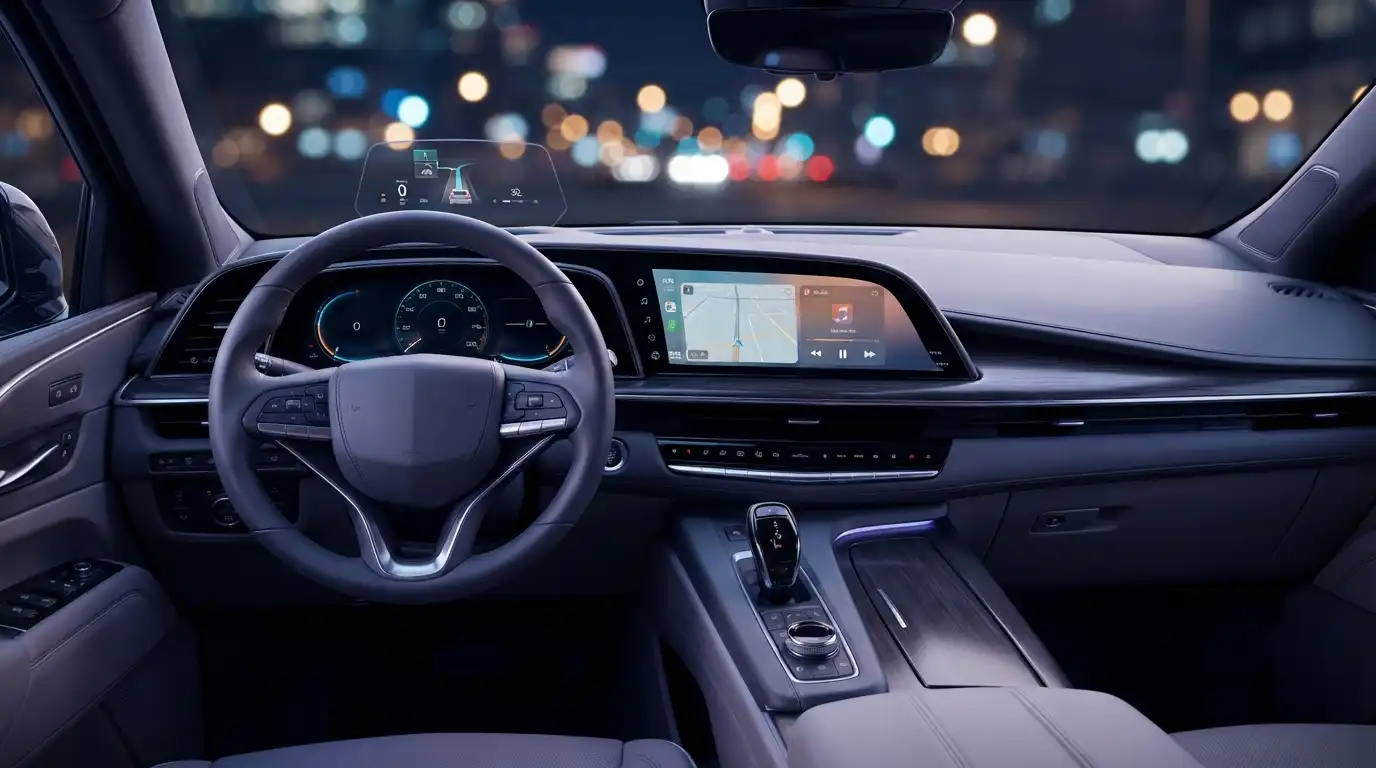
At Experion, our automotive and mobility work spans UX research, UI design, digital platform development, mobility engineering, IoT, and quality engineering, capabilities that are relevant when manufacturers are building connected in-vehicle experiences.
Where the driver, the vehicle, and its software finally meet.
For years, the dashboard had a fairly straightforward job. It showed speed, fuel, warning lights, perhaps navigation, and little more. That has changed.
Drivers now expect the car to understand their phone, remember preferences, surface navigation intelligently, manage media, display advanced driver-assistance information, and increasingly respond through natural voice. At the same time, manufacturers want one digital environment that can evolve through software rather than being fixed when the vehicle leaves the factory.
The digital cockpit sits at the center of that shift. It brings displays, infotainment, vehicle information, connectivity, controls, and increasingly AI into a connected in-cabin experience.
Key Takeaways
- A digital cockpit combines the instrument cluster, infotainment, vehicle controls, connectivity, and other in-cabin digital experiences.
- It is broader than a digital instrument cluster or infotainment screen alone.
- Centralized computing is allowing more cockpit functions to run on shared hardware.
- UX and safety matter just as much as display size or computing power.
- AI is making cockpit experiences more contextual and conversational.
- Software-defined vehicle architectures make it easier to update and expand cockpit features over time.
- Custom development becomes valuable when an automaker wants the digital experience to reflect its own brand, vehicle architecture, and customer journey.
What is a Digital Cockpit?
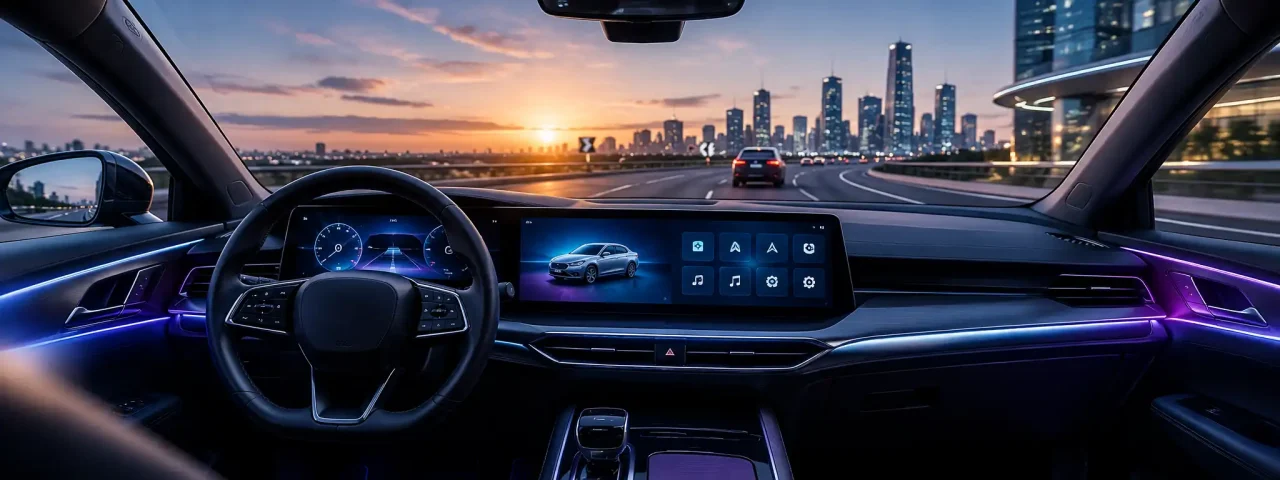
For anyone asking what is a digital cockpit in modern cars, it is the connected digital environment through which the driver and passengers interact with the vehicle.
It may include the digital instrument cluster behind the steering wheel, the central infotainment display, head-up displays, passenger screens, voice assistants, navigation, climate controls, media, smartphone connectivity, vehicle settings, cameras, and information from driver-assistance systems.
A modern automotive digital cockpit therefore goes well beyond replacing analog gauges with screens.
The important word is connected.
Information from several vehicle domains needs to reach the right person, on the right display, at the right moment. A navigation instruction may appear in both the infotainment screen and the instrument cluster. A camera feed may temporarily take priority over another interface. A warning needs to be visible immediately without being lost among entertainment controls.
Android Automotive OS illustrates how this architecture is evolving. Google now describes AAOS as a platform not only for in-vehicle infotainment but also for unified digital cockpits and wider software-defined vehicle architectures. Its unified cockpit approach combines infotainment with cluster information and safety-related displays.
What Makes a Digital Cockpit Different From Traditional Vehicle Infotainment?
Infotainment is part of the cockpit, but it is not the whole cockpit.
Traditional infotainment is mainly concerned with navigation, entertainment, connectivity, phone functions, and media. The digital cockpit brings those experiences together with vehicle information and controls.
That can include:
- Instrument-cluster information
- Vehicle status and warnings
- Navigation
- Media and communication
- Climate and comfort controls
- ADAS information
- Camera views
- EV range and charging information
- Vehicle settings
- Voice interaction
- Personalized profiles
- Connected services
The difference becomes clearer when something happens while driving.
If navigation knows that the vehicle is low on charge, it may suggest an appropriate charging stop. The same information can influence the map, range display, energy information, and route guidance at once. That requires more than a standalone infotainment application.
What are the Main Components of Digital Cockpit Technology?
Modern digital cockpit technology usually brings several hardware and software elements together.
The instrument cluster handles information that the driver needs continuously, including speed, range, warnings, and driving information.
The infotainment system handles navigation, media, connectivity, applications, and other user-facing features.
A head-up display can place selected information closer to the driver’s line of sight.
Voice interfaces reduce the need to move through menus manually, while cameras and sensors can add contextual information about the vehicle or cabin.
Behind these interfaces sits the computing architecture responsible for running applications, rendering graphics, connecting vehicle systems, managing data, and keeping functions appropriately isolated.
This computing layer is becoming increasingly important. Bosch, Qualcomm, Google, and other automotive technology providers are moving toward architectures where more cockpit functions can run on consolidated high-performance computing platforms rather than separate control units.
How Does a Digital Cockpit Work?
A digital cockpit sits between the vehicle’s underlying systems and the people inside it.
Data may arrive from vehicle networks, sensors, navigation services, mobile devices, cameras, cloud platforms, and connected services. The cockpit software decides how that information should be processed and presented.
Consider a simple example.
The driver starts the vehicle. The system loads the driver’s profile and preferred interface settings. Navigation receives the destination from the driver’s connected account. Vehicle data shows the available range. If the route requires charging, the system can surface charging information alongside navigation.
During the drive, ADAS information appears in the instrument cluster. A phone call comes through the infotainment system. When the driver selects reverse, the camera view receives priority.
Several systems may be involved, but to the driver it should feel like one experience.
That is one of the hardest parts of digital cockpit development. The engineering underneath can be extremely complex, but the experience should not feel complex.
Digital Cockpit vs. Virtual Cockpit: What’s the Difference?
The terms are sometimes used interchangeably, but they do not always mean the same thing.
A virtual cockpit usually refers more narrowly to a digital instrument cluster that replaces conventional physical gauges with a configurable display.
It may show speed, navigation, media, vehicle information, warnings, and other driver information directly in front of the steering wheel.
The digital cockpit is broader.
It can include the virtual instrument cluster, infotainment, voice controls, head-up display, passenger interfaces, vehicle controls, connectivity, and other digital experiences.
So virtual cockpits can be important components within a larger digital cockpit architecture rather than complete cockpit systems on their own.
Why are Digital Cockpits Becoming More Important?
Cars are becoming software platforms.
That changes what customers expect after purchase. Features can evolve. Interfaces can be improved. Connected services can be added. Personalization can become more sophisticated.
The cockpit is where much of that software becomes visible to the customer.
It is also becoming a stronger part of brand identity. Two vehicles may use similar processors or operating systems while creating completely different experiences through interface design, interaction patterns, animations, sound, navigation, voice, and personalization.
Large displays alone are not enough. Continental’s mobility research found strong interest in larger in-vehicle displays across several markets, but also a broad preference for simple, uncomplicated interfaces.
That balance matters. Adding more digital capability does not automatically improve the driving experience. Sometimes the better design decision is to show less.
How Digital Cockpit Technology Supports the Software-Defined Vehicle?
The shift toward software-defined vehicles is changing cockpit architecture significantly.
Traditionally, many vehicle functions relied on separate electronic control units. Modern architectures are gradually consolidating more functions onto powerful central or domain computers.
That can reduce hardware complexity and make software easier to update across vehicle programs.
Google’s current AAOS architecture, for example, describes support across infotainment, instrument clusters, body controls, and driver-assistance-related domains. Bosch similarly describes cockpit integration platforms as part of the industry’s move toward centralized electrical and electronic architectures.
This is also visible in current vehicle programs. Qualcomm and Leapmotor announced a cross-domain central computer in 2026 bringing cockpit, connectivity, body control, and driver-assistance capabilities onto a more unified computing architecture. Qualcomm has also announced expanded cockpit relationships with major automakers including BMW Group and Stellantis.
For the digital cockpit automotive industry, this means cockpit development is increasingly connected to the wider software architecture of the vehicle rather than being treated as an isolated infotainment project.
What Makes a Good Digital Cockpit User Experience?
A good cockpit does not ask the driver to admire the software.
It helps them understand what matters without unnecessary effort.
Information hierarchy is crucial. Speed, safety warnings, navigation, entertainment, climate, and secondary vehicle settings do not deserve equal visual priority.
Context matters too. The screen can behave differently when the vehicle is moving, parked, charging, reversing, or navigating through an unfamiliar area.
Consistency is another important factor. Controls should not behave differently simply because they appear on another display.
Design teams also need to consider physical interaction. Touchscreens are flexible, but a control that requires three precise taps while driving may be technically elegant and practically frustrating.
This is why UX research is an important part of digital cockpit development services for automotive infotainment systems. The work is not just about arranging interface elements. It is about understanding what the driver should see, when they should see it, and how much attention the interaction requires.
What Role Does AI Play in a Modern Digital Cockpit?
The first generation of connected cockpits largely waited for the driver to ask for something.
AI is making them more contextual.
Voice assistants can interpret more natural language. Recommendation systems can learn common preferences. Models may help understand driver intent or use information from several domains to surface a useful action.
Bosch’s 2026 cockpit work, for example, focuses on AI-enabled in-cabin experiences that combine natural voice interaction, contextual understanding, reasoning, and personalized assistance.
Imagine a driver saying:
“I’m cold, and I need somewhere to charge before my meeting.”
A conventional voice system may struggle because that sentence contains several separate requests.
A more capable system could understand the comfort request, current battery level, destination, charging availability, and travel time, then adjust the climate setting and offer appropriate charging options.
The important point is not the conversation itself. It is the integration required behind it.
AI needs context from the vehicle, navigation, connected services, user preferences, and other systems before the response becomes useful.
How Digital Cockpits Support Personalization
Cars are often shared.
The same vehicle may be driven by different family members or used by several drivers in a commercial setting. A digital environment makes it possible to adapt the experience when the user changes.
Profiles may include:
- Seat and mirror preferences
- Favorite media
- Navigation history
- Display configuration
- Climate preferences
- Preferred applications
- Accessibility settings
More advanced digital cockpit solutions may also adapt based on context rather than relying only on stored settings.
The challenge is deciding how much personalization genuinely improves the experience and how much simply adds complexity.
Digital Cockpit Security and Privacy
A connected cockpit creates a larger software environment than a traditional dashboard.
That means more interfaces, more data, and potentially more points that need protection.
User accounts, location history, voice requests, contact information, connected applications, payment information, and vehicle data may all pass through the cockpit environment.
Security therefore needs to cover identity, APIs, application isolation, communications, software updates, permissions, data storage, and connected cloud services.
Privacy matters just as much. The fact that the vehicle can collect information does not mean every application should automatically have access to it.
These considerations should be part of the cockpit architecture from the beginning rather than treated as features to add after the interface has been designed.
Digital Cockpit Testing: Why It Is More Than UI Testing
Testing a digital cockpit means testing several layers at once.
The interface needs to behave correctly, but so do integrations with vehicle systems, devices, applications, networks, and cloud services.
Teams may need to validate:
- Display behavior
- Startup and recovery
- Audio
- Navigation
- Bluetooth and mobile connectivity
- Vehicle-data integration
- Voice interaction
- Multiple displays
- User profiles
- Offline behavior
- Software updates
- Performance under load
- Security
- Failover behavior
The context of driving also makes testing different from a normal consumer application.
A minor delay in a shopping app may be irritating. A delay in displaying important vehicle information can carry different consequences.
What are the Benefits of Digital Cockpit Solutions for Automakers?
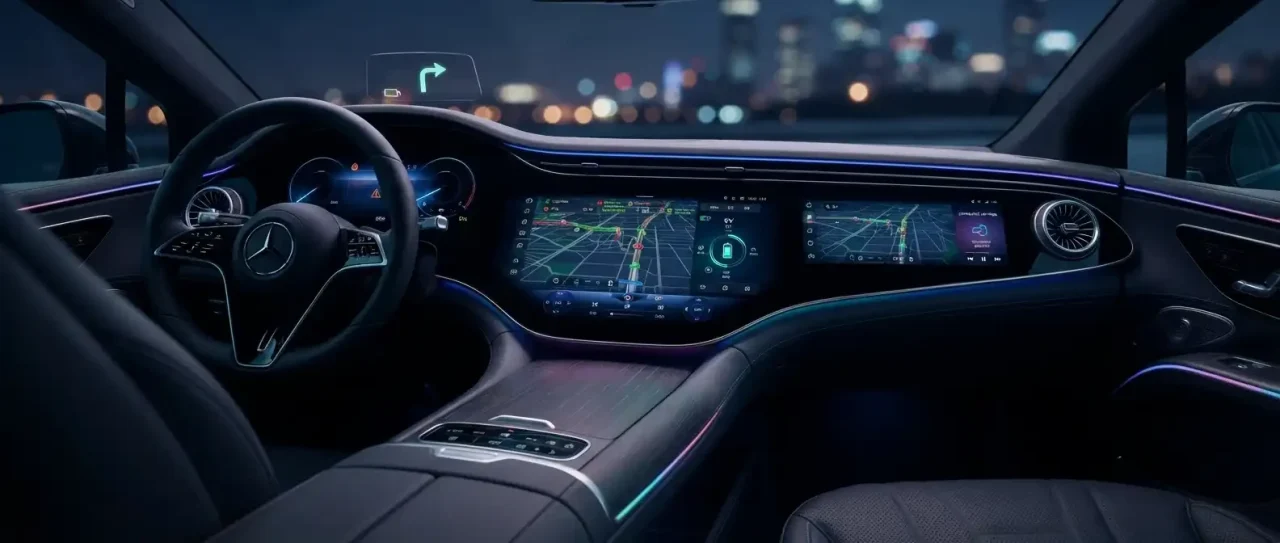
The obvious benefit is a richer driver experience, but manufacturers also gain a software platform that can evolve.
Features can be shared across vehicle models. Interfaces can be adapted for different brands or markets. Connected services can be introduced after launch. Common software foundations can reduce duplicated development across vehicle programs.
This is one reason digital cockpits solutions for automotive are increasingly discussed alongside software-defined vehicle strategies rather than only infotainment.
A well-designed architecture may also make it easier to introduce new applications, improve existing experiences, and support new services without redesigning the cockpit hardware every time.
Off-the-Shelf vs. Custom Digital Cockpit Solutions
There are now mature automotive platforms for displays, operating systems, connectivity, and cockpit computing. Using those foundations can reduce development effort significantly.
But the platform does not define the complete experience.
Custom digital cockpit solutions become relevant when an automaker wants its own interaction model, brand identity, applications, integrations, vehicle features, or connected-service ecosystem.
The best approach is often not completely custom or completely off-the-shelf.
An OEM may use established silicon, an automotive operating system, middleware, and standard services while building differentiated UX, applications, integration, and data experiences around them.
That approach allows the manufacturer to concentrate custom engineering where the customer can actually feel the difference.
Experion’s documented automotive mobility work includes UX research, UI design, digital platform development, and quality engineering, alongside broader mobility capabilities in IoT and rapid prototyping.
What Does Digital Cockpit Development Involve?
Good cockpit development starts before code.
Teams need to understand the vehicle architecture, target users, displays, hardware, vehicle signals, operating system, safety boundaries, integrations, connectivity, and expected service lifecycle.
UX research can then establish how drivers and passengers should interact with the system.
Information architecture determines where functions belong. UI design turns that structure into usable screens and interactions.
Engineering connects the experience with the vehicle and backend systems.
Testing then needs to happen across software, hardware, vehicle data, connectivity, and real-world interaction conditions.
This is why digital cockpit development often involves several disciplines working together:
- Automotive software engineering
- Embedded and platform development
- UX and HMI design
- Cloud and backend engineering
- Connectivity
- Data and AI
- Mobile integration
- Quality engineering
The cockpit may appear to the driver as one screen, but engineering it is very much a systems problem.
How to Choose a Digital Cockpit Development Approach
Start with the experience you want the vehicle to provide.
Do not start with the size of the display.
Which information matters while driving? Which functions should remain physical? What needs to work without connectivity? Which experiences should be shared across vehicle models? Which parts need to express the brand?
Then look at the technical foundation.
Consider computing architecture, operating system, vehicle interfaces, display requirements, connectivity, update strategy, security, cloud services, AI, and the expected lifetime of the platform.
Finally, decide where differentiation matters enough to justify custom engineering.
That is usually a more useful question than asking whether the entire cockpit should be built from scratch.
What’s Next for the Automotive Digital Cockpit?
The direction is toward fewer isolated screens and more connected vehicle experiences.
Centralized computing will continue to bring cockpit functions closer to other vehicle domains. Android Automotive is already extending beyond traditional IVI toward unified cockpit and broader software-defined vehicle architectures.
AI will also move from simple voice commands toward systems that understand context and coordinate actions.
Personalization will become more dynamic.
Displays may become larger and more flexible, but good interface design will remain important precisely because more screen space creates more opportunity for distraction.
And cockpit software will increasingly need to evolve throughout the vehicle’s life.
The future of digital cockpit automotive technology is therefore not simply a better dashboard. It is a programmable vehicle experience.
How Experion Can Help With Digital Cockpit Solutions?
With expertise in embedded software, UI/UX design, and cloud connectivity, we create responsive interfaces, enable over-the-air updates, and integrate voice and smartphone features. From concept to validation, Experion supports every stage, helping you reduce development time, ensure safety and compliance, and bring smarter, more engaging cockpits to market faster.
Conclusion
The digital cockpit has become one of the places where the enormous complexity of the modern vehicle has to feel simple.
Behind the screen are vehicle systems, applications, sensors, cloud services, connectivity, safety information, user data, and increasingly AI. The driver’s experience depends on how well those pieces work together.
That is why the strongest digital cockpit solution is not necessarily the one with the most displays or features.
It is the one that knows what matters at that moment.
A navigation instruction when the driver needs it. A warning that cannot be missed. A familiar interface when someone enters the vehicle. A charging recommendation that understands the actual journey. Entertainment that stays out of the way when attention belongs on the road.
As vehicles become increasingly software-defined, that experience will become an even larger part of how customers understand the vehicle and, ultimately, the brand.
Experion can support automotive digital initiatives through capabilities in mobility engineering, UX and UI design, digital platforms, IoT, integration, and quality engineering, with the approach shaped around the vehicle, user experience, and technology environment rather than a predetermined cockpit stack.
Frequently Asked Questions (FAQs)
What is a digital cockpit?
A digital cockpit is the connected in-vehicle environment that combines driver information, infotainment, navigation, vehicle controls, connectivity, and other digital experiences across one or more interfaces.
What is the difference between a digital cockpit and infotainment?
Infotainment mainly handles navigation, media, connectivity, and entertainment. A digital cockpit is broader and can include the instrument cluster, head-up display, vehicle controls, ADAS information, cameras, personalization, and infotainment.
Is a virtual cockpit the same as a digital cockpit?
Not usually. A virtual cockpit commonly refers to a configurable digital instrument cluster. It can form part of a wider digital cockpit.
What technology is used in a digital cockpit?
Typical digital cockpit technology may include high-performance automotive computing, GPUs, operating systems such as Android Automotive, middleware, vehicle interfaces, connectivity, displays, voice technology, cloud services, and AI.
How is AI used in digital cockpits?
AI can support natural voice interaction, recommendations, personalization, contextual assistance, predictive features, and increasingly multi-step in-vehicle interactions.
Can digital cockpit software be updated after the vehicle is sold?
In software-defined vehicle architectures, selected cockpit software and features can be designed to support ongoing updates. The exact capability depends on the vehicle architecture and update strategy.
What are custom digital cockpit solutions?
They are cockpit software and experiences developed around an automaker's specific vehicle architecture, UX, branding, applications, connected services, and integration requirements rather than relying entirely on a standard product.
What are digital cockpit development services for automotive infotainment systems?
They can include product strategy, HMI and UX design, software architecture, infotainment application development, vehicle and cloud integration, AI capabilities, testing, and platform modernization.
What is driving the growth of digital cockpits?
Software-defined vehicles, centralized computing, connected services, AI, larger digital interfaces, personalization, and customer expectations for smartphone-like digital experiences are major drivers.
What should automakers prioritize when developing digital cockpits?
Usability, safety, performance, integration, updateability, security, privacy, scalability, and clear differentiation in the customer experience should all be considered together.