






 Back
Back
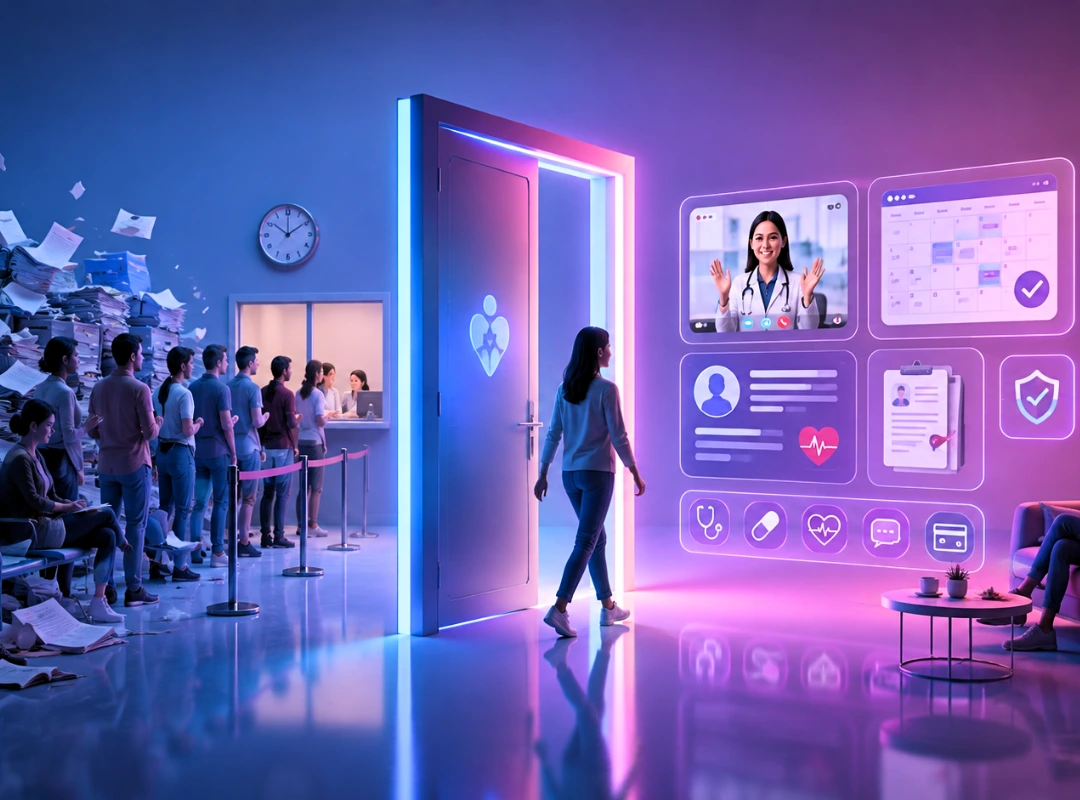
Experion’s healthcare digital engineering experience includes Digital Front Door implementation for a U.S. homecare services provider, spanning UX architecture, UI design and development, digital platform engineering, and quality engineering.
Patients do not separate their expectations of healthcare from the rest of their digital lives. If they can book a flight, track a delivery, move money, or change a reservation from a phone, they naturally wonder why finding a doctor or rescheduling an appointment still requires three phone calls.
The problem is rarely the absence of digital tools. Most healthcare organizations already have plenty of them: websites, portals, apps, scheduling systems, call centers, telehealth platforms, billing systems, and clinical applications. The difficulty is that these experiences often behave like separate doors into the same organization.
A patient searches for a specialist on one site, logs into another system to book an appointment, fills out information the hospital may already hold, receives reminders through a different channel, and later visits yet another portal for results or bills.
A digital front door tries to change that experience by creating a connected digital entry into healthcare.
The idea behind digital front door in healthcare is simple: what if a patient could discover care, complete routine tasks, communicate, receive services, and continue the relationship through one coherent experience, even when several systems are working behind it?
What is a Digital Front Door?
For anyone asking what is digital front door, it is best understood as a healthcare access strategy rather than a single application.
A digital front door gives patients a unified digital entry point to healthcare services, information, providers, and ongoing care interactions. It can bring together websites, apps, portals, scheduling, payments, messaging, telehealth, and clinical information so patients do not have to understand the organization’s technology landscape before they can receive care.
A healthcare digital front door may therefore be a platform, a connected group of technologies, or an integration layer built around systems the healthcare provider already uses.
Why Digital Front Door Matters?
A digital front door can connect provider websites, patient portals, healthcare mobile apps, appointment scheduling, provider search, telehealth, online registration, digital check-in, secure messaging, payments, prescriptions, health records, virtual assistants, and care navigation.
The important distinction is that these capabilities do not necessarily need to live inside one enormous application.
Effective digital front door solution can orchestrate existing tools behind a consistent patient experience. That makes the Digital Front Door both a technology architecture and a digital front door strategy for how patients access the organization.
Why is Digital Front Door Important for Healthcare?
Healthcare has spent years digitizing individual processes. The next challenge is connecting them from the patient’s point of view.
Major Challenges Faced by Healthcare Industry
A patient journey may begin with Google, move to a hospital website, continue through a call center, shift to an EHR portal, and end in a billing application.
Fragmented journeys create repeated logins, duplicated information, difficult provider discovery, poor scheduling experiences, and limited self-service. Manual administration increases call-center demand, while disconnected patient data makes personalization harder.
The issue is not simply convenience. Friction can appear at the exact moment somebody is trying to understand where to seek care.
This is why digital front door healthcare initiatives increasingly focus on continuity rather than creating another standalone channel.
Why are Organizations Prioritizing Front Door?
Healthcare organizations want patients to find care more easily, complete routine tasks independently, and move between digital and physical channels without starting over.
A good digital front door healthcare strategy can improve access, reduce repetitive administration, support digital engagement, and make omnichannel care easier to coordinate.
It can also create a more consistent relationship with patients. Instead of appearing only when an appointment is booked, the organization can support discovery, preparation, care delivery, payment, follow-up, and preventive engagement.
How Does the Digital Front Door Benefit Staff and Patients?
Patients gain convenience and clearer access to services. Staff gain fewer repetitive calls, more complete information, and better-defined workflows.
A patient who can confirm an appointment, complete registration, locate the facility, and pay online independently removes several small administrative tasks from frontline teams.
That does not eliminate human support. It allows human support to concentrate on situations where it adds more value.
How Does a Digital Front Door Work?
Conceptually, the journey can be pictured as:
Patient → Digital Entry Point → Identity & Personalization → Service Discovery → Healthcare Systems → Care Delivery → Follow-Up
The patient sees a connected journey. Behind that journey, different technologies exchange information and trigger workflows.
- Digital Entry Points
The first interaction might happen through a website, mobile app, patient portal, chatbot, voice assistant, SMS message, or connected device. A mature digital front door health experience does not assume every patient begins in the same channel. - Identity and Authentication
Identity connects the interaction with the right patient. Single sign-on, identity management, multi-factor authentication, and secure account recovery can reduce repeated logins while protecting sensitive information. The goal is simple access without weak access controls. - Service Discovery
Patients need to find the right service before they can use it. Search may include provider name, specialty, location, insurance acceptance, appointment availability, language, care setting, or virtual-care options. Discovery should answer the patient’s question rather than expose the organization chart of the health system. - Transaction Layer
Once patients know what they need, they should be able to act. Transactions may include booking an appointment, completing registration, making a payment, requesting a prescription refill, submitting forms, or completing digital check-in. This is where a digital front door software experience moves beyond providing information and begins removing administrative effort. - Clinical Integration
Clinical integration connects the patient-facing journey with EHRs, health records, care plans, laboratory results, and medication information. The digital front door should not become another isolated store of clinical information. Its value comes from connecting the experience with trusted systems of record. - Engagement Layer
The relationship continues after the transaction. Notifications, secure messaging, health education, follow-up reminders, and relevant recommendations help patients understand what comes next. That continuity is what turns a set of digital tasks into an ongoing experience.
Key Components of a Digital Front Door
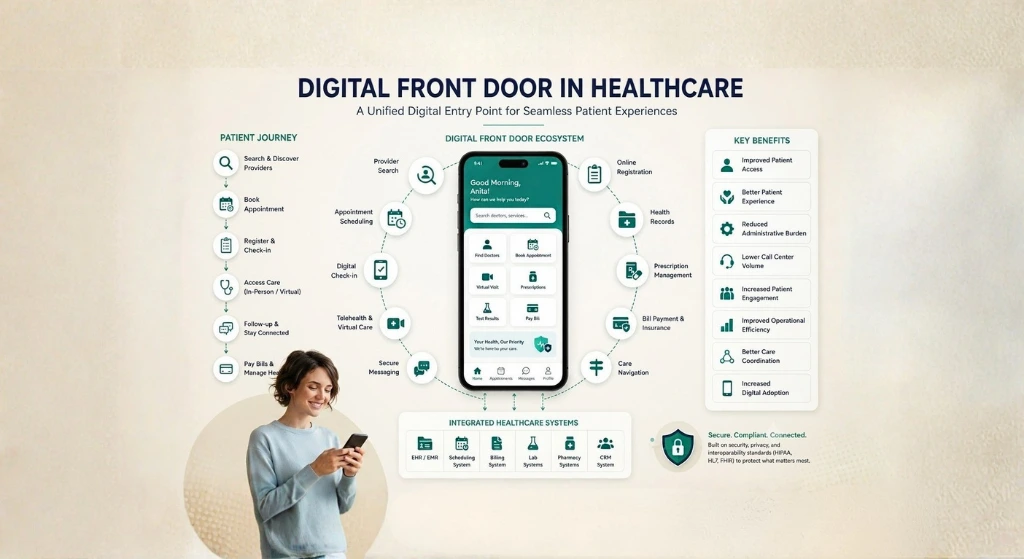
The exact combination varies by healthcare organization, but several capabilities appear repeatedly.
- A patient portal provides authenticated access to records and services.
- A healthcare mobile app brings common journeys onto the patient’s device.
- Online appointment scheduling and digital check-in reduce dependence on telephone and paper processes.
- Provider and location search help patients understand where to go.
- Telehealth and virtual care provides another route to care.
- Digital payments simplify financial interactions, while secure messaging keeps communication connected to the patient relationship.
- AI-powered healthcare assistants can support navigation and routine questions when designed with clear boundaries.
The strongest digital front door solution is not necessarily the one containing the most features. It is the one in which the features work together.
Digital Front Door vs. Patient Portal
A patient portal and a Digital Front Door overlap, but they are not the same thing.
| Area | Patient Portal | Digital Front Door |
| Primary role | Authenticated patient services | Connected access across the wider patient journey |
| Records | Core capability | Integrated into broader experience |
| Messaging | Common | Part of omnichannel engagement |
| Appointments | Often available | Includes discovery, scheduling and navigation |
| Results | Common | Connected with follow-up journeys |
| Billing | Often available | Can connect discovery through payment |
| Provider discovery | Usually limited | Core access capability |
| Care navigation | Limited | Broader navigation across services |
| Engagement | Mostly portal-based | Cross-channel and continuous |
| Follow-up | Often transactional | Can be personalized and proactive |
The key takeaway is straightforward: a patient portal can be one component of a broader Digital Front Door strategy.
Digital Front Door vs. Digital Patient Experience
Digital Patient Experience describes the quality of all the digital interactions a patient has with a healthcare organization.
The Digital Front Door is the strategy, architecture, and technology ecosystem used to make those interactions easier to access and connect.
One is the experience the patient perceives; the other helps create it.
A strong digital front door strategy healthcare program therefore starts with patient experience rather than starting with software.
Benefits of Digital Front Door in Healthcare
- The first benefit is improved patient access. Patients can find services and complete routine steps without waiting for office hours.
- A better connected patient experience can improve patient satisfaction by reducing repeated information entry, unnecessary calls, and confusing transitions between systems.
- Self-service can lower administrative workload and call-center volume. Better integration can improve care coordination and make relevant information available across journeys.
- Digital engagement also becomes easier because communication can continue before and after an appointment rather than ending when the patient leaves.
- Most importantly, digital front door healthcare can make digital adoption useful rather than simply increasing the number of tools patients are expected to use.
Experion can support these journeys through healthcare digital engineering, UX, mobile and web development, platform engineering, quality engineering, integration, and application support.
Digital Front Door Use Cases
A digital front door can support many moments that currently require separate journeys.
A patient looking for care can search by specialty and location, check insurance information, compare available appointments, and book immediately.
Before the visit, registration forms and check-in can happen digitally. The same environment can support virtual consultations, medication information, chronic-care reminders, preventive-care prompts, and post-visit instructions.
Urgent-care navigation may help patients understand appropriate care options without manually searching multiple locations.
Billing can appear naturally after care rather than through a disconnected financial portal.
These are different use cases, but the patient should not feel as if they belong to different organizations.
Role of AI in Digital Front Door
AI can make a digital front door easier to navigate when it is applied to specific patient problems.
AI-powered search can interpret conversational requests rather than requiring patients to know medical department names. Intelligent navigation can route someone towards a service, location, or next action.
Conversational AI can answer routine administrative questions and help patients complete tasks. Personalization may surface relevant information based on context and consent.
Predictive engagement can identify when reminders or outreach may be helpful.
For teams researching how ai digital front door improves patient access, the practical value lies in reducing the effort between a patient’s question and the appropriate next step.
AI agents may eventually coordinate several administrative actions across systems, but autonomy should increase only where safety and governance allow it.
Important Considerations
Healthcare AI needs clear human escalation.
Answers must be accurate, especially when a conversation begins moving from administration towards clinical guidance. Privacy, clinical safety, explainability, and governance need to be built into the operating model.
AI should help a patient reach appropriate care. It should not create false confidence about matters that require a clinician.
Role of Interoperability in Digital Front Door Healthcare
A polished interface cannot compensate for disconnected systems behind it.
Interoperability is what allows the Digital Front Door to know that an appointment was booked, a laboratory result became available, or a payment was completed without requiring duplicate data entry.
Systems That May Need Integration
Typical integrations include EHRs, CRM platforms, patient portals, practice-management systems, billing applications, scheduling engines, telehealth platforms, laboratories, pharmacy systems, and identity platforms.
The exact architecture depends on the organization’s existing estate.
Standards and Technologies
HL7 remains widely used for healthcare data exchange, while FHIR provides modern standards for exchanging healthcare information through structured resources and APIs.
APIs and healthcare interoperability platforms can make data and services available across applications, while identity-management systems help ensure information is linked to the appropriate patient.
Interoperability is therefore not an optional backend concern. It is what makes the frontend journey believable.
Digital Front Door Architecture
A useful conceptual architecture has several layers.
- The Experience Layer contains web, mobile, portal, chatbot, and other patient touchpoints.
- The Engagement Layer manages messaging, notifications, and personalization.
- The Orchestration Layer coordinates workflows across those experiences.
- The Integration Layer connects APIs, FHIR services, and enterprise interfaces.
- Enterprise Systems include EHR, scheduling, billing, CRM, telehealth, and other operational platforms.
- Finally, Data & Analytics provides insight into journeys, adoption, performance, and opportunities for improvement.
A good architecture keeps these responsibilities distinct enough to evolve independently.
Security and Privacy Considerations
The central question is unavoidable: how can healthcare organizations make digital access easier without making patient information easier to compromise?
Convenience cannot mean weak authentication.
A digital front door may need encryption, role-based access, multi-factor authentication, secure APIs, consent management, audit logging, threat monitoring, and clear session controls.
Privacy should influence personalization as well. The fact that an organization possesses information does not mean every application should use it automatically.
Security, therefore, needs to be part of architecture and experience design rather than a final compliance review.
Challenges of Implementing a Digital Front Door in Healthcare
The hardest part is often not the patient interface.
Legacy systems may have limited APIs. Data may exist in several formats. Scheduling rules can differ between departments. Multiple patient identities may exist across acquired systems.
Interoperability becomes difficult when platforms were never designed to work together.
Staff adoption also matters. A new digital workflow that creates extra manual work behind the scenes is not genuine transformation.
Healthcare organizations must also manage privacy, security, accessibility, personalization, and the practical complexity of integrating systems without disrupting ongoing care.
How to Build a Digital Front Door Strategy?
Step 1: Understand the Patient Journey
Map what patients actually do today, including calls, searches, forms, portals, and in-person interactions.
Step 2: Identify Friction Points
Find moments where patients wait, repeat information, abandon tasks, or require avoidable staff assistance.
Step 3: Define Business and Patient Goals
Connect patient improvements with measurable operational goals such as self-service adoption or reduced administrative effort.
Step 4: Assess Existing Technology
Understand what can be reused before buying or building anything new.
Step 5: Prioritize High-Value Journeys
Begin with journeys where improved access creates meaningful value.
Step 6: Design the Experience
Design around patient intent rather than individual systems.
Step 7: Build the Integration Layer
Connect the systems required to make the journey work end to end.
Step 8: Introduce Automation and AI
Automate repetitive processes after the underlying workflow is understood.
Step 9: Test With Patients and Staff
Both groups experience the consequences of poor design.
Step 10: Measure and Improve
A digital front door healthcare strategy should evolve from evidence rather than become a one-time implementation.
Digital Front Door Implementation Roadmap
Phase 1: Assessment
Map journeys, technology, data, integrations, and organizational constraints.
Phase 2: Foundation
Establish identity, integration, design standards, security, and analytics.
Phase 3: Core Digital Experiences
Introduce priority capabilities such as discovery, scheduling, registration, messaging, or payments.
Phase 4: Intelligent Experiences
Add personalization, conversational AI, predictive engagement, and carefully governed automation.
Phase 5: Optimization
Use adoption, patient feedback, operational data, and journey analytics to improve continuously.
Best Practices for Digital Front Door Solutions Implementation
- Start With Patient Needs rather than a technology catalogue.
- Make the Experience Simple even when the backend is complicated.
- Design for Mobile because many patient interactions begin there.
- Connect Existing Systems instead of replacing useful technology unnecessarily.
- Prioritize Accessibility from the first design decision.
- Build for Omnichannel Experiences rather than one preferred channel.
- Keep Humans in the Loop when judgment or reassurance matters.
- Treat Security as a Foundation rather than a feature.
These principles are often more important than the number of modules in the chosen platform.
How Digital Front Door Supports Omnichannel Healthcare?
A real patient journey rarely stays inside one channel.
Someone may discover a service on the website, book through the mobile app, call with a question, attend an in-person appointment, read results in the portal, and receive an SMS reminder later.
Website → Mobile App → Call Center → In-Person Visit → Portal → SMS Follow-Up
Omnichannel healthcare means those transitions preserve context.
The patient should not have to restart the journey merely because the communication channel changed.
That is where the idea of front door healthcare becomes useful: there may be many physical and digital doors, but the relationship behind them should feel connected.
Digital Front Door and Patient-Centric Healthcare
Traditional healthcare workflows have often been organized around providers, departments, and systems.
A patient-centric model begins with what the patient is trying to accomplish.
A digital front door allows patients to choose how they interact, access services more conveniently, receive relevant information, complete appropriate tasks independently, and remain connected with care teams.
This does not mean shifting every responsibility to patients. It means removing organizational complexity from tasks that should be simple.
The more successfully that happens, the less patients need to understand how the health system itself is organized.
Future of Healthcare Digital Front Door
The next generation of Digital Front Door experiences will become more conversational and context-aware.
Generative AI may make search and navigation easier. AI agents could coordinate selected administrative tasks across systems. Hyper-personalization may adapt journeys according to patient context and preference.
Voice-based access could make digital services easier for patients who struggle with conventional interfaces.
Predictive engagement may help organizations reach patients before routine care is missed.
Connected health devices, stronger digital identity, and healthcare super apps may bring more services together.
The direction is towards fewer disconnected transactions and a more continuous digital relationship.
How to Choose a Digital Front Door Solution?
Start with the journey, not the vendor shortlist.
A useful digital front door solution should integrate with existing clinical and operational systems, support the organization’s priority patient journeys, provide strong identity and security, and remain flexible enough to change.
Consider mobile experience, accessibility, interoperability, workflow orchestration, analytics, AI governance, and administration.
Organizations comparing digital front door healthcare companies should also examine implementation experience. Buying technology does not solve fragmented workflows automatically.
Searches for the best digital front door healthcare option or the best digital front door platform for hospitals can encourage feature-by-feature comparison. A better question is which approach fits the organization’s systems, patients, operating model, and roadmap.
Build vs. Buy: What Should Healthcare Organizations Choose?
Neither approach is automatically better.
| Factor | Build | Buy |
| Customization | High | Moderate–High |
| Time to market | Longer | Faster |
| Integration flexibility | High | Depends on platform |
| Initial effort | Higher | Lower |
| Control | High | Moderate |
| Maintenance | Internal | Vendor-supported |
Building can make sense when the patient experience is highly differentiated or existing platforms cannot accommodate important workflows.
Buying may work well when established functionality meets most requirements.
Many organizations ultimately combine both: a commercial foundation with custom experiences and integrations around it.
How to Choose a Digital Front Door Software Partner?
A digital engineering partner should understand more than frontend development.
The work can involve digital strategy, patient journey mapping, UX/UI design, healthcare application development, mobile development, API engineering, EHR integration, cloud architecture, AI, data engineering, cybersecurity, quality engineering, modernization, and ongoing support.
Healthcare experience matters because an elegant design can still fail if it ignores scheduling complexity, clinical-system constraints, privacy, or accessibility.
A partner should also be comfortable working with the systems already present rather than assuming every engagement begins with a clean technology estate.
Real-World Impact of Digital Front Door in Healthcare
Consider a routine patient journey.
Before Digital Front Door
A patient begins with a Google search.
They visit several hospital pages trying to understand which specialist they need. The appointment cannot be booked online, so they call.
After waiting, they receive a date, then complete paper forms at the facility. A follow-up question requires another call.
The organization may technically have a website, portal, EHR, scheduling system, and call center. From the patient’s perspective, however, none of them feels connected.
After Digital Front Door
The patient opens the healthcare website or app and searches for the type of care required.
They find an appropriate provider, see availability, book an appointment, and complete registration digitally.
Reminders arrive before the visit. Digital check-in reduces work on arrival.
The consultation happens virtually or in person. Follow-up instructions appear through the same connected experience, and the bill can be paid online.
Nothing about the healthcare itself has been made artificially simple. The unnecessary work surrounding it has.
Conclusion: Building a Connected Healthcare Experience
A digital front door is more than another patient-facing application.
It is a connected approach to access, engagement, care delivery, automation, data, and healthcare technology. Its value lies in making multiple systems feel like one understandable journey from the patient’s side.
That distinction matters. Healthcare organizations do not necessarily need another portal or another app. They need fewer gaps between the digital services they already provide.
Whether the organization chooses a commercial platform, a custom digital front door software approach, or a combination of technologies, success begins with patient needs, interoperability, security, staff workflows, and measurable experience goals.
For organizations developing a digital front door strategy, the ambition should not be “put everything into one app.” It should be to make access to care feel connected regardless of where the patient begins.
Experion can bring relevant healthcare digital engineering, experience design, platform development, integration, quality engineering, AI, and modernization capabilities to these programs. Connect with our experts to learn more.