






 Back

Experion helps healthcare organizations build secure connected digital products that make it easier for patients to access care, and stay involved beyond a single appointment, while giving care teams the information and tools to support them better. Patient engagement software connects these touchpoints, so people receive timely information and staff act with better context.
Why is Patient Engagement Important in Modern Healthcare?
It matters because care is more effective when patients can understand what is happening, complete the next step and reach the right support without unnecessary effort.
The global patient engagement solutions market is projected to grow from USD 41.21 billion in 2026 to USD 194.18 billion by 2034, reflecting demand for patient-centred care, remote services and chronic-condition support. Yet technology alone does not create engagement. Every interaction must be accessible, relevant and connected to the care journey. Fortune Business Insights provides the estimate.
How Digital Patient Engagement Helps in Healthcare?
Digital engagement helps patients participate throughout care while teams coordinate communication at scale. Patients can schedule visits, complete forms, access records, receive instructions and share updates digitally. Providers can manage reminders, follow-ups and education more consistently. The aim is to remove friction, not replace personal care.
Key Takeaways
Strong platforms connect patient convenience with manageable healthcare workflows.
- Patient engagement extends across the full care journey, not just a patient portal.
- Electronic Health Records (HER) and Electronic Medical Records (EMR) integration is essential for accurate, timely and context-aware communication.
- Adoption depends on accessibility, trust, channel choice and simple user journeys.
- AI can assist communication and outreach, but clinical decisions require appropriate human oversight.
- Custom development is valuable when standard products cannot support specialised workflows, integrations or patient populations.
What is Patient Engagement Software?
Understanding the category begins with the role it plays between patients, care teams and the systems that support care. Patient engagement software helps healthcare organisations communicate with patients, provide access to services and information, collect input and support participation in care. It may combine portals, mobile applications, scheduling, secure messaging, digital forms, education, payments, surveys and remote-monitoring connections.
Patient Engagement Software vs Patient Portal vs Patient Management Software
These products overlap but serve different purposes, and knowing the difference helps you avoid buying a portal when you actually need a platform.
| Solution | Primary purpose |
| Patient engagement software | Connects communication, access, education and follow-up across the care journey. |
| Patient portal | Gives patients secure access to records, messages, appointments and selected self-service functions. |
| Patient management software | Supports administrative and clinical operations such as registration, scheduling, records and billing. |
Who Uses Patient Engagement Software Solutions?
Any organisation coordinating care or health-related services can use engagement software, although the workflows differ by setting.
| User | How they use patient engagement software solutions |
| Hospitals and multispecialty organisations | Coordinate complex journeys from admission and procedures to discharge and recovery |
| Clinics and ambulatory centres | Simplify booking, digital intake and follow-up |
| Dental practices | Use dental patient engagement software for recall reminders, treatment-plan explanations and hygiene visit scheduling |
| Healthcare networks | Keep the patient experience consistent across locations and specialties |
| Payers | Support member communication, care navigation and preventive programmes |
| Digital health and telehealth providers | Run engagement as the service channel itself |
| Home health and aged care providers | Share visit schedules, care updates and family communication |
| Patients and authorised caregivers | Find information, complete tasks and contact care teams |
A portal is often one channel inside a broader patient engagement platform, while patient management software is the engine room that keeps both running.
How Does Healthcare Patient Engagement Software Work?
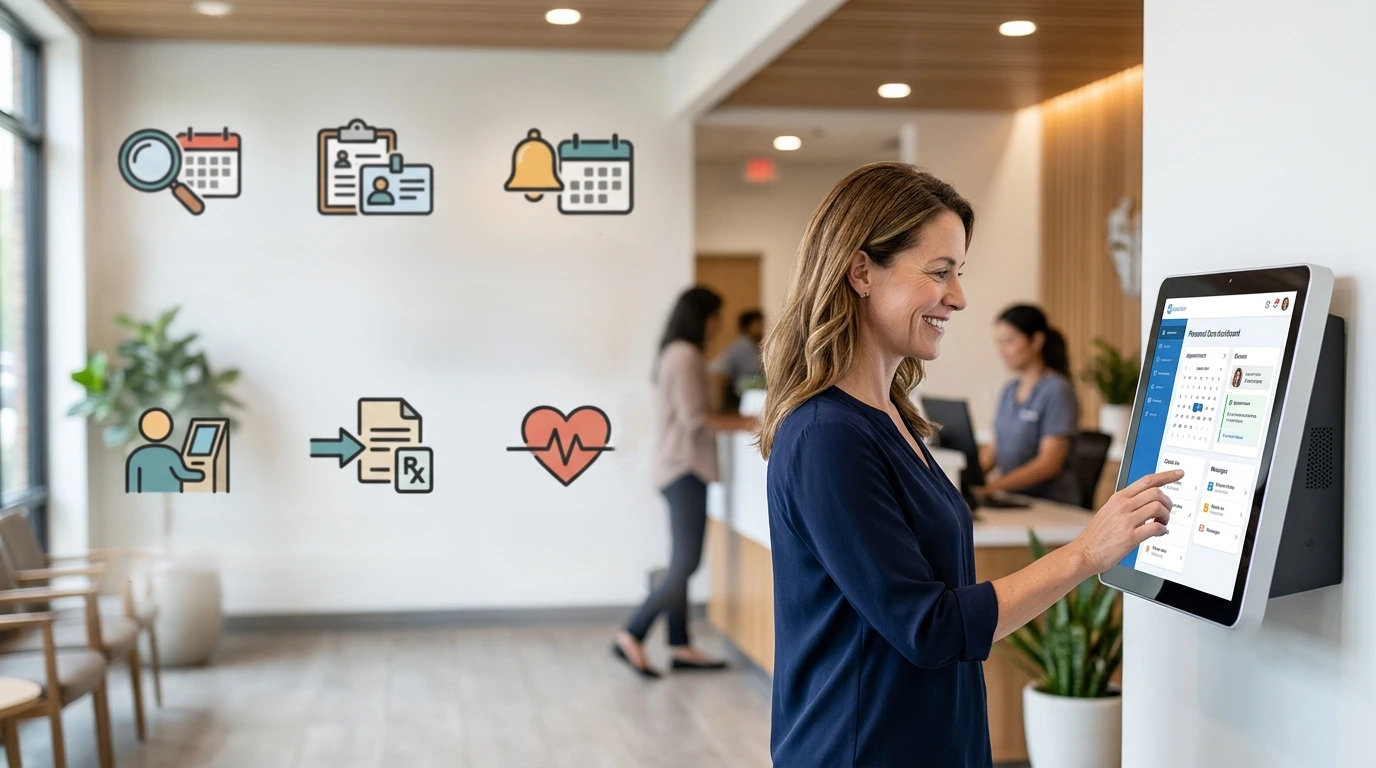
The platform connects patient interactions with clinical and operational workflows.
How patient engagement software supports the patient journey
A connected journey clarifies the next step for patients and staff.
- Patient discovery and appointment scheduling: Patients find the right service, location or clinician and book through available channels.
- Digital registration and patient onboarding: Forms, identity details, insurance information and consent are collected before arrival.
- Pre-visit communication and reminders: Relevant instructions and reminders help patients prepare and reduce avoidable missed visits.
- Patient check-in and consultation: Digital check-in updates arrival status and makes current information available to authorised staff.
- Post-visit follow-ups and care instructions: Patients receive understandable next steps, education, prescriptions and follow-up options.
- Long-term patient engagement and care management: Ongoing outreach, monitoring and care-plan reminders support needs between visits
How Does Patient Engagement Software Integrate with EHR and EMR Systems?
Integration is what turns a messaging tool into a genuine care tool.
The EHR or EMR remains the source of truth for appointments, conditions, medications and care plans. The engagement platform reads the data it needs to personalise communication, then writes patient-reported information, such as completed forms, consent, check-in status and secure messages, back into the clinical workflow. Without this two-way flow, staff re-key data and patients receive generic or outdated messages.
Experion has engineered interoperability layers that help healthcare organisations achieve FHIR compliance without modifying underlying legacy systems. In one programme, the team migrated a two-decade-old legacy EMR to a cloud-native, multi-tenant SaaS platform with 25+ plug-and-play modules and zero deployment overhead.
How Does Patient Engagement Software Exchange Patient Data?
Data exchange relies on shared standards, secure APIs and clear rules about which system owns which information.
- HL7 and FHIR interoperability: These standards let different systems understand the same clinical information. HL7 v2 messages still carry many hospital events, such as admissions and discharges, while FHIR provides modern, API-based access to resources like patients, appointments and medications. In the US, the CMS Interoperability and Prior Authorization final rule requires impacted payers to add prior authorisation information to their FHIR-based Patient Access API from January 1, 2027, broadening the data patients can see.
- APIs and third-party healthcare integrations: APIs connect the platform to scheduling, payments, telehealth, laboratories, pharmacies, devices and CRM tools. Well-documented, permissioned APIs keep each connection secure and maintainable as the ecosystem grows.
- Patient data synchronisation across systems: Synchronisation rules decide how quickly updates appear and how conflicts are resolved. A cancelled appointment in the EHR, for example, should stop its reminder before the patient sets off for the clinic.
How do Automated Workflows Improve Patient Communication?
Automation makes sure the right message goes out at the right moment, without relying on someone to remember to send it.
Workflows respond to events such as a booking, a discharge, a new result, an out-of-range device reading or an unanswered message. A discharge could trigger care instructions in the patient’s preferred language, a check-in two days later and an escalation to a nurse if the patient reports a warning sign. Staff time then goes to the exceptions that genuinely need a human.
Experion saw this in action when building a digital care platform for neurodegenerative patients. The solution replaced manual intervention in managing patients’ routine activities, let caregivers create customised routines from behavioural data and shared periodic evaluation data with every stakeholder.
What Problems Does Patient Engagement Software Solve?
Most engagement problems are coordination problems in disguise, and each one has a practical fix.
| Problem | What it looks like day to day | How patient engagement software helps |
| Missed appointments and high patient no-show rates | Empty slots, longer waiting lists and lost revenue | Automated, multi-step reminders with easy confirm, cancel and reschedule options |
| Inefficient patient communication across multiple channels | Calls, texts, emails and letters sent from different systems with different information | One orchestration layer that respects each patient’s preferred channel |
| Repetitive administrative work and manual data entry | Staff re-typing forms and chasing missing details | Digital intake that writes structured data back to clinical systems |
| Low patient adherence to treatment plans | Medicines stopped early, exercises skipped, check-ins forgotten | Timely nudges, clear education and simple ways to report problems |
| Fragmented patient data across healthcare systems | Clinicians missing context; patients repeating their history | Integration with EHR, EMR, billing and device data |
| Poor patient experience during registration and check-in | Queues, clipboards and repeated questions | Pre-visit registration and digital check-in |
| Limited patient access to health information | Patients unsure of results, instructions or costs | Secure access to records, care plans and cost estimates |
| Difficulty managing chronic conditions and long-term care | Problems noticed only at the next visit | Remote monitoring, care-plan reminders and escalation rules |
| Lack of visibility into patient engagement metrics | Leaders unable to see where patients drop off | Dashboards tracking completion, response and attendance |
| Challenges in maintaining patient relationships after discharge | Patients feeling forgotten once they leave the hospital | Structured post-discharge follow-up and easy routes back to the care team |
The evidence on reminders alone is encouraging. A systematic review and meta-analysis in BMJ Open, drawing on randomised studies covering more than 16,000 patients, concluded that electronic text notifications improve attendance and reduce no-shows across healthcare settings, and that sending multiple notifications could improve attendance further.
The administrative gains are just as tangible. Experion integrated 15+ medical device models across multiple categories for 5K+ patients, reducing data entry time by 95% and saving 15 hours a week. For a national aged care and NDIS provider, Experion’s connected healthcare data integration backbone reduced manual interventions by more than 40%.
What are the Core Features of Patient Engagement Software Platform?
The best patient engagement software is not the one with the longest feature list, but the one whose features work together around the patient.
- Patient portal and mobile application: A secure, familiar front door where patients see appointments, results, messages and care plans on the device they already use.
- Appointment scheduling and management: Self-service booking, rescheduling and waitlists that reflect real clinician availability and visit rules.
- Automated appointment reminders and notifications: Timed reminders across SMS, email, app and voice, with one-tap confirmation that frees slots for others when plans change.
- Digital patient registration and intake forms: Smart forms that pre-fill known details, adapt questions to the visit type and save time at the front desk.
- Secure patient messaging and communication: Encrypted, two-way conversations routed to the right team, with response expectations clearly set for patients.
- Telehealth and virtual consultation support: Video visits connected to scheduling, payments and records, so a virtual appointment feels as complete as an in-person one. Experion’s telehealth implementation for a health and wellness conglomerate brought together doctor and patient profiles, appointment scheduling and override, and online payment and refund portals.
- Patient education and personalised health content: Short, plain-language guidance matched to the patient’s condition, stage of care and reading level.
- Electronic consent and digital document management: Consent captured, versioned and stored with an audit trail, ready when clinicians or auditors need it.
- Patient billing, payments and cost estimates: Clear estimates, online payments and payment plans that reduce billing surprises and phone queries.
- Prescription and medication management: Refill requests, medication reminders and pharmacy coordination that support adherence between visits.
- Remote patient monitoring integration: Connected devices and patient-reported readings that flow into care workflows with escalation rules for out-of-range values.
- Patient feedback and satisfaction surveys: Short, well-timed surveys that turn patient experience into insight teams can act on.
- Care plan management and follow-up reminders: Shared care plans with tasks, milestones and reminders for both patients and care teams.
- Patient engagement analytics and reporting: Dashboards that show where patients complete tasks, where they drop off and which interventions work.
- Multilingual communication and accessibility support: Content and interfaces that work across languages, screen readers, larger text and low-bandwidth connections.
- AI-powered patient engagement capabilities: Conversational assistants, smart scheduling and predictive outreach that extend the team’s reach. Experion’s AI-infused face scan app, clinically validated in Switzerland and Brazil, captures 8 vital signs from a 35-second selfie video.
How Patient Engagement System Helps Healthcare Organizations?
The value of a patient engagement system shows up on both sides of the relationship: in how patients feel and in how teams work.
For patients, the difference is feeling guided rather than left to work things out alone. Clear next steps, fewer repeated questions and an easy route to the care team improve the experience, and that convenience is a big part of why patients stay with a provider. Shared care plans, secure messaging and synchronised records help specialists, primary care teams and caregivers act on the same current information, while mobile apps, remote monitoring and caregiver access carry support into the home, where most of a patient’s health journey actually happens. Personalised plans and timely reminders help patients follow treatment and let teams spot concerns early, which is exactly what value-based care rewards. Experion’s digital diabetes management ecosystem shows this at scale, supporting 12K+ patients with personalised healthcare plans through patient apps, care provider tools, a secure health vault and real-time notifications.
For the organisation, engagement turns into capacity and revenue. Self-service booking, automated reminders and waitlists keep schedules full, while digital intake and integrated data remove routine calls and re-keying, freeing staff for patients who need personal attention. Accurate registration, upfront cost estimates and digital payments reduce denials and the cost of chasing balances, and a smooth online experience makes it easier for new patients to choose you. Every interaction also generates insight: response rates, drop-off points and attendance trends show leaders where journeys break down and where to invest next. Experion saw this first-hand with a mobile solution for a globally reputed healthcare institution, where automating patient detail updates saved 30% of time and gave physicians more time with their patients.
Patient Engagement Software Use Cases Across Healthcare
Engagement looks different in a cancer centre than in a dental practice, and good healthcare patient engagement software adapts to each setting.
| Care setting | Engagement use case | What changes for patients and teams |
| Hospitals | Pre-admission preparation, discharge instructions and post-discharge check-ins | Fewer avoidable gaps after patients go home |
| Outpatient clinics | Online booking, digital intake and recall reminders | Shorter queues and fuller schedules |
| Dental practices | Hygiene recalls, treatment-plan explanations and payment options | More patients returning for routine and planned care |
| Chronic disease management | Device readings, care-plan reminders and coaching | Earlier action when readings drift |
| Mental and behavioural health | Digital screening, therapy exercises and outcome tracking | Continuous support between sessions |
| Home healthcare | Visit scheduling, video consultations and family updates | Better visibility for patients, families and field teams |
| Aged care and disability services | Care updates, family communication and service coordination | Families stay informed and staff spend less time on admin |
| Population health and payers | Health needs assessments, risk stratification and preventive outreach | Resources directed to the people at highest risk |
| Telehealth and digital health | End-to-end virtual journeys from triage to follow-up | Care that feels complete without a physical visit |
Experion has engineered many of these journeys. The team supported a Saudi Arabian home healthcare provider across skilled nursing, physiotherapy, paediatric, elderly, chronic disease and palliative care services, and built a web and mobile mental health assessment and engagement platform for an Australian healthcare technology organisation that scales to large patient populations with real-time analytics. In Brazil, Experion’s population health screening programme enabled automated risk stratification that identified 33 high-risk diabetes cases, 72 individuals with a BMI of 30 or above and 42 individuals with elevated cardiovascular risk. These outcomes are summarised on Experion’s healthcare and life sciences page.
What Level of Customisation Does Patient Engagement Software Need?
The right level of customisation depends on how standard your workflows, integrations and patient populations really are.
Many organisations start with a packaged product and discover the gaps only after go-live: a referral pathway it cannot model, an EHR it cannot write back to, or patients it cannot reach in their language. Deciding early where you need flexibility saves a costly second project later.
Off-the-Shelf vs. Custom Patient Engagement Software
Both routes can work well; the difference lies in how closely each fits the way you deliver care.
| Factor | Off-the-shelf software | Custom patient engagement software |
| Time to launch | Faster for standard use cases | Longer upfront, phased releases possible |
| Workflow fit | Your teams adapt to the product | The product adapts to your clinical pathways |
| Integrations | Limited to supported connectors | Built around your EHR, billing, devices and legacy systems |
| Patient experience | Generic branding and journeys | Designed for your patients, services and brand |
| Data ownership | Governed by vendor terms | Defined by your architecture and contracts |
| Cost profile | Lower entry cost, recurring licences | Higher build cost, greater long-term control |
| Differentiation | Similar to competitors using the same tool | A distinctive experience that can become a competitive asset |
Many organisations land on a hybrid: a proven core platform extended with custom journeys, integrations and interfaces where they matter most.
When Should an Organization Invest in Custom Patient Engagement Software?
Custom development earns its place when standard tools start shaping your care model instead of supporting it.
- Specialised workflows: Your pathways, such as oncology, maternity, behavioural health or home care, do not fit generic templates.
- Complex integrations: You run several EHRs, legacy systems or connected devices that off-the-shelf connectors cannot handle.
- Distinct patient populations: Your patients need specific languages, accessibility features or caregiver models.
- A digital product strategy: You are a digital health company or provider network building engagement as a core service.
- Multi-tenant or white-label needs: You must launch independently branded experiences for different clinics, franchises or partners.
- Regulatory or data residency constraints: Your markets require specific hosting, consent or data-handling arrangements.
Which Patient Engagement Features Should Be Customized?
Focus customisation where it changes outcomes, and keep standard components where they already work.
- Patient-facing interface and user experience: This is where trust is won or lost, so it should reflect your patients’ needs and your brand.
- Appointment scheduling and clinical workflows: Visit types, referral rules and clinician preferences rarely match generic templates.
- Patient communication preferences: Channels, timing, tone and languages should follow what each patient group responds to.
- Patient onboarding and registration: Forms and identity checks should reflect your services, payers and consent requirements.
- Reporting dashboards and analytics: Leaders need the measures that matter to their programmes, not just default reports.
- Integrations with existing healthcare systems: Two-way connections with your EHR, billing and device ecosystem are where custom engineering creates the most value.
How Can Custom Patient Engagement Software Support Different Patient Demographics?
Inclusive design ensures the patients who need the most support are not the ones left behind.
| Patient group | What they need | Design response |
| Older adults | Clarity, larger text and reassurance | Simple layouts, voice options and phone fallback |
| Caregivers and families | Permissioned access on a loved one’s behalf | Proxy access with clear role-based permissions |
| Multilingual communities | Information in their own language | Translated content reviewed for clinical accuracy |
| Patients with disabilities | Equal access to every task | Screen-reader support, captions and accessible forms |
| Rural and low-connectivity patients | Reliable access with limited bandwidth | SMS and lightweight, offline-tolerant experiences |
| People with chronic conditions | Ongoing, personalised support | Monitoring, care-plan tracking and tailored education |
Caregivers deserve particular attention. The ASTP/ONC 2024 data brief found that proxy or caregiver access to online records more than doubled between 2020 and 2024, from 24% to 51%. Experion’s patient management platform for a US digital health start-up shows this in practice: a secure, multilingual application with HIPAA-compliant data protection that helps hospitals support patients after discharge and gives patients a direct connection to specialists.
Experion designs patient engagement experiences around the people who will use them, from multilingual interfaces and caregiver access to device-connected monitoring, so adoption is built into the product from the start rather than added later.
How Scalable is Patient Engagement Software?
A platform that works for one clinic must keep working when it serves fifty, and that comes down to architecture decisions made early.
What Does Scalability Mean for Patient Engagement Systems?
Scalability is the ability to grow without the experience degrading for patients or staff. It covers more users and messages, but also more locations, specialties, languages, integrations and care programmes. A scalable patient engagement software platform handles a Monday-morning surge in bookings as smoothly as a quiet afternoon, and lets you add a new clinic or service without rebuilding the product.
What Should Organizations Consider When Scaling Patient Engagement Software?
Five areas decide whether growth feels effortless or painful.
- Infrastructure and cloud architecture: Cloud-native, multi-tenant designs let you add organisations, brands and regions without duplicating the whole stack.
- System performance and availability: Patients expect the app to work at 2 a.m., so plan for load spikes, redundancy and monitored uptime.
- Data security and access management: As users multiply, role-based access, strong authentication and audit trails must scale with them.
- Integration complexity: Every new site may bring a different EHR or device, so a reusable integration layer prevents each one becoming a custom project.
- Maintenance and ongoing support: Updates, security patches and new regulations never stop, so budget for continuous improvement rather than a one-time launch.
Experion builds white-labelled, multi-tenant mobile platforms with per-tenant branding, feature flags, configurable navigation and multi-language support, which allows healthcare businesses to launch independently branded apps from one scalable core.
How to Increase Patient Adoption and Improve Patient Engagement?
Adoption grows when the platform earns a place in patients’ routines, and clinicians play a bigger role in that than most launch plans assume.
- Let clinicians make the introduction: The ASTP/ONC 2024 data brief found that patients encouraged by their healthcare providers to use online records were more likely to do so.
- Start with tasks patients value: Booking, results and prescription refills give people a reason to return.
- Remove sign-up friction: Simple identity verification and single sign-on prevent patients giving up at the first screen.
- Meet patients on their channel: Some prefer an app, others a text or a phone call, so offer choices rather than forcing one route.
- Explain the value in plain language: Tell patients what they can do and how their information is protected.
- Listen and refine: Use feedback and drop-off data to simplify the journeys patients abandon.
Patient Engagement Software Integration and Interoperability
A patient engagement platform is only as useful as the information it can reach, which makes interoperability the foundation rather than an add-on.
Interoperability is what keeps every interaction accurate, safe and consistent. Without it, a reminder can point to an appointment that was already cancelled, a care plan can miss a new medication, and a symptom a patient reported in the app may never reach the nurse who needs to see it. With it, patients receive information that reflects their real situation, and clinicians see patient-reported data inside the tools they already use. The need is real: the ASTP/ONC 2024 data brief found that 59% of individuals had more than one online medical record or portal, a sign of how scattered the patient’s view of their own care can be.
The right connections depend on your care model, but most organisations begin with the EHR or EMR, the source of truth for appointments, conditions, medications and care plans. Practice management and scheduling systems add real-time availability, while billing and revenue cycle tools bring in estimates, statements and payments. From there, links to telehealth, remote monitoring devices, laboratories and pharmacies keep virtual visits, readings, results and refills inside one journey. CRM and contact centre tools complete the view of every patient interaction, payer systems supply eligibility and prior authorisation status, and identity and consent management keeps sign-in, caregiver access and permissions secure.
Legacy systems often hold the most valuable data in the least accessible form, which is why integration works best as a phased, practical effort. Where older platforms lack modern APIs, an integration layer can expose FHIR-based services without rewriting the core system. Clear validation rules normalise inconsistent data, event-based messaging replaces slow batch updates where timing matters, and patient matching prevents duplicate records from reaching patients. Middleware also reduces dependence on a legacy vendor’s roadmap. Experion applied this approach when it built a cloud iPaaS-driven integration ecosystem for a not-for-profit aged care provider, connecting clinical, workforce, finance and safety systems, cutting manual effort by more than 40% and improving compliance visibility across operations.
Patient Data Security, Privacy, and Compliance
Patients share their most personal information through these platforms, so trust has to be engineered into every layer. Protection comes from layered safeguards that cover the data, the people who access it and the partners who handle it.
| Safeguard | What it protects against |
| Encryption in transit and at rest | Interception or theft of stored and transmitted data |
| Strong authentication and identity verification | Account takeover and access by the wrong person |
| Role-based and proxy access controls | Staff or caregivers seeing more than they should |
| Audit logs and activity monitoring | Undetected misuse and gaps in accountability |
| Consent and preference management | Communication patients have not agreed to |
| Data minimisation in messages | Sensitive details exposed in texts or email previews |
| Secure hosting and data residency | Data stored outside approved locations |
| Vendor agreements, including business associate agreements | Unclear responsibility across third parties |
| Regular testing and incident response | Vulnerabilities left unaddressed and slow recovery |
Regulation continues to evolve, so platforms should be designed to adapt. In the US, HHS proposed the first major update to the HIPAA Security Rule in more than a decade, and its updated regulatory agenda now targets final action for July 2027; until then, the existing Security Rule remains fully in effect. Organisations serving other markets must also account for regional privacy laws, such as GDPR in Europe, and local health-record rules.
Experion engineers HIPAA-aligned healthcare platforms and brings cybersecurity expertise across cloud resilience, DevSecOps and Zero Trust design, so security is part of the architecture rather than a final checklist.
How to Choose the Right Patient Engagement Software?
The best patient engagement software for your organisation is the one that fits your patients, your workflows and your systems, not the one with the most impressive demo.
A practical test helps: choose one real journey, such as post-discharge follow-up, and ask each option to show it end to end, including what happens when a patient does not respond or a reading falls out of range. These questions separate platforms that look good from platforms that work well.
| Criterion | Question to ask |
| Patient usability | Can a first-time, older or non-native-language user complete key tasks unaided? |
| Clinical workflow fit | Does it match our visit types, referral rules and escalation paths? |
| EHR and EMR integration | Is data exchanged both ways, in near real time, using standards such as FHIR? |
| Security and compliance | How are encryption, access, audit logs and data residency handled? |
| Configurability | Can we change journeys, content and rules without a code release? |
| AI governance | How are AI outputs reviewed, explained and monitored? |
| Analytics | Can we measure completed care actions, not just logins? |
| Scalability | Will it support new sites, brands and programmes without a rebuild? |
| Total cost of ownership | What are the licence, integration, support and change costs over five years? |
| Partnership | Who supports us after launch, and how quickly do they respond? |
Use this list as a baseline for any shortlist or build specification.
- Two-way EHR or EMR integration: Essential for accurate, context-aware communication.
- Multichannel communication: SMS, email, app, voice and portal from one orchestration layer.
- Secure messaging and identity management: Including proxy and caregiver access.
- Configurable journeys and automation: Rules that teams can adjust as care models change.
- Accessibility and multilingual support: Built in from the first release.
- Consent and preference management: Patients control how and when they are contacted.
- Analytics and reporting: Measures tied to attendance, adherence and satisfaction.
- Scalable, secure cloud architecture: Ready for growth, audits and regulatory change.
- Responsible AI controls: Human review, transparency and monitoring wherever AI is used.
Patient Engagement Software Implementation: A Step-by-Step Guide
Successful implementation is less about switching software on and more about changing how patients and teams work together, one step at a time.
Step 1: Identify Patient Engagement Challenges and Business Goals
Start with the problem and not the product. Agree on the two or three outcomes that matter most, such as fewer no-shows, faster intake or better post-discharge follow-up, and record a baseline so progress can be measured honestly.
Step 2: Map Existing Patient Journeys and Workflows
See the journey through the patient’s eyes before redesigning it. Walk through each step, every handoff and each point where patients wait, repeat themselves or drop off. Involve front-desk staff, nurses and patients; they know where the friction really is.
Step 3: Define Functional and Technical Requirements
Translate the journey into what the platform must do and how it must connect. Cover features, integrations, security, accessibility, languages and reporting. Separate must-haves from nice-to-haves so the first release stays focused.
Step 4: Select the Right Patient Engagement Software Vendor
Choose a partner by how they handle your real scenarios, not by their slide deck. Ask for a walkthrough of one of your journeys, including exceptions, and check references from organisations with similar complexity. Decide early whether you need a product, a custom build or a hybrid.
Step 5: Plan EHR, EMR, and Third-Party Integrations
Integration planning prevents most late-stage surprises. Confirm data sources, standards, ownership rules, refresh frequency and error handling for each connection. Prioritise the integrations that unlock the first release.
Step 6: Design and Customize the Patient Engagement Platform
Design with patients, not just for them. Prototype key screens and messages, test them with real users, including older adults and caregivers, and refine wording until the next step is obvious.
Step 7: Test Security, Performance, and Usability
Testing builds the confidence that patients and clinicians need before launch. Run security and penetration testing, load tests for peak demand, accessibility checks and clinical validation of automated rules and content.
Step 8: Train Healthcare Staff and Onboard Patients
Staff confidence is the strongest driver of patient adoption. Show teams how the platform saves them time, prepare simple scripts for introducing it to patients and provide easy help options for the first weeks.
Step 9: Launch the Platform and Monitor Adoption
A phased launch lets you learn before you scale. Start with one service or site, watch enrolment, completion and support requests closely, and fix issues quickly while the group is still small.
Step 10: Optimize Workflows Based on Patient Feedback and Analytics
The launch is the beginning of improvement, not the end of the project. Review analytics and feedback regularly, retire messages patients ignore, simplify steps they abandon and extend what works to new services.
How is AI Changing Patient Engagement Software?
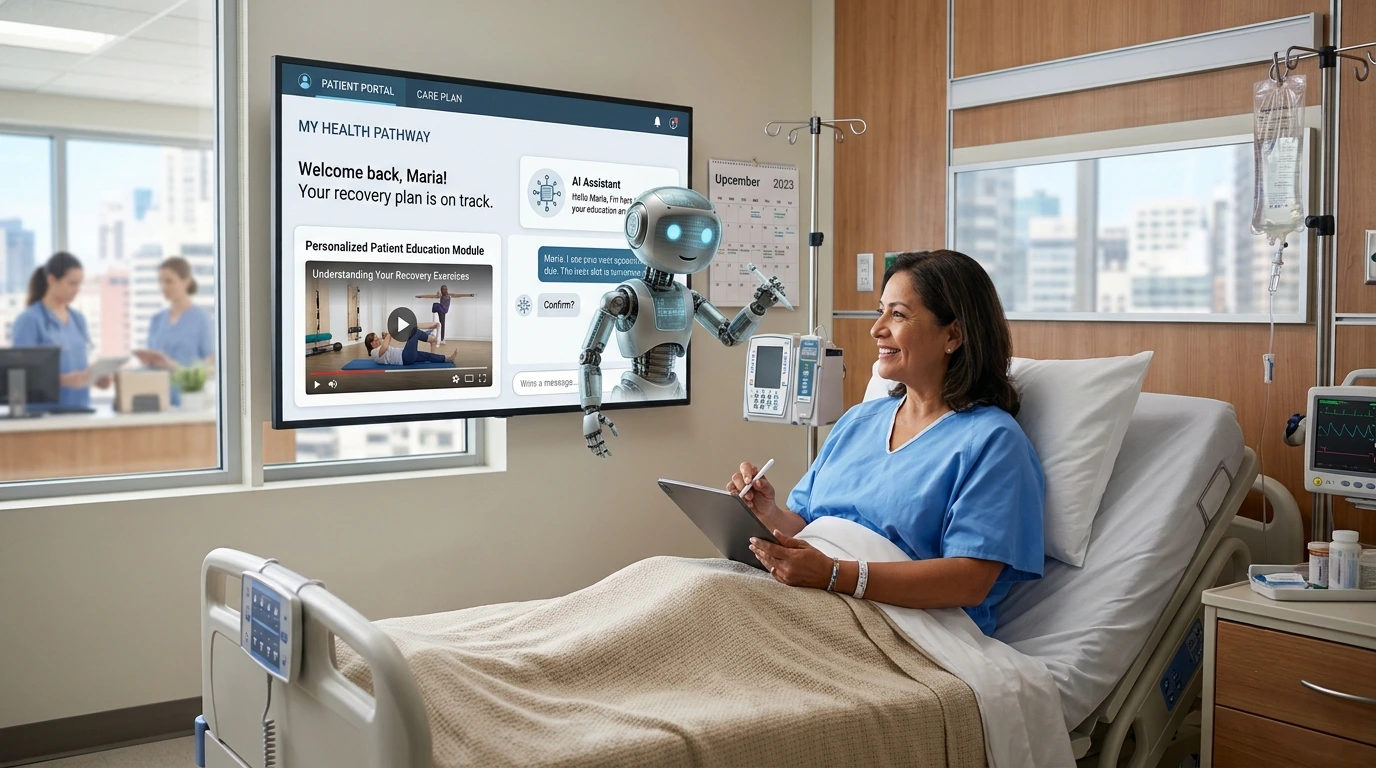
AI is moving patient engagement from scheduled broadcasts to timely, personalised conversations, while raising the bar for transparency and oversight.
An AI patient engagement platform can answer routine questions at any hour, draft messages for staff review, tailor education to a patient’s situation and flag who may need help before they ask. Regulators are watching closely. California’s AB 3030, for example, requires covered providers to disclose when generative AI produces patient communications about clinical information and to explain how patients can reach a human, unless a licensed provider has reviewed the message first.
How Does AI Work in Patient Engagement Software?
AI works best as a set of focused assistants embedded in existing journeys, each with a clear role and a human behind it.
- AI-powered patient communication: Language models help draft clear, personalised messages and replies, with clinical content reviewed by qualified staff before it reaches patients.
- Intelligent appointment scheduling and reminders: AI matches patients to suitable slots and adjusts reminder timing and channel based on response patterns.
- Personalised patient education: Content adapts to the patient’s condition, language, reading level and stage of care.
- AI chatbots and virtual assistants: Conversational assistants handle common questions, bookings and form completion, and hand over to a person when a request is clinical, urgent or unclear.
- Predictive patient outreach and risk identification: Models highlight patients likely to miss appointments or deteriorate, so teams can reach out earlier. A rapid systematic review in JAMIA found high-certainty evidence, from one randomised trial, that predictive model-based text reminders reduced no-shows.
Well-designed AI patient engagement software keeps an audit trail of what the AI suggested, what a person approved and what the patient received. Experion builds patient and staff assistants, predictive analytics and GenAI and retrieval-augmented systems with these governance controls in mind, so AI extends the care team’s reach without replacing its judgement.
Patient Engagement Software Trends and Recent Developments
The next phase of patient engagement is shaped by smarter assistance, richer data and rising expectations for experiences that feel as simple as everyday consumer apps.
- AI-powered healthcare assistants and patient communication: Conversational assistants are taking on routine questions, scheduling and form completion, with clear routes to a human for anything clinical.
- Personalised patient engagement using health data: Platforms increasingly tailor timing, content and channel to each patient’s condition, history and preferences, rather than sending the same message to everyone.
- AI-driven patient triage and care navigation: Guided symptom checks and navigation tools help patients reach the right level of care, with clinical rules and oversight defining the boundaries.
- Balancing AI automation with clinical oversight: Transparency laws such as California’s AB 3030 are making human review, disclosure and audit trails standard design requirements rather than optional extras.
- Wearables and remote monitoring integration: Device and smartphone-based monitoring is bringing continuous data into care plans. Experion’s contactless monitoring work uses smartphone cameras to track vital signs and screen for chronic disease risk.
- Consumer-style, omnichannel experiences: Patients expect to move between app, text, web and phone without starting over, and payers face growing expectations too: from January 1, 2027, impacted US payers must share prior authorisation information through their FHIR-based Patient Access API.
Why do Healthcare Organizations Need a Patient Engagement Software Development Partner?
Building patient engagement well takes clinical understanding, integration depth and product thinking at the same time, a combination few internal teams have in place all at once.
A development partner brings healthcare domain knowledge, experience with standards such as HL7 and FHIR, security engineering and user experience design under one roof. Just as importantly, a good partner stays after launch, improving journeys as patient needs, regulations and technology change.
When is a Technology Partner Better Than an Off-the-Shelf Vendor?
A partner makes the most sense when your needs go beyond what a packaged product was designed to handle.
| Situation | Off-the-shelf vendor | Technology partner |
| Standard clinic workflows and a single EHR | Often a good fit | May not be needed |
| Multiple EHRs or legacy systems | Limited by available connectors | Builds the integration layer you need |
| Specialised care models | Teams work around the product | Product is shaped around the care model |
| Building your own digital health product | Product belongs to the vendor | You own the product and its roadmap |
| Multi-brand or multi-tenant services | Often constrained | Designed in from the start |
| Modernising alongside engagement | Out of scope | Engagement and modernisation planned together |
How Can Experion Support You in Building Custom Patient Engagement Platform?
Experion brings healthcare practitioners, product engineers and domain specialists together to build patient engagement platforms that fit the way you deliver care.
Whether you are a hospital network connecting fragmented systems, a digital health company launching a new product or a care provider extending support into patients’ homes, the starting point is the same: understanding your patients and the journeys that matter most. From there, Experion designs, engineers and scales the platform around them.
| Capability | How it helps your patient engagement programme |
| Strategy and experience design | Maps patient journeys and designs interfaces for real users, including older adults and caregivers |
| Custom platform engineering | Builds web and mobile apps, portals and multi-tenant, white-label platforms |
| Interoperability and integration | Connects EHR, EMR, devices and legacy systems, including FHIR compliance without modifying legacy cores |
| Virtual care and remote monitoring | Delivers telehealth, RPM and contactless health monitoring solutions |
| AI and analytics | Embeds assistants, predictive analytics and GenAI with governance built in |
| Security and compliance | Engineers HIPAA-aligned platforms with secure cloud and DevSecOps practices |
| Operations and support | Keeps platforms improving long after launch |
The results speak through Experion’s healthcare work: a diabetes management ecosystem supporting 12K+ patients with personalised plans, device integrations that cut data entry time by 95%, and an integration backbone for a national aged care and NDIS provider that reduced manual interventions by more than 40%.
Ready to build patient engagement that patients actually use? Talk to Experion’s healthcare team
Experion partners with healthcare organisations from the first conversation to years in production, engineering custom patient engagement platforms that connect patients, care teams and systems, so every interaction moves care forward.
Frequently Asked Questions (FAQs)
What is patient engagement software used for?
It helps healthcare organisations communicate with patients, give them access to services and information, and support their participation in care. Common uses include scheduling, reminders, digital intake, secure messaging, education, payments and remote monitoring.
What is the difference between patient engagement software and patient management software?
Patient engagement software focuses on the patient-facing journey: communication, access, education and follow-up. Patient management software supports internal operations such as registration, scheduling, records and billing. The two work best when they are integrated.
What are the key measures of patient engagement?
Useful measures include appointment attendance, form and task completion, message response rates, portal or app activity, adherence to care plans and patient satisfaction. The most meaningful measures track completed care actions rather than logins alone.
How does patient engagement software improve patient outcomes?
It helps patients understand and follow their care between visits through reminders, education, monitoring and easy access to their care team. Teams can also spot concerns earlier and intervene before problems escalate.
Can patient engagement software integrate with existing systems?
Yes. Modern platforms connect with EHR and EMR, scheduling, billing, telehealth and device systems using standards such as HL7 and FHIR and secure APIs. Legacy systems may need an integration layer, which experienced engineering teams can build without replacing the core system.
Is patient engagement software suitable for small clinics?
Yes. Smaller clinics, including dental practices, often start with focused capabilities such as online booking, reminders and digital intake, then add features as they grow. Cloud-based platforms keep the entry cost and maintenance effort manageable.
Can patient engagement software be customized for different healthcare organizations?
Yes. Journeys, interfaces, languages, integrations and reporting can be tailored to each organisation's services and patients. Custom patient engagement software or a hybrid approach suits organisations with specialised workflows, multiple systems or distinct patient groups.
How much does patient engagement software cost?
Cost depends on scope, the number of users and locations, integrations, customisation and the support model. Compare the total cost of ownership over several years, including licences, integration, maintenance and change requests, rather than the entry price alone.
How long does patient engagement software implementation take?
Timelines depend on integration complexity, data readiness, customisation and internal approvals. A phased approach, starting with one high-value journey, delivers early results while the wider rollout continues.