






 Back
Back
At Experion, we help healthcare organizations to design and build EHR integration solutions that connect clinical systems and improve patient outcomes.
Around 96% of US hospitals have adopted EHR systems; however, integration remains one of their biggest problems.
A hospital can deploy the most sophisticated health software in the world, but if it cannot communicate with a patient’s medical history, then it is working in a silo. A telehealth platform that does not sync with a patient’s medical records leads to a blind spot. This in turn causes a multitude of errors. It is exactly for this reason that EHR integration is important. EHR integration is the process of linking electronic health record systems with the broader digital healthcare ecosystem.
Key Takeaways
- EHR integration connects the EHR to labs, pharmacies, billing platforms, devices, and payer systems, enabling patient data to flow automatically rather than manually.
- The right architecture depends on how many legacy systems you’re working around, how much your team can maintain, and how fast you need to move.
- HL7, FHIR, and DICOM are the standards that enable cross-vendor data exchange. FHIR R4 is now the baseline for anything new.
- Three things consistently derail projects: legacy system incompatibility, inconsistent data coding, and security gaps during data transit.
- AI-assisted data normalization, FHIR-first platforms, and cloud-native infrastructure are changing what’s possible in healthcare interoperability.
What is EHR Integration?

Understanding EHR Systems
An EHR is a digital patient record maintained by a provider. The idea is that it travels with the patient across care settings rather than staying locked in a single facility’s system. Platforms like Epic, Cerner, Allscripts, and Athenahealth have built on this basic idea to become the operational backbone of most hospitals, handling clinical documentation, medication orders, lab results, care plans, and patient communication in one place.
The limitation is that ‘one place’ isn’t actually a single place. An EHR doesn’t natively talk to your radiology system, your payer, the ICU monitor, or the pharmacy across town. Each of those connections must be deliberately built. That’s what EHR software integrations are.
What is Electronic Health Record Integration?
EHR integration connects the EHR to external systems so patient data flows between them reliably, without anyone manually moving it. Labs, billing platforms, pharmacies, devices, and insurance payers. Each becomes part of a shared data environment rather than its own isolated database.
The practical effect is that staff stop re-entering data that already exists somewhere. Results stop being manually transcribed. Clinicians stop logging into four systems to build a complete patient picture. Demographics stop drifting out of sync between registration and the clinical record. Every one of those friction points is a place where errors happen. Integration removes the friction point rather than asking people to manage around it.
Why EHR Integration Matters in Modern Healthcare?
Improved Patient Care and Outcomes
When an ED physician can pull a patient’s complete medication list, allergy record, and recent labs without leaving the EHR, decision-making is faster and carries less risk. Medication errors, one of the most preventable sources of patient harm, are more common when a prescriber doesn’t have visibility into what another provider has already ordered. This indicates a data access problem. For patients managing chronic conditions across multiple providers, connected records are more than convenient. Hence, the following occurs:
- Redundant testing goes down.
- Missed drug interactions surface before they’re dispensed.
- Care handoffs between primary care, specialists, and post-acute facilities include actual context rather than just a discharge summary.
Enhanced Operational Efficiency
Manual data entry is expensive in two ways:
- Firstly, the number of hours worked.
- Secondly, man-made errors that might occur
Every re-keyed demographic is a potential mismatch. Every manually transcribed result is a chance for a transposition error. When those errors reach the billing layer, they become rejected claims. On reaching the clinical layer, they become a clinical risk.
EHR integrations cut those steps out. Lab results are automatically added to the chart. Insurance eligibility runs before the appointment. Prescriptions route to the pharmacy without a phone call. For most teams, cleaner billing data alone justifies the integration investment, even before the clinical benefits are factored in.
Regulatory Compliance and Data Accuracy
HIPAA applies to data moving between systems, not just data sitting in storage. An integration layer without proper encryption in transit, role-based access controls, and audit logging is a compliance gap, not just a technical one.
Well-designed integrations build these in from the beginning. The audit trail that HIPAA auditors want to see is the same audit trail that helps you trace a problem when something goes wrong in production.
Your EHR shouldn’t be working in silos. Let’s connect it.
Common Types of EHR Integrations
The value of EHR integration is in connecting the EHR to the specific systems your workflows depend on. Some of these are nearly universal. Others depend entirely on your care setting.
Laboratory Information Systems (LIS)
Lab integration is the most common EHR integration for a reason. Orders go from the EHR to the lab without manual routing. Results come back the same way. No faxing, no manual entry, no one waiting for a result that arrived an hour ago but hasn’t been entered yet. In inpatient settings, the speed difference has a direct clinical impact, not just an operational one.
Hospital and Multi-Specialty Clinics
This is where integration architecture gets genuinely complicated. Operating theater scheduling, ICU monitoring, multi-specialty lab networks, anesthesiology records, and post-op notes all feed the same patient record, often in real time, from systems that were never designed to talk to each other.
For example – a surgeon scheduling an elective procedure shouldn’t have to manually communicate the patient’s medication list to the anesthesiology team. That information already exists in the EHR. The integration is what makes it show up automatically.
Getting this working reliably across a large hospital environment is one of the harder EHR integration problems, and it’s where an EHR integration platform with genuine healthcare experience earns its cost.
Radiology Information Systems (RIS)
Radiology integration routes imaging orders from the EHR to the RIS and brings DICOM images and radiologist reports back to the clinical record. The practical result is that physicians no longer need a separate PACS login to review imaging. Everything is in one place. It sounds minor until you’ve worked in a hospital where it isn’t.
Practice Management Systems
Practice management integration keeps scheduling, registration, and clinical data in sync. Without it, staff re-enters patient demographics that already exist in another system. With it, the data stays consistent across both.
Billing and Revenue Cycle Management Platforms
Billing integration extends this further: diagnosis codes, procedure codes, and patient information flow directly into claims preparation from the clinical record rather than being re-entered by a billing team member.
Telehealth Solutions and Remote
Virtual visits generate clinical data that needs to land in the same record as in-person encounters. If telehealth runs outside the EHR without integration, the patient record has gaps whenever care moves off-site.
Pharmacy and Medication Management Systems
Pharmacy integration routes prescriptions from the EHR, runs real-time formulary checks, and flags interactions before they reach the patient. In inpatient settings, this is a patient safety issue, not just a workflow one.
Medical Devices and IoT Healthcare Equipment
IoT device integration is growing fast. Infusion pumps, cardiac monitors, glucose monitors, and continuous vital sign trackers generate data constantly. Without integration, that data gets manually charted or lost. With it, device readings write directly into the EHR and can trigger early warning alerts when readings drift outside normal ranges.
Health Insurance and Payer Systems
Payer Integration streamlines communication between healthcare providers and insurance organizations. Eligibility verification, benefits checks, prior authorization requests, claims submission, and claims status updates can all occur electronically through integrated workflows.
This reduces administrative delays, minimizes claim denials, and improves the overall patient financial experience by providing faster access to coverage information.
How Does EHR Integration Work?
Data Exchange Standards
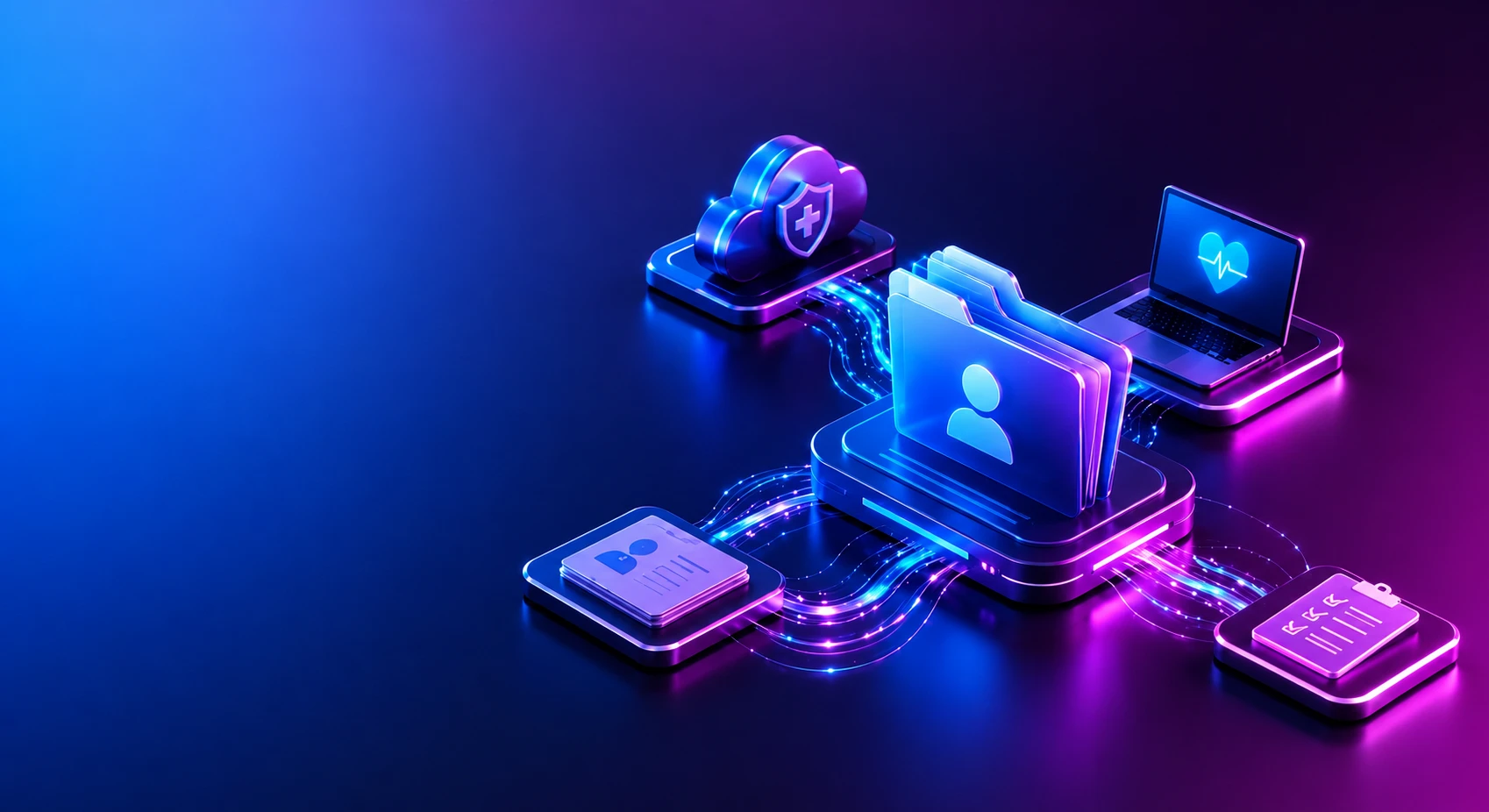
EHR integrations depend on shared standards so systems from different vendors can exchange data without a custom translation layer built for every pair. The four you’ll encounter most:
- HL7 v2: The legacy standard, still running in most hospitals for lab results, ADT events, and discharge messages. It works, but it wasn’t built for API-first architectures and requires parsing that modern developers find messy.
- FHIR R4: The current standard. REST-based, JSON-friendly, and developer-accessible in a way HL7 v2 never was. The latest EHR integration software is now built on FHIR R4, and the regulatory environment is pushing the rest of the market in that direction.
- CDA: For structured clinical documents: discharge summaries, referral notes, and care plans. Less of a real-time standard, more of a document exchange format.
- DICOM: The imaging standard. Governs how radiology images are stored, formatted, and transmitted between systems.
These standards are what allow a lab system on one vendor’s infrastructure to send results that an EHR from a completely different vendor can read and store in the right place.
EHR Integration APIs and Interoperability
The EHR integration API layer is what makes large-scale interoperability workable rather than just theoretically possible. FHIR-based APIs create reusable data channels across vendors, eliminating the need for a custom connector for every system pair.
Epic’s SMART on FHIR, Cerner’s FHIR API, and athenahealth’s developer platform have opened up enough that external teams can build integrations without needing deep access to proprietary backends. That shift has meaningfully changed the pace and cost of healthcare software development over the last several years.
Integration Architectures
Four models in common use, each with genuine tradeoffs:
- Point-to-point: Direct connection between two systems. Fast to set up and breaks down quickly when adding each new system. Each new connection is a new custom build.
- Middleware-based: A central engine, such as Mirth Connect or Rhapsody, routes data between systems. More manageable as the connection count grows, but the engine itself requires ongoing attention.
- Cloud-native: Microservices, API gateways, and managed services enable more elastic data flows. Better for environments that are growing or changing frequently.
- iPaaS: Platforms like MuleSoft or Azure Integration Services handle the infrastructure. Useful when you’d rather configure a service than manage servers.
The right model depends on how many systems you’re connecting, what your team has capacity to maintain, and how much you expect the environment to change over the next few years.
Experion’s engineering teams build integration layers across HL7, FHIR R4, and DICOM standards – so healthcare platforms can communicate regardless of what’s under the hood on either side.
Best Practices for Successful EHR Integration
Define Integration Objectives
It is imperative to get the objectives on paper. Which systems need to communicate? What data flows in which direction? What are the latency tolerances? These questions sound basic, but projects that skip them tend to end up with the wrong architecture and scope that expands mid-build.
A few hours of documentation upfront saves weeks later.
Choose Standardized Data Formats
Proprietary data formats are a debt that compounds. FHIR R4 for modern interfaces and HL7 v2 where legacy systems require it. Every custom deviation is something your team will have to maintain or migrate away from later, usually at an inconvenient time.
Prioritize Security and Compliance
Encryption, Role-Based Access Controls (RBAC), audit logging, and data residency policies are not things you add to an EHR integration after it’s built. PHI in motion is a HIPAA exposure if the integration layer isn’t designed properly. Getting the architecture right the first time is significantly less painful than retrofitting it after a compliance review.
Conduct Thorough Testing
An integration can pass all its technical tests and still fail in clinical use. A result that arrives in the wrong field, a medication that doesn’t surface during an allergy check, or a message that gets dropped under load at 3 AM. Testing needs to include end-to-end workflow scenarios with real clinical users, not just QA engineers running scripts against a staging environment.
Ensure Stakeholder Collaboration
Clinicians who weren’t consulted during the build end up using workarounds during rollout. Getting clinical staff, IT, compliance, and vendors into the design conversation early means fewer surprises at go-live and better requirements to begin with. Clinical staff know about edge cases that never make it into a functional specification.
EHR Integration Platform vs Custom Integration Solutions
Benefits of an EHR Integration Platform
EHR integration platforms connect medical software with EHR systems. Pre-built platforms such as Health Gorilla, Redox, and Rhapsody come with existing connectors, standardized workflows, and managed infrastructure. For organizations that need to move quickly and work with common EHR use cases, a platform reduces deployment time and the maintenance burden.
When to Consider Custom EHR Integration Software Solutions
Custom builds are worth the added cost when the environment is genuinely heterogeneous: proprietary legacy systems, unusual data models, and workflows that a platform wasn’t designed for. You get control over transformation logic, security architecture, and performance tuning. You also avoid the lock-in that comes when a third-party platform controls a layer you depend on operationally.
The choice isn’t always obvious. The organizations that get it right tend to be honest about their environment upfront rather than assuming a platform will stretch to cover it.
Choosing the Best EHR Software Integrations
When evaluating options, here is the criteria that matters:
Essential Evaluation Criteria
- Compatibility with existing systems: Verify whether it works with your existing healthcare systems. These include EHR systems, LIS (Laboratory Information Systems), RCM (Revenue Cycle Management) platforms, billing software, and Telehealth applications. If the integration requires replacing major systems, it could significantly increase costs.
- API availability: Enabling software applications to exchange data, API availability is a major criterion. A strong integration should provide well-documented APIs, developer access, and clear usage guidelines. Poorly documented APIs make integrations difficult to maintain.
- Security standards: Healthcare organizations handle a huge amount of sensitive patient information. It is of utmost priority to protect data from unauthorized access. Look for encryption for data at rest and in transit, RBAC, data residency, and compliance policies.
- Vendor support: No matter how reliable the integration is, it may experience failure. While evaluating vendors, ask about the following aspects: SLA, support availability, etc.
- Audit Logging: Audit logs refer to the data exchanges that are recorded. Audit logs help organizations track who accessed data, investigate security incidents, and demonstrate regulatory compliance.
- FHIR R4 compliance: FHIR (Fast Healthcare Interoperability Resources) is the modern standard for healthcare data exchange. FHIR R4 supports interoperability across numerous healthcare applications. Benefits include future-ready architecture and industry-wide adoption.
- Bidirectional Data Flow: Bidirectional integration enables applications to read patient data from the EHR and write it back. Without such a flow, staff may need to enter information manually multiple times.
- Developer-Friendly Tools: The quality of developer resources affects implementation speed. One needs to check Sandbox environments for testing, SDKs (Software Development Kits), Detailed API documentation, etc.
Not sure if your current EHR integration checks all the boxes?
Connect with an expert today
Questions to Ask Vendors
Before signing on a vendor, clarify these three aspects:
- Which EHR systems do you currently integrate with, and how do those connections work architecturally?
- What compliance certifications do you hold: HIPAA, SOC 2, ISO 27001?
- What does a realistic implementation timeline look like, and where do projects typically get stuck?
Challenges in EHR Integration – And How to Overcome Them
EHR integration is not a plug-and-play process. The same problems show up across almost every project.
- Legacy system incompatibility: This is the most common challenge. A lot of healthcare organizations run EHR or ancillary systems that predate FHIR and don’t support modern APIs. Solving this usually means middleware adapters, custom transformation layers, or a phased migration plan that doesn’t require replacing all components at once.
- Data standardization issues: Diagnoses might be coded in ICD-10 codes for billing and reporting. At the same time, clinical systems utilize SNOMED CT for detailed patient documentation. Laboratory values use LOINC standards. These coding systems don’t map perfectly to each other, and the differences matter clinically. Integration pipelines need normalization logic that handles these mappings reliably, not just during testing, but consistently in production.
- Security and HIPAA compliance risks during data transit: Poorly designed integrations pose a real liability. PHI in motion requires encryption (TLS in transit, AES-256 at rest), token-based authentication, and strict access controls.
- Vendor lock-in with proprietary EHR platforms: Vendor lock-in is a long-term risk that’s easy to overlook early on. Some EHR vendors deliberately limit API access and use proprietary formats to make switching harder. Building on open standards – FHIR especially – and keeping integration logic outside vendor-controlled layers reduces that exposure.
The organizations that navigate these challenges best are the ones with integration partners who have worked through them before – with both the technical range to handle legacy environments and enough healthcare domain knowledge to understand why the edge cases matter.
Looking for an EHR integration specialist?
EHR Integration Services: What to Expect
Assessment and Planning
A solid integration engagement starts with an honest picture of the current state: what systems exist, how they communicate today (if at all), what data flows are actually needed, and which standards are in use. The output is a concrete architecture and roadmap.
Development and Implementation
This is the actual build: connectors, transformation logic, API endpoints, and security controls. Complex implementations involve middleware for legacy systems and FHIR-compliant API layers for modern ones. The more heterogeneous the environment, the more this phase benefits from engineers who have dealt with these specific combinations before.
Testing and Validation
Nothing goes live without real-world scenario testing. Testing and validation include data accuracy tests, load tests, security-layer penetration testing, and end-to-end workflow validation with actual clinical users, not just QA engineers running scripts.
Ongoing Support and Optimization
Integrations need monitoring, incident response, and regular tuning. Since EHR environments change, vendors update APIs, New systems get added, and standards evolve. Ongoing support ensures that integrations remain reliable and adapt to the organization’s changing needs.
Future Trends in EHR Integration
AI-Powered Healthcare Interoperability
AI is being applied to the complex parts of integration:
- Automatically normalizing inconsistent data
- Flagging quality issues before they propagate downstream
- Surfacing patterns from connected data streams that static pipelines would miss.
Several EHR and integration platform vendors are building these capabilities into their core products rather than treating them as add-ons.
FHIR-First Ecosystems
The 21st Century Cures Act required EHR vendors to provide FHIR-based patient data APIs, and adoption has accelerated since then. FHIR R4 is now the default for most new EHR software integrations.
Hence, healthcare organizations still relying on older standards will face growing friction – vendor support is increasingly focused on FHIR, and HL7 v2-only environments are increasingly the odd one out.
Cloud-Based Healthcare Platforms
Forget buying servers. AWS HealthLake, Azure Health Data Services, and Google Cloud Healthcare API now provide managed FHIR servers with built-in security and scalable processing. For new integration projects, these platforms substantially reduce infrastructure overhead. The complexity doesn’t disappear. It shifts from servers you maintain to services you configure.
Predictive Analytics and Population Health Management
Connected EHR data enables population-level analysis that siloed systems cannot. Health systems are using integrated data to identify high-risk patients before they deteriorate, model readmission risk, and design more targeted interventions. But this requires more than integration; it requires a data architecture built for analytics: Fast ingestion, consistent schemas, and queryable at scale.
Organizations that invest in integration with analytics in mind will be significantly better positioned here than those that treat them as separate problems.
Conclusion
EHR integration is no longer optional. EHR integration is what turns a collection of clinical systems into a functioning healthcare organization. Without it, data gets manually re-entered, results get missed, and care coordination breaks down every time a patient crosses a system boundary.
The technical work is real: standards, architecture choices, legacy compatibility, and security design. None of it is insurmountable, but it does require experience with the specific failure modes that show up in healthcare environments. The organizations that get this right tend to have one thing in common: they treat integration as a strategic investment rather than a one-time IT project.
Whether you’re building a new healthcare platform or modernizing an existing one, Experion brings technical depth and hands-on delivery experience to get EHR integration done right – on time, on budget, and built to handle what comes next. Talk to our healthcare integration team.