






 Back
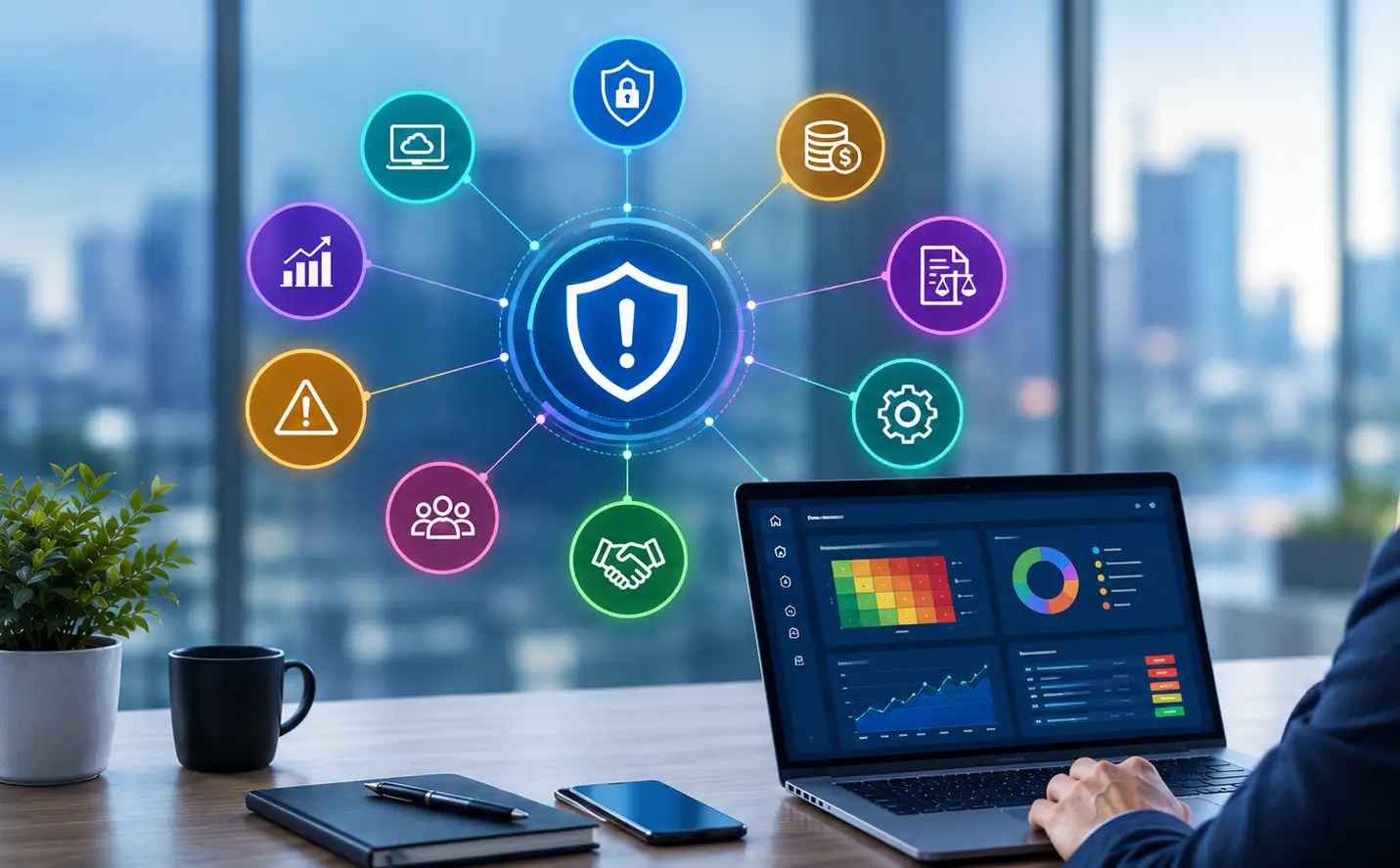
At Experion, we work across product engineering, data, AI, cybersecurity, compliance, integration, and quality engineering, with experience in areas such as governance controls, regulatory mapping, monitoring, auditability, and secure platform development.
Risk rarely arrives in neat categories anymore. A supplier failure may become an operational problem, then a customer-service problem, then a financial one. A cybersecurity incident can quickly turn into a compliance issue. A new AI initiative may introduce concerns around data privacy, model oversight, security, and accountability at the same time.
When each team tracks those risks separately, the organization sees fragments rather than the full picture. integrated risk management software is designed to bring those fragments together.
Key Takeaways
- Integrated risk management connects operational, financial, cyber, compliance, third-party, and continuity risks.
- IRM software replaces scattered spreadsheets and point tools with a shared view of risk.
- The real value is not simply documenting risks, but understanding how they relate to business decisions.
- Workflow, integration, reporting, security, and configurability matter as much as the risk register itself.
- AI can help identify patterns and exceptions, but risk ownership still sits with people.
- Custom development becomes relevant when risk models, workflows, or integrations are unusually specific.
What is Integrated Risk Management (IRM)?
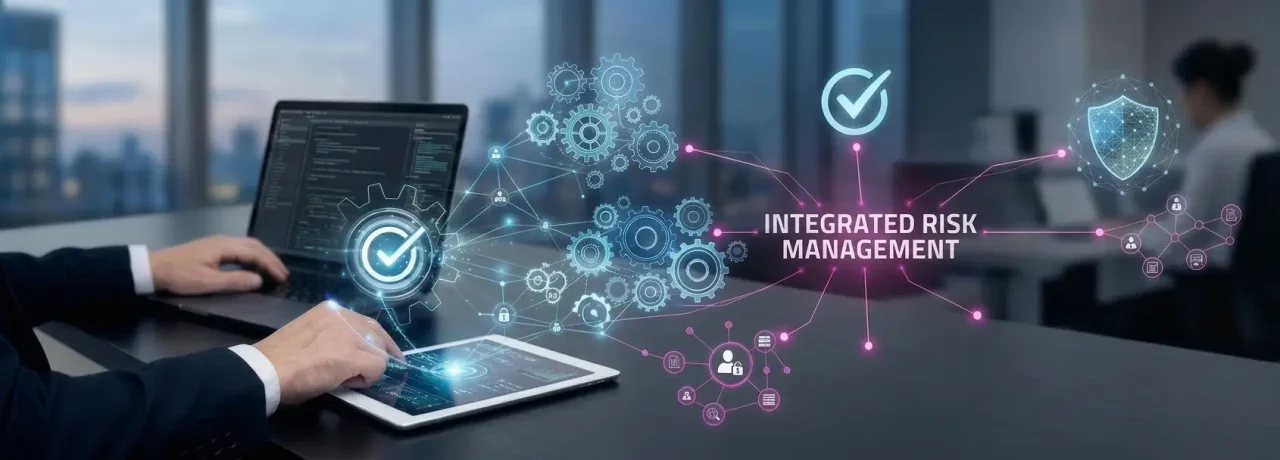
Integrated risk management is an approach to identifying, assessing, monitoring, and responding to risks across the organization rather than managing each category in isolation.
That distinction matters. Traditional risk processes often grow department by department. IT tracks cyber risk. Finance tracks financial exposure. Legal and compliance teams maintain regulatory registers. Operations manages incidents and continuity. Procurement watches supplier risk. Each process may work reasonably well on its own while still leaving leadership without a coherent enterprise view.
An integrated risk management system connects those activities so the organization can understand not only individual risks, but their relationships, ownership, business impact, and response status.
So, what is integrated risk management software? In practical terms, it is the technology used to support that process. It gives teams a common environment for risk registers, assessments, controls, incidents, compliance obligations, mitigation plans, evidence, reporting, and monitoring.
Organizations are moving away from spreadsheets because risk information changes too frequently and involves too many owners to manage reliably through disconnected files. Version control becomes difficult, updates arrive late, and reporting requires manual consolidation. An integrated risk management platform reduces that friction by centralizing risk information and keeping workflows connected.
The broader benefit is visibility. Executives can see which risks are increasing, which actions are overdue, where several risks affect the same process, and which exposures deserve attention first.
What is the Difference Between IRM, ERM, and GRC Software?
The terms overlap, but they are not identical.
- Enterprise risk management (ERM) focuses on identifying and managing risks that may affect the organization’s strategic objectives. It tends to be broad and leadership-oriented.
- Governance, risk, and compliance (GRC) software usually combines policy, control, compliance, audit, and risk processes. GRC platforms often have strong regulatory and control-management capabilities.
- Risk assessment tools may be much narrower. They help teams identify, score, and document specific risks without necessarily supporting wider workflows.
- Business continuity management software focuses more specifically on disruption preparedness, business-impact analysis, recovery plans, crisis response, and resilience.
- Integrated risk management (IRM) sits across these areas. It aims to connect risk information with operations, strategy, technology, compliance, resilience, and decision-making rather than treating them as separate disciplines.
What are the Key Objectives of an Integrated Risk Management Strategy?
A strong IRM strategy begins with visibility. The organization needs a consistent way to identify and assess risks across departments, locations, business units, and functions.
The next objective is connection. Operational, financial, cybersecurity, compliance, third-party, and strategic risks often influence one another. Looking at them together gives decision-makers a more realistic picture of exposure.
IRM should also improve prioritization. Not every risk deserves the same response. Teams need to understand likelihood, impact, control effectiveness, dependencies, and business criticality before deciding where to spend time and money.
Finally, the process should reduce disruption. That means identifying weaknesses earlier, assigning clear ownership, and making response plans easier to track.
Who Uses Integrated Risk Management Software?
IRM platforms are usually shared across several functions.
Chief Risk Officers and enterprise risk teams may oversee the overall risk framework. Compliance and legal teams use the system to track obligations, controls, and evidence. IT and cybersecurity leaders manage technology and security risks, while finance and operations teams may focus on business, financial, and operational exposure.
Internal auditors use the same information to review control effectiveness and gather evidence. Business continuity teams track resilience and recovery planning. Senior leadership and boards typically need a more concise view of significant exposures, trends, and unresolved actions.
The platform therefore has to work for detailed operational users and senior decision-makers at the same time.
What Problems Does Integrated Risk Management Software Solve?
The reason organizations move toward irm software is rarely that they lack risk information. Usually, they have too much of it in too many places.
One business unit may use spreadsheets, another a ticketing system, another a compliance platform, and another a shared document library. The problem appears when leadership asks a simple question such as, “Which risks are most likely to affect this strategic initiative?” The answer may require several teams and several days.
Fragmented risk data also hides relationships. A supplier dependency, for example, may affect production, cybersecurity, compliance, customer commitments, and financial performance. Those consequences are difficult to understand when each team records the supplier differently.
Manual assessments create another issue. Updating scores, collecting evidence, chasing owners, and preparing reports can consume more time than reviewing the risk itself.
Organizations are also dealing with newer exposures around cybersecurity, AI, third parties, data privacy, and digital operations. These risks evolve too quickly for a static annual risk register.
An irm platform helps create clearer ownership, more consistent metrics, automated workflows, and centralized reporting. It can also make emerging patterns easier to see and reduce duplicate work across teams.
For organizations researching areas such as construction risks integrated risk management software, the same principle applies: project, safety, contractor, financial, schedule, regulatory, and operational risks need to be connected rather than monitored in separate registers.
How Does Integrated Risk Management IRM Software Work?
Risk Identification and Data Collection
The process usually begins by collecting risks from business units, audits, incidents, compliance reviews, cybersecurity systems, vendor assessments, continuity exercises, and other sources.
Integrations can also bring in information from enterprise platforms so risk teams are not dependent entirely on manual updates.
Risk Assessment and Prioritization
Risks are then evaluated using agreed criteria. That may include likelihood, financial impact, operational impact, customer impact, regulatory exposure, control effectiveness, or other business-specific measures.
The objective is not simply to produce a score. The score should help teams decide which risks need attention first.
Risk Mitigation and Response Planning
Once a risk is understood, owners can assign actions, controls, deadlines, and responsibilities. Some risks may be reduced, transferred, accepted, avoided, or monitored.
A useful integrated risk management irm software platform keeps those decisions attached to the risk so it is clear what has been agreed and whether action is actually happening.
Continuous Risk Monitoring and Reporting
Risk changes. Controls fail, suppliers change, regulations evolve, incidents occur, and new technologies are introduced.
Continuous monitoring helps organizations update risk levels when the underlying conditions change. Dashboards and reports can then show current exposure, overdue actions, trends, incidents, control gaps, and emerging risks without rebuilding the picture manually each time.
What are the Key Features of Integrated Risk Management Platform?
Enterprise Risk Management and Assessment
The platform should support configurable risk registers, assessment models, ownership, scoring, categories, thresholds, and treatment plans.
Risk Analytics and Reporting Dashboards
Dashboards should help teams understand exposure, trends, concentration, overdue actions, and control performance. The goal is clarity, not a screen filled with red, amber, and green indicators.
Regulatory Compliance and Audit Management
Compliance capabilities can connect obligations with policies, controls, evidence, findings, and remediation. Audit trails should make it possible to see what changed, when, and by whom.
Incident and Issue Management
Incidents, control failures, audit findings, and risk issues should feed back into the wider risk view rather than sit in disconnected systems.
IT and Cyber Risk Management
Cyber risks may include vulnerabilities, technology dependencies, identity, data protection, third-party systems, and resilience. Integrating these with enterprise risks helps leadership understand their business consequences.
Third-Party and Vendor Risk Management
Supplier and partner risks need structured assessment, monitoring, evidence, issue management, and escalation. This becomes especially important when critical services depend on a relatively small number of external providers.
Business Continuity and Resilience Management
Business-impact analysis, recovery plans, critical processes, dependencies, testing, and incidents can all form part of the same environment.
Automated Risk Alerts and Workflows
Notifications, approvals, reassessments, escalations, and evidence requests can be automated so risk processes do not depend on someone remembering to send an email.
What are the Must-Have Technical and Security Requirements in an Integrated Risk Management System?
IRM software may contain sensitive information about vulnerabilities, incidents, compliance weaknesses, vendors, financial exposure, and internal controls. Security therefore needs to be designed into the platform.
Role-based access is essential because users should only see the information relevant to their responsibilities. Strong authentication, encryption, secure APIs, audit logging, backup and recovery, and controlled data retention are equally important.
Organizations should also examine integration security, especially where the IRM platform connects with ERP, HR, CRM, cybersecurity, ticketing, or third-party systems.
Configurability matters from a technical perspective too. Risk taxonomies, scoring models, workflows, thresholds, and reporting requirements change over time. A platform that requires major development work for every small change can become difficult to maintain.
How Integrated Risk Management System Helps Different Industries?
Banking and Financial Services
Financial institutions deal with credit, operational, market, technology, regulatory, fraud, third-party, and resilience risks. IRM can help connect those areas and provide a clearer view of how exposures interact.
Healthcare and Hospitals
Healthcare organizations need to manage patient safety, clinical operations, cybersecurity, privacy, regulatory obligations, vendor dependencies, and business continuity while keeping services available.
Manufacturing and Industrial Organizations
Manufacturers face production, equipment, supplier, safety, quality, cyber, and environmental risks. Connecting those risks can help teams understand how a disruption in one part of the operation affects the rest.
Information Technology and Software Companies
Technology companies need visibility into cybersecurity, cloud services, data privacy, software dependencies, operational resilience, compliance, and increasingly AI-related risks.
Retail and E-commerce
Retailers may need to manage payment security, fraud, supply chain disruption, data privacy, third-party platforms, inventory availability, and service continuity across physical and digital channels.
Energy, Utilities, and Oil and Gas
These sectors typically need strong visibility into asset, safety, environmental, regulatory, operational, cyber, and supplier risks.
Logistics and Transportation
Fleet availability, infrastructure, safety, weather, suppliers, cybersecurity, and service continuity can all affect operations.
Government and Public Sector
Public-sector organizations often manage large numbers of systems, suppliers, regulations, services, and critical public obligations, making clear risk ownership and auditability especially important.
Experion’s documented work in regulated environments includes product engineering, security and compliance testing, systems integration, regulatory mapping, governance controls, and AI oversight capabilities.
What to Look for When Choosing Integrated Risk Management Solutions?
Essential Capabilities for Your Organization
Start with visibility. The platform should bring risk information across functions into one understandable view without forcing every department into an identical process.
Configurable assessments are equally important because operational risk, cyber risk, compliance risk, and supplier risk may need different evaluation methods.
Reporting and analytics should make patterns clear. Automated workflows and alerts should reduce manual follow-up. Audit trails and evidence management should help teams prove what was done rather than reconstruct it months later.
Security, role-based access, integration, and data governance should be assessed from the beginning.
When comparing the best integrated risk management solutions, organizations should avoid choosing purely on feature count. The better question is whether the platform fits the way risk decisions are actually made.
Questions to Ask Before Selecting an IRM Software Vendor
Ask how easily risk models and workflows can be configured, how the platform integrates with existing systems, and whether data can be moved in and out without heavy manual work.
It is also worth asking how upgrades affect custom configuration, what security controls are available, how evidence and audit trails are maintained, and how the system handles multiple entities, regions, or regulatory frameworks.
Finally, understand what happens after implementation. Risk platforms evolve with the organization, so support and product roadmap matter.
How Much Customization Does Your Organization Need in IRM Software?
Standard Configuration vs. Custom Integrated Risk Management Software Development
Standard platforms work well when risk processes are relatively conventional. They can usually accommodate configurable fields, workflows, taxonomies, dashboards, and scoring models.
Custom integrated risk management software becomes more relevant when the risk model is deeply tied to proprietary processes, unusual integrations, or complex business structures.
The trade-off is straightforward: greater control brings greater responsibility for maintenance, testing, security, upgrades, and future development.
Areas Where Custom IRM Software Development May Be Necessary
Custom work may be useful when several legacy systems need to feed the risk model, when risk scoring uses proprietary logic, or when the organization has highly specific approval, evidence, or regulatory workflows.
It can also make sense when risk information needs to appear directly inside an existing operational system rather than in a separate application.
How to Determine the Right Level of Customization
Start with the gap rather than the preferred solution.
If configuration solves the requirement cleanly, custom development adds little value. If the business process repeatedly breaks around platform limitations, deeper customization may be justified.
The aim is to customize what differentiates the organization, not everything that can be changed.
How Scalable is Integrated Risk Management Software?
Scalability is not only about the number of users.
A growing organization may need to extend the platform across departments, legal entities, countries, facilities, and business units. The number of controls, risks, assessments, vendors, evidence records, integrations, and regulatory requirements can grow much faster than headcount.
The platform therefore needs to handle larger data volumes and more complex workflows without making reporting unusable.
Technical architecture, APIs, data model design, permission structures, workflow performance, and integration capacity all influence scalability.
A good integrated risk management platform should also scale conceptually. It needs to adapt when the organization introduces a new business model, regulation, technology, or risk category.
How AI is Reshaping Integrated Risk Management?

AI can help risk teams work through large amounts of information that would be difficult to review manually.
Models may identify unusual patterns, classify incidents, summarize regulatory documents, detect emerging themes, or highlight changes that deserve attention. Natural-language interfaces can also make it easier for leaders to query risk information without building a report first.
AI may be particularly useful in continuous monitoring, where the problem is not lack of data but the volume and speed at which it changes.
The limitations matter just as much. AI-generated risk assessments can be wrong, incomplete, or difficult to explain. Models can inherit bias from underlying data, and automated recommendations may not understand the operational context behind a decision.
That is why human oversight, traceability, monitoring, explainability, and clear accountability remain essential. Experion’s documented AI governance work similarly emphasizes monitoring, auditability, explainability, privacy, security, and human oversight rather than treating automation as a substitute for governance.
How to Implement Integrated Risk Management Software?
There is no standard answer to how long implementation takes. A focused deployment for one risk area is very different from an enterprise program involving multiple countries, integrations, regulatory frameworks, and legacy platforms.
The sensible approach is phased.
Step 1 – Assess Existing Risk Management Processes
Understand how risks are currently identified, assessed, reported, and escalated. Look closely at spreadsheets and manual workarounds because they often reveal what users actually need.
Step 2 – Define Business Requirements and Objectives
Agree on the problems the platform is expected to solve, which risk domains are in scope, and what success looks like.
Step 3 – Select and Configure the IRM Solution
Choose an integrated risk management solutions approach that fits the organization’s processes, data environment, security needs, and scale.
Step 4 – Migrate Risk Data and Integrate Systems
Clean the existing risk data before moving it. Integrations with ERP, CRM, HR, cybersecurity, ticketing, or other enterprise platforms should be planned carefully.
Step 5 – Test, Train, and Deploy
Test real workflows, unusual cases, permissions, alerts, reporting, and integrations. Training should reflect what each user actually does rather than every feature in the system.
Step 6 – Monitor and Improve Risk Management Performance
After launch, track adoption, data quality, overdue actions, reporting effort, workflow bottlenecks, and user feedback. IRM should improve as the organization learns how people actually use it.
What are the Strategic Business Benefits & ROI of Implementing IRM?
The first benefit is usually visibility. Leadership gets a more coherent view of risk across the enterprise instead of receiving disconnected reports from each function.
The second is speed. Automated workflows, common data, and clearer ownership can reduce the time spent assembling reports and following up on actions.
IRM can also improve prioritization. When risks are evaluated consistently and connected to business impact, teams can direct resources toward the exposures that matter most.
Audit readiness may improve because evidence, assessments, controls, ownership, and history are easier to retrieve.
The return should not be measured only as hours saved. Avoided disruption, faster incident response, better decisions, reduced duplicate work, and stronger accountability can all contribute to the business case.
How to Measure the Effectiveness of Integrated Risk Management Software Solution?
An integrated risk management solution should be measured against the problems it was introduced to solve.
If assessments were taking too long, track the reduction in assessment and reporting time. If actions were repeatedly overdue, measure mitigation completion rates and compliance actions.
Incident response time can show whether risks are being identified and escalated faster. Audit-readiness measures can show how quickly evidence can be produced.
Adoption is important too. A technically capable system that people avoid will eventually recreate the same fragmentation it was meant to solve.
Other useful indicators include reduction in manual activities, visibility across business units, control effectiveness, risk ownership, and the consistency of executive reporting.
Conclusion
Risk management becomes harder when the organization itself becomes more connected.
A cyber incident can affect operations. A supplier issue can affect customers and revenue. A compliance weakness can expose technology and process gaps. The value of integrated risk management software is that it allows those relationships to be seen rather than forcing leaders to assemble the picture manually.
The strongest IRM environments do not simply maintain larger risk registers. They help the organization understand what is changing, who owns the response, where controls are weak, and which decisions need attention now.
Whether the answer is a packaged integrated risk management system, an irm platform, or a more tailored implementation depends on the organization’s risk maturity, existing systems, regulatory environment, and operating model.
Experion can support organizations building or modernizing risk-related digital platforms through capabilities in product engineering, systems integration, security, data, AI governance, compliance engineering, and quality engineering, with the solution designed around the organization’s actual processes rather than a generic risk model.
Frequently Asked Questions (FAQs)
Is integrated risk management software suitable for small and medium-sized businesses?
Yes. Smaller organizations may not need the breadth of a large enterprise platform, but centralized risk ownership, assessments, controls, and reporting can still be useful. The system should match the complexity of the business.
Can IRM software manage cybersecurity and operational risks together?
Yes. One of the main purposes of integrated risk management is to connect risks that would otherwise sit in separate functions.
Does the integrated risk management solution support industry-specific compliance requirements?
Many platforms allow regulatory frameworks, obligations, controls, evidence, and reporting to be configured. The exact coverage depends on the product and implementation.
Can integrated risk management software integrate with ERP, CRM, HR, and other enterprise systems?
Yes. Integration is an important part of IRM because risk information often depends on data held elsewhere in the organization.
Can IRM software replace existing compliance or security tools?
Not necessarily. IRM often sits above or alongside specialist tools, using their information to create a broader risk view.
What is the difference between quantitative and qualitative risk scoring in IRM?
Quantitative scoring uses measurable values such as financial loss, probability, or downtime. Qualitative scoring uses categories such as low, medium, or high. Many organizations use a combination.
How much does integrated risk management software cost?
Cost depends on users, risk domains, modules, integrations, data migration, configuration, deployment model, support, and customization.
Is custom integrated risk management software better than a ready-made platform?
Not automatically. Custom software is useful where standard products cannot support the required workflows, data model, integrations, or business logic. Otherwise, configuration may be more efficient.
How secure is integrated risk management software?
Security depends on the specific architecture and implementation. Organizations should review encryption, authentication, access controls, audit logs, API security, backup, recovery, and data-retention controls.
What should organizations consider before replacing an existing risk management system?
Review current pain points, data quality, integrations, user adoption, reporting needs, regulatory requirements, migration effort, and the business value expected from the replacement.