






 Back
Back

Experion engineers enterprise-grade compliance management software solutions that transform regulatory hurdles into competitive advantages, ensuring your organization stays resilient in an increasingly complex global landscape.
In today’s fast-evolving business environment, the complexity of regulatory requirements has reached an all-time high. From data privacy mandates to industry-specific safety standards, the volume of rules businesses must follow is staggering. This surge has led to rising risks: organizations now face multi-million-dollar penalties, severe legal exposure, and irreparable reputational damage for even minor oversights.
Manual compliance processes built on disconnected spreadsheets and emails are no longer enough for modern organizations. They are slow, error-prone, and difficult to monitor during audits. Compliance management systems help organizations centralize oversight, improve audit readiness, and manage regulatory obligations more effectively.
What is Compliance Management Software?

Compliance management software is a digital platform that helps organizations manage regulatory requirements, internal policies, audits, risks, and compliance documentation in one centralized system. The main goal of compliance management software is to make sure all parts of a company are doing things correctly and legally. It helps organizations follow government regulations, industry standards, and internal policies. Compliance management software gives companies one place to manage requirements, responsibilities, and evidence so teams stay on the same page. This helps departments follow approved processes and maintain better visibility into compliance responsibilities.
Key Stakeholders
A successful compliance and management strategy involves several critical players:
- Compliance Officers: The primary users who monitor the compliance management tool to ensure the organization meets its legal obligations.
- Legal Teams: They use the software to interpret new laws and update internal policies accordingly.
- IT Teams: Responsible for the security and integration of the compliance software with other business systems.
- Operations: The frontline staff who must follow the workflows and policies defined within the system.
Difference between Compliance Management vs. Risk Management vs. Governance
While often grouped under the GRC umbrella, these three areas have distinct focuses:
- Governance: The framework of rules and processes by which a company is directed (the “Who” and “How”).
- Risk Management: The process of identifying and mitigating potential threats to the business (the “What if”).
- Compliance Management: The tactical execution of meeting specific requirements and standards (the “Must do”).
Stop reacting to audits and start leading with compliance confidence.
Talk to our Compliance Solutions Team
Compliance Management Software vs. Traditional Methods
| Aspect | Traditional Methods (Spreadsheets/Paper) | Compliance Software |
| Accuracy | Prone to human errors and outdated data. | High accuracy with automated data validation. |
| Speed | Slow, manual tracking and reporting. | Fast, automated workflows and instant updates. |
| Visibility | Limited; data is often siloed in departments. | Real-time visibility across the entire enterprise. |
| Scalability | Difficult; requires linear increases in staff. | Easy; scales automatically with business growth. |
| Audit Readiness | Reactive; frantic “fire drills” before audits. | Proactive; always-on audit & compliance software. |
Why is Compliance More Challenging Than Ever?
Increasing Regulatory Pressure
Regulations such as GDPR, CCPA, and industry-specific standards are evolving rapidly, making it difficult for global organizations to manage compliance without structured digital support.
Data Explosion and Digital Transformation
As companies move operations to the cloud, data volumes and access points increase, making it harder to track permissions, documentation, and compliance obligations.
Manual Processes and Human Error
Manual errors, missed checks, and incomplete records can increase compliance risk. Compliance management software helps automate routine tracking, reduce manual effort, and improve consistency across compliance processes.
Key Features of Compliance Software
To be considered the best compliance management software, a solution must offer more than just a place to store documents. It needs to be an active participant in your business strategy.
- Centralized Compliance Dashboard: A high-level view of your current status, flagging areas of high risk or overdue tasks.
- Automated Workflow Management: Automatically routes compliance tasks to the right person, such as asking a manager to review a new contract or policy update.
- Document and Policy Management: Securely stores and tracks versions of all corporate policies, ensuring staff are always viewing the latest version.
- Audit Trail and Reporting: Provides a timestamped record of every action taken, which is essential for compliance audit management software needs.
- Real-Time Risk Assessment and Monitoring: Constantly scans for deviations from the norm, acting as a compliance risk management software layer.
- Alerts and Notifications: Instant pings when a regulation changes or a deadline is approaching, providing much-needed compliance relief software for busy teams.
- Integration Capabilities: The ability to pull data from your ERP, HR, and CRM systems.
- Advanced Data Visualization: Turning complex compliance and risk management software data into easy-to-read charts and heat maps.
Types of Compliance Management Solutions
Depending on your industry and size, you may require a specialized compliance management solution:
GRC Platforms
Governance risk management and compliance software provides an all-in-one suite for large enterprises to manage every aspect of corporate oversight.
Industry-Specific Tools
- Healthcare Compliance Management Software: Built for HIPAA and patient data protection.
- Pharmaceutical Compliance Management Software: Tailored for FDA regulations and clinical trial tracking.
- Insurance Compliance Management Software: Manages complex multi-state licensing and policy requirements.
Policy Management Tools
Focused specifically on the lifecycle of creating, distributing, and getting “attestation” (signoffs) for company policies.
Audit Management Software
Streamlines the internal and external audit process, ensuring all evidence is collected and organized in one compliance management and monitoring software hub.
EHS Compliance Tools
Focused on Environment, Health, and Safety (EHS) standards to protect workers and stay within environmental laws.
Cloud-Native vs. On-Premise
Most modern firms choose business compliance software in the cloud for its ease of updates and remote access, though some high-security sectors still prefer on-premise compliance management solutions for total physical data control.
Benefits of Using Compliance Management Software
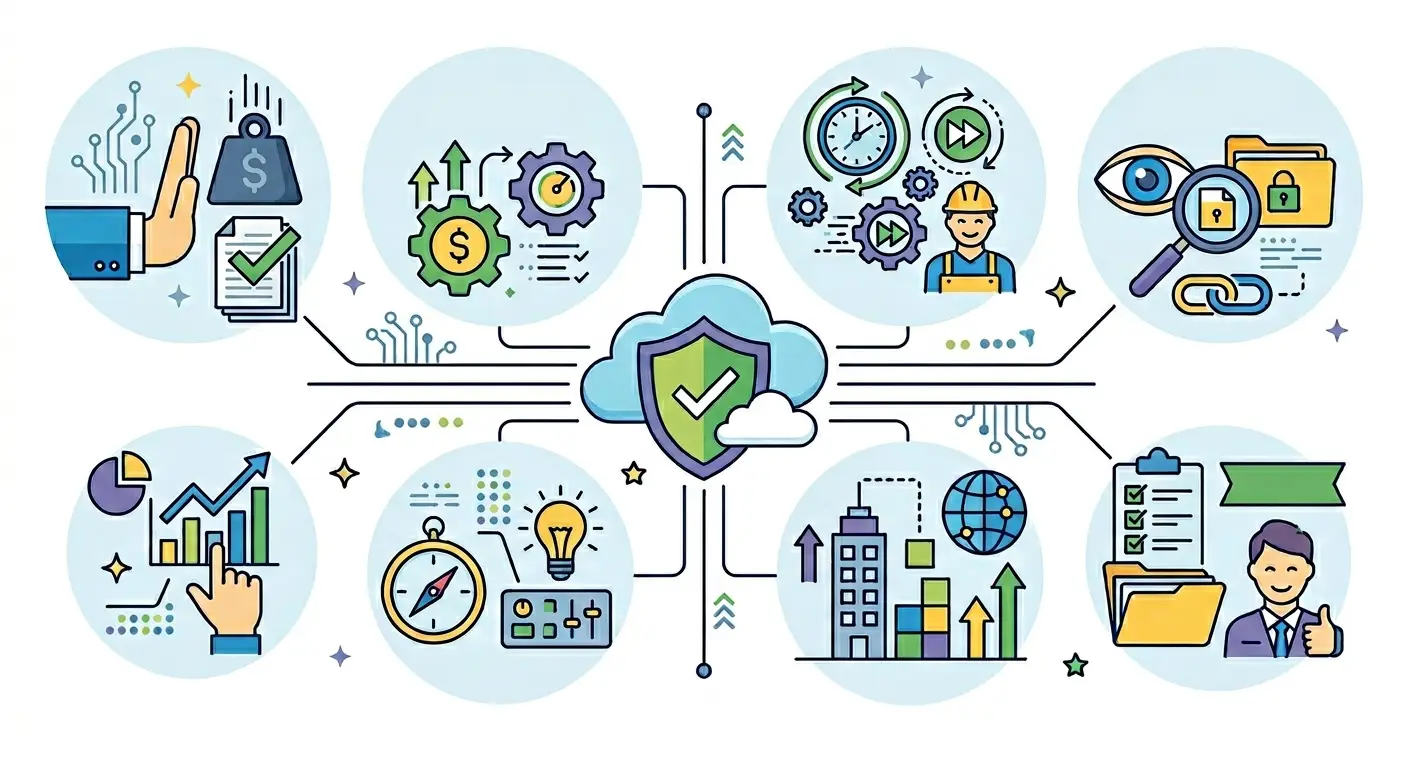
Compliance management software can support more than regulatory adherence. It can also improve visibility, accountability, and day-to-day operational control.
- The compliance management software helps reduce the risk of getting penalties. This software can help reduce the risk of penalties by improving visibility, documentation, and compliance tracking. The system helps catch problems before they become issues.
- This software also makes your business run smoothly. It does tasks for you that you would normally have to do by hand. Instead of manually reminding people to complete tasks, the compliance management tool can send reminders and support timely follow-ups.
- The compliance management system also makes everything more open and honest. It keeps a record of what people do and when they do it. This helps make sure everyone is responsible for their work.
- The compliance management software also helps you make decisions. You can see what is happening in real time and make informed changes based on current data. This helps you stay on top of things and make choices.
- If your company gets bigger, the compliance software can grow with you. It can handle rules and regulations in different areas.
- Getting ready for an audit is also a lot faster with this software. You do not have to spend weeks getting everything ready. Relevant information can be organized in one place, helping teams prepare more efficiently for audits.
Industries That Need Compliance Management System
Virtually every sector benefits from compliance management solutions, but for highly regulated industries, it is a non-negotiable requirement for legal operation.
- BFSI (Banking, Financial Services, Insurance): This sector utilizes insurance compliance management software and banking tools to manage complex AML (Anti-Money Laundering) and KYC (Know Your Customer) mandates.
- Healthcare and Life Sciences: Healthcare compliance management software is essential for protecting sensitive patient data and ensuring clinical trials meet strict safety standards.
- Manufacturing and Supply Chain: Companies use vendor compliance management software to ensure their entire partner ecosystem adheres to safety, quality, and labor laws.
- IT and SaaS Companies: Modern tech firms rely on compliance document management software to manage security certifications and global data residency laws.
- Energy and Utilities: These firms use software for compliance management to navigate environmental regulations and complex infrastructure safety protocols.
- Government and Public Sector: Public agencies use regulatory compliance management software to ensure transparency and the ethical handling of taxpayer-funded projects.
Build a future-proof digital fortress.
Common Compliance Standards and Regulations Covered
Modern compliance management and monitoring software is designed to map internal controls to multiple global frameworks simultaneously.
Global Security and Privacy Standards
- GDPR: The gold standard for data protection, requiring robust compliance document management software to handle “Right to be Forgotten” requests.
- ISO 27001: A worldwide standard for managing information security, often managed through governance risk management and compliance software.
- SOC 2: Essential for service providers handling customer data, usually tracked via compliance audit management software.
- PCI DSS: The critical standard for any business handling credit card information, often integrated into contract compliance management software.
Industry-Specific Frameworks
- Data Privacy: Beyond GDPR, business compliance software helps navigate CCPA (California), PIPL (China), and evolving regional privacy laws.
- Healthcare: Pharmaceutical compliance management software and healthcare tools focus on HIPAA and HITECH to secure patient records.
- Financial Services: Systems must handle SOX (Sarbanes-Oxley), FINRA, and rigorous anti-money laundering requirements.
- Information Security: In addition to ISO, firms use the compliance management tool to align with NIST CSF and CIS Controls.
- ESG & Sustainability: As environmental impact becomes a core metric, compliance management solutions now include modules for SEC climate disclosures and EU sustainability reporting.
Experion’s deep expertise ensures that your compliance management software solutions are built to be “framework agnostic”, allowing you to map a single internal control to multiple global regulations with one click.
Key Challenges in Implementing Compliance Management Software
Moving from spreadsheets to compliance management software solutions is a big change for companies. With the best compliance management software, companies often run into these common problems:
- Resistance to Change: Employees may be used to doing things their own way with manual tracking methods. To get past this you have to show them how the new compliance management tool will make their daily work easier.
- Integration with Legacy Systems: Existing business compliance software or separate databases may not work well with new systems, so custom integrations may be required to ensure data consistency.
- Data Migration Issues: Moving a lot of records to a new compliance document management software system can be tricky if the data is not cleaned up and organized first.
- Cost and ROI Concerns: Governance, risk, and compliance software can require significant investment, so leaders need clarity on long-term savings from reduced risk, fewer penalties, and lower legal exposure.
- Lack of Resources: To set up and maintain a good compliance management system, you need an IT team that knows about technology and regulations.
How to Choose the Best Compliance Management Software
Selecting the right compliance management solution requires a balance between technical power and user accessibility.
- Understand Your Compliance Needs: Are you solving for a specific regulation (like healthcare compliance management software) or a global enterprise-wide GRC strategy?
- Evaluate Scalability and Flexibility: Your software for compliance management must grow with you as you enter new markets or as new regulations like ESG emerge.
- Check Integration Capabilities: Ensure the compliance and management tool can pull data directly from your existing ERP, HR, and security systems.
- Assess User Experience and Ease of Use: If the regulatory software is too difficult to navigate, employees will find “workarounds” that create new risks.
- Review Security Features: Since the system holds sensitive data, it must be the most secure piece of regulatory compliance management software in your stack, featuring encryption and multi-factor authentication.
- Vendor Support and Reputation: Look for a partner with deep expertise in your specific niche, such as pharmaceutical compliance management software or finance.
- Pricing and Total Cost of Ownership: Look beyond the license fee—factor in implementation, training, and ongoing support for your compliance software.
Best Practices for Successful Implementation of Compliance Software
- Start with a Compliance Audit: You cannot fix what you haven’t measured. Perform a deep dive into your current gaps before configuring the compliance management and monitoring software.
- Define Clear Workflows and Responsibilities: Use the compliance management tool to assign specific ownership for every regulatory control.
- Train Employees and Stakeholders: Education is the backbone of compliance. Tiered training ensures everyone from the C-suite to the field staff knows how to use the compliance audit management software.
- Automate Wherever Possible: Use compliance relief software to automate “busy work” like evidence collection and deadline reminders.
- Continuously Monitor and Improve: Compliance is not a “set it and forget it” task. Use the analytics within your compliance and risk management software to refine your strategy quarterly.
Role of Automation and Agentic AI in Compliance Management
The next generation of regulatory compliance management software is moving from passive tracking to “Agentic AI“—systems that can think and act on behalf of the compliance officer.
- Predictive Risk Analysis: AI can identify patterns that teams may miss and flag potential compliance risks before they escalate.
- Automated Compliance Tracking: Instead of manually checking boxes, the system “listens” to your business processes and logs compliance evidence in real-time.
- Intelligent Alerts and Anomaly Detection: Agentic AI ignores “noise” and only alerts you to genuine deviations from your compliance management system standards.
- Reducing Manual Intervention: AI can handle routine verification tasks, allowing experts to focus on complex, high-stakes governance, risk, and compliance decisions.
- Governance in the AI Era: As businesses use more AI, the compliance management solution must also govern the AI itself, ensuring models remain unbiased and ethical.
Future Trends in Compliance Management Software

- AI-Driven Compliance: AI will move from an “extra feature” to the core engine of every compliance management tool.
- Real-Time Regulatory Updates: Future regulatory software will feature live feeds that automatically update your internal policies the moment a law changes.
- Cloud-Based Compliance Platforms: The shift to compliance management solutions in the cloud will continue, offering superior global collaboration.
- Increased Focus on ESG Compliance: Environmental, Social, and Governance reporting will become as rigorous as financial reporting, requiring dedicated compliance document management software.
- Integration with Cybersecurity Frameworks: The line between “IT Security” and “Compliance” will disappear, creating a unified compliance and risk management software ecosystem.
ROI of Compliance Management Software
Evaluating the return on investment for a compliance management system requires looking at both the prevention of loss and the creation of value.
- Cost of Non-Compliance vs. Investment: The “cost of doing nothing” is often much higher than the price of the best compliance management software. Between legal fees, multi-million dollar regulatory fines, and the cost of remediation, a single breach can eclipse the total cost of ownership of a digital solution.
- Efficiency Gains and Cost Savings: By moving to audit & compliance software, organizations eliminate thousands of hours of manual data collection. This automation reduces the “compliance tax” on your employees, allowing high-value talent to focus on innovation rather than administrative paperwork.
- Long-Term Business Value: A robust compliance management tool preserves your “license to operate”. It reduces insurance premiums and lowers the risk profile of the company during mergers, acquisitions, or public offerings.
Turn regulatory complexity into operational clarity.
Connect with our Compliance Experts
How Compliance Management Software Supports Business Growth
Far from being a “brake” on the organization, effective compliance and management act as an accelerator for expansion.
- Enables Market Expansion: Entering new geographical territories often means facing new regulatory software landscapes. A flexible compliance management solution allows you to adapt to local laws (like PIPL or GDPR) instantly, reducing time-to-market.
- Builds Customer Trust: In a world where data privacy is a top consumer concern, being able to demonstrate compliance via a recognized compliance management and monitoring software hub is a powerful sales tool.
- Strengthens Brand Reputation: Ethical operations are a core component of brand value. Utilizing compliance relief software ensures that you avoid the “headline risk” of a public regulatory failure.
- Supports Strategic Decision-Making: With real-time data from your compliance and risk management software, leadership can make bold moves with the confidence that the regulatory foundation is secure.
How Can Experion Offer Support in Developing Compliance Management Software Solutions?
Experion has expertise in developing high-integrity digital systems for regulated industries. Our teams can support the design and development of compliance management solutions aligned with business, technical, and regulatory requirements.
Our approach includes:
- Developing custom compliance management software that integrates with your proprietary legacy systems.
- Building specialized modules like healthcare compliance management software or pharmaceutical compliance management software that meet strict global standards.
- Leveraging Agentic AI to move your organization toward a “continuous compliance” model.
Conclusion
The shift from manual oversight to an automated compliance management system is the hallmark of a mature, modern enterprise. By centralizing data, automating workflows, and leveraging real-time reporting, compliance management software solutions protect your organization from the devastating costs of non-compliance while driving operational efficiency. In today’s high-stakes regulatory environment, adopting a sophisticated compliance management tool is no longer just a technology decision; it is a strategic investment in long-term resilience and growth.
Experion’s technical rigour and domain expertise ensure that your compliance management software is built to withstand the most demanding regulatory audits while providing the agility needed for global growth.
Frequently Asked Questions (FAQs)
What is compliance management software, and how does it help businesses?
It is a digital platform that automates the tracking of regulations and internal policies. It reduces legal risks by ensuring all necessary controls are in place and providing an immutable audit & compliance software trail.
What is the difference between compliance management software and GRC platforms?
Compliance software focuses specifically on adhering to rules and standards. A GRC platform (Governance Risk Management and Compliance software) is a broader suite that includes corporate governance and enterprise-wide risk assessment.
How secure is compliance management software for handling sensitive data?
When built by an expert compliance management software solutions provider, these tools feature enterprise-grade encryption, multi-factor authentication, and secure data residency to protect sensitive PII and trade secrets.
How does AI-powered compliance management software improve business efficiency?
It uses “Agentic AI” to perform predictive risk analysis and automate evidence collection, reducing the need for manual intervention and speeding up compliance audit management software processes.