






 Back
Back

Experion combines product engineering depth with cloud-native and AI-enabled capabilities to modernize software without disrupting the business it supports.
Every organization reaches a crossroads where legacy software starts to hold it back. With time, systems that used to promote growth become bottlenecks. Innovation slows, making integrations with new technologies a nightmare. Hence, software modernization becomes indispensable, as it can rearchitect the very foundation of a business.
Key Takeaways
- Software product modernization means upgrading what you’ve already got—the architecture, the tech stack, the UX—instead of starting over from scratch. Rip-and-replace is tempting but rarely worth it.
- Software product modernization is different from general application modernization. Here, the customer sees what you’re doing. Every backend decision shows up in load times, whether a feature ships this quarter or next.
- A few signs tell you it’s time: maintenance costs creeping up year over year, performance that used to be fine and now isn’t, security holes nobody wants to own, integrations that fight you at every turn, and a shrinking pool of engineers who actually understand the old codebase.
- The “6 Rs”—Rehost, Replatform, Refactor, Rebuild, Replace, Retain/Retire—aren’t a rigid checklist so much as a way to sort your options before you commit to one. Most teams end up mixing two or three.
- The strangler pattern is significantly better than the big-bang rewrite. Migrate piece by piece and ship value along the way. Big-bang rewrites promise a clean slate and usually deliver a missed deadline.
- The development partner you choose is of utmost importance. While cloud skills are a baseline expectation now, greater value comes from a partner with product engineering experience.
- What’s rarer is someone who’s built products—who’s shipped features under a deadline, not just migrated servers—and who knows enough about AI tooling to use it without overselling it.
What is Software Product Modernization?
Software product modernization means reworking what already exists — the architecture, the codebase, the infrastructure, the integrations, the UI — so it can meet today’s bar for performance, security, and customer expectations. The objective isn’t to throw out years of business logic just because the code is old. If you do it well, the product gets easier to maintain, faster to build on, and affordable to run.
Application modernization and Software product modernization seem interchangeable; however, they are not. Application modernization is about the processes a company runs for itself. Internal tools, back-office systems, and line-of-business software keep operations moving. Nobody there cares about feature velocity or competitive positioning — it’s about infrastructure and keeping costs down.
Software product modernization is the more challenging version, because it’s about what you sell. Teams must balance reducing technical debt while analyzing how the product feels to use, how fast you can ship the next feature, where you stand against competitors, pricing, and the roadmap.
Cloud Vs. Mainframe
It’s tempting to treat “move everything to the cloud” as synonymous with modernization, but that’s a mistake. Not every company needs to move its data storage to the cloud, and doing so unthinkingly can introduce cost, latency, or compliance problems that outweigh the benefits. Some workloads (high-volume transaction processing, systems bound by data-residency rules, applications with steady, predictable loads) run more economically on existing mainframe or on-premises infrastructure. Others gain a lot from cloud elasticity, managed services, and global reach.
There’s rarely an all-or-nothing answer here. Many mature products land on a hybrid: latency-sensitive or regulated data stays put, while customer-facing services, analytics, and burst-capacity workloads move to the cloud. A sound modernization strategy starts by judging each component on its own merits, not applying one destination to the whole system.
Signs Your System Needs Modernization
Most teams already know something’s off long before they do anything about it. Here’s what that usually looks like in practice.
High Maintenance & Infrastructure Costs
If you’re spending more just keeping the system alive than building anything new, the math has already flipped against you. Old systems need constant care — patches, manual workarounds, infrastructure that gets pricier every year for no good reason. Every dollar going to that is a dollar not going to a feature you could’ve shipped instead.
Performance Bottlenecks & Downtime
Slow load times. Timeouts when traffic spikes. Systems that buckle right when you need them most. This costs you revenue and trust, and both are hard to win back. If an outage feels less like “if” and more like “when,” then it’s the architecture that needs to be replaced.
Security Vulnerabilities & Compliance Risks
A lot of aging software runs on components that stopped getting security patches years ago. No one meant for that to happen — it just does, quietly, one deprecated library at a time. Each one is a door left open, and each open door adds risk under GDPR, HIPAA, SOC 2, whatever applies to you. Security debt doesn’t announce itself. It just waits for the breach that makes the news.
Integration Roadblocks
Everything runs on integrations now — APIs, cloud services, payment processors, AI tools. If your product can’t plug into that ecosystem cleanly, it turns into an island, cut off from the workflows customers already assume it should support. Honestly, this is one of the more common reasons people quietly switch to a competitor: not because the core product got worse, but because it stopped playing well with everything else.
Declining User Experience (UX)
Interfaces age faster than people expect. Something that looked sharp three years ago can look tired next to a newer competitor today. The real tipping point is when customers start calling it “dated” or “clunky” — at that point, it’s not a minor gripe anymore; it’s actively pushing them out the door.
Talent Shortages
The pool of developers who know COBOL, old Java, or ancient .NET versions shrinks every single year. When the only people who understand your system are a couple of specialists heading toward retirement, every change takes longer, costs more, and carries more risk. If you’re struggling to hire for your own stack, that alone should tell you the technology’s outlived its useful life.
Get a free technical assessment from Experion’s product engineering team.
We can map your architecture, flag the highest-risk components, and show you exactly where to start
Key Components of Software Product Modernization
Modernization isn’t really a checklist of separate projects. It’s a handful of layers that all lean on each other and treating them as isolated workstreams is how programs end up redoing the same work twice. The ones that actually work tackle these together.
Modern User Experience (UX/UI)
Redesigning for clarity, accessibility, and responsiveness isn’t just a nice-to-have; it shows up in retention and conversion numbers pretty directly. And doing it usually surfaces something nobody planned for: workflows that quietly got convoluted over the years because everyone just learned to work around the mess instead of fixing it.
Cloud Migration and Cloud-Native Architecture
Moving to the cloud gets talked about like it’s the achievement. It’s not. What you actually do once you’re there — elastic scaling, managed services, being available globally — is where the real gains live. Get that part right and the product scales with actual demand instead of being built for the worst possible day, every day, just in case.
API-First Integration
Build around clean APIs, and the product stops being a closed box. It becomes something other tools can plug into — a platform instead of just software. That opens up ecosystem and partnership options a closed system simply doesn’t get access to.
Microservices and Containerization
Split it into microservices, put them in containers, and teams can ship pieces without touching everything else. Fewer full releases, fewer full-system failures. When something does go wrong, it stays where it broke instead of dragging the rest of the product down with it.
DevOps and CI/CD Automation
CI/CD shortens the gap between writing code and having it live, and cuts out a lot of the human error along the way. Done well, shipping stops being a stressful event people brace for and just becomes something that happens on a Tuesday.
AI and Intelligent Automation
Modernization’s a good moment to build in real intelligence — predictive features, assistants, anomaly detection, automated decisions. It’s also where legacy competitors struggle hardest to keep up, because retrofitting AI onto a fifteen-year-old architecture is a very different problem than building it in from day one.
Data Modernization
Most legacy data is stuck — rigid schemas, siloed stores, information that just sits there. Modernize that layer with better models, real pipelines, decent analytics, and suddenly it’s not dead weight anymore. It’s what actually powers reporting, personalization, and whatever AI you’re planning to build next.
Benefits of Software Product Modernization
A modernization program tends to pay back in a few concrete ways.
- Faster product innovation: Clean architecture and automated delivery mean new features ship in days, not quarters.
- Improved customer experience: Users notice when things load fast and look right. They stick around longer because of it.
- Lower maintenance costs: Retire the brittle, high-overhead stuff, and the budget it was eating goes toward growth instead.
- Better scalability: Cloud-native design means a traffic spike or a new market doesn’t require a scramble.
- Stronger security: Current frameworks and patched dependencies cut risk and make compliance a lot less painful.
- Easier integrations: API-first products slot naturally into whatever ecosystem your customers already use.
Common Challenges Solved by Legacy Software Modernization Services
It also fixes the problems legacy systems create in the first place.
- Monolithic codebase and technical debt: Years of quick fixes accumulate into a tangled system that’s hard to change safely. Modernization untangles it.
- Outdated tech stack and unsupported libraries: Once a dependency stops getting updates, it’s both a security risk and a stability risk.
- Poor observability and test coverage: Without visibility and automated tests, teams fly blind and fear every deployment.
- Scalability and integration limitations: A rigid architecture caps how much you can grow and makes it hard to connect to anything else.
- Security vulnerabilities and compliance gaps: Modernization closes exposure and builds compliance into the product.
- Opportunity cost: Every hour spent maintaining old systems is an hour not spent on features that win customers.
- Market share loss: Perhaps the most serious cost of all: falling behind competitors who ship faster and integrate more easily than you do.
The Core Software Modernization Strategies (The “6 Rs” Framework)
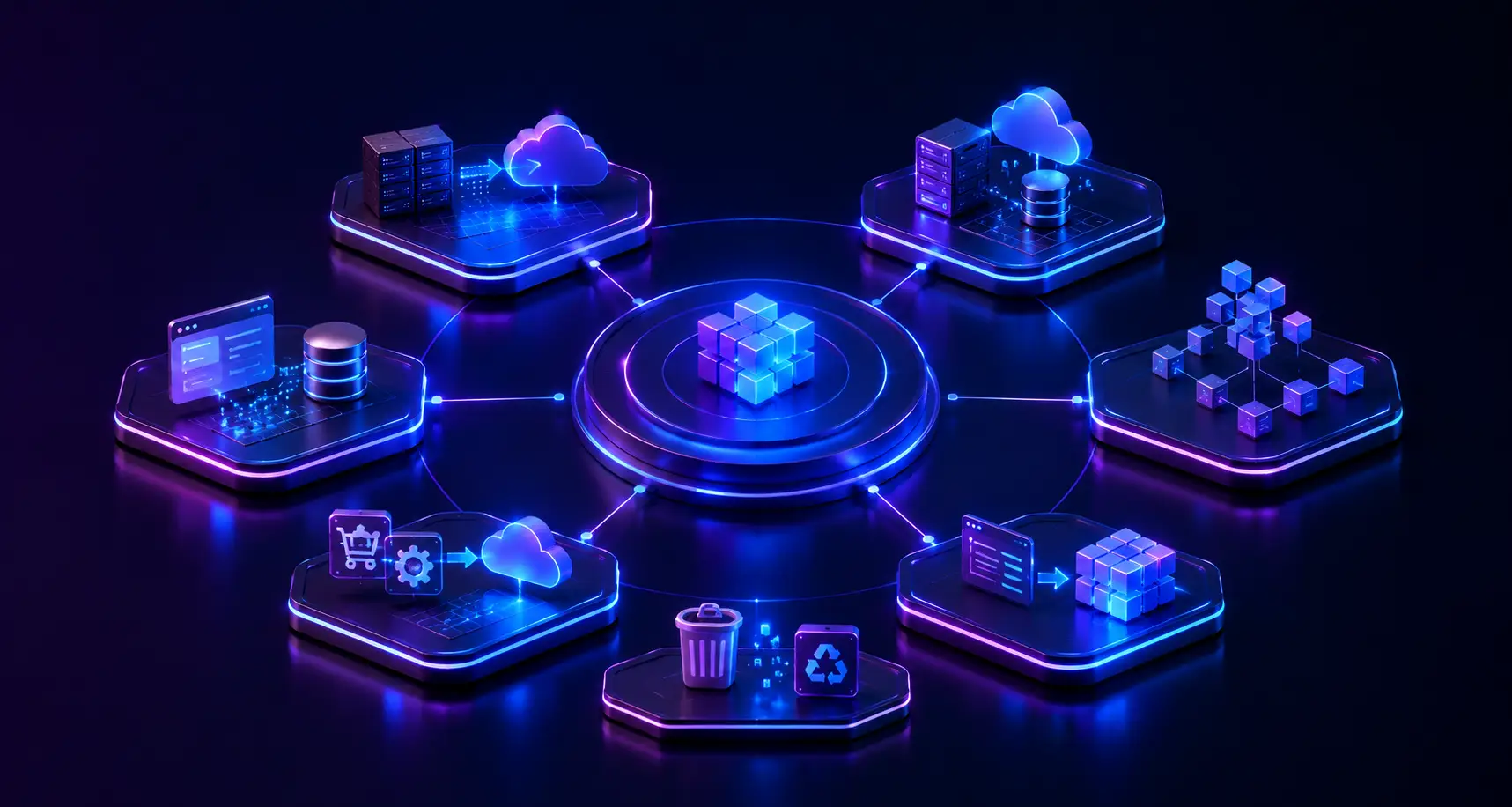
There is no single strategy to modernize. The widely used “6 Rs” framework enables teams match each component to the most appropriate approach.
Rehost (lift-and-shift)
Rehosting involves shifting applications to the cloud with minimal changes. Since it is fast and low risk, rehosting delivers infrastructure benefits. Unfortunately, it does not unlock cloud-native advantages by itself.
Replatform
Through replatforming teams can make minor optimizations to use cloud-native features such as managed databases or auto-scaling. Since it is a middle-path, if provides more value than a pure rehost, without much added risk.
Refactor / Re-architecture
Restructuring the code to adopt microservices, containers, or serverless setups. This is more involved but delivers agility, scalability, and maintainability. It’s typically reserved for the components that matter most to the product’s future.
Rebuild
Rebuilding refers to recreating a component from the ground up utilizing modern technology. This process makes sense when the existing code is too degraded to refactor economically.
Replace
The transition from custom legacy software to commercial off the shelf or Saas products is referred to as replacing. Once a capability no longer acts as a competitive differentiator, it needs to be replaced with proven third-party solutions. This frees up your team to focus on innovations instead of commodity functionality.
Retain / Retire
Not all applications require modernization. Systems that are stable and well-functioning can be retained as they are. On the other hand, obsolete systems may be retired to reduce technical debt.
Technical Patterns and Best Practices: Software Product Modernization Services
A few engineering patterns show up in almost every modernization that actually works:
- API-first design and backward compatibility so integrations remain stable as the product evolves.
- Incremental decomposition and the strangler pattern, gradually replacing legacy functionality piece by piece.
- Containerization, orchestration (Kubernetes), and serverless where each fits the workload best.
- CI/CD, automated testing, and observability to release confidently and catch issues early.
- Data migration and schema evolution strategies that move information safely without downtime.
- Security by design and compliance automation, building protection in from the first commit rather than bolting it on later.
- Feature flags to release changes gradually, test in production safely, and roll back instantly if needed.
- Test-Driven Development (TDD) to lock in correctness and prevent regressions throughout the migration.
Experion is positioned to support this as a continuous discipline — not a one-time project — through the technical depth, product thinking, and AI-enabled capabilities modernization demands.
Choosing the Right Software Modernization & Migration Services
Picking the right modernization partner matters as much as picking the strategy. Honestly, maybe more — a decent partner can rescue a shaky strategy, but a bad one will wreck a good one no matter how solid the plan looks on paper.
- Assessment checklist: Look hard at the architecture, code quality, technical debt, integrations, and security. Map what depends on what and figure out which systems the business genuinely can’t run without—that tells you what to modernize first.
- Risk analysis and prioritization: Weigh business value against effort and risk. A rough value-versus-effort comparison surfaces the quick wins while making sure the systems that matter get the time they need. Phasing it this way keeps disruption down and gets you ROI sooner.
- Roadmap components: Phases, timelines, ownership, and metrics that actually mean something—performance, deployment frequency, cost, scalability, user satisfaction, and If nobody’s measuring it, nobody will know if it worked.
- Stakeholder alignment: This isn’t just IT’s project. Product, engineering, security, ops, customer success, and leadership all need a say before decisions get made, not after. It cuts resistance later and leads to better calls throughout.
Building an Effective Strategy for Modernizing Software
A durable software modernization strategy follows a logical progression from understanding to measurement.
Assess the Existing Product
Begin with an honest audit of the current state—technical debt, performance data, architecture, and real user feedback. You can’t chart a course without knowing your starting point.
Define Business Goals
Tie modernization to outcomes the business cares about: faster time-to-market, lower total cost of ownership, entry into new markets, or improved retention. Technology goals should always serve business goals.
Prioritize Features
Not everything modernizes at once. Identify the components that deliver the greatest value or carry the greatest risk, and address those first.
Select the Right Modernization Path
Apply the 6 Rs to each component. Some parts may simply be rehosted; others warrant a full refactor or rebuild. Matching the approach to need controls cost and risk.
Plan for Security and Compliance
Bake security and regulatory requirements into the plan from the outset. Retrofitting compliance after the fact is far more expensive and error-prone.
Measure Success
Define the metrics that will prove modernization worked before you start. Otherwise, you’re just guessing whether it did.
Software Modernization Strategy: The Five Phases of Successful Modernization
Having a strategy in place allows for execution to follow a disciplined sequence.
- Phase 1: Comprehensive Code & UX Assessment: Technical debt, architecture, performance, the parts users complain about—get honest about all of it before you touch anything.
- Phase 2: Defining Strategic Goals & KPIs: “Modernize the platform” should not be a goal.” Cut deployment time from two hours to ten minutes” is.
- Phase 3: Selecting the Right Architecture: Microservices, modular monolith, serverless, event-driven—each one solves a different problem, and the trendy pick isn’t automatically the right one.
- Phase 4: Incremental Rollout (e.g., Strangler Fig Pattern): Swapping legacy components all at once feels efficient until something breaks in production and nobody knows why.
- Phase 5: Automated Testing & Continuous Integration (CI/CD): Utilize automated testing and CI/CD pipelines to maintain quality and accelerate deployments.
Metrics for Tracking Progress of Software Modernization
Key drivers to keep in focus
- Faster time-to-market
- Lower operational costs
- Improved scalability
- Stronger security and compliance
- Higher customer retention
Metrics to measure success
- Total Cost of Ownership (TCO)
- Time-to-release
- Error and defect rates
- Application performance (latency and uptime)
- User engagement and adoption
Common Pitfalls in Software Modernization and How to Avoid Them
Most modernization failures follow a familiar script. Watch for these:
- Ignoring business priorities and focusing only on tech: Elegant architecture that doesn’t move a business metric is a wasted effort. Keep outcomes front and center.
- Big-bang rewrites without incremental validation: Attempting to replace everything at once is the single most common cause of failed programs. Favor incremental delivery.
- Underestimating data migration complexity: Data is where projects quietly stall. Plan migration and validation early and thoroughly.
- Poor change management and lack of testing/observability: Without automated testing, monitoring, and organizational buy-in, even sound technical work unravels in production.
Future Trends in Product Modernization
Modernizing for today also means being prepared for the trends of tomorrow.
AI-Driven Development
AI has transformed how software is being built and modernized. Modernization projects can be accelerated with AI-assisted code generation, automated testing, and intelligent refactoring. Overall, AI enables organizations to build adaptive software products with greater capabilities.
Intelligent Automation
Intelligent automation can be embedded in modern software products to streamline business operations. It automates workflows and decision-making and enhances customer support. By reducing manual effort, intelligent automation improves efficiency to deliver faster, more consistent user experiences.
Composable Applications
Rather than one big tangled system, teams are building out of modular, swappable pieces. Want to scale one part without rewriting everything else? Make software products more flexible and easier to evolve.
Platform Engineering
Internal developer platforms are taking a lot of the guesswork out of shipping code. Fewer inconsistent deployments, less time fighting the pipeline, and if it’s done right, security and governance don’t get sacrificed along the way.
Edge Computing
When milliseconds matter, sending data across the country and back will not be feasible. Processing closer to where it’s generated cuts latency and bandwidth costs, and it’s basically non-negotiable now for IoT and anything location-sensitive.
Sustainable Software Engineering
Energy use is finally getting treated like a real design constraint, not an afterthought. Teams are tightening up infrastructure use and rethinking architecture with cost and environmental impact both in mind—two goals that, refreshingly, tend to point in the same direction.
What to Look for in Software Product Modernization Companies?
While evaluating vendors, identify those with engineering expertise, cloud-native skills, and a track record of AI-enabled transformation capability. The project delivery needs to be agile, with a user-centric design approach and security- first development. The final deciding factor is whether they act as a long-term product partner instead of a contractor that disappears once the migration is completed.
See how Experion combines product engineering depth with AI-enabled modernization to help you ship faster, not just migrate faster
Talk to our Experts
Conclusion
Software modernization is an ongoing investment that keeps software products easy to use and sustainable. It transforms the maintenance burden and allows products to scale with demand. By connecting to the tools customers already use, modernization doesn’t frustrate daily users.
Companies that treat modernization as a continuous discipline, not a project with an end date, tend to stay ahead of those that don’t. The most important advice is simple: don’t wait for a critical failure. The best time to modernize is while the product is still working, when there’s room to plan, prioritize, and execute deliberately.
Experion combines cloud-native capabilities and a long-term partnership model to help organizations modernize with confidence. Our team works alongside clients to build future-ready software products that continue to evolve with changing business needs.
Frequently Asked Questions (FAQs)
What is software product modernization?
Software product modernization is the process of re-engineering an existing software product. This involves its architecture, technology, infrastructure, and user experience. Software product modernization enables the product to keep up in today’s market while preserving the business value already built into it.
How is software product modernization different from application modernization?
Application modernization involves any software that an organization runs and mainly focuses on infrastructure and cost. On the other hand, software product modernization is narrower: it’s about products you sell to customers, where UX and feature velocity matter just as much as technical health.
When should a business modernize its software product?
When you view warning signs such as rising maintenance costs, bottlenecks in performance/downtime, security gaps, difficulties in integration, an overall declining user experience, or trouble hiring for your tech stack, it shows that you need to modernize your software product.
How long does a software modernization project take?
The time for a software modernization project varies from a few weeks for a straightforward rehost to more than a year for a large incremental re-architecture. The overall timelines depend on system complexity, the approach chosen, and scope.
What is a software modernization strategy?
A Software modernization strategy is a structured plan to assess the existing product and define business goals in addition to selecting the right modernization path. It plans for security and compliance along with defining the metrics used to measure success.
What are software modernization services?
Software modernization services can simply be termed as professional services that enable organizations to upgrade their software. These services involve, but are not limited to, assessment, architecture, migration to the cloud, and refactoring. They also include UX redesign, data modernization, and DevOps enablement.
What is the difference between rehosting, refactoring, and rebuilding?
Rehosting refers to shifting an application to the cloud with minimal changes. Often termed “lift and shift.” During refactoring, code is restructured to adopt modern patterns such as microservices or serverless architecture. Recreating a component from scratch with new technology while keeping its business purpose is referred to as rebuilding. Each trades off speed, cost, and long-term benefits differently.
How much does software product modernization cost?
The overall cost depends on the scope, complexity of the system, and approach. Rehosting is affordable, whereas re-architecture or rebuild costs more. Modernization usually pays back through reduced risk and faster delivery. To obtain a reliable estimate, conduct a proper assessment.
How do I choose the right software modernization company?
To choose the right development partner, look for product engineering expertise and cloud-native and AI capabilities. Prioritize a user-centric design approach, agile delivery, and security-first practices. Choose a partner who understands products, not just infrastructure, and who’ll stay engaged after the initial migration.
What are the biggest challenges in software product modernization?
The most common are monolithic codebases and technical debt, outdated and unsupported tech stacks, poor observability and test coverage, complex data migration, security and compliance gaps, and the organizational risk of attempting a rewrite instead of incremental change. The right strategy and partner address each of these directly.