






 Back
Back

At Experion, we bring healthcare product engineering, data, AI, cloud, workflow automation, and integration experience together to help organisations modernise complex claims and revenue-cycle processes.
A denied claim rarely arrives with drama. It appears as a code, a status change, or a line in a work queue. Yet behind that small administrative signal may be weeks of delayed payment, additional paperwork, staff follow-up, and uncertainty about whether the organisation will ever collect the full amount owed.
For hospitals and health services organisations, this is no longer an occasional inconvenience. Denials are becoming a persistent financial and operational burden.
Every denial does not become a permanent loss. Many can be corrected and appealed. The real problem is the amount of work required to recognise what went wrong, identify the responsible team, locate the correct documentation, prepare a response, meet the payer’s deadline, and prevent the same error from appearing again.
Manual spreadsheets, shared inboxes, and disconnected billing systems make that work slower. Payer rules continue to change. Authorisation requirements differ by plan. Coding and documentation must align precisely. Even a minor demographic mismatch can stop an otherwise valid claim.
Denial Management Software gives healthcare organisations a structured way to detect, prioritise, investigate, appeal, and prevent denials. The strongest platforms do not merely organise rejected claims after the fact. They identify patterns early enough to improve the claims submitted next.
Key Takeaways
- Claim denials create revenue loss, rework, and delayed cash flow.
- Many denials begin with preventable data or workflow errors.
- Automation helps teams identify and route denials faster.
- Analytics reveals recurring payer, coding, and documentation problems.
- AI can support prioritisation, prediction, and appeal preparation.
- Effective denial management must connect with the wider revenue cycle.
- Prevention is more valuable than repeatedly working the same denial.
Understanding Claim Denials
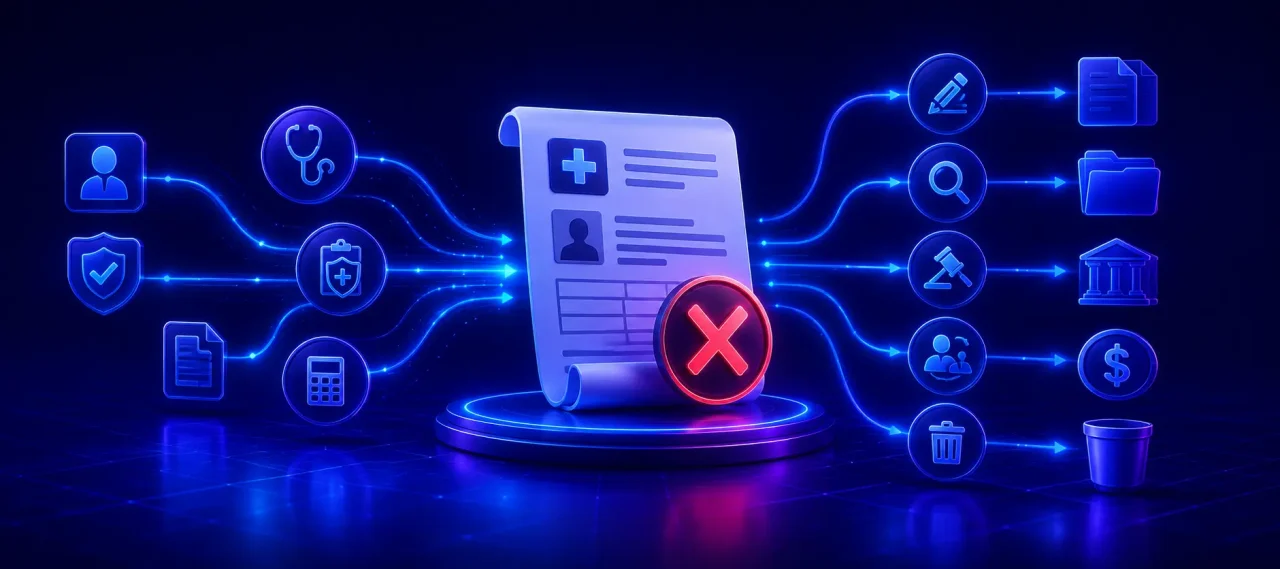
A claim denial occurs when a payer reviews a submitted healthcare claim and decides not to reimburse some or all of the requested amount.
The payer normally returns a denial or adjustment reason that explains why payment was withheld. The provider may then correct the claim, supply additional evidence, submit an appeal, transfer responsibility, or write off the balance, depending on the situation.
Denials can occur because the claim contains inaccurate information. They can also arise from disagreements about medical necessity, coverage, coding, authorisation, or payer policy.
The distinction matters because a simple registration error requires a very different response from a complex clinical denial.
Why Claim Denials Happen?
Missing documentation is a common cause. The payer may require medical records, physician notes, test results, referral documents, or proof of authorisation that were not included or could not be located.
- Incorrect coding can occur when diagnosis, procedure, or revenue codes do not accurately reflect the service delivered or do not align with payer rules.
- Eligibility issues arise when the patient was not covered on the date of service, the insurance information was outdated, or the wrong payer was billed.
- Missing authorisation occurs when a service required prior approval but the approval was not obtained, documented, or connected to the claim.
- Duplicate claims are created when the same service is submitted more than once, sometimes because teams cannot see that the original claim is still being processed.
- Timely filing denials occur when a claim or appeal is submitted after the payer’s deadline.
- Medical necessity denials arise when the payer determines that the service was not adequately supported by the diagnosis, documentation, or coverage criteria.
- Coordination-of-benefits issues happen when another insurer should have been billed first or when the payer has incomplete information about the patient’s other coverage.
A payer policy mismatch can also produce a denial even when the service itself was appropriate. The provider may have followed a familiar workflow that no longer matches the payer’s latest rule.
Claim Denial vs. Claim Rejection
Although the terms are sometimes used interchangeably, a rejection and a denial occur at different points.
| Area | Claim rejection | Claim denial |
| When it occurs | Before the payer formally processes the claim | After the payer accepts and evaluates the claim |
| Typical causes | Formatting, missing fields, invalid identifiers, transmission errors | Coverage, coding, authorisation, medical necessity, documentation, payer policy |
| Financial impact | Payment is delayed until the claim is corrected | Payment may be delayed, reduced, or permanently lost |
| Resolution | Correct and resubmit the claim | Investigate, correct, appeal, resubmit, or write off |
| Level of complexity | Usually administrative or technical | May be administrative, clinical, contractual, or regulatory |
A rejected claim has generally failed an initial validation step. The payer has not fully adjudicated it.
A denied claim has passed intake but has not qualified for payment under the payer’s adjudication process
Hard Denials vs. Soft Denials
A soft denial is potentially recoverable. It may require a corrected code, additional document, updated authorisation, or clarification.
A hard denial is unlikely to be reversed. Examples include services that are contractually excluded or appeals submitted after the final filing limit.
The terms are useful, but they should not replace detailed analysis. A denial that appears difficult may still be recoverable when the organisation has stronger documentation or clearer payer intelligence.
Initial Denials vs. Final Denials
An initial denial occurs during the first adjudication of the claim.
A final denial remains unpaid after available correction and appeal opportunities have been exhausted or missed.
Initial denial rate shows how much rework is entering the revenue cycle. Final denial rate reveals how much collectable revenue is ultimately being lost.
Why Healthcare Organisations Struggle with Claim Denials?
Denials do not belong to one department. They often begin at the point of scheduling or registration and may involve clinical documentation, coding, billing, utilisation management, finance, and payer relations before they are resolved.
That makes ownership difficult.
Increasing payer complexity adds another layer. Different insurers may require different forms, evidence, codes, portals, timelines, and authorisation procedures. Rules can also vary between plans offered by the same payer.
Insurance policies change frequently, while operational teams may continue using old reference documents or undocumented local knowledge.
Human error remains unavoidable in high-volume environments. A missing digit or incorrect modifier can delay payment for an otherwise legitimate service.
Coding inaccuracies can result from incomplete documentation, changing guidelines, or insufficient alignment between clinical and billing teams.
Eligibility failures often begin before care is delivered. Outdated coverage information may not become visible until the payer returns the claim.
Authorisation problems can develop when services change after approval, authorisation numbers are entered incorrectly, or clinical and administrative teams are not working from the same information.
Manual workflows make these issues harder to contain. Teams may track denials in spreadsheets, communicate through email, and use several payer portals without a consolidated view.
Without analytics, the organisation sees individual denied claims but misses the pattern. Limited visibility means registration teams may never learn that their data errors are creating downstream rework.
The Hidden Cost of Claim Denials
The most obvious cost of a denial is the reimbursement that does not arrive. The less visible costs can be just as damaging.
Revenue-cycle teams must investigate the reason, gather information, contact the payer, prepare an appeal, and follow the claim until it is resolved. That time could have been spent on clean claims, patient support, or higher-value exceptions.
Denials also increase accounts-receivable days. Even when a claim is eventually paid, the delay affects cash availability and makes financial forecasting less predictable.
Administrative costs rise because each additional touch adds labour. Complex denials may involve coders, nurses, physicians, finance teams, and legal or payer-relations specialists.
Staff burnout is another consequence. Denial work is repetitive, deadline-driven, and often frustrating. Teams may spend hours navigating payer portals and assembling information that already exists somewhere else in the organisation.
Cash-flow disruption can affect investment, staffing, supplier payments, and service expansion. Delayed reimbursement may also shift uncertainty towards patients. A patient may receive a confusing balance notice while the provider and payer are still determining responsibility.
Recent revenue-cycle analysis found a 25% increase in net revenue leakage from 2024 to 2025 among organisations represented in a dataset covering 2,300 hospitals and 350,000 physicians. The report linked the increase partly to higher final denial rates.
Denials may also create compliance exposure when appeals are poorly documented, patient balances are handled incorrectly, or inconsistent workflows produce unequal outcomes.
What is Denial Management Software?

Denial Management Software is a specialised platform that helps healthcare organisations identify, classify, investigate, assign, appeal, track, and prevent denied claims.
It creates a central operational layer between claims data, payer responses, billing workflows, documentation, and revenue-cycle teams.
Depending on its scope, a healthcare denial management software platform may receive claim and remittance data directly from billing systems, clearinghouses, electronic health records, or payer portals.
It then converts denial information into structured work.
Instead of asking staff to search several systems, the software can present the claim details, denial reason, payer requirements, related documents, filing deadline, financial value, and recommended next action within one workflow.
Hospitals, physician groups, specialty practices, health systems, medical billing companies, revenue-cycle providers, and third-party administrators may all use denial management software for healthcare.
Why Automate Denial Management?
Manual denial management depends heavily on individual memory, spreadsheet discipline, and repeated follow-up.
Automation helps capture denials sooner, assign them consistently, track deadlines, prioritise recoverable value, and standardise appeal workflows.
It can also reduce the time between payer response and corrective action. In denial management, delay matters. A strong appeal prepared after the deadline has no financial value.
Core Objectives
The central objectives are straightforward:
- Recover revenue that should be paid.
- Reduce the time and effort required to work denials.
- Improve the accuracy of claims before submission.
- Identify repeatable root causes.
- Strengthen payer accountability and internal ownership.
- Prevent avoidable denials from returning.
A mature denial management solution connects recovery with prevention. It does not allow the appeals team to become a permanent repair shop for errors created elsewhere.
Manual Denial Management vs. Denial Management Software
| Area | Manual process | Denial management software solution |
| Speed | Denials are reviewed after manual collection | Denials can be detected and routed automatically |
| Accuracy | Depends heavily on manual entry and interpretation | Rules and structured data improve consistency |
| Scalability | More denials require more staff effort | Automation supports higher volumes |
| Cost | High rework and administrative effort | Lower effort per denial over time |
| Insights | Patterns remain buried in spreadsheets | Dashboards reveal payer and root-cause trends |
| Automation | Limited | Routing, alerts, validation, and task creation |
| Reporting | Periodic and labour-intensive | Real-time or scheduled reporting |
| ROI | Difficult to measure | Recovery, prevention, effort, and timing can be tracked |
Why Health Services Organisations Need It?
Every health services organisation may not require the same system, but every organisation needs a reliable denial-management capability.
A small practice may need focused medical billing denial management software connected to its practice-management platform.
A hospital may require hospital denial management software capable of handling large volumes, complex clinical appeals, multiple locations, and different payer contracts. A multi-entity health system may need configurable workflows and enterprise analytics that show where denials originate across sites and service lines. The scale changes. The underlying need does not: denied revenue must be made visible, worked promptly, and prevented wherever possible.
What is the Denial Management Process?
The process begins with claim submission. Ideally, the claim has already passed eligibility, coding, authorisation, documentation, and payer-specific validation.
When the payer denies the claim, the organisation receives an electronic or portal-based response. The denial must then be identified and categorised. Teams determine whether it is administrative, technical, coding-related, clinical, or contractual.
Root-cause analysis asks a harder question: what created the denial? The payer’s reason code may describe the outcome without revealing the operational failure behind it. The case is assigned to the appropriate owner. A registration error may go to patient access. A coding issue may go to coding. A medical-necessity denial may require a clinical specialist.
The appeal is prepared using the required evidence, format, and payer procedure. The claim may be corrected and resubmitted or appealed formally. The organisation tracks the case until payment, further denial, escalation, or closure.
Finally, reporting converts individual cases into insight. Prevention initiatives should then be directed towards the teams and workflows creating the largest avoidable losses.
How Denial Management Software Works?
- Data Collection: The platform gathers claim, remittance, patient, payer, coding, authorisation, and financial information from connected systems.
- Claim Validation: Rules review the claim for missing fields, coding conflicts, inactive coverage, authorisation gaps, and payer-specific requirements.
- Denial Detection: The software identifies denials from electronic remittance advice, claim-status messages, clearinghouse data, or payer responses.
- Rules Engine: A configurable rules engine translates denial codes and payer conditions into categories, priorities, deadlines, and workflow actions.
- Workflow Automation: The platform assigns work, creates tasks, sends reminders, escalates overdue cases, and records activity.
- AI-Based Prioritisation: AI can help rank denials according to recoverability, filing deadline, financial value, effort, payer behaviour, and historical appeal success.
- Appeal Management: Users can assemble evidence, generate appeal letters, apply templates, record payer interactions, and track appeal status.
- Root-Cause Analysis: Analytics connects denials with departments, locations, providers, payers, codes, service types, and workflow failures.
- Reporting Dashboard: Dashboards display denial rate, appeal success, recovered revenue, turnaround time, payer behaviour, and avoidable root causes.
- Continuous Learning: The platform can use resolution outcomes to improve rules, prioritisation, and recommendations.
Key Features of Denial Management Software
Intelligent claim tracking gives teams one view of each claim from submission through appeal and payment.
Automated denial identification reduces dependence on manual remittance review. Root-cause analysis groups denials into meaningful operational categories rather than leaving them as isolated payer codes. Appeal workflow management helps users prepare, submit, and monitor appeals within payer deadlines.
Automated task assignment sends work to the right team based on denial type, location, payer, value, or clinical requirement. Real-time alerts draw attention to new denials, missing documentation, filing risks, and stalled appeals. AI-based recommendations may suggest the next action, required evidence, or appropriate appeal template.
Predictive analytics can identify claims at risk before they are submitted. A custom rules engine allows the organisation to configure payer, plan, specialty, and jurisdiction-specific logic. Dashboards and KPIs provide operational and financial visibility.
Payer performance monitoring shows which insurers generate high denial volumes, long resolution times, or inconsistent outcomes. Document management connects clinical notes, authorisations, correspondence, remittances, and supporting evidence to the case. An audit trail records what changed, who acted, and when.
EHR and EMR integration provides clinical and demographic data. Practice-management integration connects scheduling, registration, and provider information. Revenue-cycle integration links denial work to billing, payment, collections, and accounts receivable. API connectivity allows information to move across the wider healthcare ecosystem. Cloud deployment can support scalability and distributed workforces. Mobile access may help managers review queues, approvals, and urgent exceptions away from a desk. Security and compliance controls should include encryption, role-based access, audit logging, secure APIs, retention rules, and privacy-aware AI governance.
Experion’s capabilities include healthcare platform engineering, complex workflow automation, cloud and API integration, data engineering, document intelligence, analytics, and AI-enabled operational systems. The emphasis should remain on building around the organisation’s actual revenue-cycle workflows rather than forcing a generic product model onto them.
Must-Have Features Checklist for Denial Management Software Solutions
| Feature | Why it matters | Business value |
| Pre-submission validation | Finds errors before the payer does | Improves clean-claim performance |
| Automated denial capture | Removes manual remittance review | Speeds up response |
| Root-cause categorisation | Shows where denials originate | Supports targeted prevention |
| Priority scoring | Focuses teams on valuable and recoverable claims | Improves use of staff time |
| Appeal workflow | Standardises documentation and deadlines | Increases consistency |
| Payer-specific rules | Reflects different payer requirements | Reduces repeat errors |
| Real-time alerts | Flags deadlines and stalled work | Protects appeal opportunities |
| Document integration | Keeps supporting evidence accessible | Reduces search time |
| Analytics dashboard | Reveals trends and performance | Supports better decisions |
| Audit trail | Preserves action history | Strengthens governance |
| API integration | Connects clinical and financial systems | Reduces duplicate work |
| Predictive insights | Flags likely denial risks early | Shifts work towards prevention |
AI in Denial Management Software
The most useful role of AI in denial management is not replacing experienced revenue-cycle staff. It is helping them see risk earlier and move through repetitive work faster.
Machine-learning models can compare new claims with historical outcomes and identify characteristics associated with denial.
Predictive denial detection can flag a claim before submission because of missing authorisation, unusual coding, documentation gaps, or payer-specific patterns.
Appeal recommendation engines may suggest evidence, language, or escalation paths based on similar successful cases.
Natural language processing can read denial letters, medical notes, payer policies, and appeal documentation.
Intelligent coding suggestions may identify mismatches between the documented service and the codes selected, although final coding decisions should remain with qualified professionals.
Pattern recognition can reveal recurring denials connected to a particular payer, physician, facility, service, or registration workflow.
AI copilots can summarise the case, locate supporting documents, draft an appeal, and explain why a claim was prioritised.
An AI software for healthcare denial management should remain transparent. Users need to understand which information influenced the recommendation.
Benefits of a Denial Management Solution
A strong platform can improve the first-pass claim rate by identifying errors before submission. It can reduce the denial rate by feeding root-cause insights back into patient access, coding, clinical documentation, and authorisation workflows.
Improved cash flow comes from faster recovery and fewer delayed claims. Reimbursement may arrive sooner because work is assigned immediately and deadlines are visible. Administrative costs can fall as staff spend less time collecting data and navigating disconnected systems.
Productivity improves when teams focus on complex exceptions rather than repetitive sorting and tracking. The wider revenue cycle becomes more predictable because leaders can see where money is delayed and why.
Manual errors decrease through validation, system integration, and structured workflows. Compliance improves through consistent rules, audit trails, role-based access, and documented decisions.
Decision-making becomes more evidence-based as payer and root-cause trends are visible. Patients benefit when billing uncertainty is resolved earlier and incorrect balances are less likely to reach them.
Operations can scale without requiring a direct increase in administrative effort for every additional denial.
Types of Denials the Software Can Handle
Modern denials management software may support medical-necessity, eligibility, authorisation, coding, documentation, duplicate, technical, administrative, and clinical denials.
It may also manage payer-specific cases involving Medicare, Medicaid, commercial insurance, and workers’ compensation.
The platform should not assume that all denial types follow the same workflow. A coding correction may require a quick resubmission. A clinical appeal may require physician involvement, medical evidence, and a detailed payer-specific response.
Industries Benefiting Beyond Healthcare Providers
Insurance companies may use denial analytics to improve adjudication consistency and provider communication. HealthTech companies may embed denial intelligence into billing, clinical, or revenue-cycle products. Medical BPO organisations can use automation to manage high volumes across multiple provider clients.
Third-party administrators may need configurable payer and employer workflows. Revenue-cycle management providers use denial platforms to organise work, report outcomes, and demonstrate recovered value. Revenue-optimisation companies may combine denial analysis with underpayment detection, contract modelling, and accounts-receivable strategy.
Challenges of Traditional Denial Management
- Manual spreadsheets quickly become outdated and are difficult to govern.
- Email creates fragmented communication and weak ownership.
- Disconnected systems force users to move between billing, clinical, document, clearinghouse, and payer environments.
- Poor communication means upstream departments may never learn which errors they are producing.
- Appeals may be delayed because ownership and deadlines are unclear.
- Without reporting, managers see workload without understanding results.
- Without analytics, recurring causes remain hidden.
- The process becomes resource-intensive because highly skilled staff spend time collecting information instead of interpreting it.
Denial Management Software vs. Revenue Cycle Management Software vs. Medical Billing Software vs. Claims Management Software
| Platform | Primary purpose |
| Denial management software | Detects, works, appeals, analyses, and prevents denials |
| Revenue cycle management software | Manages the broader financial journey from patient access to payment |
| Medical billing software | Creates, submits, and tracks bills and claims |
| Claims management software | Manages claim intake, adjudication, status, and payment, often from a payer or insurer perspective |
These systems overlap, but they are not interchangeable.
A revenue-cycle platform may contain denial functions. A dedicated denial platform usually provides deeper workflows, analytics, payer intelligence, and appeal capabilities.
Integration Capabilities
- The platform may integrate with EMR and EHR systems for clinical and patient data.
- Practice-management systems provide scheduling, provider, registration, and insurance information.
- Billing software supplies charge and claim details.
- Clearinghouses provide submission status, rejection, and remittance data.
- ERP integration connects financial reporting and accounting.
- Analytics platforms combine denial data with wider revenue-cycle information.
- AI engines support prediction, document interpretation, prioritisation, and recommendations.
- An API ecosystem allows the organisation to introduce new payers, tools, services, and automation without rebuilding every connection.
How to Choose the Right Denials Management Software?
Begin with the organisation’s denial profile.
Understand which payers, services, locations, and departments produce the greatest volume and financial impact.
Evaluate whether the platform supports both administrative and clinical denials.
Review its integrations, reporting depth, configurability, security, AI transparency, and workflow design.
The interface should match the work of revenue-cycle teams rather than adding another complicated layer.
Look closely at implementation requirements. A sophisticated system cannot compensate for weak data, undefined ownership, or poor integration.
Finally, assess whether the platform supports prevention. Recovery matters, but a system that only makes appeals faster leaves the underlying problem untouched.
Questions to Ask Denial Management Services Vendors Before Buying
- Ask which denial categories and payer workflows the product supports.
- Find out how rules are configured and updated.
- Ask how data enters and leaves the system.
- Review how AI recommendations are explained and validated.
- Clarify whether appeal templates can be customised.
- Ask how recovered revenue and avoided denials are measured.
- Review security controls, auditability, service levels, implementation support, and ongoing optimisation.
- For organisations considering denial management services, clarify whether the vendor is providing software, operational staff, consulting, or a combined managed-service model.
Implementation Best Practices and Challenges
Best Practices
- Start with a clear baseline covering denial rate, root causes, recovery, appeal turnaround, and current staff effort.
- Map workflows before configuring the system.
- Clean and reconcile data before migration.
- Begin with a focused pilot involving selected payers, locations, or denial categories.
- Train users according to role and involve operational teams in design decisions.
- Plan the go-live around payer cycles and workload.
- Monitor performance after launch and refine rules continuously.
Challenges
- Resistance to change may appear when teams have built informal methods around spreadsheets and personal knowledge.
- Poor data quality can weaken automation and reporting.
- Integration may be complicated by legacy systems or inconsistent interfaces.
- Staff need time to learn new workflows.
- Some organisations discover that the real problem is not software but unclear ownership.
- Budget and timeline pressure can lead teams to configure too much too quickly.
- Vendor dependency becomes a risk when rules, data, or workflows cannot be managed internally.
How Much Does Denial Management Software Cost?
Pricing varies according to claim volume, users, modules, deployment, integrations, AI capabilities, implementation effort, and support.
Commercial products may use subscription, transaction, user-based, recovered-revenue, or enterprise licensing models.
Custom development costs more initially but offers greater control over workflows, integrations, data, and long-term roadmap.
The business case should compare the platform’s cost with the value of recovered revenue, prevented denials, reduced effort, shorter accounts-receivable cycles, and improved cash predictability.
How Software Improves Denial Appeal Success Rates?
Software does not win denial appeals simply by generating more letters.
It improves the conditions around the appeal.
The correct denial is identified earlier. The deadline is visible. The case reaches the right specialist. Relevant records are easier to locate. Payer-specific requirements are available. Similar outcomes can inform the strategy.
The platform can also track which appeal language, evidence, or escalation path produces better results.
This makes appeal management more consistent and less dependent on individual memory.
Custom Denial Management Software vs. Off-the-Shelf Software
| Area | Off-the-shelf software | Custom denial management software |
| Cost | Lower initial cost | Higher initial investment |
| Customisation | Limited to vendor configuration | Designed around specific workflows |
| Maintenance | Managed mainly by vendor | Shared or organisation-controlled |
| Implementation | Usually faster | Requires discovery and engineering |
| Scalability | Based on product architecture | Can be designed for expected scale |
| Ownership | Vendor controls product roadmap | Greater control over data and roadmap |
| Time to market | Shorter | Longer |
| Integration | Standard connectors | Tailored integration ecosystem |
Emerging Trends in Denial Management Software
AI agents may begin coordinating information across multiple systems and preparing cases for human approval.
Generative AI will support claim summaries, appeal drafts, policy interpretation, and case explanations.
Autonomous appeals may handle selected low-risk administrative denials under predefined controls.
Predictive revenue-cycle management will identify risk before claim submission.
Value-based care will require denial tools to understand more complex reimbursement arrangements.
FHIR-based interoperability can improve access to structured clinical information.
Hyperautomation will connect rules, AI, workflow, documents, and robotic automation.
Real-time payer intelligence will allow teams to respond faster to changing behaviour.
Digital workers may perform repetitive portal and status-checking tasks.
Process mining will reveal where claim and appeal workflows slow down.
Cloud-native automated denial management platforms will support higher volumes, distributed teams, and faster product evolution.
Future of Denial Management

Over the next five to ten years, denial management is likely to move steadily upstream.
Organisations will place less emphasis on building larger appeal teams and more emphasis on preventing avoidable claims from reaching the payer incorrectly.
The software will increasingly connect patient access, authorisation, clinical documentation, coding, billing, and payer policy.
AI will make recommendations earlier, but human expertise will remain necessary for complex clinical and financial decisions.
Leaders should also expect greater scrutiny of AI use by both payers and providers. Explainability, fairness, auditability, and patient impact will become part of system design rather than secondary governance exercises.
The future is therefore not a completely autonomous revenue cycle. It is a better-instrumented one: fewer invisible errors, clearer ownership, faster decisions, and more precise use of people’s time.
Conclusion
Claim denials are no longer an isolated billing issue. They reveal weaknesses across registration, authorisation, clinical documentation, coding, payer interpretation, and revenue-cycle coordination.
Working denials manually may recover some revenue, but it does little to stop the same errors from returning.
Modern Denial Management Software combines workflow, data, automation, analytics, and AI to make the process more visible and manageable.
It can identify denials sooner, prioritise valuable cases, support stronger appeals, reveal payer behaviour, and direct preventive action towards the parts of the organisation creating avoidable loss.
The right platform should reflect the organisation’s payer mix, operating model, systems, data quality, and clinical complexity.
For some providers, an established product may be sufficient. Others may require custom denial management solutions integrated deeply into their revenue-cycle ecosystem.
The aim is not to add another dashboard to an already crowded technology environment. It is to build a connected denial management solution that helps revenue-cycle teams recover what is owed, understand what went wrong, and reduce the likelihood of the next denial.
Experion can support organisations exploring such platforms through product discovery, workflow engineering, cloud architecture, system integration, data platforms, document intelligence, AI-enabled decision support, quality engineering, and ongoing product evolution.