






 Back
Back


At Experion, our relevant finance technology capabilities include treasury data modernization, TMS integration, automated reconciliation, ERP integration, and cash flow forecasting automation.
A business can be profitable on paper and still find itself short of cash at the wrong moment. Customers may pay later than expected, payroll arrives on a fixed date, inventory has to be purchased in advance, or a large tax or debt payment falls due before the next inflow.
That is why cash visibility matters. Finance teams need to understand not only how much cash the business has today, but what is likely to move in and out over the coming days, weeks, and months. cash flow forecasting software brings that forward-looking view together using financial data, expected payments, business assumptions, and actual cash movements.
Key Takeaways
- Cash flow forecasting looks ahead; cash flow reporting explains what has already happened.
- Automation reduces the work involved in repeatedly rebuilding forecasts.
- Forecast quality still depends on reliable data and sensible assumptions.
- Scenario planning helps businesses prepare for different revenue, payment, and spending conditions.
- Short-term and long-term forecasts answer different financial questions.
- AI can strengthen pattern recognition and forecast analysis, but it does not remove the need for finance judgment.
What is Cash Flow Forecasting Software?
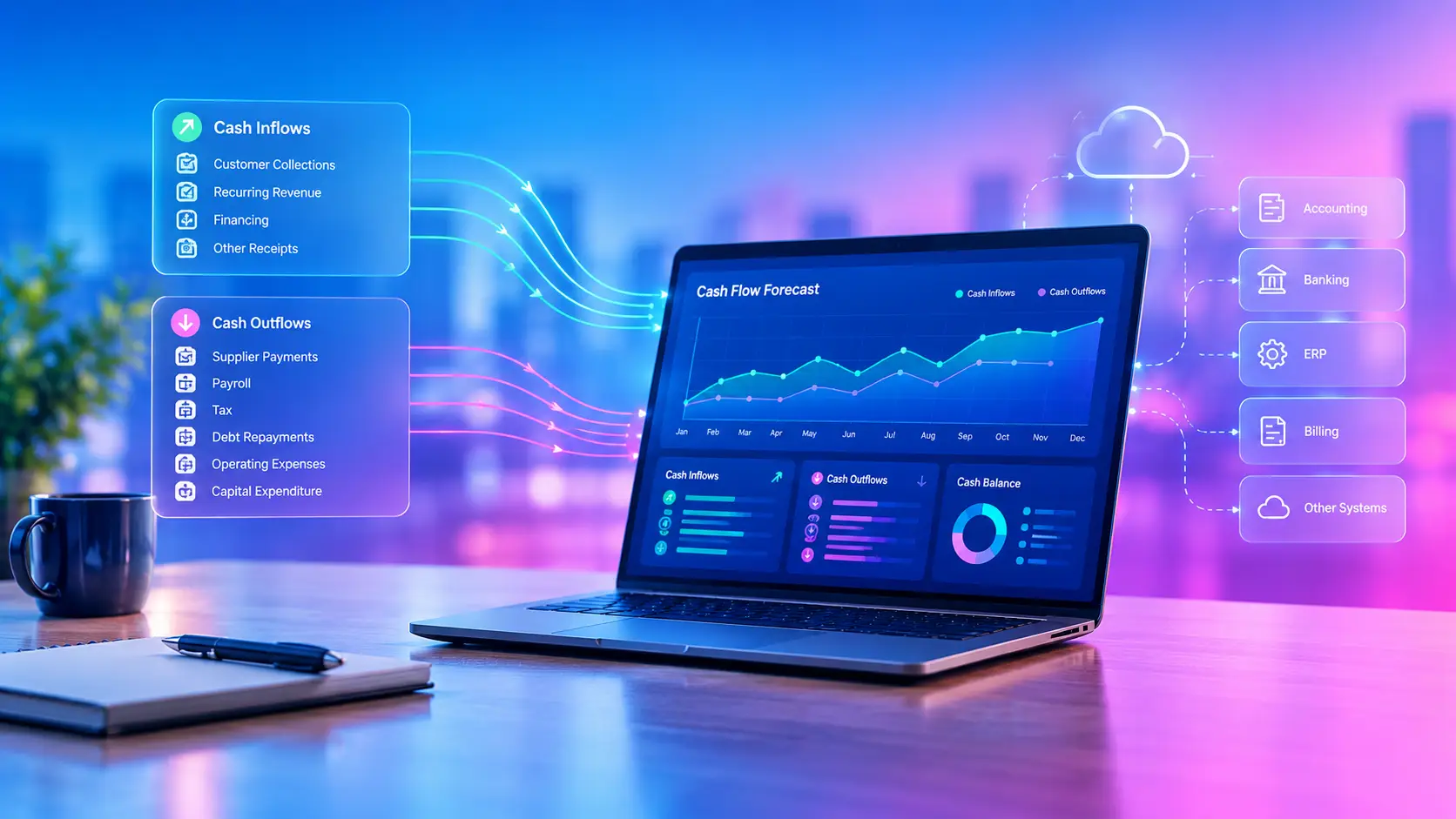
Cash flow forecasting software helps businesses estimate future cash balances by bringing together expected cash inflows and outflows.
Inflows may include customer collections, recurring revenue, financing, or other receipts. Outflows may include supplier payments, payroll, tax, debt repayments, operating expenses, and planned capital expenditure.
Unlike a static spreadsheet, a cash flow forecast software platform can connect with accounting, banking, ERP, billing, and other financial systems so the forecast can be refreshed as new information becomes available.
It may also function as cash flow projection software, allowing finance teams to see how expected business activity could affect future liquidity.
Cash Flow Forecasting vs. Cash Flow Reporting vs. Budgeting vs. Financial Modeling
| Area | Primary purpose |
| Cash flow forecasting | Estimate future cash position |
| Cash flow reporting | Show actual historical cash movement |
| Budgeting | Set planned income and expenditure |
| Financial modeling | Evaluate broader financial outcomes and scenarios |
The distinction matters. A budget may say the company expects a certain level of revenue this quarter, but that does not necessarily tell the CFO when the cash will actually arrive.
Forecasting converts financial activity into a time-based view of liquidity.
How Does Cash Flow Forecasting Software Work?
Data Collection and Integration
The software first brings together relevant information from bank accounts, accounting systems, ERP platforms, invoices, payables, payroll, sales forecasts, and other sources.
Cash Flow Data Categorization
Incoming and outgoing cash is organized into useful categories so finance teams can understand where money is expected to come from and where it needs to go.
Forecast Generation
The system combines balances, scheduled payments, receivables, recurring items, historical patterns, and assumptions to estimate future cash positions.
Forecast Monitoring and Updates
Forecasts should move with the business. As invoices are paid, dates change, new costs appear, or actual performance differs from assumptions, the forecast can be updated rather than rebuilt from scratch.
What Can You Forecast With Cash Flow Forecasting Software?
A forecast can operate at several levels depending on the business need. Treasury may need a detailed daily cash position, while management may be more interested in monthly, quarterly, or annual liquidity.
The same system can help estimate customer collections, accounts payable, payroll, tax payments, debt repayments, capital expenditure, subscriptions, and recurring operating costs. Businesses with seasonal demand can also model the effect of stronger and weaker trading periods.
Most importantly, forecasting can make future cash surpluses and deficits visible earlier. That gives the business more time to decide whether cash should be retained, invested, moved between entities, or supported through additional funding.
Why are Businesses Moving from Spreadsheet-Based Cash Flow Forecasting?
Spreadsheets are familiar, flexible, and perfectly adequate for many simple forecasts. Their limitations become more visible as the finance environment grows.
Someone has to collect the data, check formulas, reconcile several versions, update assumptions, and make sure everybody is looking at the latest file. The forecast may already be out of date by the time that work is finished.
Multiple entities make the problem harder. So do different currencies, business units, bank accounts, and data sources. Scenario modeling can become cumbersome because each change creates another version of the workbook.
The issue is not that spreadsheets are inherently unreliable. It is that they place a great deal of responsibility on manual processes.
Spreadsheet Forecasting vs. Cash Flow Forecasting Software
| Spreadsheet Forecasting | Cash Flow Forecasting Software |
| Manual data collection | Automated or integrated data feeds |
| Multiple file versions | Centralized forecast |
| Formula-dependent | Configured forecast logic |
| Manual refresh | More frequent updates |
| Limited collaboration | Shared workflows and access |
| Scenario copies | Structured scenario modeling |
| Difficult variance tracking | Forecast-versus-actual analysis |
What Problems Can Cash Flow Forecasting Software Solve?
The most common problem is uncertainty.
Finance teams may know the current bank balance without knowing what it will look like after next week’s supplier payments or next month’s payroll. They may also have receivables data without a realistic view of when those invoices are likely to convert into cash.
Software for cash flow forecasting helps bring these separate pieces together. It can reduce manual consolidation, improve visibility across entities, make forecast updates easier, and give finance teams a structured way to compare expected and actual cash movement.
Key Features to Look for in Cash Flow Forecast Software
- Automated Cash Flow Forecasting: Automation should reduce repetitive collection and consolidation work while still allowing finance teams to review assumptions.
- Real-Time Cash Visibility: Businesses evaluating software for real time cash flow forecasting should look closely at how frequently banking, ERP, and other source data is refreshed.
- Accounting and ERP Integration: Direct connections with financial systems reduce duplicate data entry and make forecast updates more practical.
- Accounts Receivable and Accounts Payable Tracking: A good forecast needs visibility into what customers owe and what the business itself is expected to pay.
- Scenario Planning and What-If Analysis: Finance teams should be able to test questions such as: What happens if collections slow down? What if sales fall? What if a planned investment moves forward by three months?
- Rolling Cash Flow Forecasts: Rolling forecasts extend the time horizon continuously rather than ending at a fixed financial period.
- Cash Flow Dashboards and Reporting: Dashboards should help people understand cash position, expected movement, key drivers, and emerging gaps without forcing them to interpret raw transaction data.
- Alerts and Notifications: Threshold-based alerts can draw attention to projected shortages, unusual changes, or important upcoming obligations.
- Multi-Entity and Multi-Currency Support: Larger businesses may need to consolidate cash positions across subsidiaries, bank accounts, legal entities, and currencies.
- Forecast Accuracy and Variance Analysis: Comparing forecasts with actual results helps teams understand which assumptions are working and where the process needs improvement.
- Security and Access Controls: Financial information should have appropriate authentication, permissions, auditability, encryption, and access restrictions.
What are the Benefits of Cash Flow Forecasting Software?

The practical benefit is earlier visibility.
A potential cash shortage identified several weeks ahead gives the business more choices than one discovered two days before payroll. Finance may accelerate collections, move expenditure, renegotiate payment timing, review funding, or adjust another planned commitment.
Better visibility can also support working capital decisions, supplier-payment planning, receivables management, and financial reporting. Teams spend less time assembling spreadsheets and more time examining why the forecast is changing.
For growing organizations, cash flow forecasting & planning software can also provide a more scalable process as transaction volumes, business units, and data sources increase.
How Cashflow Forecasting Software Supports Working Capital Management?
Working capital is closely connected with timing. Revenue may have been earned without being collected, while inventory and supplier obligations may already require cash.
Cashflow forecasting software helps finance teams bring receivables, payables, inventory-related requirements, and payment terms into the same picture. That can make the cash conversion cycle easier to understand.
It can also reveal cash sitting in places where it is not being used effectively, particularly in organizations managing several bank accounts or entities.
Who Needs a Software for Forecasting Cash Flow?
CFOs and finance leaders use forecasts to understand liquidity and funding needs. Controllers may use them to connect financial reporting with expected cash movement, while FP&A teams can incorporate cash into broader planning and scenarios.
Treasury teams often need a more detailed view across bank accounts, entities, currencies, and payment obligations. Business owners and senior management may need a simpler answer: how much cash is likely to be available, and where could pressure emerge?
In each case, software for forecasting cash flow should match the decisions the user is responsible for making.
Which Businesses Need Cash Flow Forecasting Software?
The need is not limited to large companies.
Startups and high-growth businesses may need careful visibility because expenditure can rise ahead of revenue. Small and medium-sized businesses may want a clearer picture of collections, supplier payments, and payroll.
Large enterprises and multinational organizations deal with additional complexity across entities, currencies, banking relationships, and finance systems.
Seasonal businesses, subscription companies, retailers, manufacturers, construction firms, healthcare organizations, professional-services firms, and financial-services businesses can all face different versions of the same timing problem: cash does not always arrive when expenditure occurs.
Experion’s documented treasury technology capabilities include multi-bank data feeds, near-real-time treasury information, ERP integration, reconciliation, and cash flow forecasting automation.
Cash Flow Forecasting Software for Different Business Sizes
Small Businesses
For smaller organizations, the priority is usually straightforward visibility: bank balances, invoices due, payments coming up, and what the next few weeks may look like.
A cash flow forecasting software for small business should therefore be easy to maintain and integrate with existing accounting processes. Businesses searching for the best app for forecasting cash flow should pay more attention to fit and usability than to the number of advanced features.
Mid-Sized Businesses
As organizations grow, forecasting often needs to cover departments, scenarios, several data sources, and more complex working-capital assumptions. Automated consolidation becomes much more valuable at this stage.
Large Enterprises
Large enterprises may require multi-entity forecasting, multi-currency consolidation, sophisticated scenarios, banking and ERP integrations, detailed permissions, and stronger governance around assumptions and approvals.
Short-Term vs. Long-Term Cash Flow Forecasting
| Short-Term Forecasting | Long-Term Forecasting |
| Focuses on immediate liquidity | Focuses on future financial capacity |
| Daily or weekly detail | Monthly, quarterly, or annual view |
| Collections and upcoming payments | Strategy, investment, and funding |
| Greater transactional detail | Greater dependence on business assumptions |
When Should a Business Use Both?
Usually when immediate liquidity and longer-term strategy both matter.
A business may need confidence that it can meet next month’s commitments while also understanding whether a planned expansion will create a funding gap six or twelve months later. Rolling forecasts can connect those two views.
Direct vs. Indirect Cash Flow Forecasting
| Direct Method | Indirect Method |
| Forecasts expected receipts and payments | Begins from projected financial results |
| Transaction-oriented | Adjusts for non-cash items and working capital |
| Often useful for shorter horizons | Often useful for longer planning horizons |
| Closely tied to actual cash timing | Closely tied to financial plans |
Can Software Support Both Forecasting Methods?
Yes, depending on the product and data available. A business may use detailed direct forecasting for near-term liquidity and an indirect method for longer-term planning.
A capable cashflow forecast software environment should also make the assumptions behind each method visible rather than presenting the result as unquestionable fact.
Types of Cash Flow Forecasting Software
Businesses can choose standalone cash forecasting tools, ERP-embedded modules, treasury management systems, FP&A platforms with cash functionality, or accounting add-ons.
AI-native platforms are another emerging category, using statistical and machine-learning models to assist with payment timing, pattern recognition, and forecast adjustments.
The right choice depends less on the label and more on how cash forecasting fits into the wider finance technology landscape.
How AI and Machine Learning is Changing Cash Flow Forecasting?

AI can help finance teams analyze patterns that become difficult to handle manually as transaction volumes increase. Models may identify recurring cash movements, payment behavior, seasonality, anomalies, or differences between forecast assumptions and previous outcomes.
This can support predictive analysis, automated scenario generation, and faster forecast adjustments as new data arrives. AI-assisted tools may also highlight the variables having the largest effect on the expected cash position.
Businesses looking for the best ai-powered cash flow forecasting software should still examine how the model works, what information it uses, and how easily finance teams can challenge its output. Forecasts are estimates. Unusual customer behavior, market events, acquisitions, one-off expenses, or management decisions may not be visible in historical patterns.
Human oversight therefore remains part of good forecasting.
What Data Does Cash Flow Forecasting Software Need?
Useful forecasts generally draw from historical transactions, current bank balances, accounts receivable, accounts payable, invoices, payment schedules, payroll, operating expenses, budgets, sales forecasts, debt obligations, capital expenditure plans, taxes, and recurring revenue or costs.
Not every forecast requires every data source. The important thing is that the information used is current, consistent, and appropriate for the forecast horizon.
How Secure is Cash Flow Forecasting Software Secure?
Security depends on the architecture, deployment, integrations, configuration, and operating practices of the particular product.
Because forecasting platforms can contain sensitive banking and financial information, businesses should review encryption, authentication, role-based access, audit trails, backup and recovery, API security, and data-retention policies. Access should reflect job responsibilities rather than giving every finance user the same level of visibility.
Integrations to Consider Before Choosing Cash Flow Forecasting Software
Accounting and ERP systems are usually central because they hold much of the transaction and financial data required by a forecast.
Banking platforms provide cash-balance and transaction information. Accounts payable, accounts receivable, payroll, CRM, billing, invoicing, and expense systems can provide additional context around future cash movement.
For larger businesses, business-intelligence platforms and data warehouses may also form part of the architecture. The objective is not to connect every application available, but to identify which data genuinely improves the forecast.
Cloud-Based vs. On-Premise Cash Flow Forecasting Software
Cloud-Based Software
Cloud platforms can simplify remote access, centralize updates, and make scaling across users or entities easier. The business still needs to assess data security, integration, resilience, and vendor responsibilities.
On-Premise Software
On-premise deployments give the organization greater direct control over its infrastructure, but usually require more internal responsibility for maintenance, upgrades, capacity, and security.
What Should Businesses Consider Before Choosing a Deployment Model?
The decision should reflect existing finance systems, integration requirements, data policies, internal IT capabilities, business-continuity needs, geography, and long-term cost rather than following a cloud-versus-on-premise preference in isolation.
Common Challenges When Implementing Cashflow Forecast Software
Forecasting software cannot compensate for poor financial data.
Incomplete history, inconsistent formats, disconnected systems, and unclear ownership can all weaken implementation. Finance teams may also have different assumptions or forecasting methods across business units.
User adoption matters as well. If teams continue maintaining separate spreadsheets after the new platform goes live, the organization may end up with another source of truth rather than replacing the old ones.
Overreliance on automated predictions creates a different risk. Forecast logic should support financial judgment, not hide assumptions from the people responsible for the result.
Cash Flow Forecasting Software Implementation Roadmap
Implementation should start with the business question. Is the priority daily liquidity, working capital, multi-entity visibility, scenario planning, or longer-term funding?
Once that is clear, finance teams can assess existing processes, identify data sources, choose the forecasting methodology, and select suitable software. Historical data should be cleaned before migration, and integrations need to be tested carefully.
Forecasting rules, dashboards, scenarios, and permissions can then be configured around the operating model. Before launch, teams should compare outputs with known financial periods and test unusual conditions, not just the expected case.
Training should explain the assumptions behind the forecast as well as how to use the system. After launch, forecast accuracy and actual-versus-forecast variance should be reviewed regularly so the model improves with experience.
Why Building Custom Flow Forecasting Software Development Matters?
Most organizations do not need to build forecasting software from scratch. Commercial products can handle many standard requirements well.
Custom cash flow forecasting software becomes more relevant when the business has unusual data structures, proprietary forecasting logic, several legacy systems, complex approval processes, or specialized multi-entity requirements that standard platforms cannot support comfortably.
Custom development can also allow forecasting to sit directly inside an existing finance workflow instead of becoming another standalone application. That flexibility has to justify the additional responsibility for maintenance, security, testing, and future development.
Cash Flow Forecasting Software Use Cases
A finance team may use forecasting to estimate customer collections and understand how late payments could affect liquidity. Treasury may use it to plan supplier payments while maintaining required cash buffers.
Seasonal companies can model the months when expenditure arrives before peak revenue. Growing businesses can test the effect of hiring, opening locations, acquiring equipment, or entering another market.
Groups managing several entities can forecast cash locally and consolidate the wider position. Forecasting can also help management prepare for unexpected cash requirements by showing where liquidity is already tight.
Cash Flow Forecasting Software vs. Other Financial Software
| Software | Primary Purpose |
| Cash flow forecasting software | Predict future cash position |
| Accounting software | Record and manage financial transactions |
| Budgeting software | Plan expected income and expenditure |
| FP&A software | Support broader financial planning and analysis |
| Treasury management software | Manage liquidity, cash, and financial risk |
| ERP software | Manage integrated business and financial processes |
| Business intelligence software | Analyze and visualize business data |
The categories can overlap. A cash flow management software platform may include forecasting, while an FP&A or treasury platform may already contain cash functionality.
That is why choosing the best cash flow forecasting software starts with understanding what is already available in the finance technology stack and where the actual gap sits.
Conclusion
Cash flow forecasting is ultimately about having time to act.
Knowing today’s balance is useful. Knowing that the business may face a liquidity gap six weeks from now is much more useful when a decision still can be made about collections, expenditure, funding, or investment.
That is where Cash flow forecasting software adds value. It brings financial data, expected payments, assumptions, scenarios, and actual cash movement into a more current view of what may happen next.
The software does not make uncertainty disappear. Customer payments can move, revenue can change, and unexpected costs will still occur. What it can do is give finance teams a clearer and more repeatable way to work with that uncertainty.
Experion can support finance and treasury technology initiatives through capabilities in data modernization, system integration, automation, reconciliation, and cash visibility, with the solution shaped around the organization's existing financial environment rather than a predetermined forecasting model. Experion's documented treasury work also includes near-real-time cash visibility from multi-bank payment data.
Frequently Asked Questions (FAQs)
Why should businesses use cash flow forecasting software instead of spreadsheets?
Software can reduce repetitive data consolidation, improve version control, connect with financial systems, and make forecast updates and variance analysis easier. Spreadsheets may still be suitable for simpler requirements.
Can cash flow forecasting software integrate with accounting software?
Yes. Accounting integration is common because invoices, payments, receivables, payables, and historical transactions are useful forecasting inputs.
Can small businesses use cash flow forecasting software?
Yes. The important consideration is whether the product matches the complexity of the business rather than how large the feature list is.
Can the software forecast cash flow in real time?
Forecasts can be refreshed frequently when source systems provide sufficiently current data. True refresh frequency depends on the integrations and platform architecture.
Can it handle multiple bank accounts and business entities?
Many enterprise-oriented platforms can, although multi-entity and multi-bank capabilities should be verified during product selection.
What data is required for cash flow forecasting?
Typical inputs include bank balances, transactions, receivables, payables, payroll, expenses, sales forecasts, debt, taxes, and planned investments.
How does cash flow forecasting software help prevent cash shortfalls?
It can identify projected gaps earlier, giving finance teams more time to review collections, payments, expenditure, or funding options.
How much does cash flow forecasting software cost?
Pricing varies by users, entities, features, integrations, implementation, deployment model, and support. Total cost of ownership is more useful than subscription price alone.
Can businesses build custom cash flow forecasting software?
Yes. Custom development may be appropriate where standard products cannot accommodate the required data model, forecasting logic, integrations, or workflows.
How long does it take to implement cash flow forecasting software?
There is no standard timeline. Data quality, integration complexity, forecasting methodology, number of entities, customization, testing, and user adoption all affect implementation.
