






 Back
Back

Experion brings together healthcare and life sciences expertise with product engineering, AI, data, cloud, interoperability, and cybersecurity to help organizations build secure, connected digital ecosystems across pharmaceuticals, biotech, medtech, diagnostics, and related areas.
Think of the life sciences value chain as a relay. Research, clinical trials, manufacturing, and patient care may happen at different stages, but each depends on the right information being passed accurately and at the right time. Reliable technology and trusted data keep that handoff moving.
That handoff is getting trickier. Life sciences organizations are managing growing volumes of clinical and operational data while navigating stringent regulatory requirements, complex supply chains, legacy systems, and pressure to bring therapies and products to market faster. At the same time, the advent of personalized healthcare and other, more patient-centric approaches are raising the bar on how fast information can be translated into effective action.
Technology is therefore no longer simply supporting the life sciences business from the sidelines. It is becoming part of how research moves forward, clinical trials are managed, quality is maintained, products are manufactured and distributed, and patients are ultimately served.
Key Takeaways
- The best life sciences technology solutions integrate workflows and data throughout the product lifecycle, not digitize isolated operations.
- AI has huge potential in discovery, clinical development, safety, quality and operations but its utility is dependent on trusted data and suitable governance.
- Cloud modernization can ease collaboration and scalability, but architecture, security, integration and compliance have to be planned in tandem.
- You can modernize legacy systems without doing a wholesale replacement. API-led integration and progressive modernization can preserve systems that still work.
- Technology reduces the distance between data, insight and the person who needs to act, improving patient outcomes.
- Choosing a life sciences technology partner is not a feature comparison. Domain understanding, engineering depth, security, validation readiness and long-term scalability matter just as much.
What are Life Sciences Technology Solutions?
Life sciences technology solutions are digital systems, platforms, and engineering capabilities used to support activities across research, clinical development, regulatory and quality operations, manufacturing, supply chains, commercialization, and patient engagement.
A modern life sciences platform could include cloud infrastructure, software applications, data engineering, analytics, AI, automation, cybersecurity, linked devices and integration services.
The goal is not merely to get additional software in place. It’s about helping enterprises innovate faster, enhance compliance, decrease manual effort and operational expense, increase productivity, make better decisions, and ultimately improve outcomes for patients.
Why the Life Sciences Industry Needs Digital Transformation?
There is a familiar problem in transformation programs: individually, several systems may work reasonably well. Collectively, they make getting a complete answer surprisingly difficult.
Research data may sit in one environment. Clinical information sits somewhere else. Quality processes depend on documents and manual approvals. Manufacturing operates through another set of applications. Commercial teams create yet another view of the customer or patient.
Add lengthy development cycles, evolving regulatory requirements, supply-chain complexity, traceability expectations, cybersecurity threats, and aging applications, and technology fragmentation becomes a business constraint rather than an IT inconvenience.
Effective digital transformation therefore starts with a better question than Which platform should we buy?
It starts with: Where is complexity preventing the organization from moving faster, making a better decision, or controlling risk?
Current Industry Challenges
Life sciences organizations are under pressure from several directions at once. Drug development remains expensive and time-consuming. Regulatory requirements continue to evolve. Data is often spread across laboratories, clinical systems, manufacturing environments, quality platforms, and third-party networks.
Many organizations are also working with legacy systems that were never designed for today’s volume, speed, or interoperability needs. That makes even relatively simple changes harder than they should be.
The challenge extends beyond internal systems. Global supply chains need tighter visibility, particularly where temperature-sensitive products, serialization, and traceability are involved. At the same time, greater connectivity expands the cybersecurity surface, while patients increasingly expect healthcare experiences to be as responsive and convenient as the digital services they use elsewhere.
The result is a difficult balancing act: innovate faster without compromising quality, compliance, security, or patient trust.
Core Areas Covered by Best Life Sciences Technology Platforms
The best life sciences technology platforms do not solve one isolated problem. They connect information, workflows, and decisions across the product lifecycle, from the earliest stages of research through manufacturing, commercialization, safety monitoring, and patient engagement.
| Area | Where technology creates value |
| Research & Discovery | LIMS, electronic lab notebooks, bioinformatics, scientific data management, AI-assisted discovery |
| Clinical Development | CTMS, electronic data capture, decentralized trials, remote monitoring, patient recruitment, clinical analytics |
| Quality & Regulatory | QMS, CAPA automation, audit and document management, submissions, change control |
| Manufacturing | MES, electronic batch records, IoT, digital twins, predictive maintenance, warehouse automation |
| Supply Chain | Inventory optimization, cold-chain monitoring, serialization, track-and-trace, logistics analytics |
| Commercial & Patient Engagement | CRM, sales enablement, marketing automation, omnichannel and patient engagement |
| Pharmacovigilance | Adverse-event workflows, safety analytics, signal detection and AI-assisted case processing |
These capabilities span many of the core areas highlighted in the life sciences technology brief. The important word is connect because a sophisticated laboratory system still creates friction if its data cannot move reliably into the workflows that depend on it.
The Role of Technology in Improving Patient Outcomes
Not every digital initiative touches a patient directly. Many still influence the patient’s experience indirectly.
Better clinical data can support faster decisions. With connected devices monitoring may be more constant. Better visibility in manufacturing can minimize disruptions. Enhanced pharmacovigilance workflows can assist safety teams to better detect and investigate signals.
Technology is most useful when it fills a gap. The gap between gathering the data and making sense of that data, between spotting a risk and responding to that risk, between developing an innovation and delivering it safely to those who need it. That is a more meaningful measure of a life sciences solution than the number of technologies it contains.
Major Technologies Powering Life Sciences Solutions
Machine learning and artificial intelligence are broadening the scope of what enterprises can do with complicated clinical, scientific, imaging, genomics, manufacturing, and operational data. Possible applications include drug development, biomarker identification, clinical-trial optimization, safety surveillance, demand forecasting, medical imaging and customized healthcare.
Cloud platforms offer the scalable foundation needed for global collaboration and data-intensive workloads. IoT connects laboratories, equipment, medical devices, and cold chains. Automation can reduce repetitive regulatory, administrative, and quality tasks. Digital twins enable simulation and operational monitoring.
Generative AI introduces another layer, particularly around scientific knowledge, medical writing, document intelligence, summarization, and knowledge assistants.
But adopting every emerging technology is not a strategy.
The real question is whether a technology eliminates a meaningful constraint. If an AI model saves minutes but feeds an already broken workflow, little has changed.
Experion already supports healthcare and life sciences organizations with AI and MLOps capabilities for areas including medical document intelligence, pharmacovigilance, clinical-trial eligibility and real-world-evidence use cases, alongside knowledge graphs that can connect clinical, operational and regulatory data.
From AI Experiments to Connected Life Sciences Use Cases
Several technologies become considerably more powerful when implemented together.
Consider clinical development. An isolated AI model might identify potential trial candidates. Connect reliable patient data, analytics, cloud infrastructure, the right workflows, and human review, and you’ve got part of a larger clinical trial capability.
The same principle is applicable elsewhere:
AI: discovery acceleration, precision medicine, safety monitoring, intelligent quality control and document generation.
Cloud: secure collaboration, elastic infrastructure, global research environments, disaster recovery and AI-ready computing.
Data: governance, integration, metadata management, master data, quality controls, lakes and warehouses.
This is why leading life science technologies increasingly need to be considered as an ecosystem rather than a collection of individual tools.
Essential Software Solutions for Life Sciences Companies
Life sciences organizations usually rely on several connected systems rather than one platform. Laboratory Information Management Systems (LIMS) and Electronic Lab Notebooks (ELNs) help laboratories manage samples, experiments, and research data. Clinical Trial Management Systems (CTMS) and Electronic Data Capture (EDC) platforms support trial operations and clinical data collection.
Beyond these, Enterprise Resource Planning (ERP) systems support core business operations, Customer Relationship Management (CRM) platforms manage stakeholder engagement, and Product Lifecycle Management (PLM) systems help manage product information from development through commercialization. Content management, data platforms, and Business Intelligence (BI) tools then help teams organize information, analyze performance, and make better decisions.
The challenge is what happens between these systems. When research, clinical, quality, manufacturing, and commercial data remain disconnected, employees spend time reconciling information instead of acting on it. A stronger technology foundation connects these platforms through secure integrations, APIs, shared data layers, and governed workflows.
This is where Experion’s product engineering capabilities become relevant. Experion builds integration ecosystems, modernizes legacy applications incrementally, creates cloud and data platforms, and uses knowledge graphs and AI to connect information across operational and regulatory environments. The aim is not to replace every existing system, but to make the technology estate work more effectively as one ecosystem.
Compliance and Security Cannot Be Added Later
Life sciences systems may handle sensitive patient information, scientific intellectual property, regulated records, manufacturing data, and information used in safety or quality decisions. Security and compliance therefore need to influence architecture from the beginning.
That includes identity and access controls, traceability, data integrity, secure integration, resilient cloud architecture, monitoring, controlled change, and validation considerations appropriate to the system and its intended use. A platform that becomes difficult to validate, audit, secure, or govern is not truly accelerating the organization. It is moving complexity somewhere else.
Benefits of a Life Sciences Technology Solution
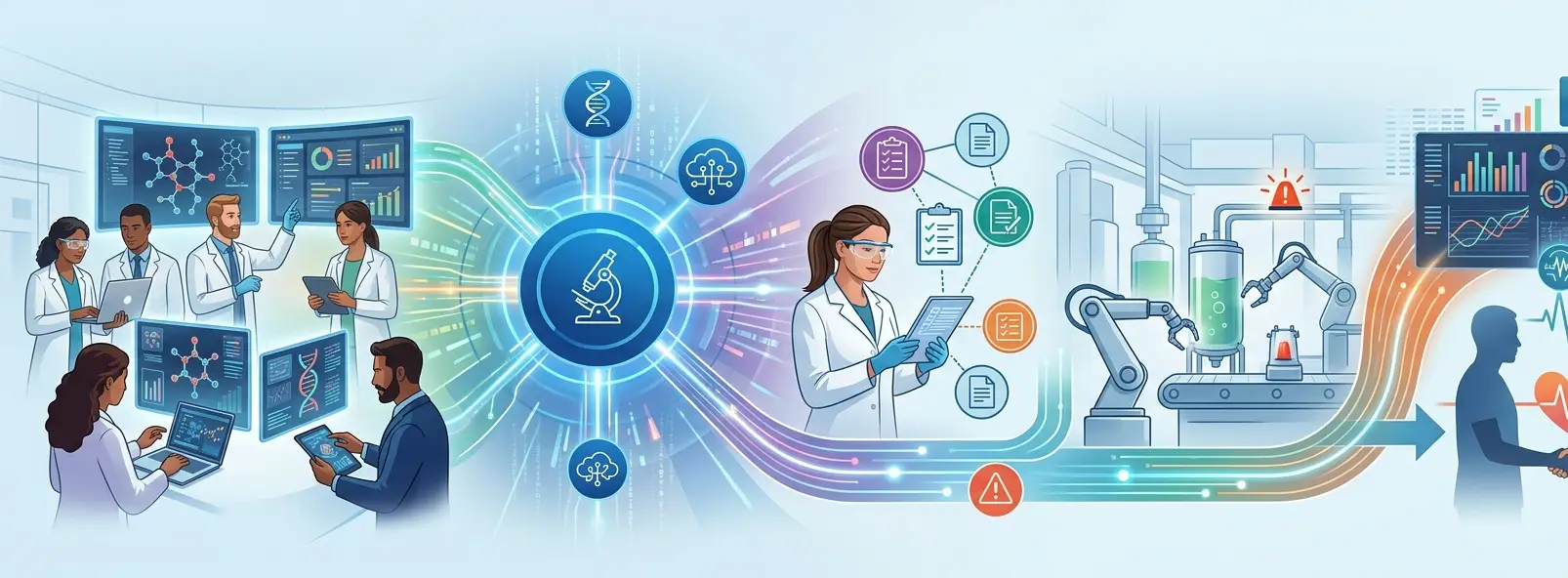
The most obvious benefit of connected life sciences technology is less friction between information and action. Researchers can get the data they need faster. Clinical and quality teams benefit from improved traceability. Production teams detect potential problems sooner. Automation and integration can aid in the reduction of repetitious administrative work.
That can result in shorter decision cycles, improved visibility to compliance, more effective operations, stronger collaboration and a more dependable data foundation for AI and analytics. The patient benefit may be indirect but it is important: fewer operational gaps might equate to better continuity, faster intervention and more dependable services.
Experion has seen this principle play out in practice. An integration ecosystem connecting clinical, workforce, finance, and safety systems helped an aged-care organization reduce manual effort by more than 40%. In another engagement, integrating 15+ medical-device models reduced manual data-entry time by 95%. The value came not from adding another isolated application, but from getting systems and data to work together.
What Does a Strong Life Sciences Technology Solution Deliver?
The answer depends on where an organization sits in the life sciences value chain.
For pharmaceutical businesses, the emphasis may be linking clinical, regulatory, manufacturing, quality and commercial operations while retaining traceability across the product lifecycle.
For biotech businesses, the focus is typically on scientific data, computing platforms, research cooperation and the potential to expand as programs proceed from discovery into development.
For medical device makers, technology must support connected products, device data, quality processes, product lifecycle management, and post-market visibility.
For Contract Research Organizations (CROs), the challenge is managing complicated trial operations across sponsors, sites, investigators, and geographies without losing visibility or consistency.
For Contract Development and Manufacturing Organizations (CDMOs), manufacturing control, quality, capacity planning, traceability, and supply-chain visibility are often more critical.
There is no single “best” life sciences platform. A strong solution is one that mirrors the organization’s operating model, regulatory environment, data needs, and growth priorities.
Why Life Sciences Technology Implementations Struggle?
The problem with life sciences technology applications is often not in the software itself.
The real problem is how to introduce a new platform into an environment constrained by legacy systems, regulated processes, fragmented data, user habits, and multiple points of integration. That may be fine on a clinical or quality platform, but if it cannot share trusted information with the systems around it, the business has just created another silo.
Validation is an additional degree of difficulty. FDA guidelines suggests a documented, risk-based approach, including how the system is used, the criticality of the data it processes and its potential impact on participant safety or the dependability of trial results. Interfaces, system updates and configurations may also need to be evaluated throughout the system lifecycle.
Data integrity is equally important. EMA guidance emphasizes that electronic data needs to be attributable, accurate, complete, consistent, available, and traceable throughout its lifecycle. That means governance, ownership, access control, and change management are part of the technology problem, not separate compliance tasks.
This is where implementation can become expensive and sluggish: teams discover integration, data-quality, validation, or adoption issues only after major technology decisions have already been made.
Best Practices for Successful Implementation
Start with the workflow that need to be optimized rather than the platform you want to introduce.
Define the intended use, the data involved, the regulatory and business risk, and the outcome you expect to change. That gives teams a clearer basis for deciding what should be modernized, integrated, automated, or left alone.
Then modernize in phased steps from there. APIs and integration layers can allow you to retain good legacy systems and build new features on top of them. Establish data ownership and quality rules up front. Build security, traceability, backup, access management, validation and change control into the architecture up front, not as a final check. Both the FDA and EMA guidance documents promote risk based life cycle methods for computerized systems and electronic data.
User adoption matters just as much as technical design. FDA guidance for computerized clinical systems also addresses training, roles and responsibilities, backup and recovery, system security, and change control, reinforcing that successful implementation depends on the operating model around the technology as well as the technology itself.
Experion’s capabilities align strongly with this approach. We combine incremental application modernization, API-led enterprise integration, cloud engineering, cybersecurity, data platforms, and regulated AI/MLOps capabilities to help life sciences organizations modernize without creating another disconnected layer of technology.
The final measure should remain practical: did the implementation reduce a delay, improve visibility, strengthen control, or help people make a better decision?
How to Choose the Right Life Sciences Technology Partner?
Searches for the best life sciences technology solutions providers in USA, best rated life sciences tech solutions providers, or best tech companies for life sciences solutions may produce long vendor lists. The better evaluation starts with your own operating problem.
Ask prospective partners:
- Do they understand pharmaceutical, biotech, medtech, or related life sciences workflows?
- Can they engineer around regulatory and validation requirements?
- Can they integrate with the systems you already depend on?
- Do they have genuine AI, data, cloud, cybersecurity, and product-engineering depth?
- Can they explain how the proposed architecture will scale?
- What happens after launch?
The best life sciences tech solutions companies should be able to discuss both technology and the business process technology is expected to improve.
How Can Experion Offer Support in Implementing Life Sciences Technology Solutions?
Experion’s healthcare and life sciences practice combines product engineering with AI, cloud, interoperability, data, security, and experience design. Its current focus extends to pharmaceutical, biotech and medtech companies, diagnostics, bioinformatics, regenerative medicine, and other healthcare and life sciences organizations.
The value of that breadth is most visible when problems cross system boundaries.
For a U.S. compounding pharmaceutical company, for example, Experion modernized a legacy order-management environment into a scalable platform supporting controlled-substance workflows. The implementation incorporated compliance automation, analytics and demand visibility and now supports more than 8,000 users and 2,000 hospitals.
In another engagement, Experion worked with a regenerative-medicine organization to assess fragmented donor operations, identify automation opportunities and establish a digital transformation roadmap designed to improve coordination and readiness for AI adoption.
The common thread is not technology for technology’s sake, but engineering technology around the operational outcome.
Where Life Sciences Technology Goes Next: Emerging Trends in Life Sciences Technology
The next generation of leading digital solutions for life sciences industry organizations will likely be defined less by isolated applications and more by connected intelligence.
AI agents and GenAI copilots can support increasingly complex knowledge work. Digital biomarkers and real-world evidence can help us understand patients beyond traditional encounters. Connected manufacturing setups can become more predictive with intelligent supply chains responding sooner to disruption. Digital therapeutics and precision medicine can make healthcare more individualized.
Autonomous laboratories, edge computing, hyperautomation, and eventually advances in quantum computing may expand the frontier further.
But the organizations that benefit most will not necessarily be those adopting technology first. They will be the ones building the data foundations, architecture, governance, and operating models that allow innovation to produce repeatable value.
With established capabilities across product engineering, healthcare and life sciences, AI, data, cloud, interoperability, and cybersecurity, Experion is positioned to help life sciences organizations move from fragmented digital initiatives toward secure, scalable technology ecosystems built around measurable outcomes.
Frequently Asked Questions (FAQs)
What are life sciences technology solutions?
Life sciences technology solutions combine software, cloud platforms, data, AI, analytics, automation, connected devices, and cybersecurity to support processes across research, clinical development, quality, manufacturing, supply chains, commercialization, and patient engagement.
What should companies look for in the best life sciences technology platforms?
Look beyond feature lists. The best life sciences technology platforms should be able to integrate with existing systems, support trusted data, scale with the organization, provide appropriate security and governance, and fit the workflows they are intended to improve.
How is AI being used in life sciences?
AI use cases include drug discovery, clinical-trial optimization, medical imaging, safety monitoring, precision medicine, predictive maintenance, quality workflows, and scientific or regulatory document intelligence.
Can legacy life sciences systems be modernized without replacing everything?
Yes. Depending on the architecture and business requirements, organizations can use APIs, cloud services, data platforms, and phased modernization to improve specific capabilities while retaining systems that still provide value.
What is the role of cloud technology in life sciences?
Cloud environments can provide scalable infrastructure for collaboration, analytics, data-intensive research, resilient operations, and AI workloads. The architecture must still account for security, governance, integration, and compliance requirements.
Which organizations use life sciences technology solutions?
Pharmaceutical companies, biotechnology organizations, medical-device manufacturers, CROs, CDMOs, diagnostics companies, research organizations, and other life sciences businesses use technology to support different parts of their value chains.
How should companies compare the best life sciences technology solutions providers?
Evaluate domain understanding, engineering depth, regulatory awareness, AI and cloud capabilities, integration experience, cybersecurity practices, scalability, global delivery, and post-launch support. The right partner should be able to connect technical choices to measurable business outcomes rather than simply demonstrate technology.
What makes Experion relevant as a life science technology solution partner?
Experion has an established Healthcare and Life Sciences practice spanning product engineering, AI, data, cloud, interoperability, cybersecurity, and digital experience, with capabilities relevant to pharmaceutical, biotech, medtech, diagnostics, bioinformatics, and related organizations.