






 Back
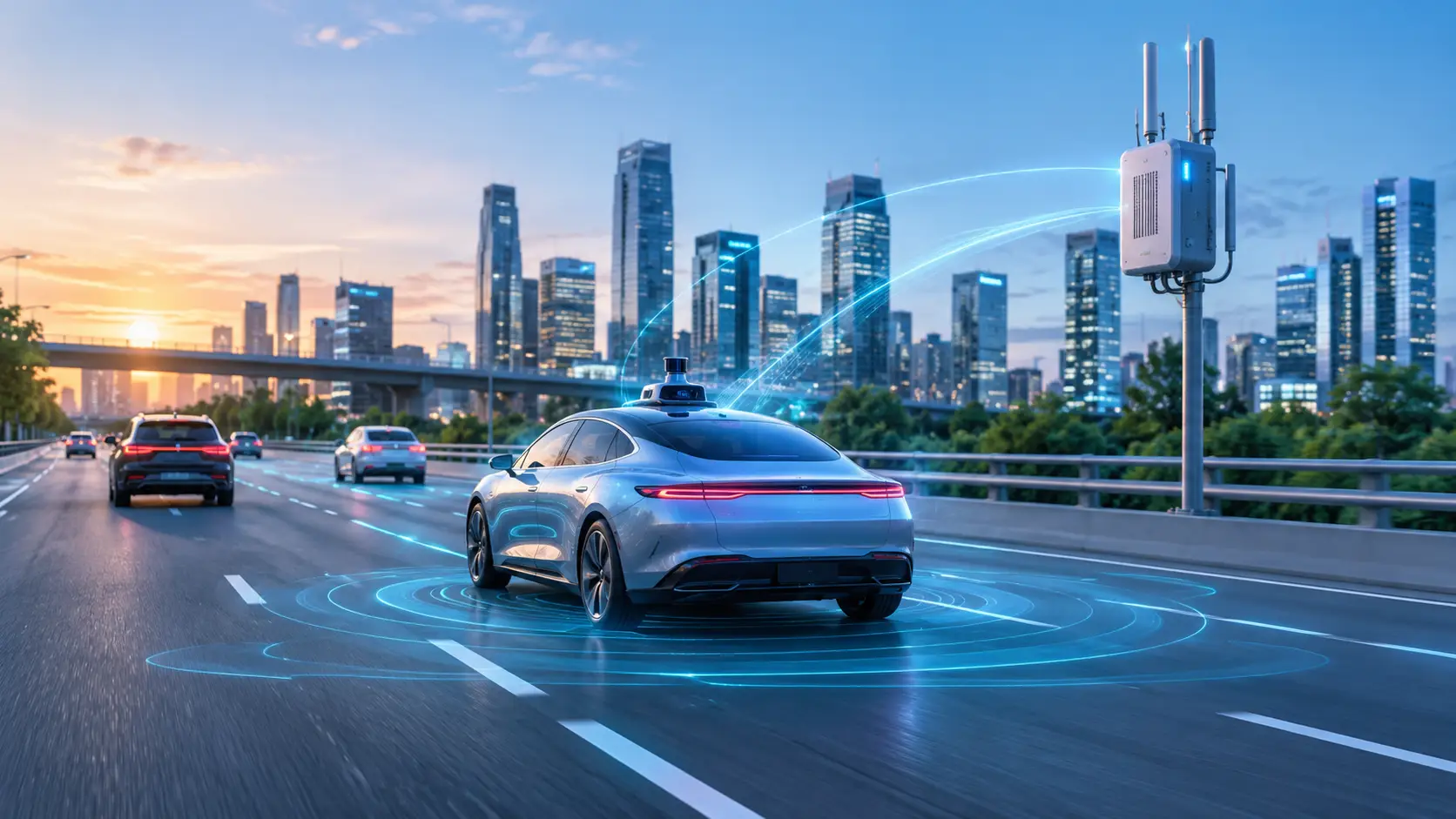
At Experion Technologies, our Mobility and Automotive teams can use real-time vehicle data to create reliable, production-quality insights, and edge computing plays a key role in that process.
Visualize a car navigating a busy traffic intersection without a driver, making split-second decisions. From self-driving cars to flying cars, the future of mobility depends on real-time computing. With self-driving cars producing terabytes of sensor data daily, relying solely on the cloud isn’t practical. Edge computing brings processing closer to the vehicle, enabling faster, safer, and more responsive autonomous driving.
Key Takeaways
- Edge computing allows autonomous vehicles to reduce their decision latency down from hundreds of milliseconds to just a few milliseconds by allowing sensor data to be processed on either the vehicle itself or near the side of the road.
- A full edge computing architecture for autonomous driving includes four layers: the in-vehicle layer, the roadside and MEC layer, the cloud layer, and the communications layer.
- The major areas where edge computing is used in autonomous vehicles include object detection, sensor fusion, path planning, predictive maintenance, Vehicle-to-X (V2X), and occupant monitoring.
- The best AI-based inference edge computing for autonomous vehicles must strike a balance between TOPS (tera operations per second), energy efficiency, functional safety certifications, quality of available software, and cost.
- Processing all vehicle data remotely using only cloud resources will fail both on low latency and poor connectivity. However, cloud resources provide ideal platforms for training models, simulating conditions, generating maps and performing analyses of vehicle fleets.
- Edge AI processing provides additional advantages regarding security and privacy since the unprocessed data remains on the vehicle.
What is Edge Computing in Autonomous Vehicles?
Edge computing refers to processing data closer to where it was generated, rather than transporting it to a remote data center. For autonomous vehicles there are two aspects of the “edge”: one is the computation hardware contained within the vehicle itself, while the other aspect is the surrounding infrastructure that can contain elements such as roadside units and multi-access edge computing (MEC) servers located near cellular towers.
There are significant reasons why this approach is important. Autonomous driving represents a difficult real-time challenge. A typical vehicle traveling at 100km/hr travels approximately 28 meters every second. If a pedestrian were to suddenly walk off the curb onto the crosswalk, the pedestrian detection system would have to identify the event, make decisions based on that identification, and activate braking before taking a round-trip journey back up to the cloud. Hence, it must do so locally.
How Edge Computing Systems for Autonomous Driving Work?
For autonomous driving, edge computing functions as a layered stack. All non-real-time functions reside in the cloud.
The data within the vehicle flows through 5 different levels:
- Sensing—Cameras, radar, and lidar collect raw sensor data at very high frame rates. Today’s advanced vehicle can stream gigabits/second from its various sensor suites.
- Perception—Neural networks recognize and categorize vehicles, pedestrians, lines of lanes, signs, and open spaces. This is typically the heaviest computational task.
- Prediction—The system predicts the future locations of all moving objects over the next few seconds, including intent (e.g., a cyclist who intends to turn).
- Planning—Based upon predictions along with a map of the environment, the planner selects a safe, comfortable, and lawful route.
- Control—Commands are issued to steering, throttle, and braking actuators via safety-certified controllers.
The entire loop executes typically thousands of times every second. Each additional millisecond of delay decreases the allowable reaction time for safe operation which is why this pipeline resides at the edge.
Edge Computing Architecture for Autonomous Driving
A robust edge computing architecture for autonomous driving spreads intelligence across four layers.
In-Vehicle Edge Layer: This is the vehicle’s own brain. A network of domain controllers, central compute units, sensor hubs, and safety controllers run perception, planning, and control. Newer vehicles consolidate many small ECUs into a few powerful central computers, which simplifies software updates and reduces wiring weight.
Roadside and MEC Layer: Data from many vehicles and infrastructure sensors are processed from roadside units, traffic signals and smart intersections. This layer can warn a vehicle about a red light runner hidden behind a truck or even coordinate vehicles through a junction.
Cloud Layer: The cloud layer is not the real-time control loop but improves the system over time. It handles model training, large-scale simulation, fleet analytics, high-definition maps, and over-the-air (OTA) updates.
Communication Layer: It forms the connectivity backbone of an autonomous driving system. This layer is what allows all the other layers in the architecture to freely exchange information with each other. Technologies such as 5G, DSRC, C-V2X, fibre backhaul, and network slicing makes this possible.
How Does Edge Computing Reduce Latency in Self-Driving Cars and Improves Real-Time Data Processing?
Edge computing reduces latencies experienced by self-driving cars and improves how quickly real-time data can be processed. Edge computing allows the processing of sensor data directly in the car (or via a roadside node) as opposed to processing sensor data on a distant server located in a “cloud”.
Therefore, using edge computing enables:
- Faster Object Detection: Quickly identifies pedestrians, vehicles, other objects and obstacles.
- Quicker Decision Making: Allows for rapid brake initiation, acceleration, and lane changes.
- Real Time Sensor Fusion: Fuses sensor inputs to provide better situational awareness of the environment surrounding the vehicle.
- Reliable Operation: Critical vehicle control operations are maintained during any possible disruption in connectivity.
Planning an edge-first architecture for your autonomous driving program?
Connect with Experion’s mobility engineering team
Key Edge Computing Applications in Autonomous Vehicles
Edge computing applications in self-driving vehicles primarily encompass safety and experience. These six applications matter the most.
Real-Time Object Detection and Collision Avoidance
Collision avoidance uses onboard computers running a real-time object detection algorithm in front of each camera. Radar frames can identify objects such as pedestrians, bicycles, cars, etc. Once an object that could potentially cause harm is detected, emergency braking or evasion will be initiated locally on the vehicle. Since no communication is required there is no potential for communication failures to delay the reaction of the vehicle.
Sensor Fusion and Perception
Each individual sensor type has its limitations. Cameras are poor in bright light conditions and very dark conditions. Radar has limited resolution; Lidar may have problems operating during periods of heavy rain. Combining the output of all sensor types to create one unified image of reality of the vehicle’s surroundings provides a much better understanding of the environment.
Path Planning and Real-Time Decision Making
Path planning involves determining the course of action over the next few seconds. A planner will assess traffic laws, comfort, intentions of surrounding road users, and perceived uncertainty based upon input from various sensors. Even without connectivity (e.g., cell phone or Wi-Fi connection), path planning will occur continuously without interruption.
Predictive Maintenance and Vehicle Health Monitoring
Edge analytics can monitor battery behavior, tyre pressure, brake wear and sensor calibration in real time. The vehicle flags only data anomalies instead of uploading everything and sends compact summaries to the cloud. Fleet operators can thus schedule the necessary repairs even before failure happens, reducing downtime and improving safety.
Traffic Management and V2X Communication
A vehicle to everything (V2X) lets vehicles exchange information with other vehicles, infrastructure and pedestrians. Edge nodes at roadsides aggregate this data to optimize signal timings, giving priority to emergency vehicle and offer hazard warnings. Processing happens at the roadside and alerts reach vehicles in near time.
Driver and Passenger Monitoring
Processing on device can enable continuous video capture and analysis from in-cab cameras/sensors for detecting drowsy or distracted driving behaviors. In addition, for Level 2 and Level 3 autonomous vehicles, processing on device can also detect when a driver is prepared to resume manual operation of the vehicle. Robotaxi passengers can be monitored for safety and cabin conditions. By maintaining all processing on board, privacy is maintained.
Edge AI for Autonomous Vehicles: Why On-Device Intelligence Matters?
There are five primary reasons why Edge AI for autonomous vehicles matter.
Role of Edge AI in Autonomous Driving
- Latency– On-device inference can respond in milliseconds, while a round trip to the cloud would take many orders of magnitude longer.
- Reliability– A vehicle will continue to function even in scenarios where connectivity is lost (tunnels, rural stretches, network congestion).
- Bandwidth/Cost– It is difficult to economically stream raw sensor data from a large number of vehicles. Reducing data transmission by processing at the source and transmitting only relevant events minimizes data transmission costs.
- Privacy – All camera and location data remain resident on board, thereby aiding in compliance with data protection regulations.
- Scalability – Each vehicle represents a self-contained compute unit. Therefore, when new vehicles enter service, there is no strain placed upon existing centralized infrastructure.
Discuss your roadmap with our technical teams and modernize your edge-to-cloud stack.
Choosing the Best AI Inference Edge Computing for Autonomous Vehicles
The top-rated edge computing for AI inference in autonomous vehicles is much more than the largest chip you can put into a vehicle. It is the combination of hardware that will meet your safety, power, and software needs at a suitable price point.
Key Criteria to Evaluate
- Inference performance (TOPS) and latency– Inference performance is indicated by the peak TOPS (tera operations per second), however, real world latency in your perception stack will matter far more.
- Power efficiency and thermal design: Efficiency refers to power consumption and thermal dissipation. Most vehicles have very little room to cool their electronics and they have very limited electrical power supplies.
- Safety certification-Automotive grade devices must meet certain levels of safety certification. Specifically, for many applications of autonomous vehicles, devices are certified under ISO 26262 and/or rated for ASIL (Automotive Safety Integrity Level) A through D levels.
- Software ecosystem and toolchain support– Level of support provided for development, integration, testing, etc., including compiler support, library optimization, simulator tools and other types of middleware. More mature ecosystems can significantly shorten the time to bring new products to market.
- Scalability and cost-Consider the total cost across the program, not just the chip price: development effort, validation, and per-vehicle cost at production volume. Also check whether the platform scales across vehicle tiers, so one software investment can serve both entry-level and premium models.
Popular Hardware Platforms
Several automotive-grade platforms such as NVIDIA and Qualcomm lead the market today.
| Platform | Indicative Performance | Power Profile | Typical Use |
| NVIDIA DRIVE Orin | Up to ~254 TOPS | Roughly 45 to 60 W class | L2+ to L4 production programmes and robotaxis |
| NVIDIA DRIVE Thor | Up to ~1,000 TOPS (INT8) and higher with lower precision | Higher-power central compute | Centralised compute for software-defined vehicles |
| Qualcomm Snapdragon Ride | Scalable family, from ADAS to high-end automated driving | Scalable by tier | Integrated cockpit and ADAS, cost-sensitive volume programmes |
| Mobileye EyeQ family | Tens to about 176 TOPS depending on variant | Low power, vision-focused | Camera-centric ADAS and L2+ to L4 |
| Tesla in-house FSD computer | Custom, vertically integrated, specs not fully public | Optimised for Tesla’s own stack | Tesla’s own vehicle fleet |
The most suitable choice depends on the autonomy level, software strategy, and sensor suite. Open platforms are flexible, while vertically integrated ones offer tight optimization.
At Experion, we can help mobility providers run structured platform evaluations, from porting and quantising models to profiling real latency and power on candidate hardware, so the decision rests on evidence rather than datasheets.
What is the Difference Between Edge Computing and Cloud Computing in Autonomous Vehicles?
In autonomous vehicles, edge computing is primarily concerned with the processing of sensor data in near-real-time. This is necessary to make timely and safe decisions regarding the driving environment. Cloud computing provides a means to support the development of autonomous vehicles by storing large amounts of data generated by autonomous vehicles; training artificial intelligence (AI) models; analyzing fleet performance; etc.
Parameter Edge Computing Cloud Computing
- Processing Occurs at the vehicle level (edge), or close proximity to it: Occurs in remote data centers.
- Latency Low: High because of networking delay.
- Primary use object detection, sensor fusion, vehicle control: AI model training, simulation, fleet analysis.
- Connectivity: The primary function works independently of internet connectivity. Requires network connectivity.
- Data Handling processes local data: Processes remote transmitted data.
Why Cloud-Only Processing Falls Short in Autonomous Driving and How Edge Computing Solves These Challenges?
While there is certainly an appeal to sending all processing to a cloud provider, since computing resources are abundant, for autonomous vehicle applications this fails for two primary reasons:
- Unacceptably long latencies: Even on high-speed networks, a round-trip communication path to a remote datacenter could potentially take tens or even hundreds of milliseconds and it will likely vary based on network traffic conditions.
- Vulnerabilities related to connectivity issues: Connectivity gaps (e.g. areas with no coverage), cell handoffs, interference and outages are common on public roads. Therefore, a vehicle that relies on cloud-based server for perception or control will become unreliable (i.e. unsafe) whenever it encounters connectivity issues. Furthermore, a cloud-based connection creates an additional vulnerability for cybersecurity attacks.
Edge computing eliminates both problems. Safety-critical perception, planning and control occur within the vehicle itself so regardless of connectivity status, the vehicle has the ability to make decisions autonomously.
Key Components of Edge Computing Systems for Autonomous Driving
Edge computing systems for autonomous driving are built from several tightly integrated components.
Onboard Computing Units
Domain Controllers and centralized Vehicle Computers are onboard computing units responsible for executing perception-related functions, planning functions and control functions. The units integrate CPUs/ dedicated accelerators along with redundant islands ensuring safe operation during failure events.
Sensors and Data Acquisition Systems
Sensors such as cameras, lidars, GNSS and inertial measurement units capture the environment around the vehicle. Data acquisition handle precise time synchronisation, calibration, and pre-processing, which are essential for accurate sensor fusion.
AI Accelerators and Inference Engines
In addition to the edge computing elements that have been described previously (edge software and middleware), edge computing also includes two other key components:
- Hardware: Including GPUs, NPUs, and dedicated automotive accelerators
- Software: Including both inference engines and compilers.
These two components work together to allow the efficient execution of neural networks and models that run on these devices.
Edge Software and Middleware
Real-time operating systems (RTOS), hypervisors, and middleware such as automotive Linux and AUTOSAR Adaptive manage scheduling, communication, and safety partitioning. Good middleware lets teams update features independently without destabilising safety-critical code.
Cloud and Edge Integration
Secure OTA pipelines, data logging, and fleet management tools connect vehicles with the cloud. Selective data upload, such as sending only interesting or rare driving scenarios, powers continuous model improvement without overwhelming the network.
Need help benchmarking edge AI hardware for your vehicle platform?
Speak to Experion’s AI engineering experts
Future Trends in Edge Computing in Autonomous Vehicles
In addition to enabling real-world deployments, there are many emerging trends that will significantly impact how edge computing is used in autonomous vehicles in the future. Some examples include:
- 5G and 6G advancements-While 5G provides significant improvements in terms of low-latency connections and network slicing, researchers are actively exploring what further improvements might be possible in the area of 6G. Specifically, researchers are studying whether it may be possible to create wireless networks with even lower latencies than 5G.
- Software-defined vehicles-As vehicles transition toward being fully software defined, vehicle owners will be able to download new features via OTA updates onto a centralized compute platform. Therefore, edge platforms will require long-lifecycle designs that can accommodate continuous changes.
- Federated learning across fleets– Rather than uploading raw sensor data from every vehicle in a fleet, vehicles will be able to train models locally based on their experiences and then send only model updates back to a central server.
- Neuromorphic and next-gen AI chips-Neuromorphic sensors and processors are being developed that consume extremely low amounts of energy and latency for specific perception-related tasks. At the same time, newer generations of acceleration hardware continue to improve upon previous ones.
- Growing collaboration between automakers, chipmakers and telecom providers-Since no single entity controls the entire value chain, collaborative partnerships between OEMs, chip makers and telecom providers have emerged as the preferred method of delivering end-to-end mobility solutions powered by edge computing.
Opportunities in Edge Computing for Autonomous Vehicles Market
There are currently two main opportunities for growth in the autonomous vehicle market related to edge computing.
- Firstly, edge AI platforms for Level 3 and higher level autonomous driving programs. Many manufacturers and mobility service providers are transitioning from developing driver-assistance systems towards developing Level 3+ autonomous driving systems.
- Secondly, roadside edge infrastructure for Vehicle-to-Vehicle (V2V), Vehicle-to-Infrastructure (V2I), Smart Corridors and Multi-access Edge Computing (MEC) node deployments. Municipalities and state transportation agencies are beginning to invest large sums of money in deploying connected corridors along highways, smart intersections in urban environments, and MEC nodes along major thoroughfares.
How Edge Computing Enhances Security in Autonomous Vehicles?
Autonomous vehicle security is primarily a matter of safety. If an attacker were successful in gaining unauthorized remote access to a vehicle’s onboard computer systems it is likely that serious consequences would result.
Edge computing addresses some of these issues by providing the following benefits:
- Reduced amount of sensitive data transmitted over potentially insecure networks- When processing occurs on the vehicle itself instead of being sent over networks, less sensitive information travels through networks where it could be captured.
- Less reliance on external communication– A vehicle that can operate autonomously regardless of its connection status with a cellular network or public Wi-Fi is much less vulnerable to disruption by an adversary seeking to gain unauthorized access through the network.
- Privacy by Design- Data collected directly by cameras or other sensors may remain resident on the vehicle unless it needs to be shared anonymously or in aggregate form with others.
- Trust based on hardware– Automotive-specific edge platforms offer capabilities like secure boot processes, HSMs (Hardware Security Modules), encryption of data stored on the platform, digital signatures applied to OTA updates received by the vehicle’s onboard computer(s) and prevention of modified code from executing.
- Layered defenses– Multiple layers of defense-in-depth such as network segmentation and intrusion detection systems combined with functional partitioning enabled by good-quality safety-critical software frameworks (such as ISO/SAE 21434 compliant)
While edge computing reduces an attacker’s ability to successfully target an autonomous vehicle’s onboard computer systems (i.e., reducing “attack surfaces”), it does not eliminate the possibility entirely.
What are the Benefits of Edge Computing for Autonomous Driving?
The benefits of Edge AI computing for Autonomous driving systems can be summarized as follows:
- It enables faster, safer decision-making at millisecond levels
- Resilience when connectivity is unavailable;
- Lower bandwidth usage and cloud storage costs
- Stronger protection for sensitive customer data
- Scalability as each vehicle contributes its own compute capability
- Constant improvement through fleet-wide data collection
- OTA updates and federated learning.
How Experion Builds Edge-to-Cloud AI Architecture for Mobility?
Experion Technologies enables automotive OEMs, Tier 1 suppliers, and mobility platforms to develop integrated edge-to-cloud AI systems. Our team brings experience in mobility engineering, edge computing, AI/ML, and cloud technologies to build solutions that support real-time data processing, intelligent decision-making, and scalable vehicle operations.
Conclusion
Edge Computing has now become the foundation of autonomous driving. By supporting real-time perception, safer decisions and vehicle intelligence, it is imperative in function. The strongest vehicle systems, now pair powerful onboard inference with roadside edge nodes and a cloud that trains, simulates, and learns from the fleet. Teams that get this balance right will ship safer, more capable, and more cost-effective autonomous vehicles.
With numerous years of experience across automotive software development and emerging mobility technologies, Experion is well positioned bridge the gap between vehicle-level intelligence and cloud-based innovation, enabling next-generation connected and autonomous mobility solutions.
Frequently Asked Questions (FAQs)
How does edge computing improve vehicle safety and reduce latency?
By processing sensor data locally either on the automobile or on a roadside device that is near to the automobile, edge computing reduces the delay from sending data to an external server via a network round-trip. The detection, decision-making, and braking functions can occur within milliseconds.
Can autonomous vehicles operate without cloud connectivity?
Yes. All core functions related to operating a vehicle autonomously, including perception, planning, and control are performed on-board; therefore, they can continue to operate autonomously with no need for a connection. While connectivity offers additional features, it is not necessary for safe autonomous operation of a vehicle.
What is the difference between edge AI and cloud AI in autonomous driving?
Edge-AI performs real-time inference processing on an automobile or near-by edge infrastructure; whereas cloud-AI processes information remotely, typically located in large remote data centers performing tasks associated with high-performance computing.
Which processors are used for AI inference in autonomous vehicles?
Processors commonly selected for this function include NVIDIA DRIVE (using Orin and Thor), Qualcomm Snapdragon Ride, Mobileye EyeQ processors, and custom silicon such as Tesla's internal computer chip. These processors provide a combination of CPU-based, GPU-based, and/or Neural Accelerator-based performance.
Is edge computing safe and secure for autonomous vehicles?
Yes. Because the data remains local to the vehicle, this approach improves safety and security; however, while improved compared to traditional approaches that rely upon external servers and networks, there are still many factors involved in ensuring the overall safety and security of autonomous vehicles through design.
How does 5G support edge computing for autonomous driving?
5G provides high bandwidth, low latency and network slicing. Combined with MEC servers at the network edge, it lets vehicles exchange data with infrastructure and each other quickly and reliably.
Will edge computing enable fully driverless cars?
Edge computing is an essential building block, enabling real-time onboard intelligence. Fully driverless operation also depends on the sensors, software maturity, validation, regulation, and public trust.
What are the main edge computing applications in autonomous vehicles?
The main edge computing applications include object detection and collision avoidance. Other applications include but are not limited to sensor fusion, path planning, predictive maintenance, driver and passenger monitoring.
What sensors does an edge computing system for autonomous driving use?
An edge computing system typically utilizes cameras, lidar, radar, GNSS and inertial measurement units. The sensor outputs are often combined through sensor fusion for a better view of the environment.
What is V2X, and how does it work with edge computing?
V2X stands for vehicle to everything and it lets vehicles communicate with other vehicles along with roadside infrastructure and pedestrians. Roadside edge nodes process data locally and communicates timely alerts to vehicles over C-V2X or 5G.