




 Back
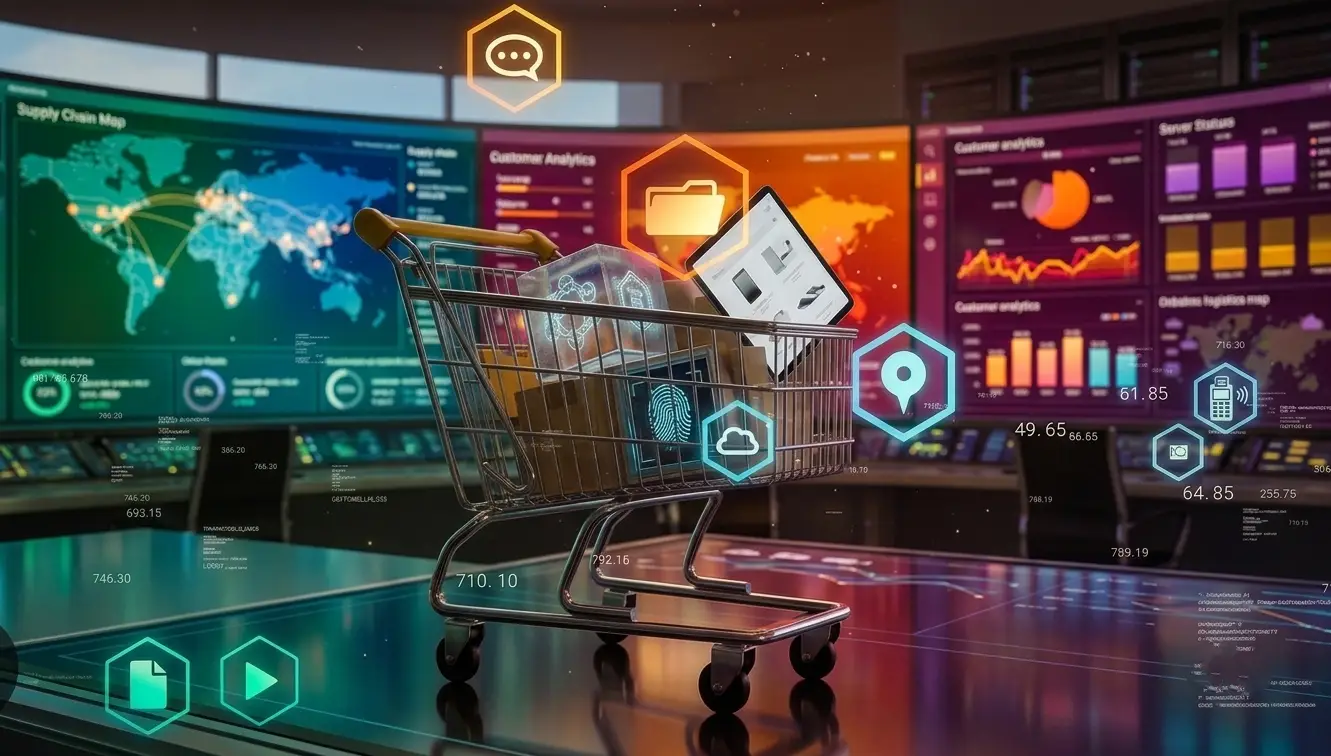
Experion can build the connected systems retailers run on. Our engineers work across commerce, data, AI, and cloud, and our retail technology solutions are built for the places where retail gets decided.
Consumers of today expect the same experience in all their channels of interaction. Prices are compared in seconds and with the rise in quick commerce, product delivery is expected in hours. As retailers expand their omnichannel presence, they have to manage a number of systems. Inventory sits in stores and warehouses, and some of it on marketplaces, while customer data is scattered across loyalty apps and POS terminals that don’t share a database with the web shop. Margins are thin and labor is expensive.
The retailers that stay ahead, tend to see their business clearly and move fast on what they see. Innovations in retail tech makes that possible.
Key Takeaways
- POS, E-commerce, CRM, inventory, payments, and analytics are connected into a single view with the help of retail technology solutions.
- Current customers expect more, decisions require live data and manual work is expensive. Retailers thus invest money into retail technology solutions.
- With the prevalence of AI, it now handles routine work in customer service, forecasting, customer analytics, and in-store operations.
- The emerging trends in retail tech solutions are Edge computing, agentic commerce, composable architecture, computer vision, digital twins, and augmented reality. These are worth following, even if you adopt only one.
- Stock outs and overstocking cost retailers a loss of around $1.75 trillion a year. The most practical solution to this challenge is through connected systems.
- Retail technology support services deserve the same careful approach as the launch, especially before peak season.
What are Retail Technology Solutions?
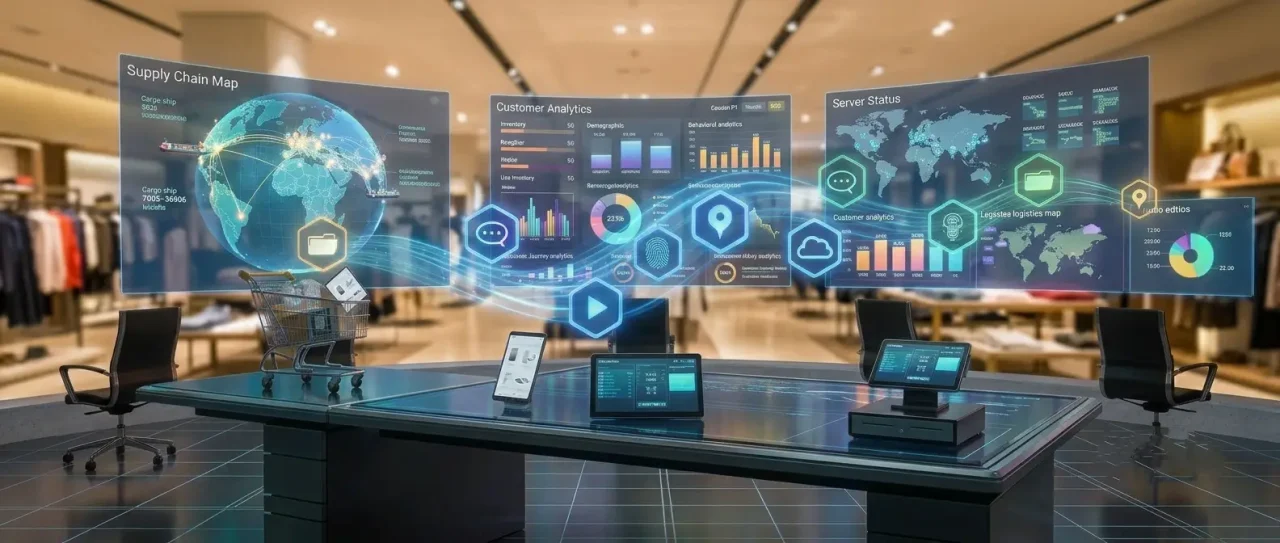
Retail technology is the hardware, software, data platforms, and services used by retailers in selling to and serving customers and in conducting their business. A corner-shop checkout terminal is included. So does a cloud analytics engine forecasting the demand of thousands of items in hundreds of stores.
A good solution goes both ways. At the front end, it must deal with product discovery, personalized offers, checkouts, loyalty, and service. Behind the store, it manages inventory, orders, employees, returns, reporting, and supplier coordination.
Retailers used to purchase these functions one tool at a time. The question now is how well the tools talk to each other. Retail industry technology solutions are worthwhile when a sale in one channel updates inventory everywhere and a customer’s preferences follow them from the app to the store.
Core components of Retail Technology
Retail technology comprises of the following core components. These are:
- POS systems: POS systems lie at the center of all the in-store operations. Most modern POS systems have the capability to run on cloud and mobile devices. They can process transactions, apply promotions, capture various customer details and sync with inventory and finance.
- Ecommerce platform: Ecommerce platforms exist in the online realm. It manages catalogs, pricing, carts and checkout. By connecting to marketplaces and social channels as well as fulfillment partners, Ecommerce platforms are a critical component of retail technology.
- CRM systems: A customer’s history lives in its CRM system. Their purchases, preferences and loyalty activity are recorded to form a customer persona. Without one customer record, personalization is guesswork.
- Inventory management systems: Inventory management systems can track stock wherever they exist, including trucks in transit. They trigger reorders, flag slow sellers, and inform customers of an item’s availability.
- Payments and checkout tools: These include cards, digital wallets and self-checkout.
- Data Analytics and AI platforms: Data Analytics platforms ingest raw data and produce reports, forecasts and recommendations. With the aid of these platforms, a retailer can plan their stock in advance.
Why are Retailers Investing in Retail Tech?
There are four major drivers behind most Spending on retail technology and why retailers are investing in retail tech companies more than ever. These four drivers include:
Meeting Evolving Customer Expectations
Consumers increasingly expect seamless and integrated shopping experiences across all touchpoints – whether through digital (e.g., e-commerce) or physical (e.g., stores). Consumers also expect their purchases to be recognized and supported across all those different touchpoints. For example, consumers who browse for a product on a mobile device and then pick-up that product in a store expect their experience to continue seamlessly from start-to-finish. For a retailer to meet consumer expectations as described above, retailers will require centralized customer data and real-time inventory visibility, along with flexible fulfillment options (e.g. Click-and-collect, ship-from-store, same-day delivery). If the retailer misses delivering on one of these components, the next closest retailer could receive the purchase.
Improving Operational Efficiency
Retail operates primarily on repetitive tasks. Automation delivers the greatest benefits here. Retailers implement automation into various repetitive functions throughout their inventory, order management and store operations (i.e. Automatically ordering a replenishment when stock reaches a predetermined threshold, automatically routing an order to the nearest store that carries the product ordered, automatically reconciling payment discrepancies, etc.). Savings from automation are important; however, the greater benefit of automation comes down to where people are spending their time.
Gaining Real-Time Business Insights
Retail decisions are based on monthly reports. Stakeholders can pinpoint problems only after they occur. This is where modern analytics and reports become useful. It displays purchasing patterns and customer preferences as they happen. For example- A merchandiser may view product sales rising in a particular geography and be able to adjust the promotions by afternoon. Operations managers can easily tackle fulfillment bottlenecks even before they turn into bottlenecks and marketers learn the campaigns that bring profitable customers instead of clicks.
Supporting Omnichannel Retail
Omnichannel retail involves connecting various channels including brick & mortar stores, e-commerce websites/platforms, mobile apps, and logistics/fulfillment capabilities. This allows the customer to interact with the brand via whatever means they prefer. While Omnichannel retail is relatively easy to define, it is challenging to deliver due to various systems and teams operating independently for each channel. Various retail technology solutions address these challenges through layers of integration, data sharing platforms, and order orchestration.
Experion works at the seam between strategy and engineering. Our teams build the connected platforms, integrations, and data foundations that let a retailer deliver the same experience across every channel without starting over.
AI in Retail: Transforming Customer Experiences and Operations
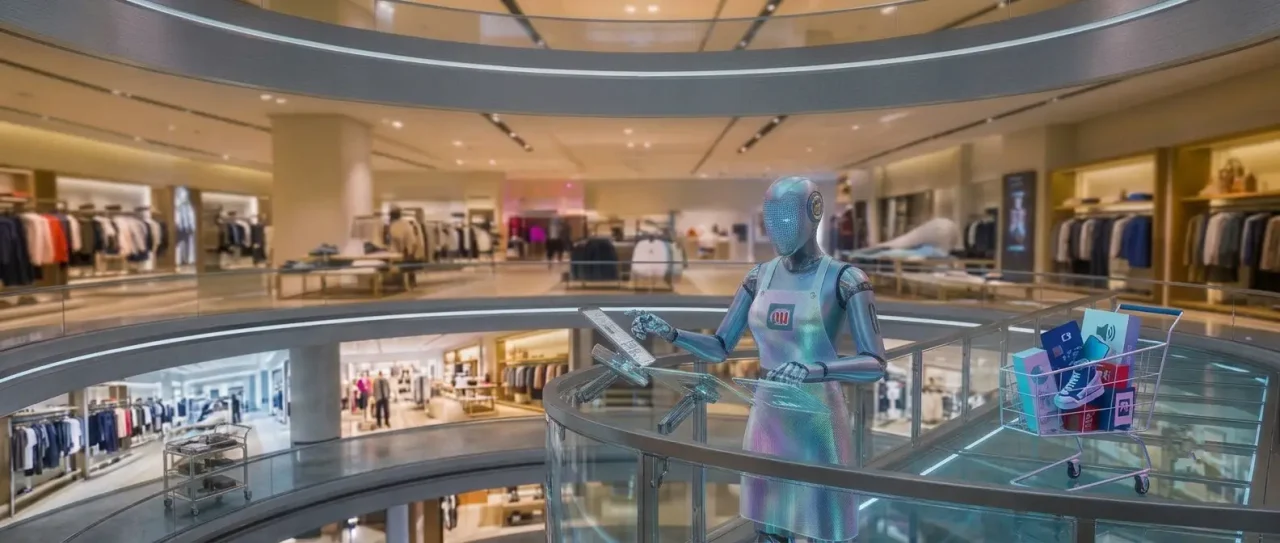
AI has shifted from pilot projects into daily retail work. It personalizes customer interactions at scale, helps supply chains absorb shocks, automates routine store tasks, and speeds up decisions that used to wait on a spreadsheet. Four use cases stand out.
Customer Service with Agentic AI
Chatbots were traditionally scripted. However, Agentic AI uses intelligence to pursue goals. Therefore, Agentic AI can read what the customer wants to do with their order/inventory information, act on the customer’s request, and transfer control over to a person when necessary. Asking “where is my order?” used to result in receiving a link with shipping information. With an Agentic AI system, a human representative can look up the status of the shipment, find out why there was a delay, determine if there is an acceptable replacement/refund option under company policy, and confirm the resolution of the issue with the customer within one interaction.
Managing Supply Chain Disruptions with AI
Regardless of how well run a supply chain is, storms, delayed shipments from ports, supplier shortages, and unexpected changes in demand create chaos. By applying machine learning algorithms to historical sales data combined with seasonal trends/promotions/weather/climate change/disaster-related factors/etc., retailers can significantly improve their ability to predict future demand. A primary benefit of utilizing AI in managing disruptions is the increased velocity of response.
AI-Powered Customer Analytics
Retailers have plenty of customer data with them, but they use very little of it. AI-powered customer analytics convert purchase history, loyalty activity and service contacts into predictions. Find out key insights such as who is about to lapse, which user is ready to buy again, products a consumer is likely to buy again, which offer would entice them etc. All these predictions feed relevant recommendations, messaging and loyalty programs.
Store Operations Automation with AI
Within the store, AI removes the repetition from daily tasks. Cameras and sensors are adept at spotting empty shelves and can alert staff accordingly. Scheduling tools can match staffing to expected foot traffic and pricing agents engines update shelf labels and online prices together. Loss-prevention systems flag odd patterns at checkout and in stockrooms.
The objective is better tools for store teams. Once routine monitoring runs itself, associates spend their time on service and product knowledge, which is what physical retail does better than any website.
Need end-to-end retail transformation services?
See how Experion can help you get better results, and talk to our retail technology experts
Emerging Trends in Retail Technology
Retailers are looking at what comes after current retail technologies. There are likely to be six areas of retail technology spending in the near future. Most retailers won’t want or need all six; however, they should consider their options.
Edge Computing for Real-Time Retail Operations
Retail transactions are delayed by round trips into the cloud. When you’re in a physical location (store), this delay may result in an uncompleted transaction or missed alerts. Edge computing allows processing of data at the point of production – camera/sensor/retail device. This enables instantaneous checkout validation, live shelf monitoring and reactive digital signage even on a low-bandwidth connection. For large chains with multiple locations, edge computing saves bandwidth and keeps mission-critical functions operational during network outages.
Agentic Commerce and Autonomous Shopping Experiences
Agentic commerce places AI agents in the consumer’s shopping chair. Consumers use these agents to find products, price comparisons and applying personal preferences and in some cases completing purchases. Retailers need to think about how consumers discover products because an AI agent views a catalog differently than a consumer who browses a website. As a result, product information will need to be correct and machine readable. Those retailers which take steps now to clean their product information catalogs and make available flexible APIs.
Unified Commerce and Composable Retail Architecture
Unified commerce represents an advancement from Omnichannel by having a unified platform across all channels for managing inventory, pricing, orders and customer data. A path to achieving unified commerce is through composability of retail technology. Rather than using a single monolithic application, a retailer uses best-of-breed applications that include search, carts, promotions, and order management. These applications communicate via APIs. Composability provides retailers with greater agility: replace one application without requiring a full platform replacement and deploy new channels more quickly.
Computer Vision and Smart Retail Environments
With computer vision, cameras and sensors can make sense of the store. It is used for queue management, footfall analysis, planogram compliance, cashierless checkout, and shelf-availability monitoring. The biggest concern is privacy. The successful implementations rely on aggregated anonymous data and educating customers about how the cameras improve the experience and the reason they’re there.
Digital Twins for Retail Stores and Supply Chains
A digital twin is a digital version of a store, warehouse, or supply chain that is updated with real-time data. Merchants test a layout by simulating the movement of a disruption in the network before moving a single fixture. Experiments run on the copy, so mistakes cost little, and only the ideas that work reach the real store.
Spatial Computing and Augmented Reality Shopping
With the help of augmented reality, a shopper can view how a sofa can fit their living room or how well spectacles sit on their face. Spatial computing blends digital content with the physical space with the help of phones, headsets and smart glasses. With AR, retailers can greatly reduce customer hesitation and the probability of returns.
Explore how we reengineered a 25 year Retail Platform into a modern, future-proof platform
Retail Management Software
Connected Retail Technology Solutions: Solving Inventory Distortion
Retailers around the world lose approximately $1.75 trillion annually as a result of inventory distortions.
These distortions occur in two ways: overstocking, which results in tying-up capital with inventory that does not sell (and ends up at a discount), and understocking or “stock-outs,” when a customer goes elsewhere because the desired item was not available. The primary reason that these distortions exist is due to disconnected systems. Retailer’s systems are designed to provide a “live” picture of their store’s inventory; however, they have no access to real-time information about their warehouse’s inventory levels, suppliers’ lead time, or online demand.
When all channels within a retail enterprise use connected technologies to share a single view of their inventory and customer demand, then the following occurs:
- The ability to see all channels of inventory (stores, warehouses, etc.) will enable each channel to operate from the same base numbers.
- AI-based demand forecasts that take into consideration factors such as seasonal variations, promotion related activities, local events/trends, etc.
- Automated Replenishment that directs stock to those stores most likely to sell the items.
- Utilization of RFID/Sensor Tracking to improve accuracy of physical counts and reduce losses resulting from theft/shrinkage.
- Simple dashboards that identify slow moving items early enough in their life cycle to allow for alternative strategies prior to being forced to utilize deep price reductions (markdowns).
Even small improvements in the accuracy of demand forecasting and physical count data will produce improvements in gross margins and working capital. Additionally, customers will also recognize the changes.
Custom Retail Technology Solutions vs. Off-the-Shelf Platforms
Ultimately, retailers are faced with the choice of purchasing an off-the-shelf platform or creating one. In certain cases, both answers are reasonable.
When Off-the-Shelf Solutions Make Sense
Off-the-shelf technology solutions for retail cover predictable standard needs, deadlines, and budgets. They’re slated to implement a new online store or a chain out to eliminate dying POS systems. They have known features and vendor support, for less money up front. They can be implemented for much less and deployed fasting.
When Custom Retail Technology Solutions Are a Better Fit
Custom retail technology solutions are worth it when the business does not fit the standard mold. This includes processes that a standard application cannot support or integration with legacy ERP or warehouse applications. Another is a customer experience that’s misaligned with the brand, like a product configurator or stylist’s clienteling app.
Custom builds are more expensive to create and require good engineering and product management. In return, they deliver something competitors can’t copy by buying the same software. If your customer experience sets you apart, that is worth paying for.
A Hybrid Approach to Retail Technology
Therefore, most retailers end up choosing a hybrid approach. They do this by leveraging existing platforms for any must-have aspects like payments, tax, and core commerce and adding custom applications and API and extensions where they would like to stand apart. Risk and time to market are reduced, and the retailer has room to differentiate itself. It also supports composable architecture, buying or building every component according to its strategic value.
Retail Technology Support Services: Why Post-Launch Matters?
Most retail tech projects are overthought by teams all the way until launch day and (afterward deprioritize). But that’s wrong. Retail systems are real-time systems running under unpredictable load, and each minute of downtime costs. Retail technology support sustains post-launch investments. A good retail technology support service offers a 24/7 helpdesk with clear escalation paths for store staff, e-commerce teams, and operations. They also include regular maintenance and updates (security patches, version upgrades, etc.) and proactive monitoring of performance, integrations, and payment flows to catch problems before they are visible to customers. The best even cover optimization from usage data work.
Downtime cost during peak times
Sales around holidays, back to school, and Black Friday can account for a significant portion of annual revenues. These windows mean that a checkout outage stalls sales and sends customers to a competitor, sometimes for good. A short outage is worth more than a year of support fees. All support plans should include load testing, disaster recovery planning, and pre-peak on-call coverage.
What to seek in a SLA
An SLA puts the promises in writing as commitments. Look for:
- Response & resolution time by severity.
- Guarantees on availability of POS, checkout, and order management.
- Coverage hours aligned to your trading hours, including weekends and holidays.
- Critical issue escalation contacts.
- Review meetings and performance reporting on a periodic basis.
- Security requirements and incident reporting terms.
- Service level miss remedies.
An SLA is only as good as the humans assigned to it, so ask to be provided references and real-world use cases.
How Experion Can Support Retail Technology Modernization?
With proven expertise in retail technology modernization, Experion helps retailers build connected, scalable technology ecosystems across headquarters, store back-office operations, mobile platforms, and customer-facing systems.
Some of our capabilities include:
- Real-time data integration: Enable seamless data flow across pricing, inventory, transactions, and reporting systems, giving retailers better visibility into business operations.
- Enterprise system integration: Connect POS, ERP, CRM, loyalty management, business intelligence (BI), and e-commerce platforms to create a unified retail ecosystem.
- API and middleware development: Build robust APIs, middleware, and integration layers that allow disparate applications to exchange data and work together efficiently.
- Cloud-ready platform modernization: Modernize legacy retail applications and infrastructure to improve scalability, flexibility, performance, and readiness for evolving business needs.
Turn fragmented operations into scalable digital ecosystems.
Contact us
Real-World Retail Technology Use Cases
Three scenarios showcase how retail technology services and tools work in the real world.
Grocery retailer: Smart Shelves, Dynamic Pricing, Self-Checkout and Inventory Visibility. A grocery business has high volumes and very little profit margin due to the fact most products have a limited shelf life. Therefore even the smallest improvement in operations may result in significant savings. Smart Shelves help identify when stock levels are running low so that employees are alerted prior to this happening. Employees can then restock the area with additional product thereby eliminating empty space on the shelves. Dynamic Pricing allows for product prices to drop as time gets closer to expiration date. This reduces the amount of expired product. Additionally, by reducing expired product it also reduces waste.
Fashion retailer: In fashion retail trends and sizes constantly fluctuate depending upon seasonal changes. Therefore AI Demand Forecasts use historical sales data combined with current trends in order to determine purchasing decisions and allocate merchandise accordingly. RFID Inventory Tracking systems provide the ability to track inventory accurately at all times. Ship From Store and Click and Collect become reliable options. Furthermore, an omnichannel return process enables customers to return online purchases in stores and get those returned items back onto the floor quickly.
Beauty retailer: Virtual Try-On, Personalized Recommendations, Loyalty Data and Clienteling Beauty retail is a highly personal experience where consumers seek evidence that a product will meet their individual needs. For this reason virtual try on allows customers to test color options at home. Additionally, recommendation engines create customized recommendations based on customer preferences (skin type), purchase history and other relevant information.
Experion helps retailers identify the technology gaps holding their operations back, assess existing systems, and build a modernization roadmap that prioritizes business needs, connects critical applications, and supports long-term scalability.
Frequently Asked Questions (FAQs)
Do retailers need custom retail technology solutions?
Not necessarily. Standard checks involve retail packaging. However, if they're not standard or they're tricky to integrate, custom retail tech solutions are the solution. Many retailers do both: they buy the common parts and build the uncommon parts.
What is the difference between retail tech and e-commerce technology?
Shopping carts, online payment, and digital delivery are what E-commerce technology means for doing shopping from stores online. Retail technology is broader. It involves in-store systems such as POS and inventory management, CRM, supply chain, tools, analytics, and AI. All integrated with modern in-store technology.
How can retailers modernize legacy systems without disrupting operations?
Upgradation happens one step at a time. Wrap APIs on legacy systems and port features while old and new systems are both live. Schedule cutovers during off-peak business hours and test each cutover beforehand.
What are the most common types of retail technology?
Common types of retail technology include POS systems,e-commerce platforms, inventory management systems, payment and checkout tools, and analytics and AI platforms. Many retailers also run mobile apps, loyalty platforms, order management systems, and supply chain tools.
How are retailers using technology to change shopping?
Retailers often personalize recommendations, provide click and collect options, same day delivery and speeds up checkout. Technology has added virtual try-ons and combined online and in-store experiences. AI assistants can easily answer questions and aptly resolve issues. Finally, analytics help retailers stock what customers require.
How do I choose the best innovation services for retail transformation?
Firstly look for a partner that has experience in retail and experience in integrating with existing systems. Ask them about any similar cases they've worked with. Also ask about the steps they take regarding their clients' data, AI/Analytics, Security. Make sure they plan to continue providing support after launch. Ultimately, the best innovation services for retail transformation will link every single technology decision to measurable business outcomes.
Can retail tech solutions integrate with my existing ERP, POS, or e-commerce platform?
Yes. Most modern tech solutions for retail are designed to connect with your existing ERP, POS and E-commerce platforms. This is done via APIs, Middleware and Event Driven Integration. As part of the Discovery Phase, identify the data flow, System Limitations and Integration Points prior to making any technical decisions.
What ROI can retailers expect from retail technology?
ROIs from retail technology varies by projects. Most benefits include include higher conversion, bigger baskets, lower inventory costs, less manual labor, fewer stockouts, and better retention. Keep baseline metrics and targets before you start, then measure regularly and adjust.
What security and compliance issues should retailers consider?
When considering new retail technology vendors, consider addressing at least the following: PCI-DSS Compliance related to payment processing, Privacy Rules (GDPR etc.) related to customer data storage and usage, Access Controls related to employee usage and Vendor Risk related to third party software/data usage. Plan for Incident Response procedures and make sure that any AI/Analytics Projects follow transparent and consent-based data collection practices.
What factors should retailers consider when investing in new retail technology solutions?
While investing in new retail technology solutions start with business goals and customer needs. Then weigh the integration with existing systems, the ability to grow, total cost of ownership, security, vendor support, and whether your team can adopt the change. Pilot where you can, and pick a roadmap that delivers value in stages.