






 Back
Back
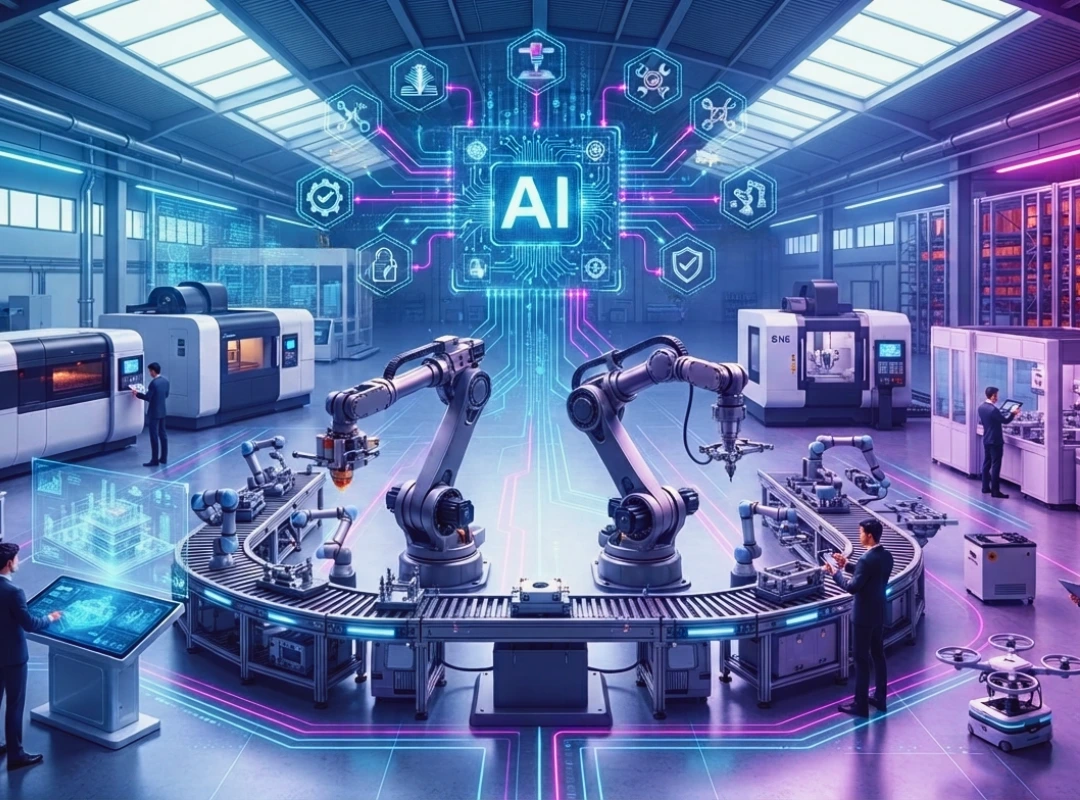
At Experion, we enable enterprises to translate this shift from theory into practice-not by building AI factories from the ground up, but by engineering the custom AI software, data pipelines, and MLOps layers that make one actually run.
The term “AI factory” was first conceptualized by Harvard Business School professors in their 2020 book “Competing in the Age of AI,” which explored how organizations can build and scale AI.
It was during the 2025 Nvidia GTC conference, when CEO Jensen Huang introduced his vision for the “AI factory,” that the term gained widespread attention and became a buzzword.
The concept is now widely known as one that aligns AI development with the industrial process. Years ago, AI sounded like an experiment confined to a laboratory. Now it is industrialized, and its operating model is the AI factory. Data serves as the raw material, while algorithms, compute infrastructure, and MLOps pipelines work together to produce and improve AI models, applications, and business insights.
Key Takeaways
- An AI factory is a purpose-built system that turns raw data into deployable, continuously improving intelligence on a repeatable, industrial scale.
- It integrates data pipelines, compute, model development, MLOps orchestration, and governance into one system—not a pile of disconnected tools.
- It solves the fragmentation, slow deployment, and reproducibility problems that plague most traditional ML workflows.
- It’s distinct from an AI data center (that’s just the raw infrastructure) and from traditional IT (general-purpose, not AI-optimized).
- Success gets tracked through model KPIs, operational KPIs, and business KPIs—and gets built fastest with the right custom AI software development partner.
What is AI Factory?
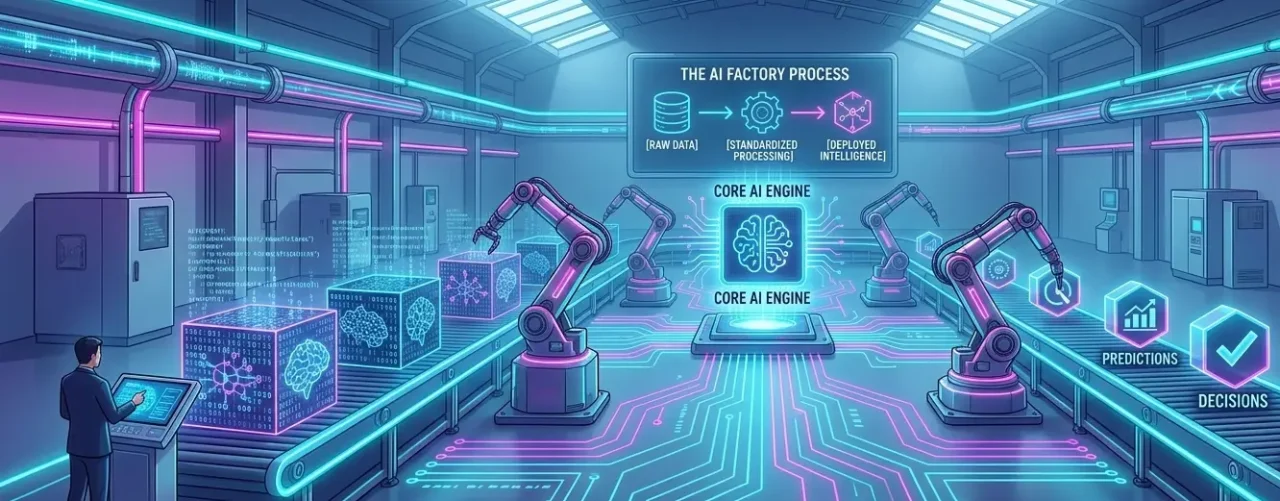
An AI factory is a system that takes in raw data on one end and reliably produces deployed, working intelligence on the other. This includes predictions, automated decisions, and recommendations on a repeatable schedule.
The manufacturing metaphor isn’t just a catchy name. A physical factory takes raw steel or plastic and runs it through the same standardized process every time, so the ten-thousandth unit off the line is as reliable as the first. An AI factory does the same thing with data. Nothing that comes out the other end is a hand-built exception. It’s the product of a process that runs again tomorrow, with the same discipline, whether the person who built it is in the office or on vacation.
The Data-to-Intelligence Pipeline
Every AI factory follows the same basic arc, and it’s worth internalizing because it changes how you think about the whole investment.
- Input is data such as transactions, logs, sensor feeds, unstructured text, or whatever your business generates. In a factory that’s working, this data flows through governed, reusable channels instead of getting scavenged fresh for every new project.
- Processing is where real machinery lives. Data gets shaped into features; models get trained and fine-tuned on serious compute, and every candidate gets validated and versioned before it goes anywhere near production.
- Output is intelligence doing something useful, a prediction served to an app, a decision made inside a workflow, or an action taken by an agent. And here’s the part people miss: the output loops back. Real-world results become new training data, and the factory gets better on its own over time instead of going stale the week after launch.
Core Components of AI Factory Infrastructure Solutions
An AI factory isn’t a product you purchase off a shelf. It’s an assembled set of capabilities that need to work together:
- Data pipeline — Ingestion, cleaning, transformation, and feature engineering that turns messy raw sources into model-ready inputs
- Algorithm development — Where data scientists actually design and refine models
- Experimentation platform — Tracking and comparing runs so the best approach wins on evidence, not on whoever argued loudest in the meeting
- Software infrastructure — The APIs and application layer that let models plug into products people use
- AI infrastructure — GPUs, accelerators, high-throughput storage, and networking built for training and inference, not general-purpose computing
- Automation tools — The connective tissue that kills manual handoffs, from retraining triggers to CI/CD for models
- MLOps and orchestration software—The control plane schedules jobs, manages versions, and keeps the whole thing observable and governed
When these pieces are actually integrated, you get a factory. When they’re bolted together as an afterthought — which is how most organizations end up — you get the fragile, expensive mess that most companies are trying to escape.
Who are Building AI Factories?
AI factories aren’t limited only to enterprises. A few different players build and run them, each for their own reason.
- Enterprises build one to use it. Models that improve operations, customer experience, or decision-making, depending on what the business actually needs.
- Cloud providers build the infrastructure that other people’s factories sit on. Compute, AI platforms, and managed services. That’s the whole pitch—you don’t have to buy and monitor your own hardware.
- Platform Teams (Dedicated Internal Engineering teams), usually internal engineering or MLOps groups, build and run the factory itself. They’re the ones standardizing workflows, handling security, and keeping things consistent as the org scales up.
Why AI Factories Matter?
Traditional machine learning workflows are fragmented almost by design. Data sits in silos. Feature engineering gets rebuilt from scratch for every project because nobody bothered to save the last version. Models get trained on someone’s personal laptop. Deployment is a manual scramble that depends on whoever’s around that week. And reproducibility — the ability to recreate exactly what shipped and explain why it behaved a certain way — is often flatly impossible six months later.
An AI factory is the direct inverse of every one of those pains:
- Faster time-to-model, because pipelines and tooling get reused instead of being rebuilt from zero each time
- Consistent deployment, because shipping a model follows the same automated path every single time
- Real cost efficiency, because compute and storage are pooled and right-sized rather than duplicated across ten different teams doing the same thing badly
- Governance that actually holds up, because every model, dataset, and decision is versioned and auditable—which matters a great deal the first time a regulator or auditor asks how a decision was made
This is the shift from occasionally demonstrating AI to dependably operating it — the same maturity leap that modern AI software development services are built around. It’s the difference between a company that can show off a good demo and one that can run AI the way it runs payroll: quietly, reliably, without drama.
How Do AI Factories Work?
An AI factory isn’t a project with a finish line. It’s a cycle that runs continuously, and understanding the four stages helps you spot exactly where your current setup is breaking down.
Data Ingestion and Preparation
Everything starts with data flowing in from source systems — databases, event streams, files, third-party feeds—and then going through cleaning, validation, transformation, and feature engineering. Well-designed factories centralize reusable features in a feature store, so the same high-quality inputs power multiple models rather than being rebuilt every time someone starts a new project. Data quality checks run automatically here, catching drift and anomalies before they poison whatever gets trained downstream.
Model Training and Fine-Tuning
Prepared data feeds into training, where teams build new models or fine-tune existing foundation models on their own domain data. The experimentation platform tracks every run — data version, parameters, results — so comparisons are rigorous rather than based on gut feeling. High-performance computing gets scheduled and shared across teams, which matters more than it sounds: idle GPUs are one of the quietest ways enterprises burn money on AI without realizing it.
Inference and Deployment at Scale
A trained model that’s never deployed is a research project, not a business asset. The factory automates deployment through standardized packaging and CI/CD pipelines, pushing models into production via APIs or directly embedded in applications. It handles the unglamorous but critical parts: autoscaling to meet demand, keeping latency low, running versioned rollouts, and rolling back safely when something goes sideways.
Continuous Monitoring and Optimization
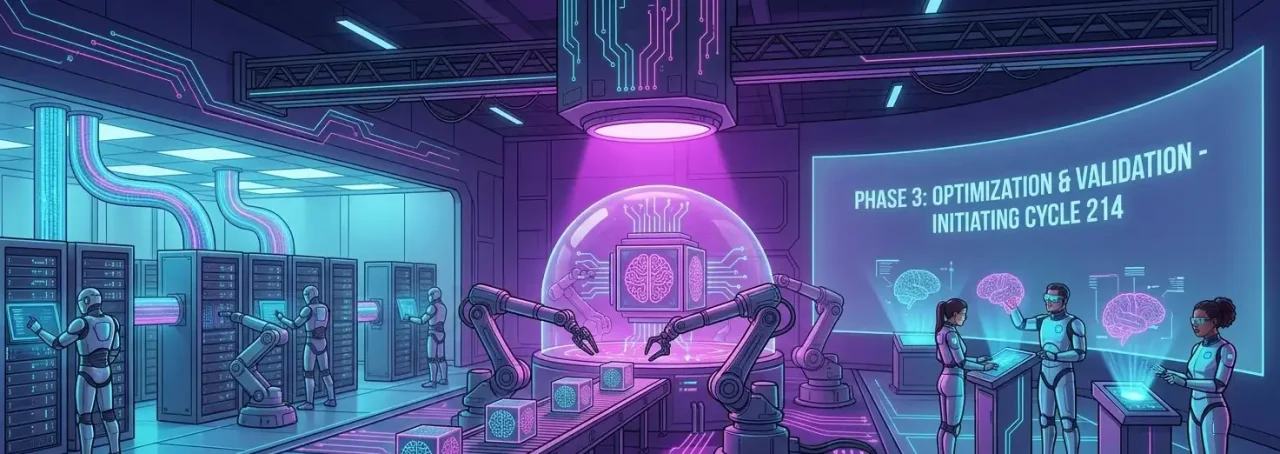
Deployment isn’t the finish line — this is the stage most organizations skip entirely, and it’s usually where things quietly fall apart. The factory watches live models for accuracy degradation, data drift, latency creep, and cost anomalies. When performance drops below a set threshold, it can trigger automated retraining, closing the loop back to ingestion. This continuous-improvement loop is what actually separates a factory from a one-time launch.
Artificial Intelligence factory vs AI Data Center
These two terms get used almost interchangeably, and that confusion costs companies real money.
An AI data center is a physical or cloud infrastructure — the buildings, racks, GPUs, networking, and power built to run heavy AI workloads. It’s raw horsepower.
An AI factory is the operational system built on top of that horsepower — the software, pipelines, orchestration, and workflows that turn compute into a repeatable data-to-intelligence process. You can own a data center packed with the most expensive accelerators on the market and still not have an AI factory, because the factory is defined by process and integration, not hardware specs. Put simply: the data center is where the power lives. The factory is how that power actually turns into products people use.
Turn your data into an AI factory.
Reach out to our team of experts
AI Factory vs Traditional IT Infrastructure — What’s the Difference?
For anyone weighing whether to modernize, this comparison is usually the clearest way to see the actual value.
| Dimension | Traditional IT Infrastructure | AI Factory |
| Primary purpose | Run general-purpose applications and store data | Produce, deploy, and improve AI models continuously |
| Hardware | CPU-centric, general compute | GPU/accelerator fleets for training and inference |
| Elasticity | Provisioned for steady, predictable loads | Elastic, built to burst for spiky training and inference demand |
| Software stack | Databases, app servers, middleware | Data pipelines, feature stores, MLOps, experimentation tooling |
| Workflow | Deploy once, maintain steadily | Continuous retraining, redeployment, and monitoring loops |
| Optimization target | Uptime and transaction throughput | Time-to-model, prediction quality, cost per prediction |
Traditional infrastructure was never designed for AI’s actual demands — the parallel compute needed for training, the elastic scaling inference requires, or the specialized software needed to manage a model’s entire lifecycle. The honest question for most organizations isn’t whether existing infrastructure can technically run a model. It can, in a pinch. The real question is whether it can do that repeatedly, affordably, and at scale without an engineer manually babysitting it whenever something changes. That’s the gap an AI factory closes.
Many organizations invest in AI infrastructure but struggle to integrate it into a cohesive, production-ready AI factory. Experion’s custom AI software development services can help connect the pieces.
Building Your Own AI Factory — Key Infrastructure Considerations
Building an AI factory comes down to a handful of deliberate architectural calls. Three tend to dominate the conversation.
On-Premise vs Cloud vs Hybrid AI Factory Models
- On-premise gives you maximum control over data and hardware — which matters if you’re operating under strict data residency or regulatory demands — but it comes with high upfront capital cost and requires real in-house expertise to run well.
- Cloud offers elasticity, managed services, and fast time-to-value with no hardware to procure, at the cost of ongoing operational spend and dependence on a provider’s roadmap.
- Hybrid is increasingly the default for large enterprises: sensitive data and steady workloads stay on premises, while training and experimentation burst into the cloud when needed. There’s no universally right answer here — it depends on your data sensitivity, cost profile, and whatever you’ve already sunk money into.
Choosing the Right Compute and Storage Stack
Compute decisions center on choosing the right accelerators for your actual workload mix — training-heavy environments need different hardware than inference-heavy ones — and on rightsizing so you’re neither starving teams of capacity nor paying for GPUs that sit idle. Storage must handle both volume and velocity: object storage for large datasets, high-throughput storage for active training, and feature stores for fast, reusable feature serving.
Security, Governance, and Compliance in AI Factories
Since an AI factory primarily focuses on data and decision making, security and governance cannot be afterthoughts.
Some security checks include:
- Strong Identity and Access Controls
- Encryption of data in transit and at rest
- Full lineage tracking
- Audit trails
In regulated industries, especially, governance is what separates an AI factory that can scale from one that gets shut down. Building this in from the start is far cheaper than retrofitting it later.
Common Challenges and How to Address Them?
None of this is frictionless, and it’s worth naming the friction honestly rather than pretending the path is smooth.
- Data quality and labeling bottlenecks—Garbage in, Garbage out still applies, and it applies at scale now.
- Model reproducibility and drift—Models degrade quietly, and without monitoring, you often don’t notice until a customer does.
- Compute and storage cost—GPUs are expensive, and idle ones are a silent budget leak.
- Organizational alignment and skill gaps—The technology is rarely the hardest part; getting data science, engineering, and business teams rowing in the same direction usually is
None of these is a reason to avoid building a factory. There are reasons to build one with people who’ve hit these walls before.
Talk to our AI engineers about your first use case
Key Benefits of AI Factories for Businesses
Operational Efficiency and Automation
Automated pipelines replace manual handoffs, so people stop wrangling data, monitoring deployments, and firefighting production issues — and get to work on harder problems. Routine decisions run themselves, and the model’s lifecycle needs a lot less handholding to keep moving.
Faster Time-to-Insight and Decision-Making
Reusable pipelines and standard tooling turn a months-long path from idea to deployed model into a matter of weeks, sometimes days. Decisions that used to wait on a slow analysis cycle can now happen close to real time.
Scalability Without Linear Cost Increase
The infrastructure and pipelines are shared; the second model costs much less than the first, and the fiftieth costs even less. Value grows faster than cost, which is basically the only reason enterprise-wide AI pencils out financially.
Improved ROI on AI Investments
Scattered, one-off AI projects waste money on duplicated work and pilots that go nowhere. With a factory approach, the dataset, feature, or pipeline built for one use case makes the next one cheaper and faster. That compounding, not any single project, is where the real return shows up.
KPIs and Metrics to Track
A successful AI factory measures performance across three key areas:
- Model Metrics—These metrics evaluate how efficiently AI models perform. Accuracy, precision, recall, inference latency, and throughput indicate how well individual models perform.
- Operational Metrics—These metrics assess the efficiency and stability of AI operations. Metrics such as mean time to identify (MTTI), mean time to resolve (MTTR), deployment frequency, and pipeline success rates. This tells you whether the factory is running smoothly.
- Business Metrics—It can capture the value delivered by AI initiatives. Revenue impact, cost savings, cost per prediction, and return on investment (ROI) are some examples.
Real-world Use Cases and Case Studies
An AI factory earns its keep in industries that run many models on large volumes of data, where the cost of manual, fragmented ML workflows compounds fastest.
- Telecom: Telecoms are utilizing AI factories to improve customer service and network efficiency. It combines national data, energy, and GPUs to generate AI applications at scale.
Eg: In 2025, Telenor opened Norway’s first AI factory, enabling organizations to process sensitive data securely. Additionally, it allows businesses to scale AI models efficiently while keeping in line with Norway’s strict data protection regulations. - Finance: Enables the continuous retraining of fraud detection models. In the financial sector, as attack patterns evolve constantly, credit risk assessments are automated, and real-time decision-making is improved through analytics.
Eg: Standard Chartered Bank launched an AI factory with a library of micro-AI capabilities, enabling its internal teams to create their own solutions. The AI factory provides teams with a hub of reusable components for retrieval-augmented generation (RAG), intelligent document processing (IDP), agentic AI, and machine learning (ML) model training and deployment. - Advanced Robotics and Autonomous Vehicles: AI factories can train and validate perception and decision-making models using large volumes of real-world sensor and driving data.
Prominent examples include Hyundai Motor Group’s collaboration with NVIDIA to create an AI factory. One that brings together autonomous driving, factory automation, and in-vehicle AI all into one single ecosystem. - Drug Discovery and Personalized Medicine: Uses AI factories to screen molecular candidates, model biological interactions, and tailor treatments—compressing timelines that once took years.
Eg: Lilly, the pharmaceutical giant, along with NVIDIA, announced an AI factory that can train frontier models to optimize and validate new molecules with higher accuracy. It can also support advanced applications in medical imaging and scientific AI agents. - Manufacturing/Logistics: Logistics applies AI in factories for predictive equipment maintenance and demand forecasting, reducing downtime and optimizing supply chains at scale. It can continuously process data from machines, warehouses, and supply chains to generate real-time insights for minimizing disruptions.
Implementation Roadmap: How to Build an AI Factory?
Building an AI factory is an iterative process, and a practical roadmap looks like this:
- Assess maturity and goals, choose scope for first use cases: Evaluate the entire set of data, skill sets, and infrastructure. Then pick a first use case that would offer measurable outcomes. Examples of use cases include fraud detection, demand forecasting, and customer service automation.
- Design data and feature pipelines: Build the ingestion, cleaning, and feature engineering foundations—ideally with reuse in mind from day one. Typical data sources include ERP and CRM platforms, third-party APIs, and customer interactions.
- Select tooling and infrastructure: With the data foundation decided, organizations can build the tech stack that powers the AI factory.
- Setup CI/CD for models, monitoring, and governance: Implement MLOps practices to automate model testing, deployment, and updates using CI/CD pipelines. Continuously monitor model performance to detect data drift and trigger retraining when needed. Establish governance policies for data security, privacy, compliance, etc.
- Pilot, iterate, scale, and measure ROI: Ship the first use case, learn from it; harden the platform; then reuse those foundations for the next use cases, measuring ROI at every step.
For a typical enterprise pilot, expect roughly three to six months to deliver a first production use case on a minimal viable factory, with the platform maturing and expanding across use cases over the following six to twelve months. The exact timeline depends heavily on data readiness and organizational alignment.
Get a free AI readiness assessment for your data pipelines
AI Factory Infrastructure Solutions
Infrastructure needs its own strategy, too, and the old on-prem vs. cloud vs. hybrid debate resurfaces here — just through the lens of latency, cost, and data residency. On-prem keeps things fast and your data close, but you’re paying for the hardware and the people to run it. Cloud gets you elasticity and speed, at a bill that never really stops. Most large enterprises end up splitting the difference with a hybrid approach.
The key infrastructure building blocks are as follows:
- GPU/accelerator fleets for training and inference
- An orchestration layer (commonly Kubernetes) to schedule and manage workloads
- Storage spanning object stores and feature stores
- High-throughput networking
- Robust identity and access management.
Finally, organizations must choose between managed solutions, open-source stacks, and commercial platforms. Managed cloud services offer speed and lower operational burden; open-source stacks offer control and cost flexibility at the price of engineering effort; commercial platforms sit in between. Most successful factories blend all three — and the assembly of these pieces into a coherent, business-fit system is exactly where experienced custom AI software development services earn their keep.
The Future of AI Factories — What’s Next?
The concept is still evolving, and a few trends are worth watching if you’re planning a multi-year investment rather than a one-off project.
- Edge AI factories will push training and inference closer to where data actually gets generated—inside vehicles, on factory floors, and on devices themselves—enabling real-time intelligence without a round trip to the cloud.
- Agentic AI integration will shift factories from producing predictive models toward producing autonomous agents that plan and act on their own.
- Sustainability and green computing will move from a nice-to-have talking point to a genuine mandate as the energy footprint of large-scale AI training comes under greater scrutiny.
- Industry-specific AI factories, pre-tuned for the data and regulatory realities of sectors like healthcare or finance, will lower the barrier to entry for companies that don’t want to build everything from scratch.
- The democratization of AI will put factory-grade capabilities within reach of mid-sized organizations, not just the handful of enterprises that can afford to build one internally today.
Conclusion
In short, AI factory industrializes AI development, much like a production assembly line that converts data into valuable AI insights and predictions. Though it is expensive to build, requiring a high initial investment in technology and data governance, in the long run, it becomes a strategic advantage for businesses. The organizations that treat AI as a production capability rather than a series of experiments are the ones capturing durable ROI, scaling without runaway cost, and turning AI from a promising demo into a dependable engine of the business. That is the promise of the AI factory and the reason it has become the central architecture of the AI era.
Whether you are scoping your first use case or scaling across teams — Experion's AI software development services can help you build the pipelines, integrations, and applications an AI factory runs on, without you having to engineer it all in-house.
Frequently Asked Questions (FAQs)
What is an AI factory in simple terms?
An AI factory takes in raw data and converts it into useful intelligence. Forms of insights include predictions, automations, and decisions on a repeatable scale, much like a physical factory that turns raw materials into finished products.
How is an AI factory different from a traditional data center?
A traditional data center usually runs general-purpose applications on CPU-centric hardware. An AI factory is built specifically for AI, with GPU/accelerator fleets, specialized software for pipelines, MLOps, and continuous model deployment.
Is an AI factory the same as an AI data center?
No. An AI data center is the raw infrastructure (buildings, GPUs, networking). An AI factory is the operational system — software, pipelines, and workflows — built on top of that infrastructure to produce intelligence in a repeatable way.
What are the core components of an AI factory?
The core components include data pipelines, algorithm development, an experimentation platform, and software and AI infrastructure that provide computing and storage. Automation tools streamline repetitive workflows, and MLOps provide versioning, deployment, and continuous model updates.
Should an AI factory be built on-premises, or can it be in the cloud?
It can be built on-premises, in the cloud, or as a hybrid model. Cloud offers speed and flexibility; on-premises offers data residency; and hybrid balances both features. The right choice depends on your data sensitivity, cost profile, and compliance needs.
What business problems does an AI factory actually solve?
AI factory solves various business problems such as fragmentation, slow deployment, poor reproducibility, and runaway cost. All of these enable faster time-to-model, strong governance, and AI value that scales without a linear increase in spend.
How long does it take to build an AI factory?
The timeline ultimately depends on the organization's data readiness, infrastructure, and business goals. A first production use case typically takes three to six months. Over the following six to twelve months, the platform will expand across further use cases depending on data readiness.
What are the biggest challenges when implementing an AI factory?
Data quality and labeling bottlenecks, model reproducibility and drift, the cost of compute and storage, and organizational alignment and skill gaps — all of which can be mitigated with the right processes, tooling, and expertise.
What KPIs should be tracked to measure an AI factory's success?
KPIs such as model metrics (accuracy, latency, throughput), operational metrics (MTTI/MTTR for model incidents, deployment frequency), and business metrics (revenue impact, cost savings, cost per prediction) can be used to measure an AI factory’s success.
Which industries benefit most from an AI factory?
Telecom, finance, advanced robotics and autonomous vehicles, drug discovery and personalized medicine, and manufacturing and logistics are among the biggest beneficiaries — any industry that runs many AI models on large volumes of data.