






 Back
Back

At Experion, we enable logistics and mobility companies to build IoT fleet management solutions that combine connected devices, cloud platforms, AI analytics, and enterprise integrations into a single operational ecosystem.
Fleet operators are increasingly moving towards IoT fleet management. Using connected sensors and telematics on vehicles and assets, a fleet manager can easily get answers to hard questions such as “Where is truck 42?”, “which vehicle might fail” and “which route is burning your fuel budget?”
Key Takeaways
- IoT fleet management is one step ahead of GPS. Legacy tracking simply answers “Where,” but IoT answers “Why,” “What Next,” and “What it costs.”
- There are four layers that make fleet management possible. These are sensors and connected devices, a connectivity layer, a cloud platform, and an AI decision layer.
- The highest cases of ROI are fuel monitoring, predictive maintenance, route optimization, driver safety scoring, and cold-chain compliance.
- Fleet management brings true value when it is integrated with other systems. IoT data needs to flow into your ERP, TMS, dispatch, fuel card, and maintenance systems.
- Many challenges can be expected from legacy vehicles, cybersecurity exposure, privacy laws and data volume. All of this is solvable with the right architecture.
- A custom IoT fleet management solution is usually advantageous for mixed fleets, unusual assets, or deep back-office integration; off-the-shelf is better suited for small, uniform fleets.
What is IoT Fleet Management?
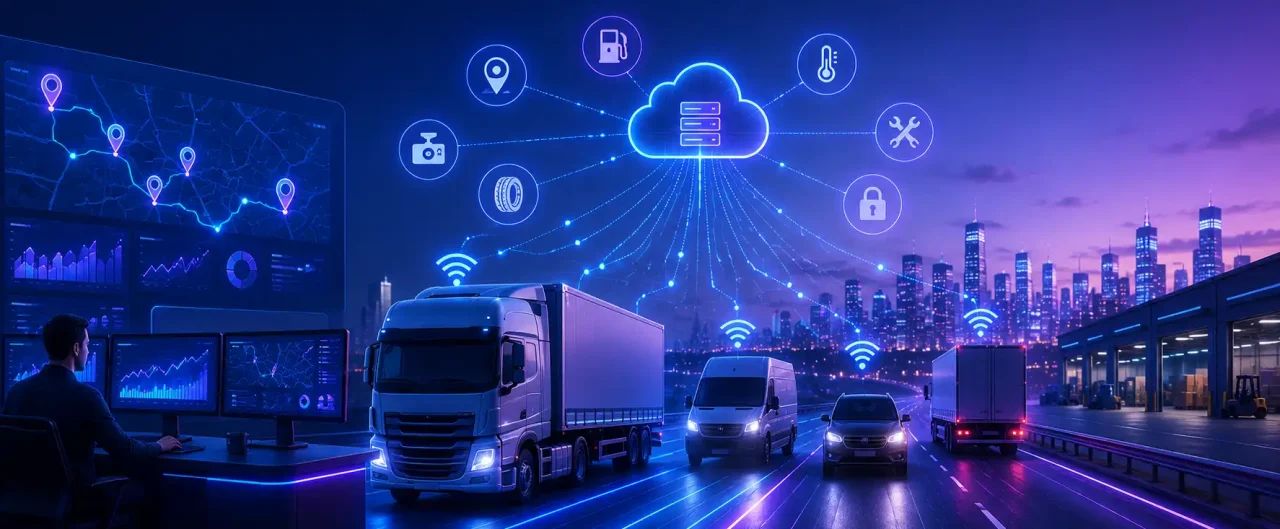
IoT fleet management is a connected operating model for your fleet. In this model, every vehicle ends up becoming a data source, every asset is traceable, and every decision, such as dispatch, servicing, coaching, or billing, gets made against live evidence.
Traditional fleet management was location-centric. It utilized GPS coordinates at specified intervals, and managers watched icons. Drivers were then phoned to fill in the gaps. Data such as fuel logs, service records, hours of service, and damage reports used to live in separate spreadsheets. IoT replaces that single data point with a connected sensor network.
| Legacy GPS-only tracking | IoT fleet management |
| Location pings at fixed intervals | Continuous multi-sensor telemetry |
| Reactive: you learn after a failure | Predictive: you’re warned before one |
| Isolated system, manual reporting | Integrated with ERP, TMS, maintenance, payroll |
| Descriptive dashboards | AI-driven recommendations and automation |
| Vehicle-centric | Vehicle, driver, trailer, and cargo-centric |
Core Components: Every deployment, regardless of the specialization, comprises of four blocks:
- Sensors and Telematics Hardware: Hardware is often placed on the vehicle, trailer, or Numerous data are collected, the primary ones being engine diagnostics, fuel level, tire pressure, temperature, cameras, and door sensors.
- Connectivity: Connectivity is achieved using technologies such as 4G/5G, GPS/GNSS positioning, Low Power Wide Area Network (LPWAN) for low-power assets like battery-operated fleets, and satellite for remote corridors.
- Cloud Platform: Ingests, cleans, stores, and analyzes fleet data. It transforms raw data into actionable insights.
- Analytics Dashboard: A dashboard can be leveraged to surface analytics. At a glance, dispatchers, maintenance planners, safety managers, and executives can view insights.
How Does IoT Work in Fleet Management?
The data flow has five journeys: Device, Gateway, Cloud, Dashboard, Action.
A telematics control unit typically captures a reading. This reading is then aggregated by an in-vehicle gateway; noise is filtered and then transmitted over the mobile network. Whenever coverage drops, it buffers locally.
The cloud platform validates and enriches the data, combining it with route plans, driver records, and service history. Alerts and Dashboards display the necessary information. Finally, an action closes the loop. As per the data insights, a work order can be raised, a route can be sequenced or a customer ETA can be updated automatically.
Benefits and Use Cases of IoT Fleet Management
These are some of the use cases of IoT fleet management and their benefits.
- Real-time GPS tracking and route optimization: Real-time GPS tracking provides live positioning. Often combines traffic, weather, and delivery-window data that allows dispatchers to reroute delays. The final outcome is an accurate ETA for customers and an overall reduction in empty miles and idle time.
- Predictive maintenance and diagnostics: Even before a breakdown occurs, engine diagnostics, fluid temperature, and vibration patterns get analyzed to catch faults in real A roadside failure ends up costing recovery fees and a missed delivery window along with driver hours.
- Fuel Monitoring and Theft Protection: IoT enables the combination of fuel sensor data, GPS location, and fuel card transactions to detect siphoning of fuel, reduce fuel costs, and improve overall fleet efficiency.
- Driver Behavior and Safety Scoring: Various parameters can be used to judge driver Among these are harsh braking, cornering, speeding, lack of seatbelt use, and idling. These scores can be used for coaching rather than punishment, thereby reducing accidents and tire wear.
- Cold-chain and temperature-sensitive cargo monitoring: Certain products need to be transported within a specific temperature range. The most important among them are medicines, vaccines, frozen foods, and dairy products. A shipment of vaccines must always remain between 2 to 8°C. Whenever the refrigeration unit fails and the temperature rises to 10°C, the IoT system immediately sends an alert so that the fleet manager can take immediate action.
- Asset and trailer tracking. Trailers, containers, and site equipment are the things a fleet loses most often. Battery-powered tags also reveal utilization rates and usually show you need fewer assets, not more.
- Automated compliance reporting (HOS, ELD): Hours-of-service data get captured automatically, cutting out paper logs, reducing violations, and shortening audit prep from weeks to hours.
- Geofencing and theft recovery: Virtual boundaries around depots, sites, and corridors trigger instant alerts on unauthorized movement, and live location makes recovering a stolen vehicle far more likely.
Turn fleet data into business intelligence.
Talk to our IoT experts
Key Components of an IoT Fleet?
IoT Sensors and Connected Devices
This is the first layer of data acquisition, and all the hardware choices here constrain everything above it.
- GPS trackers: positioning, speed, heading, and trip history.
- OBD-II / CAN bus devices: Fault codes, engine load, coolant temperature, and true odometer readings.
- Fuel sensors: Tank level and flow for consumption analytics and theft detection.
- Tire pressure sensors: Real-time inflation and temperature monitoring.
- Temperature sensors: Multi-zone probes for reefers and insulated containers.
- Camera systems: Road, cabin, and side-view video for incident evidence and exoneration.
- Driver monitoring devices: Fatigue and distraction detection, plus fob or biometric ID so events attach to the right driver.
Connectivity Layer
- Cellular (4G/5G): The workhorse for high-frequency telemetry and video upload.
- LPWAN (NB-IoT, LoRaWAN, LTE-M): Low power and low bandwidth, ideal for trailer tags running years on a battery.
- Satellite: Coverage for mining, forestry, maritime, and long-haul routes with cellular dead zones.
- Wi-Fi: Bulk offload of stored video and logs at the depot, avoiding cellular data costs.
- Edge computing: On-device filtering and local vision models that keep working through outages.
Cloud-Based Fleet Management Platform
- Data collection: High-throughput ingestion, device provisioning, and time-series storage for millions of daily messages.
- Analytics: Normalization across mixed vehicle makes, KPI computation, and model training.
- Dashboards: Role-specific views, a live map for dispatch, a service queue for maintenance, scorecards for safety, and cost-per-mile for finance.
- Reporting: Scheduled and ad hoc reports for compliance, customer SLAs, and board reviews.
AI-Powered Decision Making
- Predictive maintenance: Component-level failure forecasting and automatic work-order creation.
- Route optimization: Continuous re-planning against traffic, weather, load, and driver hours.
- Driver behavior analysis: Risk clustering, coaching prioritization, and gamified improvement programmes.
- Fuel optimization: Identifying the routes, vehicles, driving styles, and idling patterns that drive consumption.
From telematics integration and edge connectivity to AI-powered dashboards and enterprise integrations, Experion is well-positioned to develop such scalable IoT platforms tailored to the operational needs of modern fleet businesses.
Key Features of IoT Fleet Management Solutions
All the best solutions share similar key features
Real-Time Vehicle Tracking
Sub-minute location updates with trip replays, stop detection, and shareable customer tracking links.
Predictive Maintenance Alerts
Severity-ranked warnings tied to specific components, with service scheduling that follow route commitments and parts availability.
Driver Behavior Monitoring
Driver Behavior can be monitored with event capture, video context, per-driver scorecards, and coaching workflows with measurable improvement tracking.
Fuel Consumption Monitoring
Fuel consumption can be measured with tank-level trends, fill and drop events, idling analysis, and reconciliation against fuel card data.
Route Optimization
Routes can be optimized with multi-stop sequencing, dynamic re-routing, territory planning, and plan-versus-actual variance reporting.
Asset and Trailer Tracking
Utilization dashboards for unpowered assets, dwell-time analysis, and yard management.
Cargo Condition Monitoring
Temperature, humidity, shock, tilt, and door-open logging with exportable compliance certificates.
Geofencing and Instant Alerts
Creates Unlimited zones, entry/exit rules, out-of-hours movement detection, and escalation through push, SMS, or email.
Fleet Performance Analytics
Measures key metrics such as Cost per mile, on-time delivery, uptime, emissions per tonne-kilometre, and benchmarking across depots and vehicle classes.
Fleet Management IoT Used Across Industries
Logistics and Transportation
Long-haul carriers use IoT to raise asset utilization, evidence SLA performance, and automate HOS compliance across large mixed fleets. Dispatchers stop guessing where a load is, and fuel and driver-behavior data usually surface a few thousand dollars a month nobody was tracking before.
Last-Mile Delivery
Dense urban routes get the most out of this: re-sequencing on the fly as traffic and new orders come in, a photo or signature at the door that ends most delivery disputes before they start, and live ETAs that mean customers stop calling to ask where their package is.
Construction Equipment Fleets
Excavators, loaders, and generators get tracked for engine hours, idle time, fuel theft, and unauthorized weekend movement across scattered sites. Geofencing catches equipment leaving a site it shouldn’t. Maintenance runs off actual hours instead of a calendar guess — and more than one fleet manager has been surprised to find three job sites sitting on idle machines while a fourth is short.
Public Transportation
Transit operators publish accurate arrivals, watch passenger counts, manage depot charging, and track vehicle health. Occupancy data shapes peak-time deployment; diagnostics catch a failing part before it strands a route, and electric operators get to schedule charging around actual need instead of just plugging in whenever a bus is back.
Mining Operations
Haul trucks in remote pits need satellite connectivity, tyre and payload monitoring, collision avoidance, and fatigue detection. A stoppage out here is expensive enough that the fatigue alerts alone tend to pay for the system.
Oil and Gas Fleets
Tankers and service vehicles need hazardous-area certified hardware, route compliance tracking, lone-worker safety features, and spill-risk alerting. A technician working a remote site alone is exactly who the SOS and check-in features are built for.
Utility Service Vehicles
Field-service fleets combine location, job scheduling, equipment usage, and technician safety monitoring. Jobs route to whoever’s closest and qualified. During an outage, knowing where every crew actually is matters more than almost anything else on this list.
Cold Chain Transportation
Pharmaceutical and grocery distributors need continuous temperature evidence, reefer fuel monitoring, and automated excursion alerts. Nobody’s spot-checking anymore, the sensor log itself doubles as the paperwork an auditor will eventually ask for.
Integrate IoT with your existing enterprise systems.
Discuss your integration needs
IoT Fleet Management Integration
Successful integration is what separates a dashboard from an operating system for your business. Data has to reach the systems where the work actually happens.
Integrating with existing systems
- ERP: Feed fuel, maintenance, and utilisation costs into asset accounting and depreciation.
- TMS: Synchronise loads, dispatch decisions, and live ETAs with order management.
- Dispatch software: Push optimised routes to drivers and pull job status back automatically.
- Fuel cards: Reconcile every transaction against vehicle location, tank level, and volume.
- Maintenance systems (CMMS): Auto-generate work orders from predictive alerts, with parts and labor tracking.
- HR and payroll: Connect verified driving hours and safety scores to scheduling and incentive programmes.
API and middleware considerations
Prefer documented REST APIs and event streaming (webhooks, message queues) over nightly file transfers, so decisions run on current data rather than yesterday’s export. A middleware layer should own device abstraction, normalizing differences between vehicle makes and hardware vendors, plus identity management, retry logic, and a canonical data model. Design for vendor change: hardware suppliers get acquired, and your platform needs to survive it.
Hardware reliability
Fleet hardware lives in heat, vibration, dust, moisture, and voltage spikes. Choose rugged, certified hardware with appropriate IP ratings, wide operating-temperature ranges, automotive electrical certification, and hazardous-area approvals where relevant. Cheap devices fail in the field, and every failure costs a technician visit plus a blind spot in your data.
Common integration challenges, and how to solve them
- Data silos. Fuel, maintenance, and telematics data in separate tools.
Solution: A unified data platform with one canonical vehicle and driver record.
- Legacy hardware. Older vehicles without modern data buses.
What works: aftermarket OBD-II or hardwired trackers plus discrete sensors, phased by vehicle age.
- Connectivity gaps. Rural and underground dead zones.
Solution: Edge buffering with store-and-forward, multi-network SIMs, and satellite fallback.
- Inconsistent data quality. Different vendors reporting the same metric differently.
Fix: A normalisation layer and automated data-quality monitoring.
Challenges in Implementing IoT Fleet Management

Legacy Fleet Infrastructure
Mixed-age fleets rarely support uniform data capture. Plan a tiered rollout: full telematics on new vehicles, retrofit kits on mid-life assets, minimal tracking on units nearing replacement.
Connectivity Limitations
Coverage gaps are a design constraint, not a defect. Edge processing, local storage, and multi-network or satellite fallback keep data intact through outages.
Cybersecurity Risks
Connected vehicles expand the attack surface. Insist on secure boot, signed OTA updates, mutual TLS, per-device certificates, network segmentation, and device behavior monitoring.
Data Privacy and Compliance
Driver location and video are personal data under GDPR and similar laws. Publish clear policies, limit collection to legitimate purposes, minimise retention, consult employee representatives, and consider blurring or non-work-hours suppression.
Managing Large Volumes of IoT Data
A mid-size fleet generates millions of messages daily. Tiered storage, aggregation, edge filtering, and time-series databases keep costs predictable while preserving raw detail for model training and disputes.
Device Maintenance and Scalability
Device fleets need their own lifecycle management: remote diagnostics, OTA firmware updates, battery monitoring, spares logistics, and installation QA.
Change management and training
Drivers often read monitoring as surveillance. Talk about the safety and exoneration benefits early, involve drivers in scorecard design, reward improvement, and train planners before go-live.
Access Control
Telematics data is commercially sensitive. Enforce role-based access, least privilege, audit logging, and tight scoping of what integrators and customers can see.
Tips for IoT Implementing in Fleets
Most rollouts that actually work follow roughly the same shape, whether it’s ten trucks or ten thousand.
Discovery and Audit: Catalogue what you’ve already got: Vehicles, hardware, data sources — and figure out which systems (ERP, TMS, fuel cards) already hold relevant data versus where the real gaps sit. Pick one use case with a fast, visible payback. Usually that’s fuel monitoring or predictive maintenance. Don’t try to do everything on day one; that’s how these things die.
Pilot: Instrument a small slice: One depot, one vehicle class, whatever is manageable and actually check the sensor data holds up, that connectivity works on real routes and not just in a demo, and that the dashboard answers what dispatchers and maintenance planners are genuinely asking, not what looked good in the sales deck.
Integration: Then integration, which is easy to skip and shouldn’t be. Connect the pilot data into at least one system you already run, typically maintenance or fuel cards. This is the part that proves you got integration value out of it.
Scale: Roll hardware out in phases, prioritized by vehicle age and how well the use-case fits. Once the platform, the integrations, and the team’s habits have all proven out, branch into adjacent use cases — fuel monitoring feeding into driver scoring is a common next step.
Optimise: Last is optimization, and it’s the one teams tend to forget about. Once enough data has piled up, go back and retune your thresholds, retrain models on your own fleet’s actual patterns, and start closing the loop.
Skipping straight to a full-fleet rollout without a pilot is the most common reason these programmes stall. The team hasn’t yet learned what “normal” looks like for their own vehicles, so alerts either get ignored or drown everyone in noise.
Future Trends in IoT Fleet Management
AI-Powered Autonomous Fleet Operations
Autonomous yard moves, hub-to-hub corridors, and platooning will arrive before full driverless operation, and IoT telemetry is the sensory foundation all of it depends on.
Digital Twins for Fleet Monitoring
Virtual replicas of vehicles and networks let you simulate maintenance strategies, route changes, and electrification scenarios before committing capital.
Edge Computing
More inference moves onto the vehicle itself: vision, fatigue detection, anomaly scoring, cutting latency, bandwidth cost, and privacy exposure along the way.
5G-Enabled Connected Vehicles
High bandwidth and low latency make live multi-camera streaming and remote diagnostics practical at scale.
Electric Fleet Management
EV fleets add battery state of health, thermal management, tariff-aware charge scheduling, and range prediction under real load.
Vehicle-to-Everything (V2X) Communication
Vehicles exchanging data with infrastructure and each other will unlock signal-priority routing and collision-avoidance warnings.
Sustainability and Carbon Emissions Monitoring
Per-trip and per-consignment emissions reporting is turning into a customer and regulatory requirement, and IoT data is the only credible source for verified figures.
Greater automation and predictive intelligence
Expect closed loops: an alert that books its own service slot, orders the part, and reassigns the load.
Smarter compliance and reporting
Continuous, machine-readable compliance across HOS, emissions, cold chain, and tolling, replacing periodic manual submissions.
Future-proof your fleet with custom IoT solutions.
Start your IoT fleet project
Choosing the Right IoT Fleet Management Software
Evaluate software against criteria that reflect your operation, not a feature checklist:
- Real-time monitoring capabilities: How frequently is data refreshed, and how quickly do alerts actually arrive?
- AI-powered analytics: Are predictions validated against your own historical data, or are they generic rules dressed up as intelligence?
- Scalability: Can it handle ten times your current asset count, message rate, and geography?
- Integration support: Documented APIs, webhooks, and proven connectors to your ERP, TMS, and CMMS.
- Security features: Encryption in transit and at rest, device identity, OTA update signing, penetration test history, relevant certifications.
- Mobile accessibility: Usable driver and supervisor apps that work offline and don’t fight the daily workflow.
- Reporting capabilities: Configurable reports, self-service analytics, and raw data export you own.
- Vendor expertise: Domain knowledge in your industry, embedded plus cloud plus AI capability, and a credible support model across your regions.
- Total cost of ownership: Hardware, installation, connectivity, licenses, integration, support, and eventual replacement over five years, not just the sticker price per vehicle per month.
For small, uniform fleets, an off-the-shelf platform is often the right start. For mixed fleets, unusual assets, complex compliance regimes, or deep back-office integration, a custom solution typically wins on long-term cost and capability and keeps your operational data under your control.
How Experion Offers Support in Developing IoT-Based Fleet Management Solutions?
With proven experience in developing IoT solutions, Experion has a strong track record of helping organizations build custom fleet management systems tailored to real-world operating conditions. A recent engagement with a global truck manufacturer demonstrated this expertise — combining custom hardware to interface with vehicle onboard systems, real-time data transmission over LoRaWAN, and a control room dashboard with live tracking, analytics, and automated alerts. With features like automated fleet assignment and queue management, backed by an iterative co-development process, Experion helps businesses achieve better fleet utilization and extended vehicle life.
Conclusion
Connecting IoT in fleet management isn’t an experiment anymore, and it isn’t a competitive luxury either. It’s what running a profitable logistics operation now requires. Fleets that can see component health before it fails, coach drivers on evidence rather than anecdote, prove cold-chain integrity on demand, and report verified emissions will win contracts others can’t even bid for. Fleets that can’t will keep absorbing costs they never see.
None of this requires replacing your vehicles or your systems. It takes an honest audit of the data you already have, a hardware plan for the gaps, a platform that integrates, and a first use case chosen visible payback.
Our proven expertise in connected mobility solutions, helps us develop future-ready IoT fleet management platforms that improve fleet visibility, optimize operations, and support long-term digital transformation.
Frequently Asked Questions (FAQs)
How IoT for Fleet Management Improves Fleet Efficiency?
It removes uncertainty from all three cost centers. Route optimization can cut distance and idle time; predictive maintenance can schedule service before a vehicle faces breakdown and behavior monitoring can reduce accidents and component wear. Since the data is continuous, you can see whether a change worked or not.
How does IoT help fleet management?
Fleet management gives managers real-time visibility into the vehicle's parameters such as its location, engine health, fuel level, cargo’s condition, and driver behavior. It automates reporting that used to take up a lot of administrative hours. Thus, the fleet shifts from reacting to problems to preventing them.
What are the best IoT solutions for fleet management?
The best solution is the one that meets your needs and requirements. Prioritize hardware connectivity with edge buffering to store local data where there is no network connectivity, a scalable cloud platform, AI analytics, strong cybersecurity, and open APIs.
What are common IoT fleet management use cases?
Common IoT fleet management use cases includes real-time tracking and route optimization, predictive maintenance, fuel monitoring, driver safety scoring, cold-chain monitoring, trailer and asset tracking, automated HOS/ELD compliance, and geofencing with theft recovery.
How do I integrate IoT fleet management software?
Make a catalogue of all the exisiting systems and the data it owns. Define a canonical vehicle, driver, and asset record. Then connect through documented APIs and event streams via an integration layer that handles device abstraction, authentication, and retries. Pilot the integration on one depot, validate the data, and then roll out in phases.
What should businesses look for in IoT fleet management software?
Some must-have features are real-time monitoring of fleet, AI analytics, integration support, credible vendor expertise and a transparent five-year total cost of ownership.
What is a fleet management IoT device?
Any connected hardware that is able to collect and transmit data from a vehicle or asset can be termed as a fleet management IoT device. This includes but is not limited to telematics control units, OBD-II or CAN bus trackers, AI dashcams, fuel and tire pressure sensors, and battery-powered trailer tags.
Is a custom IoT fleet management solution better than off-the-shelf software?
This depends on the complexity. Off the shelf is quick and more affordable for homogenous fleets. Custom solutions work for mixed asset types. It is apt for situations that need deep ERP/TMS integration or when you want to own your own data model along with avoiding vendor lock-in.
How much does an IoT fleet management solution cost?
Overall costs primarily include installed hardware per vehicle. Certain recurring connectivity and software subscriptions for each asset per month and a onetime integration effort also adds to the cost. Customized builds have higher upfront engineering costs and lower per vehicle license cost. Hence, the payback depends on the fleet size.
What is the difference between traditional GPS tracking and IoT fleet management?
GPS tracking simply reports the location. IoT fleet management combines this location with engine diagnostics, fuel, temperature, video, and driver data. All of this is analyzed with AI, and decisions can be fed into other business systems.