






 Back
Back


With deep expertise in financial software engineering, Experion is well positioned to help lenders transform fragmented servicing processes into connected, future-ready loan management platforms.
Lending is a numbers business that quietly turned into a software business. Every loan that is booked drags a long tail of processes behind it—interest accrual, repayment schedules, compliance reports, collections, and portfolio risk. This tail can run for years. Manage it on spreadsheets and a pile of disconnected tools, and small errors compound fast: charged-off loans, failed audits, and borrowers calling in angry. That’s the gap loan management software fills.
Whether you’re a community bank modernizing a decades-old core system, a fintech scaling from a few hundred accounts to a few hundred thousand, or a small lender trying to get out of manual reconciliation, the right loan management system turns servicing from a cost center into an actual advantage.
Key Takeaways
- Loan management (servicing) software is different from loan origination software. Origination gets a loan funded; servicing manages it for every day of its life after that.
- The core values are accuracy, efficiency, and visibility: correct balances calculated automatically, routine tasks handled without manual work, and real-time portfolio data rather than month-end snapshots.
- Collections and delinquency management are usually where the software pays for itself fastest, since that’s where portfolios lose money.
- Platforms are often specialized by loan type—commercial, consumer, auto, construction, payday, micro, and small business. So, match the category to your book of business rather than picking a generalist tool.
- Cloud deployment is the default for most lenders today; on-premises still make sense for strict data residency rules or heavy existing infrastructure.
- Evaluate vendors against your own documented requirements first, not their feature list, and always test with a pilot using real data before signing a multi-year contract.
What is Loan Management Software?
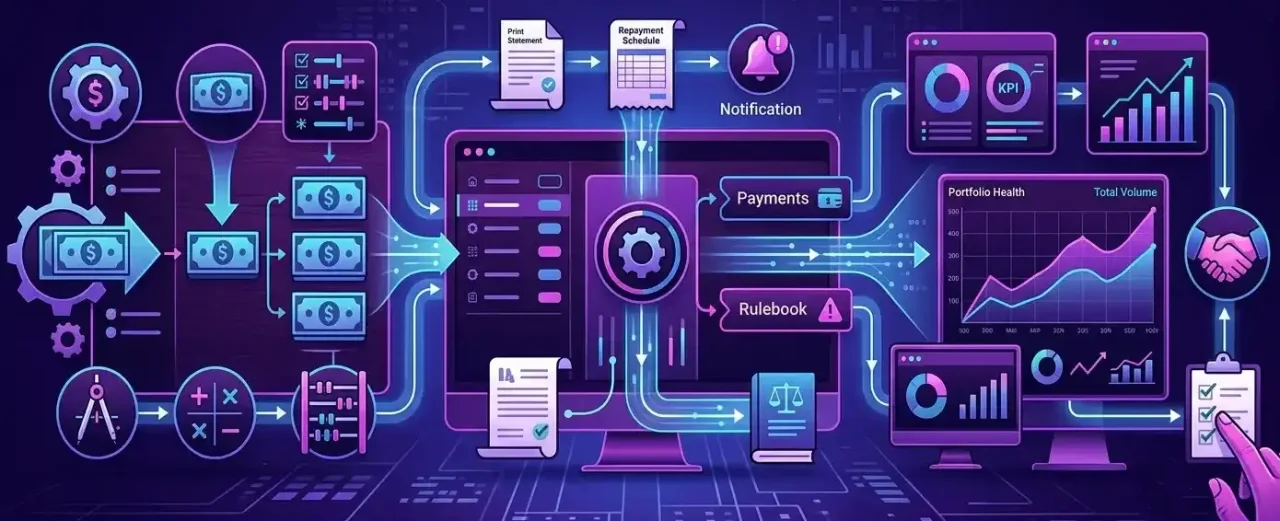
Software for loan management automates and centralizes everything that happens after a loan is approved: disbursement, repayment scheduling, interest accrual, collections, and final payoff. It’s the system of record: it knows what every borrower owes, when, and under what terms, and it enforces the rules behind each product.
The point of it comes down to three things: accuracy, efficiency, and visibility.
- Accuracy means interest, fees, and balances get calculated the same way every time.
- Efficiency means statements go out, payments get applied, and delinquencies get flagged without someone doing it by hand.
- Visibility means a manager can check portfolio health today, rather than waiting until month-end to find out how bad things are.
How it Differs from Loan Origination Systems?
Loan Origination covers everything before the money goes out — the application, document collection, credit checks, underwriting, and approval.
On the other hand, Loan management takes over the moment the loan is funded and runs for as long as the loan exists.
- An origination system is built for speed, to get the applicant a decision fast.
- A loan management system software is built for the long haul—accuracy, repayment discipline, and oversight of the entire portfolio.
Plenty of vendors now bundle both, but the two jobs are still different, and the difference matters when you’re evaluating vendors.
Who Uses Loan Management Software?
Loan management software can be used by anyone who lends money and expects it back on schedule. Banks serving consumer and commercial books, credit unions handling member loans, and NBFCs operating at scale without a deposit base. Fintech lenders tend to rely on cloud platforms to ship changes quickly, while mortgage lenders need something built for decades-long terms and heavy compliance requirements.
Small business lenders use it to compete without a large ops team. Microfinance institutions need to handle huge volumes of tiny loans. Commercial and payday lenders each configure it around their own products and rules.
How Does Loan Management Software Work?
Borrower Onboarding
Once a loan is approved, onboarding is the handoff from origination to servicing. The system creates the borrower’s account, records the terms (principal, rate, tenure, fees), and sets up the repayment plan. A decent platform checks this against the original approval and any regulatory limits, so the loan lands in servicing exactly as it was underwritten. Contact details, disclosures, and consent records are captured here too, so audits and future communications have a clean starting point.
Loan Processing
This is the engine that never stops: disbursing funds, accruing interest under the right day-count convention, applying fees, and correctly posting payments to principal, interest, escrow, and penalties.
A good APR calculator and configurable amortization logic matter a lot here, because amortizing installment loans, interest-only lines, and balloon structures all do the math differently.
Repayment Scheduling
This piece builds the amortization schedule and tracks every installment against what’s actually been paid. It sends statements, fires off reminders, and reconciles incoming funds on its own. Pay early, late, or in partial amounts, and the system recalculates the rest without anyone touching a keyboard. If a lender offers grace periods, restructures, or seasonal payment plans, these are what makes those products workable.
Collections and Delinquency Management
When a payment gets missed, the account moves through a delinquency workflow — aging buckets, automated dunning notices, escalation to a human collector, eventually charge-off or recovery. Better tools prioritize accounts by risk and recoverability, so a team spends its time on the accounts that are worth it. This is usually where the software pays for itself fastest, because delinquency is where portfolios lose money.
Reporting and Compliance
Behind all of it sits a compliance layer logging every transaction, decision, and message in an audit trail. It generates the reports regulators want, builds dashboards for management, and keeps the documentation examiners will ask for. In a regulated industry, this isn’t optional.
Get a custom demo built around your loan products and portfolio
Key Benefits of Implementing a Loan Management System
Lenders who move off manual processes tend to see the same handful of gains:
- Faster loan cycle times: Less time between disbursement, repayment, and getting capital back out the door, earning again.
- Fewer defaults: Early-warning signals and consistent delinquency workflows let a lender step in before a struggling borrower turns into a write-off.
- Easier audits: A complete, automatic audit trail means an exam is mostly about exporting reports rather than reconstructing history from memory.
- Room to grow: A cloud platform can absorb volume spikes and new products without a proportional increase in headcount.
- Staff actually doing useful work: People move off manual data entry and into exception handling and borrower relationships—the parts of the job that need a human.
- A real-time view of the portfolio: Leadership sees risk concentration and cash flow today, not a stale snapshot from three weeks ago.
Core Features of Modern Loan Management Software
The market is crowded, but the strong platforms tend to share the same list. Use this as a checklist when you’re comparing vendors.
Loan Origination and Underwriting
Even if origination is a separate system, tight integration matters. Approved loans should flow into servicing without anyone re-keying data.
Automated Repayment Management
Amortization, payment posting, interest accrual, and statements across every product the lender offers, including restructures.
Loan Portfolio Management
Robust loan portfolio management software gives lenders real-time visibility into portfolio performance, concentration risk, cash flow, and yield. Commercial lenders in particular need this to handle complex facilities, syndications, and covenant monitoring.
Loan Document Management
Loan document management software provides a secure, searchable repository for agreements, disclosures, collateral records, and borrower correspondence.
Workflow Automation
Routes tasks, approvals, and exceptions to the right person automatically instead of relying on someone remembering to forward an email.
Risk Assessment and Credit Scoring
Built-in models (increasingly ML-assisted) that track borrower risk not just at origination but for the life of the loan.
Compliance Management
Encodes jurisdiction-specific rules and produces the filings and documentation regulators expect.
Customer Self-Service Portal
Borrowers check balances, make payments, and pull statements themselves, which cuts down inbound calls.
Analytics and Dashboards
The right numbers for the right role: delinquency trends for collections, yield for risk, and cash flow for finance.
API Integrations
Connections to core banking, CRM, accounting, payments, and credit bureaus, so data moves without manual reconciliation between systems.
Security, Encryption, Audit logs, Regulatory compliance
End-to-end encryption, role-based access, full audit logs, and the certifications regulators expect.
Advanced APR Calculator
APR calculator stands for Annual Percentage Rate calculator. Every product, however unusual its structure, needs to be priced and disclosed correctly. Get this wrong, and it’s a compliance problem, not just a math problem.
Whether you are modernizing a legacy servicing platform or standing up loan management for the first time — Experion’s software engineering can help you build the automation, integrations, and compliance layer a modern loan management system runs on, without you having to engineer it all in-house.
Types of Loan Management Software

Lending products vary enough that platforms tend to specialize:
Commercial Loan Management Software
Many lenders rely on commercial loan portfolio management software to monitor syndicated facilities, covenant compliance, and multi-entity commercial portfolios
Consumer Loan Management Software
Built for high volumes of standardized retail loans: automation, self-service, consumer-protection compliance.
Personal Loan Management Software
Unsecured lending, where speed and efficient collections matter more, is given thinner margins.
Auto Loan Management Software
Adds collateral and title tracking, insurance verification, and dealer relationships on top of standard servicing.
Construction Loan Management Software
Funds get disbursed in draws tied to project milestones, so these handles draw schedules, inspections, and the interest-only phase before conversion to permanent financing.
Bank Loan Management Software
Built to integrate deeply with core banking systems and meet the heavier reporting demands placed on depository institutions.
Payday Loan Management Software
Very short-term, high-frequency lending with its own compliance rules, rollover restrictions, and fast collections workflows.
Micro Loan Management Software
Optimized for large numbers of small-ticket loans, often in emerging markets: low per-loan cost, mobile access, simple onboarding.
Loan Management Software for Small Business
Balances real capability with affordability, so a lean team gets enterprise-grade automation without enterprise-grade complexity or cost.
Cloud-Based vs. On-Premise Loan Management Software
One of the first decisions you’ll make is your deployment model, which shapes cost, speed, and the level of control you keep.
Advantages of Cloud Deployment
Cloud deployment requires little upfront infrastructure investment, elastic scaling as the portfolio grows, and vendor-managed patching, security, and uptime. Updates ship continuously, and remote teams can log in from anywhere. For a fintech or a lender that needs to move fast, the cloud is almost always the starting point.
When On-Premise Makes Sense
Strict data residency rules, a heavily customized environment, or existing infrastructure you’ve already invested in can tip the decision toward keeping things in-house. Some larger institutions choose on-premise or private cloud specifically to satisfy a regulatory or security mandate.
Which Model is Right for Your Organization?
Choosing the right model for your organization depends on your needs. If speed and low overhead matter most, go cloud. If control over data and infrastructure is non-negotiable, on-premises might be worth the extra cost. A lot of lenders land somewhere in between — sensitive functions in-house, everything else in the cloud. Make a decision based on your regulatory profile and growth plans.
How to Select a Loan Asset Management Software?
Selecting a platform is a multi-year commitment, so a sloppy evaluation gets expensive fast. Start with your own requirements, not a vendor’s feature list.
Identify Business Requirements
Identify your business requirements, such as Portfolio size, product types, and regulatory complexity. A single-product microlender and a multi-state commercial bank need entirely different systems. Note down what you actually need before anyone shows you a demo.
Evaluate Scalability and Performance
Ask about the vendor’s largest deployment and how the system holds up under peak load, not just today’s volume.
Review Automation Capabilities
How much manual work does it actually remove from repayment processing, collections, statements, and compliance reporting?
Assess Security and Compliance
Encryption standards, access controls, audit logging, and support for the specific regulations your products fall under.
Check Integration Options
APIs and pre-built connectors for your core banking system, CRM, accounting software, payment processors, and credit bureaus. A platform with weak integration just rebuilds the silos you’re trying to get rid of.
Consider Customization
How much can you configure — ideally without custom code — versus how much you’d have to bend your own processes to fit the software?
Evaluate Vendor Experience
Experience in your specific lending segment predicts success better than a polished sales deck.
Analyze Total Cost of Ownership
Licensing, implementation, data migration, integration, training, and ongoing maintenance. A cheap license with an expensive implementation can cost more over five years than the pricier, more complete option.
Demo and Pilot Testing
Run a pilot with a subset of real loans, define your KPIs up front. Be it accuracy, cycle time, adoption, or measuring against them before signing anything.
Book a free consultation and see how our team modernizes your servicing platform
Pricing Models and ROI
Vendors typically price per loan, per user, or through tiered subscriptions, usually plus a one-time implementation fee. Worth comparing these carefully since they scale very differently as your book grows.
The real ROI isn’t just “new license cost vs. old process.” It comes from labor saved through automation, more recovered through disciplined collections workflows, and capital that cycles back into new lending faster because loans are processed more quickly.
Model these benefits against the total cost of ownership over several years — for most lenders, getting off manual processes means payback in months.
Implementation Best Practices
Even a great platform fails with a bad rollout. Some implementation best practices are the following:
- Project governance—Project Governance refers to one clear owner, servicing/risk/compliance/IT all in the room from day one, scope and success metrics agreed before anyone touches configuration. Misalignment between departments causes more troubled rollouts than any technical issue.
- Data Migration—Treat data migration as its own project. Build a checklist, clean the legacy data before it moves, and run the old and new systems in parallel until the numbers match exactly. Moving dirty data into a clean system just relocates the mess.
- Training—The best platform in the world does nothing if people circumvent it or use it incorrectly. Role-specific training, documented processes, and real support during the transition. Adoption is the actual measure of success here.
Future Trends in Lending Management Software
- AI-driven credit scoring & risk prediction: Let’s lenders read risk more accurately and continuously rather than at a single point in time. It transforms risk assessment, achieving 15 to 20% accuracy compared to traditional methods. With a more nuanced approach to understanding borrowers and making smarter credit decisions, AI-driven credit scoring enables data-driven decision-making.
- Embedded lending & API-first architecture: Embedded lending allows borrowers to access financing within the digital platforms they use, such as e-commerce or business software. API-first lending management software makes these integrations seamless, allowing lenders to launch new products faster.
- Automation in collections: Collections were extremely manual. Automation changes that: it sorts borrowers by actual risk, times the reminders better, and lets a human step in only when it matters. The upside isn’t just fewer missed payments; it’s fewer angry borrowers who felt hounded over a $40 balance.
- Real-time portfolio analytics: Fraud detection used to mean reviewing flagged transactions after the money had already moved. Now models monitor device signals and behavior as the transaction happens, which reduces losses and — just as important — reduces false positives that lock out honest customers.
- Real-Time Fraud Detection: Fraud detection used to mean reviewing flagged transactions after the money had already moved. Now models watch device signals and behavior as the transaction happens, which cuts losses and — just as important — cuts down on the false positives that lock out honest customers.
- Open Banking Integrations: Instead of asking someone to upload three months of bank statements, lenders can pull verified financial data directly, with permission. That means underwriting decisions based on what’s actually happening in an account, not what a borrower remembers to report and onboarding that doesn’t feel like a background check.
- Smart contracts and tokenized loan assets: Blockchain technology is opening up new opportunities for loan management. Smart contracts are self-executing digital agreements stored on a blockchain. It can automatically execute loan terms and repayments without any compliance checks. Tokenized loan assets are traditional loans represented as a digital token on a blockchain. With tokenization, multiple investors can own portions of the same loan.
Why Choose Experion for Custom Loan Management Software Solutions?
Experion brings extensive experience in loan management software development, helping lenders build secure, scalable, and integration-ready servicing platforms tailored to their business. We can build loan management software the way lenders actually work—covering both the loan origination management software layer that gets a loan funded and the servicing that runs for the rest of its life: repayment scheduling, interest accrual, collections, compliance reporting, and portfolio oversight.
Share your requirements and get a recommended solution architecture
Conclusion
Digitizing loan servicing is not optional for lenders who require a competitive advantage.
For lenders looking to replace spreadsheets, modern loan manager software improves servicing accuracy, operational efficiency, and borrower experience. A modern loan management system replaces that fragility with automation, real-time visibility, and built-in compliance.
The case holds across lender types: automation reduces costs and errors, compliance features reduce regulatory risk, analytics turn raw data into decisions, and cloud scalability lets you grow without adding headcount at the same rate. Whether you’re a bank, a fintech, a microfinance institution, or a small business lender, the right platform turns servicing from a cost center into something closer to a competitive edge.
Experion's engineering can help you build the automation, integrations, and audit trail a modern loan management system runs on, without you having to piece it together from disconnected tools. We can enable the consolidation of multiple loan products onto one platform or prepare your servicing stack for the next audit.
Frequently Asked Questions (FAQs)
What is loan management software?
Loan Management Software is a platform that automates and centralizes loan servicing after approval: disbursement, interest accrual, repayment scheduling, collections, and compliance reporting. It’s the system of record for what every borrower owes, and it enforces the rules governing each loan.
What is the difference between loan origination management software and loan management software?
Origination handles everything up to funding - application, underwriting, and approval. Loan management takes over after funding and runs repayment, interest, collections, and reporting for the life of the loan. Origination is the front door; servicing runs the house.
What features should a loan management system include?
At minimum: automated repayment management, portfolio management, document management, workflow automation, risk and credit scoring, compliance management, a self-service portal, analytics, API integrations, strong security, and an accurate APR calculator.
How much does loan management software cost?
The cost depends on the pricing model. This model is based on per-loan, per-user, or tiered subscriptions — plus implementation fees. Factor in data migration, integration, and training. Most lenders see payback within months from operational savings and better collections.
Can loan management software integrate with banking systems?
Yes. Mature platforms offer APIs and pre-built connectors for core banking, CRM, accounting, payments, and credit agencies.
Is cloud based loan management software secure?
Reputed cloud based loan management software is usually secure with features such as end-to-end encryption, role-based access, audit logs, and industry certifications. Often more secure in practice than an under-resourced on-premises setup.
Can small businesses use loan management software?
Yes, plenty of platforms are built specifically for lean teams that need enterprise-grade automation without enterprise-grade cost or complexity.
What industries benefit most from loan management software?
Banks, credit unions, NBFCs, fintech lenders, mortgage lenders, microfinance institutions, commercial lenders, auto lenders, small business lenders. Basically, anyone lending money on a repayment schedule.
What is the best loan management software?
There isn’t a single best one. It depends on your portfolio size, product mix, regulatory environment, integration needs, and budget. Define your requirements first, then test platforms against them through demos and pilots.
Can loan management software support multiple loan products?
Yes. Strong platforms are configured for commercial, consumer, personal, auto, construction, payday, and microloans, each with its own terms and compliance rules, within one system.
