






 Back
Back

For enterprises dealing with complex technology estates, DevOps transformation needs to work with existing systems—not simply replace them. Experion helps teams modernize incrementally while keeping business continuity in focus.
“The DevOps consulting service market is projected to grow, with estimates pointing to an increase of USD 26.28 billion by 2032.”
Modern enterprises need fast, reliable software delivery. However, legacy infrastructure and growing security requirements make DevOps transformation highly challenging. DevOps works by combining development and operations together across the software lifecycle. It effortlessly covers practices such as automation, CI/CD, infrastructure management, monitoring, and continuous improvement.
DevOps consulting services enable organizations to streamline operations through automation, CI/CD, and standardized processes.
Key Takeaways
- A strategic DevOps approach combines strategy, tooling, automation, and hands-on implementation to accelerate software delivery.
- Alignment of people, processes, and technology goes beyond configuring pipelines. It involves aligning engineering culture, processes, and technology so speed and stability work together.
- Cloud expertise brings specialized expertise across AWS, Azure, and multi-cloud environments to support complex infrastructure requirements.
- Integrated security embeds security into development and deployment pipelines through DevSecOps practices.
- Continuous optimization often extends beyond initial implementation with ongoing monitoring, improvement, and optimization of DevOps processes and infrastructure.
- An outcome-driven partnership should involve the right DevOps consulting partner. Evaluate this based on technical depth, relevant industry experience, and measurable outcomes.
What are DevOps Consulting Services?
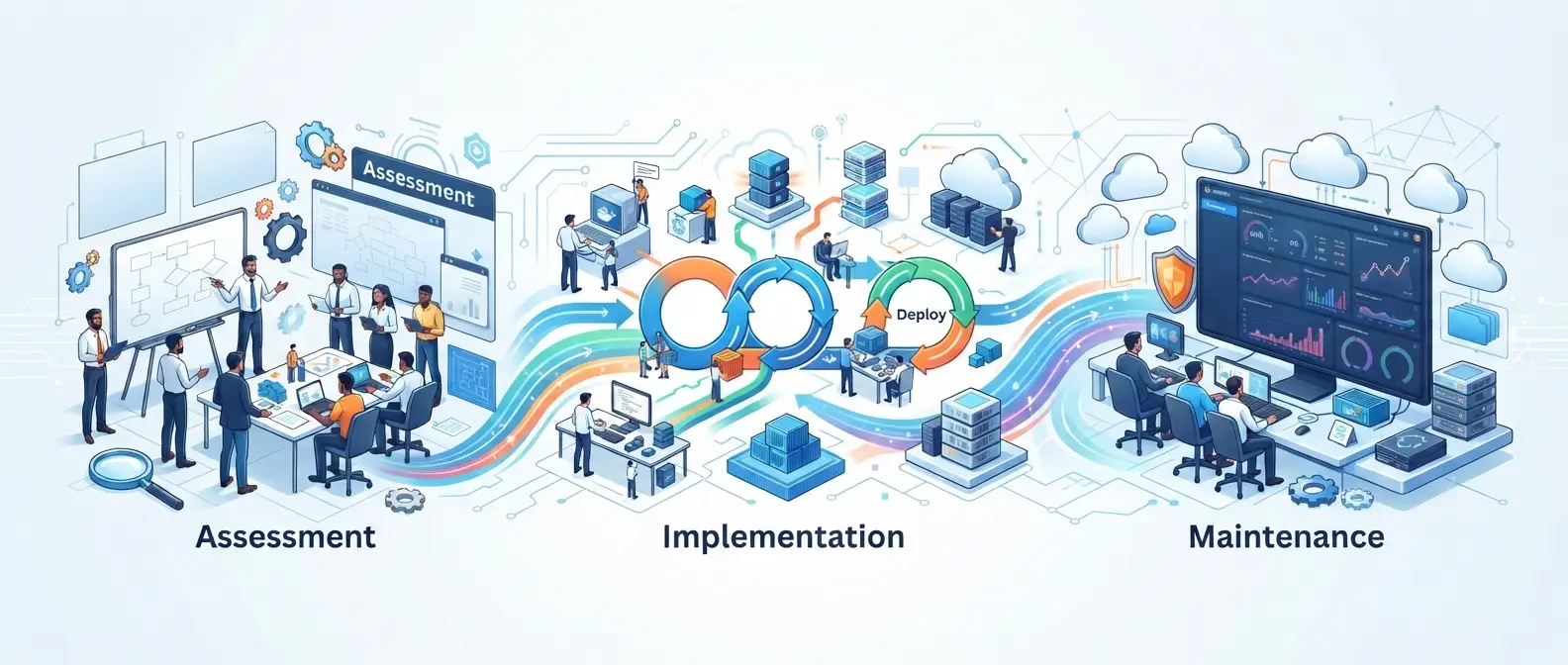
DevOps consulting services, sometimes called DevOps consulting services and solutions or simply DevOps services and consulting, are engagements where an external team helps you design, build, and run the practices, pipelines, and infrastructure needed to ship software continuously and reliably. DevOps as a Service (DaaS) takes this a step further by providing ongoing access to DevOps expertise, tools, automation, and operational support as a managed service. Most engagements run through the same three phases.
- Assessment: This stage assesses DevOps maturity, identifies gaps, and defines a realistic roadmap based on the org’s actual constraints.
- Implementation—CI/CD, infrastructure as code, containerization, automated deployment.
- Maintenance: Monitoring, adjusting security and performance, reliability, and cloud costs indefinitely. DevOps advisory services provide strategic guidance alongside implementation. It includes maturity assessments, tool selection, governance, roadmaps, etc. A company brings in advisory consultants to build the internal case and align everyone before they sign off on the larger implementation budget.
Why Businesses Need a DevOps Consulting Company?
Companies rarely hire a DevOps consulting company because DevOps sounds appealing in the abstract. They call one because a specific, painful symptom has become impossible to ignore.
Common Pain Points
Hours-long deploys turn into days—complex approval chains, undocumented configs, and scripts. Siloed teams make it worse: every handoff between dev, QA, security, and ops adds delay and creates someone new to blame. And the manual processes—hand-run scripts, undocumented changes—are difficult to troubleshoot and scale effectively.
The Value DevOps Service Providers Deliver
Good providers replace manual, error-prone work with pipelines you can actually audit, so dev and ops stop telling different stories about the same outage. Infrastructure gets codified.
ROI and the Business Case
The pitch leans on four numbers—deployment frequency, lead time, change failure rate, and mean time to recovery. Most decent orgs already track them.
A team that cuts lead time from weeks to days isn’t just faster on one project.
Turn DevOps bottlenecks into a faster, more reliable delivery pipeline.
Talk to Experion
Core Offerings of Top DevOps Consulting Firms
The best DevOps consultancy services build their offerings around the full delivery lifecycle, not a single tool or technology. In complex, multi-system environments, that often means bringing in DevOps experts to address specific bottlenecks, slow pipelines, or legacy release processes, on top of the broader engagement.
DevOps Strategy Consulting & Roadmapping
Before any tool changes, DevOps strategy consulting determines where an organization stands today: release cadence, toolchain maturity, and team structure. From there, it builds a phased roadmap toward the target state, sequenced by business priority and risk.
DevOps Implementation & CI/CD Pipeline Setup
This is where strategy turns into working software. Continuous integration pipelines automatically build and test every code change. Continuous delivery pipelines push validated changes toward production with little to no manual intervention.
Infrastructure as Code (IaC) & Automation
Treating infrastructure as versioned code, using tools like Terraform, Pulumi, or CloudFormation, lets teams provision and modify environments predictably and roll back changes safely. It also eliminates the configuration drift behind most “it worked in staging” failures.
Monitoring, Security & Compliance (DevSecOps)
Building security scanning, secrets management, and compliance checks directly into the pipeline, instead of bolting them on right before release, is what DevSecOps actually means. At this point, it’s table stakes, not a premium add-on.
Managed DevOps as a Service Companies vs. Project-Based Engagements
There are two basic delivery models. DevOps-as-a-service companies run pipelines, infrastructure, and monitoring on an ongoing, subscription basis, essentially acting as an extension of your platform team. Project-based engagements work differently: a defined scope—say, a CI/CD overhaul or a cloud migration—then operations are handed back to you.
Containerization and Kubernetes
Most modern application delivery runs on containers now. Consulting teams package applications into containers to ensure consistency across environments. They set up Kubernetes to handle scaling, self-healing, and rolling updates. And they design microservices architectures where independent services can be built, deployed, and scaled on their own.
Monitoring and Observability
Reliable operations depend on seeing what’s happening. That means real-time application and infrastructure monitoring, plus logging, metrics, and tracing to reconstruct what happened during an incident and why. Mature DevOps consulting companies usually layer service-level objectives and error budgets on top of raw metrics too.
Cloud-Specific DevOps Consulting Services
Cloud platforms shape how DevOps practices get implemented, so most engagements are anchored to a specific provider or a multi-cloud strategy.
Cloud DevOps Consulting Services
Cloud DevOps consulting covers the practices and tooling needed to run CI/CD, infrastructure automation, and monitoring natively on cloud infrastructure. It also covers multi-cloud strategy for organizations that want to avoid vendor lock-in or manage data residency requirements across regions.
AWS DevOps Consulting
AWS DevOps consulting typically covers pipeline design with native services like CodePipeline and CodeBuild, infrastructure as code with CloudFormation or Terraform, and cost optimization that right-sizes compute and storage as workloads scale.
Azure DevOps Consulting Services
Azure DevOps consulting usually centers on Azure Pipelines for CI/CD, ARM templates or Bicep for infrastructure provisioning, and hybrid cloud setups for organizations running a mix of on-premises and cloud workloads.
Multi-Cloud and Hybrid DevOps
For organizations running workloads across multiple providers, the work usually centers on standardizing pipelines and tooling so teams aren’t maintaining separate practices for each cloud. In practice, that means writing infrastructure as code that can target multiple providers.
DevOps and Other Modern Operations Practices
- MLOps: MLOps relates to Machine Learning, and this practice applies DevOps principles to Machine learning. It covers development, deployment, monitoring, and ongoing management of ML models.
- GitOps: GitOps uses Git as the central source of truth to define how applications and infrastructure should be configured. This enables version-controlled deployments.
- ModelOps: Manages models across their lifecycle. It is particularly leveraged in enterprise environments where multiple models need to be deployed or monitored.
- BizOps: Connects business strategy with operational execution. BizOps uses data, processes, and cross-functional collaboration to improve decision-making.
DevOps vs. IT Ops
They are not competing functions. Instead, ITOps focuses on maintaining systems and security, while DevOps brings development and operations together to speed up software delivery. DevOps’ end outcome is reliable software releases. On the other hand, ITOps focuses on secure, available IT environments.
How to Choose the Right DevOps Consulting Company?
Not every DevOps consulting company fits every organization’s needs. A structured evaluation helps separate genuine expertise from a generic services pitch.
Evaluate Technical Expertise
Look for demonstrated depth across cloud platforms, automation tooling, CI/CD pipeline design, containers, infrastructure as code, and security. Not just familiarity with one or two of these areas.
Look for Relevant Industry Experience
Experience in enterprise environments, regulated industries, legacy modernization, and cloud-native development shows a partner has dealt with the constraints you’re facing. Not just greenfield projects.
Assess Their Implementation Approach
A sound implementation approach moves deliberately through strategy, implementation, and optimization, with real documentation and knowledge transfer along the way. It also includes a change management plan that accounts for how the engagement affects your staff.
Review Case Studies and Outcomes
Ask for concrete before-and-after data: deployment frequency, lead time, reliability metrics, cost optimization achieved, and infrastructure efficiency gains. Vague claims of “faster releases” without numbers are a warning sign.
Consider Geographic and Delivery Requirements
Delivery model matters as much as technical skill. Onshore, offshore, or blended teams. Time-zone coverage for support and incident response. How often you’ll actually talk to the people doing the work. If you’re evaluating DevOps consulting services in the USA, it’s worth checking how a partner’s global delivery centers work alongside US-based teams for coverage and cost.
Managing DevOps across thousands of repositories and distributed engineering teams?
Learn how Experion helped a global automotive manufacturer improve software efficiency and accelerate release cycles
Validate Security and Compliance Credentials
Confirm DevSecOps is actually built into the pipeline, not treated as a separate audit step. That includes secrets management and compliance automation for standards like SOC 2, ISO 27001, GDPR, and HIPAA, where relevant. Audit-ready pipelines with proper access controls should be the baseline.
With experience across complex enterprise environments, Experion can help teams address the practical challenges of DevOps adoption—from legacy systems and fragmented toolchains to security, scalability, and governance.
Enterprise DevOps Consulting: What Sets It Apart
Large organizations face limitations that small companies don’t. As a result, Enterprise DevOps consulting services look different from a typical engagement. Enterprises typically run dozens of interdependent applications and infrastructure accumulated over many years. Hence, enterprise DevOps consulting needs to scale across teams, geographies, and legacy systems at once. Governance, compliance, and change management scale up too- approval workflows, audit trails, and security policies that hold across hundreds of engineers instead of a single team.
DevOps for Legacy Application Modernization
Modernizing legacy applications usually starts with deciding which parts of a monolith can be safely broken into microservices and which should stay intact for now. From there, it’s about replacing manual, high-risk release procedures with automated pipelines. Then moving workloads off legacy infrastructure onto platforms that actually support continuous delivery.
DevOps Governance and Compliance
Enterprise-scale governance comes down to a few things: who can change what and where, a paper trail for every deployment, security checks baked into the pipeline instead of bolted on after, and whatever compliance rules the industry throws at you.
Getting that right — role-based approvals that pass an audit without turning every deploy back into a three-week sign-off chain — is honestly where a decent consultancy earns its keep. Anyone can automate a pipeline. Keeping it automated once legal and compliance get involved is the hard part.
DevOps Consulting Services and Solutions for Different Business Needs
The right engagement model depends on organizational size and maturity. That’s why a one-size-fits-all package rarely works across a consulting firm’s full client base.
Startups and Growing Businesses
Startups usually need fast-to-implement pipelines and cloud infrastructure that scales without a big upfront platform investment. The priority is getting automated builds, tests, and deployments in place early. You can add the full governance and compliance layer later.
Mid-Market Organizations
Mid-market companies often need to formalize processes that grow organically, replacing ad hoc scripts and manual deployments with standardized pipelines. This is often the stage where one engineer’s personal deployment scripts have quietly become a single point of failure. It is also where the case for consultancy is easiest to make, because leadership can already see the risk.
Large Enterprises
Enterprises need the governance, scale, and cross-team coordination described above, delivered by a partner capable of running multi-year transformation programs. These engagements typically unfold in waves: a pilot with one business unit, refinement based on lessons learned, then a broader rollout. Rarely a single big-bang cutover across the organization.
Organizations Modernizing Legacy Applications
These organizations need a phased approach that keeps critical systems running while incrementally introducing automation and modern architecture. The goal is rarely a full rewrite. It’s usually about finding the seams where you can wrap, containerize, or gradually decompose legacy systems without disrupting the business processes that depend on them.
Cloud-First Organizations
Cloud-native companies typically need advanced automation, cost optimization, and multi-cloud or hybrid strategy rather than foundational DevOps setup. These organizations often already have strong engineering practices, so the highest-value work tends to be FinOps discipline, advanced observability, and platform engineering that lets internal teams self-serve infrastructure safely.
Highly Regulated Businesses
Financial services, healthcare, and other regulated industries need DevSecOps and compliance automation built into the pipeline from day one. The consulting engagement often must satisfy internal security teams, external auditors, and regulators at once. This puts a premium on documentation and traceability alongside the technical implementation itself.
DevOps Consulting Services & Solutions in the USA

Demand for DevOps consulting services USA has grown alongside enterprise cloud adoption. It’s concentrated in financial services, healthcare, retail, and technology, sectors that depend on reliable releases to stay competitive.
Organizations evaluating a US-based DevOps consulting firm usually weigh cost against time-zone alignment and compliance familiarity. US-based teams tend to know domestic regulatory standards, HIPAA, SOC 2, and state-level privacy laws closely. Blended models that pair US-based leads with global delivery teams can bring real cost savings without losing oversight.
Currently, a few trends are shaping demand:
- The shift toward platform engineering
- Internal developer platforms that let teams self-serve infrastructure.
- Growing adoption of FinOps to control cloud spend.
- Regulatory pressure that’s turning DevSecOps into a baseline requirement.
The DevOps Consulting Engagement Process
A structured engagement process is what separates a DevOps consulting company that delivers lasting change from one that simply installs tools.
Step 1 — Discovery & Assessment
The engagement starts with an audit: current tooling, team structure, release process, and where things actually break down. That gives a baseline. It usually means interviews across dev, ops, and security—not because it’s thoroughness for thoroughness’s sake, but because the roadmap is useless if it doesn’t reflect how the organization really works, not how the org chart says it works.
Step 2 — Define DevOps Goals and KPIs
That assessment yields a short list of concrete targets: deployment frequency, lead time, reliability. Setting these before any implementation starts gives the consulting team and the internal stakeholders the same yardstick, so six months in, nobody’s arguing about whether the engagement worked.
Step 3 — Strategy & Roadmap Design
The roadmap gets phased by business priority and risk — quick wins first, architectural overhauls later. Front-loading changes that reduce risk or unblock other teams matters more than it sounds; it’s how you keep buy-in instead of everyone waiting for a distant milestone to prove the thing is working.
Step 4 — DevOps Implementation & Tooling Setup
Core tooling gets picked and configured — version control workflows, CI/CD platforms, infrastructure as code, container orchestration if it’s relevant. The real constraint here isn’t what’s best in the abstract; it’s what the internal team can actually keep running once the consultants are gone.
Step 5 — Implement CI/CD and Automation
Build and test pipelines, automating the run from commit through build, test, and deploy. This almost always starts with one representative application rather than the whole portfolio at once — prove the pattern works, then roll it out.
Step 6 — Integrate Security and Monitoring
Layer security scanning, secrets management, and observability into the pipeline so problems surface before release or right after, not three weeks later. Alerting thresholds and dashboards get tuned carefully in this phase too—get it wrong and teams start ignoring every notification.
Step 7 — Continuous Optimization & Support
Once pipelines are live, the work shifts to tuning: performance, cost, adapting as the organization changes. This is also when knowledge transfer actually gets finished — documentation, pairing, runbooks — so the organization isn’t stuck needing the consulting partner forever.
Find the gaps slowing down your software delivery.
Get in touch with us for a devops consultation
Benefits of Partnering with a DevOps Consulting Services and Solutions Company
Organizations that commit to a full-time engagement with DevOps consulting services see multiple gains in the following areas:
- Faster time-to-market: Manual bottlenecks disappear from the release process.
- Reduced operational costs: Better automation and resource use reduce operational costs.
- Improved reliability and scalability: Infrastructure becomes consistent and reproducible.
- Stronger security posture: DevSecOps is built into the pipeline instead of being added on.
- Lower Operational Costs: These savings compound over time, too, as right-sized infrastructure and automated scaling keep cutting waste long after the initial engagement ends.
- More Efficient Cloud Operations: Continuous monitoring, infrastructure optimization, and automated scaling improve cloud performance while controlling resource usage.
Common Myths About DevOps Consulting
The common myths around DevOps include the following:
- “DevOps is just tools“: Tools are important, but adding new tooling onto old workflows rarely delivers much if team structure, ownership, and process don’t change with it. A CI/CD platform layered over siloed teams with unclear ownership will automate the dysfunction just as efficiently as it automates a healthy process. Tooling amplifies whatever already exists.
- “Only large enterprises need a DevOps solutions provider” Startups and mid-market companies often benefit even more from a DevOps solutions provider, precisely because they don’t have a dedicated platform engineering team to build these practices in-house. Waiting until you’re “big enough” to justify an internal platform team usually just means years of accumulated manual process and technical debt to unwind later, at a much higher cost than doing it right from the start.
- “In-house teams don’t need a DevOps consultant”: Even strong internal teams benefit from an outside perspective on emerging practices, tooling choices, and the blind spots that are hard to see due to day-to-day operations. Internal teams are also invested in defending decisions they already made. DevOps consulting companies have no such attachment and can recommend the right path when needed.
Conclusion: Partner with the Right DevOps Consulting Services and Solutions Company
The end outcome of DevOps consulting is an overall DevOps transformation, and picking the right tools was never the whole story. What matters is a proper strategy, disciplined automation, built-in security, cloud expertise that fits your environment, and a plan for continuous optimization. The organizations that get the most out of DevOps consulting treat it as a long-term shift in how their operational strategy works.
At Experion, that’s how we’ve structured our approach: deep cloud and platform engineering expertise paired with the delivery discipline to carry a DevOps transformation from strategy through implementation and into ongoing optimization, so the gains keep compounding instead of fading after go-live.
At Experion, we can support enterprises in modernizing their DevOps practices with cloud-native engineering, automation, CI/CD, and infrastructure expertise built around their specific technology landscape.
Frequently Asked Questions (FAQs)
What is the cost of devops consulting services?
There's no honest answer. A quick assessment and a multi-year transformation are not priced the same way, and most firms won't commit to a number until they have analysed the details. Be a little skeptical of anyone who quotes you cold.
How long does devops implementation take?
A single pipeline will take a few weeks. A full infrastructure-security-governance overhaul will take a few months, sometimes over a year, depending on how many teams are involved.
What's the difference between devops consulting services and solutions vs. managed DevOps?
Devops consulting services and solutions end after the engagement is over, focusing solely on improving your DevOps environment. Managed DevOps does not.It provides operational support and end-to-end maintenance.
Do small businesses need devops advisory services?
Yes, and sooner than most assume. Working with DevOps advisory consultants early can help small businesses establish efficient deployment practices before technical debt becomes harder to fix.
How do I select the best devops service provider for my industry?
To select the best devops service provider: prior experience in your regulatory environment, real case studies (numbers), and a working rhythm that won't grate on you months in.
What is the difference between AWS and Azure DevOps consulting?
AWS uses CodePipeline, CodeBuild, CloudFormation. Azure uses Pipelines with ARM or Bicep. Same principles underneath but different tools — the choice mostly follows wherever your infrastructure already sits.
What is included in a DevOps consulting service?
DevOps consulting service usually includes assessment, roadmap, CI/CD build, infrastructure as code, containerization where it fits, security, and monitoring. Not every project needs all of it.
Why do companies need DevOps consulting?
Companies need DevOps consulting to mostly to skip the years of trial and error it takes to get releases faster, cut manual errors, and break down the dev-ops wall most companies build by accident.
How is a devops consultant different from an internal DevOps engineer?
The consultant brings cross-industry experience and is focused on a transformation scope. The DevOps engineer owns the day-to-day operations and maintenance even after the transformation phase is complete.
What is cloud DevOps consulting?
Cloud DevOps consulting means building CI/CD, infrastructure as code, and monitoring directly into a cloud environment—AWS, Azure, whatever multi-cloud mess you've ended up with—instead of retrofitting it later.