

Experion builds custom event management software that covers the full lifecycle- attendee registration, session scheduling, vendor coordination, hybrid event delivery, mobile apps, and analytics – engineered to fit your existing tech stack rather than replace it.
Managing multiple events is not easy. While outdated tools can help you manage one or two events, they quickly become inefficient as the number of events grows. Event planning would start to feel like a juggling act. The events industry is expanding, and successful event management needs a digital solution to move forward.
This is where adopting event management software has become the smartest move you can make. Industry Research reports that the event management software market is set to grow rapidly. From $8.736 billion in 2023 to $33.347 billion by the year 2033.
This reflects a strong compound annual growth rate (CAGR) of 14.39%.
Key Takeaways
- Event management software integrates planning, registration, communication, and analytics into a single platform.
- Software capabilities vary depending on the sort of event- virtual, hybrid, corporate, and in-person.
- Integrations, scalability, and security must be given top priority by enterprise buyers. Cost-effectiveness and usability should be the main priorities for small firms.
- The best online event management software increases participant engagement and reduces coordination overhead to deliver quantifiable ROI.
- Future event management platform developments include artificial intelligence (AI), predictive analytics, and immersive technologies.
What is Event Management Software?

Event Management software is a set of digital platforms designed to help organizations plan, organize, execute, and analyze events efficiently. From Registration to post-event reporting, a dedicated event management solution can bring all processes into a single, connected environment.
Key Users
Event management software serves the following professional groups.
- Event planners: Use it to coordinate logistics, vendor networks, and timelines.
- Marketing teams – Rely on event management software for capturing leads, attendee nurturing, and campaign attribution.
- Enterprises – Deploy them to manage large-scale conferences, roadshows, and partner summits at volume.
- Agencies- Use them to run events for multiple clients simultaneously, often with white-label customization.
Core Functions of an Event Management System
The following are the core functions of an event management system:
- Registration and ticketing, including tiered pricing and discount codes
- Scheduling and agenda management across sessions and tracks
- Vendor and venue coordination – task assignments, timelines, etc.
- Attendee communication via email, SMS, and in-app messaging
- Budget tracking and financial reporting with real-time visibility
- Post-event analytics and feedback collection
Event Management Software Solutions vs. General Project Management Tools
General Project Management tools such as Asana and Monday.com are good at what they do. The problem is that managing a live event isn’t task management. It involves registration flows, attendee data, on-site check-in, real-time communication, and post-event reporting. General tools do not handle any of these natively. Event project management software is designed for these specific workflows. If you’re running events at a large scale and relying on a generic tool, you’re spending staff time compensating for what the software can’t do.
Custom Event Management Software vs Off-The-Shelf Software
Off-the-shelf platforms offer faster deployment and lower upfront costs.
The development of custom event management applications is more time-consuming and initially more expensive, but it yields workflows that precisely fit your processes, deeper interactions with your current tech stack, and complete control over data and branding.
The right choice depends on the event’s complexity, volume, and the level of differentiation your attendees’ experience needs.
Build enterprise-grade event management software with Experion ⟶
Connect Us Today
Types of Event Management Software
Corporate Event Management Software
Corporate event management software is designed for internal and external business events: sales kickoffs, annual conferences, product launches, town halls, and partner summits. These platforms emphasize branded registration, executive-level reporting, and integration with enterprise CRM and marketing tools. For organizations running dozens of events per year, a dedicated corporate event management software platform becomes a strategic asset rather than a logistics tool.
Virtual Event Management Software
Post-pandemic, virtual events became a permanent fixture of the enterprise calendar.
Virtual event management software adds capabilities that physical event tools do not need:
virtual lobbies, breakout rooms, live streaming infrastructure, digital networking lounges, and on-demand content libraries.
Managing virtual attendee engagement requires purpose-built features. A general webinar tool will not replicate the depth of interaction a dedicated virtual event management software platform provides.
Hybrid Event Management Software
Hybrid events represent the most operationally complex format. Since it combines both in-person and virtual attendance simultaneously. Hybrid event management software must synchronize two distinct attendee experiences in real time: live session streaming to remote participants, networking tools that span both audiences, and unified analytics that capture engagement across both channels.
The synchronization challenges are non-trivial, and only platforms built explicitly for hybrid delivery can manage them reliably.
Cloud-Based Event Management Software
Cloud-based event management software removes the infrastructure overhead of on-premises deployments. It enables real-time collaboration across distributed event teams.
Scalability is a main advantage: Unlike server-based tools, Cloud platforms can handle registration spikes and concurrent user loads. It also helps manage events across multiple geographies.
Why Enterprises Need Dedicated Event Management Platforms?
The Business Case: What’s at Stake Without the Right Software
Events represent significant revenue and pipeline investment.
A poorly executed conference can damage both the brand perception and pipeline.
Slow check-ins, broken session links, and missed follow-up sequences ruin the attendee experience.
The hidden costs of manual coordination compound quickly: Staff hours spent on spreadsheet reconciliation, errors in attendee data, last-minute vendor fixes, and post-event reporting delays.
Key Capabilities That Separate Enterprise-Grade Platforms
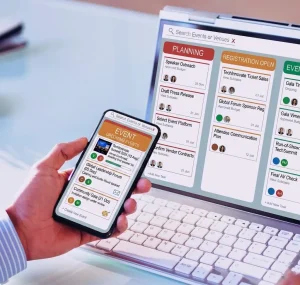
- Omnichannel attendee communication across email, SMS, and event app push notifications, with automated triggers and personalization.
- Native integration with CRM platforms such as Salesforce and HubSpot, ERP systems, and marketing automation tools (Marketo, Pardot) to ensure event data flows seamlessly into attribution reporting.
- Event inventory management software capabilities for multi-track, multi-venue events. At the enterprise grade, this means managing room allocations, session capacities, speaker schedules, and resource availability across complex event programs.
- Security information and event management software (SIEM) integration for enterprise-grade data protection, audit logging, and compliance with security policies.
- Advanced analytics dashboards that display attendance trends, session engagement metrics, and ROI attribution in real time.
- White-label and branded experience options to maintain corporate identity across every attendee touchpoint.
- No-code / low-code configuration. This capability allows non-technical event managers to build registration workflows, email sequences, and reporting views without developer support.
Build event management software that makes post-event reporting effortless. ⟶
Consult our engineering team.
Features to Evaluate in the Best Online Event Management Software
Examine these features methodically while choosing the best online event management program for your company:
- Registration and ticketing engine: Support for multiple ticket types, promo codes, group registration, and waitlists
- Multi-session / multi-track scheduling: Ability to track multi-session scheduling with drag-and-drop agenda builders with conflict detection
- Attendee networking and engagement tools: Matchmaking algorithms, meeting schedulers, and community feeds
- Cloud-based accessibility: Cloud platforms allow real-time updates, global CDN performance, and 99.9%+ uptime SLAs
- Budgeting and financial management: Allows line-item tracking, approval workflows, and variance reporting
- Payment processing and invoicing: Enables Multi-currency support and PCI compliance
- Venue and resource management: Floor plan tools, AV scheduling, and catering coordination
- Mobile event management app: It includes a native iOS and Android app for attendees and organizers
- Real-time reporting and event analytics: Involves dashboards for registration, attendance, engagement, and revenue
- Integration APIs: This refers to Pre-built connectors for Salesforce, HubSpot, SAP, Marketo, and Zoom
- On-site check-in and badge printing support: QR code scanning, self-service kiosks, and real-time attendance tracking
- Compliance and data privacy controls: GDPR consent management, SOC 2 certification, and data residency options
The best online event management software is the one whose capabilities align most precisely with your event types and workflows.
Experion designs and builds custom event management software for enterprises across healthcare, logistics, BFSI, and retail- end-to-end, from architecture to deployment.
Mobile & App-First Strategy
- The Attendee Experience: The event management application is often evaluated last and experienced first. A dedicated event management application improves on-site navigation, session discovery, and real-time attendee engagement in ways that mobile-optimized web pages do not fully replicate. For multi-track events in large venues, the app is how attendees find their sessions, connect with other participants, and adapt their schedules when plans change on the day.
- Push Notifications: Push notifications through the event management application handle schedule changes, session reminders, and networking prompts in real time, during the event itself, when email goes unchecked, and attendees need information immediately. A well-configured notification approach keeps communication timely without becoming noise.
- Offline Capability: This feature is what most reliably distinguishes functional event apps from unreliable ones. Conference venues consistently deliver poor Wi-Fi, and an event management app that requires a stable connection becomes a liability precisely when it is most needed. Schedules, floor plans, and attendee lists must be cached locally on the device . Additionally, it needs to synchronize with the platform when connectivity is restored. This is a technical requirement to verify during evaluation, not a preference to note and move past.
Event Management Software for Small Business
Enterprise buyers and SMB buyers need different things. Evaluating event management software against an enterprise feature checklist is a reliable way for a smaller organization to end up with a platform that’s expensive, complex, and used for about 15% of its capabilities.
The most practical test for small businesses: can a non-technical team member operate the platform without specialist support? That’s it. The best online event management software for smaller organizations delivers core workflows out of the box, with transparent pricing and a learning curve that doesn’t require weeks of onboarding.
A clean, navigable event management app that attendees can use without instructions is worth more to a small team than a sophisticated system that requires a dedicated admin to run.
Industry Applications: Where Event Management Software Delivers the Highest ROI
Corporate and Enterprise Events
Sales kickoffs, annual conferences, and partner summits generate measurable pipeline impact. ROI metrics here include lead volume, deal velocity for attendee-influenced opportunities, and net new pipeline attributed to event participation. This is where dedicated event management software solutions quickly justify their cost.
Trade Shows and Exhibitions
Trade show environments need specialized tooling: booth management, lead capture via badge scanning, and event inventory management software to coordinate exhibitor resources, booth assignments, and on-floor logistics. The operational complexity is specific enough that general-purpose event platforms often struggle with it.
Conferences and Summits
Multi-track conferences with dozens of sessions, hundreds of speakers, and layered sponsorship tiers require multi-session scheduling, speaker management portals, and dedicated sponsor dashboards. The complexity is real, and platforms that weren’t built for it tend to show the seams.
Healthcare and Financial Services Events
Compliance requirements in these industries aren’t negotiable. HIPAA for healthcare events, GDPR for financial services in Europe. Attendee data handling, consent management, and audit logging are requirements that determine which platforms are even on the shortlist — not features to evaluate later.
Education and Training Events
Learning-oriented events benefit from LMS integration, certification tracking, and virtual attendance records that feed into learner management systems. Not every event management system handles this well. It’s a specialized use case worth checking specifically.
Build event management software for hybrid and virtual event programs with Experion ⟶
Consult our engineering team.
How to Choose an Event Management Platform: A Decision Framework?
Define Your Event Type and Scale First
Before looking at any platform, stakeholders need to be specific about what they’re actually running.
Single-day or multi-day events? Is it In-person, virtual, or hybrid? One event per quarter or a continuous program?
Vague requirements lead to vague evaluations and expensive mistakes. The software’s capabilities have to match the actual complexity of the events.
Must-Have Criteria When Evaluating Software for Event Management
- Scalability: What is the platform’s concurrent user capacity, and what SLAs govern infrastructure performance during peak registration windows?
- Integration depth: how deeply does the platform connect with your existing CRM, marketing automation, and finance tools?
- Mobile-readiness: evaluate the event management app quality directly — install it, simulate attendee flows, and test offline behavior.
- Analytics and reporting: Can the platform generate the reports your leadership team needs, without custom development?
- Support model and onboarding: what does implementation look like, and what level of support is available during live events?
Questions to Ask Every Vendor
- How does your platform handle last-minute scaling if registration volumes exceed projections?
- What does your data residency and security posture look like, and do you hold SOC 2 or ISO 27001 certifications?
- Can you provide documented ROI from comparable deployments in our industry?
- What is your roadmap for AI and automation features over the next 12 months?
Common Mistakes When Selecting Event Management Computer Software
The most common mistake most organizations make is selecting event management computer software based on feature count rather than workflow fit. If a platform has 200 features and you use only 3, isn’t it a better platform?
Other mistakes include: Underestimating how complex integrations are to configure, ignoring the mobile attendee experience during evaluation, and committing without a proof-of-concept on real event data first.
Each of these creates problems that are significantly harder to fix after you’ve signed a contract.
Analytics and Optimization: Measuring What Your Events Actually Deliver
The best event management platforms generate the data needed to improve them. Key metrics to track across your event program include:
- Attendance and registration conversion rates: What percentage of registrants actually show up, and where do the drop-offs happen?
- Session engagement and drop-off: Which sessions hold attention, and where do virtual attendees drop off? This data is particularly actionable for virtual formats.
- Net Promoter Score(NPS) and Post-event survey data: How likely are attendees to recommend the event?
- Revenue and pipeline attribution: How much closed-won revenue can be traced to event participation?
Organizations that feed this data from one event cycle into planning decisions for the next treat events as a strategic channel.
ROI of Investing in Event Management Software
The business case for dedicated software for event management is straightforward when you account for the total cost of ownership. Staff hours spent reconciling spreadsheets. Errors in attendee data that create downstream problems. Missed communication triggers. Slow post-event lead handoff that lets the momentum die before sales can follow up.
Event management implementations typically produce: 20–40% fewer staff hours per event, higher registration conversion from optimized flows, better attendance through automated reminder sequences, and faster sales follow-up from direct CRM integration. These are documented outcomes from real deployments, not projections.
Future Trends: AI Co-Pilots and Predictive Analytics
- Agentic AI: The near-term development for event management software is a shift from passive reporting to active operational intelligence. Agentic AI can take action with minimal human intelligence. It is software that not only surfaces data but also recommends responses to it.Examples of recommendations include:
- Adjust the session schedule because real-time drop-off data suggests a timing problem.
- Flag registrants whose engagement patterns indicate they are unlikely to attend.
- Automate vendor follow-up when a milestone passes without confirmation.
The distinction between a platform that shows information and one that helps act on it is significant for event teams managing multiple programs simultaneously.
- Sustainability Tracking: It’s no longer just a competitive advantage. Organizations with ESG reporting obligations need platforms that automatically calculate event carbon footprints, accounting for travel, venue energy consumption, and materials. The platforms building this capability into core functionality now are ahead of where compliance requirements are heading.
- Immersive technologies (AR/VR events): Immersive technologies, including AR and VR event environments, represent a significant change in what virtual and hybrid formats can deliver. Adoption is in earlier stages, but the gap between flat video delivery and spatial event environments is real in terms of attendee engagement and networking quality for specific event types.
- Integration with marketing and CRM ecosystems: Integration with marketing and CRM ecosystems continues to deepen, with the goal of making event attribution fully automatic. Event participation is now feeding directly into lead scoring, opportunity influence tracking, and campaign reporting without manual reconciliation.
- Advanced cloud collaboration: As increasingly distributed global event teams expand, advanced cloud collaboration capabilities enable co-management of complex programs across time zones in real time.
Conclusion
Events are a business investment. Likewise, the software running on them should be considered the same way.
The events that go wrong do not fail because of the agenda or the venue. They fail because of the infrastructure behind them. Perhaps it’s a registration flow nobody tested on mobile, or attendee data that never made it into the CRM. Sometimes it might be follow-up emails that went out three days too late.
Choosing the right event management software is less about features and more about whether the system holds up when it matters. Pick the platform that fits how your team actually works, not the one with the longest list of capabilities. Choosing the right event management software depends on your event type, your volume, integration with your existing tools, and the analytics your team needs. This is a decision that compounds in value over every event you run.
The difference shows up in every event you run from that point forward.
Frequently Asked Questions (FAQs)
- What is event management software?
A1. A digital platform that pulls registration, scheduling, attendee communication, vendor coordination, budgeting, and reporting into one system, instead of managing all of that across tools that weren’t designed to work together.
- What is the difference between an event management system and event planning software?
An event management software is an end-to-end system. It includes all the stages of execution, logistics, analytics, and attendee management. On the other hand, event planning software covers only the planning stage.
- What is the best event management software for enterprises?
There’s no single answer. Enterprise buyers typically need strong security certifications (SOC 2, GDPR compliance), solid CRM integration with platforms like Salesforce and HubSpot, scalable cloud architecture, and analytics that actually surface ROI. The right fit depends on event type, volume, and what’s already in the tech stack.
- What is hybrid event management software?
Hybrid Event Management Software is built to manage in-person and virtual attendees at the same time, synchronizing content delivery, session experiences, and engagement tools across both audiences in real time.
- How does cloud-based event management software work?
It runs on cloud infrastructure rather than on-premise servers. That means your team can access and update everything remotely, collaborate across locations in real time, and scale up during registration spikes without the platform buckling under the load.
- What is event inventory management software?
It tracks the physical and logistical resources tied to an event – booths, rooms, equipment -and flags conflicts before they become problems on the day. Double-booked rooms and missing AV equipment are avoidable.
- How long does event management application development take?
Custom development typically runs three to nine months, depending on feature scope, integration complexity, and target platforms. Off-the-shelf solutions can be up and running within days to weeks – the tradeoff is configurability and how well they fit your specific workflows.
- What is the best event management software for small businesses?
A platform that a non-technical team member can operate without specialist support, with transparent pricing and core features that work out of the box. The best options also offer a clear path to expanded capabilities, so you’re not forced to switch platforms the moment your event program grows.
- How much does event management software cost?
Entry-level platforms typically run $50–$200 per month. Mid-market solutions sit in the $500–$2,000 per month range. Enterprise pricing is almost always custom, based on event volume, user counts, and integration requirements – so that conversation happens directly with the vendor.
- What features should be looked for in event management software?
Registration and ticketing, multi-session scheduling, CRM integration, mobile app quality, real-time analytics, on-site check-in support, and data privacy compliance — GDPR consent management and SOC 2 certification are the main ones. The feature list matters less than how well each of those actually works in practice.
- How does event management software integrate with CRM platforms?
Most platforms ship with pre-built connectors for Salesforce, HubSpot, and Microsoft Dynamics. These sync registration data, session attendance, and engagement scores directly to contact and opportunity records, so sales teams can follow up based on actual event behavior rather than a static attendee list .
- What is security information and event management software (SIEM)?
SIEM is a cybersecurity tool that aggregates and analyzes security event data across an organization’s IT infrastructure. It has nothing to do with running live events. The reason it comes up is that enterprise event platforms often integrate with SIEM systems to satisfy internal security and audit requirements, which is where the two get conflated.
Experion partners with enterprises to design and build custom event management software from the ground up – whether that’s a standalone event app, a full event management platform, or an integration layer connecting your existing tools.