

Transforming asset reliability with Experion’s engineering excellence and AI-driven intelligence
Organizations across industries are shifting from traditional maintenance approaches toward intelligent prediction and automation. AI predictive maintenance has emerged as one of the most impactful applications of artificial intelligence in operations-heavy sectors, enabling companies to detect failures early, prevent costly breakdowns, and optimize asset performance. As businesses seek more predictable, efficient, and data-driven operations, AI predictive maintenance software is becoming the strategic backbone of modern digital transformation.
Conventional maintenance methods, whether reactive or preventive, often result in unplanned downtime, excessive repairs, unnecessary maintenance cycles, and rising operational costs. AI predictive maintenance changes this entirely. By combining machine learning, AI prediction algorithms, IoT sensors, and real-time analytics, businesses gain the ability to continuously assess equipment health, identify anomalies, predict failures before they occur, and take timely action.
This shift toward AI based predictive maintenance is accelerating across manufacturing, energy, oil and gas, logistics, transportation, healthcare, and smart infrastructure. As organizations adopt AI predictive models and intelligent monitoring systems, the future of maintenance is moving toward autonomous decision-making, self-healing assets, and AI-powered predictive maintenance workflows.
What Is AI Predictive Maintenance?
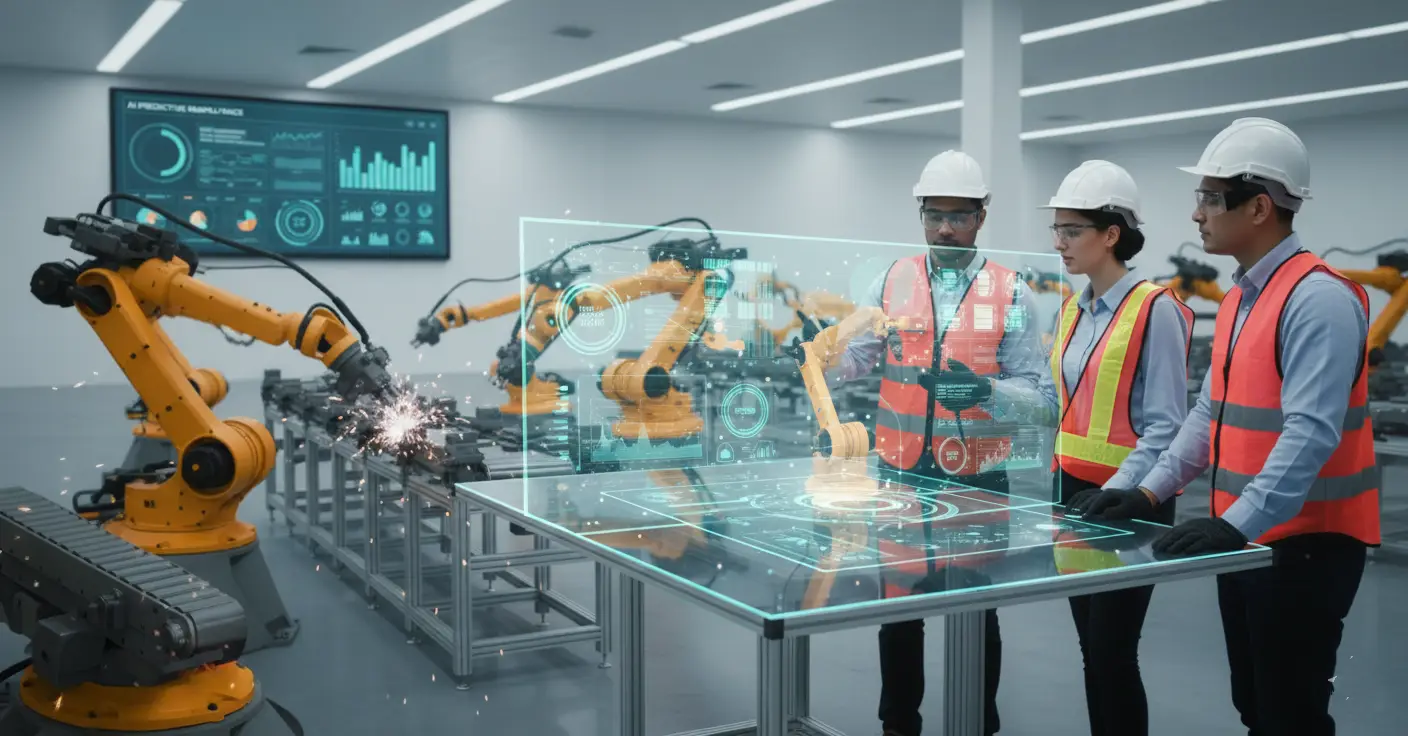
AI predictive maintenance refers to the use of artificial intelligence, machine learning, and sensor-driven data to forecast equipment failures before they happen. Instead of relying on fixed schedules or waiting for machines to break, AI for predictive maintenance continuously analyzes data patterns, assesses asset degradation, and provides early warnings so maintenance can be planned at the optimal time.
AI in predictive maintenance differs significantly from older approaches because it does not rely solely on historical averages or manual inspections. Instead, it uses AI prediction models and advanced algorithms to understand real-time asset behavior, detect anomalies instantly, and estimate remaining useful life (RUL). This capability makes AI predictive maintenance software far more accurate, cost-efficient, and scalable than traditional condition monitoring.
Why Predictive Maintenance Matters Today?
Rising Equipment Complexity and Downtime Costs
Modern industrial equipment is more complex, interconnected, and software-driven than ever. Unplanned breakdowns can halt production lines, delay shipments, disrupt energy distribution, or cause safety hazards. Downtime costs have surged across industries, making AI predictive insights critical for uninterrupted operations.
Need for Real-Time Visibility into Asset Health
Organizations want a live view of machine performance, stress levels, and degradation patterns. AI based predictive maintenance enables continuous monitoring using IoT sensors that measure temperature, vibration, acoustics, torque, pressure, and more. Real-time dashboards alert teams to issues before they escalate.
Impact on Profitability, Customer Experience, and Safety
A single unplanned failure can trigger product delays, missed SLAs, shipment penalties, customer dissatisfaction, or safety risks. AI predictive maintenance software reduces this risk and ensures consistent output quality and performance reliability.
Industries Relying Heavily on Predictive Intelligence
Artificial intelligence in predictive maintenance is now essential in:
- Manufacturing for robotics, CNC machines, and assembly lines
- Oil and gas for pumps, compressors, and pipelines
- Energy utilities for wind turbines, grids, transformers, and solar assets
- Transportation and logistics for fleets, aircraft engines, and rail systems
- Healthcare for imaging systems, lab instruments, and diagnostic machines
- Smart buildings for HVAC systems, elevators, and electrical units
These sectors operate high-value, mission-critical assets where even minor disruptions can create significant financial or operational impact. AI predictive maintenance provides the intelligence required to run these environments efficiently.
How AI Based Predictive Maintenance Works?
AI predictive maintenance solutions combine multiple advanced technologies to detect failure patterns, perform predictive diagnostics, and guide maintenance teams with data-driven actions.
Core Technologies Enabling AI Predictive Maintenance
Machine Learning Models
ML models identify anomaly patterns, detect abnormal machine behavior, and predict failures before they occur.
IoT Sensors
Sensors capture critical data such as vibration, temperature, rotation, noise, pressure, humidity, and electrical signatures. These real-time indicators help AI predictive algorithms assess equipment health continuously.
Big Data Analytics
AI prediction relies on processing millions of data points from historical logs, SCADA systems, IoT devices, and operational data lakes.
Cloud and Edge Computing
Cloud platforms scale predictive models across facilities, while edge computing ensures instant, low-latency analysis for sensitive environments.
Digital Twins
Virtual models simulate machine behavior, stress conditions, and life cycles to predict deterioration and optimize performance.
Data Flow Architecture for AI Predictive Maintenance
AI predictive maintenance software typically follows a multi-stage data pipeline:
Sensor Data Ingestion
IoT devices transmit data streams to edge nodes or cloud platforms.
Data Normalization and Feature Extraction
Raw signals are cleaned, structured, and converted into meaningful features for AI algorithms.
Model Training and Continuous Learning
AI models learn from operating patterns, label outcomes, and refine predictions through feedback loops.
Notifications, Alerts, and Automated Workflows
When anomalies are detected, the system generates alerts, assigns tasks, or triggers automated maintenance processes through CMMS or enterprise systems.
Unlock predictive intelligence for your assets. Partner with Experion to get started.
Key Benefits of AI Prediction
 AI for predictive maintenance delivers measurable impact across equipment-heavy industries. By combining machine learning, IoT data, and real-time analytics, organizations gain a powerful ability to foresee failures, optimize maintenance schedules, reduce cost, and protect critical assets.
Below are the core benefits of adopting AI predictive maintenance software.
Reduced Unplanned Downtime
Unplanned downtime disrupts production, delays deliveries, impacts customer commitments, and increases labor costs. AI predictive maintenance detects early warning signs such as vibration spikes, thermal anomalies, and irregular acoustic patterns that humans may miss.
AI prediction models enable organizations to:
- Forecast failures days or weeks before breakdown
- Schedule repairs at optimal times
- Prevent cascading equipment damage
- Maintain production stability and performance
This shift from reactive firefighting to predictive planning is one of the biggest reasons industries are adopting AI-based predictive maintenance at scale.
Lower Maintenance Costs
AI predictive maintenance helps organizations move away from unnecessary routine servicing toward smarter, condition-based interventions.
Cost reductions come from:
- Fewer emergency repair calls
- Reduced overtime and labor waste
- Optimized spare parts usage
- Improved maintenance planning
- Lower machine failure risk
AI-powered predictive maintenance ensures that maintenance teams focus on the right tasks at the right time, which reduces overhead and eliminates wasteful spending.
Increased Equipment Lifespan
Artificial intelligence in predictive maintenance makes it possible to understand machine deterioration patterns and structural fatigue long before visual signs of wear appear.
AI predictive systems identify:
- Progressive degradation
- Hidden inconsistencies
- Micro-failures
- Load impact trends
This enables organizations to adopt targeted, preventive actions that slow down asset wear, significantly extending machine life.
Enhanced Safety and Compliance
Equipment failures can pose safety risks to workers or customers. AI predictive maintenance software acts as an intelligent watchdog, spotting safety-critical issues in advance.
Benefits include:
- Early detection of dangerous anomalies
- Automated compliance documentation
- Improved safety audit readiness
- Lower risk of workplace incidents
For industries like energy, transportation, logistics, and oil and gas, AI predictive maintenance helps meet strict regulatory requirements while protecting operations.
Higher Operational Efficiency
AI powered predictive maintenance simplifies decision-making and improves plant-wide visibility. Real-time dashboards allow teams to monitor asset health, track performance trends, and take action instantly.
Integration with ERP, EAM, and CMMS systems provides:
- Automated task assignment
- Optimized repair cycles
- Faster approvals
- Complete traceability
This results in streamlined workflows across maintenance operations.
AI Predictive Maintenance vs Traditional Maintenance Approaches

Maintenance strategies have evolved significantly, and the shift toward AI based predictive maintenance is reshaping operational models across industries.
Here is a breakdown of the three major approaches:
Reactive Maintenance
Fix equipment only after it breaks.
Characteristics:
- High downtime
- Unpredictable failures
- Expensive emergency repairs
Works for:
Non-critical, low-cost assets only.
Preventive Maintenance
Scheduled maintenance at fixed intervals regardless of actual machine health.
Characteristics:
- Often unnecessary servicing
- Higher labor and part replacement costs
- Still no guarantee of preventing failure
Works for:
Medium-value assets with stable degradation patterns.
AI Predictive Maintenance
Uses artificial intelligence to monitor real-time conditions and predict issues proactively.
Characteristics:
- Minimum downtime
- Maximum accuracy
- Optimal maintenance timing
- Resource and cost efficiency
Works for:
High-value, mission-critical assets that demand uninterrupted operations.
Comparison Table
| Maintenance Approach | Cost Efficiency | Downtime | Accuracy | Resource Usage |
| Reactive | Low | High | Low | High |
| Preventive | Medium | Medium | Medium | Medium |
| AI Predictive Maintenance | High | Very Low | High | Optimized |
AI predictive maintenance clearly surpasses traditional models by combining accuracy, efficiency, and automation.
Industry Applications of Artificial Intelligence in Predictive Maintenance
AI predictive maintenance software is transforming operations across diverse industries. Any sector that relies on machinery, fleets, or high-value assets benefits from predictive intelligence.
Below are the major applications across industries.
Manufacturing
Manufacturing uses AI for predictive maintenance to protect complex machinery such as:
- CNC machines
- Industrial robots
- Conveyor systems
- Compressors
- Motors and production lines
Benefits include reduced downtime, minimized production disruptions, and higher throughput.
Oil and Gas
AI in predictive maintenance supports:
- Pipeline corrosion monitoring
- Offshore drilling equipment
- Pumps and compressors
- Valve and flow monitoring systems
This improves safety, reduces environmental risks, and enhances operational continuity.
Energy and Utilities
AI based predictive maintenance strengthens reliability for power systems:
- Wind turbines
- Solar inverters
- Substation transformers
- Grid equipment
Predicting failure in advance helps avoid energy outages and service disruptions.
Transportation and Logistics
AI predictive maintenance helps fleet operators keep assets running smoothly:
- Trucks and delivery fleets
- Rail systems
- Aircraft engines
- Heavy shipping equipment
This enhances safety, delivery accuracy, and asset utilization.
Healthcare
AI powered predictive maintenance ensures reliability of critical medical systems:
- MRI and CT scanners
- X ray machines
- Laboratory analyzers
Preventing equipment downtime directly impacts patient care quality.
Smart Buildings and Facilities
Facilities use AI predictive maintenance for:
- HVAC systems
- Elevators and escalators
- Power distribution panels
This supports energy efficiency and a safer building environment.
Ready to build a future ready predictive maintenance strategy? Talk to Experion today.
Core Features of an Effective AI Predictive Maintenance System
AI predictive maintenance systems combine real-time monitoring, anomaly detection, machine learning insights, and seamless enterprise integration. For organizations evaluating predictive maintenance software, the following capabilities define a robust, scalable, and future-ready solution.
Real-Time Monitoring and Alerting
AI predictive systems continuously track asset conditions through IoT sensors that measure:
- Temperature
- Vibration
- Electrical currents
- Pressure
- Noise levels
- Humidity
This real-time monitoring enables early detection of anomalies and informs rapid decision-making.
Automated Diagnostics
AI based predictive maintenance automates root cause identification. Instead of manual troubleshooting, the software analyzes data patterns, identifies potential points of failure, and provides a probable cause map.
Automated diagnostics reduce inspection time and support quicker maintenance planning.
Root Cause Analysis
AI powered predictive maintenance systems understand not just what failed but why it is likely to fail. This helps maintenance engineers:
- Analyze recurring failures
- Identify deeper systemic issues
- Improve maintenance strategies
Root cause intelligence increases long-term asset reliability.
Predictive Scoring and Remaining Useful Life (RUL)
AI prediction models calculate health scores and estimate RUL for each asset. This allows teams to:
- Prioritize high-risk equipment
- Delay unnecessary maintenance
- Avoid sudden failures
Predictive scoring is central to AI in predictive maintenance.
Visualization Dashboards
AI predictive maintenance software includes interactive dashboards showing:
- Live machine status
- Failure probability graphs
- Trend analytics
- Maintenance recommendations
These dashboards improve collaboration across maintenance, operations, and engineering teams.
Integration with ERP, IoT Platforms, CMMS
AI predictive maintenance must integrate seamlessly with:
- ERP systems like SAP, Oracle, Microsoft Dynamics
- CMMS platforms for work orders
- IoT platforms such as AWS IoT, Azure IoT, Google Cloud IoT
- SCADA systems
Integration enables automated task assignments, asset histories, compliance tracking, and closed-loop workflows.
Scalability Across Fleets, Plants, or Locations
Enterprise-grade predictive maintenance must support:
- Thousands of sensors
- Multiple plants
- Distributed fleets
- Remote operations
Scalability is essential for organizations expanding production capacity or operating globally.
Step-by-Step Process to Implement AI Predictive Maintenance
Implementing AI predictive maintenance requires a systematic plan combining sensors, data engineering, machine learning, and enterprise integration.
Below is a clear, structured roadmap.
Step 1: Identify Critical Assets
Begin by selecting machines that:
- Cause the most downtime
- Have high maintenance costs
- Affect production output
- Require continuous operation
This ensures maximum ROI during early implementation.
Step 2: Install IoT Sensors
Sensors measure asset performance in real time. Common sensor types include:
- Vibration sensors for mechanical systems
- Thermal sensors for overheating detection
- Acoustic sensors for noise analysis
- Pressure sensors for hydraulic systems
- Electrical current sensors for motors and pumps
The right sensors create the foundation of AI based predictive maintenance.
Step 3: Centralize Data Collection
Companies must establish a secure, scalable data platform using:
- Cloud storage
- On-premise data lakes
- Edge computing devices
This ensures high-quality, continuous data flow for AI prediction.
Step 4: Build and Train Predictive Models
Data scientists build AI models that analyze:
- Operational patterns
- Failure signatures
- Stress indicators
- Degradation timelines
Models include:
- Anomaly detection
- Failure classification
- Remaining Useful Life (RUL) prediction
- Regression forecasts
This is the core of AI for predictive maintenance.
Step 5: Integrate with Existing Systems
AI predictive maintenance becomes powerful when integrated with enterprise systems such as:
- ERP
- CMMS
- SCADA
- IoT platforms
Integration automates work orders, maintenance schedules, and reporting.
Step 6: Pilot, Measure, Scale
Begin with one asset or a single production line.
Pilot results will show:
- Downtime reduction
- Accuracy of predictions
- Maintenance cost savings
- Operator acceptance
Once validated, scale the solution plant-wide or across global operations.
Challenges in Deploying AI-Driven Predictive Maintenance and Ways to Address Them

Implementing AI predictive maintenance can involve technical and organizational challenges. Understanding these early helps companies plan better.
- Data Quality Issues
Poor sensor data or incomplete historical data reduces AI accuracy.
Solution:
Introduce better sensors, consistent data collection practices, and automated cleaning pipelines.
- Lack of Skilled Personnel
AI, IoT, and data analytics require specialized skills not always available in-house.
Solution:
Partner with experienced AI predictive maintenance software providers or upskill teams with targeted training.
- Integration Complexity
Legacy machines may lack IoT connectivity or digital interfaces.
Solution:
Use retrofitted sensors, edge gateways, and modular integration layers.
- Model Drift and Continuous Optimization
AI models lose accuracy if machines age or conditions change.
Solution:
Enable continuous retraining and periodic validation procedures.
- Upfront Investment vs ROI Concerns
Organizations fear high initial costs.
Solution:
Show ROI through pilot programs, progressive scaling, and performance dashboards.
ROI of AI Predictive Maintenance Software
AI predictive maintenance creates strong and measurable ROI across industries. Companies typically experience financial returns within months.
Key ROI Drivers
- Reduction in unplanned downtime
- Increased equipment availability
- Reduced labor and maintenance expenses
- Optimized spare part inventory
- Minimized production loss
Typical ROI Timeline
Most medium to large enterprises see:
- 20 percent to 40 percent reduction in maintenance costs
- 30 percent to 50 percent reduction in downtime
- 2x to 10x ROI within the first year
AI predictive maintenance is not a cost but an investment with rapid and compounding returns.
Reduce downtime, cut costs, and boost reliability with AI predictive maintenance. Start now.
Future Trends in AI Predictive Maintenance
AI predictive maintenance continues to evolve rapidly as technologies mature, sensors become more intelligent, and enterprises adopt automation at scale. The next generation of AI prediction systems will reshape how industries manage assets and reliability.
Below are the top trends defining the future of AI predictive maintenance.
Self-Healing Machines
Equipment will soon be able to detect issues and automatically initiate corrective actions using robotics or closed-loop automation. AI powered predictive maintenance will not only diagnose problems but also trigger automated repairs, recalibration, or adjustments without human intervention.
Autonomous Maintenance Using Robotics
Robotic arms and mobile robots will perform:
- Physical inspections
- Lubrication
- Component replacement
- Cleaning
- Calibration
These capabilities will transform maintenance into an autonomous workflow supported by AI based predictive maintenance and automated decision-making.
Generative AI for Failure Interpretation
Generative AI models can analyze complex patterns and generate:
- Diagnostic reports
- Maintenance recommendations
- Technician instructions
- Failure narratives
This enhances the speed and accuracy of insights, especially for industries that require clear traceability and compliance.
5G-Enabled Edge AI
Predictive maintenance requires near real-time insights, especially for remote industrial sites, smart factories, fleets, and offshore systems.
5G combined with edge AI enables:
- Ultra-low latency monitoring
- Faster AI prediction
- High-frequency sensor sampling
- Improved data transfer reliability
This makes AI predictive maintenance software more responsive and effective.
Cross-Asset Intelligence for Multi-Location Facilities
AI predictive maintenance will unify data from global manufacturing plants, power stations, logistics fleets, and smart buildings to create:
- Centralized health dashboards
- Standardized maintenance rules
- Global anomaly models
This allows organizations to scale predictive maintenance efficiently across all their operations.
Build a smarter, safer, and more efficient maintenance ecosystem with Experion’s AI expertise.
Conclusion
AI predictive maintenance is transforming how industries manage equipment, reliability, and operational efficiency. Instead of reacting to failures or relying on fixed schedules, organizations can now use artificial intelligence in predictive maintenance to anticipate issues with precision, optimize resources, and maintain continuous operations.
Whether in manufacturing, logistics, oil and gas, smart facilities, or healthcare, AI powered predictive maintenance gives organizations the ability to operate with confidence, reduce costs, and improve safety. As machine learning models mature, IoT sensors become more advanced, and automation expands, predictive maintenance will evolve into an autonomous maintenance ecosystem supported by AI based predictive maintenance and intelligent workflows.
Organizations that embrace AI predictive solutions today position themselves at the forefront of efficiency, reliability, and competitive advantage. Experion brings deep engineering expertise, domain knowledge, and AI capabilities to help enterprises build scalable predictive maintenance software and future-ready reliability strategies.
Key Takeaways
- AI predictive maintenance enables early failure detection and reduces unplanned downtime.
- AI for predictive maintenance delivers higher accuracy than traditional preventive methods.
- Machine learning, IoT sensors, analytics, and edge computing drive predictive intelligence.
- AI predictive maintenance software improves safety, asset lifespan, and cost efficiency.
- Industries such as manufacturing, oil and gas, energy, logistics, healthcare, and smart buildings rely heavily on predictive insights.
- AI based predictive maintenance provides real-time monitoring, diagnostics, and root cause analysis.
- Continuous model training and integration with ERP, EAM, and CMMS systems are essential.
- ROI is strong, with many enterprises reducing downtime by up to 50 percent.
- Future trends include self-healing machinery, generative AI diagnostics, and autonomous maintenance systems.
- Experion supports enterprises in deploying scalable, AI powered predictive maintenance solutions tailored to operational needs.
FAQ’s
- What is AI predictive maintenance and how does it reduce equipment downtime?
It uses AI, IoT sensors, and machine learning to identify failures early, allowing planned repairs before breakdowns occur, reducing downtime significantly.
- How does AI predictive maintenance work compared to traditional preventive maintenance?
Predictive maintenance is condition-based and real time, unlike preventive maintenance which relies on fixed schedules.
- What are the business benefits of AI predictive maintenance systems?
Lower maintenance costs, improved reliability, longer asset lifespan, safer operations, and higher productivity.
- How much does AI predictive maintenance cost to implement?
Costs vary based on sensors, data infrastructure, model complexity, and number of assets, but ROI is typically fast.
- What data is required for AI predictive maintenance models?
Historical maintenance logs, sensor readings, operational data, environmental conditions, and usage patterns.
- How does AI detect machinery failures before they happen?
AI prediction algorithms analyze anomalies, compare patterns to failure signatures, and forecast deviations.
- Which industries benefit most from predictive maintenance?
Manufacturing, transportation, oil and gas, energy, logistics, healthcare, and utilities.
- How does AI predictive maintenance improve asset reliability in oil and gas?
It identifies corrosion, pressure anomalies, vibration faults, and equipment fatigue early.
- How is AI predictive maintenance helping energy companies prevent outages?
It monitors turbines, transformers, and grids in real time to detect faults before failures.
- How does predictive maintenance support fleet management?
AI tracks engine health, tire pressure, fuel systems, and operational stresses to prevent breakdowns.
- Can AI predictive maintenance reduce unplanned downtime in automotive plants?
Yes, it identifies faults in robotics, conveyors, and machining tools proactively.
- How do IoT sensors and AI work together in predictive maintenance?
Sensors provide data, AI analyzes it, and the system generates alerts or recommendations.
- How accurate are predictive maintenance algorithms compared to human inspections?
AI predictive maintenance is significantly more accurate due to continuous monitoring and large data analysis.
- How do you integrate predictive maintenance with ERP or CMMS systems?
Through APIs, middleware, and workflow integrations to automate maintenance tasks.
- What are common data challenges in implementing predictive maintenance?
Low-quality sensor data, missing logs, inconsistent formats, and insufficient labeling.
- How quickly can companies see ROI after adopting predictive maintenance?
Many companies see ROI within the first year, especially if downtime was previously high.
- Can AI predictive maintenance reduce operational and repair costs?
Yes, by optimizing service intervals, reducing spare part usage, and avoiding emergency repairs.
- Is predictive maintenance worth the investment for small businesses?
Yes, especially for small businesses with critical equipment where failure leads to revenue loss.