

Experion helps compliance-driven enterprises replace fragmented, spreadsheet-based audit processes with integrated audit management software solutions that connect risk and reporting in one platform built for regulatory scrutiny.
Imagine the last time your team had prepared for an external audit. They might have spent several days chasing evidence across different departments and manually updating an outdated status spreadsheet.
When audit findings are not properly tracked, critical issues may be overlooked. And if supporting evidence is not documented properly, proving compliance becomes difficult. These small gaps may not be immediately visible, but they accumulate over time until identified by an auditor. Manual audit processes are not only inefficient; they introduce hidden risks that can have consequences. This is why implementing audit management software is essential.
This blog covers what audit management software actually does, how it differs from generic compliance tools, and what to look for when you are ready to evaluate your options.
Key Takeaways
- Audit management software is not simply a digital checklist. It can manage the full audit lifecycle: planning, scheduling, fieldwork, findings, remediation, and board-level reporting, all from one connected system.
- Internal audit management software enables modern platforms to link audit activity directly to live risk registers. Continuous assurance is thus practical rather than just aspirational.
- Regulated industries get the highest return. Financial services, healthcare, and manufacturing run the most audits. These industries face the steepest penalties for gaps, which is why ROI shows fastest there.
- Best-in-class platforms do more than generate reports. Audit management and scheduling software, AI-powered analytics, mobile fieldwork tools, and real-time dashboards are standard expectations for enterprises today.
- Choosing the right audit management software solution is more than comparing features. How deeply it integrates with your existing systems, which regulatory frameworks it supports natively, and whether your audit team will use it are the questions that matter most.
What Is Audit Management Software?

For the longest time, auditing ran on spreadsheets and email threads. Audit plans existed in Excel, and audit plan evidence arrived as email attachments. Findings were recorded in Word documents. These were manually updated after every status call.
This process worked when audit volumes were manageable, and regulatory requirements were relatively stable. Neither of those conditions apply anymore. This is where audit management software is most useful. It can handle all the stages- From the initial risk assessment and planning stage through fieldwork, evidence collection, remediation tracking, and the final sign-off. Audit managers get a single environment to assign work, track progress, and report results.
Auditors get a structured environment that keeps engagements consistent regardless of who is running them. And leadership gets a view of the control environment that correctly reflects today’s status.
Not sure which platform fits your industry? ⟶
Connect with us to shortlist the best solution.
Core Functions of an Audit Management System Software
Features can vary across various platforms, but any audit management system software worth evaluating should cover four core areas:
- Planning and scheduling: This involves developing the annual audit plan based on risk scores, regulatory deadlines, and resource availability.
- Fieldwork and evidence collection: The system software provides auditors with a structured space to collect evidence, link it to specific controls, and maintain clear control of custody.
- Issue tracking and findings management: It tracks every finding from identification to closure. Who owns it, what the remediation is, and when it is due.
- Reporting and sign-off workflows: They include generating audit reports, sharing them through the appropriate approval chain, and capturing sign-offs. When regulators ask for evidence of whether a specific finding was escalated, you need documentation, not a reconstructed email thread.
Audit Software vs. Compliance Tools: What’s the Difference?
Audit software, compliance audit management software, and audit and compliance software get used interchangeably in most vendor conversations. The distinction matters when you are making a purchasing decision.
- Audit software specifically supports the internal audit function: workpaper management, findings tracking, and audit scheduling. The users are auditors.
- Compliance audit management software manages audits against specific regulatory frameworks, including SOX, ISO 27001, HIPAA, GDPR, and PCI-DSS. The focus is on demonstrating adherence to external requirements, with evidence mapped directly to control frameworks.
- Audit and compliance software combines both. One system handles the internal audit workflow and the regulatory framework mapping, so the same evidence does not need to be collected separately by two different teams.
Types of Audit Management Software
Not all audit management solutions are designed for the same purpose. Buying a platform well-suited to financial audit workflows will not serve a manufacturing team running supplier audits across 12 countries. Here is how the main categories break down.
Internal Audit Management Software
Internal audit management software is built for the internal audit function: risk-based audit planning, workpaper management, issue tracking, and audit committee reporting. The main users are Chief Audit Executives, internal audit teams, and the governance committees that rely on their work.
The best internal audit management software does more than store workpapers. It connects the audit plan to the organization’s risk register. The team is spending time on areas that pose the greatest risk.
External Audit
Independent third parties conduct external audits to confirm that financial statements, controls, and procedures adhere to reporting and regulatory requirements.
When the auditors arrive, they expect well-organized evidence and a transparent record of how findings are handled. This is made possible by audit management software, which records findings, stores evidence, and tracks remedies before, rather than after, the request.
IT Audit Management Software
IT audit management software covers technology controls: User access reviews, Change management audits, cybersecurity assessments, and IT general controls testing. The better platforms integrate directly with identity management systems and ITSM tools to automatically pull evidence. This removes the back-and-forth of manual evidence requests that slows down most IT audit cycles.
Many enterprises run separate teams for IT audit and financial or operational audit. The tools they use often reflect that split. Platforms that can serve both teams without forcing one group’s workflow onto the other tend to see higher adoption across the organization.
Operational Audit Management Software
Operational audit management software covers process-level audits: checking whether business processes work as designed, not just whether a control was documented. Auditors in this space assess vendor performance, operational procedures, workforce compliance, and process adherence across sites and business units.
This type of audit rarely happens at a desk. Fieldwork tools need to work on a tablet, capture photos and handwritten signatures, collect data offline, and sync everything once connectivity returns. That capability set is largely absent from platforms built exclusively for financial audit teams.
Audit Software for Supply Chain Management
Audit software for supply chain management handles supplier audits, third-party risk assessments, ISO 9001 certification reviews, and EHS inspections across extended supplier networks. It needs to work in multiple languages, span geographies, and support field-based evidence collection.
Organizations running multi-tier supplier programs need to manage hundreds of concurrent audits, track corrective action plans by supplier, and produce a consolidated view of supply chain compliance that procurement leadership can actually use. Generic internal audit tools were not built for that scale.
Financial Audits
Financial audits verify the accuracy and compliance of an organization’s financial statements with relevant accounting standards. Most teams lose time on preparation, including manually reconstructing sign-off trails, gathering evidence, and pursuing workpapers. The audit operates on actual documentation rather than a last-minute assembly job since audit management software stores everything in one location.
Compliance Audit
Compliance audits determine whether a company is adhering to internal and external regulations, such as ISO 27001, SOX, HIPAA, and GDPR.
The issue with handling these across several frameworks is that, for criteria that substantially overlap, the same proof must be gathered three or four times. Evidence gathered once counts across all frameworks because compliance audit management software automatically maps controls to them.
Why Enterprises Are Replacing Spreadsheets with Audit Management Solutions?
The Real Cost of Manual Audit Processes
A spreadsheet-based audit process has a predictable failure pattern.
The real risk is not inefficiency. It is the gap between what was flagged and what was actually remediated. Suppose a regulatory finding traces back to a risk that your own audit team identified. Perhaps they were not able to track it to closure. This is the kind of outcome that triggers consent orders. The cost of that outcome is rarely compared with the cost of the software that would have prevented it.
Start with a free audit process assessment. ⟶
Find your gaps before your next regulatory review does.
What Audit and Risk Management Software Changes?
Audit and risk management software changes the relationship between finding a problem and fixing it. Three things happen differently:
- Audit findings connect directly to the risk register: When a control failure surfaces in an audit, the relevant risk score updates automatically. The risk and audit teams are no longer working from separate pictures of the same organization.
- Monitoring becomes continuous rather than periodic: Instead of completing an annual plan and moving on, audit teams can track control performance on an ongoing basis and trigger reviews when something changes. This could be a new acquisition, a market shift or an operational incident.
- Engagement cycle times drop substantially: With automated scheduling, structured evidence workflows, and configurable approvals, audits that previously took six weeks can finish in under two.
The Benefits of Integrated Audit and Compliance Software
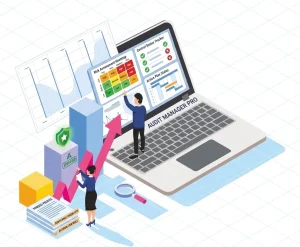
- Regulatory Readiness: When every piece of evidence and every corrective action lives in a single searchable system, regulatory reviews become less disruptive. The team presents documentation rather than assembling it under deadline pressure.
- Continuous Monitoring: Integrated audit and compliance software shifts the operating model away from annual snapshots. Control failures show up when they happen, not six months later, when the next scheduled audit finally reaches that area.
- Cost Savings: Eliminating duplicate evidence collection, cutting manual preparation time, and avoiding non-compliance penalties all contribute to measurable savings. The ROI tends to be clearest in organizations that previously spent weeks each quarter rebuilding the same reporting packages from scratch.
- Faster Audit Cycles: Automated scheduling, structured evidence workflows, and configurable approvals cut the time between audit kickoff and final sign-off. Engagements that previously ran for 6 weeks tend to finish in under 2. That time comes back to the audit team as capacity for work that actually requires judgment.
- Better Risk Management: When audit findings automatically feed into the risk register, risk scores reflect the current control environment rather than the last manual update. The risk and audit teams stop working from separate pictures of the same organization. The leadership gets a view that neither function could produce on its own.
- Enhance Compliance: Integrated compliance-tracking maps controls across multiple regulatory frameworks. Evidence collected for one audit satisfies overlapping requirements without having to be collected again. For teams managing three or four frameworks with significant overlap, this alone tends to justify the platform cost
- Increased Transparency and Accountability: Every finding, owner, deadline, and remediation action sits in one place. Nothing gets quietly deferred or buried in an inbox. Audit committees can see what was found, who owns it, and whether it has been closed.
Core Features Every Audit Management Software Should Have
Audit Management & Scheduling Software
Audit management and scheduling software handles the mechanics of building and maintaining the annual audit plan.
This includes:
- Assigning auditors based on availability and expertise
- Setting schedules based on risk scores
- Tracking whether engagements start and finish on time.
The practical value shows up in resource management.
Overallocation is one of the most common reasons audit plans slip. A platform that makes capacity visible before the quarter starts, rather than after two engagements have been quietly deferred, changes how planning conversations happen.
Recurring standard reviews should run on automated schedules. One need not rebuild them from scratch each cycle.
Workflow Automation
Manual handoffs are where audit cycles quietly fall apart. Tasks sit in inboxes. Reviewers miss deadlines because no one follows up.
With Audit Management Software, Workflow automation handles the routing. This includes sending tasks to the right people, triggering reminders, and escalating overdue items. The process runs the same way every time, regardless of who is running it.
Real-Time Dashboards & Reporting
Audit committee members do not read 40-page reports before board meetings. They need a consolidated view of what was tested and what was found, ideally in a format that can be reviewed in 10 minutes.
Audit and risk management solutions built for enterprise use automatically generate executive dashboards, heat maps of the audit universe, and reporting templates that pull live data. This eliminates the need for an analyst to consolidate status from a stack of separate documents manually.
Risk Assessment and Control Management
Audit planning only works if it reflects where risk actually sits. Risk assessment and control management tools let teams score risks, map controls to risk areas, and build an audit plan that directs coverage accordingly. A risk may change mid-year. This might be a new acquisition or an operational incident. The plan updates rather than waiting for the next annual cycle to catch up.
Evidence Management
Evidence management is where the gap between a spreadsheet process and a proper audit platform becomes most concrete.
Auditors often attach files directly to specific findings. These files have a documented chain of custody that satisfies both internal quality standards and external regulatory requirements.
Version control, access logging, and tamper-proof storage are not premium features. For regulated industries, they are the baseline that makes electronic evidence usable during a regulatory examination.
Integration with ERP, GRC, and ITSM Systems
An audit platform that cannot connect to the systems where your business data actually lives is just a better-looking spreadsheet.
Platforms that deliver measurable value integrate with SAP, Oracle, ServiceNow, Salesforce, and GRC (Governance, Risk and Compliance) tools like Archer. It pulls data directly, eliminating the need for auditors to transfer information between systems manually.
API-first architecture is the indicator to look for. Platforms that rely on flat-file imports or scheduled data transfers accumulate integration debt that grows each year as the audit universe expands and underlying systems change.
Document Management
Audit documentation, such as Workpapers, policies, evidence files, and sign-off records, can add up quickly. It needs to be easily findable when a regulator asks for it.
Document management provides auditors with a structured repository that supports version control, access logging, and clear chain-of-custody records. The difference between producing documentation and scrambling to reconstruct it under deadline pressure comes down to whether this is in place before the review starts.
Mobile and Offline Fieldwork Capabilities
It is to be noted that Supply chain auditors, EHS inspectors, and operational reviewers do not work from offices.
The audit happens on a factory floor or at a remote supplier facility where connectivity is unreliable. The platform needs to work on a tablet, capture photos and signatures, support offline data entry, and sync everything back when a connection is available.
This requirement is straightforward. It is also missing from a surprising number of platforms that were designed primarily for financial audit teams who work from desks with reliable internet access.
Compliance Tracking
Compliance tracking connects audit activity to regulatory frameworks. Team members always know which controls have been tested, which findings are still open, and whether the organization is on track. For teams managing multiple frameworks simultaneously, it replaces the need for a separate tracking spreadsheet for each requirement.
Ready to take the next step?
Talk to Experion’s audit technology team and start with a process assessment before the vendor shortlist gets built.
Advanced Capabilities of Audit Management Software Solutions
AI-Powered Analytics
Traditional audits test samples. An auditor selects 25 transactions from a population of 50,000 and assesses whether controls are in place for that subset. The implicit assumption is that the sample is representative. Often it is not, and the exceptions that matter most are precisely the ones that statistical sampling tends to miss.
AI-powered analytics in internal audit software solutions evaluate the full population instead. Every transaction, journal entry, vendor payment, or access event gets reviewed against expected patterns, and deviations are flagged for auditor investigation. The auditor’s job shifts from selecting what to test to following up on what the system has already identified.
Audit and Risk Management Solutions
Audit and risk management have historically lived in separate organizational silos. The risk team identifies and scores risks. The audit team tests controls. The problem is that findings from audit engagements rarely make it back to the risk register in any systematic way. Hence, risk assessments remained anchored to the last time they were updated rather than reflecting the current control environment.
Integrated audit and risk management solutions close that gap. Risk scoring in the audit planning module uses live register data. When an audit uncovers a control failure, the relevant risk score is automatically updated. When a new risk gets added, the planning module flags it for coverage.
Leadership gets a consistent view of risk and control status, which neither function could provide on its own when operating separately.
How to Choose the Best Audit Management Software?
Before scheduling vendor demos, map out where your current audit process actually breaks down. The most common mistake is buying a feature-rich platform that solves the wrong problem.
- Identify your Business Needs: Before looking at any platform, map out what your audit function actually does.
– How many audits are run each year?
– Which regulatory frameworks apply?
– Where does the current process break down: Scheduling, evidence collection, findings tracking or reporting?
A platform chosen without that baseline tends to be feature-rich but wrong for the job.
- Scalability: Can the internal audit management software grow with your organization? Think about where audit volume will be in three years, not just today. New acquisitions, market expansion, and additional regulatory requirements all add to the audit universe. A platform that needs re-implementation every time the scope increases is a high hidden cost.
- Integration: Does it connect with your ERP, GRC, HR, and ITSM systems? Integration depth is often what separates a platform that gets fully adopted from one that runs alongside the existing process.
- User Experience: The best audit management software is the one your team actually opens and uses. A platform with strong features and a frustrating interface will be quietly worked around within months. Evaluate the experience for auditors conducting fieldwork, not just for the CAE reviewing a dashboard.
- Check Compliance Requirements: List the regulatory frameworks your organization operates under. Check whether the platform supports them natively. Pre-built templates for SOX, ISO 27001, HIPAA, and GDPR significantly reduce implementation time. For regulated industries, also check data residency requirements, certifications, and whether the vendor’s infrastructure meets your jurisdiction’s specific obligations.
- Security: Minimum requirements include SOC 2 Type II certification, multi-factor authentication, role-based access controls, and encryption for data at rest and in transit. For regulated industries, ask specifically about data residency and whether the vendor’s infrastructure can meet your jurisdiction’s requirements.
When you reach the evaluation stage, request a proof-of-concept using your actual audit data. How a platform handles your real organizational data tells you far more than a polished demonstration built on clean sample records.
Take the first step toward a fully connected audit process ⟶
Talk to our team today
Top Use Cases Across Industries
BFSI- Regulatory Compliance
Financial services organizations run audits against regulatory frameworks, with higher stakes for gaps than most other sectors.
SOX compliance requires documented testing of internal controls over financial reporting.
AML programs need transaction monitoring and defensible audit trails. Model risk management audits require detailed validation documentation. Internal audit software in banking needs to handle all of this in a single environment, with access controls that restrict auditors to authorized data and an audit trail that withstands examiner scrutiny without weeks of manual preparation.
Manufacturing – Operational Audits
Manufacturing audit programs encompass multiple audit types: quality reviews, supplier compliance assessments, EHS inspections, and ISO 9001 certification maintenance.
Audit software for supply chain management sits at the center of this. It tracks corrective action plans across large supplier networks and manages audit frequency by risk tier.
Organizations managing this well are not running a separate tool for each audit type. They use a single operational audit management software platform with configurable workflows that adapt to each category, eliminating the need for custom development for every new program.
Healthcare- Compliance Audits
Healthcare audit teams handle HIPAA compliance, clinical operations reviews, billing integrity audits, and a payer environment that is becoming increasingly complex.
Clinical documentation audits need EHR integration.
Billing audits connect to revenue cycle platforms. Any audit management platform that handles protected health information must meet strict data residency and access requirements before deployment.
Compliance audit management software in healthcare also has to distinguish clearly between findings that require human clinical judgment and those that can go straight to automated remediation tracking. Getting that boundary wrong creates both clinical and compliance risks.
Retail and Ecommerce – Supply Chain Audits
Retail organizations face steady pressure to verify supplier compliance across extended supply chains covering labor standards, environmental requirements, product safety, and data security. Audit management solutions in retail need to run high volumes of concurrent supplier audits, support corrective action workflows across languages and time zones, and feed results into supplier scorecards that procurement teams rely on for vendor decisions.
IT & SaaS
IT and SaaS organizations deal with a concentrated set of audit requirements: SOC 2 Type II reviews, access control audits, change management testing, and vendor security assessments. IT audit management software built for this environment connects to identity platforms and ITSM tools to automatically pull evidence, cutting the back-and-forth that makes most IT audit cycles run longer than they should.
Government & Public Sector
Public sector audit programs have limited funding and personnel. They are often subject to stringent accountability regulations. Government organizations may maintain comprehensive documentation trails, standardize departmental operations, and prove compliance by using audit management software. In this setting, manual procedures are not only ineffective but also difficult to defend when outcomes are examined publicly.
Implementation Best Practices
These are some of the best practices to follow during implementation:
- Define audit scope before you configure anything
Decide which audit types, business units, and regulatory frameworks are in scope for the initial deployment. Implementations that start focused on one audit type or one region consistently go live faster and see higher adoption than attempts to deploy everything at once.
- Train teams before go-live, not after
Auditor adoption is the most common point of failure. Training needs to cover why the new process is better than the spreadsheet approach it replaces, not just how to click through the interface. That context is what drives actual behavior change.
- Start with pilot testing
Before rolling out to the entire organization, run the platform against a specific audit type or one business unit. A focused pilot will surface integration gaps, workflow mismatches, and usability problems while the scope is still small enough to fix without disrupting the rest of the deployment.
- Bring in integration and IT teams early
Connecting audit management software to your ERP, GRC, and ITSM systems is where implementations most often run over schedule. Waiting until the platform is already configured to address integration requirements means rebuilding work that was already done.
- Set baseline metrics before go-live and measure against them
Track audit cycle time, finding closure rate, and evidence collection time per engagement before the platform launches.
Then measure again at 30, 90, and 180 days. That data is how you demonstrate ROI to leadership and identify where the implementation needs adjustment.
Future Trends: AI and Agentic Auditing in 2026
Agentic AI – Autonomous Preliminary Control Testing
Agentic AI systems can plan and execute multi-step tasks without continuous human direction. In audit management, that translates to autonomous agents that pull evidence from integrated systems, check it against defined control criteria, flag exceptions, and prepare findings summaries, all without an auditor having to initiate each step manually. The auditor reviews the output. The agent handles the initial work.
Predictive Auditing
Predictive auditing uses historical audit data, risk indicators, and other operational metrics to identify where control failures are most likely before they occur. Rather than discovering a problem during the next scheduled cycle, predictive models surface elevated-risk areas in real time, enabling audit coverage to shift accordingly.
Platforms investing in this capability offer a meaningfully different value proposition than tools that simply digitize existing audit workflows.
Global Collaboration via Cloud-Based Internal Audit Software
Global enterprises need audit programs that operate consistently across continents, time zones, regulatory regimes, and languages. Cloud-based internal audit software makes that possible by giving distributed teams access to the same platform, evidence repository, and reporting environment regardless of location.
For organizations that previously ran regional audit programs on separate tools and then tried to consolidate results at the group level, a single cloud-based platform eliminates the need for consolidation.
Increased Automation
Certain routine audit tasks, such as scheduling, status reminders, and report generation, will now run automatically. Audit teams, who spent a significant portion of their time on administrative work, can now reclaim their time.
Greater use of Machine Learning
Machine learning models are trained on historical audit data. It often gets better at detecting anomalies over time and produces fewer false positives.
The real-time effect is that the model learns what a typical dataset for an organization looks like.
Continuous Auditing Models
Continuous monitoring frameworks are replacing annual audit cycles. Controls are tested on an ongoing basis, and exceptions surface in real time. This requires platforms that connect directly to operational systems. They should not rely on periodic data exports.
The gap between when a control fails and when an auditor discovers it goes from months to days.
Integration with Enterprise Ecosystems
Audit management platforms will connect to ERP, GRC, HR, and operational systems as a default rather than through custom integrations built project by project. When the audit function has live access to data across the organization, findings can be connected to operational responses more quickly.
The audit team stops functioning as a separate layer that has to request everything manually.
Conclusion
For years, the internal audit function has been pushed to accomplish more, including covering more risk, reporting more often, and exhibiting independence.
By eliminating the administrative burden that keeps qualified auditors from using their judgment, audit management software fills that gap. A single, interconnected environment is used for scheduling, gathering evidence, tracking findings, following up on remediation, and executive reporting.
By playing a crucial role in performance, audit management software has evolved beyond compliance. The degree of integration, alignment with the regulatory framework, management of the implementation, and whether your audit team genuinely accepts the platform or discreetly keeps using the old method all affect the result.
At Experion, we can transform your audit process so your team spends less time assembling evidence and more time acting on findings. Whether you run internal audits or IT assessments, we can build the platform around how your audit function actually operates.