

At Experion, we design and build high-performance custom mobile solutions that align technology with real business outcomes.
In today’s rapidly evolving digital landscape, having an online presence alone is no longer enough for businesses. They need tailored solutions that align with their goals, serve their users effectively, and support their workflows. Custom mobile app development addresses this need by delivering mobile solutions built specifically around business objectives, processes, and user expectations- resulting in stronger performance, enhanced security, and better long-term ROI compared to generic alternatives.
Whether you’re exploring custom mobile app development for the first time or looking to scale an existing product, this blog will walk you through everything you need to know.
What is Custom Mobile App Development?
Custom mobile app development is the process of designing, building, and launching mobile applications tailored specifically to a business’s unique requirements – rather than adapting pre-built, off-the-shelf software. Every feature, workflow, and design element is created to reflect the company’s brand identity and target user audience.
The key difference from generic mobile app development is ownership and customization. A generic app serves the broadest possible audience, forcing businesses to compromise features and workflows.
Custom mobile app development, on the other hand, prioritizes your demands and produces an application that functions precisely as your company requires. It scales with your expansion while integrating with your current systems and adhering to industry laws.
Real-world use cases cover every possible industry- from healthcare and logistics to retail and finance. For example:
- A hospital that uses a HIPAA-compliant telemedicine app integrated with its EHR system.
- A logistics company that builds a real-time fleet tracking and route optimization platform.
- A retailer creating a mobile application that provides an AR-powered shopping experience connected to live inventory data.
In each of these cases, off-the-shelf applications simply wouldn’t be able to replicate the required functionality.
Why Businesses Need Custom Mobile App Development Today?
Modern businesses operate in highly competitive digital ecosystems. Therefore, a tailored mobile application is no longer optional – it is a strategic infrastructure. Here are the primary reasons companies are choosing to invest:
- Personalized user experience: A custom app delivers personalized user experiences that reflect brand identity and customer behavior. Custom apps allow sophisticated personalization that generic solutions cannot match.
- Scalability and flexibility: Custom mobile application development services are designed to grow with your business, accommodating new users, markets, and features without requiring a rebuild.
- Enhanced security: Custom apps implement security measures designed for your specific compliance requirements – HIPAA, PCI-DSS, GDPR – rather than generic data protections that may leave gaps.
- Integration with business systems: Custom mobile apps seamlessly connect with CRMs, ERPs, payment platforms, and proprietary databases, eliminating data silos and manual synchronization.
- Competitive advantage: When competitors use the same generic tools, differentiation is impossible. Custom mobile apps incorporate your unique processes and innovations into a product that competitors cannot easily replicate.
Key Benefits of Custom Mobile Application Development
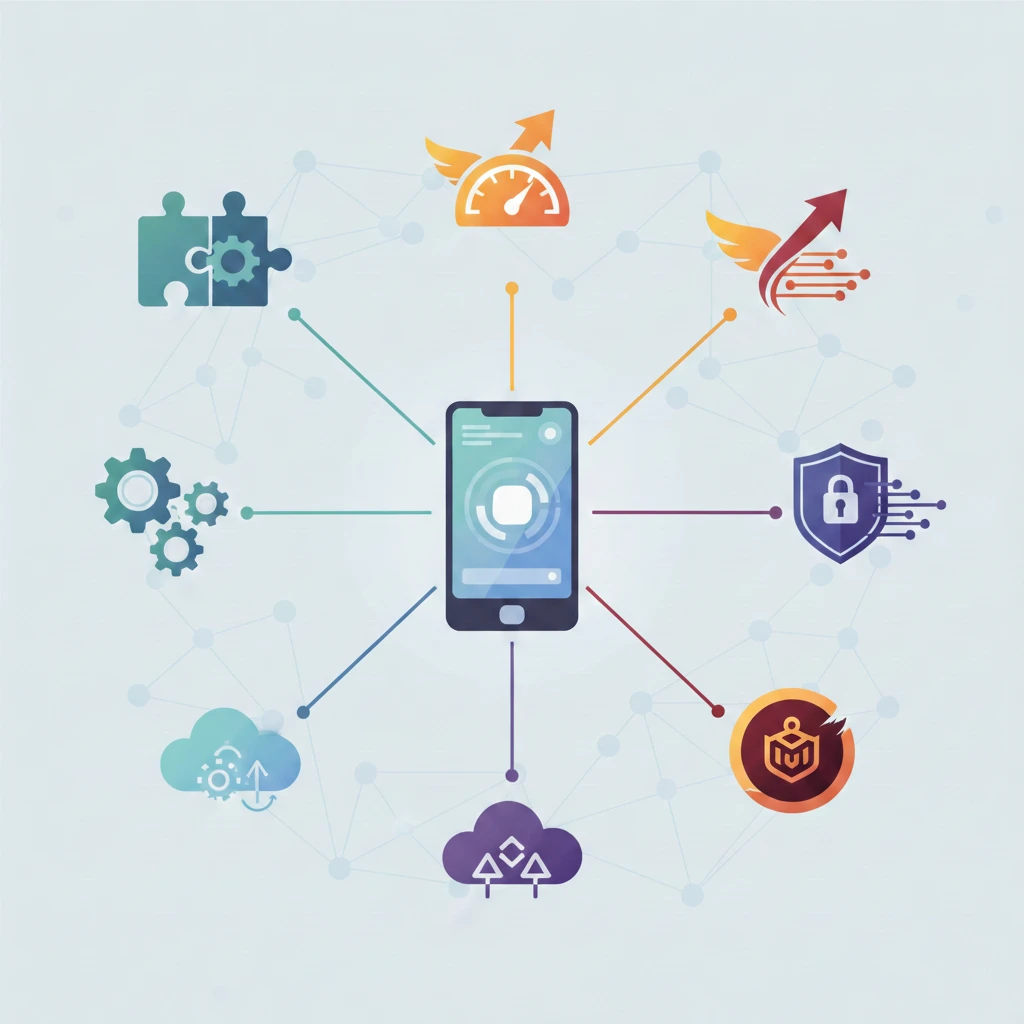 Through Custom Mobile Apps, businesses can deliver unique customer experiences. In other words, it can help provide a much-needed competitor advantage in the cut-throat market.
Tailored functionality
Every feature in a custom app serves a defined business purpose. You’re not paying for unused functionality or working around limitations. Custom mobile apps development ensures your application reflects your exact operational workflows, giving users precisely what they need and nothing they don’t.
Better performance
Off-the-shelf apps are built to serve many, which often results in bloated codebases. Custom mobile application development services enable optimization specifically for your use cases. This results in faster load times, lower battery consumption, and a smoother experience even under heavy usage.
Improved data security
Custom development lets you implement encryption standards, access controls, and authentication mechanisms tailored to your data sensitivity and regulatory environment. Unlike widely used generic software, which is a common target for attackers, your custom app’s unique architecture adds an additional layer of protection.
Seamless integrations
Custom apps are designed to fit your technology stack. This eliminates the workarounds and middleware hacks required to make generic apps communicate with enterprise systems.
Brand alignment
From color palettes and fonts to user interactions and voice, every element of a custom mobile app can be crafted to reflect your brand. Consistent, on-brand mobile experiences build recognition and trust – converting users into loyal advocates.
Custom Mobile App Development vs Traditional Mobile App Development
Traditional mobile app development using off-the-shelf platforms offers lower upfront costs but often accumulates expenses through per-user licensing, tier upgrades, and the cost of features the platform doesn’t support. Though custom mobile application development requires a higher initial investment, the total cost of ownership over three to five years frequently favors custom mobile app development – particularly for organizations with specific requirements or high-growth trajectories.
On the maintenance side, generic solutions are updated based on the vendor’s schedule, which may introduce unwanted changes or break integrations. Custom apps update based on your terms. On scalability, generic platforms impose hard limits on users, transactions, or data that force expensive tier changes. Custom architectures scale precisely as your business demands, without constraints.
With generic software, you license an asset owned by someone else. Custom mobile apps development gives you full ownership of your code, algorithms, and intellectual property – a strategic asset that grows in value over time.
Industries Leveraging Custom Mobile Application Development Services
Custom mobile application development has become essential across virtually every sector:
- Healthcare: HIPAA-compliant telemedicine platforms, patient monitoring apps, and clinical decision support tools that integrate with hospital information systems.
- Fintech: Mobile banking, investment platforms, and fraud detection systems built with proprietary risk algorithms and real-time transaction processing.
- Retail & eCommerce: AR-powered shopping, personalized loyalty programs, and omnichannel experiences driven by live inventory and CRM data.
- Logistics: Fleet management, route optimization, and real-time delivery tracking that connect GPS, traffic data, and customer communication in one platform.
- Education: Adaptive learning management systems, virtual classrooms, and student information platforms tailored to specific curricula and institutional workflows.
- Startups: Custom mobile app development for startups enables rapid implementation of innovative business models and differentiated experiences-the foundation of market disruption.
Custom Mobile App Development Process Explained
A structured development lifecycle is central to every successful custom mobile application development company. The process typically follows these phases:
Requirement Discovery
Deep-dive stakeholder interviews, user research, and business process mapping to surface both explicit requirements and hidden needs that define the app’s success.
UX/UI Design
User personas, wireframes, and high-fidelity prototypes validated with real users before a line of code is written – ensuring the design solves the right problems.
Architecture Planning
Technology selection, database design, API architecture, and scalability planning that future-proofs the application.
Development
Agile sprints delivering working functionality incrementally, with regular stakeholder reviews ensuring alignment throughout.
Testing & QA
Functional, performance, security, and compatibility testing across target devices and OS versions to ensure dependable real-world performance.
Deployment
App store submission, infrastructure configuration, monitoring setup, and phased rollouts to manage launch risk.
Maintenance & Scaling
Once the mobile application is functional, it is important to ensure it remains so. At this stage, maintenance is of utmost importance. Ongoing security updates, performance optimization, feature enhancements, and infrastructure scaling keep the app competitive long after launch.
Technologies Used in Custom Mobile Apps Development
To build a successful mobile application, you would need to select the right combination of technologies across every layer of the stack. The following 5 technology pillars form the foundation of custom mobile app development:
- Native development – Native Apps are built for specific OSes. If an app is developed for iOS, then it will run only on an iOS device. On the other hand, Android apps can run only on Android devices. It is expensive to develop, since it requires engineers with OS-specific language skills, such as Objective-C or Swift for iOS and Kotlin for Android. Especially for applications requiring maximum performance, deep platform integration, or complex device-specific capabilities.
- Cross-platform frameworks– Cross-platform frameworks are used to create software applications compatible with multiple operating systems. React Native and Flutter enable shared codebases across iOS and Android – reducing time and cost while maintaining near-native performance for most use cases.
- Backend technologies– Backend technologies such as Node.js, Python, Java, and .NET run the app’s backend logic. They are built to handle growth and are often organized into small, independent services or cloud functions, so each part can scale smoothly as demand increases.
- APIs & integrations– APIs and integrations, such as RESTful APIs and GraphQL, connect the mobile frontend to backend systems and third-party services, enabling data to be sent securely and efficiently.
- Cloud infrastructure– Cloud platforms such as AWS, Google Cloud, and Azure provide flexible cloud infrastructure that scales with demand – removing the need for upfront hardware investments while ensuring consistent performance.
Experion utilizes modern frameworks, secure architectures, and scalable cloud ecosystems to deliver future-ready mobile platforms.
Choosing the Right Custom Mobile App Development Company
Selecting the right partner from the many custom mobile app development companies available is one of the most important decisions you’ll make. The gap between a top custom mobile app development company and an average provider shows not just in code quality, but in business outcomes, project timelines, and long-term value.
You would need to evaluate potential partners across six dimensions:
- Industry expertise and domain knowledge relevant to your sector.
- A portfolio of comparable projects with measurable outcomes.
- A technology stack that matches your requirements rather than just the vendor’s preferences.
- Transparent communication practices and project management methodologies.
- Robust security standards and compliance expertise.
- End-to-end post-launch technical support offering
Ask for detailed case studies, speak with past clients, and assess whether the custom mobile application development company genuinely understands your business context – not just your technical requirements. The best custom mobile app development companies combine deep technical expertise with strategic thinking.
Custom Mobile App Development Services You Should Expect
Comprehensive custom mobile app development services go far beyond writing code. When evaluating a provider for custom mobile application development services, ensure the following are included:
- Consultation & strategy: Translating business objectives into a mobile roadmap with clear feature prioritization and success metrics.
- UI/UX design: User research, information architecture, wireframing, and testing high-fidelity designs that drive adoption.
- Full-cycle development: End-to-end custom mobile app development service covering frontend, backend, database, and infrastructure.
- Integration services: Connecting your app with existing CRM, ERP, payment, and analytics systems for real-time data flow.
- Support & upgrades: Ongoing maintenance, security patching, OS compatibility updates, and feature enhancements post-launch.
Custom Mobile App Development for Startups
Startups have distinct needs that make custom mobile app development for startups a uniquely valuable investment. Unlike enterprises, startups need to validate assumptions fast, conserve capital, and pivot when necessary – all while building something competitors can’t easily copy.
MVP-focused development concentrates initial effort on the core features that prove your value proposition, enabling market entry faster and at lower cost. Cloud-native, modular architectures support budget-friendly scaling – growing from hundreds to hundreds of thousands of users without requiring architectural rewrites. Rapid prototyping and built-in analytics enable data-driven iteration, helping startups find product-market fit before resources run dry.
The combination of unique functionality, speed to market, and strategic scalability makes custom mobile app development for startups a smarter choice than building platforms designed for generic use cases that don’t reflect your business model.
Cost Factors in Custom Mobile Application Development
Custom mobile application development costs vary widely based on five primary factors:
- Application complexity (the most significant driver – sophisticated logic, algorithms, and data processing multiply development effort);
- Platform choice (native iOS and Android development costs more than cross-platform, but may deliver superior results for demanding use cases);
- Feature requirements (advanced capabilities like AR, machine learning, or real-time synchronization add significant effort);
- Development timeline (compressed schedules require larger teams and carry premium costs);
- Ongoing maintenance (budget for regular security updates, OS compatibility, and feature evolution).
Simple applications may range from $50,000 to $100,000, whereas complex enterprise-grade platforms can exceed $500,000.
Most businesses compare only initial development costs against generic software licensing fees. However, make sure to evaluate investment against the total cost of ownership – including the value of features that generate revenue, reduce costs, or protect competitive position.
Common Challenges in Custom Mobile App Development
Understanding common challenges helps organizations prepare for them.
- Scope creep refers to continuous requirement expansion without corresponding timeline and budget adjustments and is the most prevalent challenge. It can be addressed through clear initial requirements, formal change management, and regular prioritization reviews.
- Security concerns demand a proactive architecture rather than post-launch patching and the integration of security into every development phase. Platform compatibility requires systematic testing across representative device portfolios rather than assuming uniform behavior.
- Performance optimization is critical given mobile devices’ resource constraints; Software providers need to build performance benchmarking into the QA process from the start.
- Finally, user adoption requires investment in onboarding, engagement strategy, and continuous improvement based on real feedback – technical excellence alone doesn’t guarantee adoption.
Best Practices for Successful Custom Mobile App Development
Five practices consistently differentiate successful custom mobile apps development engagements:
- Firstly, define clear, measurable goals before any design or development begins.
- Apply agile methodology to deliver working software incrementally and incorporate feedback continuously.
- Prioritize user-centered design by testing prototypes with real users rather than relying on internal assumptions.
- Implement continuous testing throughout development rather than treating QA as a final gate.
- Architect for scalability from day one, building modular, cloud-native foundations that grow with demand rather than retrofitting scale when problems emerge.
Future Trends in Mobile App Development

The mobile app development landscape is evolving faster than ever. These are the five trends that are shaping the next generation of custom applications:
- AI-powered apps: Machine learning is enabling intelligent features such as personalized recommendations, predictive analytics and natural language interfaces. These are accessible to businesses of all sizes through cloud AI services.
- IoT integration: Mobile apps are becoming control hubs for connected device ecosystems, demanding expertise in real-time data processing and edge computing architectures.
- 5G experiences: Ultra-low latency and high bandwidth unlock AR, cloud processing offload, and real-time collaboration experiences previously impossible on mobile.
- Super apps: Comprehensive platforms integrating multiple services in one application are gaining priority globally – requiring modular architectures that support ongoing capability expansion.
- Hyper-personalization: Dynamic experiences that adapt in real-time to individual user behavior, context, and preferences are becoming the baseline expectation rather than a premium differentiator.
How to Measure Success of Your Custom Mobile App?
Success metrics of a mobile app should connect directly to business objectives.
You can track engagement through daily and monthly active users, session length, and feature adoption rates.
Monitor performance via load times, crash rates, and API response benchmarks – poor performance will drive abandonment regardless of feature quality.
For revenue-generating apps, measure ARPU, conversion rates, and customer lifetime value.
Most importantly, track retention: day-1, day-7, and day-30 retention rates reveal whether the app creates genuine, lasting value or merely initial curiosity.
Establish baselines at launch and review trends regularly to guide ongoing investment.
The Experion Advantage: Custom Mobile App Development Built Around Your Business
The right custom mobile app development company doesn’t just build what you ask for – it challenges assumptions, identifies opportunities, and delivers solutions that perform better than the original brief.
Providing proper support ensures your application evolves with changing requirements rather than becoming a legacy liability. Deep industry expertise means faster onboarding, fewer mistakes, and more relevant innovation. Proven delivery methodologies reduce risk and compress time to market. And genuine innovation capability – staying current with AI, 5G, IoT, and emerging design paradigms – ensures your custom app leads rather than follows.
These qualities are what separates a true strategic partner from a vendor. When your mobile strategy is central to competitive positioning, the quality of this partnership has outsized impact on outcomes.
Conclusion
Custom mobile app development has shifted from a competitive differentiator to a strategic necessity. Organizations across healthcare, fintech, retail, logistics, education, and beyond are discovering that generic solutions cannot deliver the tailored functionality, security, and user experiences required to lead their markets. The investment in custom mobile application development services yields superior long-term ROI through full code ownership, unlimited scalability, and the ability to implement features that directly drive revenue and operational efficiency.
More than just selecting custom versus generic; a successful mobile app also calls for user-centered design, a clear goal, the appropriate technology stack, and collaboration with seasoned custom mobile app development firms that are aware of the business and technical aspects of mobile strategy. The principles are the same whether you require a full-scale business platform or a startup MVP: grow purposefully, test often, and develop with a purpose.
Key Takeaways
- Custom mobile app development delivers tailored solutions whereas off the shelf alternatives lead to compromises on functionality, security, and user experience.
- Key benefits of custom mobile app development are plenty – personalization, security, integration, scalability, brand alignment. This delivers stronger long-term ROI than off-the-shelf licensing.
- Custom mobile application development services are being used by a variety of industries, including healthcare and logistics, to revolutionize client engagement and operations.
- Custom mobile app development for startups enables MVP-focused, scalable builds that accelerate market validation without over-engineering.
- Emerging trends like AI, IoT, 5G and hyper-personalization make custom mobile apps development increasingly critical for evolving businesses.
- Expertise, portfolio, communication, security standards, and long-term support commitment are all important factors to consider when selecting a top mobile app development company.
Ready to build something that works as hard as your business does? Consult a professional mobile app development services provider like Experion and take the first step toward a custom mobile application built for lasting impact
Frequently Asked Questions (FAQ’s)
- How is custom mobile app development different from standard mobile app development?
Custom App development builds an application from scratch. Generic or off-the-shelf apps are pre-built for a broad audience. This forces you to adapt your processes to fit the software. The main difference is ownership, specificity, and the ability to scale and integrate on your own terms.
- How long does custom mobile app development take?
A simple custom app typically takes 3 to 6 months, while complex enterprise-grade platforms can take 9 to 18 months or more. The timeline depends on feature complexity, platform choice, integration requirements, and team size.
- Can custom mobile apps integrate with existing systems?
Yes – seamless integration is one of the core advantages of custom development. Custom apps are designed to connect with your CRMs, ERPs, payment gateways, and proprietary databases from the ground up.
- Is custom mobile app development secure?
Custom apps allow you to implement security measures tailored to your specific regulatory requirements, whether that’s HIPAA, PCI-DSS, or GDPR. Unlike widely used generic software, which is a frequent target for attackers, a custom app’s unique architecture reduces its attack surface. Security can also be embedded into every phase of development rather than patched in after launch.
- How do I choose the top custom mobile app development company?
Evaluate partners with industry expertise, a portfolio of comparable projects with measurable outcomes, and transparency in communication and project management. Verify that their technology stack aligns with your requirements, not just their preferences. Speaking directly with past clients and reviewing detailed case studies is the most reliable way to assess efficiency.
- What services are included in custom mobile app development services?
A provider should cover strategy and consultation, UI/UX design, full-cycle development across frontend, backend, infrastructure, and third-party integrations. Post-launch technical support including security updates, OS compatibility patches, and feature enhancements should also be included. Anything less than end-to-end coverage shifts risk back to you.
- How much do custom mobile application development services cost?
Simple applications typically range from $50,000 to $100,000, while complex enterprise platforms can exceed $500,000. Cost is driven primarily by feature complexity, platform choice, timeline, and ongoing maintenance needs. It’s important to evaluate total cost of ownership rather than just upfront development cost when comparing custom development against off-the-shelf licensing.
- Who should invest in custom mobile app development?
Any business or organization whose needs, workflow or user experience cannot be adequately met with generic software should adopt custom mobile apps. If your application is the focal point of your operations, then customization is the way to go.