





 Back
Back
At Experion, we have the expertise to build scalable OTT platforms for content and media companies, designed to deliver seamless viewing experiences as audiences grow.
Gone are the days of waiting for your favorite TV show to air on TV. With the development of OTT apps, one can stream a show at one’s own convenience. OTT changed how people watch, listen, and learn. Everyone from the big streaming names to a single creator with a loyal following is now building their own app, because owning the audience relationship is better than renting it from a broadcaster or an app store.
This blog is about what goes into OTT app development: Why the market is moving so fast, the features you can’t skip, the build process, how to generate revenue from it, what it costs, and how to choose the right development partner who won’t slow you down.
Key Takeaways
- OTT is now a core distribution strategy, not an experiment – driven by mobile-first viewing, smart-TV adoption, and global streaming demand.
- A handful of factors separate an OTT app that works from one that doesn’t: multi-device support, adaptive streaming, real DRM, personalization, and a monetization setup you can actually change later.
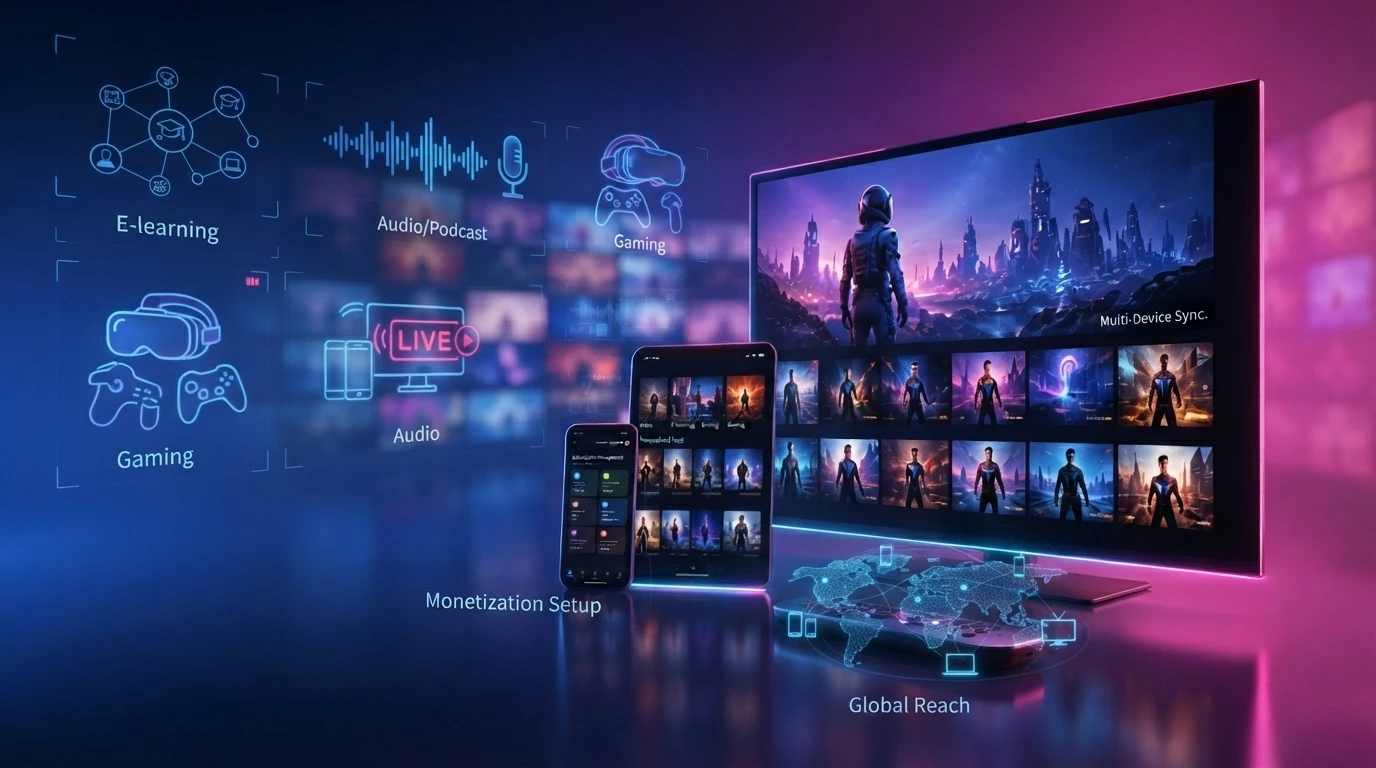
- “OTT” encompasses much more than video. Audio, e-learning, gaming, live events – each one comes with its own technical demands, and treating them all the same is a common mistake.
- The cost depends on how many platforms you are targeting, your DRM choice, CDN usage, how much content you’re managing, and how custom the features are. Build, buy, or customize – each path moves the budget and the timeline differently.
- If there’s one decision that determines whether a platform scales well, it’s who you pick to build it.
Introduction – Why OTT is No Longer Optional for Content & Media Businesses?
Ten years ago, reaching an audience meant going through cable operators, broadcasters, and other distribution gatekeepers. That model has now changed dramatically.
More consumers now embrace cord-cutting. Cord-cutting is the practice of shifting away from cable TV in favor of streaming services over the internet. Surprisingly, OTT platforms are now, and there’s a whole generation that’s never signed a cable contract.
Mobile access has pushed this further. Phones and tablets now account for a large share of viewing worldwide, and smart TVs have closed the gap between the living room and the internet. This is where an over-the-top application comes in—the technical term for a service that delivers content directly over the internet rather than through traditional distribution.
Why is OTT App Development Booming?
The growth in OTT platform development services isn’t hype. It’s a handful of trends that happened to converge at once.
- Rise in mobile and smart TV consumption: People move between a phone on the commute, a laptop at lunch, and a smart TV at night without thinking about it. Streaming is the default now, and that creates real demand for streaming app development.
- Demand for personalized content: Audiences don’t want one generic catalog anymore. They expect recommendations and a continuous-watching list, and platforms that get this right see better engagement and retention.
- Subscription revenue: Recurring subscription revenue is one of the more predictable models in digital media, which is part of why investors and operators both like it.
- New industries getting into OTT: Streaming isn’t limited to film and TV anymore. Fitness, education, faith-based content, sports, gaming, and corporate communications are all building their own branded streaming experiences, widening the market well beyond traditional media.
Partner with Experion to launch your streaming platform.
Key Market Trends Shaping OTT Platform Development
For OTT app development, here are a few trends to keep an eye on:
- AI-powered recommendations, where machine learning models read viewing behavior to surface what someone’s likely to watch next — the difference between a generic homepage and one that actually keeps people around.
- Interactive and shoppable video. Clickable hotspots, branching stories, and in-stream purchases – video is slowly turning into a two-way medium instead of something you just sit and watch.
- Multi-device streaming that actually works, meaning the same profile and the same progress, no matter what screen someone picks up next. This used to be a nice extra. Now people expect it and get annoyed when it’s missing.
- Cloud-native infrastructure lets a platform handle a live premiere or a sudden traffic spike without anyone having to pre-provision a pile of servers that sit idle the rest of the year.
Must-Have Features of a Successful OTT App
Regardless of the genre or business model, the apps that actually work all share a common backbone. The lack of any features tends to show up fast – in the form of App Store reviews, churn numbers, or quietly in lost revenue nobody notices until the quarterly review.
- Multi-device support: Devices such as smart TVs, mobile devices, web browsers, and set-top boxes each need an interface suited to that device, and remote-control navigation is its own design problem that mobile teams sometimes underestimate.
- Adaptive bitrate streaming & low buffering: This feature adjusts video quality on the fly based on network conditions so that playback remains watchable regardless of the location from where they stream.
- Personalization & recommendation engine: It encompasses profiles, watch history, and suggestions that feel accurate.
- Secure Digital Rights Management (DRM) & content protection: For licensed content, this feature is paramount. Encrypted delivery and proper key exchange protect the content and keep you on the right side of your licensing agreements.
- Multi-language & subtitle support: Opens doors to markets you’d otherwise miss entirely, and it is an accessibility requirement as much as a growth lever.
- Analytics dashboard for content performance: An analytics dashboard tells operators what’s actually being watched, where people give up partway through, and which titles are pulling subscriptions or ad dollars. Without an analytics dashboard, you are simply guessing.
- Payment gateway & subscription management: This needs to be reliable, as it includes billing, trials, upgrades, and downgrades.
- Multiple content categorization – Needs to accommodate a growing content library and should include genres, collections, channels, tags, etc.
Different Types of OTT Apps you can build
OTT platforms are not a single product. It’s a category, and depending on your audience, the build can look completely different.
Connected TV & Multi-Device Apps
The classic streaming experience – smart TVs, mobile, web, and set-top boxes. The hard part isn’t the video itself; it’s getting decent performance on lower-powered TV hardware and building navigation that makes sense with a remote in someone’s hand while keeping profiles and progress in sync no matter which screen they pick up.
Audio,Podcast, & Music Streaming Apps
Audio-first platforms care about different things: gapless playback, offline downloads, background audio that keeps running when someone switches apps, and metadata that’s actually useful. Discovery and playlisting matter just as much as the playback engine itself.
Educational & e-Learning OTT Apps
These blend video lessons with quizzes, progress tracking, certificates, and sometimes cohort-based features. Content gating and a structured curriculum are central here — it’s one of the faster-growing OTT categories right now, partly because the engagement metrics are so easy to tie to outcomes.
Gaming and Live Streaming Platforms
Game streaming and creator-led live platforms push latency about as far as it can go. Ultra-low-latency protocols, live chat, real-time moderation, and the ability to handle huge concurrent audiences during peak moments — this is where infrastructure decisions are tested hardest.
Event and Webinar Streaming Apps
Virtual events and webinars mix live and on-demand video with registration, ticketing, Q&A, and networking. The reliability bar is high because, unlike a regular catalog title, the event usually happens exactly once.
At Experion, we have the capability to build OTT applications by combining cloud, streaming, and DevOps expertise, delivering scalable architectures that can support growing audiences without compromising performance.
OTT App Development Process – Step by Step
A disciplined process does not guarantee success, but it removes a lot of avoidable risk.
Discovery & Business Requirement Mapping
Discovery begins with gaining a clear understanding of the audience, content strategy, monetization model, target devices, and success metrics.
UX/UI Design for Streaming Experience
Streaming UX is its own discipline, not a smaller version of regular app design. Browsing, search, playback, and account flows – they all need to work on a touchscreen, a mouse, and a TV remote, and friction in any of those cuts straight into watch time.
Platform & Tech Stack Selection
The frameworks, streaming protocols, cloud services, and third-party tools you choose here set a ceiling on performance and maintainability that you’ll be living with for years. Worth getting right the first time.
Development & Integration (CDN, DRM, Payment, Analytics)
This is where the platform actually gets built: the apps and backend first, then CDN, DRM, payment, and analytics integrated into one working system. Together, these components create a secure, scalable, and seamless streaming ecosystem.
QA, Load Testing & Multi-Device Testing
QA checks playback, billing, and navigation across the device matrix. Load testing answers the question that actually matters: Does this survive launch day or a live event with everyone showing up at once?
Deployment & Post-Launch Support
Launch is a milestone and not a finish line. Phased rollouts, real monitoring, and an actual support plan are what keeps the OTT platform running well six months later, not just on day one.
OTT App Monetization Models Explained
How you make money isn’t just a business decision – it shapes the entire viewer experience. Four approaches cover most of the field.
Subscription Video on Demand (SVOD)
Users pay a recurring subscription fee for unlimited access to the platform’s content. The upside is predictable revenue. The catch: you only get it if people stay engaged enough to renew, month after month, which puts real pressure on content and personalization.
Advertising Video on Demand (AVOD)
Content’s free; ads pay the bills. Lower barrier to entry, wider reach — this works well when scale and watch time matter more than squeezing every viewer for revenue.
Transactional Video on Demand (TVOD)
Pay per title, like a rental or purchase. Fits premieres, live events, anything premium, and one-offs that don’t sit comfortably inside a subscription.
Freemium and Hybrid Models
Plenty of the more durable OTT platforms don’t pick just one model. A free ad-supported tier that nudges engaged users toward paid subscriptions or a subscription with pay-per-view events layered on top – hybrid setups capture revenue across very different audience segments at once.
Common Challenges in OTT Platform Development (and How to Solve Them)
Build OTT solutions at any real scale, and you’ll run into the same handful of problems almost everyone runs into. The good part is they’re well understood.
- Buffering and latency during peak traffic are effectively managed using adaptive bitrate streaming, a multi-CDN architecture, and edge caching. This enables the platform to handle heavy traffic.
- Content piracy & DRM gaps need multi-DRM support, forensic watermarking, and token-based access. There’s no single fix; just layer enough of them so the obvious holes close.
- Device fragmentation is just a fact of life in this space. A shared core codebase plus platform-specific UI layers, backed by real testing across the device matrix, keeps it from becoming unmanageable.
- Monetization complexity sneaks up on teams that didn’t plan for it. A billing engine built to handle multiple models, currencies, and promotions from day one saves a lot of painful rework down the line.
- Regulatory Compliance – GDPR-style privacy rules, accessibility standards, and regional content restrictions – is much easier to build in from the start than to retrofit once you’ve got a few hundred thousand users and a legal team asking questions.
- Cost management comes down to usage-based scaling, efficient codecs, and actually watching unit economics per stream instead of finding out at the end of the quarter that CDN spend quietly doubled.
Start building your OTT platform today
Technology Stack for OTT App Development
The technology choices behind a platform decide how well it performs and how far it can scale. A typical stack covers a few layers:
- Frontend Development, where native and cross-platform frameworks build the apps people actually touch, trading off raw performance against how fast the team can ship.
- Backend Development, handling content management, accounts, entitlements, and business logic — usually as microservices, because a monolith gets painful fast at this scale.
- Database Management, with relational and NoSQL databases doing different jobs: one for structured data, one for the high-volume reads that come with millions of viewing events.
- Cloud Storage and CDN, where object storage stores the media, and a CDN delivers it physically closer to viewers so playback doesn’t lag.
- Streaming Protocols – HLS and MPEG-DASH, paired with modern codecs, covering adaptive streaming across nearly every device and connection type out there.
- Security and Compliance – multi-DRM, encryption, secure authentication, privacy controls – the aspects nobody sees until it fails.
- AI and Analytics Integration – Where recommendation engines and analytics pipelines turn raw viewing data into something the business can actually act on.
OTT App Development Cost – What Influences the Budget?
There’s no single, clean price tag for OTT app development, and anyone who quotes a single number without asking about scope is skipping a step. The cost comes from a handful of levers.
- Platform coverage: How many platforms are you targeting – iOS, Android, web, and the various TV platforms – adds development and testing effort with each one you add.
- Content Protection: DRM licensing costs scale with the level of protection your content actually needs.
- Streaming Infrastructure: CDN and video delivery are ongoing operational costs tied directly to audience size and watch time.
- Content Library Size: A bigger content library means more encoding, storage, and day-to-day content operations.
- Advanced Features: Customized features such as advanced personalization, interactive video, live streaming, etc. – all add to the scope, sometimes more than people expect going in.
- Development Approach: The build vs. buy vs. customize question sits underneath all of this. A white-label solution gets you to launch fastest and cheapest, but you’ll look a lot like everyone else using the same platform. A fully custom build gives you the most control, at a real cost premium. Customizing an existing platform usually lands somewhere in between.
Get a free OTT app development cost estimate
How to Choose the Right OTT App Development Company?
The development partner that you choose doesn’t just shape the launch. It shapes every year after the launch.
Evaluate the Technical Expertise
Look for actual depth in streaming protocols, Digital Rights Management (DRM), cloud architecture, and multi-device development. This can be proven through the platforms they’ve shipped and supported.
Assess the Industry Experience
A team that already understands media workflows, content licensing, and how audiences actually behave will catch problems early that a generalist team would only discover the hard way, usually after launch.
Review Technology Partnerships
Strong relationships with cloud providers, CDN vendors, and DRM and analytics platforms tend to translate into smoother integrations, faster support when something breaks, and occasionally better commercial terms.
Examine Scalability and Security Capabilities
Confirm the partner actually designs for growth and resilience — handling traffic spikes, protecting content, and securing user data — rather than something that happens to work fine at the small scale of a demo.
Consider Long-Term Support and Maintenance
OTT platforms need continuous updates as devices, operating systems (OS), and standards keep evolving beneath them. A partner who’s still around for support a year or two later protects the investment you already made.
OTT App Development Services Businesses Should Consider
Beyond a single build, established providers usually offer a fuller set of services that cover the whole lifecycle of a streaming business.
- Custom OTT platform development: Platforms built around your specific audience, content, and monetization approach.
- Cross-platform application development: Consistent experiences across mobile, web, and TV from a shared codebase.
- Smart TV app development: Specialized work for major TV platforms, where performance and navigation work differently than on mobile.
- OTT migration and modernization: Moving an older platform to a modern, cloud-native setup without disrupting your audience.
- Cloud integration and infrastructure management: Designing and running the infrastructure that keeps streaming fast and reliable.
- Maintenance and support services: Ongoing updates and monitoring that keep the platform secure and competitive.
Future of OTT Platform Development
Streaming keeps changing. A few developments are likely to reshape what people expect from OTT platforms next:
- AI-driven personalization: It has now gone beyond recommendations. It is now more focused on personalization. This includes interfaces, thumbnails, and even content edits that are adjusted per viewer. Imagine integrating AI chatbots and copilots to help users find content with natural-language prompts. (Asking the chatbot to “Show me a funny movie about time travel” would instantly surface relevant suggestions.)
- Interactive and immersive streaming: With branching stories and on-demand shoppable video, this feature is bringing content and audience closer together than a passive screen ever allowed.
Example: Amazon Prime X-ray and its live shopping features. Leveraging computer vision and machine learning, the platform uses the “X-ray” feature to detect products within each scene, generating personalized product recommendations instantaneously. - AR/VR-enabled viewing experiences: An AR/VR integration shifts OTT apps from a passive experience into a 360-degree environment. Users can watch movies by interacting with 3D content overlaid in their living room or even experience immersive live sports.
- Hyper-personalized content delivery: OTT platforms are now using AI to deliver a hyper-personalized experience for each viewer. AI can customize content rows, trailers, playback quality, and even promotional banners based on preferences, location, language, and time of day. Thereby, increasing engagement, subscriber retention, and viewing time.
- Advanced analytics and audience insights: AI-powered analytics can be used at a granular level to track metrics such as watch time, drop-off points, search patterns, and engagement trends. Advanced insights help platform owners improve overall user experience and refine their marketing campaigns.
- Short Form Content: The popularity of platforms like TikTok and Instagram Reels has greatly influenced OTT services to embrace short-form, mobile-friendly content. Streaming platforms now offer bite-sized episodes, highlights, and behind-the-scenes to capture the viewer’s attention span quickly.
Conclusion
OTT app development isn’t a side project anymore — it’s at the center of how content and media businesses reach their audiences. As cord-cutting keeps accelerating and mobile and smart-TV viewing dominate, a direct-to-consumer streaming presence has gone from nice-to-have to something most serious players can’t really skip if they want to own their audience and their economics.
Getting it right comes down to the fundamentals: the features audiences expect, a monetization model that actually fits your content, a tech stack built for scale and security, and a clear-eyed sense of what it costs to build and run. It also means planning for buffering, piracy, device fragmentation, and compliance from day one, rather than patching them in after something goes wrong.
The right development partner brings the technical depth and industry judgment that turns a streaming idea into something that actually grows – leaving you free to focus on content and audience. At the same time, the OTT solution just works in the background.
Talk to Experion about building an OTT platform that turns viewers into paying audiences – built to perform now and built to keep up with wherever streaming goes next.