





 Back
Back

At Experion, we bring proven engineering capabilities to build senior living software solutions from – EHR and CRM to scheduling, procurement, and resident engagement – designed on how your community actually operates.
Introduction: The Digital Evolution of Senior Living
According to the 2020 Census Report, by 2030, the U.S. will have more adults over 65 than children under 18. This demographic shift is termed the “Silver Tsunami”.
This reality is already visible across the senior care industry through rising occupancy demand, staffing strain, and the increasing complexity of care needs in assisted living and independent living communities.
With this sudden boom of the senior population, caregivers have more on their plates than ever before. They spend more time managing documentation than on their primary work of caregiving. At the same time, families expect transparency and personalized care experiences for their loved ones.
To meet these growing demands, senior living communities are adopting health tech solutions. Solutions that can help communities improve operational efficiency and deliver more personalized experiences. Specifically designed for senior living communities, a modern senior living platform is an integrated set of tools including EHR, CRM, scheduling, procurement, resident engagement, and billing.
The right senior living software solutions balance two things that often feel in tension: clinical precision and a genuine home-like environment.
Key Takeaways
- Senior living management software reduces administrative burden and supports regulatory compliance across care settings.
- Customized senior living EHR software outperforms general healthcare EMRs for documentation accuracy and survey readiness.
- Senior living CRM software shortens the lead-to-move-in cycle and improves occupancy forecasting.
- Staff scheduling software for senior living reduces agency dependency and helps maintain mandated care ratios.
- Resident engagement, procurement, billing, and analytics modules work best when integrated on a single platform.
- The right software choice depends on community size, care level mix, budget, and existing systems.
Why Does Your Community Need Dedicated Senior Living Management Software?
Communities that switch from manual processes to integrated senior living management software typically see documentation time drop by 30-40% within the first quarter.
The case for dedicated software comes down to four problems in communities still running on fragmented systems:
- Manual paperwork and fragmented systems: When a caregiver finishes a shift, they often spend 45 minutes at a nursing station documenting what happened six hours ago from memory.
- Scheduling inefficiencies: Senior living staffing software powered by smart scheduling helps efficiently assign staff. When supervisors can see coverage gaps, they fill them with their own staff instead of agency nurses at three times the hourly rate.
- Communication gaps between caregivers and families: Families who are unable to contact staff or receive vague updates become a source of grievances, negative reviews, and early move-outs.
- Limited visibility into operations and resident care: Without consolidated reporting, leadership is always looking backward. By the time a trend in fall incidents or medication errors surfaces in a manual audit, it’s already a survey risk.
Different senior living communities, such as assisted living, independent living, and memory care, all operate under different regulatory frameworks. The best senior living software is configurable enough to serve each care setting without forcing operators to run separate platforms.
The Core Pillars of a Comprehensive Senior Living Solution
Resident Health & Senior Living EHR Software
Senior living EHR (Electronic Health Record) software is different from a traditional hospital EMR (Electronic Medical Record).
General-purpose EMRs handle episodic, physician-driven encounters such as hospital visits and diagnoses. Meanwhile, senior living EHR handles long-term resident care. Nurses and CNAs document ADL assistance, behavioral observations, medication rounds, and functional assessments.
Key capabilities of purpose-built senior living EHR include:
- eMAR with barcode verification – Reduces medication errors at the point of administration.
- ADL tracking and functional decline alerts – Identifies patterns before they become clinical crises.
- Real-time vitals and incident reporting – Immediate documentation with automatic notifications to the care team.
- HL7/FHIR interoperability – HL7 and FHIR are healthcare data standards that help different healthcare systems exchange patient information securely. It maintains continuity of care when residents move between healthcare providers.
- Survey readiness – Every care interaction is audit-logged and available in organized reports when surveyors arrive.
Senior Living CRM Software – Managing the Long Sales Cycle
The average family takes 90 to 120 days from first inquiry to signed move-in agreement. Senior living CRM software structures that process: it tracks every touchpoint, automates follow-up sequences, schedules tours, and scores leads based on engagement.
Features to look for include:
- Lead scoring
- Multi-touch nurture automation
- Referral source attribution
- Family engagement tools,
- Integration with marketing platforms
CRM data connects to occupancy dashboards. In effect, leadership can gain insights
into which referral sources actually convert.
Senior Living Property Management Software
Senior living property management software helps senior living communities handle maintenance work orders, preventive maintenance scheduling, unit inspection workflows, and turnover tracking.
Thereby reducing the time it takes to turn a vacant unit from weeks to days.
For independent living communities, lease management adds unit pricing, lease renewals, rent escalations, and occupancy reporting. When property management data is integrated with the resident record, operators get a complete picture in one place.
Senior Living Scheduling Software & Staff Management
Caregiver turnover in senior care averages 65% annually in many markets. Mobile-first staff scheduling software for senior living addresses the major causes: Inflexible scheduling, mandatory overtime, and last-minute shift changes.
Key features include:
- Self-scheduling portals – Staff view open shifts and submit availability without calling a supervisor.
- Shift swap management — Peer-to-peer swaps within approved parameters, reviewed for ratio compliance.
- Credential tracking and expiration alerts — Prevents a lapsed CNA certification from appearing on a schedule.
- Shift optimization – Automated coverage recommendations based on census, acuity, and historical patterns.
- Payroll integration and Payroll Based Journal reporting — Approved schedules flow directly into payroll and CMS payroll-based journal submissions.
Senior Living Resident Engagement Software
Engaged residents have longer lengths of stay, lower hospitalization rates, and generate more family referrals. Senior living resident engagement software provides activity directors with the infrastructure to deliver programming consistently: digital activity calendars, RSVP and attendance tracking, family communication portals, and wellness tracking that feeds into the clinical record. When a resident stops attending programs they used to enjoy, that’s a clinical signal — and the engagement platform is what surfaces it.
Senior Living Procurement Software
A 100-bed community can spend $2M+ annually on food service, medical supplies, housekeeping, and maintenance, most of it informally, without visibility or controls. Senior living procurement software brings structure to that spend:
- Approved vendor catalogs with pre-negotiated pricing.
- Digital purchase orders (PO) with role-based approval workflows.
- Three-way matching – PO, receiving record, and invoice are reconciled before payment is approved.
- Spend analytics by category, department, and vendor.
For multi-site operators, centralized procurement management creates the leverage to negotiate volume-based contracts and enforce purchasing policy consistently.
Billing & Financials
Billing in senior care is complex — private pay, medicaid, long-term care insurance, and VA benefits (assistance for eligible veterans) often coexist in a single community. A well-designed billing module handles:
- AR/AP (Accounts Receivable/Accounts Payable) management – automated charge capture, payment posting, and aging reports.
- Census-driven billing — charges auto-populate when care levels change, eliminating revenue leakage.
- Medicaid and insurance workflows — state-specific claim submission, denial management, and remittance processing.
- Private pay invoicing — automated monthly statements with payment portal integration.
- Multi-site financial rollup – consolidated P&L across all communities accessible in real time.
The month-end close that once took a week can happen in a day when billing is integrated with the rest of the platform.
Analytics & Reporting
Strong analytics within a senior living platform gives different roles different visibility:
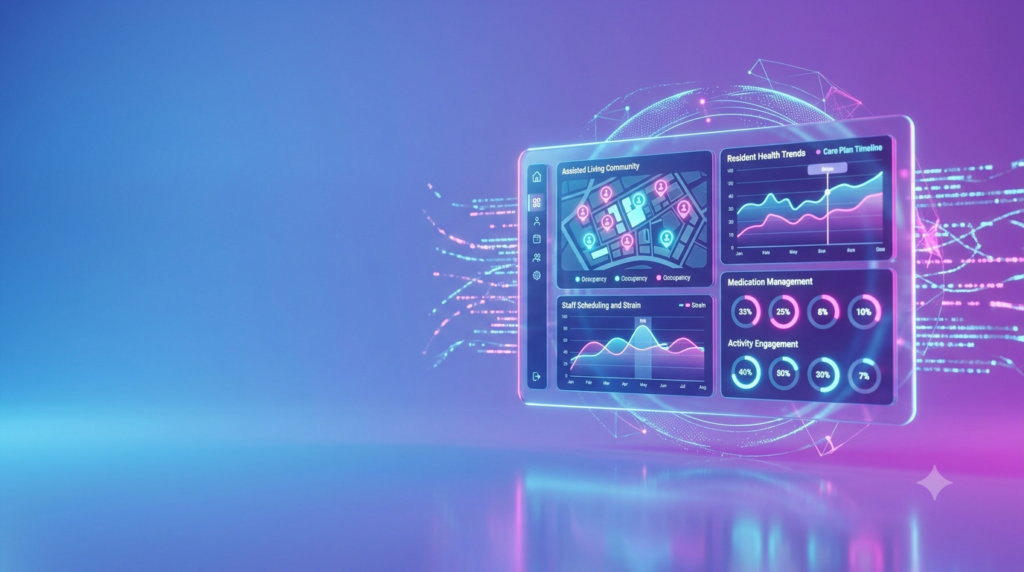
- Occupancy dashboards – Real-time and trended data by unit type, care level, and move-in/move-out velocity.
- Staffing ratio reporting – Live nurse-to-resident ratios by shift and wing, with compliance alerts before ratios breach mandated thresholds.
- Clinical quality metrics – Fall rates, medication error trends, hospital readmission rates, and incident patterns tracked over time.
- Financial performance – Revenue per occupied unit, labor as a percentage of revenue, agency spend, and budget vs. actual by department.
- Custom report builder – Role-specific dashboards so a director of nursing, executive director, and ownership group each see what matters to their decisions.
Enhancing the Resident Experience through Technology
Technology in senior care often gets discussed purely in operational terms. But the resident experience is where it shows up most visibly.
- Beyond care delivery: Senior living resident engagement software creates the digital layer of a community’s social life — resident-facing activity boards, interest-based programming, and communication tools that reduce isolation.
- Family transparency: Families who can log in to a portal, view activity participation, read care notes, and message the care team directly are far less anxious — and far less likely to call the front desk three times a week. That transparency also accelerates the sales process.
- Integrated wellness tracking: Senior living solutions that connect physical activity data, dining participation, and social engagement to the clinical record provide care teams with a longitudinal picture of resident well-being that point-in-time assessments miss entirely.
Types of Senior Living Communities That Use These Platforms
Senior living software isn’t one-size-fits-all. Different care settings need different configurations depending on the level of care delivered.
Assisted Living Facilities
The documentation volume in assisted living is high: daily care coordination, medication administration, incident tracking, and care plan updates that must hold up in a state survey. (A state survey is an official inspection conducted by the state government.)
Assisted living software built for this setting handles that density without creating a documentation burden that drives caregivers out.
Independent Living Communities
Independent Living residents chose a community, not a care program.
Software for independent living puts lifestyle management at the center: activity programming, dining preferences, amenity scheduling, and the family communication tools that make the community worth recommending.
Memory Care Communities
Memory care requires safety monitoring that other settings don’t:
Door and wander alerts, behavioral documentation, and care workflows designed for residents who can’t reliably communicate their needs.
The software needs to surface the right clinical triggers fast and support workflows that memory care teams actually use day to day.
Continuing Care Retirement Communities (CCRCs)
A CCRC campus may house residents at IL (Independent Living), AL (Assisted Living), memory care, and skilled nursing levels simultaneously.
The platform challenge is keeping a single resident record that follows a person across care levels while supporting distinct clinical and operational workflows at each level — and then rolling it all up into unified billing and reporting for the organization.
Partner with us to develop customized senior living software for your community
Top Benefits of Implementing Senior Living Software Solutions
- Operational efficiency — Documentation time drops, manual processes shrink , and staff spend more time on care.
- Cost reduction – Agency labor costs fall when scheduling is proactive, procurement controls stop budget leakage, and billing cycles shorten.
- Compliance assurance – Documentation is audit-ready by default. Care plan deviations trigger alerts rather than showing up during surveys.
- Staff satisfaction — Tools that work on mobile, don’t require double entry, and give staff control over their schedules reduce daily friction.
- Revenue growth — Faster move-in cycles, better occupancy retention, and referral generation from satisfied families.
- Family trust — Families that have visibility into care stay calmer, complain less, and refer more.
- Improved Resident Care Quality – Real-time clinical data and early-warning alerts support better decisions before situations escalate.
- Increased Occupancy and Revenue Growth – Better sales tools, faster onboarding, and a resident experience worth talking about all contribute to census.
Ready to cut admin time and reduce agency spend?
Let’s talk about what the right senior living platform looks like for your community
How to Evaluate Senior Living Software Vendors ?
Short checklist
- Integration capabilities – Does the EHR connect natively to CRM, scheduling, billing, and payroll, or does each connection require custom middleware?
- Compliance and security – HIPAA-ready, SOC 2 certified, with full audit trails and documented breach notification procedures.
- Usability – Does it work for a CNA on a tablet during a shift, or only for an administrator at a desktop?
- Implementation and support – Who specifically manages the implementation on the vendor’s side, and what does the first 90 days look like?
- Pricing model – Per-resident, per-user, or bundled; and what happens to the price when you add communities or care levels?
Top Questions to Ask Any Vendor
- Who owns the data if we end the contract?
- What is your uptime SLA, and how do you handle downtime incidents?
- Can we talk to three current clients, communities of our size with the same care mix?
- Who leads implementation on your team, and what does the onboarding timeline look like?
- How do you handle state-specific regulatory updates when requirements change?
- What’s on your product roadmap for the next 12 months?
- How does your system handle Medicaid billing in our state specifically?
- What integration support do you provide for our existing payroll and pharmacy systems?
- What training is included, and how is it delivered for frontline staff?
- Have any of your clients undergone a state survey while using your platform? What were the outcomes?
Senior Living Solutions: Implementation Roadmap
A failed software implementation has adverse effects, as it disrupts the entire care delivery system and erodes staff trust, which is hard to rebuild. The following is a phased approach:
Stakeholder interviews and requirements
Talk to the people who will use the system before choosing it.
For example, a nursing assistant, charge nurses, activity directors, billing staff, and administrators all have different workflows and frustrations.
Map the current workflow before deciding on what the new system needs to do.
Vendor shortlist & demos
Compare two to four vendors against your documented requirements. Run demos using real scenarios from your community. This could be a care plan update, a shift swap, or a billing reconciliation.
Data migration plan
Clean your data before migrating it. Legacy systems accumulate years of inconsistencies.
A migration plan defines what moves, what gets archived, and how records are validated post-transfer. Skipping this step creates problems that appear weeks after go-live.
Pilot and training
Pilot on one wing or department before rolling out elsewhere.
Use real staff and real workflows. The edge cases that break the system are much easier to fix when they affect 20 people rather than 200.
Go-live and Hypercare
The first 30 days after launch need dedicated support from both the vendor and an internal point of contact. Staff will be able to detect scenarios the pilot didn’t cover. A clear escalation path means those get resolved quickly instead of becoming workarounds.
Continuous improvement and quarterly reviews
Software implementation lacks a finish line.
Quarterly reviews need to be conducted. This is to check adoption rates and surface feature gaps, and to adjust for any regulatory changes to keep the platform delivering value.
Common Integration Scenarios
The value of a senior living platform grows when it connects to the adjacent systems that staff already use.
Integration operators prioritize:
- EHR to Pharmacy: Medication orders go directly to the pharmacy, and fill confirmations are automatically returned to the eMAR (Electronic Medication Administration).
- CRM to Marketing Automation: Lead data syncs to email nurture sequences; campaign results tie back to which sources actually generate move-ins.
- Scheduling to Payroll: Approved schedules convert to time records without manual entry, and overtime flags appear before the hours are worked.
- Billing to Medicaid Portals: Claims are automatically submitted and reconciled, with state-specific formatting handled by the system.
- EHR to Hospital Systems: FHIR-based data exchange supports care transitions without relying on faxes or phone calls.
Use Cases
Assisted Living Community: Fewer Medication Errors After EHR Adoption
A 90-bed assisted living community in the Midwest went live with senior living EHR software that included eMAR and barcode verification. Six months later, reported medication errors had dropped by 62%.
Nurses said the difference came from real-time verification at the medication cart – the system caught discrepancies that paper MARs missed because they required a nurse to catch them manually.
The community’s next state survey had no medication-related deficiencies.
Independent Living Community: Occupancy Gains Through CRM and Engagement
A regional operator with three independent living communities deployed both a senior living CRM and a resident engagement platform during the same implementation. Lead-to-tour conversion improved by 28% after automating follow-up sequences that previously depended on individual counselor habits.
On the retention side, linking activity attendance data to family portals correlated with longer stays: residents whose families used the portal regularly stayed about 4 months longer on average.
How to Choose the “Best Senior Living Software” for Your Community?
Requirements vary depending on the facility.
The best senior living software for a 60-bed assisted living facility in a rural market has different requirements than the right platform for a 12-community portfolio with mixed care levels and centralized finance.
A practical decision framework:
| Factor | What to Assess |
| Community size | Single-site vs. multi-site
This determines reporting complexity, user management, and pricing structure. |
| Care level mix | IL only, AL only, or continuum
Drives how deep the clinical modules need to go. |
| Budget | Total cost including implementation, training, and annual licensing
Not just the monthly SaaS fee. |
| Existing systems | What you’re replacing vs. what stays and needs to integrate |
| Staff tech comfort | Mobile-first or desktop-primary
Affects training time and adoption risk. |
| Growth plans | Whether the platform’s architecture supports adding communities or care levels |
One thing that gets underweighted in vendor evaluations: ease of use for frontline staff. A platform that your CNAs won’t consistently adopt will underperform a simpler system they actually use. Involve frontline staff in the selection process.
Scalability matters most if growth is on the horizon. Ask about architecture, not features. A platform that handles five communities well may not handle fifty, and finding that out two years into a contract is an expensive lesson.
How Could Experion Offer Support in Developing Senior Living Software?
Experion builds custom senior living software for operators who have outgrown what off-the-shelf platforms offer or whose workflows don’t cleanly map to a vendor’s standard product.
Our teams have hands-on experience across the full operational stack of senior care, and we build those modules to function as a unified platform rather than a collection of integrated third-party tools with their own quirks and data models.
Future Trends in Senior Living Platform
- AI-powered fall risk prediction – Models trained on vitals, movement data, and incident history can flag high-risk residents before falls happen; this capability is already embedded in some senior living EHR platforms.
- Remote patient monitoring – Wearables and in-room sensors feed continuous health data into the EHR without requiring staff collection. Hence, the data is there when the care team needs it.
- Voice-enabled resident interaction – Conversational interfaces let residents request assistance or contact family without needing to navigate a screen. This is useful for residents with mobility or vision limitations.
- Telehealth integration – Virtual physician visits and remote specialist consultations embedded directly in the EHR. This means fewer transport-related hospitalizations for residents who don’t need to leave the community.
- Predictive staffing – Demand forecasting built from census trends, seasonal patterns, and historical data builds better schedules before any gaps appear.
- IoT and smart building integration – IoT enables devices in a senior living facility to collect data and send it to the resident’s EHR. A smart bed can detect when a person is trying to get out of bed at night. Environmental sensors can track room temperature and pressure. A door sensor can alert caregivers if the resident wanders outside. Hence, caregiving staff need not manually check everything.
- FHIR interoperability – As healthcare data exchange standards mature, senior living EHR systems will connect more cleanly to hospital networks, payer systems, and specialist platforms.
Conclusion – The Right Technology Makes Every Part of Your Operation Better
Senior living software is the operational infrastructure of your senior living community. It determines whether it can grow without incurring proportional overhead, deliver care consistently, retain good staff, and compete seriously for families’ business, making one of the most consequential decisions of their lives.
The communities gaining ground in this market tend to share a few things: tight operations, staff with the tools to do their jobs without daily frustration, and a clear data picture to make decisions before problems become crises.
Software doesn’t create any of that on its own. But the right senior living software solutions remove enough friction that the people doing the actual work can deliver on what your community promises.
Experion can develop senior living platforms for the operational model of each client, delivering integrated solutions. If you’re ready to build or modernize your senior living technology, our team is ready to talk.
Frequently Asked Questions (FAQs)
What is Senior Living Software?
Senior living software covers the technology platforms that manage clinical, operational, and administrative functions across senior care communities. A full platform typically includes EHR, CRM, scheduling, billing, procurement, and resident engagement, integrated so that data moves between them rather than being re-entered.
What features should the best senior living software include?
The core modules are electronic health records, medication management, staff scheduling, CRM for sales and occupancy management, resident engagement tools, procurement management, billing across multiple payer types, and analytics dashboards.
How does senior living CRM software improve occupancy rates?
Senior living CRM software provides sales counselors with a structured pipeline to manage a process spanning months and involving multiple decision-makers. It automates follow-up sequences that would otherwise depend on individual habits, captures referral source data, and connects sales activity to occupancy outcomes.
What is the role of EHR in senior living communities?
Senior living EHR software maintains the clinical record for each resident: care plans, medication administration, ADL documentation, incident reports, and functional assessments. It supports regulatory compliance, enables real-time documentation at the point of care, and produces the audit trail that is significant during state surveys.
How does staff scheduling software help senior living facilities?
Staff scheduling software senior living gives supervisors coverage visibility 48 to 72 hours out, rather than hours before a shift starts. It automates shift assignments based on credentials and availability, enables staff to self-schedule within defined parameters, and tracks credential expirations.
Can senior living software integrate with existing healthcare systems?
Yes, through HL7 and FHIR-based integration. Most modern senior living platforms can connect to hospital EHR systems, pharmacy networks, payroll platforms, and external marketing tools. The quality of those integrations varies significantly between vendors.
What are the benefits of resident engagement software in senior living communities?
Activity programming improves, families stay connected through communication portals, and the platform’s participation data correlates with health and retention outcomes. Communities that run active engagement programs tend to see longer average stays and stronger referral rates.
Is assisted living software suitable for independent living communities?
Not without significant reconfiguration. Assisted living software is designed around clinical documentation, medication management, and regulatory compliance workflows that IL communities don’t need at the same depth. IL communities need lifestyle management, amenity scheduling, and resident communication tools at the center. The better approach is a platform configurable for both settings.
How secure is senior living management software?
Check for HIPAA compliance, encryption at rest and in transit, role-based access controls, full audit logging, and documented breach notification procedures. Requesting a current SOC 2 Type II report and specifically asking about data residency and backup policies will tell you more than any vendor’s marketing language.
How do senior living software solutions improve operational efficiency?
The efficiency is from a few improvements: the time taken for documentation drops, billing cycles shorten, and scheduling overhead is reduced. Communities that implement integrated platforms typically report 25-40% reductions in administrative time, with corresponding gains in direct care capacity.