

At Experion Technologies, we deliver scalable, secure, and high-performance Web Application Development solutions that empower businesses to innovate, automate, and grow in the digital economy.
In simple terms, web application development is the process of building software applications that run on web browsers instead of being installed on individual devices. Unlike static websites that only display information, web apps allow users to interact, perform actions, process data, and complete transactions in real time.
Businesses today are investing heavily in web app development because traditional websites are no longer enough. Customers expect personalized dashboards, seamless transactions, real-time updates, and integrated services. Whether it is a CRM system, SaaS platform, customer portal, or enterprise workflow tool, web applications development has become central to digital transformation strategies.
Web applications improve scalability because they can be hosted on cloud infrastructure, accessed globally, and updated centrally without requiring user-side installations. For organizations pursuing digital transformation, enterprise web application development provides agility, operational efficiency, and faster innovation cycles.
Launch faster with secure, enterprise-ready web app development.
Key Takeaways
- Web application development enables dynamic, interactive digital platforms.
- Web apps are more scalable and flexible than traditional websites.
- Custom web application development supports automation and innovation.
- Enterprise web application development drives digital transformation.
- Partnering with a professional web application development company ensures long-term success.
What is Web Application Development?

Web Application Development refers to the development of web based application systems that operate through browsers using internet connectivity. These applications process data, support user authentication, integrate databases, and provide interactive interfaces.
Unlike static web pages, web applications development involves both frontend and backend engineering, database architecture, security layers, and hosting environments.
A web application development firm typically handles everything from UI design to backend architecture, API integration, and cloud deployment.
Web Application vs Website – What’s the Difference?
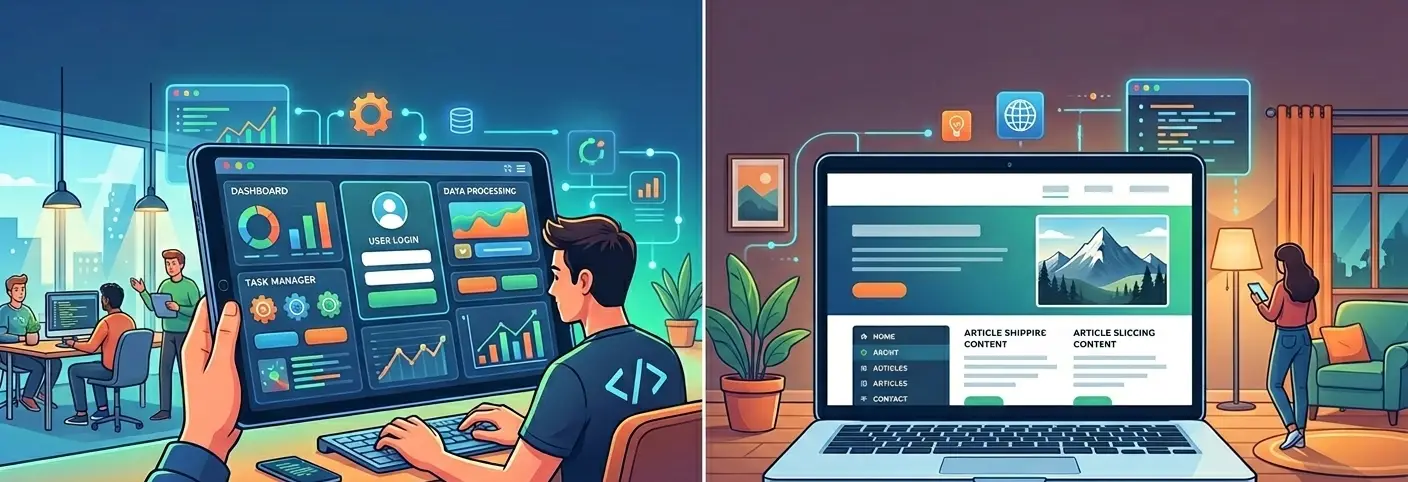
Understanding the distinction between a website and a web application is critical.
Static vs Dynamic
Websites are typically static and informational. Web applications are dynamic and interactive.
User Interaction
Web apps allow user login, transactions, dashboards, and data manipulation. Websites mainly provide content.
Database Connectivity
Web applications connect to databases to store and retrieve user data.
Examples
- CRM platforms
- SaaS tools
- Customer portals
- Enterprise dashboards
When businesses need automation and functionality, they turn to web application development services instead of traditional website design.
Turn your idea into a high-performance web application.
Types of Web Applications
Web Application Development encompasses a wide range of application types, each designed to serve specific business needs, user experiences, and scalability requirements. Choosing the right type of web app depends on your industry, audience, functionality requirements, and long-term growth strategy.
Below is a deeper look at the major categories of web applications.
Static Web Apps
Static web applications are simple platforms that primarily display fixed content. They have minimal interactivity and typically do not rely heavily on databases or complex backend processing.
Characteristics include:
- Basic informational interfaces
- Limited user interaction
- Faster development timelines
- Lower infrastructure complexity
These are often used for landing pages, product showcases, or informational portals. While static apps are not suitable for complex workflows, they can be a starting point for businesses testing new ideas before investing in full-scale custom web application development.
Dynamic Web Apps
Dynamic web apps are data-driven platforms that adapt content based on user input and backend processing. These applications connect to databases, manage user authentication, and support real-time updates.
Examples include:
- Customer dashboards
- Online booking systems
- Membership portals
- CRM platforms
Dynamic applications are central to enterprise web application development because they support high levels of user engagement and operational functionality. Most modern web app development projects fall into this category.
Single-Page Applications (SPAs)
Single-Page Applications load a single HTML page and dynamically update content without refreshing the entire page. Frameworks like React, Angular, Vue, and Svelte are commonly used to build SPAs.
Benefits of SPAs include:
- Faster user experience
- Reduced server load
- Seamless navigation
- App-like interaction within browsers
SPAs are popular in SaaS platforms and enterprise dashboards where smooth performance is critical.
Multi-Page Applications (MPAs)
Multi-Page Applications load new pages from the server for each user action. This traditional model is still relevant for complex systems that require multiple distinct views.
MPAs are often used for:
- Large enterprise systems
- Content-heavy portals
- Government or institutional platforms
They can offer better SEO performance and structured navigation for large-scale platforms.
E-commerce Applications
E-commerce web applications allow users to browse products, add items to carts, complete payments, and track orders. These applications integrate payment gateways, inventory systems, and CRM platforms.
Key components include:
- Product catalog management
- Secure checkout systems
- Order tracking dashboards
- Customer account management
Custom web application development services often build tailored eCommerce platforms for retail businesses seeking unique branding and scalability.
SaaS Applications
Software as a Service platforms are subscription-based web applications hosted on the cloud. Users access them through browsers without installing software.
Examples include:
- Project management tools
- Accounting platforms
- HR management systems
- Marketing automation tools
SaaS platforms are a core focus of many web application development companies because they offer recurring revenue models and scalable growth.
Micro-services Based Apps
Micro-services architecture divides applications into independent modules that communicate through APIs. Each module handles a specific function, such as authentication, billing, or analytics.
Advantages include:
- Improved scalability
- Faster feature deployment
- Easier maintenance
- Fault isolation
Enterprise web application development increasingly relies on micro-services for large, distributed systems.
Progressive Web Apps (PWAs)
Progressive Web Apps combine the reach of web apps with the functionality of mobile applications. They can work offline, send push notifications, and be installed on user devices.
Benefits include:
- Mobile-like experience
- Offline functionality
- Lower development cost compared to native apps
- Cross-platform compatibility
Many web application development service providers recommend PWAs for businesses seeking mobile accessibility without separate native app development.
Enterprise Web Applications
Enterprise web applications are large-scale systems designed to support complex corporate operations. These may include:
- Supply chain management systems
- Financial reporting platforms
- Enterprise resource planning dashboards
- Internal collaboration tools
Enterprise web application development requires robust architecture, high security standards, and integration with multiple internal systems.
Cloud Based Web Applications
Cloud based web applications are hosted on cloud infrastructure such as AWS, Azure, or Google Cloud. These platforms offer scalability, redundancy, and global accessibility.
Advantages include:
- Elastic scaling
- Automatic backups
- Global content delivery
- High availability
A modern web and application development company typically prioritizes cloud-native architecture to ensure resilience and performance.
Why is Web App Development Important for Businesses?
Web application development is no longer optional in a digitally competitive market. Businesses rely on web apps to automate processes, enhance customer engagement, and scale operations efficiently.
Scalability
Enterprise web application development enables systems to handle increasing user loads, transactions, and data volumes. Cloud-based architectures allow businesses to expand without rebuilding infrastructure.
Scalable web app development ensures:
- Smooth performance during traffic spikes
- Easy addition of new features
- Expansion across geographies
Cost Efficiency
Unlike traditional desktop applications that require installation and updates on each device, web applications are updated centrally. This reduces IT maintenance costs and minimizes downtime.
Custom web application development also eliminates the need for licensing multiple software tools by consolidating features into a unified platform.
Cross-Platform Accessibility
Web applications run on browsers, making them accessible across desktops, tablets, and smartphones. This eliminates compatibility issues across operating systems.
Web and application development company solutions ensure consistent user experience across devices.
Centralized Updates
Updates in web applications are deployed server-side. Users automatically access the latest version without downloading patches or reinstalling software.
This ensures:
- Faster feature rollouts
- Reduced security vulnerabilities
- Seamless user experience
Cloud Integration
Cloud integration allows web applications to connect with third-party services, APIs, analytics tools, and storage systems.
Benefits include:
- Real-time data synchronization
- Global access
- Disaster recovery capabilities
- Integration with AI and analytics platforms
Cloud-native web application development services empower businesses with flexibility and global reach.
In summary, web application development forms the backbone of digital transformation. From static apps to enterprise web applications and cloud based web applications, each type serves a specific strategic purpose. Investing in the right web app development approach ensures scalability, cost control, operational efficiency, and long-term competitive advantage.
Industry Use Cases of Web Application Development
Web and application development is used across industries:
- Healthcare patient portals
- Fintech dashboards
- Retail eCommerce systems
- Logistics tracking platforms
- Education learning management systems
Custom web applications development allows organizations to address industry-specific challenges effectively.
How Does Web App Development Work (Programming Languages and Frameworks)?
Front-end Development
The frontend defines the user interface and experience. Frameworks include:
- React
- Angular
- Vue
- Svelte
These frameworks enable responsive UI/UX design.
Back-end Development
Backend systems handle:
- Server-side logic
- APIs
- Database connectivity
Languages often used include Java, Python, .NET, and Node.js.
Database Management
SQL databases like MySQL or PostgreSQL are structured.
NoSQL databases like MongoDB handle flexible data models.
Deployment and Hosting
Cloud platforms like AWS, Azure, and Google Cloud enable application deployment. DevOps pipelines automate builds and updates.
At Experion Technologies, we combine robust backend engineering and intuitive frontend design to deliver high-performance web application development services tailored to enterprise needs.
Step-by-Step Enterprise Web Application Development Process
 Step 1: Requirement Analysis
Stakeholder interviews and market research define scope and objectives.
Step 2: Planning and Architecture Design
Wireframes and technology stack selection are finalized.
Step 3: UI and UX Design
User-centric design ensures seamless experiences.
Step 4: Development
Frontend and backend coding take place simultaneously.
Step 5: Testing and QA
- Functional testing
- Performance testing
- Security testing
Step 6: Deployment
Application is hosted and launched.
Step 7: Maintenance and Optimization
Continuous monitoring and feature updates ensure scalability.
Build a scalable web app that grows with your business.
How to Implement Web Application Development for Your Business?
Implementing Web Application Development successfully requires more than just hiring developers and starting to code. It demands strategic clarity, technical alignment, financial planning, and the right execution model. Whether you are building an internal enterprise platform or launching a customer-facing SaaS product, a structured approach ensures long-term scalability and ROI.
Below is a detailed roadmap to guide your implementation journey.
Define Business Goals
Before initiating web app development, clearly define what you want the application to achieve. Every successful web application development service engagement starts with business clarity.
Ask key questions:
- Is the goal to generate new revenue streams?
- Are you aiming to improve operational efficiency?
- Do you want to automate manual workflows?
- Are you enhancing customer engagement?
- Is digital transformation a strategic priority?
For example:
- A logistics company may focus on operational automation and real-time tracking.
- A retail brand may prioritize revenue growth through eCommerce web applications development.
- A financial institution may emphasize compliance and secure transaction processing.
Clear goals help shape feature requirements, technical architecture, and scalability plans. In enterprise web application development, aligning business KPIs with technical milestones is critical for measurable success.
Choose the Right Technology Stack
Selecting the right technology stack directly impacts performance, scalability, security, and long-term maintainability.
Common stacks include:
MERN (MongoDB, Express, React, Node.js): Ideal for dynamic single-page applications and SaaS platforms.
MEAN (MongoDB, Express, Angular, Node.js): Suitable for structured enterprise-grade applications.
.NET: Widely used for enterprise web application development in corporate environments.
Java: Recognized for stability and scalability in handling complex backend systems.
Python: Popular for AI-powered web apps and rapid development cycles.
Your choice should depend on:
- Project complexity
- Expected user load
- Security requirements
- Integration needs
- In-house expertise
A professional web application development company can help evaluate your technical requirements and recommend the most appropriate stack. The right technology foundation ensures smooth development of web based application systems that scale with your business.
Decide Between In-House vs Outsourcing
One of the most strategic decisions in web and application development is choosing between building an internal team or partnering with a custom web application development company.
In-House Development
Advantages include direct control, long-term team ownership, and internal knowledge retention. However, it requires recruitment, training, and infrastructure investment.
Outsourcing to a Web Application Development Firm
Partnering with experienced web application development companies can accelerate timelines and reduce hiring overhead. It provides access to specialized expertise, structured project management, and proven development methodologies.
Outsourcing is often cost-effective for startups and mid-sized enterprises that need enterprise web application development but lack internal technical resources.
A hybrid model is also common, where strategic oversight remains in-house while technical execution is handled by custom web application development services providers.
Budget Planning
Financial planning is a critical component of successful web app development.
A realistic budget should account for:
Design Costs: UI/UX research, wireframing, prototyping, and visual design.
Development Costs: Frontend, backend, API integration, database setup, and security implementation.
Infrastructure Costs: Cloud hosting, DevOps pipelines, monitoring tools, and backup systems.
Testing and Quality Assurance: Functional testing, performance testing, and security audits.
Maintenance and Optimization: Bug fixes, feature updates, scaling improvements, and ongoing support.
For enterprise web application development, budgeting must also consider compliance requirements, data security frameworks, and integration complexity.
It is important to think beyond initial launch costs. Long-term sustainability depends on ongoing optimization and support. A reliable web and application development company will provide transparent cost estimates and phased investment planning.
Additional Implementation Considerations
While the four steps above form the foundation, successful web applications development also requires:
- Clear project governance
- Agile or DevOps methodology adoption
- Continuous stakeholder communication
- Scalable cloud deployment strategy
- Security-first architecture
Implementing custom web applications development is not just a technical project. It is a strategic business initiative that impacts workflows, customer experience, and competitive positioning.
Final Thought
Implementing Web Application Development for your business requires alignment between strategy, technology, and execution. By defining clear goals, choosing the right technology stack, selecting the appropriate development model, and planning your budget carefully, you create a strong foundation for digital success.
Partnering with an experienced web application development services provider ensures that your web and application development journey delivers measurable impact, scalability, and long-term value.
How Much Does Web Application Development Cost?
Regional Breakdown
- USA and UK tend to have higher development costs.
- India offers cost-effective web application development services.
- Middle East and Australia fall in mid-to-high ranges.
Cost Factors
- Complexity
- Features
- Security requirements
- Integration needs
Estimated Cost Ranges
- Basic web app: 20,000 to 50,000 USD
- Mid-level SaaS: 50,000 to 120,000 USD
- Enterprise application: 120,000 USD and above
Latest Trends in Web Application Development

- AI-powered web apps
- Low-code integration
- Cloud-native development
- Serverless architecture
- Cybersecurity-first development
- Voice and gesture navigation
- Sustainable web development practices
Common Challenges in Web Application Development
Even with a well-defined roadmap, Web Application Development comes with technical and operational challenges. Whether handled in-house or by a web application development company, understanding these risks early helps businesses design scalable and resilient systems.
Scalability Issues
One of the most frequent problems in web app development is underestimating growth. Applications may perform well during initial launch but struggle as user traffic increases.
Scalability challenges often arise due to:
- Poor database design
- Monolithic architecture
- Limited server capacity
- Inefficient API calls
In enterprise web application development, scalability must be built into the architecture from the beginning. Cloud based web applications and micro-services models help manage high user loads and expanding feature sets without system breakdowns.
If scalability is ignored, businesses face downtime, degraded performance, and poor customer experience.
Security Vulnerabilities
Security is a critical concern in development of web based application platforms. Web apps often handle sensitive user data, financial transactions, or enterprise information.
Common security vulnerabilities include:
- SQL injection attacks
- Cross-site scripting
- Weak authentication mechanisms
- Insecure API endpoints
- Poor data encryption practices
Custom web application development services must implement secure coding standards, encryption protocols, multi-factor authentication, and regular penetration testing. Enterprise web applications especially require compliance with regulations such as GDPR and HIPAA.
A professional web application development firm prioritizes security from the architecture stage rather than treating it as an afterthought.
Performance Bottlenecks
Slow-loading applications frustrate users and increase bounce rates. Performance bottlenecks may stem from:
- Heavy frontend scripts
- Inefficient backend queries
- Unoptimized images or assets
- Lack of caching mechanisms
In web applications development, performance optimization includes database indexing, content delivery networks, code refactoring, and load balancing.
Performance is directly linked to user satisfaction and revenue, particularly in SaaS and eCommerce web app development.
Poor UI and UX
Even technically robust applications can fail if the user interface is confusing or unintuitive. Poor navigation, inconsistent design, and lack of accessibility reduce engagement.
Successful web and application development prioritizes user research, wireframing, usability testing, and accessibility compliance. Custom web applications development must align design with user behavior and business goals.
A user-centric design approach improves adoption rates and customer retention.
Integration Failures
Modern web applications rarely operate in isolation. They must integrate with:
- CRM systems
- ERP platforms
- Payment gateways
- Third-party APIs
- Analytics tools
Integration failures occur when systems use incompatible formats, outdated APIs, or poor documentation.
Enterprise web application development demands API-first design and standardized data exchange protocols. Without proper integration planning, businesses face data silos and operational inefficiencies.
Best Practices for Successful Web Applications Development
Overcoming these challenges requires disciplined execution and adherence to industry best practices. A structured approach ensures long-term performance, scalability, and security.
Mobile-First Design
With the majority of users accessing digital platforms via mobile devices, web app development must prioritize responsive and mobile-friendly interfaces.
Mobile-first design ensures:
- Seamless user experience across devices
- Faster load times
- Improved search engine visibility
- Higher user engagement
Whether building SaaS platforms or enterprise web application development projects, responsive design is no longer optional.
API-First Architecture
An API-first approach means designing application interfaces before building frontend or backend components. This ensures modularity and seamless integration.
Benefits include:
- Easier third-party integration
- Faster feature expansion
- Better support for micro-services architecture
- Scalability across platforms
API-first design is particularly important for custom web application development projects that require integrations with multiple enterprise systems.
DevOps Adoption
DevOps practices integrate development and operations teams to streamline deployment cycles.
Key DevOps practices include:
- Continuous integration and continuous deployment
- Automated testing
- Infrastructure as code
- Monitoring and logging systems
Adopting DevOps reduces deployment errors, accelerates release cycles, and enhances collaboration in web application development services projects.
Continuous Testing
Testing should not be limited to the final phase of development. Continuous testing throughout the lifecycle helps detect bugs early and reduce costly fixes later.
Testing includes:
- Functional testing
- Performance testing
- Security testing
- User acceptance testing
Enterprise web application development relies heavily on automated testing tools to maintain quality at scale.
Performance Optimization
Optimizing performance involves:
- Code refactoring
- Efficient database queries
- Load balancing
- Caching strategies
- Content delivery networks
Cloud based web applications benefit from auto-scaling and distributed infrastructure to maintain consistent performance under high traffic.
Security Compliance such as GDPR and HIPAA
Compliance is essential for businesses operating in regulated industries. Web application development services must incorporate:
- Data encryption at rest and in transit
- Role-based access controls
- Audit logs
- Secure authentication protocols
Enterprise web applications handling healthcare or financial data must align with GDPR, HIPAA, or other regional regulations.
Final Perspective
Web Application Development is a strategic investment, but it comes with technical complexity. Scalability challenges, security risks, performance bottlenecks, poor user experience, and integration issues can derail even promising projects.
By following best practices such as mobile-first design, API-first architecture, DevOps adoption, continuous testing, performance optimization, and strict security compliance, businesses can ensure that their web applications development initiatives deliver sustainable value.
Partnering with an experienced web and application development company further strengthens execution, reduces risk, and accelerates time to market.
How Custom Web Application Development Differs from Traditional Web App Development?
Custom web application development focuses on tailored solutions built around specific business needs. Unlike generic templates, custom web application development services provide flexibility, scalability, and unique competitive advantages.
A custom web application development company builds platforms aligned with workflow, compliance requirements, and industry-specific use cases.
Why Partner with a Professional Web Application Development Services Company?
- Technical expertise
- Faster time to market
- Cost efficiency
- Post-launch support
- Dedicated project management
Partnering with an experienced web application development firm ensures reliability and long-term performance.
Transform your digital vision into a scalable web application today.
How Experion Can Help in the Development of Web Based Application?
As a web and application development company with global expertise, Experion delivers custom web application development services across industries.
Case Study
A leading logistics enterprise partnered with Experion to develop web based application solutions that streamlined shipment tracking and automated reporting. The result was improved operational efficiency and reduced processing time.
Conclusion
Web Application Development is no longer optional for businesses seeking digital transformation. From enterprise web application development to custom web applications development for startups, web apps enable automation, scalability, and innovation.
Investing in web application development services positions businesses for long-term success in an increasingly competitive digital environment.
At Experion Technologies, we combine strategic thinking and advanced engineering to deliver enterprise-grade web application development that drives measurable business growth.
Frequently Asked Questions(FAQ’s)
1. What is web application development?
It is the process of building interactive applications that run in web browsers.
2. What is the time required to develop a web application?
Timelines range from a few weeks for simple apps to several months for enterprise platforms.
3. What distinguishes web application development from website development?
Web apps are interactive and data-driven, while websites are primarily informational.
4. What technologies are used in enterprise web application development?
React, Angular, .NET, Java, Python, Node.js, and cloud platforms.
5. What differentiates a web application from a mobile application?
Web apps run on browsers, mobile apps are installed on devices.
6. What is the cost of web application development?
Costs depend on complexity and region.
7. Is outsourcing web application development cost-effective?
Yes, outsourcing to experienced web application development companies can reduce overhead.
8. What is the best framework for enterprise web applications?
It depends on business requirements and scalability needs.
9. How secure are web applications?
Security depends on architecture, encryption, and compliance measures.
10. How do I start web application development for my startup?
Define goals, select a tech stack, and partner with a web application development company.
11. What are the stages involved in building a scalable web application?
Requirement analysis, design, development, testing, deployment, and maintenance.
12. What are the benefits of developing a custom web application?
Customization, scalability, integration flexibility, and competitive differentiation.
13. How to choose the right web app development services partner?
Evaluate experience, portfolio, communication, and post-launch support.
14. What are web application development processes?
Structured methodologies that guide planning, development, testing, and deployment.
At Experion Technologies, we deliver end-to-end web application development services that help enterprises innovate, scale, and succeed in the digital era.