

Experion helps global enterprises navigate through the complex landscape of Conversational AI by architecting domain-specific solutions that transform customer engagement and operational efficiency.
Conversational AI platforms such as Siri and Alexa have become household names – we summon them with a simple “Hey Siri, how’s the weather today?” eliciting an instant response. Imagine your ideal customer support. They would be available 24/7 and equipped to give you a perfect answer. This isn’t a distant vision. Conversational AI is already empowering businesses to deliver exactly that. From GPS systems to Alexa, we interact with this technology daily, often without realizing it.
Behind these seamless interactions lie powerful technologies like speech recognition, Natural Language Processing (NLP), and machine learning. All of these work together to understand intent and deliver human-like responses.
Key Takeaways
- A conversational AI platform is not merely a simple bot but an end-to-end system that uses Natural Language Processing and Machine Learning to enable human-like interactions across multiple channels.
- Enterprise conversational AI platforms are evolving. From a simple “FAQ-based” bot to transactional agents that integrate with core systems like ERPs and CRMs.
- Conversational AI in banking and healthcare are the leading sectors with high investment, driven by their high compliance requirements and the volume of repetitive queries.
- Success isn’t just limited to the chat; it’s also about AI conversation analytics software that identifies gaps and measures sentiment.
- Choosing a conversational AI platform for enterprise businesses requires scrutiny. Stakeholders need to evaluate security, scalability, and “human-in-the-loop” handoff capabilities.
What is Conversational AI Platform?

During the advent of the internet, interaction online was typically a one-way street. Users filled out forms and hoped for a response. But today, it is no longer a monologue, thanks to the Conversational AI platform.
But what is a conversational AI platform, exactly?
It is a software that allows developers to build, deploy, and manage applications. Examples include virtual assistants or voicebots. These virtual agents can understand, process, and respond to voice or text inputs in a natural way.
Defining Conversational Artificial Intelligence in Platforms
Conversational artificial intelligence refers to the set of technologies (including Generative AI, Large Language Models, and Neural Networks) that enable computers to simulate human conversation.
When we talk about conversational artificial intelligence on platforms, we refer to the centralized “brain” that manages these interactions. The platform is well developed with a robust infrastructure that can handle memory, context, and multi-user scaling.
How a Conversational AI Chatbot Platform Works
A conversational AI chatbot platform works on the basis of intensive data processing. The steps include:
- Automatic Speech Recognition (ASR) or Text Input: The system receives the user’s message.
- Natural Language Understanding (NLU): The engine breaks down the sentence to understand the Intent (what the user wants) and the specific details in the inquiry, such as a date or account number. The intent and details form the crux of the conversation.
- Dialogue Management: The platform can then decide the best response. It considers the current context and historical data to formulate a response.
- Natural Language Generation (NLG): The output is structured data that is then converted into a human-friendly response.
Transform your customer experience with a conversational AI strategy engineered to deliver impact.
Conversational AI Software vs. Traditional Chatbots
While it is common to use these terms interchangeably, the difference between the two is as follows:
A traditional chatbot is rule-based, often following a decision tree. For example: If the user clicks A, display B. If the user performs an out-of-the-box action, the chatbot fails.
Machine Learning powers conversational AI software. Hence, it is smarter at understanding intent and can keep up with the user regardless of typos, slang, or topic changes mid-conversation. This software can learn from every AI conversation and improve accuracy over time.
Types of Conversational AI Platforms
Not all AI platforms are built equally. Understanding the three main types of conversational artificial intelligence can help you choose a conversational AI platform for enterprise businesses that fits your technical maturity.
Rule-Based Platforms
The most basic conversational AI software solution. Operating on a strict “if-then” logic flow, thereby letting users interact through buttons or certain keywords.
Commonly used for simple FAQ retrieval, order status checks, and basic data collection.
AI-Powered Intelligent Platforms
AI-powered intelligent platforms utilize Natural Language Processing and Machine Learning. These are self-learning models that can identify the intent behind users’ words rather than focusing solely on keywords.
Most suited for Complex customer support and high-context sectors like conversational AI in banking.
Hybrid Platforms
Hybrid models are the current gold standard for enterprise conversational ai platforms.
It can switch between a rule-based layer for 80% of routine tasks (such as password resets) and conversational AI for complex queries.
Best for Global conversational ai platforms for businesses that require both strict compliance and high-level engagement.
| Feature | Rule-Based | AI-Powered | Hybrid |
| Logic Type | Pre-defined scripts | Intent-based (NLU) | Used both Rules Intent |
| Adaptability | Low (Rigid) | High (Dynamic) | High (Balanced) |
| Learning | Manual updates only | Continuous self-learning | Manual + Automated |
| Setup Time | Days | Months | Weeks |
| Enterprise ROI | Low | High | Maximum |
Why Conversational AI Platforms Matter for Enterprise?
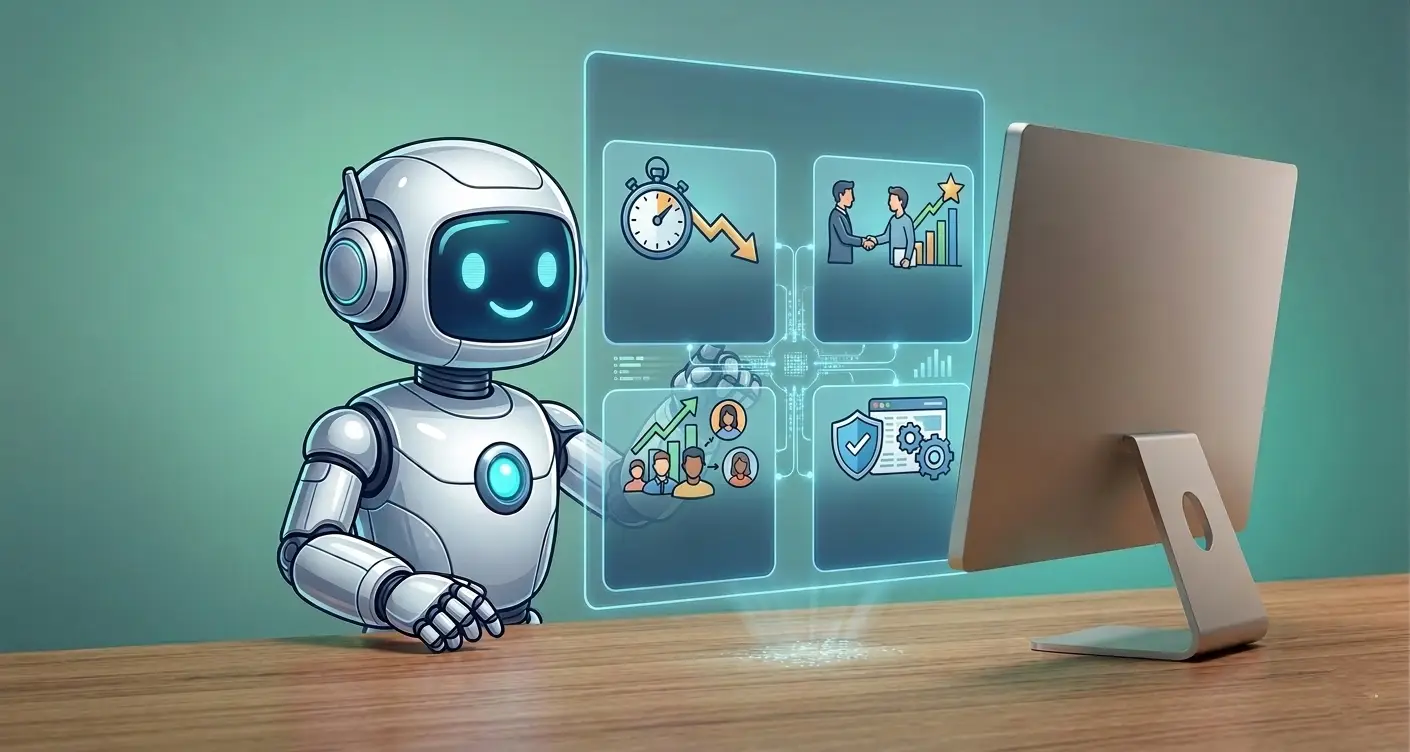
Large organizations are shifting towards enterprise conversational AI platforms, not just because it’s a trend. But due to the numerous benefits and the competitive advantages it offers.
The Business Case for Enterprise Conversational AI Platforms
- Cost reduction: By implementing conversational AI software solutions, enterprises can automate up to 80% of Tier-1 support queries. This includes routine HR queries (such as “How many PTO days do I have?”) and IT helpdesk tickets (such as password resets), freeing up human talent for complex problem-solving.
- Revenue enablement: Modern AI platforms can serve as sales tools. They provide personalized sales conversations for each inquiry. Moreover, it can qualify leads in real time and recommend products to users based on their past behaviour.
- Employee productivity: Employees no longer need to dig through old documents or sift through their company’s extensive knowledge base. Internal conversational AI platforms for businesses can act as onboarding assistants or knowledge bots to do the same.
Turn every conversation into a conversion.
Key Capabilities That Separate Enterprise-Grade AI Platforms
- Omnichannel deployment: The platform’s ability to function across multiple channels. If a query arises on the website, it should be able to continue the conversation via SMS and even finish it over a voice call without losing any context.
- Security and Compliance: A conversational AI platform for enterprise use cases must include SOC 2, GDPR, and data residency controls. It is of utmost importance that sensitive customer data isn’t leaked or used to train public models.
- Integration: The platform is only as good as its data, and its integration capabilities determine this. It must be able to plug into your CRM (Salesforce, HubSpot), ERP (SAP, Oracle), and ITSM (ServiceNow).
- Analytics & reporting dashboards: AI conversation analytics software measures the bot’s success rate and lets you view dashboards at a glance. Identify “intent discovery” for continuous improvement.
- No-code / low-code bot builders: All stakeholders within the organisation should be able to create AI conversation flows. No code builders democratize this process by providing visual, drag-and-drop interfaces. Now, all users, even Business Analysts and HR managers, can interact with the platform.
- Workflow orchestration: The platform should also be able to execute tasks. This includes managing multi-step processes. For example, processing a refund or updating a patient record.
- Advanced AI Conversation Analytics Software: Suppose your bot was not able to answer a particular query. Analytics software helps you identify what customers are asking for that your bot can’t yet answer. In other words, it lets you discover intent.
- Multi-language and multi-region support: For global conversational AI platforms for businesses, the ability to detect and switch between languages (and adhere to regional data laws) is non-negotiable. The AI must understand local dialects to maintain a high-quality user experience.
Conversational AI Software Solutions: Build vs. Buy
When to build on Foundational AI platforms
This process involves using APIs from providers like OpenAI, Google (Gemini/Vertex AI), or Microsoft Azure. You may follow this approach if you have:
- Unique Intellectual Property: If your conversational artificial intelligence is the core product of your business, and requires highly proprietary logic.
- Niche Data Requirements: When you possess massive amounts of specialized data that requires custom-trained models that off-the-shelf solutions cannot handle
- Internal Expertise: If you have a dedicated team of data scientists who can manage the infrastructure.
Overwhelmed between the Buy Vs Build Debate? Let’s discuss your unique use case.
When to Buy Purpose-Built Conversational AI Software Solutions
“Buying” refers to partnering with established conversational ai platforms for businesses that come with pre-built features and industry-specific guardrails.
- Rapid Time-to-Value: If you need to deploy the solution within weeks rather than a year
- Lower Maintenance Burden: The vendor handles the more complex aspects of AI. Server scaling, security patches, and keeping up with the latest LLM updates? No need to get into the nitty-gritty details.
- Built-in Analytics: Purpose-built solutions already include AI conversation analytics software. This saves you from having to build your own reporting dashboards.
Core Architecture: Decoding Conversational Artificial Intelligence in Platforms
To truly understand how an enterprise conversational AI platform works, one must first analyze the sophisticated AI conversation models beneath it. Technology that enables conversational artificial intelligence to mimic the human cognitive process.
- NLU vs. LLM: The engine powering conversational AI chatbots has evolved. Traditionally, platforms relied only on Natural Language Understanding (NLU).
It is a process of categorizing text into “intents.” But it was observed that NLU can be rigid. Modern AI platforms now integrate Large Language Models (LLMs). While NLU identifies the intent (e.g., “The user wants to pay a bill”), the LLM provides the fluency. It allows the bot to handle the additional features of complex phrasing. Conversational AI platforms can answer follow-up questions easily and even detect subtle nuances in tone. The best conversational AI software solutions use a hybrid approach: NLU for assessing strict business logic and LLMs for engaging in generative, human-like interaction. - Memory and Context: A common user frustration, especially with early-stage Conversational artificial intelligence, was its inability to retain history across sessions. In other words, the bot had digital amnesia. Memory refers to two types:
1. Short-term Memory: The bot should recognize that “it” refers to the invoice mentioned two sentences earlier in the conversation.
2. Long-term Memory: The bot should recognize returning customers and pick up where their previous conversations left off.
(e.g., “Welcome back, Sarah. Are you still having trouble with your last order?”) - Multi-modal Capabilities: As mentioned previously, an ai conversation need not be limited to text on a screen. Modern conversational AI software frameworks can support multimodal inputs. This means a user can communicate with a conversational AI platform in multiple ways. You can upload a photo of a broken part or ask a question using your voice. The bot will reply and even send you a link to a tutorial video.
Benefits of Conversational AI Platforms for Businesses

Achieve a level of efficiency that was earlier unimaginable.
- 24/7 Customer Support – Assists in different time zones. Your customer always receives support- 24/7.
- Reduced Operational Costs – Automates upto 80% of routine queries. Be it password resets or order tracking. Human agents can now handle more complex issues.
- Improved Customer Experience – Modern AI platforms can provide a personalised experience. It remembers user history and preferences to turn a cold conversation into a helpful one.
- Faster Response Times – The bot provides instant answers, significantly reducing customer wait time.
- Higher Lead Conversion Rates – When a user lands on a landing page, they are immediately greeted by a bot. Hence, conversational AI platforms for businesses qualify leads in real time and guide them through the sales funnel.
- Scalable Customer Engagement – Whether you have 10 or 10000 users, an enterprise conversational AI platform scales instantly to meet demand without the need for additional hiring.
Experion combines deep domain expertise with cutting-edge AI research to ensure your conversational strategies are built on a future-proof architectural foundation.
Challenges in Adopting Conversational AI Platforms
Implementing conversational artificial intelligence comes with its own set of challenges to overcome:
- Data privacy concerns: For industries like conversational AI in healthcare and banking, data sovereignty is the top priority. Enterprises need to ensure PII (Personally Identifiable Information) is redacted and that sensitive data isn’t leaked into public LLM training sets.
- Integration complexity: A conversational AI chatbot platform is only effective if it can integrate with legacy ERPs, custom-built CRMs, and diverse databases, often requiring significant middleware that can be a technical bottleneck.
- Training data quality: High-performing AI platforms require clean, structured, and unbiased historical data to learn effectively. Many businesses find that their existing chat logs are too disorganized to be used for initial model training.
- Managing conversational design: Creating a natural to-and-fro dialog that feels professional is challenging. Conversational AI software fails in rare instances when the tone is off or the bot gets stuck in a repetitive loop.
- User trust and adoption: Employees fear that conversational AI solutions are meant to replace them rather than assist them. Customers often demand a human after a poor experience with dumb bots.
Industry Applications – Where Conversational AI Delivers the Highest ROI
While conversational AI platforms for businesses are versatile, two sectors, primarily Banking and Healthcare, have emerged as the gold standards for implementation. This is owing to their high volume of data-driven queries. Read on to learn some real-life use cases.
Conversational AI in Banking
Banking now stands at a digital crossroads, with many transactions conducted online. To bring back the personalized experience, Banks now deploy conversational AI agents.
Use cases:
Some high impact use cases include:
- Account inquiries– Real-time balance checks and transaction history.
- Fraud alerts– Immediate, automated outreach when suspicious activity is detected, allowing the user to “Confirm” or “Block” via chat.
- Loan pre-qualification– Reading through a 10-page form on loan qualification is time-consuming. Conversational AI platforms can guide users through complex applications using a conversational interface.
Compliance considerations:
Deploying a conversational AI platform for enterprise banking requires strict adherence to PCI-DSS and SOC 2. PCI- DSS stands for Payment Card Industry Data Security Standard. It primarily concerns the handling and storage of credit card data.
SOC 2 (System and Organization Controls 2), on the other hand, covers data security practices. Both these frameworks require data to be encrypted at rest and in transit, with “redaction” layers to prevent PII (Personally Identifiable Information) from being stored in training logs.
Real-world impact:
Banks using the best conversational AI platforms have reported up to a 40% reduction in call center volume. CSAT (Customer Satisfaction) scores have also been significantly boosted by providing 24/7 instant support.
Unicredit, a multinational banking group, improved its debt collection process. The group used AI to categorise customers by their payment behaviour and employed different strategies. Chatbots would engage in personalized reminders and friendly communication. This approach improved their recovery rates.
Other examples include Bank of America’s Erica, which provides tips to save money and helps customers check their account balance.
Conversational AI in Healthcare
Healthcare is currently tackling rising costs and a large number of patients. Amid this scenario, conversational AI provides much-needed relief from the mounting number of patient enquiries.
Use cases:
- Smart Appointment scheduling: Bots integrate with EHRs to check doctors’ real-time availability and even handle complex rescheduling, drastically reducing no-show rates by 30%.
- Symptom triage: AI-powered agents can guide patients through questionnaires and assess the urgency of their condition accordingly. Patients can thus be directed to the right level of care. It could either be self-care or a visit to the Emergency Room.
- Clinical documentation support: Voice-to-text conversational ai software that helps doctors navigate EHR (Electronic Health Record) systems hands-free.
- Regulatory landscape: Similar to the Banking sector, the Healthcare sector also has stringent data regulations. All deployments must be HIPAA-compliant. This also involves “Business Associate Agreements”. It also needs to be ensured that the conversational AI chatbot does not cross the line into “providing a medical diagnosis” without human oversight.
- Patient engagement:
1. Reducing no show rates: Healthcare systems lose billions annually to missed appointments. An enterprise conversational AI platform can work to counter that. Instead of just sending a one-way SMS reminder, it engages in a two-way AI conversation. If a patient says, “I can’t make it because I don’t have a ride,” the AI can offer to reschedule or even integrate with medical transport services like Uber Health or Lyft Healthcare in real-time.
2. Improving Medication Adherence: Non-adherence is a leading cause of hospital readmissions. A conversational AI chatbot can check in daily: “Did you take your Lisinopril this morning?” If the patient says “No, it makes me dizzy,” the platform can immediately escalate the conversation to a human pharmacist or nurse, preventing a potential emergency. - Staff-facing applications
Apart from treating patients, clinicians experience significant burnout, much of which stems from administrative overhead. Conversational artificial intelligence is being deployed internally to give clinicians their time back.
1. Clinical Decision Support: In fast-paced clinics, doctors can get quick answers by simply asking the conversational ai software: “ What is the recommended pediatric dosage for Amoxicillin for a 20kg patient with a penicillin allergy? “
2. EHR Navigation and Documentation: Electronic Health Records (EHR) are monotonous to navigate. AI-powered voice interfaces let staff use natural language to ask “Show me the last three lab results for Mr. Smith,” or “Draft a discharge summary based on today’s notes.”
Other High-Impact Verticals for B2B Leaders
- Retail & e-commerce: Ecommerce has transitioned from simply “tracking orders” to “personal shoppers” that assist in product discovery.
- Insurance: Handling claims processing and wealth management inquiries through AI conversation flows. This feels more personal rather than transactional.
- HR & IT Service Management: Internal bots that handle employee self-service. This lowers the “cost-per-ticket” for internal support teams.
How to Choose a Conversational AI Platform for Enterprise Businesses?
Define Your Use Case and Success Metrics Before Evaluating Vendors
Before implementing any technology, the enterprise must first drill down to the problem. How to choose a conversational AI platform for enterprise businesses starts by mapping specific pain points to AI capabilities.
- Map business problems: There are different kinds of conversational artificial intelligence. Start by identifying your exact use case. Are you looking for support deflection to reduce live agent hits, lead qualification to drive sales, or employee enablement for HR/IT internal support? Choose a bot accordingly.
- Set measurable KPIs: Success is measured in numbers. Here are some KPI’s that are used to measure the success of Conversational AI Platforms
1. Containment Rate: The percentage of queries that are handled entirely by the AI without any human intervention.
2. CSAT (Customer Satisfaction): CSAT Scores are short surveys sent to customers to gauge how helpful the AI conversation felt.
3. Time-to-Resolution: How much faster can the AI solve a problem compared to a human agent?
- Identify channel requirements: Which channel is preferred by your audience: voice, web chat, SMS, or WhatsApp? Make sure the platform provides genuine omnichannel assistance so a user can move from desktop chat to mobile voice call without having to deal with the same issue twice.
Must-Have Criteria for Enterprise Conversational AI Platforms
Some of the must-have criteria while evaluating enterprise conversational ai platforms:
- Security & Compliance: For conversational AI in banking or healthcare, look for SOC 2 Type II, GDPR, HIPAA, and ISO 27001 certifications. Ask about “Data Redaction”- the ability to erase credit card numbers or SSNs from chat logs automatically.
- Scalability: Can the platform handle 10,000 concurrent ai conversations during a peak holiday rush or a service outage? Check their SLA (Service Level Agreement) guarantees.
- Domain-Specific Models: A general-purpose LLM might know how to write a poem, but does it understand “mortgage escrow” or “ICD-10 codes”? The best conversational AI platforms come with pre-trained libraries customised for your specific industry.
- Human-in-the-Loop (HITL): No AI is 100% accurate. The platform must have a seamless “warm handoff” to a human agent, passing the full transcript so the customer doesn’t have to start over.
- API-First Architecture: Your conversational AI chatbot should be able to access the necessary data. It must plug into your existing tech stack (Salesforce, Zendesk, SAP) via robust APIs.
Evaluation Framework: Questions to Ask Every Vendor
Before you sign the final contract for conversational AI software solutions, ask these important questions:
How will our proprietary data be handled?
This is to ensure that your data will not be used to train the vendor’s global model.
How do you handle “Out-of-Scope” queries?
A good bot should be objective and admit when it doesn’t know an answer rather than “hallucinating” a false one. Hallucination is a common feature seen in AI.
What does the “Day 2” experience look like?
Who maintains the model? How easy is it for a non-technical manager to update a response?
Can you show documented ROI from a similar enterprise deployment?
Common Pitfalls When Selecting Conversational AI Software
- Falling for the shiny demo– A demonstration of the software on Day One will look perfect. But the actual way to attain certainty is to demand a proof of concept (POC) using your actual data to see how it works.
- Integration Capabilities– A major chunk of work in an enterprise conversational AI platform is connecting it to your back-end systems.
- Ignoring the Analytics: If the platform doesn’t include robust AI conversation analytics software, you are flying blind. You won’t know where the bot is failing until customers start complaining one by one.
Analytics and Optimization: Measuring the AI Conversation
The AI conversation analytics software enables the bot to refine its conversations to achieve better outcomes continuously.
- Beyond Deflection: Most businesses measure only deflection. For true optimisation, the bot should be able to perform:
1. Sentiment Analysis: Is the user unsatisfied or frustrated?AI conversation analytics software can detect shifts in tone and make necessary changes to the conversation.
2. Intent Accuracy: The Bot may not understand all the questions the user asks. Analytics can identify this “intent gap” and note it as a new training requirement for the conversational artificial intelligence.
3. Goal Completion Rate: Was the user able to complete the task (such as “Booking an appointment or paying a bill) or did they drop off mid-way?
4. Revenue Attribution: Conversational AI platforms for businesses can be integrated with your CRM for lead qualifications and upsell opportunities. - Continuous Learning: Above all, the best conversational AI platforms don’t stay the same. They keep improving based on “Reinforcement Learning from Human Feedback”. Whenever a human takes over from their conversation with a customer, the platform analyses how the human solves the problem and uses that data to suggest better responses in the future.
Conclusion
For the modern enterprise, the ability to deliver quick, personalized communication is what differentiates it from other organizations.
As you evaluate which conversational AI platform to choose for your enterprise, remember that the technology is only as good as the strategy behind it. Focus on features such as data security, integration capabilities, and the insights that can be derived from AI conversation analytics software.
Frequently Asked Questions (FAQ’s)
- What is a conversational AI platform?
A software framework that can combine Natural Language Processing, Machine Learning, and Integration to create human-like responses across different channels. - How is a conversational AI platform different from a chatbot?
A traditional chatbot works on decision trees and is very rigid. A conversational AI chatbot platform uses machine learning to understand intent and learn from interactions over time. - What are the best conversational AI platforms for enterprise?
The “best” platform depends on your requirements. Still, business leaders typically look for solutions that offer features like SOC 2 compliance, multichannel support, and deep integration with ERP/CRM systems like Salesforce or SAP. - How is conversational AI used in banking and healthcare?
In the banking industry, it handles fraud alerts and loan pre-qualifications. In healthcare, it manages patient triage, appointment booking, and helps clinicians retrieve EHR records hands-free. - What industries benefit most from conversational AI platforms?
Almost all industries benefit from conversational AI platforms. But the highest ROI is found in Banking, Healthcare, Retail/E-commerce, and Insurance. Horizontal Business functions, such as HR and IT Service Management (ITSM), also benefit immensely from conversational AI software. - What is AI conversation analytics software, and why does it matter?
AI conversation analytics software serves as the intelligence layer, monitoring every interaction. It turns raw chat logs into actionable data. It tracks customer sentiment, identifies “intent gaps” (questions the bot couldn’t answer), and measures containment rates. Without it, enterprises cannot optimize their AI or display the ROI of their deployment. - What is the difference between conversational AI software and conversational AI software solutions?
Conversational AI software usually refers to the technical tools or APIs (such as a raw NLP engine) that developers use to build an interface. On the other hand, Conversational AI software solutions encompass the complete package, including the interface, pre-built industry logic, security protocols, and integration middleware. It is designed to solve a specific business problem right out of the box. - How long does it take to deploy a conversational AI platform for an enterprise?
Deployment timelines have reduced greatly. A custom-built system might take 6 to 12 months, but modern conversational AI software solutions can often be piloted in 3 to 4 months. - Is conversational AI the same as generative AI?
Both are interconnected. Conversational AI revolves around interaction – Responding to a human dialogue. Generative AI is focused on creation. It is all about generating new text, code, images, etc. Modern AI platforms use Generative AI (such as LLMs) as the “brain” to make AI conversations feel more natural and fluid. However, they still require the structured guardrails of Conversational AI to remain accurate and compliant.
Experion brings over 20 years of product engineering excellence to help you build, deploy, and scale AI solutions that actually move the needle for your business.