






 Back
Back

At Experion, we’ve helped global enterprises ship software across fintech, healthcare, SaaS, and beyond. The organizations that consistently outpace their competitors share a common trait: they don’t wait for the perfect in-house hire. They build distributed engineering teams, and nearshore software development is the model that makes that work.
Key Takeaways
- Nearshore software development combines cost efficiency with timezone alignment – something offshore models almost never deliver consistently.
- The three key engagement models—staff augmentation, dedicated teams, and project-based delivery – each suit a different business need.
- The essence of Nearshore agile development is that your teams share most of a working day. Thus, real-time collaboration is actually possible.
- While evaluating a nearshore partner, one needs to look beyond the sales pitch. Security posture, delivery governance, and domain depth are what separate a reliable long-term partner from a vendor that looks good on paper.
- AI-powered development is changing what nearshore teams can deliver. The quality of talent is more important than the hourly rate.
What is Nearshore Software Development?

Nearshore software development is the practice of outsourcing engineering work to a team based in a geographically close country – one that shares your time zone.
For example,
US companies typically work with teams in Latin America.
European companies collaborate with teams in Eastern Europe or North Africa.
Unlike offshore software development, which often involves 8–12 hour time differences, nearshore development enables real-time collaboration and improved delivery outcomes.
In contrast:
- Onshore development offers maximum alignment, but at a significantly higher cost.
- Offshore development reduces cost but introduces communication delays.
Nearshore strikes the optimal balance, making it a preferred model for companies seeking both agility and cost efficiency.
Nearshore vs. Offshore vs. Onshore: Understanding the Difference
| Factor | Onshore | Nearshore | Offshore |
| Cost | High | Moderate | Low |
| Time Zone Overlap | Full | 4-8 hours | Minimal |
| Cultural Fit | High | High | Variable |
| Communication | Seamless | Near-seamless | Often difficult |
| Talent Depth | Limited | Strong | Very large |
| Travel | Easy | Manageable | Impractical |
From the comparison table, it can be noted that nearshoring strikes a middle ground between onshore and offshore models.
What Makes Nearshoring Different from Traditional Outsourcing?
Traditional outsourcing was mostly transactional. Lowest bid wins, quality follows. Nearshore software development outsourcing operates differently in practice.
The proximity advantage is real. Teams in Bogota, Warsaw, or Lisbon can join your morning standup without anyone setting a predawn alarm. Cultural alignment reduces the low-grade friction that kills sprint velocity.
Business travel is a five-hour flight, not a 20-hour ordeal. These aren’t simply soft benefits; they show up in your delivery metrics.
When is Nearshoring the Right Call And When it Isn’t?
Nearshoring software development makes sense when you need to scale engineering quickly without sacrificing collaboration quality. When you are running agile and need real-time availability, or when you’re in a regulated industry where close coordination isn’t optional. It’s less compelling when your work is highly commoditized, and pure cost is the only variable. In that case, offshore may win on rate alone.
It’s also not a fix for underdeveloped internal product management. No external team can compensate for unclear requirements.
How Does Nearshore Software Development Outsourcing Work?
Typical engagement models include:
- Dedicated Nearshore teams: The partner provides a full cross-functional team comprising developers, QA, a scrum master, and sometimes a product owner. The team would be working exclusively on your product. This fits product companies with ongoing development needs.
- Staff augmentation: You augment your existing team by bringing in individual engineers or specialists. This lets you keep control of architecture decisions, sprint cadence, and workflow. The nearshore developer would then integrate like a local hire would, just in a different city.
- Project-based outsourcing: You hand off a defined scope against agreed milestones. This engagement model works well for bounded initiatives. It refers to projects with a clear end state, such as a platform migration, a new module build, or a legacy modernization project.
- Collaboration process: The success of nearshore development teams depends heavily on how well collaboration is structured.
- Communication channels: Day-to-day collaboration runs through Slack for asynchronous messaging, Zoom for real-time calls, and Confluence for shared documents. Nearshore teams that communicate well are structured around defined windows for synchronous collaboration.
- Agile methodologies: Work runs in two-week sprints tracked in Jira, with daily standups, sprint planning, mid-sprint check-ins, and end-of-sprint reviews. Retrospectives keep the process honest. The agile cadence only works when both sides treat it seriously, not as a ceremony, but as the actual mechanism for surfacing blockers early.
- Time zone alignment: This is the structural advantage that separates nearshore from offshore. A nearshore team in Latin America or Eastern Europe typically shares four to eight overlapping hours with your in-house team. That window is enough for standups, live problem-solving, and design reviews, without anyone adjusting their schedule around an overnight gap.
A well-run engagement follows a predictable sequence:
- Requirement Gathering: The first phase involves defining the scope, tech stack preferences, team size, and success criteria. The nearshore partner runs technical discovery to validate feasibility and surface gaps early.
- Partner Selection: Evaluate companies on domain fit, technical depth, security posture, and delivery history.
- Team Onboarding: Engineers go through a structured onboarding. This includes codebase familiarization, toolchain setup, team introductions, and sprint alignment.
- Agile Execution: Two-week sprints with daily standups, sprint reviews, and retrospectives. Communication often runs through Slack, Jira, and Zoom.
- Delivery and Scaling: Once the project picks up pace and trust builds, the team can scale up. They can take on more complexity or transition into a long-term product partnership.
Nearshore Software Development by the Numbers
The market data backs up what practitioners already know:
- The global nearshore development market will exceed $130 billion by 2027, charting to grow at roughly 12% annually.
- Deloitte’s Global Outsourcing Survey consistently finds that, beyond cost, companies report access to talent (59%) and speed to market (40%) as the primary outsourcing drivers.
- Latin America produces over 500,000 STEM graduates annually, with strong developer pipelines in Brazil, Mexico, Colombia, and Argentina.
- Everest Group research reports that nearshore teams regularly outperform their offshore counterparts on communication quality and sprint completion rates.
Why Are Enterprises Choosing Nearshore Software Development Services?
The Business Case: ROI Beyond Cost Savings
Companies that evaluate nearshoring purely as a labor cost reduction exercise usually undersell its value. Yes, you’ll pay less per engineer-hour than you would hiring locally in San Francisco or London. But the more useful metric is cost-per-feature-delivered. This accounts for communication overhead, rework rates, and actual delivery speed.
Nearshore agile teams, when operating well, cut feature delivery cycles by 20-35% compared to offshore arrangements.
The reason is simple: async communication gaps are gone. That acceleration compounds over product cycles. A company that ships quarterly instead of biannually gains a significant market position.
Key Advantages/ Benefits of a Nearshore Software Development Team
- Time Zone Compatibility: The single biggest structural advantage. Real-time problem-solving, same-day feedback, and actual collaboration. None of which you get reliably with a 10-hour time zone gap.
- Cost Efficiency Without Compromise: Senior engineers in Medellin or Krakow bring comparable technical depth to their US or UK counterparts at 40-60% lower total cost. You’re not trading quality for budget.
- Cultural and Language Alignment: Especially strong in Latin America for US clients, and Eastern Europe for EU clients. Communication style and professional norms tend to align more closely with Western enterprise expectations than with most offshore markets.
- Access to Deep Talent Pools: Nearshore hubs have invested heavily in technical education. Countries such as Poland, Romania, Colombia, and Mexico now have engineers with strong backgrounds in cloud-native development, AI/ML, and platform engineering.
Tools for Effective Nearshore Collaboration
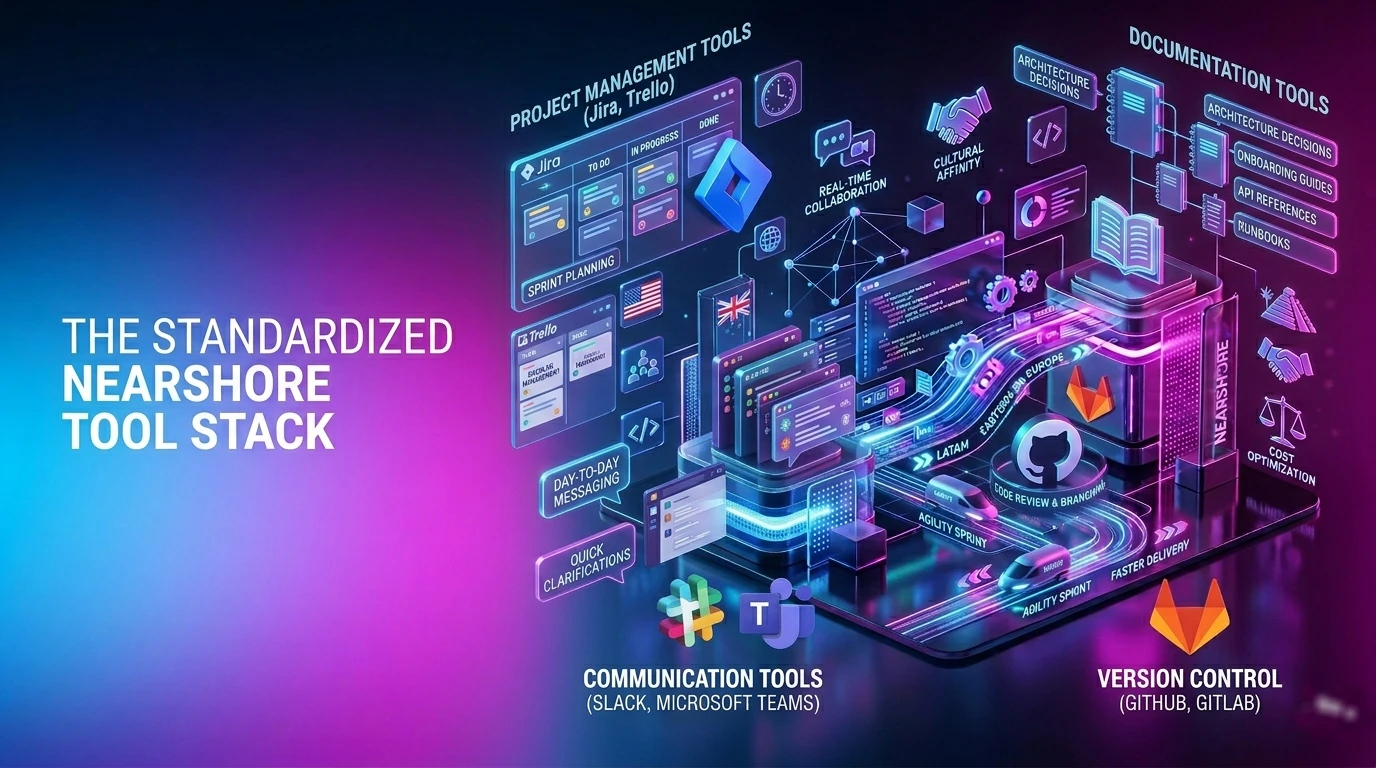
The right tooling doesn’t replace good process, but it makes it a lot easier to sustain across geographies. High-performing nearshore teams typically standardize around four categories:
- Project management tools (Jira, Trello): Sprint planning, backlog management, and progress tracking all live here. Jira is the standard for engineering-heavy teams running agile. Trello works well for lighter workflows or cross-functional visibility. Either way, shared boards keep both sides accountable to the same definition of progress.
- Communication tools (Slack, Microsoft Teams): Day-to-day messaging, quick clarifications, and async updates run through Slack or Teams. Dedicated channels per project, squad, and escalation path keep conversations organized and searchable, which matters when you’re onboarding new team members or tracing a decision made three sprints ago.
- Version control (GitHub, GitLab): Code review, branching strategy, and release management are where quality discipline shows up in practice. GitHub and GitLab also serve as a natural audit trail, useful when distributed teams need to demonstrate who reviewed and approved what, particularly in regulated industries.
- Documentation tools: Architecture decisions, onboarding guides, API references, and runbooks all need a permanent home. Good documentation is what separates teams that scale smoothly from those that lose six weeks of context every time someone changes roles.
See how Experion enables the close alignment expected from nearshore partnerships
Nearshore Software Development Cost: What to Expect
Typical Hourly Rate Ranges by Region
| Region | Senior Engineer Hourly Rate |
| Latin America | $45-$85/hr |
| Eastern Europe | $50-$95/hr |
| North Africa | $35-$65/hr |
| Onshore (US) | $120-$200/hr |
Engagement Model Pricing Structures
- Time & Materials: You pay for hours that are billed monthly. Best suited for evolving scope and agile delivery where requirements change from sprint to sprint. This pricing structure refers to maximum flexibility and less budget predictability.
- Fixed Price: Agreed cost for a defined deliverable. This pricing structure works when the scope is genuinely stable and unlikely to shift. Budget certainty, but less room to adapt.
- Dedicated Team / Retainer: Monthly fee for a committed cross-functional team. Best for long-term product partnerships, platform modernization, or SaaS companies scaling engineering capacity over time.
Top Nearshore Regions and Locations
These are some of the top nearshore regions
Latin America: The Go-To Region for US-Based Enterprises
For US businesses, Latin America has become the dominant nearshore destination. Time zone alignment with US Eastern and Pacific time is near-perfect. The talent base in Mexico, Colombia, Argentina, and Brazil has matured quickly over the past decade.
Key hubs include Bogota, Medellin, Buenos Aires, Mexico City, and Sao Paulo. These cities have dense technology ecosystems with engineers experienced in JavaScript, Python, Java, cloud platforms, and AI/ML frameworks.
Eastern Europe: Deep Technical Talent for EU and Global Enterprises
Poland, Romania, Portugal, and Ukraine have long been the go-to nearshore markets for European enterprises. These regions are known for deep expertise in systems engineering, cybersecurity, data engineering, and complex backend work.
Poland alone has over 400,000 software developers, with Warsaw and Krakow as established tech hubs. Romanian engineers have a strong track record in embedded systems and financial technology. Portugal has attracted significant investment from global tech firms and now has a mature enterprise tech scene.
Choosing a Region Based on Your Business Priorities
- US companies: US companies can opt for Latin America for time zone fit and cultural alignment. For specialized AI or data engineering, Eastern Europe is the right fit.
- EU companies: Eastern Europe has strong talent at competitive rates with minimal travel friction.
- AI-specific work: Markets with strong STEM pipelines such as Argentina and Poland are worth particular attention.
Nearshore Agile Software Development: Built for Speed
Why are Agile and Nearshore a Natural Fit?
Agile methodology depends on real-time collaboration. This involved daily standups, sprint planning, mid-sprint clarifications, and end-of-sprint demos. All of these need teams to be simultaneously available. That’s the structural problem with offshore agile: you can run the rituals, but the gaps show up in sprint velocity and rework rates.
When your nearshore team in Bogota or Warsaw shares six to eight working hours with your in-house team, problems get solved the same day they surface.
How Agile Nearshore Software Development Teams Are Structured?
A well-configured agile nearshore team typically includes:
- Product Owner (often on the client side)
- Scrum Master (on the nearshore side, managing delivery cadence)
- Frontend and Backend Developers
- QA Engineers (integrated into sprints)
- DevOps / Platform Engineers (CI/CD, infrastructure, release management)
Standard tools used: Jira for project tracking, Confluence for documentation, Slack for async communication, and Zoom for real-time sessions.
Your next sprint doesn’t have to wait for the perfect in-house hire. ⟶
Talk to us about extending your team the right way
Nearshore Custom Software Development: When Off-the-Shelf Won’t Do
Use Cases That Demand Custom-Built Solutions
Some problems don’t have a SaaS answer. Nearshore custom software development makes sense when:
- You need an industry-specific platform. This can be a claims management system, a patient engagement portal, or a logistics visibility tool.
- While modernizing a legacy monolith into microservices
- When the product has proprietary logic that can’t be exposed to third-party platforms
- When you are building a new SaaS product and need full control over the tech stack
How Nearshore Custom Software Development Teams Operate
Custom builds start with a real discovery phase: architecture design, technology selection, and roadmap definition.
From there, iterative sprints with regular client reviews.
The difference from offshore lies in tight review cycles that are actually possible when your team shares your working hours.
This matters on complex custom builds where a misunderstood requirement in week two compounds through weeks three to ten.
Nearshore AI-Powered Software Development: The Next Frontier
How is AI Changing What Nearshore Teams Deliver?
AI development tooling (GitHub Copilot, AI-assisted testing, automated code review) is changing the output equation for strong nearshore teams. Engineers who use these tools well can deliver better code faster.
The more interesting shift is at the product level. Enterprises are no longer just outsourcing execution. They want nearshore partners to bring an informed perspective on where AI belongs in the product itself. Recommendation engines, intelligent automation layers, predictive analytics, and conversational AI interfaces are built into enterprise platforms.
That requires engineers who understand both the technical implementation and the business context of what they’re building.
What to Look for in a Nearshore AI-Powered Software Development Company?
When evaluating a nearshore partner for AI development, general programming capability isn’t enough. Look specifically for:
- Demonstrated experience with LLM integration, RAG architectures, or ML model deployment in production.
- Familiarity with AI governance and responsible AI practices (critical for regulated industries)
- Data engineers and MLOps specialists on staff and not just as application developers
- A clear methodology for AI product development. Here, Experimentation, evaluation, and production deployment are distinct phases with different requirements
Whether organizations are considering nearshore, offshore, or distributed development models, Experion brings the technical expertise needed to develop solutions tailored to their unique business requirements.
Challenges in Nearshore Software Development (And How to Overcome Them)
- Managing Distributed Team Culture: Process alone doesn’t build cohesion. Occasional in-person workshops or site visits – even once a year – enables team alignment. Don’t skip them because they’re not in the original budget.
- Maintaining Code Quality Across Geographies: Organizations need to maintain shared coding standards, automated testing pipelines, and regular architecture reviews from the start. Not as a corrective measure six months in.
- Communication Gaps During Transitions: Onboarding, offboarding, and scope changes are when knowledge leaks. Structured handoff protocols prevent this. Document while the context is fresh, not after the person who held it has moved on.
- Alignment on the Definition of Completed: This sounds basic, but misalignment here is the root cause of most delivery disputes. Agree explicitly – in writing – on what ‘complete’ means before the first sprint starts.
How to Choose the Right Nearshore Software Development Company?
Define Your Engagement Model First
Before evaluating vendors, be clear on what you’re actually buying. Match the model to your situation:
- MVP stage: Dedicated team with product engineering experience
- Scaling an existing platform: Staff augmentation to extend your in-house team
- Enterprise modernization: Project-based delivery with defined governance
Not sure which engagement model fits your stage? ⟶
Experion’s team will help you figure that out before you sign anything
Must-Have Criteria When Evaluating Nearshore Software Development Companies
- Technical Depth and Stack Alignment: Can they demonstrate real expertise in your tech stack? Ask for architecture case studies and technical interviews with the engineers who’ll actually be assigned and not the ones who give the sales demo.
- Security Posture: For any enterprise engagement, verify SOC 2 Type II certification, ISO 27001 compliance, NDA frameworks, and clear data handling policies. Non-negotiable in regulated industries.
- Communication Protocols and SLA Transparency: How are sprint reviews conducted? What’s the escalation path when delivery slips? Who is accountable on the nearshore side?
- Client References from Your Vertical: Generic references aren’t enough. Ask for case studies or reference calls from companies in your industry with comparable complexity.
- Domain Expertise Beyond Generic Development: The best nearshore firms understand the business problem, not just the technical spec. That understanding shows up in the questions they ask before they write a line of code.
Red Flags to Watch Out For
- Teams staffed primarily with junior developers without real senior engineering oversight
- No structured onboarding or knowledge transfer documentation
- Vague pricing with costs that balloon unpredictably at scale
- No delivery governance framework, just a project manager and good intentions
- Inability to provide production deployment examples, only demos and prototypes
Evaluation Questions to Ask Every Vendor
- How do you handle scope changes mid-sprint without derailing the sprint?
- What does team continuity look like when we need to scale up or eventually transition out?
- How do you protect our intellectual property, particularly proprietary logic?
- Can you share actual delivery metrics such as velocity, defect rates, and sprint completion from comparable engagements?
- What does model maintenance look like for AI components over time?
Future Trends in Nearshore Software Development
A few shifts are worth tracking:
- AI Development Tooling Becomes the Baseline: AI coding assistants are becoming standard for high-performing nearshore teams. Partners who don’t use them will fall behind in delivery speed. Ask how teams are integrating these tools, not just whether they are.
- Outcome-Based Models Replace Pure T&M: Enterprises are pushing for accountability tied to results, not hours logged. Outcome-based contracts linked to delivery milestones or product metrics are gaining traction, and the better nearshore partners are ready for that conversation.
- Hybrid Teams Are Becoming the Norm: The line between ‘internal’ and ‘nearshore’ is blurring. The better model treats nearshore engineers as genuine product team members with shared context and shared accountability.
- Second-Tier Cities Are Growing: Medellin, Guadalajara, Cluj-Napoca, Wroclaw – these markets are producing strong engineering talent with less cost pressure than established hubs.
- Low-Code Integration Is Part of the Job: Nearshore teams are increasingly expected to work alongside low-code platforms, integrating custom-built components into broader automated workflows rather than building everything from scratch.
Industry Applications: Where Nearshore Development Delivers the Highest ROI
Fintech and Banking
Industries such as fintech and banking are subject to strict regulatory compliance. Along with real-time transaction processing and core banking modernization, the sector requires both technical depth and strong security.
Nearshore teams in Eastern Europe and Latin America have established a track record in PCI-DSS-compliant development, payment gateway integration, and migrating legacy banking systems to cloud-native architectures.
Healthcare and Life Sciences
HIPAA-compliant application development, EHR integration, and patient-facing digital products require domain knowledge that generic development firms don’t typically have. Nearshore partners with healthcare specialization bring both technical depth and regulatory familiarity. This matters when a compliance misstep costs more than the product itself.
Retail and E-Commerce
Seasonal demand spikes, personalization engines, and supply chain visibility tools need scalable architectures that perform under unpredictable load.
Nearshore custom development teams that understand commerce infrastructure can build to that spec without over-engineering the solution.
SaaS and Product Companies
For product companies, feature velocity is a competitive fact. A well-run nearshore team can double engineering output without proportionally increasing payroll, thereby directly reducing customer acquisition costs through faster time-to-market.
Conclusion
Nearshore software development services work best when they’re treated as a strategic model, rather than a cost line. The companies getting the most value from it aren’t using nearshoring as an affordable version of local hiring. They are selecting partners with genuine domain depth, running proper agile delivery, and treating their nearshore teams as extensions of their product organizations.
If you are evaluating nearshore software development companies, focus on what actually predicts delivery success: security posture, domain expertise, communication quality, and the ability to show you documented results.
The right partner won’t just build what you ask for. They’ll ask better questions before they start.
With flexible engagement models, overlapping working hours, and agile delivery practices, our engineering teams can help clients maintain the close collaboration typically sought in nearshore software development partnerships.
Frequently Asked Questions (FAQs)
What is nearshore software development?
Nearshore software development involves partnering with engineering teams in geographically close countries. These countries would share most of your working hours. It combines the cost advantages of outsourcing with better collaboration quality.
How is nearshore different from offshore software development?
Offshore development usually separates teams by 8-12 time zone hours. That gap makes real-time collaboration difficult. Daily standups, code reviews, and mid-sprint decisions all run through async communication. Nearshore eliminates most of that gap.
What are the benefits of nearshore agile software development?
Time zone alignment makes agile rituals work the way they are supposed to. Daily standups, sprint reviews, and mid-sprint clarifications can happen in real time. Teams can respond to changing requirements the same day and not 24 hours later.
How do I choose the best nearshore software development company?
Evaluate the technical depth in your actual tech stack, security certifications, domain expertise in your industry, and documented delivery metrics from comparable engagements. Demand a proof of concept with your real operational data before signing anything long-term.
What does a nearshore software development team typically include?
The team comprises frontend and backend developers, QA engineers, a scrum master, and DevOps or platform engineers. For AI-specific work, you’d also want data engineers and ML specialists.
Is nearshore custom software development secure?
Yes, when the partner has the right certifications in place. Examples include SOC 2 Type II, ISO 27001, clear NDA frameworks, and documented data handling policies. Verify this directly for any work in regulated industries rather than taking it on faith.
What industries benefit most from nearshore software development services?
Fintech, healthcare, retail, e-commerce, and SaaS product companies consistently report the strongest ROI. Industries with high compliance requirements and complex platform needs benefit most from the close collaboration that nearshoring enables.
How long does it take to onboard a nearshore development team?
Staff augmentation is usually operational within two to four weeks. A dedicated nearshore team with custom onboarding typically needs four to eight weeks for full productivity. The time taken depends on the codebase complexity and team size.
What is nearshore AI-powered software development?
It refers to nearshore teams that combine strong software engineering with genuine AI/ML expertise. This refers to building products with intelligent features like recommendation engines, predictive analytics, LLM-based interfaces, and AI-assisted automation.
How is nearshoring different from traditional outsourcing?
Traditional outsourcing mainly involved cost-minimizing transactional vendor relationships. Nearshoring works more like a product partnership. This includes shared time zones, context, and accountability for delivery outcomes rather than just hours logged.