






 Back
Back
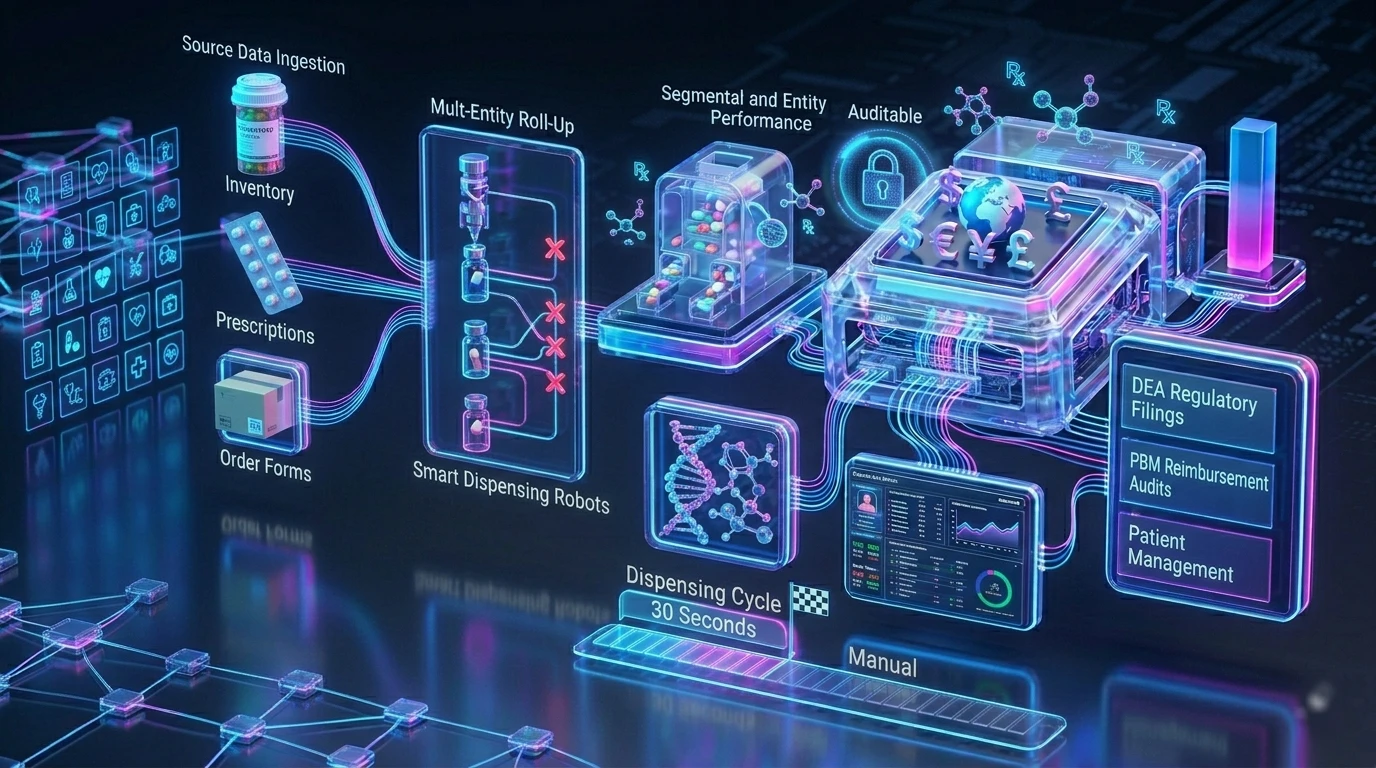
With deep experience in healthcare technology, Experion can support the development of scalable pharmacy software platforms tailored to operational, regulatory, and integration requirements.
Pharmacy management software can help streamline operations in today’s dynamic healthcare environment. It can act as a major enabler of patient care and streamline operations. Modern PMS platforms can automate core tasks and significantly minimize human error. Customized to ensure safe data management, it is built to comply with both international and local regulations.
Key Takeaways
- A pharmacy management system integrates inventory, billing, EHR data, patient communication, and compliance into a single operational workflow.
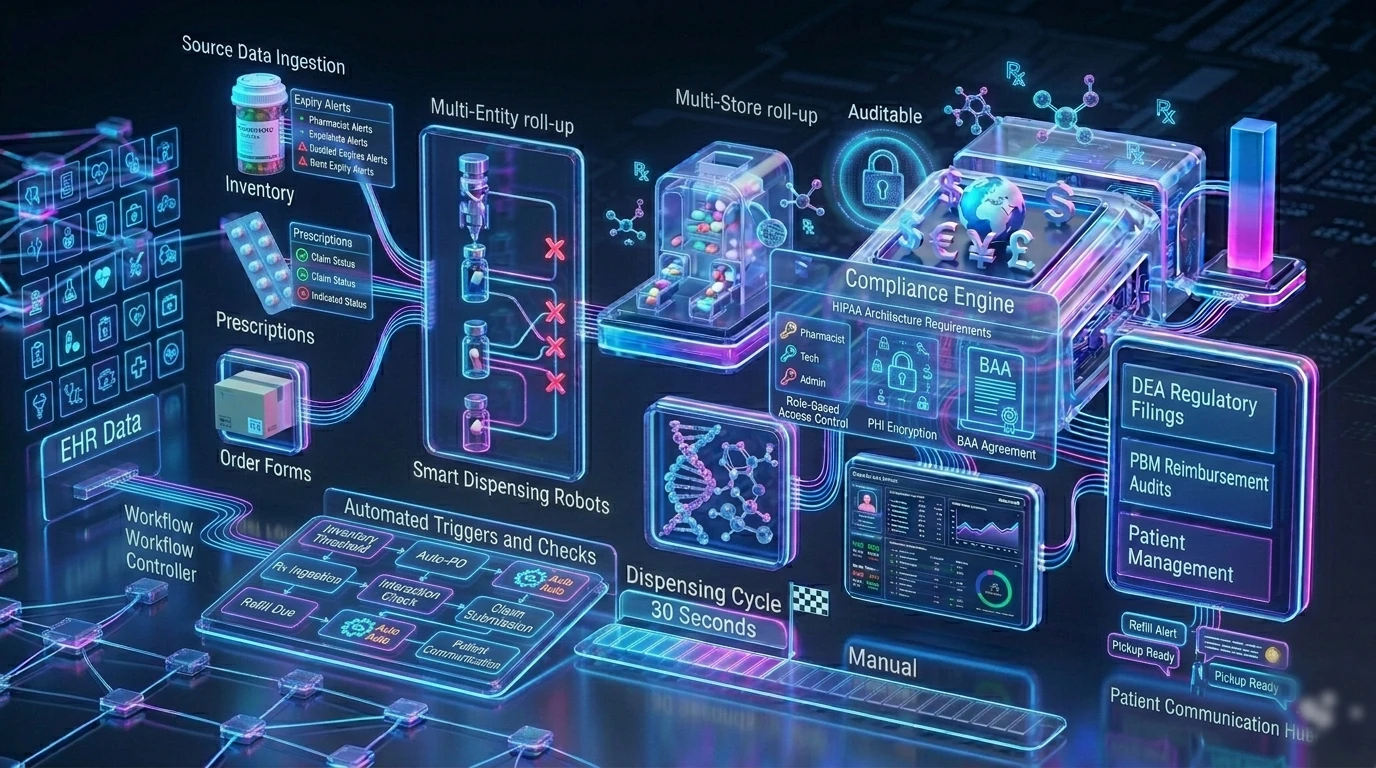
- Pharmacy automation software solutions have moved well beyond the dispensing counter. Refill triggers, drug interaction checks, claim submissions, and expiry alerts now run automatically. For high-volume operations, that automation is what keeps the workflow from breaking under load.
- HIPAA-compliant pharmacy software development is the baseline, not a feature. Role-based access controls, PHI encryption, audit trails, and documented business associate agreements are now architectural requirements.
- The build vs. buy decision for a pharmacy management system comes down to one honest question: Is your dispensing logic genuinely proprietary? Specialty and compounding pharmacies typically need to build. Retail chains and hospital pharmacies are almost always better served by buying.
- Multi-location pharmacy software requires more than replicating a single-site setup across branches. Centralized formulary management, unified patient records, real-time inventory visibility, and branch-level compliance controls set a chain management platform apart from a scaled-up single-location tool.
- Selecting the best pharmacy management software for an enterprise starts before any vendor conversation – with a defined use case, measurable KPIs, and a fixed evaluation checklist. Platforms that look identical in a demo often perform very differently under your actual data and integration environment.
Introduction: The Digital Evolution of Pharmacy Management
In 2026, a pharmacy management system is no longer a digital logbook. It is the operational brain of a modern pharmacy. The infrastructure that decides whether a patient gets the right medication on time, whether your inventory numbers hold up at month-end, and whether a compliance audit ends cleanly.
And yet a surprising number of pharmacy enterprises are still running on systems built for a different era. One for dispensing, one for billing, a spreadsheet for inventory, and a staff member manually reconciling all three at the close of business. That model breaks under volume. It breaks under multi-location complexity, creating compliance risk that nobody is explicitly tracking.
What is Pharmacy Management Software?
Pharmacy management software is a platform that connects every operational function of a pharmacy – prescription intake, drug verification, dispensing, billing, inventory, patient communication, and compliance reporting – into one system. The objective is simple: fewer disconnected tools, fewer manual handoffs, fewer errors.
A pharmacy management system is the architecture that enables that. Pharmacy software is the broader category. The system is the engine underneath it.
Pharmacy software systems range significantly in functions.
- Basic solutions cover only POS and inventory
- Advanced platforms extend into clinical decision support, telepharmacy, and patient engagement across multiple channels.
Some core modules in a pharmacy management system include:
- Prescription management: Intake, verification, dispensing queue management
- Inventory control: Real-time stock tracking, expiry alerts, automated reordering
- POS and billing: Insurance claims, co-pay processing, end-of-day reconciliation
- Patient records: Medication history, allergy flags, refill schedules
- Compliance and audit: HIPAA controls, role-based access logs, reporting
As these systems mature, the focus shifts from simply connecting functions to actively managing them.
A decade ago, pharmacy automation software solutions were largely limited to dispensing robotics. Today, automation reaches the full workflow:
- Automated refill triggers
- Real-time drug interaction checks,
- Insurance claim submissions
- Expiry-based inventory alerts.
None of it requires a pharmacist to initiate. For high-volume retail chains processing thousands of prescriptions daily, that degree of automation is not optional.
Must-Have Features in Enterprise Pharmacy Management Software
Inventory management software for pharmacy
Inventory is where most pharmacies quietly lose money. Expired medications, over-ordered slow-movers, and stockouts on high-demand drugs all hit the P&L.
However, these losses are rarely traced back to the system gaps causing them. Inventory management software for pharmacies solves this through:
- Real-time stock visibility
- Demand-based automated reordering to avoid shortages
- Expiry tracking that flags risk before the product becomes unsellable.
For chain operations, pharmacy inventory management software needs to do more than manage one location. Inter-branch stock transfers, centralized procurement, and visibility across every site from a single dashboard are what make inventory manageable.
Pharmacy management system with POS integration
A pharmacy management system with POS integration brings billing, payments, and claims into a single workflow.
Insurance claims, co-pay processing, healthcare account payments such as FSA/HSA, and cash sales all move through the same system. No more manual reconciliation between two systems at the close of business. More practically, it means claim errors are caught before submission.
That difference alone has a measurable impact on cash flow for high-volume operations. For high-volume pharmacies, even a small percentage of claim errors can translate into delayed reimbursements and revenue leakage.
Pharmacy EHR integration software
For clinical pharmacies, especially, pharmacy EHR integration software is where the most consequential errors are prevented. Thus, the pharmacy system connects directly to the patient’s clinical record.
With pharmacy EHR integration software:
- E-prescriptions arrive pre-verified. Thus, manual validation effort is reduced.
- The patient’s entire medication history is visible at the dispensing counter.
- Drug interaction alerts are automatically generated rather than depending on a pharmacist to manually cross-check.
Hospitals that have moved to full EHR integration report meaningful reductions in dispensing errors.
Patient Engagement Features in pharmacy management software
Refill reminders are the bare minimum. Patient engagement features in pharmacy management software now include:
- Two-way SMS conversations
- Personalized medication adherence programs
- Mobile app access for prescription history
- Proactive outreach in case of a drug recall.
Prescription abandonment caused retail pharmacies to lose significant revenue annually, and most of it is preventable with timely communication.
Mobile Delivery Management Features Cloud-based pharmacy software
Home delivery is no longer a specialty offering. For many pharmacy chains, it is a primary fulfillment channel, and the software infrastructure behind it needs to match. Mobile delivery management features in cloud-based pharmacy software cover driver assignment, route optimization, real-time GPS tracking for patients, electronic proof of delivery, and temperature alerts for cold-chain medications.
Analytics and Reporting Dashboards
A pharmacy management software platform that does not surface actionable data is just a faster version of the old process. Enterprise dashboards need to cover dispensing throughput, inventory turnover, claim acceptance ratios, staff productivity, and patient engagement metrics in real time. The best platforms also support custom report exports for regulatory submissions and board-level KPI reviews, so compliance reporting is not a quarterly scramble.
HIPAA-compliant pharmacy software development
HIPAA-compliant pharmacy software development is not a feature category. It is the price of entry for any pharmacy platform operating in the U.S. healthcare market. The requirements are specific: role-based access controls, full audit trails, encryption at rest and in transit, automatic session timeouts, and documented business associate agreements with every vendor in the software supply chain. Any platform that treats compliance as a checkbox rather than an architectural principle will expose you to risks you cannot afford.
Is your current pharmacy software built for compliance at scale?
Talk to Experion about a HIPAA-readiness assessment
Regulatory Compliance in Pharmacy Software: What Enterprises Must Get Right
Pharmacy enterprises operating at scale are navigating several compliance frameworks simultaneously, and a platform that handles one well while ignoring the others creates gaps that auditors will find.
- HIPAA & PHI Handling – Data isolation, encryption protocols, breach response procedures, and BAA execution with every vendor in the supply chain.
- DEA EPCS (Electronic Prescribing for Controlled Substances) – Federal requirements for Schedule II-V digital prescriptions, including two-factor authentication and tamper-evident audit logging.
- PCI-DSS for Pharmacy POS – Payment Card Industry standards for credit and debit card transactions at the dispensing counter. Often overlooked in pharmacy compliance reviews.
- State-Level Pharmacy Board Regulations – Dispensing rules, pharmacist-to-technician ratios, and labeling requirements vary by state. Multi-location operations need these to be configurable at the branch level without requiring IT involvement every time a regulation changes.
- FDA Drug Database Integration – NDC (National Drug Code) database integration for accurate drug identification, substitution management, and recall handling.
Pharmacy Management System Architecture Explained
Typical Pharmacy Management System Architecture
A well-designed pharmacy management system architecture consists of three layers.
The frontend handles user-facing interfaces for pharmacists, technicians, patients, and delivery staff. It has role-appropriate views on the web, mobile, and kiosk.
The backend manages business logic, workflow orchestration, and data processing.
The database layer handles the structured storage of patient records, prescription history, inventory data, and audit logs, with high availability and automated failover.
Sitting across all three is an integration layer that handles real-time data exchange with EHR systems, insurance clearinghouses, POS terminals, delivery platforms, and government drug databases. How well this layer is designed determines how complex every future integration project will be.
Pharmacy Management Software API Integration
Pharmacy management software API integration is where enterprise implementations succeed or stall.
An API-first architecture connects the platform to:
- EHR systems like Epic, Cerner, and Meditech;
- Insurance clearinghouses for claims processing
- Payment gateways for transaction handling
- Last-mile delivery services
- FDA drug databases
Platforms that were not designed with APIs at the core rely on building custom point-to-point connections that become maintenance debt. It tends to accumulate these connections over time, and by year three, the integration layer is the most fragile part of the whole system.
Scalability and Performance Considerations
Pharmacy software scalability and performance stop being theoretical the moment you hit a peak volume period. A platform handling 500 prescriptions daily encounters different infrastructure constraints than one processing 50,000. Cloud-native architectures are built to handle demand spikes. They happen during post-disaster prescription surges and end-of-benefit-year rushes. On-premise systems require someone to provision capacity before the spike.
Security Architecture in Pharmacy Management Systems
- Role-Based Access Control (RBAC) – Each role sees only what it needs. Pharmacists, technicians, delivery staff, and administrators have separate access profiles with no overlap.
- End-to-End Encryption – End-to-end encryption ensures patient data is secure both during transmission (TLS 1.3) and while stored (AES-256), making it a non-negotiable requirement for protecting sensitive health information (PHI).
- Penetration Testing and Vulnerability Management – Third-party security assessments on a documented schedule, with remediation timelines tracked to closure.
- Disaster Recovery Protocols – Disaster recovery protocols define how much data you can lose (RPO) and how quickly systems must recover (RTO), with guarantees supported by the vendor’s SLA and backed by geographically distributed infrastructure.
Build vs Buy Pharmacy Management System
Most enterprise pharmacy buyers eventually end up asking this question. The honest answer is that it depends on one factor: whether your workflows are genuinely proprietary or whether they just feel that way because you have been doing them the same way for a long time.
When to Choose Custom Pharmacy Management Software Development?
Custom pharmacy management software development makes sense when your dispensing logic is actually proprietary. When it differentiates you clinically or operationally in a way that off-the-shelf platforms cannot replicate. Specialty pharmacies managing oncology or rare disease protocols, compounding pharmacies with patient-specific formulation workflows, and pharmacy benefit managers with highly customized adjudication rules fall into this category.
Working with an experienced pharmacy software development company on a custom build gives you full ownership of the codebase and complete control over the product roadmap. The tradeoff is honest: 6 to 12 months to deploy, a significantly higher upfront cost, and an internal team that needs to own the system long-term.
When to Buy a Purpose-Built Pharmacy Software Solution?
For most retail chains and hospital pharmacies, a purpose-built pharmacy management software solution gets you to value faster and at a lower total cost than a custom build. The vendor handles compliance updates, security patches, and infrastructure scaling.
The question to ask every pharmacy software vendor is not what the platform does on day one. It is what the support model looks like on day 180, after the implementation team has moved on.
Total Cost of Ownership Comparison
| Factor | Build (Custom) | Buy (Purpose-Built) |
| Upfront Cost | High ($250K–$1M+) | Medium (licensing + implementation) |
| Time to Deploy | 6–12 months | 4–12 weeks |
| Compliance Updates | Internal team responsibility | Vendor managed |
| Customization Depth | Maximum | Configuration only |
| Ongoing Maintenance | Requires internal engineers | Vendor supported |
| Scalability | Depends on architecture decisions | Built-in |
| Best Fit | Specialty/proprietary workflows | Retail chains, hospital pharmacies |
Not sure whether to build or buy?
Multi-Location and Pharmacy Chain Management Software: A Different Scale of Challenge
Running one pharmacy itself is operationally complex.
Running 50 locations is a different problem entirely. Most platforms designed for single-site operations hit a wall around location five or six.
Overall, multi-location pharmacy software needs to act as the central nervous system for the entire chain:
- Centralized formulary management – Ensures that each branch dispenses from the same approved drug list.
- Unified patient records across branches – Unified patient records ensure that customers can visit any branch.
- Real-time inventory visibility at every site – Prevents blind spots when it comes to inventory.
Inventory: The two most common sources of inventory loss are stockouts and overordering. Stockouts lead to sales loss, whereas overordering leads to wastage. These two issues can be solved with pharmacy chain management software. Inter-branch stock transfers enable excess stock at one location to be reallocated to another.
Compliance: State-specific regulatory requirements add another layer. Dispensing rules, pharmacist-to-technician ratios, and labeling standards vary across jurisdictions. A platform that cannot enforce these rules at the branch level while maintaining central reporting creates compliance exposure that the parent organization is ultimately responsible for.
Acquisition Challenge: Chains that have grown through acquisitions face a more complex version of this problem: multiple legacy systems across different locations, each with its own data model and integration landscape. The practical approach is phased. That connects acquired locations to the central platform on a structured timeline. This reduces disruption without leaving newly acquired sites running on disconnected infrastructure indefinitely.
Pharmacy Management System Modernization: A Practical Roadmap
Organizations that shift efficiently from their core operational systems treat the pharmacy digital transformation strategy as a planning exercise.
- Phase 1: Begin by mapping your current systems: integrations, data flows, compliance gaps, and manual workarounds. The workarounds are the most important finding. Every workaround is a system failure that someone compensated for with human effort , and those are your highest-priority modernization targets.
- Phase 2: Separate what you need from what would be nice to have. Set measurable success criteria before you talk to a single vendor: Target claim acceptance rate, inventory write-off reduction, patient adherence improvement , and dispensing error rate. Without these numbers, you cannot evaluate vendor claims.
- Phase 3: Cloud-based pharmacy management software is the default for most operations. It eliminates infrastructure overhead, enables real-time multi-location access, and shifts compliance maintenance to the vendor.
However, hybrid models (cloud + on-premise) make sense when:
- There are strict data residency requirements
- Integration with hospital clinical systems demands low latency
- Regulatory constraints limit full cloud adoption
- Phase 4: Lastly, start with just one location or one workflow. Validate all integrations before rolling out further. Train clinical and operational staff during deployment. Post-launch iteration based on real usage data consistently produces better outcomes.
Pharmacy system modernization is not about buying the “best software”. The primary objective is to design the right system for your operations.
How to Choose the Best Pharmacy Software Vendor?
Choosing between pharmacy software vendors is straightforward in theory and surprisingly easy to get wrong in practice.
Use case: Define your specific use case before any vendor conversation. Get precise about factors such as prescription volume, number of locations, integration requirements, and compliance obligations. Without this, every vendor will appear equally capable because you haven’t defined what ‘capable’ means for your operation.
Evaluation Criteria: Build your evaluation criteria before you see any demonstrations. Score each platform against the same fixed checklist: compliance certifications, integration depth, scalability SLAs, and usability for pharmacists and technicians on the floor.
Questions: Ask the questions vendors don’t volunteer answers to. How is PHI isolated in a multi-tenant environment? What does post-go-live support actually look like? Can you produce documented ROI from a deployment comparable to ours in volume and integration complexity?
Proof of Concept: Demand a proof of concept using your actual data and integrations. Narrow to two or three pharmacy software vendors and run a real test.
Common Mistakes When Evaluating Pharmacy Software Vendors:
- Selecting based on demo quality rather than real-world workflow accuracy
- Underestimating integration complexity with legacy and EHR systems
- Evaluating licensing cost without accounting for implementation, training, and ongoing maintenance
- Running the evaluation without clinical staff to verify.
Managing multiple pharmacy locations? One platform should do it all.
Find out how Experion delivers it
Industry Use Cases: Where Pharmacy Management Software Delivers the Highest ROI
Retail Pharmacy Chains
For retail chains, inventory accuracy and patient retention drive the numbers. Centralized inventory management reduces write-offs from expired stock by 25-40% in documented enterprise deployments.
Features such as automated refill reminders and patient engagement reduce prescription abandonment . Since retail pharmacy chains have multiple locations, cloud-based pharmacy management software enables real-time visibility across all locations from one dashboard. This is not achievable with on-premise systems that require someone to pull reports from each site separately.
Hospital and Clinical Pharmacies
Hospital pharmacies benefit most when their systems have deep EHR integration and robust clinical decision support.
A pharmacist can access a patient’s full medication history and receive drug interaction alerts . All of this can be done without switching between systems. The end result is that dispensing errors drop.
Formulary management refers to the hospital’s approved list of medications. Pharmacy management software ensures that all patient prescriptions follow this. It reduces clinical risk and procurement costs simultaneously.
For hospital systems where a single dispensing error can have serious consequences, the ROI calculation is not purely financial.
Specialty and Compounding Pharmacies
Specialty and compounding pharmacies differ from retail pharmacies. The distinction lies in their dispensing logic. Medications are not procured from inventory but are prepared, adjusted, or combined for each patient.
This includes certain pediatric formulations or allergy-free variants. Specialty pharmacies focus on disease-specific drugs. It also procures medicines that require strict handling protocols, such as cold-chain storage and transport. These operations typically require custom pharmacy management software development rather than configuring a standard platform.
Telepharmacy and Home Delivery
Home delivery has moved from a differentiator to a standard offering for most pharmacy chains. The software infrastructure needs to match. In other words, it needs to support both logistics and patient interactions.
Modern cloud-based pharmacy software includes mobile delivery management features
- Driver assignment
- Route optimization,
- Patient-facing GPS tracking
- Electronic proof of delivery
- Cold-chain monitoring alerts
These features have reduced missed deliveries and improved patient satisfaction in documented deployments. Pharmacies managing delivery without customized tools run logistics operations as workarounds, and the errors eventually become visible to patients.
In addition, telepharmacy perfectly complements home delivery. It enables:
- Remote prescription verification
- Virtual pharmacist consultations
- Medication counseling without in-person visits
Future Trends in Pharmacy Software Systems
- AI-driven recommendations: AI in pharmacy software has numerous uses. Machine learning models can flag potential adverse drug events before dispensing. It can check the prescription against patient data and warn against situations such as high dosage or if the drug might interact badly with other existing drugs. If a particular drug is unavailable, it can recommend therapeutic alternatives. AI can also analyze behavior patterns such as missed refills and regular purchase history and identify individuals who are unlikely to take their medications properly. This helps pharmacies send reminders and improve treatment outcomes. In other words, AI can act as a second pair of expert eyes.
- Predictive inventory management: Instead of reacting to stockouts, predictive inventory management software for pharmacies uses historical dispensing data, seasonal demand patterns, and external variables. Perhaps this could be a flu season onset or a local disease prevalence. All these factors can help forecast demand and automate procurement. Early enterprise deployments report 15-30% reductions in emergency stock orders and more consistent service levels during high-demand periods.
- Telepharmacy and remote care: Telepharmacy is making pharmacy services viable in rural and underserved areas where physical locations are not economically feasible. The required infrastructure includes remote dispensing units, video consultation platforms, and cloud-based pharmacy management software that supports remote pharmacist verification. This is becoming a standard procurement requirement rather than a specialty request.
- Data-driven patient engagement: Pharmacy systems are shifting from transaction-focused tools to outcome-driven platforms. It analyses patient behavior such as refill patterns, missed pickups, and interaction history. Thus, it enables pharmacy management to move beyond generic reminders to deliver targeted messages. This includes personalized refill alerts, two-way communication via SMS or mobile apps, and condition-specific adherence programs. When combined with AI, these systems can predict which patients are likely to drop off treatment and trigger proactive outreach at the right time.
- Blockchain for Drug Supply Chain Integrity: The Drug Supply Chain Security Act requires end-to-end traceability of prescription drugs from manufacturer to patient. Blockchain-based solutions create immutable custody records at each transfer point, auditable in real time. Pharmacy enterprises with complex supply chains are beginning to factor API integration for pharmacy management software with blockchain traceability platforms into their architecture planning.
Conclusion: Choose the Right Pharmacy Management Software Solution for Your Needs
Modern pharmacy software systems are the foundation of patient safety and operational efficiency. The platform your pharmacy runs on determines how many errors reach patients, how much inventory gets written off, and how quickly you can respond to a compliance requirement. It dictates the bottom line – Does your clinical staff spend time on patient care or on administrative overhead?
The tech stack chosen is of utmost importance. It affects scalability, compliance posture, patient outcomes, and the ability to add locations without rebuilding from scratch.
Apart from this, the criteria that matter include HIPAA-compliant architecture, deep EHR and POS integration, cloud infrastructure that scales without manual intervention, and analytics that tell you what is actually happening across your operations. Whether you build with a pharmacy software development company or purchase a customized pharmacy management software solution, the platform has to work under enterprise conditions.
Pharmacy enterprises that have made this investment well are running leaner, making fewer errors, and retaining more patients. The ones still on legacy systems are managing around their software rather than with it.
With over 20 years of healthcare technology experience, Experion brings the engineering expertise and domain knowledge to help healthcare organizations design and build scalable software solutions that support evolving pharmacy operations and business growth.