




Data Modernization in BFSI: Overcoming Legacy Challenges

Introduction

In an era where data drives decision-making and customer experiences, the Banking, Financial Services, and Insurance (BFSI) sector is increasingly recognizing the need for data modernization. Despite the clear benefits, many financial institutions struggle with legacy systems and data quality issues. This blog explores the challenges and the critical steps needed for successful data modernization.


The Need for Data Modernization

The past two decades have transformed banking operations significantly. The shift towards virtual banking and digital payments accelerated due to the financial crisis of 2008 and the recent pandemic. Today, data plays a crucial role in defining enterprise goals and achieving business growth. The key to success lies in leveraging available data and strategically architecting it to attract new customers, maintain existing ones, and enhance customer satisfaction. Transitioning from legacy infrastructures to a modern data architecture that supports data-driven operations and analytics with high security and governance is imperative.


Challenges in Data Modernization

Customer Experience and Expectations

Modern customers expect seamless, personalized experiences, particularly in mobile and online banking. However, many institutions struggle to prioritize the customer experience. Outdated systems are often incapable of delivering the personalized and efficient services that customers now demand. This gap can lead to dissatisfaction and churn.


Lack of Customer Intelligence

The absence of a “Single View of Customer” hampers effective customer segmentation and engagement. Without a unified view, banks cannot fully understand their customers’ needs and behaviors. Implementing a comprehensive customer intelligence system can significantly improve customer interactions and loyalty by providing actionable insights into customer preferences and trends.


Ineffective Digital Transformation

Digital transformation efforts fall short without a robust data platform. Banks need to harness the power of their data to innovate and stay competitive. However, many are held back by fragmented data systems that limit their ability to make data-driven decisions and offer advanced services.


Data Abundance

Managing the volume, velocity, variety, and veracity of data is a significant challenge. Ensuring data accuracy, comprehensiveness, and coherence is crucial for meaningful insights. With the exponential growth of data, traditional systems often struggle to keep up, leading to data silos and quality issues.


Competition from FinTech

Neo-banks and FinTech companies are setting high standards in customer service and efficiency. These agile competitors leverage modern technologies to offer superior services and products. Traditional banks must modernize rapidly to stay competitive and meet evolving customer expectations.

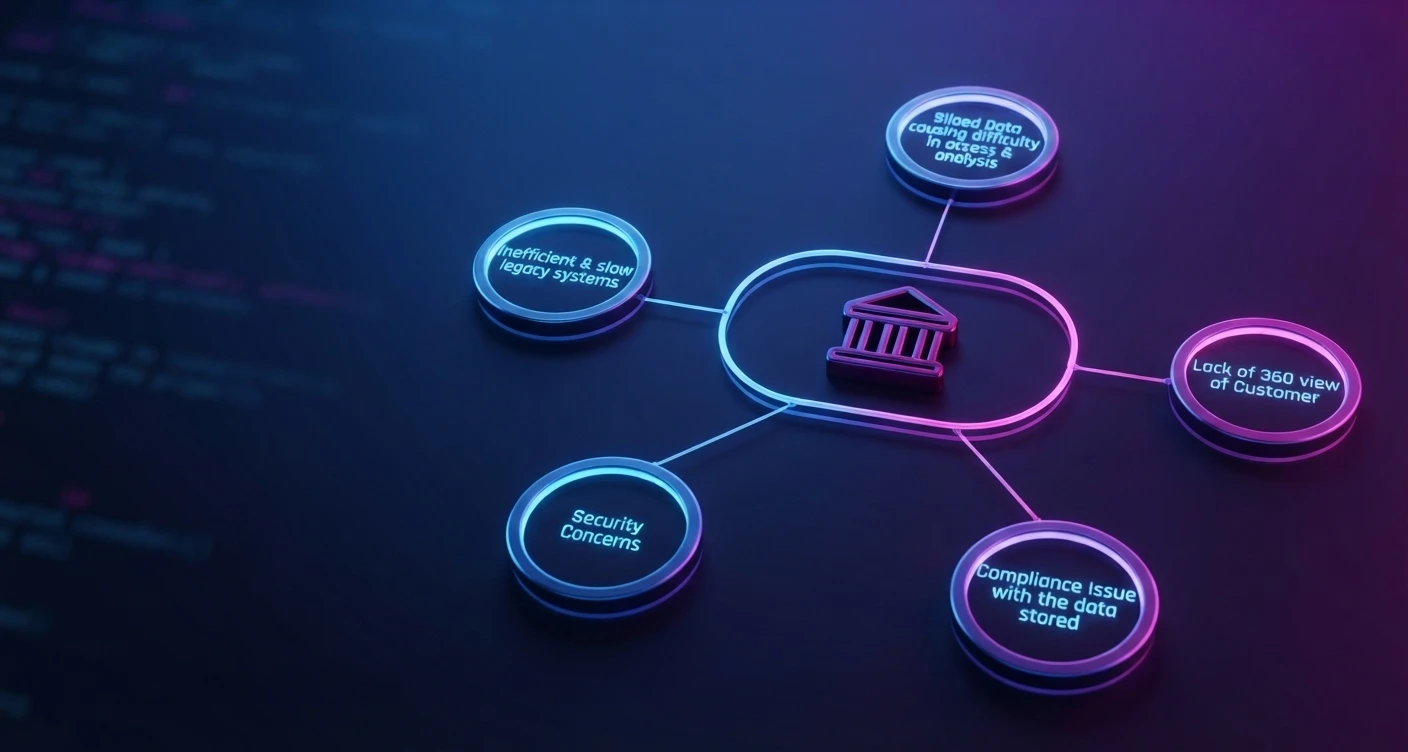
Here is a simplified view of the core challenges that the banking institute might face if they are still operating with a legacy data platform. Addressing them through a modern data platform should always be the key objective.
 

Data Modernization in BFSI: Overcoming Legacy Challenges


The First Step Towards Data Modernization

Experion’s expertise guides organizations in selecting the optimal solution that balances cost, scalability, and performance to meet their unique business needs. The initial decision is whether to build the modern data platform on-premises or in the cloud. Both approaches have their merits and challenges.

On-Premises

Many businesses continue to use traditional methods with in-house infrastructure. On-premises solutions offer control over data and systems, which can be critical for regulatory compliance and security. However, they come with significant challenges, such as high upfront costs, limited scalability, and the need for ongoing maintenance and upgrades.


Cloud Platforms

Cloud platforms offer scalability, flexibility, and the ability to handle multiple inconsistencies at once. They enable rapid deployment, reduce infrastructure costs, and provide access to advanced analytics and AI tools. Cloud solutions can also enhance collaboration and data sharing across the organization. However, they require careful management of data security and regulatory compliance.

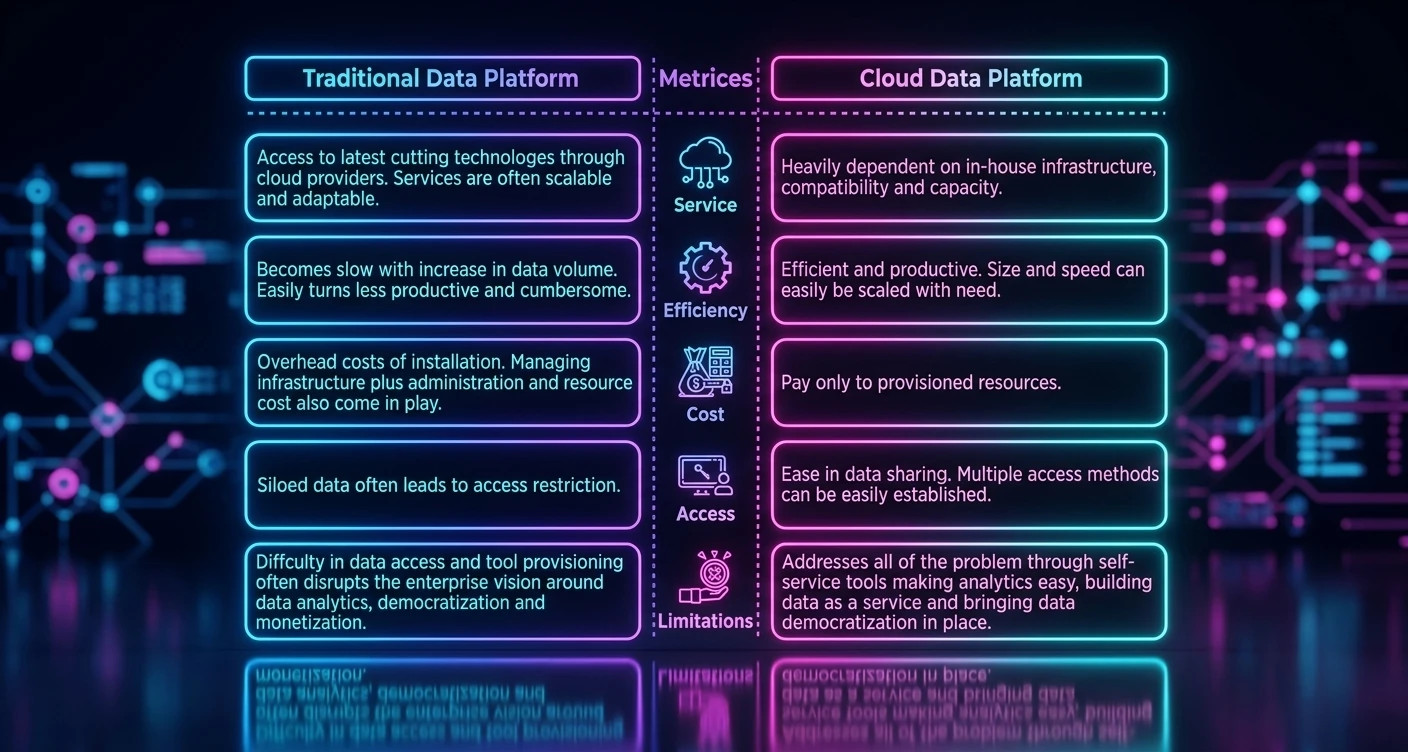
Many businesses continue to use traditional methods (with in-house infrastructure), albeit with some complications and challenges. Perhaps the effectiveness diminishes over time as the business landscape undergoes changes due to technological disruption. The modern approach (the cloud data platform) has a distinct pace and benefits that can handle multiple inconsistencies at once. This diagram highlights the key differences between traditional and modern data platforms:
 

Data Modernization in BFSI: Overcoming Legacy Challenges


Conclusion

Overcoming these challenges with a strategic approach to data modernization can enable banks and financial institutions to enhance customer satisfaction, improve operational efficiency, and stay competitive. The journey towards data modernization begins with the right decisions about infrastructure and a commitment to leveraging modern technologies. By embracing cloud solutions and advanced data analytics, financial institutions can unlock new opportunities for growth and innovation.

Modernizing data platforms is not just a technological upgrade but a strategic transformation that positions BFSI institutions for future success. It requires a clear vision, strong leadership, and a willingness to invest in new technologies and processes. Ultimately, the benefits of enhanced customer experiences, operational efficiencies, and competitive advantages make data modernization a crucial priority for the BFSI sector.


EV Charging Software

Brief Overview of the Growth in the Electric Vehicle (EV) Market

The electric vehicle (EV) market has grown significantly over the recent years. With advancements in technology, growing environmental awareness, and supportive government policies, more consumers are switching from traditional combustion engines to electric alternatives. This shift in the automotive sector is fueled by the need to reduce greenhouse gas emissions, decrease reliance on fossil fuels, and address the growing concerns about climate change. The International Energy Agency (IEA) reported that global EV sales surpassed 10 million units in 2022, marking a significant milestone for the industry.

Importance of Efficient EV Charging Infrastructure

As the number of electric vehicles on the road increases, the demand for a robust and efficient EV charging infrastructure becomes critical. Without a well-established network of charging stations, EV adoption could be hindered by range anxiety—drivers’ fear of running out of battery power without access to a charging station. Efficient charging infrastructure is essential not only for the convenience of EV owners but also for the sustainability and scalability of the electric vehicle ecosystem. This is where EV charging software comes into play, offering solutions that optimize the management and operation of charging stations.


What is EV Charging Software?

EV Charging Software

EV charging software is a technological solution designed to manage, monitor, and optimize the operation of electric vehicle charging stations. It provides a platform for charging station operators, utility companies, and EV drivers to efficiently manage charging activities, ensuring a seamless experience for all stakeholders involved.

Key Stakeholders

  1. Charging Station Operators: They are responsible for installing, maintaining, and managing charging stations. EV charging software helps operators monitor station performance, manage billing, and ensure uptime.
  2. Utility Companies: These entities play a crucial role in the integration of charging stations with the power grid. They need to manage energy distribution and ensure that EV charging does not disrupt the stability of the grid.
  3. EV Drivers: The end-users of the charging stations, who need a convenient and reliable way to charge their vehicles. EV charging software provides a user-friendly interface for locating charging stations, starting and stopping charging sessions, and making payments.


Key Features of EV Charging Software

Real-time Monitoring and Management

One of the fundamental features of EV charging software is its ability to provide real-time monitoring and management of charging stations. This includes tracking charging sessions, monitoring station status, and remotely managing operations.

  • Monitoring Charging Sessions: The software allows operators to monitor the status of each charging session, including energy consumption, duration, and user information. This data is crucial for billing, maintenance, and optimizing the user experience.
  • Remote Management of Charging Stations: Operators can remotely control charging stations, including starting or stopping charging sessions, updating firmware, and performing diagnostics. This feature reduces the need for on-site maintenance and helps in promptly addressing issues.

Payment and Billing Systems

A robust payment and billing system is essential for the smooth operation of EV charging stations. The software integrates with various payment gateways, allowing users to pay through multiple channels, such as credit cards, mobile wallets, and subscription services.

  • Integration with Various Payment Gateways: This feature ensures that users have a seamless payment experience, regardless of their preferred payment method. It also facilitates the implementation of flexible pricing models, such as pay-per-use, subscription, or time-based billing.
  • Billing Management for Users: The software provides detailed billing information to users, including energy consumed, charging time, and cost. This transparency enhances user trust and satisfaction.

User Management

EV charging software also includes features for user management, such as authentication and access control. These features ensure that only authorized users can access the charging stations and that their usage is tracked and billed accurately.

  • User Authentication and Access Control: The software can authenticate users through various methods, such as RFID cards, mobile apps, or key fobs. It also allows operators to set access controls, restricting certain users or vehicles from using specific stations.

Energy Management

Effective energy management is crucial for the sustainability and efficiency of the EV charging ecosystem. The software offers features such as load balancing and integration with renewable energy sources to optimize energy consumption.

  • Load Balancing and Demand Response: Load balancing ensures that the energy demand from multiple charging stations does not exceed the capacity of the local grid. Demand response features allow the software to adjust charging rates based on grid conditions, reducing the risk of power outages and enhancing grid stability.
  • Integration with Renewable Energy Sources: The software can integrate with renewable energy sources, such as solar or wind, to provide a more sustainable charging solution. This integration helps reduce the carbon footprint of EV charging and supports the transition to clean energy.

Reporting and Analytics

Data collection and analysis are vital for the continuous improvement of EV charging infrastructure. EV charging software provides detailed reports and analytics, offering insights into station performance, user behavior, and energy consumption.

  • Data Collection and Analysis: The software collects data from charging sessions, including energy usage, station uptime, and user demographics. This data is analyzed to identify trends, optimize operations, and improve the user experience.
  • Performance Metrics and Insights: Operators can access key performance metrics, such as station utilization rates, revenue generated, and maintenance needs. These insights help in making informed decisions about station expansion, pricing strategies, and customer engagement.

Software Integration

EV charging software is designed to be compatible with various hardware and integrate with existing systems and platforms. This flexibility ensures that operators can easily scale their operations and adapt to changing market conditions.

  • Compatibility with Different Hardware: The software supports a wide range of charging station models and communication protocols, ensuring compatibility across different manufacturers and regions.
  • Integration with Existing Systems and Platforms: It can integrate with existing systems, such as customer relationship management (CRM) software, enterprise resource planning (ERP) systems, and energy management platforms.


Benefits of Using EV Charging Software

EV Charging Software

EV charging software offers a range of benefits that can significantly enhance the operation of charging stations, improve user experiences, and support the broader adoption of electric vehicles. The key benefits are:

  1. Improved Operational Efficiency

EV charging software streamlines the management of charging stations, reducing the need for manual oversight and enabling operators to manage multiple stations from a single platform.

  • Automated Processes: The software automates various tasks such as station monitoring, user authentication, and billing, which minimizes human error and reduces labor costs.
  • Remote Management: Operators can control and troubleshoot charging stations remotely, which helps in quickly addressing any issues and reducing downtime. This remote capability also allows for software updates and diagnostics without the need for on-site visits.
  • Optimized Resource Allocation: By analyzing usage patterns and energy consumption, the software helps operators allocate resources more effectively, ensuring that stations are available when and where they are needed most.


  1. Enhanced User Experience

A seamless and reliable charging experience is crucial for encouraging more people to adopt electric vehicles. EV charging software greatly enhances the user experience in several ways:

  • User-friendly Interfaces: The software often comes with intuitive mobile apps or web portals that allow users to easily locate charging stations, start or stop charging sessions, and make payments.
  • Real-time Information: Users can access real-time data about station availability, charging speeds, and estimated wait times, which helps them plan their charging sessions more efficiently.
  • Flexible Payment Options: By integrating with multiple payment gateways, the software allows users to pay using various methods, including credit cards, mobile wallets, and subscription models, offering convenience and flexibility.


  1. Cost Savings for Operators and Users

By optimizing the operation and maintenance of charging stations, EV charging software can lead to significant cost savings for both operators and users.

  • Reduced Maintenance Costs: Predictive maintenance features, enabled by continuous monitoring and data analysis, help identify potential issues before they become major problems, reducing repair costs and prolonging the life of the equipment.
  • Energy Management: Features such as load balancing and integration with renewable energy sources optimize energy usage, which can lower electricity costs for operators and provide cheaper charging options for users.
  • Dynamic Pricing Models: The software can implement dynamic pricing based on demand, time of day, or energy costs, allowing operators to maximize revenue while offering competitive rates to users.


  1. Scalability and Future-proofing

As the demand for electric vehicles continues to grow, the ability to scale and adapt to new technologies becomes increasingly important. EV charging software supports this need for scalability and future-proofing.

  • Easily Scalable: Cloud-based software solutions can easily scale to accommodate more charging stations and users without requiring significant infrastructure changes.
  • Support for New Technologies: The software is often designed to integrate with emerging technologies, such as vehicle-to-grid (V2G) systems and AI-driven energy management, ensuring that the charging infrastructure remains up-to-date and capable of supporting future innovations.
  • Compliance with Regulations: As regulations around EV charging evolve, software updates can help ensure that charging stations remain compliant, avoiding potential fines or disruptions.


  1. Support for Sustainable Energy Solutions

Integrating sustainable practices into EV charging is crucial for reducing the overall carbon footprint of electric vehicles. EV charging software supports these efforts in several ways:

  • Integration with Renewable Energy: The software can prioritize the use of renewable energy sources, such as solar or wind, to power charging stations, reducing reliance on fossil fuels and lowering greenhouse gas emissions.
  • Demand Response Capabilities: By adjusting charging rates based on grid conditions and renewable energy availability, the software can help balance the grid and support a more sustainable energy ecosystem.


How to Select the Best EV Charging Software

EV Charging Software

Selecting the right EV charging software is a critical decision that can impact the efficiency, scalability, and overall success of your EV charging operations. Here are the steps and key factors to consider when choosing the right software:


  1. Assessing Your Needs: Size of Operation and User Base

Before selecting a software solution, it’s essential to evaluate your specific needs based on the size and scope of your operations:

  • Size of Your Charging Network: If you operate a large network of charging stations across multiple locations, you’ll need software that can handle complex operations and provide centralized management.
  • Types of Users: Consider the types of users your charging stations will serve, such as private EV owners, fleet operators, or public users. Different user bases may have unique requirements for payment methods, access control, and reporting.


  1. Key Factors to Consider: Scalability, Integration, Support

When evaluating different software options, focus on these critical factors to ensure the software meets your current and future needs:

  • Scalability: As EV adoption increases, your charging network may need to expand rapidly. A scalable solution will allow you to add more stations and accommodate more users without major overhauls or additional costs.
  • Integration Capabilities: The software should seamlessly integrate with your existing hardware and systems, such as customer relationship management (CRM) tools, energy management systems, and payment gateways.
  • Customer Support and Service: Reliable customer support is crucial, especially during the initial setup and when resolving technical issues. Look for vendors that offer robust support, including training, documentation, and responsive customer service.


  1. Vendor Reputation and Customer Support

Choosing a reputable vendor with a proven track record is vital for ensuring the quality and reliability of the software:

  • Research Vendor Reputation: Look for reviews, case studies, and testimonials from other customers. This feedback can provide insights into the vendor’s reliability, product quality, and customer service.
  • Evaluate Customer Support: Consider the vendor’s customer support offerings, including the availability of technical support, training resources, and user communities. Reliable support can make a significant difference in the smooth operation of your charging network.


  1. Cost Considerations and Return on Investment (ROI)

Understanding the total cost of ownership and potential ROI is essential when selecting EV charging software:

  • Initial and Ongoing Costs: Evaluate the software’s upfront costs, including licensing fees, installation, and setup charges. Also, consider ongoing costs such as maintenance, updates, and support fees.
  • Calculate Potential Savings: Assess the potential savings from improved operational efficiency, reduced maintenance costs, and optimized energy usage. Comparing these savings to the total cost will help you determine the software’s ROI and make an informed decision.


  1. User Experience and Usability

The software should offer a user-friendly interface for both operators and end-users:

  • Ease of Use: The software should be easy to navigate, with clear and intuitive interfaces that minimize the learning curve for both operators and users.
  • Customization: Look for software that allows for customization to meet specific needs, such as branding, pricing models, and reporting requirements.


  1. Security and Compliance

Security is a paramount concern for any digital infrastructure, and EV charging software is no exception:

  • Data Security: Ensure the software has robust security measures in place to protect sensitive user data, payment information, and operational data.
  • Compliance with Regulations: The software should comply with relevant local, regional, and international standards and regulations, such as GDPR for data protection and PCI-DSS for payment processing.


Challenges and Future Trends in EV Charging Software

As the electric vehicle (EV) market continues to grow, EV charging software plays a crucial role in ensuring efficient and reliable charging solutions. However, this rapidly evolving sector faces several challenges that must be addressed to support the widespread adoption of EVs. Two of the most significant challenges are interoperability and cybersecurity. Understanding these issues is key to developing robust and future-proof EV charging networks.

Current Challenges

Interoperability: Ensuring Seamless Integration Across Platforms

Interoperability is the ability of different systems, devices, and software to function together smoothly. In the context of EV charging, interoperability is crucial for ensuring that various charging stations, vehicles, and software platforms can communicate and function effectively with one another. However, achieving interoperability in the EV ecosystem is a significant challenge due to the diversity of equipment and protocols involved.

  • Diverse Hardware and Software: The EV charging landscape comprises numerous manufacturers and service providers, each using proprietary hardware and software. This diversity often leads to compatibility issues, as different systems may not communicate effectively with one another. For example, a charging station from one manufacturer may not be compatible with the management software from another, leading to operational inefficiencies and user frustration.
  • Lack of Standardization: Although efforts are underway to standardize charging protocols and communication standards, the industry has yet to fully converge on universal standards. Organizations like the Open Charge Alliance (OCA) and CharIN are working to promote open standards such as the Open Charge Point Protocol (OCPP) and the Combined Charging System (CCS). However, the lack of widespread adoption of these standards means that interoperability remains a challenge.
  • Fragmented Market: The EV charging market is highly fragmented, with different regions and countries adopting various standards and regulations. This fragmentation complicates the deployment of a unified, interoperable charging network. For instance, a charging station that works perfectly in Europe may not be compatible with systems in the United States or Asia due to differences in voltage, plug types, and communication protocols.
  • Impact on User Experience: Interoperability issues can negatively impact the user experience, creating barriers to EV adoption. If drivers are unable to find compatible charging stations or face difficulties in initiating a charging session due to software incompatibilities, their confidence in EV technology may be undermined. Ensuring seamless operation across different platforms is essential for building a reliable and user-friendly charging network.


Cybersecurity: Protecting the Digital Infrastructure of EV Charging Networks

Cybersecurity is another critical challenge in the EV charging ecosystem. As charging stations become more interconnected and reliant on digital systems, they are increasingly vulnerable to cyberattacks. Protecting the infrastructure and sensitive user data is essential to maintaining trust and ensuring the safe operation of EV charging networks.

  • Growing Connectivity and Digitalization: Modern EV charging stations are no longer standalone units; they are part of a broader network that includes cloud-based management systems, mobile applications, and IoT devices. This increased connectivity exposes charging stations to a range of cyber threats, including hacking, data breaches, and malware attacks.
  • Vulnerability to Cyberattacks: Cyberattacks on EV charging stations can have serious consequences, ranging from unauthorized access to systems and data theft to service disruption and damage to equipment. For example, a cybercriminal could potentially disable a charging station, steal payment information, or manipulate charging sessions to cause overloads or damage to the grid.
  • Data Privacy Concerns: EV charging stations collect a significant amount of data, including user information, payment details, and charging patterns. This data is valuable for optimizing operations and providing personalized services, but it also presents a target for cybercriminals. Ensuring that this data is securely stored and transmitted is crucial for protecting user privacy and maintaining trust in the system.
  • Regulatory Compliance: As the EV charging industry grows, so does the need for compliance with various data protection and cybersecurity regulations. Regulations such as the General Data Protection Regulation (GDPR) in Europe and the California Consumer Privacy Act (CCPA) in the United States set strict guidelines for data security and privacy. Compliance with these regulations is not only a legal requirement but also a critical component of building a secure and trustworthy charging network.
  • Developing Robust Security Measures: To address cybersecurity challenges, operators must implement robust security measures that protect against both external and internal threats. This includes using encryption for data transmission, regularly updating software to patch vulnerabilities, implementing strong access controls, and conducting regular security audits. Additionally, operators should develop incident response plans to quickly detect and mitigate any security breaches.


The Path Forward: Addressing Interoperability and Cybersecurity Challenges

Addressing the challenges of interoperability and cybersecurity is crucial for the continued growth and success of the EV charging ecosystem.

  • Promote Standardization: Industry stakeholders should collaborate to develop and adopt universal standards for EV charging hardware, software, and communication protocols. By aligning on common standards, the industry can ensure that all components work together seamlessly, enhancing interoperability and user experience.
  • Enhance Cybersecurity Awareness and Training: Operators should invest in cybersecurity training for their staff to ensure they are aware of potential threats and know how to protect against them. This includes educating employees on best practices for data security, such as using strong passwords, avoiding phishing scams, and regularly updating software.
  • Implement Advanced Security Technologies: Leveraging advanced security technologies, such as artificial intelligence and machine learning, can help detect and prevent cyber threats in real time. These technologies can analyze patterns and identify anomalies that may indicate a cyberattack, allowing operators to respond quickly and effectively.
  • Collaborate with Regulatory Bodies: Engaging with regulatory bodies and participating in industry forums can help operators stay informed about the latest cybersecurity threats and regulatory requirements. Collaboration with regulators can also lead to the development of more effective cybersecurity standards and practices.


Future Trends: AI and Machine Learning, V2G Technology, Blockchain Integration

  • AI and Machine Learning: Artificial intelligence (AI) and machine learning (ML) are set to play a significant role in the future of EV charging software. These technologies can optimize energy management, predict maintenance needs, and enhance user experience through personalized services.
  • V2G (Vehicle-to-Grid) Technology: V2G technology allows EVs to not only draw power from the grid but also feed it back when needed. This bidirectional energy flow can help balance grid demand, reduce energy costs, and support the integration of renewable energy sources.
  • Blockchain Integration: Blockchain technology can enhance the transparency, security, and efficiency of EV charging transactions. It can facilitate peer-to-peer energy trading, ensure secure payments, and provide a decentralized platform for managing charging stations.


Conclusion

The importance and benefits of EV charging software are clear. As the EV market continues to grow, the need for efficient, scalable, and sustainable charging solutions will only increase. By investing in robust EV charging software, operators can improve operational efficiency, enhance user experience, and support the transition to a sustainable energy future. The future of the EV industry is bright, and software will play a crucial role in its growth and success.

Key Takeaways

  • EV charging software is essential for the efficient operation of charging stations and the growth of the EV market.
  • Key features include real-time monitoring, payment systems, energy management, and reporting.
  • Future trends in EV charging software include AI, V2G technology, and blockchain integration.

The Strategic Power of Low Code Platforms

In today’s fast-paced digital world, the need for innovative solutions is higher than ever. This is where low code development steps in, revolutionizing how we build applications and empowering more people to join in the digital innovation process.  Low code development simplifies application creation by offering visual interfaces, pre-built templates, and drag-and-drop functionalities. This approach breaks down the barriers in software development, making it accessible to more than just dedicated developers.

One of the biggest advantages of low code development is its ability to speed up application delivery, significantly reducing both development time and costs. This speed is crucial for meeting the ever-changing demands of the market and customer needs. Additionally, it fosters innovation by enabling rapid prototyping, encouraging experimentation, and nurturing new ideas.

Low code development excels in creating applications with well-defined functionalities, like internal workflow automation and reporting dashboards. However, its success depends on continuous collaboration between business stakeholders and IT teams. Strategic alignment, user satisfaction, and a strong focus on security and governance are essential for successful low code projects.

Looking towards the future, low code development is set to become the new norm in application building, democratizing software development and inviting a wider range of innovators into the digital realm. Its potential to drive agility, innovation, and efficiency is reshaping the industry and setting a new standard in application development.


The Role of AI in Low Code Development

Artificial Intelligence (AI) is poised to revolutionize low code development further. By automating tasks, enhancing decision-making, and facilitating predictive capabilities, AI opens up a world of possibilities for low code platforms. With machine learning algorithms, these platforms can streamline the development process, minimize errors, and improve the performance and effectiveness of applications.

When choosing a low-code platform for your project, consider crucial factors like flexibility, scalability, security, integration capabilities, and the level of support and resources provided. These aspects are vital for the success of your project and for ensuring that the chosen platform aligns with your organization’s goals and requirements.

The Strategic Power of Low Code Platforms

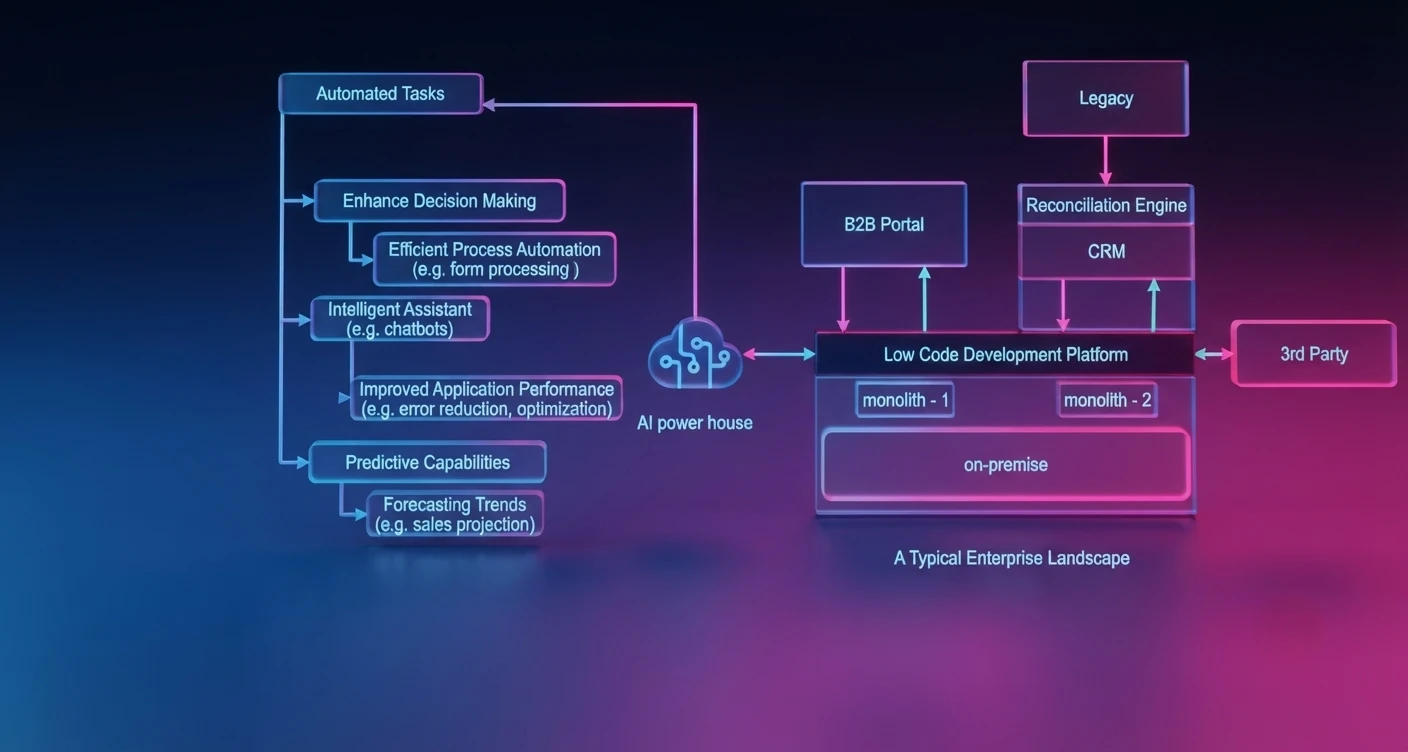
The above image represents a typical enterprise landscape, highlighting the role of a low code development platform within a broader system. The role the low-code development platform:

  1. Central Integration Hub: The low code development platform acts as a central hub, integrating various systems and applications within the enterprise. It connects legacy systems, CRM, B2B portals, and third-party applications, ensuring seamless data flow and operational harmony.
  2. Automated Tasks and AI Integration: The platform is powered by AI capabilities, which enhance its functionalities. Automated tasks are managed through AI, facilitating efficient process automation, intelligent assistance (like chatbots), improved application performance, and predictive capabilities such as forecasting trends.
  3. Application Development and Deployment: The platform supports the development of applications through a low code approach, enabling faster development cycles and reducing the need for extensive coding expertise. It can manage both on-premises applications and monolithic applications (monolith-1 and monolith-2), providing flexibility in deployment and scaling.
  4. Enhanced Decision Making: AI integration aids in enhanced decision-making processes by offering insights and optimizing operations.
  5. Efficiency and Optimization: The platform optimizes various functions such as reconciliation engines, thereby improving efficiency and reducing errors.
  6. Seamless Collaboration: It facilitates collaboration between business units and IT teams, ensuring that developed applications meet business needs and technical requirements.

In summary, the low code development platform in the landscape serves as a core element in the enterprise architecture, integrating multiple systems, enabling AI-powered automation and decision-making, and streamlining application development and deployment processes.


Embracing Low Code for Future Success

As the digital landscape continues to evolve, low code development stands as a beacon of transformation, redefining how applications are built and democratizing software development. By embracing the power of low code, businesses can pave the way for a future driven by innovation and efficiency.

To explore the transformative power of low code development, let’s delve into its core advantages and future possibilities. From accelerating application delivery to fostering innovation through rapid prototyping, low code development streamlines processes and promotes inclusive participation in digital creation.

Making Low Code Relatable and Engaging

To make the concepts discussed relatable and inspiring, real-world examples and case studies can breathe life into the content. Streamlining the information, avoiding repetition, and presenting technical details in a user-friendly manner are essential to maintain reader engagement and comprehension.

Strategic Utilization of Low Code Platforms

In today’s hypercompetitive market, the strategic use of low code development is crucial for organizations aiming to expand and thrive in the digital era. This innovative approach not only accelerates application delivery but also aligns with global strategic objectives to drive market competitiveness and achieve specific goals like market expansion.

Ensuring robust regulatory compliance is essential for leveraging low code platforms effectively. Compliance with stringent regulations such as General Data Protection Regulation (GDPR) and Payment Card Industry Data Security Standard (PCI DSS) is critical for safeguarding sensitive data and maintaining customer trust. Demonstrating successful integration of these regulatory requirements within low code projects showcases an organization’s commitment to data protection and security.

Scalability and Adaptability

Scalability and adaptability are key to the long-term success of low code architecture. As technology evolves rapidly, low code platforms must be flexible enough to embrace future trends seamlessly. Emphasizing support for long-term growth and risk management in a dynamic digital landscape helps organizations future-proof their applications, ensuring they remain relevant and effective.


In a Practical Example: Utilization of Low Code Platforms in Our Experience

To demonstrate the effectiveness of low code development, consider a client, a global leader in industrial automation and digitalization. They utilized a low code platform to overhaul their internal processes and expedite their digital transformation journey.

The Challenge

The client faced the task of swiftly creating and deploying customized applications to meet the varied needs of their worldwide operations. Conventional development methods were cumbersome and expensive, struggling to keep pace with rapidly changing market demands.

The Solution

By embracing low code development, the client empowered their business units to efficiently create bespoke applications. The platform’s visual development environment, ready-made templates, and drag-and-drop functionality enabled their team members, even those with limited coding expertise, to actively contribute to the development process.

The Outcomes

  1. Increased Development Speed: They significantly reduced application development time, speeding up responses to market shifts and internal demands.
  2. Cost Efficiency: Development costs were notably decreased, allowing resources to be redirected to other strategic initiatives.
  3. Improved Collaboration: The low code platform fostered better collaboration between business and IT teams, ensuring that applications met user needs and business goals.
  4. Innovative Solutions: They successfully prototyped and deployed advanced solutions like IoT-enabled applications and sophisticated analytics tools, driving digital innovation throughout their operations.

While low code development platforms offer numerous benefits, there are several caveats to consider. One major concern is the potential for vendor lock-in, where businesses become heavily dependent on a specific platform’s ecosystem, making it difficult to switch vendors without substantial effort and cost. Additionally, low code solutions might not be suitable for all types of applications, particularly those requiring highly specialized, complex functionalities that may exceed the platform’s capabilities. There can also be issues with scalability and performance if the underlying infrastructure of the platform is not robust enough to handle large-scale applications. Security is another critical aspect; low code platforms must adhere to strict security protocols to ensure that the applications built on them are not vulnerable to cyber threats. Finally, while low code platforms aim to democratize software development, they still require a certain level of technical understanding, and without proper training, users may inadvertently create inefficient or suboptimal applications.


Conclusion

Low code development is not just about streamlining application building; it’s a strategic tool that can propel organizations towards market leadership and sustainable growth. By aligning with global strategic objectives, prioritizing regulatory compliance, and investing in scalability and adaptability, businesses can harness the full power of low code platforms to drive innovation, competitiveness, and success in the digital age.

The fusion of low code development and cutting-edge technologies like AI heralds a new era of software creation, where possibilities are limitless, and innovation knows no bounds. Embrace the evolution, seize the opportunities, and embark on a transformative journey with low code development at the helm of digital progress.

Custom Facility Management Software

In a world where every facility has unique needs, one-size-fits-all solutions just don’t cut it. Every facility has its own rhythm, challenges, and goals. What if you could harness a solution as distinctive as your operation? A system designed not just to meet industry standards but to exceed them by adapting perfectly to your specific needs. The future of facility management is all about precision and personalization. Let’s explore how a tailored approach can redefine your operational success.

Facility management (FM) is a comprehensive range of services that aim to optimize the use of an organization’s buildings and infrastructure. It encompasses everything from building maintenance and repairs to space planning, energy management, and environmental sustainability. Ultimately, FM seeks to create a safe, efficient, and productive environment for occupants while maximizing the value of the facility.

While off-the-shelf facility management software solutions can be a good starting point, they often fall short of meeting the unique needs of specific organizations. Custom solutions, on the other hand, are tailored to address the specific challenges and goals of a particular facility or company. With a bespoke approach, the software integrates smoothly with business operations, boosts productivity, and maximizes returns. 

What is Custom Facility Management Software?

Custom facility management software is a technology solution specifically designed and developed to meet the unique requirements of an organization. It is not a generic product but a tailored system that integrates seamlessly with the company’s existing infrastructure and workflows. Custom facility management software can be defined as a digital platform that automates, streamlines, and optimizes various facility management tasks. Its purpose is to provide a centralized system for managing assets, maintenance, space utilization, energy consumption, and other facility-related functions. By automating routine tasks and providing real-time data, the software empowers facility managers to make informed decisions, improve operational efficiency, and reduce costs.

Key Stakeholders

Several key stakeholders are involved in the development and implementation of custom facility management software. By understanding the needs and perspectives of key stakeholders, organizations can create and implement facility management software that provides real value.

  • Facility Management Team: Responsible for managing the day-to-day operations of the facility and utilizing the software to optimize processes.
  • IT Department: Provides technical expertise and support for software development, integration, and maintenance.
  • End-Users: Include employees, tenants, and visitors who interact with the facility and benefit from the software’s functionalities.
  • Software Development Team: Develops and implements the custom software based on the requirements of the facility management team.
  • Executive Management: Provides strategic direction, budget allocation, and approval for the software development project.

Key Features of Custom Facility Management Software

Custom Facility Management Software

By incorporating the following features, custom facility management software can significantly enhance operational efficiency, reduce costs, and improve overall facility performance.

Asset Management

  • Comprehensive asset database: Centralized repository of all facility assets including equipment, furniture, and infrastructure.
  • Inventory tracking: Real-time visibility of asset location, condition, and maintenance history.
  • Barcode/RFID integration: Efficient asset tracking and management.
  • Asset lifecycle management: Tracking asset acquisition, usage, maintenance, and disposal.
  • Depreciation calculation: Automated calculation of asset depreciation for financial reporting.

Work Order Management

  • Work order creation and assignment: Efficiently generate, prioritize, and assign work orders.
  • Mobile access: Field technicians can access and update work orders on mobile devices.
  • Maintenance scheduling: Optimize maintenance tasks based on asset usage and condition.
  • Preventive maintenance: Schedule and track routine maintenance to extend asset lifespan.
  • Corrective maintenance: Manage unplanned repairs and breakdowns efficiently.

Space Management

  • Space utilization tracking: Monitor space occupancy and utilization rates.
  • Floor plan management: Create and manage digital floor plans for accurate space planning.
  • Move management: Efficiently manage space allocation and reassignments.
  • Lease management: Track lease agreements, renewal dates, and occupancy costs.
  • Space optimization: Identify underutilized space and optimize allocation.

Energy Management

  • Energy consumption tracking: Monitor energy usage across different areas of the facility.
  • Energy efficiency analysis: Identify opportunities to reduce energy consumption and costs.
  • Utility billing management: Automate utility bill processing and reconciliation.
  • Sustainability tracking: Measure and report on environmental impact.
  • Energy performance benchmarking: Compare energy performance to industry standards.

Compliance and Safety

  • Safety management: Track safety incidents, inspections, and training.
  • Regulatory compliance: Keep things in check by following all relevant industry regulations and standards. 
  • Audit management: Conduct and document regular facility audits.
  • Emergency management: Plan and manage emergency procedures.
  • Risk assessment: Pinpoint potential pitfalls and take action to neutralize them.  

Reporting and Analytics

  • Customizable reports: Generate reports on various facility metrics.
  • Performance dashboards: Bring key performance indicators (KPIs) to life with visualizations.  
  • Predictive analytics: Identify trends and patterns to optimize facility operations.
  • Cost analysis: Analyze facility expenses and identify cost-saving opportunities.
  • Data visualization: Translate intricate data into simple, accessible formats 

Benefits of Custom Facility Management Software

Custom Facility Management Software

Enhanced Efficiency and Productivity

  • Streamlined workflows: Tailored processes to match specific organizational needs, eliminating redundant tasks and reducing errors.
  • Reduced paperwork: Digitalization of documents and forms, saving time and storage space.
  • Improved response times: Faster issue resolution through automated workflows and mobile access for field technicians.
  • Optimized resource allocation: Efficient utilization of staff and equipment based on real-time data and analytics.

Cost Reduction

  • Preventive maintenance: Prolong asset lifespan, reducing costly breakdowns and repairs.
  • Energy management: Identify areas for energy savings through consumption monitoring and analysis.
  • Space optimization: Maximize space utilization by tracking occupancy and identifying underutilized areas.
  • Inventory control: Minimize stockouts and overstocking by accurately tracking asset levels.

Improved Decision Making

  • Real-time data: Access to up-to-date information on asset conditions, work orders, and space utilization for informed decisions.
  • Performance analytics: Identify trends and patterns to optimize operations and resource allocation.
  • Predictive maintenance: Anticipate equipment failures based on historical data and schedule maintenance proactively.
  • Budget control: Track expenses and allocate resources effectively based on data-driven insights.

Enhanced Compliance and Risk Management

  • Regulatory adherence: Ensure compliance with industry standards and regulations through automated checks and notifications.
  • Safety management: Identify and mitigate potential hazards through incident tracking and safety inspections.
  • Audit preparation: Streamline audit processes by providing easy access to relevant data and documentation.
  • Incident management: Efficiently handle and document incidents, minimizing downtime and liability.

Increased Tenant Satisfaction

  • Improved facility conditions: Proactive maintenance and timely issue resolution enhance tenant comfort and satisfaction.
  • Enhanced communication: Effective communication with tenants through portals and mobile apps.
  • Optimized space allocation: Meeting tenant needs and preferences through flexible space management.
  • Energy efficiency: Contributing to a sustainable environment and potential cost savings for tenants.

Scalability and Flexibility

  • Adaptability to changing needs: Easily modify the software to accommodate growth, mergers, or changes in business operations.
  • Integration with other systems: Seamless integration with existing IT infrastructure, such as HR, finance, and accounting systems.
  • Customizable reporting: Generate tailored reports to meet specific business requirements and stakeholder needs.

Our solutions go beyond the basics, providing intuitive features and advanced analytics to optimize every corner of your facility. From smart scheduling and maintenance tracking to seamless integration with your existing systems, we ensure your operations run smoothly and effectively.

Types of Custom Facility Management Software

Custom facility management software can be categorized into three primary types: cloud-based, on-premise, and hybrid.

Cloud-Based Solutions

  • Deployment: Cloud-based FM software is hosted on remote servers managed by a third-party service provider. This allows users to access the system from any internet-connected device.
  • Accessibility: Users can access the software and data from various devices, including computers, tablets, and smartphones, providing flexibility and convenience.
  • Scalability: Cloud-based solutions are highly scalable, enabling organizations to easily adjust resources as their facility management needs grow or fluctuate.
  • Cost: Typically, cloud-based FM software involves lower upfront costs compared to on-premise solutions. However, users might incur recurring subscription fees.
  • Security: While cloud providers implement robust security measures, organizations must carefully evaluate the security protocols and data privacy practices of the service provider

On-Premise Solutions

  • Deployment: On-premise FM software is installed and operated within an organization’s own IT infrastructure. This means the software and data reside on the company’s servers.
  • Accessibility: Access to the software is usually restricted to users within the organization’s network.
  • Scalability: Expanding an on-premise FM system often requires additional hardware, software, and IT resources, which can be time-consuming and costly.
  • Cost: On-premise solutions typically involve higher upfront investments in hardware, software, and IT infrastructure. Include the costs for ongoing maintenance and support in your consideration.
  • Security: Organizations have greater control over data security as the information is stored within their own network, but it requires robust security measures to protect against breaches.

Hybrid Solutions

  • Deployment: A hybrid FM solution combines elements of both cloud-based and on-premise systems. Critical data and applications can be hosted on-premises, while other less sensitive functions can be managed in the cloud.
  • Accessibility: Access depends on the specific components. On-premise data might have restricted access, while cloud-based modules can be accessed remotely.
  • Scalability: Hybrid solutions offer flexibility in scaling resources, as organizations can expand either the cloud or on-premise components as needed.
  • Cost: The total cost of ownership for a hybrid solution is often a balance between the initial investments of on-premise systems and the ongoing costs of cloud services.
  • Security: Hybrid solutions provide a layered security approach, allowing organizations to protect sensitive data on-premises while leveraging the benefits of cloud-based services.

How to Choose the Right Custom Facility Management Software

Selecting the appropriate custom facility management software is crucial for optimizing facility operations. Here’s a breakdown of key considerations:

Assessing Your Needs

  • Identify pain points: Determine the specific challenges your facility faces, such as inefficient work order management, space utilization issues, or energy consumption concerns.
  • Define requirements: Clearly outline the essential features and functionalities the software must possess to address your pain points.
  • Consider scalability: Evaluate your organization’s growth plans and select software that can adapt to future needs.

Key Factors to Consider

  • Functionality: Ensure the software aligns with your specific facility management processes and covers essential areas like work order management, asset tracking, space utilization, and maintenance scheduling.
  • User interface: A user-friendly interface enhances adoption and productivity.
  • Integration capabilities: Evaluate the software’s ability to integrate with your existing systems, such as HR, finance, and accounting.
  • Data security: Prioritize robust security measures to protect sensitive facility data.
  • Mobile accessibility: Assess the availability of mobile apps for on-the-go access and management.

Vendor Reputation and Support

  • Research vendors: Explore the reputation and experience of potential software providers.
  • Customer references: Seek feedback from other organizations using the software.
  • Support options: Evaluate the level of technical support and training provided by the vendor.
  • Implementation process: Understand the vendor’s implementation methodology and timeline.

Cost Considerations and ROI

  • Total cost of ownership: Consider not only the initial purchase price but also ongoing costs like maintenance, support, and potential customizations.
  • ROI analysis: Calculate the expected return on investment by quantifying anticipated cost savings and efficiency gains.
  • Budget allocation: Determine the available budget for software acquisition and implementation.
  • Long-term value: Evaluate the software’s potential to generate long-term benefits beyond cost savings.

By carefully considering these factors, you can select a custom facility management software that effectively addresses your organization’s unique needs and drives operational excellence.

Challenges and Future Trends in Facility Management Software

Custom Facility Management Software

Current Challenges

Facility management software is evolving, but several key challenges continue to impact the industry:

  1. Data Integration
    Integrating diverse data sources—such as IoT devices, building management systems, and historical maintenance records—into a cohesive platform is still a significant challenge. Effective data integration is crucial for providing a unified view of facility operations and enabling informed decision-making.
  2. Workforce Challenges
    The facility management sector is experiencing a shortage of skilled professionals, making it increasingly difficult to find and retain talent. This shortage affects not only operational efficiency but also the ability to implement and manage advanced technologies effectively.
  3. Compliance and Regulations
    Staying abreast of evolving regulations in areas such as safety, environmental impact, and energy efficiency requires continuous effort. Ensuring compliance while adapting to new rules and standards can be complex and resource-intensive.
  4. Cost Management
    Balancing operational costs with the need for technological upgrades and energy-efficient solutions presents a significant challenge. Facility managers must navigate the financial implications of adopting new technologies while maintaining cost-effectiveness.
  5. Sustainability
    Integrating sustainability goals into facility management practices—such as reducing energy consumption and minimizing waste—requires careful planning and execution. The challenge lies in achieving these goals without compromising operational efficiency.
  6. Space Utilization
    Optimizing space usage, particularly in hybrid and flexible work environments, poses its own set of challenges. Effective space management is crucial for accommodating changing work patterns and maximizing the utility of available space.

Future Trends

As we look to the future, several key trends are shaping the evolution of facility management software:

  1. Artificial Intelligence (AI) and Machine Learning
    AI and machine learning are set to revolutionize facility management by enabling predictive maintenance, optimizing energy usage, and identifying anomalies before they become issues. These technologies will enhance operational efficiency and extend the lifecycle of assets.
  2. Internet of Things (IoT)
    IoT technology will integrate a vast array of smart devices and sensors, providing real-time data on building systems, energy consumption, and asset conditions. This integration will facilitate proactive management and enable more responsive and data-driven decision-making.
  3. Virtual and Augmented Reality
    Virtual and augmented reality will offer immersive visualization of facility spaces, aiding in equipment maintenance, design planning, and training. These technologies will enhance the ability to visualize and interact with facilities in innovative ways.
  4. Sustainability Focus
    The emphasis on sustainability will grow, with software solutions prioritizing energy efficiency, waste reduction, and carbon footprint minimization. Facilities will increasingly adopt tools that support environmental goals while ensuring operational effectiveness.
  5. Digital Twin Technology
    Digital twin technology will create virtual replicas of physical spaces, allowing for simulation, optimization, and predictive modeling. This technology will enable facility managers to test scenarios and optimize operations in a virtual environment before implementation.
  6. Workforce Optimization
    Software solutions will increasingly support remote work, flexible scheduling, and overall employee well-being. These tools will help adapt to modern workforce needs and improve employee satisfaction and productivity.
  7. Cybersecurity
    With the rise of digital transformation, robust cybersecurity measures will be crucial for protecting sensitive data. Facility management software will need to enhance data protection and privacy to safeguard against growing cyber threats.

Conclusion

Custom Facility Management Software stands out as a pivotal solution for addressing the unique needs of your facility. By offering a tailored approach, it helps overcome specific challenges, streamline operations, and enhance overall efficiency. Unlike off-the-shelf solutions, custom software adapts to your facility’s distinct requirements, ensuring that you get the most out of your investment. With the right custom solution, you can transform your facility management, driving both innovation and operational excellence. Explore the possibilities and see how a bespoke approach can revolutionize your facility’s management and performance.

Elevate Your Facility Management with Experion’s Expertise

Ready to transform your facility management into a streamlined, efficient powerhouse? At Experion, we specialize in crafting custom facility management software that aligns perfectly with your unique needs. Our tailored solutions don’t just meet expectations—they set new standards. Let us partner with you to create a system that works as hard as you do, driving innovation and excellence every step of the way. Discover how Experion can turn your vision into reality and take your facility management to the next level!

Key Takeaways

  • Precision Fit: Custom software is designed to meet the unique needs of your facility, ensuring it aligns perfectly with your specific challenges and goals.
  • Efficiency Boost: It streamlines operations by automating and integrating key functions like asset management and space utilization, which enhances overall efficiency.
  • Data-Driven Decisions: Provides real-time data and analytics that support informed decision-making and proactive issue resolution.
  • Cost Savings: Helps in managing costs effectively through features like preventive maintenance and energy management, leading to significant savings.
  • Scalability: Available in cloud, on-premise, or hybrid models, custom software scales with your organization and adapts to evolving needs.
  • Seamless Integration: Integrates with existing systems for a unified management experience and leverages data from various sources.
  • Space Optimization: Enhances space management by tracking and optimizing usage, allowing for better facility layout and resource allocation.
  • Sustainability and Compliance: Supports sustainability efforts and ensures regulatory compliance, contributing to a more responsible and efficient operation.
  • Increased Productivity: Automates routine tasks and provides mobile access, reducing paperwork and improving response times.
  • Future-Ready: Positioned to incorporate emerging technologies like AI and IoT, ensuring your facility management stays ahead of the curve.

Mortgage CRM

A satisfied customer can be your best marketing tool, while a lost lead can mean missed opportunities. That’s where the right Customer Relationship Management (CRM) software comes in. Imagine having a digital powerhouse that not only remembers every client interaction but also predicts their next move. This isn’t just about managing contacts; it’s about nurturing relationships, streamlining workflows, and, ultimately, closing more deals. Mortgage CRMs are the secret weapon for businesses looking to gain a competitive edge. Let’s dive in and explore how the right CRM can transform your mortgage business.


What is Mortgage CRM?


Mortgage CRM


A Mortgage CRM is a specialized software platform meticulously crafted for the mortgage industry. It is engineered to simplify and enhance the mortgage lending process through specialized software. Acting as a centralized hub, it efficiently manages customer interactions, tracks loan progression, and enhances overall operational efficiency. By consolidating customer data, automating tasks, and providing insightful analytics, mortgage CRMs empower lenders to deliver exceptional customer experiences while boosting productivity and profitability.


It offers a comprehensive suite of features to manage customer interactions, track loan pipelines, automate marketing efforts, and generate insightful reports. Core functionalities include:

  • Contact Management: Centralized storage and organization of customer information, including contact details, communication history, and preferences.
  • Lead Management: Efficiently capturing, qualifying, and nurturing leads through the sales pipeline.
  • Loan Tracking: Monitoring loan progress, managing documents, and setting reminders for critical milestones.
  • Marketing Automation: Creating and executing targeted marketing campaigns, including email, SMS, and social media.
  • Document Management: Securely storing and accessing loan-related documents for easy retrieval.
  • Analytics and Reporting: Generating valuable insights into customer behavior, loan performance, and sales trends.


Importance of Mortgage CRM in Mortgage Lending

Mortgage CRM

In today’s fiercely competitive mortgage market, a powerful CRM system has become essential rather than optional. It acts as the core of efficient customer relationship management by providing a detailed view of each borrower’s journey. By automating repetitive tasks like lead nurturing and document handling, CRMs greatly improve operational efficiency and reduce errors. Additionally, they are crucial for maintaining compliance with complex mortgage regulations through precise recordkeeping and audit trails.


Market Trends in Mortgage CRM

The mortgage CRM landscape is rapidly evolving, driven by technological advancements and shifting customer expectations. Key trends shaping the industry include: 

  • Increased Automation: Leveraging AI and machine learning to automate repetitive tasks, freeing up loan officers to focus on building relationships and closing deals.
  • AI Integration: Incorporating AI-powered tools for lead scoring, predictive analytics, and intelligent automation to optimize processes.
  • Mobile Access: Providing on-the-go access to CRM functionalities through mobile apps, enabling real-time updates and decision-making.
  • Cloud-Based Solutions: Transitioning to cloud-based CRMs for enhanced accessibility, scalability, and cost-effectiveness.


Difference Between Mortgage CRM and Generic CRMs

While generic CRMs offer basic contact management and communication tools, mortgage CRMs are specifically tailored to address the unique complexities of the mortgage industry. They incorporate features such as loan origination integration, compliance tracking, and industry-specific reporting, providing a more comprehensive and tailored solution for mortgage lenders.


Benefits of Using a Mortgage CRM

Mortgage CRM

  1. Enhanced Customer Experience
    A mortgage CRM empowers lenders to deliver personalized and exceptional customer experiences. By capturing and analyzing customer data, lenders can tailor interactions, provide timely information, and address customer needs effectively.
  2. Efficiency and Automation
    Mortgage CRMs automate repetitive tasks, such as data entry, email campaigns, and document management, significantly improving operational efficiency. This frees up loan officers to focus on building relationships and closing deals.
  3. Regulatory Compliance
    Adhering to complex mortgage regulations is crucial. A mortgage CRM aids in maintaining compliance by automating audit trails, tracking document retention, and providing tools for regulatory reporting.
  4. Data Analytics and Reporting
    CRMs offer valuable insights into customer behavior, loan performance, and sales trends. By analyzing data, lenders can identify opportunities for improvement, optimize marketing efforts, and make data-driven decisions.


Essential Features of a Mortgage CRM

  1. Lead Management and Scoring
    Effective lead management is essential for mortgage lenders. A CRM should provide tools to capture, qualify, and prioritize leads based on specific criteria. Lead scoring helps identify high-potential leads for targeted follow-up.
  2. Marketing Automation
    Automated marketing campaigns are crucial for nurturing leads and building relationships. A mortgage CRM should enable personalized email campaigns, social media integration, and drip marketing sequences.
  3. Loan Tracking and Pipeline Management
    Efficiently managing the loan pipeline is critical for closing deals on time. A mortgage CRM should allow loan officers to track loan status, manage documents, and set reminders for important deadlines.
  4. Integration Capabilities
    Seamless integration with other systems, such as loan origination systems (LOS) and electronic signature platforms, is essential for streamlining workflows. A mortgage CRM should offer robust integration capabilities to ensure data consistency and efficiency.
  5. Mobile Access
    The ability to access CRM data and functionalities on mobile devices is essential for today’s on-the-go professionals. A mobile-friendly CRM empowers loan officers to stay connected with clients and manage their pipelines from anywhere.


Choosing the Right Mortgage CRM

Technology serves different purposes across BFSI sectors, and Experion can craft the right mortgage CRM to meet your needs — be it automating tasks, simplifying loan origination, or boosting productivity.

  • Identifying Business NeedsBefore selecting a mortgage CRM, it’s crucial to assess your specific business needs, including the size of your team, the complexity of your loan processes, and your desired level of automation. Clearly defining your requirements will help narrow down your options and select a CRM that aligns with your business goals. 
  • Evaluating Features and UsabilityConsider the CRM’s core features, such as lead management, loan tracking, marketing automation, and reporting. Additionally, evaluate the user interface and overall usability to ensure a smooth user experience for your team. A user-friendly system will enhance adoption and productivity. 
  • Integration and Scalability: The CRM should seamlessly integrate with your existing systems, such as your loan origination system (LOS) and marketing platforms. This integration ensures data consistency and efficiency. Moreover, the CRM should be scalable to accommodate future growth and changes in your business.
  • Customer Support and TrainingReliable customer support and comprehensive training resources are essential for successful CRM implementation. Consider the vendor’s reputation for support and the availability of training options. Adequate support will help your team maximize the CRM’s potential.
  • Cost and Budget Considerations: Evaluate the cost of different CRM solutions, including licensing fees, implementation costs, and ongoing maintenance expenses. Choose a solution that fits within your budget and offers the best value for your investment.


Implementing a Mortgage CRM

  • Initial Setup and Data MigrationImplementing a mortgage CRM involves several steps, including data migration from existing systems, configuring user roles and permissions, and customizing workflows. Careful planning and execution are essential for a smooth transition.
  • Customization and Configuration:Tailor the CRM to your specific business processes and workflows. This may involve customizing fields, creating custom reports, and integrating with other systems. Customization ensures the CRM aligns with your unique operations.
  • User Training and Adoption: Offer thorough training for your team to ensure they can use the CRM effectively. Highlight the benefits of the CRM to encourage adoption and provide continuous support. Emphasize that effective training and clear communication are crucial for maximizing user engagement and making the most of the system.
  • Ongoing Maintenance and Support: Regularly update the CRM with the latest features and security patches. Establish a maintenance plan and provide ongoing support to users. Proactive maintenance ensures optimal performance and data security.


Common Challenges and Solutions in Mortgage CRM

Mortgage CRM

  1. Data Security and Privacy
    Protecting sensitive customer data is paramount. Implement robust security measures, such as encryption, access controls, and regular security audits. Prioritize data security to safeguard customer information and comply with regulations.
  2. Integration Issues
    Merging a CRM with existing systems can present challenges. Partner with your IT team to achieve seamless integration and synchronized data. Strong communication and cooperation are key to overcoming these hurdles.
  3. User Resistance
    Overcoming user resistance to change is crucial for successful CRM adoption. Provide clear communication, training, and incentives to encourage user adoption. Address user concerns and demonstrate the benefits of CRM in fostering a positive attitude.
  4. Maintaining Data Quality
    Accurate and up-to-date data is essential for the CRM’s effectiveness. Establish data quality standards, implement data cleansing processes, and encourage users to maintain data accuracy. Regular data audits and cleansing help ensure data reliability.


Future Trends in Mortgage CRM

  • AI and Machine LearningAI and machine learning will play an increasingly important role in mortgage CRM, enabling predictive analytics, intelligent automation, and personalized customer experiences. These technologies will revolutionize the way lenders operate, allowing for more efficient processes and improved decision-making.
  • Enhanced Mobile Functionality: Mobile CRM solutions will become even more prevalent, allowing loan officers to stay connected with clients and manage their pipelines on the go. This trend will further empower loan officers to provide exceptional customer service and increase productivity.
  • Greater Personalization: Mortgage CRMs will offer advanced segmentation and personalization capabilities, enabling lenders to deliver highly targeted marketing messages and improve customer engagement. By understanding customer preferences and behavior, lenders can tailor their offerings to meet individual needs.


How Experion Global Can Help

Custom Solutions
At Experion Global, we design tailored CRM solutions specifically for mortgage lenders, giving you a competitive edge in the market. With our deep industry expertise, we create solutions that address your unique challenges and goals. 

Expertise and Experience
Our extensive experience in the mortgage industry means we understand the hurdles and opportunities lenders face. This knowledge allows us to deliver CRM solutions that drive your business growth effectively. 

Key Takeaways 

  • A mortgage CRM is essential for managing customer relationships, improving efficiency, and ensuring compliance in the mortgage industry.
  • Selecting the right CRM involves careful consideration of business needs, features, usability, integration, and cost.
  • Successful CRM implementation requires proper planning, training, and ongoing support.
  • Embracing emerging trends like AI and mobile technology will be crucial for staying competitive in the mortgage market.
  • Experion Global offers customized CRM solutions and expertise to help mortgage lenders achieve their goals.

Custom Healthcare Software Development

Overview of Custom Healthcare Software Development

Custom healthcare software development refers to the creation of personalized software solutions that are specifically designed to address the unique needs and challenges faced by healthcare organizations. Unlike off-the-shelf solutions, which offer a one-size-fits-all approach, custom software is developed from scratch to integrate seamlessly with existing systems, enhance operational workflows, and ultimately improve patient care. These tailored solutions can range from electronic health records (EHR) systems to telemedicine platforms and patient engagement tools, all built to cater to the specific requirements of healthcare providers. 

Importance of Custom Healthcare Software Solutions

The importance of custom healthcare software solutions lies in their ability to address the specific needs of healthcare organizations, leading to improved efficiency, better patient outcomes, and enhanced regulatory compliance. Generic software solutions often fall short in meeting the nuanced demands of healthcare providers, such as managing patient data, streamlining clinical workflows, and ensuring compliance with stringent regulations like HIPAA. Custom software solutions, on the other hand, are designed with these unique requirements in mind, providing healthcare organizations with tools that are both powerful and user-friendly. 

Current Market Trends in Healthcare Software Development

The healthcare software development market is evolving rapidly, driven by technological advancements and the increasing demand for efficient, patient-centric care. Key trends include:

  • Telemedicine: The COVID-19 pandemic has accelerated the adoption of telemedicine, making it a critical component of modern healthcare. Custom telemedicine platforms enable remote consultations, improving access to care and reducing the burden on healthcare facilities.
  • Artificial Intelligence and Machine Learning: AI and ML are transforming healthcare by enabling predictive analytics, personalized treatment plans, and improved diagnostic accuracy. These technologies are increasingly being integrated into custom healthcare software to enhance clinical decision-making.
  • Data Security and Compliance: With the growing volume of sensitive patient data, there is an increased focus on data security and regulatory compliance. Custom software solutions are being developed with robust security features and compliance measures to protect patient information.
  • Mobile Health (mHealth): Mobile applications are becoming an essential tool for patient engagement and self-management. Custom mHealth apps provide patients with easy access to their health information, appointment scheduling, and telehealth services, enhancing their overall healthcare experience.

Custom Healthcare Software vs. Off-the-Shelf Solutions

Custom Healthcare Software Development

Custom Healthcare Software Solutions

Custom healthcare software solutions are designed and developed specifically for a particular healthcare organization, taking into account its unique workflows, challenges, and goals. These solutions offer a high degree of customization, ensuring that all features and functionalities align perfectly with the organization’s needs.

Advantages of Custom Healthcare Software Solutions

  • Tailored Functionality: Custom software is built to meet the specific needs of an organization, providing features that are essential for its operations.
  • Seamless Integration: Custom solutions can be integrated seamlessly with existing systems, reducing the risk of data silos and ensuring smooth workflows.
  • Scalability: Custom software can be scaled to accommodate the growth and evolving needs of the organization.
  • Regulatory Compliance: Custom software can be designed to comply with specific regulatory requirements, ensuring that the organization remains compliant with healthcare standards such as HIPAA.
  • Competitive Advantage: By leveraging unique functionalities, organizations can gain a competitive edge in the market, offering superior services to their patients.

Off-the-Shelf Healthcare Software Solutions

What is Off-the-Shelf Software 

Off-the-shelf software refers to pre-packaged software solutions that are developed for a broad audience with general needs. These solutions are readily available for purchase and can be deployed quickly without the need for extensive customization.

  1. Electronic Health Records (EHR): Standard EHR systems provide essential functionalities for managing patient records, including data entry, storage, and retrieval.
  2. Practice Management Software: These solutions help manage administrative tasks such as appointment scheduling, billing, and patient registration.
  3. Telemedicine Platforms: Generic telemedicine solutions enable remote consultations and patient monitoring, offering a quick and cost-effective way to provide virtual care.

Benefits of off-the-shelf software include lower initial costs, quicker implementation, and vendor support for updates and maintenance. These solutions are ideal for smaller healthcare organizations or those with less complex needs.

Limitations Compared to Custom Healthcare Software Solutions

  1. Limited Customization: Off-the-shelf solutions may not offer the specific functionalities required by an organization, leading to inefficiencies.
  2. Integration Issues: These solutions may not integrate seamlessly with existing systems, resulting in data silos and fragmented workflows.
  3. Scalability: Off-the-shelf software may not be easily scalable or adaptable to the evolving needs of the organization.

Compliance Gaps:

  1. Generic solutions may not fully comply with specific regulatory requirements, posing risks to the organization.

Benefits of Custom Healthcare Software Development

Enhanced Functionality

Custom healthcare software provides enhanced functionality tailored to the specific needs of an organization. This includes specialized features that are not available in generic solutions, such as customized workflows, patient management systems, and analytics tools that provide deeper insights into operations and patient care.

Improved Efficiency

By streamlining processes and automating routine tasks, custom healthcare software significantly improves operational efficiency. This allows healthcare providers to focus more on patient care rather than administrative tasks, leading to better patient outcomes and higher satisfaction.

Scalability and Flexibility

Custom software solutions are designed to be scalable and flexible, allowing healthcare organizations to adapt to changing needs and growth. This means that as the organization expands or its requirements evolve, the software can be modified and upgraded without significant disruptions.

Compliance and Security

Custom healthcare software can be developed with stringent security measures and compliance protocols in mind, ensuring that patient data is protected and regulatory requirements are met. This is particularly important in the healthcare industry, where data breaches can have severe consequences.

Types of Custom Healthcare Software Development

Electronic Health Records (EHR) Systems

EHR systems are a cornerstone of healthcare IT, providing a digital version of patients’ paper charts. Custom EHR systems are designed to meet the specific needs of a healthcare provider, offering features such as:

  • Comprehensive patient data management: Custom EHR systems allow for the detailed recording and management of patient information, including medical history, treatment plans, and lab results.
  • Integration with other healthcare systems: Custom EHRs can be seamlessly integrated with other systems such as laboratory information systems (LIS), radiology information systems (RIS), and billing systems.
  • Customizable templates for different specialties: Custom EHRs can be tailored to include templates specific to various medical specialties, improving workflow efficiency.
  • Advanced analytics and reporting: Custom EHRs provide powerful analytics tools that enable healthcare providers to generate detailed reports and gain insights into patient care and operational performance.

Telemedicine Platforms

Telemedicine platforms enable remote consultations and monitoring, improving access to care for patients in remote areas or those with mobility issues. Custom telemedicine solutions offer features such as:

  1. Secure video conferencing: Custom telemedicine platforms provide secure, HIPAA-compliant video conferencing capabilities for remote consultations.
  2. Integration with EHR systems: Custom telemedicine solutions can be integrated with EHR systems to ensure that patient information is readily available during virtual visits.
  3. Remote patient monitoring: Custom telemedicine platforms can include features for remote monitoring of patients’ vital signs and health metrics.
  4. Customizable patient portals: Custom telemedicine solutions can offer patient portals that allow patients to schedule appointments, access health information, and communicate with healthcare providers.

Practice Management Software

Custom practice management software helps healthcare organizations manage administrative tasks more efficiently. Key features include:

  • Appointment scheduling and reminders: Custom practice management software can include advanced scheduling tools that allow for the easy management of appointments and automated reminders to reduce no-shows.
  • Billing and coding: Custom practice management software can streamline billing and coding processes, reducing errors and improving revenue cycle management.
  • Patient registration and intake: Custom practice management software can automate the patient registration and intake process, improving accuracy and efficiency.
  • Workflow automation: Custom practice management software can automate routine administrative tasks, freeing up staff to focus on patient care.
Custom Healthcare Software Development

Patient Portals

Patient portals enhance patient engagement and self-service by providing a secure online platform for accessing health information and services. Custom patient portals offer:

  • Secure messaging with healthcare providers: Custom patient portals allow patients to securely communicate with their healthcare providers, improving communication and patient satisfaction.
  • Access to medical records and test results: Custom patient portals provide patients with easy access to their medical records and test results, empowering them to take an active role in their healthcare.
  • Appointment scheduling: Custom patient portals allow patients to schedule appointments online, reducing the administrative burden on staff.
  • Bill payment and insurance information: Custom patient portals provide patients with the ability to view and pay their bills online and access insurance information.

Custom Mobile Apps

Custom mobile apps increase accessibility and patient interaction by providing convenient, on-the-go access to healthcare services. Features of custom mobile apps include:

  • Appointment scheduling and reminders: Custom mobile apps allow patients to schedule appointments and receive reminders on their mobile devices.
  • Medication management: Custom mobile apps can include features for managing medications, including reminders to take medications and tracking of medication adherence.
  • Health tracking and monitoring: Custom mobile apps can provide tools for tracking and monitoring health metrics such as blood pressure, glucose levels, and physical activity.
  • Telehealth consultations: Custom mobile apps can include telehealth capabilities, allowing patients to have virtual consultations with their healthcare providers.

Healthcare Analytics Solutions

Healthcare analytics solutions utilize data to provide better decision-making and insights. Custom analytics tools can help healthcare organizations:

  • Identify trends and patterns in patient care: Custom analytics solutions can analyze patient data to identify trends and patterns that can inform treatment plans and improve patient outcomes
Custom Healthcare Software Development
  • Monitor and improve clinical outcomes: Custom analytics solutions can track clinical outcomes and identify areas for improvement, helping healthcare providers to deliver better care.
  • Optimize operations and reduce costs: Custom analytics solutions can analyze operational data to identify inefficiencies and opportunities for cost savings.
  • Ensure compliance and quality control: Custom analytics solutions can monitor compliance with regulatory requirements and quality control standards, helping healthcare organizations to maintain high standards of care.

Why is it Better to Outsource Custom Healthcare Software Development

Cost Efficiency

Outsourcing custom healthcare software development can be more cost-efficient than building an in-house team. By outsourcing, healthcare organizations can avoid the high costs associated with hiring, training, and retaining specialized IT staff. Additionally, outsourcing allows organizations to benefit from the economies of scale and expertise of a dedicated software development company.

Access to Global Professionals and the Latest Talent

Outsourcing provides access to a global pool of professionals and the latest talent in software development. This ensures that healthcare organizations can leverage the expertise of experienced developers who are up-to-date with the latest technologies and industry best practices.

Flexibility

Outsourcing offers greater flexibility in terms of project management and resource allocation. Healthcare organizations can scale their development efforts up or down based on their needs, without the constraints of maintaining a large in-house team.

Increased Productivity and Saving Time

By outsourcing custom software development, healthcare organizations can focus on their core competencies and patient care, while the software development company handles the technical aspects. This can lead to increased productivity and significant time savings, allowing organizations to deliver better care and services to their patients.

  • Monitor and improve clinical outcomes: Custom analytics solutions can track clinical outcomes and identify areas for improvement, helping healthcare providers to deliver better care.
  • Optimize operations and reduce costs: Custom analytics solutions can analyze operational data to identify inefficiencies and opportunities for cost savings.
  • Ensure compliance and quality control: Custom analytics solutions can monitor compliance with regulatory requirements and quality control standards, helping healthcare organizations to maintain high standards of care.

Custom Healthcare Software Development Process

Custom Healthcare Software Development

Initial Consultation and Requirement Analysis

The first step in the custom healthcare software development process is the initial consultation and requirement analysis. During this phase, the development team works closely with the healthcare organization to understand its specific needs, challenges, and goals. This involves conducting interviews, reviewing existing systems, and gathering detailed requirements.

Planning and Design

The planning and design phase involves creating a detailed project plan and designing the software architecture. This includes defining the scope of the project, setting timelines, and identifying the technologies and tools to be used. The design phase involves creating wireframes, prototypes, and user interface (UI) designs to ensure that the software meets the organization’s requirements.

Development and Implementation

The development and implementation phase involves writing the code and building the software according to the design specifications. This phase includes:

  • Coding and programming: The development team writes the code for the software, following best practices and coding standards.
  • Integration with existing systems: The software is integrated with existing systems and databases to ensure seamless operation.
  • Feature development: The development team builds the features and functionalities defined in the requirement analysis phase.

Testing and Quality Assurance

Testing and quality assurance (QA) are critical to ensuring that the software functions as intended and is free of bugs and errors. This phase involves:

  • Unit testing: Testing individual components of the software to ensure they function correctly.
  • Integration testing: Testing the integration of different components to ensure they work together seamlessly.
  • User acceptance testing (UAT): Involving end-users in the testing process to ensure that the software meets their needs and expectations.
  • Performance testing: Testing the software’s performance under various conditions to ensure it can handle the expected load.

Deployment and Integration

Once the software has passed all testing and QA phases, it is deployed and integrated into the healthcare organization’s environment. This phase involves:

  • Installation and configuration: Installing and configuring the software on the organization’s servers and systems.
  • Data migration: Migrating data from existing systems to the new software.
  • Training and support: Providing training and support to end-users to ensure they can effectively use the new software.

Maintenance and Support

After deployment, ongoing maintenance and support are essential to ensure the software continues to function optimally. This includes:

  • Bug fixes and updates: Addressing any issues that arise and providing regular updates to improve functionality and security.
  • Performance monitoring: Monitoring the software’s performance to identify and address any potential issues.
  • User support: Providing ongoing support to end-users to address any questions or issues they may have.

Common Challenges in Custom Healthcare Software Development and How to Overcome Them

Complexity of Requirements

Healthcare organizations often have complex and specific requirements that can be challenging to address in custom software development. To overcome this challenge, it is essential to conduct a thorough requirement analysis and involve stakeholders in the planning and design phases to ensure all needs are addressed.

Integration with Existing Systems

Integrating new custom software with existing systems can be challenging, particularly if the existing systems are outdated or lack interoperability. To address this, it is important to conduct a detailed analysis of the existing systems and plan the integration carefully, using industry-standard protocols and APIs.

Data Security and Compliance

Ensuring data security and compliance with healthcare regulations is a significant challenge in custom software development. To overcome this, developers should implement robust security measures, conduct regular security audits, and ensure that the software complies with all relevant regulations.

Managing Project Timelines and Costs

Custom software development projects can be complex and time-consuming, making it challenging to manage timelines and costs. To address this, it is important to create a detailed project plan, set realistic timelines, and closely monitor progress to ensure the project stays on track.

Key Considerations for Custom Healthcare Software Development

Selecting the Right Development Partner

Choosing the right development partner is crucial for the success of a custom healthcare software project. Key factors to consider include the partner’s experience in healthcare software development, their technical expertise, and their ability to understand and address the specific needs of the organization.

Budgeting and Cost Management

Effective budgeting and cost management are essential to ensure that the project stays within budget and delivers value. This involves setting a realistic budget, monitoring expenses, and being prepared for unforeseen costs.

Security and Compliance

Security and compliance should be a top priority in custom healthcare software development. Developers must implement robust security measures, conduct regular audits, and ensure that the software complies with all relevant regulations.

Future-Proofing Your Solution

Future-proofing involves designing software that can adapt to changing needs and technologies. This includes using scalable and flexible technologies, staying updated with industry trends, and planning for future upgrades and enhancements.

Our Expertise and Approach

Experion has extensive experience in developing custom healthcare software solutions that meet the unique needs of healthcare organizations. Our approach involves a deep understanding of the industry, a focus on innovation, and a commitment to delivering high-quality solutions.

Why Choose Experion?

  • Proven Track Record: We have a proven track record of successfully delivering custom healthcare software projects.
  • Industry Expertise: Our team has in-depth knowledge of healthcare regulations and standards.
  • Cutting-Edge Technologies: We leverage the latest technologies to develop innovative solutions that enhance patient care and operational efficiency.
  • Customer-Centric Approach: We work closely with our clients to understand their needs and deliver solutions that exceed their expectations.

Key Takeaways

Custom healthcare software development offers numerous benefits, including enhanced functionality, improved efficiency, scalability, and compliance. While off-the-shelf solutions can provide quick and cost-effective options, custom software is tailored to meet the unique needs of healthcare organizations, providing a competitive edge and better patient outcomes. Outsourcing custom software development can be cost-efficient and provide access to global talent and the latest technologies. However, it is essential to select the right development partner, manage costs effectively, and ensure that the software is secure and compliant. Looking ahead, emerging technologies such as AI, ML, and blockchain will continue to shape the future of custom healthcare software development, offering new opportunities for innovation and improvement.