Web Accessibility Testing with WCAG Guidelines: Ensuring Inclusive Digital Experiences

Rethinking Accessibility in the Digital Age

Disability often isn’t a personal limitation—but a consequence of progress that wasn’t built for everyone. When digital platforms overlook accessibility, they inadvertently create barriers—not because users lack ability but because inclusion wasn’t considered from the start.

In a world increasingly reliant on digital platforms, accessibility is no longer a checkbox—it’s a cornerstone of responsible and effective digital transformation. At its core, web accessibility ensures that people of all abilities can perceive, navigate, and interact with digital content without barriers. But despite its growing relevance, accessibility is still misunderstood as a narrow design tweak or compliance requirement. The reality is far broader—and far more impactful.

At Experion, we’ve come to understand accessibility as both an ethical responsibility and a business advantage. When integrated early into design, development, and testing, accessibility transforms the way users experience technology. It’s not about retrofitting apps to check boxes. It’s about designing with empathy—and with standards like WCAG guiding every decision.

The WCAG Framework: POURing Accessibility into Design

The Web Content Accessibility Guidelines (WCAG), developed by the W3C’s Web Accessibility Initiative (WAI), provide the most widely accepted benchmark for accessibility compliance. These guidelines are built on four core principles—Perceivable, Operable, Understandable, and Robust (POUR).

  • Perceivable: Information must be presented in ways all users can perceive—text alternatives for images, audio descriptions, sufficient contrast.
  • Operable: Users must be able to navigate content, whether by keyboard, voice, or other assistive technology.
  • Understandable: Content should be consistent, readable, and predictable.
  • Robust: Websites must be compatible with evolving assistive technologies and future-proof in structure.

Evolving Standards: WCAG 2.0, 2.1, and 2.2 Compared

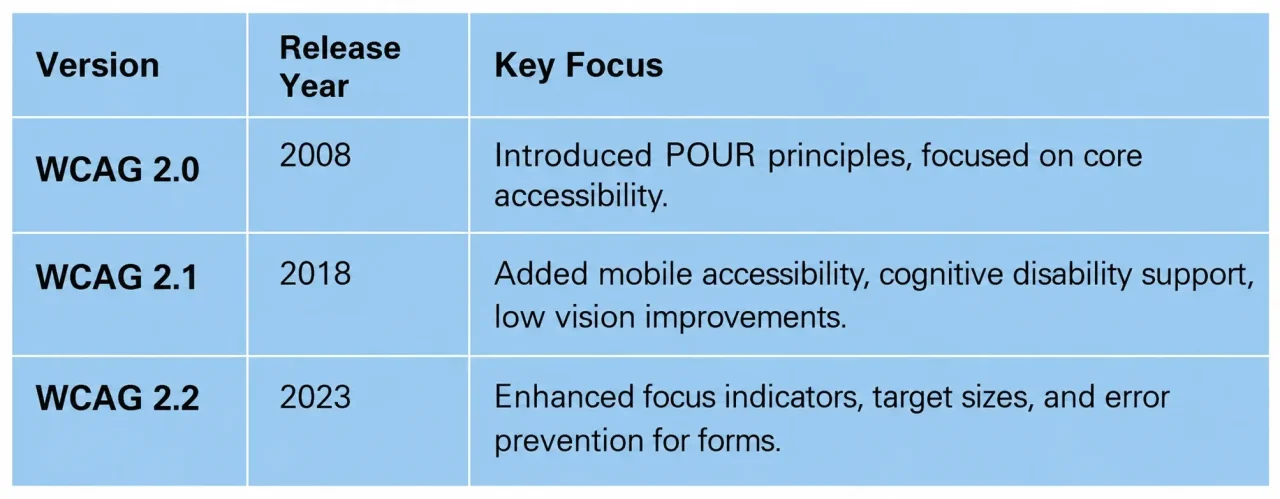
Accessibility isn’t static—it adapts to new devices, behaviors, and user needs. The WCAG standard has evolved significantly since its inception. Here’s a quick comparison:

Web Accessibiity Testing

At Experion, our accessibility testing frameworks are aligned with evolving standards and global regulations.

More Than Compliance: Why Accessibility Matters for Business

What’s often missed in accessibility conversations is the business upside. Globally, over 1.3 billion people live with some form of disability. That’s not a niche market—it’s a massive segment of potential users.

Beyond moral and legal obligations, inclusive design leads to:

  • Expanded reach across geographies and demographics.
  • Reduced legal risk—in 2023 alone, over 4,500 ADA-related lawsuits were filed in the U.S.
  • Stronger SEO—search engines prioritize accessible content.
  • Increased customer retention—71% of users with disabilities will leave a site that isn’t accessible.
  • Enhanced brand perception—a commitment to accessibility signals a commitment to all users.

Where Most Applications Fall Short

Accessibility barriers can be subtle, yet significantly disruptive. Among the most common challenges we uncover during testing are:

  • Visual barriers: Missing alt text, insufficient contrast, inaccessible infographics.
  • Motor barriers: Lack of keyboard navigation, inaccessible form fields.
  • Cognitive barriers: Complex UI patterns, inconsistent behavior, auto-playing content.
  • Auditory barriers: Missing captions and transcripts in video or audio-based content.

These issues not only affect people with disabilities—but also hinder usability for everyone.

Building Accessibility into the SDLC
Retrofitting accessibility after development is expensive and inefficient. That’s why Experion integrates accessibility early in the Software Development Lifecycle (SDLC)—starting from design workshops and extending into QA automation. We focus on:

  • Shift-left accessibility testing.
  • Component-level audits and reusable accessible design patterns.
  • Automated and manual testing using tools like NVDA, Chrome Web developer, axe, WAVE, and many more.
  • Real-world validations with assistive technologies.

According to Deque’s research, fixing accessibility issues during the design or development phase is far more cost-effective than remediating them post-launch. By embedding accessibility in our culture and process, we ensure that inclusivity is not an add-on—it’s built in.

Author’s Note: Why This Matters to Me

Having completed formal training from W3C on web accessibility, I’ve come to appreciate the depth and nuance of accessible design. It’s not just a checklist—it’s a mindset shift. One that embraces the diversity of users we build for every day.

Web Accessibility Testing

What has stayed with me the most is this simple yet powerful realization: the world often becomes more difficult not because of a person’s special abilities, but because it hasn’t been designed to include them. As someone who helps shape digital products, I see it as both a responsibility and a privilege to advocate for accessibility—because when we design for everyone, we build a better digital world for all.

Healthcare System Integration

In hospitals, every patient journey generates data. Behind every consultation, test, and treatment, there’s a story unfolding, one made of data. A scan here, a lab result there, a billing update somewhere else. Each of these pieces holds a part of a patient’s journey. But more often than not, they’re scattered across different systems that don’t really talk to each other.

What happens next is a familiar scene: doctors waiting on results, nurses juggling duplicate records, and patients repeating the same details at every turn. It’s not just frustrating; it’s risky.

This is where healthcare system integration comes in. Not as another tool or software, but as a way to make sense of it all. To connect the dots between systems, so data can move freely and securely. When that happens, care becomes smarter, faster, and far more human.

Let’s take a closer look at how integration is quietly transforming the way care is delivered.


Understanding Healthcare System Integration

Healthcare System Integration

So, what exactly is healthcare system integration?

At its core, healthcare system integration is the process of connecting different healthcare software systems to enable the smooth and secure flow of information. It’s about ensuring that your EHR doesn’t exist in a vacuum but can seamlessly exchange data with pharmacy systems, labs, billing platforms, imaging software, and even mobile apps that track patient vitals.

This isn’t just a backend upgrade; it’s a shift in how care is delivered.

When systems are isolated (a common issue called “data silos”), critical patient information can get buried, delayed, or lost in translation. A doctor might order duplicate tests simply because the lab results weren’t visible. Nurses may have to sift through multiple platforms to piece together a patient’s history.

But with integration in place, all stakeholders from front desk staff to specialists can access a unified view of patient data. The result? Smarter decisions, quicker interventions, and better care.

Why it matters:

  • Reduces administrative duplication.
  • Enhances collaboration across departments and institutions.
  • Enables real-time insights that support evidence-based decisions.
  • Minimizes medical errors due to incomplete or inaccurate data.

Imagine a cancer patient being referred from a general hospital to a specialist clinic. With integrated systems, their medical history, lab reports, radiology scans, and treatment notes follow them like a digital passport; no more paper files or redundant tests.

The Role of Technology in Connecting Disparate Healthcare Systems

Technology is the silent hero behind successful healthcare system integration. Here’s how it pulls the strings:

  1. APIs (Application Programming Interfaces):
    These are like interpreters between systems. APIs allow different applications to “talk” in real time, fetching, sending, and updating data without manual interference. For example, an API can allow a doctor’s scheduling software to sync with a hospital’s central calendar.
  2. Health Information Exchange (HIE):
    HIEs are networks that facilitate the secure sharing of patient information across institutions, states, or even countries. This is particularly useful during emergencies, where immediate access to a patient’s history can be life-saving.
  3. Cloud Computing:
    With cloud-based platforms, healthcare organizations no longer need to rely on isolated local servers. Cloud infrastructure supports scalability, centralized data access, and remote collaboration, which is especially crucial in telemedicine and multi-location hospital networks.
  4. Interoperability Standards (e.g., HL7, FHIR):
    These are agreed-upon rules and data formats that ensure systems interpret shared data correctly. For example, HL7 (Health Level Seven) and FHIR (Fast Healthcare Interoperability Resources) help standardize how health data is structured and transmitted.
  5. Middleware and Integration Engines:
    Acting as digital translators, these tools map data formats, validate inputs, and route information between systems. Think of them as air traffic control, making sure every data packet reaches its destination accurately and on time.
  6. Database Management Systems:
    These systems consolidate scattered data sources into a structured format, making retrieval and reporting seamless. When data from wearable health devices, EHRs, and lab systems can be pulled into a single dashboard, care teams gain a clearer picture.

Key Challenges in Integrating Healthcare Systems

Integration may sound like a magic fix, but it comes with its fair share of hurdles. Let’s break down the major challenges:

  1. Data Standardization:
    Different systems may use different terminologies (think: “BP” vs “Blood Pressure”) or units (mg/dL vs mmol/L). Harmonizing these variations is a daunting but essential task to ensure consistency and accuracy.
  2. Legacy Systems:
    Many hospitals still rely on outdated platforms developed decades ago. These systems often lack APIs or even basic connectivity features, making integration an uphill battle.
  3. Security and Privacy:
    Among other datasets, patient data is the most sensitive type of information. Ensuring secure data exchange that complies with laws like HIPAA or GDPR is critical. One breach can cause more than just reputational damage; it can cost lives.
  4. Interoperability Issues:
    Even with standards like HL7, not all systems implement them the same way. Vendors may tweak protocols, leading to compatibility issues. Getting different software platforms to cooperate is often like forcing a square peg into a round hole.
  5. Cost and Complexity:
    System integration requires skilled professionals, time, infrastructure upgrades, and ongoing maintenance. Smaller clinics may struggle to justify the investment without external support.
  6. Organizational Resistance:
    People don’t like change, especially in high-pressure environments like hospitals. Staff may be resistant to learning new systems or workflows, even if they promise long-term benefits.
  7. Maintaining Data Integrity:
    During data transfer, there’s always a risk of information being lost, duplicated, or altered. Ensuring accuracy throughout the exchange process is crucial for clinical decision-making.


Benefits of Healthcare System Integration

Healthcare System Integration

The true impact of healthcare system integration goes far beyond the backend. It transforms the very experience of care delivery. From patients and clinicians to administrators and insurers, everyone stands to gain.

  1. Improved patient care and experience

Integrated systems empower clinicians with a full view of a patient’s medical journey. When a physician can instantly access past diagnoses, allergies, imaging reports, and prescriptions, they are better equipped to make accurate and timely decisions. This not only improves the quality of care but also creates a smoother experience for the patient.

Patients no longer have to repeat the same information at every stop. Their history travels with them, whether they are at a general practitioner’s office, a specialist clinic, or an emergency room. It leads to faster access to test results, quicker diagnoses, and timely interventions when every moment matters.

Moreover, when healthcare providers work with shared data, communication between departments and teams becomes seamless. This reduces the likelihood of medical errors and enhances patient safety, especially during transitions of care.

  1. Enhanced operational efficiency and cost reduction

System integration streamlines workflows behind the scenes. Tasks that once took hours, like manually entering data or submitting claims, can be handled instantly by automated systems. This reduces the administrative burden and frees up healthcare staff to focus on what matters most: patient care.

Duplication of tests and procedures is a common cost trap in healthcare. When systems are connected, tests don’t need to be repeated because data is already accessible. This eliminates unnecessary expenses and improves the use of healthcare resources.

Revenue cycle management also benefits from integration. Claims are processed faster, denials are minimized, and reimbursements flow more smoothly. With fewer paper forms to process and less time spent correcting errors, cost savings are significant.

  1. Better data-driven decision-making

One of the most powerful outcomes of integration is the ability to turn data into insights. With access to aggregated, real-time patient data, healthcare providers and researchers can analyze trends across populations, track disease outbreaks, and evaluate the effectiveness of treatments.

Integrated systems support the creation of real-time dashboards and custom reports, enabling health administrators to monitor performance, optimize operations, and drive continuous quality improvement.

On the clinical side, these insights help develop more personalized treatment plans and support predictive analytics. It becomes easier to anticipate complications, adjust therapies, and manage chronic conditions more effectively.

  1. Strengthening collaboration between providers, insurers, and stakeholders

Integration encourages a more collaborative approach across the entire healthcare ecosystem. Different providers involved in a patient’s care can share notes, test results, and treatment plans without delay, creating a continuous and connected care journey.

Insurers also benefit from efficient data exchange, which speeds up claims processing and reduces errors. Patients, too, enjoy more transparent communication with their providers, improving engagement and satisfaction.

Whether it is a private hospital, a diagnostic lab, a public health registry, or a mobile telehealth platform, everyone is connected and informed. This is the foundation of a truly patient-centred model of care.


Key Components of Healthcare System Integration

Healthcare System Integration

Creating an integrated healthcare environment requires the right building blocks. These components serve as the backbone of a connected and intelligent health system.

Electronic Health Records (EHR) and Health Information Exchange (HIE)

EHRs are the digital equivalent of traditional patient charts, but with far greater functionality. They act as a central repository for a patient’s health data, accessible to authorized providers across various points of care.

Health Information Exchanges (HIEs) allow different healthcare organizations to securely exchange patient records. They ensure that a patient referred from one hospital to another can be treated with complete visibility into their history, allergies, medications, and previous procedures.

This is essential for enabling coordinated care, avoiding redundant testing, and improving the overall patient journey. HIEs also ensure that privacy is maintained during the data transfer process.

Interoperability standards (FHIR, HL7, DICOM)

Standards are the universal language of healthcare data exchange. Without them, integration would be chaotic and error-prone.

FHIR (Fast Healthcare Interoperability Resources) is a modern web-based standard designed for the digital age. It enables systems to exchange data in small, modular chunks that are easier to implement and understand.

HL7 (Health Level Seven) has long been a foundation for exchanging clinical and administrative data between software applications used by various healthcare providers.

DICOM (Digital Imaging and Communications in Medicine) is the go-to standard for handling medical images. It ensures that X-rays, MRIs, and other scans can be shared and viewed across different platforms without losing clarity or context.

Together, these standards allow diverse systems to communicate in a consistent and reliable manner.

Integration of IoT and wearable health technologies

Smart devices and wearable sensors are becoming increasingly common in everyday healthcare. They track everything from heart rate and sleep cycles to oxygen levels and blood sugar.

Integrating these devices into EHRs allows clinicians to monitor patients in real time. This is especially valuable for managing chronic conditions or for post-operative care where early intervention can prevent readmissions.

Patients also feel more engaged in their care when their devices contribute directly to clinical decision-making. It encourages healthier behaviour and helps providers act on early warning signs.

The data generated can be used to shape preventive strategies, spot risk factors, and personalize care plans.

Telehealth and remote patient monitoring integration

Telehealth has become a staple of modern healthcare, especially in rural and underserved regions. But its true potential lies in integration.

When virtual consultation platforms are connected to EHRs, patient data from these sessions is instantly recorded and available for follow-up visits or referrals. Similarly, remote patient monitoring devices can transmit vital signs directly to healthcare teams, enabling timely interventions.

This enhances accessibility for patients who might otherwise face barriers due to distance or mobility issues. It also allows for more frequent touchpoints between patients and providers, which is key to managing long-term conditions.

By integrating telehealth into the broader ecosystem, care becomes continuous, not episodic. Experion Technologies has stood beside healthcare teams, solving the unseen frictions in their everyday. Because what feels like magic to users is often the result of design, discipline, and deep domain expertise.


Challenges and Solutions in System Integration in Healthcare

Healthcare System Integration

Integrating healthcare systems is not a plug-and-play affair. It demands strategic foresight, technical expertise, and ongoing commitment. Despite the promise of seamless interoperability and enhanced care delivery, organizations often find themselves facing several roadblocks. But for every challenge, there is a solution waiting to be applied with care and precision.

Common integration hurdles

Data silos are one of the most persistent obstacles in healthcare. Different departments or facilities may operate with their own software systems, storing information independently. This prevents care teams from seeing the full picture, leading to fragmented treatment and delays in decision-making.

Security risks rise significantly when systems begin to interconnect. While integration improves accessibility, it also increases exposure to potential threats. Healthcare data is particularly sensitive, and breaches can have serious ethical, legal, and financial implications.

Compliance issues are another major concern. Healthcare providers must navigate complex regulations such as HIPAA in the United States or GDPR in Europe. Every data exchange must meet these legal requirements, ensuring patient privacy and proper consent management.

Other integration hurdles include:

  • Lack of standardization in data formats and terminologies, which leads to misinterpretation or loss of data during exchanges.
  • Legacy system incompatibility, where older software cannot communicate effectively with newer platforms.
  • High implementation costs, both in terms of money and time, which can deter smaller providers from pursuing integration.

Strategies to overcome integration challenges

The first step toward overcoming these hurdles is embracing interoperability standards like HL7 and FHIR. These standards provide a common language for data exchange, reducing ambiguity and streamlining communication between systems.

Next comes robust security implementation. Encryption, access control, and continuous monitoring tools can safeguard patient data across integrated platforms. Using APIs and modern integration platforms further enables smooth and secure data exchange while maintaining system flexibility.

Data governance plays a crucial role. Setting protocols for data ownership, quality checks, and usage ensures consistency and accountability. A phased approach is often more effective, breaking large integration projects into smaller, manageable steps.

Comprehensive testing is essential. Every integration point must be validated to prevent errors, delays, or breakdowns once the system goes live. Alongside this, change management is necessary to prepare teams for new workflows. Educating clinicians, administrators, and IT staff about the benefits of integration reduces resistance and increases adoption.

Role of AI and automation in simplifying integration processes

Artificial intelligence and automation are game changers in healthcare system integration. They help simplify complex tasks and bring efficiency to otherwise time-consuming processes.

AI-powered data mapping automatically translates data between systems, saving hours of manual work and reducing human error. Automation can also handle routine tasks like data entry and report generation, freeing up resources for more critical functions.

With predictive analytics, integration platforms can anticipate and flag potential issues before they escalate. Automated systems can continuously monitor integration pipelines, detect anomalies, and trigger alerts.

Even in cybersecurity, AI plays a vital role, identifying threats in real time and providing intelligent threat detection. Automated correction tools can resolve minor errors in the background, keeping systems running smoothly and ensuring data integrity.


Best Practices for Implementing Integrated Healthcare Systems

Integrated healthcare systems implementation requires more than just choosing the right tools. It demands a strategic and inclusive approach that balances technical needs with clinical realities.

Steps to a successful integration strategy

Start by clearly defining your integration goals. Whether the aim is improved patient outcomes, better resource utilization, or regulatory compliance, clarity from the outset guides every decision.

Conduct a comprehensive assessment of current systems. Understand what works, what doesn’t, and where the gaps lie. Use this knowledge to develop an integration roadmap that includes timelines, responsibilities, and milestones.

Choosing the right technologies is critical. Look for platforms that support modern standards, offer scalability, and align with your long-term goals. Establish a data governance framework early in the process to ensure quality, consistency, and security.

Include all key stakeholders in the conversation. From doctors and nurses to IT teams and administrative staff, their input helps shape systems that are user-friendly and effective. Always keep patient safety and data privacy as central priorities.

Integration is not a one-time task. Continuous monitoring and maintenance are necessary to adapt to new challenges, update systems, and ensure everything runs smoothly.

Ensuring regulatory compliance

Data security and compliance go hand in hand. To meet regulatory requirements, implement robust security protocols, including encryption, multi-factor authentication, and intrusion prevention tools.

Set up clear access controls and maintain detailed audit trails to track who accesses data and when. Establish internal policies that govern how data is stored, shared, and used.

Conduct regular audits and assessments to identify gaps and stay aligned with evolving regulations. This not only keeps the organization compliant but also builds trust with patients and partners.

Future trends shaping healthcare system integration

As healthcare continues to evolve, so does the role of integration. We are witnessing a growing shift toward cloud-based integration solutions that offer flexibility and reduce infrastructure overhead.

IoT devices and wearables are also becoming part of the integration landscape. With continuous data streaming in from smart devices, healthcare providers gain a deeper understanding of patient behaviour and needs.

Artificial intelligence and machine learning will further enhance the power of integration by unlocking insights from vast datasets, automating decisions, and refining workflows.

The industry is also moving toward patient-centred interoperability, giving individuals more control over their own health data and making it easier to transfer between providers.

The expansion of telehealth and remote patient monitoring will require even more agile integration models, ensuring that remote care data is fully synchronized with core systems.

Finally, there is growing interest in blockchain technology to secure healthcare data, offering transparent and tamper-proof records that can build greater trust across the ecosystem.


How Experion Offers Support


System integration in healthcare is a complex journey, and having the right technology partner can make all the difference. At Experion, we understand the intricacies of healthcare workflows, data standards, and the pressing need for security and compliance. Our approach combines deep domain expertise with cutting-edge technology to create integration solutions that are built to last.

Expert Consulting and Strategy

Experion begins every integration journey with thoughtful planning. Our expert consultants work closely with healthcare organizations to develop integration strategies tailored to specific goals, patient needs, and operational challenges.

We conduct thorough assessments of existing systems to identify gaps and inefficiencies, helping you understand exactly where integration can add the most value. With our deep knowledge of healthcare technologies and platforms, we guide you in selecting solutions that align with both short-term requirements and long-term growth.

Custom Integration Solutions

No two healthcare organizations operate the same way. That’s why Experion builds custom integration solutions that reflect your unique workflows and data needs. Whether it’s developing APIs, building connectors between systems, or designing integration architectures from the ground up, our solutions enable real-time data exchange and consistent communication.

We also implement middleware and integration engines to ensure that data flows efficiently and accurately between various systems. These components serve as the backbone of reliable interoperability.

Data Management and Security

In the world of healthcare, data integrity and security cannot be compromised. Experion places a strong emphasis on maintaining the confidentiality, availability, and accuracy of health information.

We implement advanced security measures, including encryption, user access controls, and detailed audit trails, ensuring compliance with international regulations such as HIPAA and GDPR. Our data governance services help maintain data quality and set clear guidelines for access and usage.

Implementation and Support

Our support does not end with strategy and development. We provide end-to-end assistance throughout implementation, deployment, and go-live phases.

Experion ensures that integration systems are stable, scalable, and optimized for performance. We also offer training sessions for healthcare staff, helping them make the most of the newly integrated systems. Whether it’s supporting legacy systems or integrating new technologies, we are there at every step.

Innovation and Future-Proofing

Technology evolves quickly, and so do the needs of healthcare. Experion stays ahead of the curve by keeping a close eye on emerging trends. From artificial intelligence and machine learning to IoT integration and cloud-native solutions, we help healthcare providers embrace what’s next.

Our integration solutions are built with adaptability in mind, making it easier for organizations to scale and upgrade without disruption. As standards change and patient expectations grow, we ensure your systems are ready to evolve along with them.


Conclusion

Healthcare system integration is a foundational requirement for modern, efficient, and patient-focused care. When done right, integration transforms scattered systems into a unified ecosystem that enhances clinical decisions, operational workflows, and patient outcomes.

To summarize:

  • Integration enables better patient experiences, streamlined processes, and more informed decision-making.
  • Addressing integration challenges requires clear strategy, reliable technologies, and a strong commitment to security and compliance.
  • Adopting industry standards, using automation, and following best practices all contribute to long-term integration success.
  • Collaborating with technology partners like Experion significantly improves the chances of successful integration, offering both strategic insight and technical excellence.

As patient expectations rise and technology reshapes every corner of care, system integration is no longer optional. It is essential. Cloud adoption, wearable health devices, and AI-powered diagnostics are not visions of the future. They are already redefining how healthcare works today. Organizations that embrace this shift will not just keep pace. They will lead, setting new standards in connected, intelligent, and patient-centred care.


Digital Engineering Services

In today’s hyper-digital landscape, digital engineering has become the backbone of modern enterprises, enabling them to innovate rapidly, deliver personalized experiences, and optimize operational processes. As traditional engineering methods evolve, organizations are adopting digital-first strategies to stay competitive and future-ready.

From accelerating product development to ensuring seamless platform integration, digital engineering empowers businesses to innovate at scale, increase efficiency, and adapt swiftly to market demands.


What Are Digital Engineering Services?

Digital Engineering Services

Digital engineering services encompass a comprehensive and interconnected set of capabilities that facilitate the design, development, deployment, and lifecycle management of next-generation digital systems. These services enable businesses to transition from conventional engineering approaches to agile, data-driven, and experience-focused models that are built for the demands of the digital age.

At its essence, digital engineering merges traditional software engineering principles with emerging technologies such as cloud computing, AI/ML, IoT, DevOps, and advanced data analytics. This fusion results in the creation of robust, scalable, and user-centric digital solutions that are not only technically sound but also aligned with evolving business goals and customer expectations.

Organizations leverage digital product engineering services to bring innovative products to market faster—products that are intelligent, adaptive, and seamlessly integrated with modern digital ecosystems. Simultaneously, digital platform engineering services are being adopted to build scalable, cloud-native platforms that serve as foundational engines for delivering consistent and personalized digital experiences across multiple channels.

Furthermore, digital and application engineering services play a critical role in modernizing legacy systems, improving performance, enhancing security, and enabling seamless interoperability across enterprise environments. Combined with AI integration and data-driven insights, these services empower businesses to optimize decision-making, automate workflows, and stay agile in a rapidly changing landscape.

Industries such as healthcare, automotive, financial services, retail, and manufacturing are at the forefront of this digital transformation. For example:

  • In healthcare, digital engineering enables virtual care platforms, AI-driven diagnostics, and patient engagement apps.
  • In automotive, it supports connected vehicle ecosystems, real-time analytics, and predictive maintenance.
  • Finance and banking institutions use digital platforms for personalized services, regulatory compliance, and operational automation.
  • Retailers harness digital engineering to offer omnichannel shopping experiences, real-time inventory visibility, and customer personalization.
  • Manufacturers adopt smart factory solutions, digital twins, and IoT-powered monitoring systems to boost efficiency and agility.

Across these industries, digital engineering services act as a strategic enabler—helping organizations build the right technology foundation, accelerate time-to-market, and deliver compelling, future-ready customer experiences.


Core Components of Digital Engineering Services

Digital Engineering Services

To truly harness the potential of digital transformation, organizations must adopt a strategic and holistic approach. Digital engineering services bring together various interconnected components that drive innovation, efficiency, and customer-centricity across the product and platform lifecycle. At Experion, we offer a full spectrum of digital product engineering services, digital platform engineering services, and digital and application engineering services, ensuring that every solution we build is aligned with business goals, user needs, and market dynamics.

Product Engineering

Digital product engineering services lie at the heart of Experion’s offerings. We help businesses transform their most innovative ideas into intuitive, high-performing digital products. From the initial phase of ideation and design to prototyping, development, deployment, and scaling, we manage the entire product lifecycle with agility and precision.
Our approach focuses on delivering customer-centric products that are not only technologically sound but also market-ready and built to adapt to future changes. With rapid prototyping, iterative development, and user testing, we ensure your product is optimized for performance, usability, and scalability from day one.

Platform Engineering

A strong digital foundation requires a resilient and scalable platform. Our digital platform engineering services are designed to create powerful digital ecosystems that support complex workflows, enable seamless user experiences, and scale with your business.
From microservices architecture and API management to multi-device responsiveness and real-time processing capabilities, our platform engineering solutions deliver high availability, performance, and seamless integration across channels. These platforms empower businesses to deliver personalized, consistent, and efficient services across a rapidly evolving digital landscape.

Application Engineering

Legacy systems often act as a bottleneck in the path to digital maturity. With our digital and application engineering services, we help organizations modernize and optimize their existing applications to meet today’s performance, security, and usability standards.
We re-engineer outdated architectures, streamline application performance, and enhance user interfaces for maximum engagement. Whether it’s migrating to the cloud, refactoring monolithic apps into microservices, or ensuring cross-platform compatibility, we focus on cost-efficient modernization that future-proofs your digital investments.

Cloud and DevOps

Cloud and DevOps are key enablers of speed, agility, and resilience in today’s digital environments. At Experion, we embrace cloud-native development, automated provisioning, CI/CD pipelines, and DevOps best practices to streamline and accelerate software delivery.
Our solutions ensure continuous integration, automated testing, secure deployments, and real-time monitoring—empowering your teams to innovate faster and respond quickly to market feedback. The result? Faster release cycles, improved system uptime, and the ability to scale effortlessly as your user base grows.

Data and AI-driven Engineering

Modern digital experiences are fueled by data and intelligence. Experion integrates data engineering, real-time analytics, and AI/ML capabilities into your digital products and platforms to enable smarter decisions and more engaging user journeys.
From predictive analytics and intelligent automation to personalization engines and NLP-driven interfaces, our data and AI-driven engineering services ensure that every solution is insight-driven and performance-optimized. We empower organizations to unlock the full value of their data and create proactive, adaptable digital ecosystems.


Benefits of Digital Engineering Services

In an increasingly competitive digital landscape, adopting digital engineering services is not just a strategic choice—it’s a business imperative. These services empower organizations to innovate rapidly, reduce operational inefficiencies, and deliver superior user experiences. At Experion, we enable clients to realize the full value of digital engineering by offering scalable, secure, and future-ready solutions tailored to their goals.

  1. Faster Time-to-Market

Speed is the new currency of digital business. With agile methodologies, rapid prototyping, and CI/CD pipelines, businesses can significantly shorten development cycles and respond to market needs faster than ever before. Experion’s digital product engineering services prioritize iterative development, enabling faster MVP launches and quicker feedback loops that accelerate time-to-value.

  1. Scalability and Flexibility

Modern digital systems must adapt effortlessly to changing user demands and business requirements. Our digital platform engineering services leverage cloud-native architectures and microservices-based solutions that offer on-demand scalability, modular upgrades, and seamless integration across channels. Whether you’re expanding user bases or entering new markets, our platforms scale with you.

  1. Cost Efficiency

Through automation, intelligent optimization, and strategic modernization, digital engineering helps reduce both development and operational costs. Experion’s digital and application engineering services replace legacy inefficiencies with lean, cloud-optimized systems that maximize ROI. Our clients benefit from reduced downtime, lower maintenance overheads, and optimized resource utilization.

  1. Enhanced Security

Security is no longer optional—it’s a critical pillar of digital success. At Experion, security is embedded across every stage of engineering. Our solutions integrate cybersecurity best practices including encryption, access controls, vulnerability scanning, and regulatory compliance. We ensure your systems are fortified to withstand today’s complex threat landscape.

  1. Improved Customer Experience

Exceptional customer experience is the hallmark of successful digital products and platforms. By leveraging personalization, seamless integration, and responsive, cross-device design, Experion delivers solutions that engage users and foster loyalty. Whether it’s through AI-driven recommendations or frictionless interfaces, we ensure your users receive a consistent and delightful experience.


Digital Engineering Lifecycle


Effective digital transformation is built on a structured and iterative lifecycle. Experion’s approach to digital engineering services follows a well-defined path—from strategy to continuous improvement—ensuring every phase aligns with your business vision and delivers tangible outcomes. Our methodology brings clarity, agility, and value at every step.

  • Ideation & Strategy

The journey begins with understanding your business objectives, market dynamics, and technical landscape. We work collaboratively with clients to identify key challenges, assess current capabilities, and shape a forward-looking digital roadmap. Our strategic workshops and discovery sessions ensure your digital initiatives are aligned with both short-term goals and long-term vision.

  • Design & Prototyping

Next, we translate insights into intuitive, user-first designs. Leveraging UX research, wireframing, and rapid prototyping tools, our teams create interactive models that visualize user flows and validate ideas before development. This phase reduces rework and aligns all stakeholders on the user journey, look, and feel of the final solution.

  • Development & Testing

This is where concepts become code. Using agile sprints, modern tech stacks, and automated testing frameworks, we ensure robust, scalable, and maintainable solutions. Our CI/CD pipelines allow for faster releases and incremental improvements, ensuring continuous delivery of value without compromising quality.

  • Deployment & Maintenance

Post-development, we leverage cloud deployment strategies, DevOps automation, and real-time monitoring to ensure reliable rollouts and high system uptime. But the journey doesn’t end there—Experion continues to support clients with maintenance, feature enhancements, and performance tuning to ensure long-term product success and adaptability to changing business needs.

At every stage of the lifecycle, Experion brings together the best of digital product engineering services, digital platform engineering services, and digital and application engineering services—empowering businesses to turn ideas into market-leading digital experiences, faster and more effectively.


Challenges in Implementing Digital Engineering Services

While digital engineering services present transformative opportunities for businesses, their successful implementation can be complex. Organizations often face a series of technical, operational, and strategic challenges that must be addressed to unlock the full value of digital transformation. At Experion, we help clients proactively navigate these roadblocks with strategic planning, domain expertise, and future-ready technology solutions.

  • Legacy System Integration

One of the most common barriers is dealing with legacy infrastructure that is outdated, rigid, and not built for today’s agile digital demands. These systems often lack compatibility with modern tools and architectures, slowing down integration with cloud platforms, APIs, and intelligent applications. Our digital and application engineering services specialize in system modernization, helping organizations transition from monolithic systems to scalable, interoperable digital ecosystems.

  • Security and Compliance

As businesses expand across geographies and industries, the need for robust security frameworks and adherence to evolving regulatory standards becomes paramount. From GDPR to HIPAA and industry-specific protocols, maintaining compliance while securing data integrity is a critical hurdle. Experion embeds security into the DNA of our digital engineering services, ensuring that solutions are compliant, encrypted, and threat-resilient from the ground up.

  • Skill Gaps

The digital engineering landscape demands specialized skills in areas like cloud-native development, AI/ML integration, DevOps automation, and platform engineering. However, many organizations struggle to build or access the right talent pool. Our team of digital experts brings deep knowledge across domains, helping clients fill this gap with highly skilled resources and continuous upskilling as part of our partnership.

  • Data and AI Management

With the rise of data and AI-driven engineering, companies are now dealing with massive volumes of structured and unstructured data. Transforming this data into meaningful insights through analytics or machine learning models requires sophisticated data pipelines, governance frameworks, and ethical AI practices. Experion’s digital engineering expertise ensures seamless data ingestion, processing, and AI implementation—driving smarter decision-making and operational efficiency.


Emerging Trends in Digital Engineering Services

Digital Engineering Services

The future of digital transformation is being shaped by innovative technologies and evolving user expectations. Staying ahead of these trends is essential for organizations that want to remain competitive, relevant, and sustainable. Here’s how the digital engineering landscape is evolving:

  • AI-Driven Automation

AI-powered automation is revolutionizing the way businesses operate. From intelligent code generation to automated testing, deployment pipelines, and customer support, AI-driven digital engineering services reduce manual efforts, enhance accuracy, and accelerate development. At Experion, we embed AI across the software lifecycle, bringing smarter tools into every stage of engineering.

  • Digital Twins & IoT

Industries like manufacturing, automotive, and healthcare are leveraging digital twins—virtual replicas of physical systems—to simulate behavior, predict outcomes, and optimize performance in real time. Paired with IoT devices, they provide continuous monitoring, predictive maintenance, and intelligent automation. This combination is redefining engineering precision and operational insight.

  • Blockchain Integration

Blockchain is no longer limited to financial use cases. It is increasingly being adopted in digital platform engineering services to create secure, decentralized applications. Use cases such as smart contracts, digital identity verification, and tamper-proof records are becoming mainstream, particularly in sectors like finance, healthcare, and supply chain.

  • Low-Code/No-Code Platforms

The demand for rapid innovation has propelled the growth of low-code and no-code platforms. These tools enable business users and developers to build applications quickly with minimal coding, fostering collaboration and reducing development timelines. As part of Experion’s digital and application engineering services, we empower clients to embrace these platforms for agile product delivery and iterative innovation.

  • Green Digital Engineering

Sustainability is now a strategic priority for forward-thinking enterprises. From energy-efficient architecture designs to carbon-conscious code practices, the focus is shifting toward green digital engineering. Experion supports organizations in creating sustainable digital solutions that minimize energy consumption, reduce waste, and align with ESG goals—making innovation not just smart but responsible.


How to Choose the Right Digital Engineering Partner?

Choosing the right partner for your digital transformation journey is a strategic decision that can significantly impact your business’s agility, innovation, and long-term growth. As organizations increasingly shift toward digital-first models, the demand for capable, visionary, and adaptable partners in digital engineering services continues to rise.

Key Factors to Consider

When evaluating potential partners for digital engineering, it’s important to go beyond just technical capabilities. You need a provider who brings a blend of innovationscalability, and domain-specific knowledge to the table.

  • Expertise in Emerging Technologies: Ensure the partner has hands-on experience with modern tools and frameworks across AI/ML, IoT, blockchain, cloud-native development, DevOps, and automation.
  • Industry-Specific Experience: A strong understanding of your industry’s unique challenges and opportunities (such as healthcare compliance, financial regulations, or retail personalization) is critical for tailored solutions.
  • End-to-End Capabilities: From digital product engineering services to digital platform engineering services, and from digital and application engineering services to data and AI-driven engineering, look for a comprehensive offering under one roof.
  • Scalability & Security: The right partner should be able to design scalable architectures that are secure by design—adhering to industry best practices and regulatory standards.
  • Proven Methodologies & Flexibility: Agile methodologies, CI/CD pipelines, and customizable engagement models ensure faster releases and seamless collaboration.
  • Culture of Innovation: A forward-thinking mindset that embraces experimentation, co-creation, and continuous improvement is essential to stay ahead in a dynamic market.

The Role of a Digital Engineering Service Provider

A true digital engineering service provider is not just a vendor but a strategic enabler of transformation. They bridge the gap between business goals and technology execution—unlocking tangible value through:

  • Accelerated product development and reduced time-to-market.
  • Operational efficiency through automation and optimization.
  • Future-proofing through scalable, cloud-native, and AI-integrated solutions.
  • Creation of new revenue models and digital business opportunities.

By leveraging full-spectrum services such as digital product engineeringdigital and application engineering, and platform modernization, the right partner empowers you to turn ideas into impactful digital experiences.

How Experion Can Offer Support


At Experion, we combine global experience, deep technical expertise, and a customer-centric mindset to deliver best-in-class digital engineering services.

We are trusted by startups, enterprises, and Fortune 500 companies to bring their digital visions to life.

Whether you are building a next-gen digital platform, modernizing legacy applications, or integrating AI/ML-powered analytics into your products, our capabilities span the entire digital spectrum. From digital product engineering services that bring your innovations to market, to digital platform engineering services that power scalable ecosystems, Experion’s approach is grounded in agility, quality, and business value.

Our agile delivery model ensures rapid iteration, continuous feedback, and measurable outcomes—while our innovation-driven culture helps future-proof your operations. As your digital and application engineering services partner, we’re here to solve complex challenges and deliver seamless digital experiences that drive growth.


Conclusion

In an era where digital transformation is not just an option but a necessity, digital engineering services serve as the cornerstone for building future-ready enterprises. From enabling personalized customer experiences to streamlining operations and unlocking new business models, digital engineering is redefining how businesses innovate, operate, and grow.

Organizations across industries—from healthcare and automotive to finance, retail, and manufacturing—are increasingly turning to digital product engineering services, digital platform engineering services, and digital and application engineering services to gain a competitive edge.

However, the path to successful digital transformation lies in choosing the right partner—one who understands your vision, aligns with your business objectives, and brings the right mix of technology, agility, and innovation.

At Experion, we empower businesses with cutting-edge digital engineering solutions that are scalable, secure, and built for the future. By seamlessly integrating AI, cloud, DevOps, and data-driven intelligence, we help you stay ahead in a rapidly evolving digital world.

Key Takeaways

  • Digital engineering is essential for modern businesses aiming to innovate, scale, and adapt to changing market dynamics.
  • Digital engineering services encompass product engineering, platform development, application modernization, cloud adoption, and AI-driven innovation.
  • Industries such as healthcareautomotivefinanceretail, and manufacturing are seeing transformative results through digital engineering.
  • Digital product engineering services help bring ideas to life—faster, smarter, and customer-first.
  • Digital platform engineering services enable the creation of scalable and integrated digital ecosystems.
  • Digital and application engineering services focus on modernizing legacy systems for improved performance and user experience
  • Leveraging cloud-native architectureDevOps, and automation reduces costs and accelerates time-to-market.
  • Embedding cybersecurity best practices throughout the engineering lifecycle ensures robust, secure digital solutions.
  • The digital engineering lifecycle—from ideation to deployment—requires a structured, agile, and business-aligned approach.
  • Challenges like legacy integration, security, and talent shortages must be strategically addressed to unlock full value.
  • Emerging trends such as AI automationIoT and digital twinsblockchain, and sustainable engineering are shaping the future of digital transformation.
  • Choosing the right digital engineering service provider is crucial—look for expertise, scalability, industry knowledge, and a culture of innovation.
  • Experion combines global expertise, domain experience, and agile methodologies to deliver end-to-end digital engineering solutions tailored to your needs.
  • Investing in digital engineering today is a step toward building a resilientefficient, and future-ready organization.

Payment Gateway Integration

What is Payment Gateway Integration?

Payment Gateway Integration

A payment gateway integration acts as a digital bridge between a business’s website or mobile application and the financial institutions that process payments. It securely transmits payment data between the customer, the merchant, and the bank, ensuring that online purchases and transactions occur smoothly and safely.

Businesses today operate in a competitive digital landscape where customers expect fast, convenient, and secure payment options. A well-integrated payment gateway API eliminates manual payment processing, reducing the risk of errors and transaction failures. This not only enhances customer satisfaction but also minimizes cart abandonment rates, a common challenge in online retail and service-based businesses.

By leveraging payment gateway integration services, businesses can:

  • Accept a variety of payment methods, including credit/debit cards, digital wallets, net banking, and UPI.
  • Provide a seamless checkout experience with one-click payments and saved payment details.
  • Ensure transactions are encrypted and compliant with security standards such as PCI DSS.
  • Automate payment workflows, improving efficiency and financial reconciliation.

For businesses looking to expand globally, integrating multiple payment gateways is a strategic advantage. It allows organizations to accept cross-border payments, support multi-currency transactions, and comply with region-specific regulations.


How Payment Gateway Integration Services Matter?

Payment Gateway Integration

In today’s fast-paced digital economy, businesses cannot afford inefficiencies in online transactions. Customers expect seamless, secure, and instant payments, and any friction in the payment process can lead to lost sales, reduced trust, and poor user experiences. This is where payment gateway integration services play a crucial role. At Experion, we specialize in providing businesses with robust payment gateway integration solutions that not only facilitate smooth transactions but also optimize security, compliance, and user convenience.

What Are Payment Gateway Integration Services?

Payment gateway integration services refer to the technical and strategic processes that enable businesses to embed a reliable and secure payment processing system within their websites, mobile applications, or digital platforms. These services ensure that customers can complete transactions using various payment methods such as:

  • Credit and Debit Cards (Visa, Mastercard, American Express, etc.)
  • E-wallets and Digital Payment Solutions (Google Pay, Apple Pay, PayPal, Venmo)
  • Net Banking and Direct Bank Transfers
  • UPI and QR-Based Payments (Popular in India and emerging markets)
  • Cryptocurrency and Blockchain Payments (For businesses adopting Web3 technology)

A well-integrated payment gateway API ensures that payments are processed smoothly without unnecessary delays, technical glitches, or security vulnerabilities. It acts as a secure intermediary between the customer, merchant, and financial institution, encrypting sensitive data and ensuring that payments are authenticated and settled accurately.

How These Services Streamline Online Transactions

As online transactions continue to rise, businesses must eliminate inefficiencies and enhance automation to provide customers with a frictionless payment experience. A robust payment gateway integration eliminates the need for manual payment handling, reducing the chances of human error, improving operational efficiency, and ultimately enhancing customer satisfaction.

Here’s how Experion’s payment gateway integration services help streamline transactions:

  1. Automating Payment Processing to Reduce Transaction Time

Manual payment processing is not only time-consuming but also prone to errors. With automated payment gateway integration, transactions are processed instantly, reducing delays in order confirmation and fund settlements. This ensures a faster checkout experience, improving conversion rates and reducing abandoned carts.

  1. Enhancing Security with Encrypted Data Transfers

With cyber threats and fraudulent activities on the rise, security is a non-negotiable aspect of payment processing. Experion ensures that all payment gateway integrations comply with industry standards like PCI DSS (Payment Card Industry Data Security Standard). Our solutions implement:

  • End-to-End Encryption to protect transaction data.
  • Tokenization to replace sensitive payment details with secure tokens.
  • Multi-Factor Authentication (MFA) to verify transactions and reduce fraud risks.
  1. Improving Customer Experience with Seamless Checkouts

A smooth checkout experience directly impacts customer retention. By integrating advanced payment gateway APIs, businesses can:

  • Offer one-click payments for returning customers.
  • Enable saved card options for faster transactions.
  • Reduce redirects and pop-ups, keeping customers on the platform.
  • Provide instant payment confirmation and real-time tracking.

With Experion’s expertise, businesses can implement a payment system that minimizes customer effort while ensuring maximum security and efficiency.

Factors to Consider When Choosing a Payment Gateway Integration Service Provider

Choosing the right payment gateway integration service provider is critical, as it determines the efficiency, security, and overall success of online transactions. Businesses must evaluate several factors before selecting a payment solution that aligns with their needs.

  1. Security Protocols and Compliance

Security is the backbone of any payment gateway integration. Businesses must ensure that their payment provider adheres to:

  • PCI DSS Compliance: A global security standard for handling card transactions securely.
  • Encryption and Tokenization: To protect payment information from cyber threats.
  • Fraud Detection Mechanisms: AI-driven risk management tools to detect suspicious transactions.

Experion’s payment gateway solutions incorporate multi-layer security protocols to safeguard sensitive data and prevent fraud.

  1. Ease of Integration (API-Based, Hosted, or Self-Hosted Solutions)

Businesses can choose between different types of payment gateway integrations, depending on their technical capabilities and business model:

Integration Type Description Best For
API-Based Integration Direct integration with a payment processor using an API for full control and customization. Businesses that require a seamless, fully integrated payment flow.
Hosted Payment Gateway Customers are redirected to a third-party payment page for transaction processing. Businesses that prefer low-maintenance, secure payment solutions.
Self-Hosted Payment Gateway The payment process occurs on the business’s website, but data is forwarded to the payment processor. Businesses that want control over the checkout experience without storing payment details.

Experion offers customized integration solutions, ensuring businesses select the best approach based on their technical and operational needs.

  1. Supported Payment Methods

To serve a diverse customer base, businesses should choose a payment gateway that supports multiple payment methods. This includes:

  • Local and International Credit/Debit Cards
  • Digital Wallets and Alternative Payments
  • UPI and QR Code-Based Payments
  • Cryptocurrency Transactions

Experion helps businesses expand their payment capabilities by integrating diverse payment options that cater to global customers.

  1. Global Reach and Multi-Currency Support

For businesses operating internationally, a payment gateway should:

  • Support multi-currency transactions for seamless global payments.
  • Provide regional compliance for different countries.
  • Offer localized payment methods to improve transaction success rates.

By choosing Experion’s payment gateway integration services, businesses can scale effortlessly across borders while ensuring regulatory compliance.

  1. Transaction Fees and Cost-Effectiveness

Different payment gateways have varying transaction fees, including:

  • Setup and Monthly Fees
  • Transaction-Based Charges (percentage per transaction)
  • Chargeback and Refund Fees

Businesses should evaluate cost structures based on their transaction volume and business model. Experion assists clients in selecting cost-effective payment gateway solutions that maximize ROI while minimizing transaction costs.


The Role of Payment Gateway API Integration in Modern Businesses

As digital transactions become the backbone of global commerce, businesses need payment solutions that are fast, flexible, and secure. Payment gateway API integration provides organizations with a seamless way to handle online transactions while maintaining complete control over the payment process. Unlike traditional hosted gateways that redirect customers to an external payment page, API-based integrations enable direct communication between the business’s platform and the payment processor, offering a smoother checkout experience and higher conversion rates.

What is Payment Gateway API Integration?

Payment gateway API integration refers to the process of embedding a payment gateway’s application programming interface (API) directly into a business’s website, mobile app, or online platform. This allows merchants to process payments without redirecting customers to a third-party site, resulting in a more seamless and professional user experience.

API-based payment gateways provide businesses with:
Greater control over the entire transaction process.
Customizable user interfaces tailored to match brand identity.
Enhanced security measures, such as tokenization and fraud detection.
Automation of payment workflows, including subscriptions and refunds.

Businesses leveraging payment gateway API integration can optimize their transaction flow, making payments more intuitive and frictionless for customers. This ultimately reduces cart abandonment rates, improves customer trust, and leads to higher revenue generation.

API-Based Integration vs. Hosted Payment Gateways

When implementing a payment gateway, businesses have two primary choices:

  1. API-based integration, where transactions occur directly on the merchant’s platform.
  2. Hosted payment gateways, where customers are redirected to a third-party payment page.

The table below highlights the key differences:

Feature API-Based Integration Hosted Payment Gateway
Customization High – Complete UI/UX control Limited – Third-party UI
Security Requires business-side security (PCI DSS compliance, encryption) Fully managed by the payment provider
User Experience Seamless, customers remain on the website/app Redirection required, which may cause drop-offs
Setup Complexity Moderate to high – Requires developer support Low – Plug-and-play integration
Cost Higher (development required) Lower (often subscription-based)

For businesses aiming for brand consistency and user engagement, API-based integrations are the superior choice. However, they require additional security measures, as businesses must handle sensitive financial data directly.

How APIs Help Businesses Customize Payment Workflows

A major advantage of payment gateway API integration is the ability to customize payment workflows based on business needs. This flexibility allows companies to implement unique payment experiences that enhance customer convenience and drive revenue growth.

Here’s how API-based payment gateways empower businesses:

  1. Personalized Checkout Experiences

API integrations allow businesses to build custom checkout flows, offering a branded and seamless payment experience. Customers remain on the company’s website or app without any external redirection, reducing trust concerns and drop-off rates.

  1. Automating Recurring Billing & Subscriptions

For businesses offering subscription-based services (such as SaaS companies, membership platforms, and streaming services), payment gateway APIs automate:
Recurring billing cycles.
Subscription renewals and cancellations.
Automatic payment retries for failed transactions.

This ensures that customers experience uninterrupted service, improving long-term retention.

  1. Enabling One-Click Payments for Returning Customers

By storing payment details securely (using tokenization), businesses can allow one-click checkouts for returning customers. This drastically reduces checkout time and enhances the user experience, leading to increased sales.

  1. Improving Fraud Detection by Integrating Third-Party Security Tools

With API-based integrations, businesses can implement:
AI-driven fraud detection to identify suspicious transactions.
Multi-factor authentication (MFA) for additional security.
Chargeback management systems to minimize losses.

By integrating third-party security solutions, businesses can prevent fraud before it happens, ensuring a secure payment environment for their customers.


Exploring Different Payment Gateway Integrations

Payment Gateway Integration

Different industries require tailored payment gateway solutions based on their transaction volume, customer base, and security needs. Some popular payment gateway providers cater to specific industries, offering specialized features for optimized payment processing.


Popular Payment Gateway Integrations for Various Industries

Industry Recommended Payment Gateways
E-commerce Stripe, PayPal, Razorpay, Square
SaaS & Subscription Services Braintree, Authorize.Net, Adyen
Retail & Point-of-Sale (POS) Worldpay, Fiserv, PayU
Travel & Hospitality Ingenico, CCAvenue, Amadeus


Why Choosing the Right Payment Gateway Matters?

Selecting the right payment gateway API can make or break a business’s transaction success rate. A poorly integrated payment system can result in:
1. High cart abandonment rates due to a clunky checkout experience.
2. Failed transactions and revenue loss due to unreliable payment processing.
3. Security vulnerabilities that expose customer data to fraud risks.

To ensure a seamless and secure payment experience, businesses must consider:
1. Ease of integration (developer-friendly APIs, documentation).
2. Support for multiple payment methods (credit cards, digital wallets, UPI, etc.).
3. Security compliance (PCI DSS, tokenization, fraud detection).
4. Scalability (support for global payments, multi-currency transactions).

With Experion’s cutting-edge payment integration solutions, businesses can optimize digital transactions, boost customer trust, and unlock new revenue streams—empowering them for success in the modern digital economy.

How Successful Implementations Work in E-commerce, SaaS, and Retail

A well-integrated payment gateway optimizes customer journeys by offering fast, secure, and diverse payment options. For instance:

  • E-commerce platforms boost conversions by enabling multiple payment options and one-click checkouts.
  • SaaS companies automate subscription billing with recurring payments.
  • Retailers enhance omnichannel experiences by integrating in-store and online payment systems.

Common Challenges and How to Overcome Them

  • Security risks: Implementing PCI DSS compliance and tokenization.
  • Payment failures: Using multiple payment gateway integration for fallback options.
  • Cross-border transactions: Supporting multiple currencies and localization.


The Importance of Multiple Payment Gateway Integration for Businesses

What is Multiple Payment Gateway Integration, and Why is it Important?

Multiple payment gateway integration enables businesses to incorporate more than one payment gateway into their systems. This strategy improves payment reliability, reduces downtime, and enhances customer experience.

How Businesses Can Expand Globally by Integrating Multiple Payment Options

By integrating multiple gateways, businesses can:

  • Offer local payment methods preferred by customers in different regions.
  • Reduce reliance on a single provider, avoiding transaction failures.
  • Optimize transaction processing fees by selecting cost-effective gateways.


Best Practices for Secure and Efficient Payment Gateway Integration

  1. Ensuring Compliance with PCI DSS and Other Security Standards

PCI DSS Compliance: Ensures secure handling of credit card information.
SSL Encryption: Protects payment details during transactions.
Tokenization: Converts card details into encrypted tokens for additional security.

  1. Implementing Fraud Detection and Risk Management Solutions

AI-Driven Fraud Detection: Identifies suspicious transactions in real time.
Multi-Factor Authentication (MFA): Adds an extra layer of security.
Chargeback Management: Reduces losses from fraudulent claims.

  1. Optimizing Payment Flows for a Better Customer Experience

One-Click Checkouts: Reduces friction in returning customer transactions.
Auto-Filled Payment Details: Enhances convenience for repeat buyers.
Instant Payment Confirmation: Provides real-time transaction updates.


Future Trends in Payment Gateway Integration

Payment Gateway Integration

The Rise of AI-Driven Fraud Prevention

AI-driven fraud prevention tools are enhancing security by analyzing transaction patterns and flagging suspicious activities.

The Impact of Blockchain on Payment Processing

Blockchain technology is driving decentralized and transparent payment processing, reducing transaction costs and fraud.

The Potential of Decentralized Payment Gateways

Decentralized finance (DeFi) payment solutions eliminate intermediaries, offering faster and more cost-effective transactions.


Choosing the Right Payment Gateway Integration Service Provider

Selecting the right provider is critical to business success. Companies must assess security, pricing, and compatibility with their tech stack before finalizing a payment gateway integration service.

How Experion Can Support You With Payment Gateway Integration

At Experion, we understand that a seamless, secure, and efficient payment system is crucial for business success in today’s digital-first economy. Our end-to-end payment gateway integration services cater to businesses across industries, ensuring they have a reliable and optimized payment infrastructure that enhances customer experience, improves operational efficiency, and supports global expansion.

With a team of experienced payment integration specialists, we provide businesses with tailored solutions that align with their specific needs, whether they require a single payment gateway API integration or a multi-gateway setup for enhanced reliability and scalability.

Our Expertise in Payment Gateway Integration

  1. Implementing Payment Gateway API Integration with Ease

Experion specializes in integrating payment gateway APIs into various digital platforms, including websites, mobile applications, and enterprise systems. Our approach ensures:

  • Seamless transaction processing, minimizing payment failures and enhancing reliability.
  • Faster checkout experiences, improving user satisfaction and reducing cart abandonment rates.
  • Support for multiple payment methods, including credit/debit cards, e-wallets, UPI, and cryptocurrency.
  • Scalability and flexibility, allowing businesses to adapt to growing transaction volumes and evolving customer preferences.

Whether businesses need API-based direct integrations for a custom checkout experience or hosted payment solutions for quick implementation, we deliver solutions that align with their operational goals.

  1. Integrating Multiple Payment Gateways for Optimized Global Transactions

For businesses operating in multiple markets or handling high transaction volumes, relying on a single payment gateway can be risky due to potential downtime, higher processing fees, and limitations in payment method support. Experion helps businesses integrate multiple payment gateways, ensuring:

  • Higher payment success rates by enabling automatic fallback options when one gateway faces downtime.
  • Cost optimization by routing transactions through the most cost-effective provider based on location, currency, or payment type.
  • Global expansion support with multi-currency transactions and compliance with region-specific regulations.
  • Local payment preferences that enhance user adoption in different markets, such as Alipay in China, Paytm in India, and Klarna in Europe.

By implementing a multi-gateway integration strategy, businesses gain greater transaction reliability, better cost efficiency, and improved customer satisfaction.

  1. Ensuring Security Compliance and Fraud Prevention

Security is a non-negotiable aspect of digital payments. At Experion, we implement robust security measures to protect businesses from fraud, data breaches, and compliance issues. Our security-first approach includes:

  • PCI DSS Compliance: Ensuring that all payment integrations meet industry security standards for handling credit card transactions.
  • End-to-End Encryption & Tokenization: Protecting sensitive customer payment data from cyber threats and unauthorized access.
  • AI-Powered Fraud Detection: Implementing machine learning algorithms to detect and prevent suspicious transactions in real time.
  • Multi-Factor Authentication (MFA) and Risk-Based Authentication: Strengthening user verification processes to reduce fraud risks.
  • Chargeback Management Solutions: Helping businesses reduce losses from fraudulent chargebacks and disputes.

Our team ensures that security best practices are integrated into every payment gateway solution, providing businesses with peace of mind while handling financial transactions.

Why Choose Experion for Payment Gateway Integration?

  • Industry Experience: Years of expertise in implementing and optimizing payment gateway solutions for businesses of all sizes.
  • Custom-Tailored Integrations: Solutions designed specifically for each business’s requirements, whether for e-commerce, SaaS, retail, or enterprise applications.
  • Ongoing Support & Maintenance: Ensuring smooth operation of payment systems with regular updates, security patches, and technical support.
  • Seamless Scalability: Allowing businesses to expand their payment infrastructure as they grow, without disruptions.


Conclusion

A well-executed payment gateway integration strategy enhances user experience, ensures secure transactions, and drives business growth. By leveraging payment gateway API integration, businesses can streamline online payments, while multiple payment gateway integration helps expand their reach globally.

Key Takeaways

  • Payment gateway integration is essential for businesses to process digital transactions efficiently and securely.
  • API-based payment gateway integration provides enhanced customization, better user experience, and full control over the payment process.
  • Multiple payment gateway integration improves payment reliability, reduces downtime, and enhances customer convenience.
  • Security compliance and fraud prevention (PCI DSS, encryption, and AI-driven fraud detection) are critical for protecting transactions and customer data.
  • Optimized payment workflows (one-click checkouts, auto-filled details, and instant confirmations) significantly improve customer experience and conversion rates.
  • Automated subscription billing ensures seamless recurring payments, making it ideal for SaaS and membership-based businesses.
  • Cross-border payment support enables businesses to expand globally by offering multi-currency transactions and localized payment options.
  • Choosing the right payment gateway provider impacts transaction success rates, operational costs, and scalability.
  • AI and machine learning are transforming fraud detection, real-time payment monitoring, and risk assessment.
  • Blockchain and decentralized payment gateways are reshaping the payment industry by enhancing transparency and reducing transaction fees.
  • Integrating multiple payment gateways allows businesses to optimize processing fees and route transactions through the most cost-effective providers.
  • Future-proof payment strategies must adapt to emerging trends like Buy Now, Pay Later (BNPL), contactless payments, and cryptocurrency adoption.
  • Customer trust and retention are heavily influenced by a seamless and secure payment experience.
  • Regulatory compliance and industry standards must be met to avoid penalties and ensure smooth payment operations.
  • Mobile payment adoption is rising, making it crucial for businesses to optimize for mobile-friendly transactions.
  • Experion’s payment gateway integration expertise ensures businesses achieve seamless, secure, and scalable digital payment solutions tailored to their specific needs.

Businesses looking to optimize their payment infrastructure must invest in a reliable payment gateway integration service to stay competitive in the digital marketplace.

Robotic Process Automation in Healthcare

The healthcare industry is a whirlwind of patient care, paperwork, and regulatory hurdles where every second counts. Doctors and nurses race against the clock, while administrative teams juggle mountains of data, insurance claims, and compliance requirements. In this high-pressure environment, efficiency is a necessity. By taking over repetitive, time-consuming tasks, Robotic Process Automation (RPA), frees up medical professionals to focus on what truly matters: delivering exceptional patient care.


Understanding Automation in Healthcare

What is Business Process Automation in Healthcare?

Robotic Process Automation in Healthcare

Business process automation in healthcare refers to the use of technology to optimize routine, rule-based tasks that traditionally require manual effort. These tasks range from patient scheduling to billing, claims processing, and medical records management. By leveraging software, artificial intelligence (AI), and digital workflows, healthcare institutions can improve operational efficiency, reduce human errors, and ensure compliance with industry standards.

At its core, automation in healthcare serves as a digital assistant, performing repetitive tasks with precision and consistency. Whether it’s handling patient data, streamlining administrative workflows, or optimizing resource allocation, automation helps hospitals and clinics function more efficiently.

Some of the key areas where automation plays a transformative role include:

  • Billing and Claims Processing – Automating claim submissions, tracking payments, and managing denials reduces administrative overhead and speeds up reimbursements.
  • Patient Scheduling and Registration – Automation simplifies appointment booking, patient registration, and check-in, enhancing both provider efficiency and patient satisfaction.
  • Inventory Management – Medical supplies and pharmaceuticals require meticulous tracking; automated systems ensure timely replenishment and minimize waste.
  • Medical Records Management – Digitization and automation streamline the storage, retrieval, and sharing of patient data, reducing paperwork and improving data accuracy.
  • Data Entry and Reporting – Automating data input minimizes human error and accelerates reporting for compliance, audits, and performance tracking.
  • Prior Authorization – Automating the approval process for medical procedures and prescriptions cuts down delays, improving patient access to timely care.

How Automation Streamlines Administrative and Clinical Workflows

Healthcare professionals often juggle multiple responsibilities, from direct patient care to handling administrative tasks. Automation helps by:

  • Reducing Manual Workload – Automating tasks like data entry, scheduling, and claims processing allows healthcare workers to focus on higher-value activities.
  • Enhancing Accuracy – Automation minimizes human errors, ensuring data consistency and reducing discrepancies in patient records, billing, and compliance documentation.
  • Accelerating Processes – With automation, approvals, reports, and documentation can be processed faster, improving responsiveness in healthcare operations.
  • Ensuring Compliance – Standardized workflows ensure adherence to healthcare regulations such as HIPAA (Health Insurance Portability and Accountability Act) and GDPR (General Data Protection Regulation).
  • Improving Communication and Collaboration – By integrating different systems and departments, automation facilitates seamless coordination among healthcare professionals, insurers, and patients.

The Impact of Automation on Cost Reduction and Patient Outcomes

Automation brings tangible benefits not just in operational efficiency but also in financial and patient care aspects:

  • Cost Reduction – Automating repetitive administrative tasks reduces the need for extensive manual labor, resulting in lower operational costs.
  • Minimized Errors – Mistakes in billing, claims processing, and documentation can lead to costly rework. Automation helps prevent such errors, saving both time and money.
  • Optimized Revenue Cycle Management – Faster claims processing and reimbursement tracking improve financial stability for healthcare providers.
  • Improved Patient Access – Streamlined scheduling and registration processes help patients receive care without unnecessary delays.
  • Reduced Wait Times – Efficient workflows speed up processes, leading to a better patient experience and satisfaction.
  • Enhanced Focus on Patient Care – By reducing administrative burdens, healthcare professionals can dedicate more time to patient interactions, leading to better diagnoses, treatment plans, and outcomes.


Introduction to Robotic Process Automation (RPA) in Healthcare

What is Robotic Process Automation (RPA)?

Robotic Process Automation in Healthcare

Robotic Process Automation (RPA) is a form of automation that utilizes software robots commonly known as bots to perform repetitive, rule-based tasks traditionally handled by humans. These bots can interact with applications, input data, process transactions, and communicate with other systems just like a human would. Unlike traditional automation, RPA doesn’t require extensive system modifications, making it a cost-effective solution for healthcare providers looking to improve efficiency without overhauling their existing IT infrastructure.

The Role of RPA in Healthcare

Robotic Process Automation in Healthcare

RPA is particularly useful in healthcare because of its ability to handle tasks with speed, accuracy, and compliance. Some of its key applications include:

  • Claims Processing – Automating insurance claims submission, status tracking, and appeal processes speeds up reimbursements and reduces errors.
  • Patient Onboarding – RPA bots can automate data collection and verification, ensuring seamless patient registration.
  • Billing and Payments – From invoice generation to payment reconciliation, RPA simplifies financial processes and minimizes errors.
  • Appointment Scheduling – Bots can manage appointment bookings, cancellations, and reminders, reducing no-shows and improving patient flow.
  • Medical Data Entry – RPA eliminates the need for manual data entry in Electronic Health Records (EHRs), ensuring accuracy and consistency.
  • Regulatory Compliance & Audits – RPA helps generate compliance reports, conduct audits, and track regulatory changes to ensure adherence to industry standards.

Key Use Cases of RPA in Healthcare

1. Patient Data Management

Hospitals and clinics handle massive amounts of patient data daily, from medical histories to test results and treatment plans. Manual data entry not only consumes valuable time but also increases the risk of errors. RPA automates the process by transferring data between electronic health records (EHRs) and other systems, ensuring accuracy and consistency. Bots can also validate and clean patient data, reducing duplicate entries and inconsistencies. Additionally, they can generate patient reports and summaries, giving healthcare professionals quick access to well-organized information.

2. Insurance Claim Processing

Filing and processing insurance claims is often a tedious and error-prone task. Delays in submissions and incorrect claim entries can lead to payment rejections, causing financial strain for healthcare providers. RPA streamlines the process by automatically submitting claims, verifying patient eligibility, and tracking claim status. If a claim is denied, bots can analyze the reason, gather necessary documents, and process appeals efficiently, improving reimbursement cycles and minimizing administrative burdens.

3. Appointment Scheduling and Reminders

Efficient appointment management is crucial for optimizing patient care and reducing no-shows. RPA automates scheduling by coordinating available time slots, confirming appointments, and sending reminders to patients via text or email. If a patient needs to reschedule, the system can instantly adjust bookings and notify relevant staff, ensuring a seamless scheduling process.

4. Revenue Cycle Management

Tracking invoices, payments, and outstanding balances is vital for healthcare organizations, yet manual processes can lead to errors and financial discrepancies. RPA simplifies revenue cycle management by automating invoice generation, tracking payments, and managing accounts receivable. Bots can generate revenue reports and analytics, helping administrators maintain financial stability and ensure efficient billing operations.

Benefits of RPA in Healthcare

Reducing Human Error and Improving Compliance

The accuracy of healthcare data is crucial, as errors in patient records, billing, or regulatory documentation can lead to serious consequences. RPA reduces the risk of human error by executing tasks with consistent precision, ensuring that data remains accurate and reliable across all systems.

Compliance with healthcare regulations, such as HIPAA and GDPR, is another critical aspect of healthcare operations. RPA helps maintain compliance by:

  • Automating compliance-related tasks – Bots can monitor for violations and ensure that all processes align with regulatory standards.
  • Generating compliance reports – RPA creates audit trails, tracking every action performed and making it easier to document regulatory adherence.
  • Providing real-time monitoring – Bots can scan for inconsistencies in processes and flag potential compliance risks before they become serious issues.

By reducing errors and ensuring compliance, RPA not only enhances operational efficiency but also helps healthcare providers avoid costly fines and legal complications.


Robotic Process Automation as a Service (RPAaaS) in Healthcare

Robotic Process Automation in Healthcare

For healthcare organizations that lack in-house automation expertise, Robotic Process Automation as a Service (RPAaaS) offers a scalable, cost-effective solution to streamline operations without requiring significant infrastructure investments.

With RPAaaS, providers can implement automation without the burden of managing hardware, software, or technical maintenance. Instead, they access RPA tools through a cloud-based service, making adoption faster and more flexible.

  • Cloud-based RPA solutions – eliminating the need for on-premise infrastructure.
  • Customizable automation workflows – tailored to healthcare providers’ specific needs.
  • Cost-effective implementation – allowing institutions to leverage RPA without heavy upfront investment.
  • Continuous updates & maintenance – ensuring that automation capabilities evolve with industry requirements.

How Does It Differ from Traditional Automation?

Key differences between RPA and traditional automation:

  • No System Overhaul Required – Traditional automation requires backend modifications, while RPA operates within the existing interface, making it ideal for legacy systems.
  • Faster Implementation – RPA can be deployed in weeks instead of months or years, reducing the time and cost associated with automation projects.
  • Greater Flexibility – Unlike traditional automation, which is often limited to specific tasks, RPA can be applied across various administrative and clinical workflows.
  • Non-Invasive Integration – RPA does not disrupt existing software systems but instead interacts with them, reducing the risk of system failures or costly downtime.

At Experion, we don’t just automate processes; we create pathways for healthcare providers to thrive in a tech-driven world. The future of healthcare is here, and we’re making it happen.

How Cloud-Based RPA Solutions Are Making Automation More Accessible

The rise of cloud-based automation has made it easier than ever for healthcare providers to integrate RPA into their workflows. Some of the key advantages include:

  • Scalability – Organizations can adjust their automation capacity as needed, whether for a single department or enterprise-wide implementation.
  • Cost-Effectiveness – Subscription-based pricing eliminates the need for heavy capital investments, making automation accessible to smaller healthcare providers.
  • Remote Accessibility – Cloud-based platforms allow administrators to monitor and manage RPA deployments from anywhere, ensuring real-time oversight.
  • Faster Implementation – RPAaaS providers offer pre-built automation templates that can be customized, significantly reducing setup time.
  • Automatic Software Updates – Cloud-based solutions ensure that the latest compliance measures and technological advancements are always in place, keeping automation tools up to date without manual intervention.


Challenges and Considerations in Implementing Robotic Process Automation in Healthcare

While RPA is revolutionizing healthcare by cutting down inefficiencies and automating repetitive tasks, its implementation comes with its own set of hurdles. Healthcare organizations must balance innovation with strict compliance, ensure that automation integrates seamlessly into existing systems, and ease concerns about workforce adaptation. Successfully overcoming these challenges isn’t just about adopting new technology; it’s about creating a smarter, more efficient healthcare ecosystem.

1. Compliance and Data Security Concerns

The healthcare industry operates under some of the strictest data protection regulations, including the Health Insurance Portability and Accountability Act (HIPAA) in the United States, the General Data Protection Regulation (GDPR) in Europe, and other regional laws governing patient data. Given that RPA handles sensitive information, maintaining compliance is paramount.

To ensure security and regulatory adherence, organizations must:

  • Implement data encryption to protect patient information at rest and in transit.
  • Use strict access controls to limit who can interact with RPA systems and the data they process.
  • Maintain detailed audit trails to track every automated action for compliance reporting and audits.
  • Conduct thorough risk assessments to identify vulnerabilities before deploying RPA solutions.
  • Ensure that RPA bots handle patient data with privacy-first practices, avoiding unnecessary exposure of sensitive information.

While RPA itself does not store data, it interacts with healthcare systems that do. Ensuring that bots follow the same security protocols as human users is crucial in preventing breaches and regulatory violations.

2. Integration with Legacy Healthcare Systems

Many healthcare organizations rely on outdated legacy systems that were not designed with modern automation in mind. While one of RPA’s biggest advantages is its ability to work with existing software, integrating with older systems can still pose challenges.

Key considerations include:

  • Developing robust APIs and connectors to bridge gaps between old and new systems.
  • Data mapping and transformation to ensure smooth interaction between RPA and different data formats.
  • Comprehensive testing and validation to maintain data integrity and prevent disruptions in operations.
  • Performance optimization to ensure that RPA doesn’t slow down existing systems.

RPA is often chosen because it can work without modifying core systems, but that doesn’t mean integration is always simple. Successful implementation requires careful planning, technical expertise, and rigorous testing.

3. Overcoming Resistance to Automation Within Healthcare Organizations

One of the biggest barriers to RPA adoption is resistance to change. Healthcare workers may fear that automation will replace jobs or disrupt established workflows. However, RPA is not about replacing staff but rather enhancing their ability to focus on patient care by eliminating repetitive administrative tasks.

To foster acceptance and smooth adoption, organizations should:

  • Communicate the benefits clearly – Emphasize how RPA frees up time for higher-value tasks, improves efficiency, and reduces burnout.
  • Provide training and support – Helping employees understand how to work alongside automation builds confidence and reduces apprehension.
  • Involve healthcare professionals in implementation – Getting their input early on ensures that RPA is tailored to real-world needs.
  • Demonstrate successful case studies – Showing measurable improvements in efficiency and job satisfaction can help shift mindsets.


The Future of Robotic Process Automation in Healthcare

Robotic Process Automation in Healthcare

RPA is already making a significant impact in healthcare, but its future is even more promising. As artificial intelligence (AI), machine learning (ML), and predictive analytics become more integrated with automation, RPA is evolving from rule-based task execution to intelligent decision-making.

AI-Driven Advancements in RPA for Healthcare

The next generation of RPA in healthcare will be powered by AI and cognitive automation, enabling bots to handle more complex processes. Instead of simply following predefined rules, AI-enhanced RPA will be able to:

  • Understand and process unstructured data from medical documents, lab reports, and handwritten notes.
  • Use natural language processing (NLP) to extract information from physician notes, emails, and chat conversations.
  • Adapt to changing conditions with self-learning capabilities, allowing bots to optimize workflows based on real-time data.
  • Enhance intelligent document processing, making it easier to scan and categorize medical records.
  • Make informed decisions based on historical patient data and treatment guidelines.

This evolution will enable healthcare automation to move beyond repetitive tasks into cognitive decision-making, improving efficiency while maintaining accuracy.

Predictive Analytics and Intelligent Automation in Patient Care

With the integration of predictive analytics, RPA can play a crucial role in proactive healthcare rather than just reactive administration. Healthcare organizations can use automation to analyze patient data and identify potential risks before they escalate.

Some key applications include:

  • Early detection of high-risk patients – Analyzing patterns in medical history to predict disease progression.
  • Automated risk assessments – Flagging patients who may require additional monitoring based on health trends.
  • Personalized treatment recommendations – Using AI-driven RPA to tailor treatment plans based on individual patient data.
  • Automated monitoring of vital signs – Continuously tracking data from wearable health devices and alerting healthcare providers when necessary.
  • Preventative care optimization – Identifying patients who are overdue for screenings, vaccinations, or follow-ups and automating outreach.

The Role of RPA in Telehealth and Remote Patient Monitoring

Telehealth has grown rapidly, increasing the volume of remote patient data that needs to be processed. RPA can enhance telehealth services by managing administrative workflows and supporting remote patient monitoring.

Key applications include:

  • Automating patient onboarding – Collecting and verifying patient information before virtual consultations.
  • Managing remote monitoring data – Processing real-time patient health data and identifying anomalies.
  • Scheduling virtual appointments – Automating appointment booking and rescheduling for telehealth visits.
  • Generating reports for telehealth consultations – Summarizing remote patient interactions and updating EHRs.
  • Handling the increased data load – Processing large volumes of remote healthcare data efficiently.

As telemedicine and home-based healthcare continue to expand, RPA will play a critical role in ensuring smooth, scalable, and efficient patient care delivery.


Robotic Process Automation Services

The growing reliance on automation in healthcare has led to an increasing demand for Robotic Process Automation services. Robotic Process Automation services refer to specialized offerings that help healthcare organizations implement, optimize, and maintain automation solutions.

How Robotic Process Automation Service Enhance Healthcare Ecosystems

RPA services go beyond simply implementing RPA tools. They provide end-to-end solutions that ensure seamless automation of complex healthcare processes. From strategy development to deployment and maintenance, RPA service providers help hospitals and clinics integrate automation effectively without disrupting patient care. These services include:

  • Consulting & Strategy Development – Assessing current workflows to identify automation opportunities.
  • Custom RPA Development – Designing bots tailored to specific healthcare needs, such as claims processing or patient data management.
  • Implementation & Integration – Ensuring RPA works smoothly alongside existing hospital management systems (HMS), electronic health records (EHRs), and financial systems.
  • Maintenance & Support – Offering ongoing monitoring, updates, and troubleshooting to keep automation running efficiently.
  • Compliance & Security Assurance – Ensuring that automation adheres to regulations such as HIPAA, GDPR, and local healthcare compliance standards.

How RPA Service Providers Help Hospitals and Clinics Integrate Automation

For healthcare institutions, integrating RPA without disrupting operations is critical. RPA service providers ensure a smooth transition by:

  • Conducting a process analysis to determine where automation will have the greatest impact.
  • Customizing RPA bots that match the organization’s workflows without requiring system overhauls.
  • Assisting with legacy system integration, ensuring automation works even with older software.
  • Implementing training programs for healthcare professionals to help them collaborate effectively with automation.
  • Providing ongoing technical support to adapt automation solutions as healthcare needs evolve.

Choosing the Right RPA Service for Healthcare Institutions

Selecting the right RPA service provider requires careful consideration. Healthcare organizations should look for:

  • Industry Experience – A provider with a proven track record in healthcare automation.
  • Compliance Expertise – Ensuring adherence to data protection and regulatory standards.
  • Scalability – The ability to expand automation across multiple departments as needs grow.
  • Customizability – Offering tailored solutions that fit specific hospital workflows.
  • Technical Support – Providing ongoing assistance, updates, and system monitoring.


How Experion Supports Healthcare with Robotic Process Automation


At Experion Technologies, we believe that healthcare should be about people, not paperwork. But too often, doctors, nurses, and administrators find themselves buried under repetitive tasks, from processing insurance claims to managing endless streams of patient data. These inefficiencies don’t just slow things down; they take time and attention away from what truly matters: patient care.

That’s where we come in. Our RPA solutions are designed to lift this burden, streamlining workflows, reducing errors, and ensuring healthcare professionals have the freedom to focus on their patients.

Why Experion is the Right Partner for Healthcare Automation

  1. Deep Healthcare Understanding – We know that healthcare is about precision, compliance, and trust. Our automation solutions are built to enhance operations without disrupting the care patients receive.
  2. Seamless System Compatibility – Hospitals and clinics run on complex, interconnected systems. Our RPA seamlessly integrates into existing infrastructures, ensuring smooth transitions without costly system overhauls.
  3. Scalability that Grows with You – Whether you need small-scale automation or an enterprise-wide transformation, our solutions adapt to your evolving needs.
  4. Security & Compliance First – Patient data is sensitive, private, and sacred. Our automation tools are designed to meet HIPAA, GDPR, and industry-specific regulations, ensuring the highest levels of data security.
  5. More Than Just SoftwareA Partner in Care – From consultation to implementation and long-term support, we walk this journey with you, making sure automation works for your team, not against it.

With Experion’s RPA solutions, healthcare teams can:

  • Speed up insurance claims processing, ensuring patients get the care they need without administrative delays.
  • Eliminate manual data entry errors, keeping patient records accurate and up to date.
  • Simplify billing and revenue management, reducing financial stress for both providers and patients.
  • Enhance telehealth and remote monitoring, making virtual care more accessible and efficient.

At the heart of everything we do, we never lose sight of the people behind the processes. Because in healthcare, every second saved on administration is a second gained for healing, connection, and compassionate care.


Conclusion: The Future is Automated, But Patient-Centered

RPA is not just about efficiency; it’s about redefining how healthcare operates. By eliminating repetitive tasks, ensuring compliance, and integrating AI-driven analytics, RPA is helping healthcare providers move towards a future where operations are streamlined, errors are minimized, and patients receive more personalized, proactive care.

With advancements in AI, predictive analytics, and telehealth integration, RPA is poised to become even more intelligent and impactful. Healthcare providers that embrace automation today will be better equipped to handle the growing demands of tomorrow.

As the industry moves forward, one thing is clear: RPA is not replacing healthcare professionals; it’s empowering them. By reducing administrative burdens, automation allows doctors, nurses, and staff to focus on what truly matters, that is, providing exceptional patient care.

For healthcare organizations looking to implement RPA seamlessly, choosing the right RPA service provider is key. Experion Technologies offers end-to-end healthcare automation solutions, ensuring that hospitals and clinics can leverage automation effectively while maintaining data security and compliance.

EV Charging Station Management Software

The EV industry is at a tipping point. With governments pushing for zero-emission targets and automakers racing to go fully electric, the demand for charging infrastructure is soaring. Yet, headlines still highlight charging deserts, areas where stations are scarce, unreliable, or overcrowded. This gap isn’t just about hardware; it’s about intelligent management.

That’s where EV charging management software becomes a game-changer. It’s about optimizing what exists, ensuring stations are always operational, balancing power loads, and making every charge seamless. Whether for fleet operators, businesses, or city-wide networks, smart software is the key to making EV adoption practical, profitable, and ready for the next wave of demand.


Understanding EV Charging Station Management Software

EV Charging Station Management Software

An EV charging station management software is a comprehensive software system that allows station owners and operators to efficiently monitor, control, and optimize the performance of their charging network. It acts as a command center, centralizing all critical functions required to ensure the seamless operation of EV charging stations.

At its core, this software serves multiple stakeholders, including:

  • EV station operators who need to oversee charging sessions and ensure minimal downtime.
  • Fleet managers who require data-driven insights into vehicle charging patterns.
  • Retail businesses looking to offer EV charging as an amenity.
  • Smart city planners integrating EV charging infrastructure into urban ecosystems.

Key Components of EV Charging Management Software

An advanced EV charging management solution is built on several key components that work together to create an efficient, user-friendly, and cost-effective ecosystem.

  1. Centralized Dashboard

A real-time control panel that provides a comprehensive overview of all charging stations in a network. Operators can:

  • View the status of each station (available, in use, or faulty).
  • Analyze performance metrics such as energy consumption, charging speed, and station utilization.
  • Access predictive analytics for fault detection and maintenance planning.
  1. User Management

Ensuring a seamless and secure user experience, this feature includes:

  • User authentication through RFID cards, mobile apps, or keyless access.
  • User account management, allowing station owners to set custom permissions.
  • Charging session tracking, helping customers monitor their usage history.
  1. Payment Gateway Integration

A seamless, hassle-free payment system is crucial for user convenience. The software supports:

  • Multiple payment options, including credit/debit cards, mobile wallets, and digital invoicing.
  • Subscription plans and membership billing for corporate users.
  • Automated receipts and billing for better financial management.
  1. Remote Monitoring & Control

One of the most critical features, remote monitoring, allows operators to:

  • Track station health and performance from anywhere.
  • Diagnose and fix issues remotely, reducing the need for on-site technicians.
  • Implement software updates without disrupting charging operations.
  1. Data Analytics & Reporting

Data is the backbone of operational efficiency. The system collects detailed analytics, offering insights into:

  • Usage trends which locations see the highest demand.
  • Peak charging times to optimize station availability.
  • Revenue tracking, ensuring better financial planning.
  1. Energy Management & Load Balancing

Managing power efficiently is crucial to prevent overloading the electrical grid. Features include:

  • Dynamic power distribution, optimizing electricity use across multiple stations.
  • Grid integration, allowing charging stations to work in sync with the local power supply.
  • Load balancing to prevent energy wastage during off-peak hours.
  1. Mobile App Integration

Modern users expect on-the-go access to EV charging stations. A dedicated mobile app allows them to:

  • Locate nearby stations based on real-time availability.
  • Book charging slots in advance to avoid waiting.
  • Monitor charging progress remotely.
  1. API Integrations

To enhance connectivity and automation, charging management software often integrates with:

  • Smart grid management systems to optimize power distribution.
  • Navigation apps like Google Maps or Waze for seamless user access.
  • Fleet management systems, providing a complete overview of EV usage.

How EV Charging Management Solutions Improve Efficiency

The primary goal of charging management software is to enhance operational efficiency and reduce the challenges associated with EV station management. Here’s how:

  • Automation of Key Processes – Features like automated billing, self-service check-ins, and AI-driven diagnostics reduce operational workload.
  • Smart Scheduling & Dynamic Pricing – Enables price fluctuations based on demand and grid energy costs, helping both businesses and consumers save money.
  • Load Balancing & Power Distribution – Prevents overloads by distributing energy usage effectively, ensuring faster charging and minimal wait times.


Key Features of EV Charging Station Management Software

EV Charging Station Management Software

  1. Real-Time Monitoring & Analytics
  • Provides instant visibility into each station’s status.
  • Tracks energy consumption, session durations, and revenue.
  • Sends instant alerts for outages or technical issues.
  1. Remote Diagnostics & Maintenance
  • Detects issues remotely, reducing on-site maintenance costs.
  • Allows automatic software updates to enhance performance.
  • Uses AI-driven predictive maintenance to prevent failures.
  1. Smart Scheduling & Dynamic Pricing
  • Enables advance slot reservations for high-traffic locations.
  • Adjusts pricing based on demand, energy supply, and grid load.
  • Reduces peak-hour congestion by offering incentives for off-peak charging.
  1. Secure User Authentication & Payment Processing
  • Supports RFID, app-based, and QR code authentication.
  • Integrates with multiple digital payment gateways.
  • Offers automated invoicing and tax compliance.
  1. Scalability & Renewable Energy Integration
  • Designed to support thousands of stations as EV adoption grows.
  • Integrates solar and wind power for sustainable energy use.
  • Supports battery storage solutions, storing power during low demand and using it during peak hours.
  • Contributes to grid balancing, stabilizing energy distribution in cities.


Benefits of Using EV Charging Station Management Software

Enhancing Efficiency in EV Charging Station Management

The key to running a successful EV charging network is efficiency. Managing multiple charging stations manually is a complex task that requires constant oversight, but EV charging management software automates many of these processes, allowing operators to focus on strategic improvements rather than day-to-day maintenance. Automation handles routine tasks such as billing, reporting, and monitoring, reducing the operational burden on staff.

With real-time data and analytics, operators gain valuable insights into how their stations are performing. They can track usage trends, identify high-demand locations, and detect bottlenecks before they become major issues. This proactive approach ensures that stations remain available and functional, minimizing downtime and maximizing customer satisfaction. Additionally, optimized scheduling and load balancing allow energy to be distributed efficiently across multiple chargers, reducing wait times and preventing system overloads.

One of the biggest advantages of this software is its predictive maintenance capabilities. Instead of reacting to malfunctions after they occur, operators receive alerts about potential technical issues before they lead to downtime. By addressing these concerns in advance, charging stations remain operational for longer periods, ensuring that EV drivers always have access to a reliable charging experience.

Cost Reduction Through Optimized Energy Usage

The cost of running an EV charging station extends far beyond the initial setup. Energy consumption is one of the biggest expenses, and without an efficient system in place, costs can quickly spiral out of control. EV charging management software helps operators save money by optimizing energy use and reducing waste.

With smart scheduling and dynamic pricing, station operators can encourage EV drivers to charge during off-peak hours when electricity rates are lower. This approach not only cuts down operational expenses but also prevents excessive strain on the power grid during peak demand periods. Additionally, the software’s energy management features ensure that power is allocated efficiently across multiple stations, preventing overuse and unnecessary expenditures.

Remote diagnostics and maintenance also contribute to cost savings. Instead of deploying technicians to physically inspect and repair stations, operators can diagnose and resolve many issues remotely. This significantly reduces the need for costly on-site visits, lowering maintenance expenses while ensuring smooth operations.

Another way EV charging management software reduces costs is through its integration with renewable energy sources. By incorporating solar panels, wind energy, or energy storage systems into the charging network, operators can lower their dependence on expensive grid electricity. This not only results in lower operational costs but also contributes to a more sustainable and eco-friendly charging infrastructure.

Improved Customer Experience and Accessibility

For EV drivers, a smooth and hassle-free charging experience is just as important as charging availability. Long wait times, unreliable stations, and complicated payment processes can drive customers away, leading to a poor adoption rate of EVs. Charging management software addresses these challenges by offering a more user-friendly and accessible system.

With mobile apps and online portals, drivers can easily locate nearby charging stations, check real-time availability, and even reserve a charging slot in advance. This eliminates the frustration of arriving at a station only to find that all chargers are in use. Navigation assistance further enhances the experience by providing the best route to the nearest available charger.

Payment flexibility is another major benefit. Instead of limiting customers to a single payment method, modern EV charging management software supports various options, including credit cards, mobile wallets, and RFID authentication. This ensures that users can pay in a way that suits their preferences, making the entire process more seamless.

Reliability is key to customer retention, and well-maintained stations enhance driver confidence in the network. By using real-time monitoring and automated maintenance alerts, operators can quickly address technical issues, preventing prolonged downtime and ensuring that customers always have access to a functioning charger. A smooth and consistent charging experience fosters customer loyalty and encourages more people to adopt EVs as a viable mode of transportation.

Compliance With Regulations and Sustainability Goals

As governments and regulatory bodies push for a cleaner and more sustainable future, businesses operating EV charging stations must stay compliant with evolving policies and environmental standards. EV charging management software simplifies this process by offering built-in compliance tools that help operators adhere to local and national regulations regarding energy usage, data privacy, and accessibility.

Many regions have specific guidelines for how charging stations should operate, including power distribution regulations, carbon footprint tracking, and reporting requirements. The software streamlines compliance by automatically tracking and storing relevant data, making it easy for operators to generate reports for audits and regulatory checks.

Sustainability is a growing priority in the EV industry, and charging management software plays a crucial role in achieving eco-friendly goals. By integrating renewable energy sources into the charging infrastructure, businesses can actively contribute to reducing carbon emissions. The software also provides insights into energy efficiency, allowing operators to make informed decisions about reducing waste and improving sustainability efforts.

Additionally, as regulatory frameworks evolve, the software can be updated to accommodate new requirements, ensuring that charging networks remain compliant without requiring costly overhauls. This flexibility allows businesses to stay ahead of legal changes while continuing to provide a reliable and environmentally responsible service.


Types of EV Charging Management Software

Cloud-Based EV Charging Management Software

Cloud-based EV charging management software operates on remote servers and is accessible over the internet, providing operators with unparalleled flexibility and scalability. This type of system eliminates the need for on-site hardware, significantly reducing maintenance costs and setup time.

Because it is hosted in the cloud, updates and security patches are deployed automatically, ensuring that the system remains up to date without requiring manual intervention. Operators can manage their entire charging network from anywhere in the world, accessing real-time data and analytics through a web portal or mobile app.

Cloud-based solutions are particularly beneficial for businesses looking to expand their charging infrastructure. Since the system is designed to scale effortlessly, new stations can be added without requiring significant investments in hardware or IT support. Many providers offer subscription-based pricing models, making it easier for companies to budget and plan their expansion without high upfront costs.

On-Premise EV Charging Management Software

Unlike cloud-based solutions, on-premise EV charging management software is installed and operated on local servers, giving businesses complete control over their data and security. This type of system is often preferred by organizations with strict regulatory requirements or sensitive user data, such as government agencies and large enterprises.

On-premise solutions require a higher initial investment in both hardware and software, as well as ongoing maintenance by in-house IT teams. However, they offer a level of data protection and system customization that cloud-based solutions may not be able to match.

For businesses that prioritize security and have the resources to manage their own infrastructure, on-premise software provides the advantage of direct control and enhanced privacy while maintaining full operational capabilities.

Open-Source EV Charging Management Software

Open-source EV charging management software provides full access to its source code, allowing businesses to modify and customize the system according to their specific needs. This level of flexibility is ideal for organizations that require a tailored solution rather than a one-size-fits-all approach.

While open-source software eliminates licensing fees, it does require technical expertise for installation, customization, and ongoing maintenance. Companies without in-house development teams may find it challenging to manage, but for those with the right resources, it offers complete freedom to optimize and enhance the software to fit their operational requirements.

Integrated EV Charging Management Software

For businesses that already use management systems such as energy monitoring platforms or customer relationship management (CRM) tools, integrated EV charging software provides a seamless way to unify operations. This type of software is designed to work in sync with existing business systems, consolidating data into a single dashboard for streamlined workflows.

By integrating EV charging management with other operational tools, businesses can improve efficiency, enhance customer engagement, and gain a more comprehensive understanding of their energy consumption. This approach is particularly useful for fleet operators, smart city planners, and commercial businesses that want to optimize their charging infrastructure without disrupting existing workflows.

Public vs. Private Network Software

The distinction between public and private charging networks plays a significant role in software selection. Public network software is designed for open-access charging stations, catering to EV drivers who rely on widespread infrastructure for daily travel. These systems require real-time availability updates, secure payment processing, and seamless user authentication to accommodate large-scale usage.

On the other hand, private network software is built for closed environments, such as workplaces, residential complexes, or fleet operations. These networks prioritize controlled access, allowing only authorized users to charge their vehicles. Private charging software often includes customized billing systems and membership-based authentication, providing a more tailored experience for specific user groups.


How an EV Charging Management Platform Optimizes Operations

EV Charging Station Management Software

Centralized control for multiple charging stations

Managing a network of EV charging stations across different locations can be challenging, but an EV charging management platform simplifies the process by providing a unified interface. This allows operators to oversee multiple stations remotely, regardless of the hardware manufacturer, ensuring seamless operations. With real-time monitoring, operators can track performance, check availability, and address potential issues before they disrupt service. Standardized maintenance and software updates ensure that all stations function optimally, reducing the need for on-site personnel and lowering operational costs.

AI-driven demand forecasting and load balancing

The unpredictable nature of EV charging demand requires intelligent systems that can adapt in real time. By utilizing artificial intelligence and machine learning, charging management platforms analyze historical usage data to predict peak demand periods. This enables proactive power distribution, preventing overloads and ensuring that stations operate at optimal efficiency. Load balancing across multiple chargers helps minimize wait times, improves energy efficiency, and ensures that power is allocated based on actual demand rather than guesswork.

Integration with fleet management systems

For businesses operating electric vehicle fleets, efficient charging management is essential. An EV charging management platform integrates seamlessly with fleet management systems, allowing operators to automate charging schedules based on vehicle routes and usage patterns. This ensures that fleet vehicles are always charged and ready for operation without unnecessary delays. Real-time insights into charging progress and energy consumption help fleet managers optimize costs and maintain an efficient workflow.

Enhancing uptime and minimizing downtime through proactive maintenance

Downtime at a charging station not only results in revenue loss but also damages customer trust. EV charging management software continuously monitors station performance and detects potential issues before they escalate. Operators receive instant alerts about faults or performance drops, allowing them to take immediate action. Remote diagnostics and over-the-air software updates reduce the need for on-site maintenance, keeping stations operational for longer periods. Predictive maintenance tools further enhance uptime by identifying wear and tear before it causes a complete system failure.

Experion’s expertise in cloud-based platforms, AI-driven demand forecasting, and IoT-enabled smart infrastructure is transforming how EV networks operate. Our technology not only optimizes charging efficiency but also ensures that businesses stay ahead of evolving industry trends, regulatory shifts, and user expectations.


The Role of EV Charging Management Solutions in Business Growth

Monetization strategies for charging station operators

A well-managed EV charging station can be more than just a utility—it can be a profitable business. Charging management software allows operators to implement flexible pricing models, including per-kWh, per-minute, or subscription-based charging. Dynamic pricing strategies adjust costs based on demand, time of day, or energy supply, maximizing revenue potential. Payment processing and automated billing simplify revenue collection, ensuring a seamless financial workflow. Some charging stations also incorporate digital advertising displays, providing an additional revenue stream by allowing businesses to showcase ads while customers charge their vehicles.

Customization options for various business models

Different businesses have different needs when it comes to EV charging infrastructure. Some may operate public charging networks, while others focus on private fleet management or workplace charging. EV charging management software offers customization options to align with specific business models. Operators can tailor the user interface to reflect their branding, set unique access permissions for users, and integrate the software with other business systems. The ability to offer personalized experiences, such as membership plans or loyalty rewards, further enhances customer engagement and satisfaction.

Data-driven decision-making for infrastructure expansion

Expanding an EV charging network requires strategic planning, and charging management software provides the data needed to make informed decisions. Detailed analytics on charging station usage, demand trends, and energy consumption help operators identify high-traffic areas where additional stations would be most effective. Real-time insights into revenue and customer behavior allow businesses to forecast future demand, ensuring that expansion efforts align with market needs. By leveraging data, operators can avoid underutilized stations and instead invest in locations where demand is growing.

Leveraging software for competitive advantage

With the EV charging market becoming increasingly competitive, offering a superior user experience is key to standing out. Charging management software enables operators to provide a seamless, reliable, and efficient charging experience, which encourages customer loyalty. Advanced data collection helps businesses refine their services, offering better pricing strategies, improved station availability, and tailored customer interactions. The ability to quickly implement new features, such as AI-driven scheduling or expanded payment options, ensures that businesses remain agile and ahead of competitors.


Choosing the Right EV Charging Management Software

EV Charging Station Management Software

Selecting the right EV charging management software starts with understanding your specific needs. The scale of your charging network, the types of stations, and the requirements of your users will determine the best solution. Consider whether you need in-depth reporting, real-time monitoring, remote diagnostics, or advanced user management features. Vendor reputation is equally important! Choosing a provider with strong customer support, positive user reviews, and proven reliability will ensure smooth operations.

Experion specializes in developing intelligent, data-driven solutions that optimize EV charging networks with real-time monitoring, predictive analytics, and seamless automation. Our expertise in IoT, AI, and cloud-based platforms ensures that charging infrastructure is not just operational but also smart, scalable, and future-ready. By integrating advanced energy management, dynamic pricing models, and intuitive user interfaces, we help businesses enhance efficiency, maximize revenue, and provide a frictionless charging experience. As the EV industry evolves, our technology solutions empower operators to stay ahead of demand, scale seamlessly, and drive the future of electric mobility.


Future Trends in EV Charging Station Management

The EV charging industry is evolving rapidly, with innovations in cloud-based platforms, AI-driven demand forecasting, and IoT-enabled real-time monitoring. Security improvements enhance data protection, while AI optimizes predictive maintenance, load balancing, and customer support. Wireless and ultra-fast charging solutions are becoming more widespread, reducing charging times and improving convenience.

Emerging business models, such as subscription-based charging and fleet-specific solutions, are gaining traction. Regulatory changes around energy usage, data privacy, and accessibility will shape the industry’s future, while vehicle-to-grid (V2G) technology and energy storage hubs will further integrate EV charging into smart energy ecosystems.


Conclusion

EV charging management software is a vital tool for optimizing operations, improving user experience, and maximizing infrastructure ROI. As the industry continues to evolve, staying ahead of innovations and regulatory shifts will be essential for long-term success. Choosing the right software now will ensure a scalable, future-ready charging network that supports the growing demand for EV adoption.

Ensuring Data Integrity at Scale with Great Expectations (GX Core) – An Experion Perspective

The Data Dilemma: When Wrong Data Costs Businesses

Data is the backbone of modern enterprises. It fuels AI models, shapes business strategies, and powers real-time analytics. But what happens when the data itself is flawed? A misplaced decimal, a missing entry, or an unnoticed schema change can ripple through an organization, distorting insights and leading to costly mistakes. Ensuring data integrity isn’t just about fixing errors—it’s about preventing downstream failures before they happen.

Take e-commerce, for example. Retailers rely on AI-driven algorithms to manage inventory, personalize recommendations, and optimize pricing. But if sales data is inaccurate or customer preferences are misrepresented, the results can be costly—overstocked warehouses, missed sales opportunities, or frustrated customers receiving irrelevant product suggestions.

This isn’t just an e-commerce problem. It’s a data problem—one that organizations across industries face every day. Unvalidated data leads to unreliable decisions. And in high-stakes environments, whether it’s financial forecasting, healthcare analytics, or AI-driven customer insights, bad data isn’t just an inconvenience- it’s a critical risk.

That’s why businesses need a systematic way to catch and correct data errors before they cause damage.

Enter Great Expectations (GX Core)—an open-source framework designed to automate data validation, enforce governance, and ensure consistency across complex data pipelines. It acts as a safety net, proactively identifying anomalies, missing values, and schema drifts before they corrupt downstream processes.

At Experion, we go beyond standard validation by combining a diverse set of tools- including proprietary solutions, open-source frameworks, and other industry-leading frameworks like GX Core. Our expertise extends across multiple validation approaches, ensuring businesses have the right solution tailored to their data needs.

Our approach enables organizations to:

  • Leverage AI and ML models – Ensuring data accuracy, reducing bias, and improving predictive performance.
  • Ensure regulatory compliance – Automating validation to meet industry standards, minimize risks, and maintain audit readiness.
  • Improve decision-making – Delivering reliable data that eliminates inconsistencies and enhances business intelligence.

With Experion, businesses can confidently build high-trust data ecosystems, leveraging the best validation strategies to turn raw data into actionable insights.


Data Quality Challenges in Enterprises

Ensuring data integrity is a constant challenge for organizations, as various factors can compromise the reliability of data and negatively impact decision-making. Some of the most common issues include:

  • Incomplete Data – Missing values can skew reports, disrupt AI models, and lead to inaccurate predictions.
  • Schema Drift – Unexpected changes in database structures can break data pipelines, causing operational disruptions.
  • Duplicate Records – Redundant data entries result in inconsistent metrics, misreporting, and analytical errors.
  • Erroneous Inputs – Invalid or incorrectly formatted data can distort machine learning predictions and analytics.
  • Cross-Platform Data Drift – Discrepancies between cloud and on-premise databases can lead to inconsistencies in analytics, impacting decision-making, data integrity, and overall business intelligence.

Overcoming these challenges requires a proactive approach to data validation, governance, and pipeline integrity. Without robust controls, poor data quality can result in regulatory non-compliance, exposing businesses to risks under GDPR, HIPAA, and other compliance standards. By ensuring data accuracy and consistency, organizations can make informed, reliable, and compliance-driven decisions with confidence.


Why is Data Validation Critical?

For software engineering teams, data quality isn’t just about accuracy—it’s about preventing disruptions before they occur. A sudden schema change can break APIs, causing application failures and frustrating users. If ETL workflows ingest delayed or incomplete data, critical insights are stalled, leading to inefficiencies and increased operational costs. Freshness checks ensure data arrives on time, while volume monitoring detects anomalies like an unexpected surge in records—both of which help maintain seamless operations.

For business leaders, data quality directly influences decision-making and financial stability. A flawed report can misguide strategies, lead to revenue loss, or expose companies to compliance risks. AI and machine learning models rely on clean, well-structured data—without proper validation, they risk making biased or unreliable predictions. Data distribution checks highlight inconsistencies, while lineage tracking ensures that any upstream issue is promptly identified before it impacts downstream systems.

This is where Experion’s expertise adds tangible value. By integrating tools like Great Expectations into enterprise data workflows, we help businesses automate validation, strengthen governance, and ensure their data remains a dependable asset. The result? More informed decisions, seamless operations, and a future built on trustworthy data.


How Experion Elevates Data Quality with Automated Validation

Ensuring Data Integrity at Scale with Great Expectations (GX Core)

At Experion, we believe that data is only as valuable as its accuracy. That’s why we integrate automated data validation into our Quality Engineering (QE) framework, ensuring that businesses can rely on high-integrity data for operations, analytics, and AI-driven decision-making.

By embedding validation at every stage of the data lifecycle, we help organizations enhance accuracy, ensure compliance, and build robust AI/ML pipelines that remain free from inconsistencies and bias. Our approach not only safeguards against data errors but also optimizes performance, reduces operational risks, and strengthens regulatory adherence—giving businesses the confidence to make data-backed decisions with absolute trust.


Why Great Expectations (GX Core)?

In today’s data-driven world, businesses need data that is accurate, timely, and reliable. To assess data quality effectively, organizations look at key factors like freshness, volume, distribution, schema integrity, and lineage. GX Core helps set expectations for these factors, making it easier to monitor and improve data quality.

In a world where data quality can make or break business success, Great Expectations (GX Core) stands out as a trusted, open-source framework that helps enterprises proactively validate and govern their data. With its scalable approach and seamless integrations, GX Core empowers organizations to automate data quality checks, enhance transparency, and ensure reliability across their data ecosystems.

What Makes GX Core A strong candidate?

  • Expectation Suites – Predefined, reusable validation rules that help maintain consistent data quality.
  • Batch Processing – Validates large datasets in a single run or batches, ensuring efficiency and smooth operations.
  • Checkpoints & Data Docs – Provides detailed HTML reports that enhance visibility into validation results.
  • CI/CD Integration – Embeds seamlessly into ETL & ML pipelines, enabling continuous validation and real-time monitoring.

With GX Core, businesses can detect inconsistencies before they become costly errors, ensuring that their data remains a trusted asset.

For a hands-on demonstration of GX Core in action, check out our sample implementation on GitHub: Great Expectations Integration Repository


Use Cases & Business Impact

From finance to healthcare, retail to manufacturing, businesses generate massive volumes of data every second. But raw data alone isn’t valuable—its accuracy, consistency, and reliability determine whether it fuels growth or creates setbacks. GX Core plays a crucial role in safeguarding data integrity, ensuring every insight and decision is backed by trustworthy information.

How GX Core Enhances Data Quality in Real-World Applications

  • Financial Services – Verifies banking transactions before they impact reports, preventing costly miscalculations.
  • Healthcare – Maintains compliant, error-free patient records, supporting clinical research and regulatory standards.
  • Retail & E-commerce – Standardizes product catalogs across marketplaces, avoiding mismatched pricing and listings.
  • Manufacturing & IoT – Ensures sensor data accuracy, keeping AI-driven analytics precise and actionable.

Technical Implementation of GX Core

Core Components of GX Core

GX Core is designed with key components that enable seamless data validation.

  • Data Context – Stores configurations, expectations, and validation results.
  • Expectation Suites – Define reusable validation rules tailored to datasets.
  • Checkpoints – Automate validation runs within data pipelines.
  • Data Docs – Generate human-readable validation reports for auditability and governance.

Seamless Integration with Data Pipelines

GX Core is designed for flexibility and interoperability, making it a powerful addition to modern data workflows:

  • SQL & NoSQL Compatibility – Works natively with SQL databases while supporting NoSQL via DataFrame-based integrations.
  • ETL & Orchestration Support – Seamlessly integrates with a wide range of ETL and orchestration frameworks, enabling real-time validation within data pipelines.

Batch & Streaming Support – Ensures real-time data integrity across both batch and streaming data workflows.


Best Practices & Common Pitfalls

  • Standardize Validation Rules – Use Expectation Suites consistently across teams for unified data quality standards.
  • Automate Validation in CI/CD – Integrate validation checks into CI/CD pipelines to catch issues before deployment.
  • Maintain Data Transparency – Store validation results in Data Docs for auditability and compliance.
  • Schedule Regular Checks – Use Checkpoints to automate periodic validation runs and ensure continuous data health.
  • Balance Validation Rules – Avoid over-validation to prevent unnecessary false positives (e.g., allowing rare but valid email formats).
  • Version Control Expectations – Track changes in validation logic using a Git repository to ensure consistency across teams.

Common Pitfalls to Avoid

  • Ignoring Schema Drift – Unexpected database schema changes can break data pipelines and lead to failures.
  • Not Versioning Expectations – Different teams may have evolving validation needs; versioning helps manage updates efficiently.
  • Skipping Production Testing – Many teams validate data only in dev environments, leading to unforeseen issues in production.

By following these best practices and avoiding common pitfalls, businesses can build robust, scalable, and reliable data validation workflows—ensuring that their data remains a trusted asset for decision-making and AI-driven innovations.

Aspect Traditional Data Validation Great Expectations (GX Core) Validation
Approach Rule-based, requires manual scripts for each dataset Declarative, expectation-driven validation
Automation Requires custom scripts for every validation step Automated validation with reusable expectations
Error Handling & Reporting Manual debugging and limited visibility Generates detailed validation reports & interactive Data Docs
Testing in Data Pipelines Requires manual intervention CI/CD integration with checkpoints for continuous validation


Business & Technical Impact

Unreliable data isn’t just a technical issue—it’s a business risk. Clean, validated data fuels smarter decisions, enhances AI accuracy, and ensures seamless regulatory compliance. GX Core mitigates data drift, eliminates inaccuracies, and strengthens data governance, ensuring AI models deliver reliable, unbiased insights. A strong data validation strategy goes beyond error reduction—it provides the foundation for data-driven growth and a competitive edge.


Experion’s Expertise – Driving Data Confidence with GX Core

At Experion, we help organizations streamline data validation as part of a robust Quality Engineering strategy. By integrating tools like GX Core into data pipelines, we ensure businesses can automate validation, maintain compliance, and optimize AI/ML models.

As businesses continue to scale, data validation is no longer optional—it’s essential. With Experion’s expertise in data quality checks, organizations can eliminate uncertainty, ensure compliance, and turn data into a powerful asset for growth.