




Open Charge Point Protocol (OCPP)

As more countries commit to net-zero targets and automakers pivot to all-electric lineups, EVs are shifting rapidly from novelty to necessity. But the real challenge isn’t just building better cars, it’s building the smart, scalable infrastructure to support them. Charging stations are springing up across highways, parking lots, workplaces, and apartment complexes, but with different vendors, platforms, and networks involved, one question becomes critical: how do all these systems talk to each other?

At this point, the Open Charge Point Protocol (OCPP) becomes essential.

Think of OCPP as the common language of EV charging, a standard that enables chargers and management systems to communicate seamlessly, regardless of brand, model, or location. Without it, every new charging station could become a digital silo, forcing users and operators into fragmented, incompatible systems. But with OCPP, the entire charging ecosystem becomes interoperable, intelligent, and ready to grow.

This blog dives into what makes OCPP the invisible engine of the EV revolution! How it works, why it matters, and what it means for businesses, developers, and everyday drivers.


What is Open Charge Point Protocol (OCPP)?

Open Charge Point Protocol (OCPP)

The Open Charge Point Protocol (OCPP) is a communication standard that facilitates interaction between an EV charging station (also known as an Electric Vehicle Supply Equipment or EVSE) and a central charge point management system (CPMS). Developed by the Open Charge Alliance (OCA), a global consortium of public and private sector companies, its primary purpose is to ensure interoperability and standardization within the EV charging ecosystem. OCPP is an “open standard,” meaning its specifications are publicly available, fostering a competitive market and enabling diverse manufacturers and software developers to build compatible solutions. This openness is crucial, as it avoids vendor lock-in and promotes flexibility for both charge point operators and EV drivers.

Evolution of OCPP: From OCPP 1.5 to OCPP 2.0.1

OCPP has undergone significant evolution to keep pace with the rapid advancements in EV technology and charging infrastructure needs.

  • OCPP 1.5: An earlier widely adopted version that established the foundational communication messages for starting/stopping charging sessions, sending meter values, and status updates. It laid the groundwork for basic charger-to-network communication.
  • OCPP 1.6: This version introduced WebSocket communication, enhancing efficiency and enabling new functionalities like smart charging (load balancing) and firmware updates. It became a very popular and stable version, still widely in use today.
  • OCPP 2.0 and 2.0.1: These represent a major leap forward, designed to address the growing complexities of EV charging. OCPP 2.0.1, the latest stable version, brings enhanced security, improved smart charging capabilities, comprehensive device management, and support for advanced features required by modern charging networks. It reflects a deeper understanding of the entire charging ecosystem, including energy management and payment systems.


Key Features of the Open Charge Point Protocol

Open Charge Point Protocol (OCPP)

Core functionalities: Communication between EV chargers and management systems

At its heart, the OCPP protocol enables bi-directional communication, allowing the central management system to send commands to the charger (e.g., start/stop charging, set schedules) and for the charger to send data back to the system (e.g., meter readings, status updates, error messages). This continuous dialogue is essential for remote management and monitoring of charging infrastructure.

Key features in OCPP 2.0.1

OCPP 2.0.1 introduces or significantly enhances several critical features:

  • Security enhancements (e.g., TLS encryption): Recognizing the importance of securing sensitive charging and payment data, OCPP 2.0.1 mandates and improves security by incorporating Transport Layer Security (TLS) encryption for communication. It also includes robust device certificate management and enhanced authorization mechanisms, protecting against unauthorized access and cyber threats.
  • Smart charging capabilities: This version offers advanced functionalities for intelligent energy management. It allows for sophisticated load balancing across multiple chargers, integration with grid services for demand-response programs, and optimized charging schedules based on energy prices or grid stability. This is crucial for managing grid strain as EV adoption increases.
  • Support for firmware updates and diagnostics: OCPP 2.0.1 significantly improves remote management capabilities. It allows charge point operators to remotely push firmware updates to chargers, ensuring they always have the latest features and security patches. Furthermore, it provides extensive diagnostic capabilities, enabling remote troubleshooting and reducing the need for on-site maintenance, thereby minimizing downtime.


The Role of EV Charger OCPP in Charging Infrastructure

How EV chargers with OCPP ensure compatibility across different manufacturers

Before OCPP, a charge point operator might be forced to use chargers and management software from the same vendor, creating proprietary “walled gardens.” With OCPP, any EV charger that is compliant with the protocol can communicate with any OCPP-compliant central management system, regardless of the manufacturer. This means a single software platform can manage a diverse fleet of chargers from various brands, simplifying operations for charge point owners and offering more choice.

Advantages of OCPP in reducing vendor lock-in for businesses and users

The most significant advantage of OCPP is the drastic reduction in vendor lock-in. For businesses investing in charging infrastructure (e.g., fleet operators, workplaces, public charging networks), this means they are not beholden to a single provider for both hardware and software. They can choose the best hardware for their needs and pair it with their preferred management software, or even switch software providers without having to replace their entire charging station infrastructure. For EV users, this translates to a more reliable and consistent charging experience, as their vehicle can generally charge at any OCPP-compliant station, regardless of the brand.

Real-world examples of OCPP-based EV chargers in public and private use

OCPP has become the de facto standard for EV charging networks globally. You can find OCPP-based EV chargers in a multitude of settings:

  • Public Charging Networks: Major public charging networks worldwide (e.g., those operated by utility companies, fuel station chains, or dedicated charging service providers) heavily rely on OCPP to manage their vast networks of chargers, enable remote monitoring, and process payments.
  • Workplace Charging: Many companies offering EV charging as an employee perk use OCPP-compliant chargers connected to a central system for billing, access control, and usage reporting.
  • Residential Apartments and Condos: Multi-unit dwellings installing shared EV charging often leverage OCPP to manage access, allocate costs, and monitor charger health.
  • Fleet Depots: Commercial fleets transitioning to EVs use OCPP-enabled chargers to manage their charging infrastructure, optimize charging schedules, and track energy consumption for their electric vehicles.


Building an OCPP Based EV Charging Application
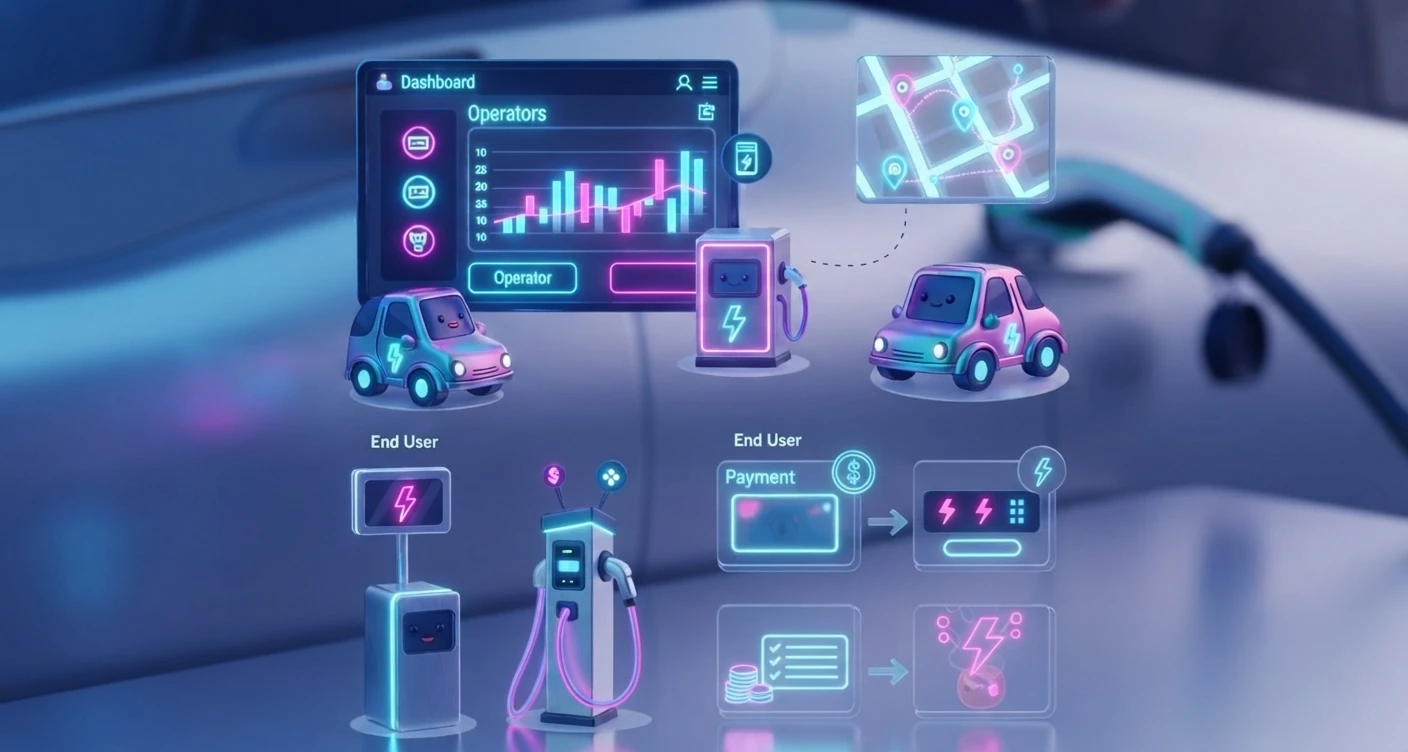
Open Charge Point Protocol (OCPP)

Overview of an OCPP-based EV charging application: Features and benefits

Developing an EV charging application that leverages OCPP is crucial for charge point operators to manage their infrastructure, provide services to EV drivers, and integrate with other systems.

An OCPP-based EV charging application (often referred to as a Charge Point Management System or CPMS) is the software brain that communicates with and controls the physical EV chargers. Such an application typically provides a dashboard for operators to monitor their network and offers features for end-users to find, activate, and pay for charging sessions.

Key features typically include:

  • Remote Control: Starting, stopping, and resetting charging sessions.
  • Monitoring: Real-time status of chargers (available, charging, out of order), energy consumption, and session data.
  • User Management: Registering users, managing payment methods, and setting access permissions.
  • Pricing and Billing: Configurable pricing structures and automated billing based on energy consumed or time.
  • Reporting: Generation of reports on usage, revenue, and charger uptime.

Benefits of such an application include:

  • Centralized Control: Manage an entire network of chargers from a single interface.
  • Improved Efficiency: Automate tasks, reduce manual intervention, and improve operational workflows.
  • Enhanced User Experience: Provide EV drivers with a seamless way to find, use, and pay for charging.
  • Data-Driven Insights: Collect valuable data on charging patterns, energy consumption, and network performance.
  • Future-Proofing: Leverage the open standard to adapt to new charger models and technologies.

As EV networks grow, so do the challenges in control and compliance. Experion builds future-proof platforms that handle scale, support diverse hardware, and simplify management with precision.

Key Components of an OCPP-based app

  • Charging station management: This core module handles the communication with individual EV chargers using the OCPP protocol. It processes messages from chargers (e.g., “boot notification,” “meter values,” “status notification”) and sends commands to them (e.g., “remote start transaction,” “reset,” “firmware update”). It maintains the operational state of each charger and logs all interactions.
  • User interfaces for monitoring and control: This includes both an operator-facing dashboard and potentially a public-facing mobile or web application for EV drivers. The operator dashboard allows for real-time monitoring of charger status, troubleshooting, configuration management, and comprehensive reporting. The user interface for drivers enables finding available chargers, initiating and stopping charging, viewing session details, and managing payment.
  • Integration with payment systems and smart grid solutions: A robust OCPP-based application must integrate with various external systems. This includes payment gateways (e.g., credit card processors, mobile payment solutions) for seamless billing. For smart grid integration, it might connect with energy management systems, utility companies, or grid operators to participate in demand-response programs, optimize charging based on renewable energy availability, or balance grid load.

Challenges in developing and maintaining an OCPP-compliant application

Developing and maintaining a robust OCPP-compliant EV charging application comes with its own set of challenges:

  • Protocol Complexity: While open, OCPP (especially 2.0.1) is a complex protocol with many message types and scenarios. Thorough understanding and correct implementation are crucial.
  • Interoperability Testing: Despite the standard, variations in manufacturer implementations can lead to subtle interoperability issues requiring extensive testing with various charger models.
  • Scalability: The application must be designed to scale efficiently as the number of connected chargers and users grows exponentially.
  • Security: Implementing strong security measures to protect sensitive data (user information, payment details) and prevent unauthorized access to chargers is paramount.
  • Real-time Performance: The application needs to handle real-time communication with numerous chargers simultaneously, requiring robust backend infrastructure and efficient data processing.
  • Integration with Legacy Systems: Integrating with older, non-OCPP compliant chargers or existing backend systems can add complexity.
  • Staying Up-to-Date: The OCPP protocol itself continues to evolve, requiring ongoing development and maintenance to support newer versions and features.


Benefits of Open Charge Point Protocol for Different Stakeholders

 

Open Charge Point Protocol (OCPP)

The widespread adoption of the Open Charge Point Protocol (OCPP) delivers tangible, far-reaching benefits for everyone involved in the EV ecosystem, from end-users to infrastructure developers and technology providers. Each stakeholder sees unique advantages as the protocol continues to unlock the full potential of interoperability and innovation.

For EV Owners

Seamless charging experience across different locations:
For EV drivers, the value of OCPP is experienced daily in the form of charging convenience. Gone are the days when drivers had to worry about whether their vehicle would be compatible with a particular charging station. With EV charger OCPP compliance, users enjoy a unified experience—plugging into a charger from any manufacturer, anywhere on the road, with the same confidence as fueling up at a traditional gas station. Whether you’re at home, in a mall parking lot, or navigating a cross-country trip, OCPP ensures the process is smooth, consistent, and predictable. That level of reliability significantly reduces range anxiety, encouraging more drivers to embrace electric mobility.

For Businesses

Scalability and reduced costs for charging networks:
For businesses like fleet operators, real estate developers, retailers, and charge point operators, OCPP is a game-changer. It allows for modular growth; companies can start small, then expand by integrating chargers from different vendors without overhauling their backend systems. This standardization not only trims integration costs but also drives down hardware prices due to the increased supplier competition. A cloud-based investment in OCPP-based EV charging applications also minimizes operational overhead, as businesses can centralize control, automate diagnostics, and update firmware without sending a technician to every station. The outcome? More reliable infrastructure at a lower total cost of ownership.

For Developers and Manufacturers

Easier integration and innovation within the ecosystem:
For developers and charger manufacturers, OCPP represents a well-documented, stable foundation upon which to build. No longer is there a need to reinvent the wheel or create proprietary systems for every new project. With OCPP as a universal protocol, innovation can be focused on advanced features, like predictive maintenance, AI-powered analytics, and energy optimization, rather than basic connectivity. Developers creating an OCPP based EV charging application can build once and deploy anywhere, confident that their software will communicate seamlessly with any compliant charger on the market. This cross-compatibility fosters a dynamic marketplace, rich in diverse, interoperable solutions.


Future of the OCPP in the EV Industry

The Open Charge Point Protocol is not merely a snapshot of today’s standards; it is a living framework, designed to evolve in tandem with the fast-changing world of electric vehicles. As EV adoption surges and technology transforms, OCPP is expected to adapt and lead.

Emerging trends in EV charging and their implications for OCPP

A variety of future-facing developments are already shaping how OCPP will grow:

  • Public and Destination Charging Expansion:
    With EVs becoming the default choice for many, the need for ubiquitous charging infrastructure—in cities, on highways, and in parking garages—will skyrocket. Managing these networks will require robust, scalable protocols like OCPP.
  • Faster Charging Technologies:
    As ultra-fast DC charging stations become more prevalent, OCPP’s real-time communication features will need to support instantaneous control and feedback loops, ensuring safety and efficiency at high energy loads.
  • Renewable Energy Integration:
    The transition to green energy is placing pressure on charging systems to be smarter. OCPP’s smart charging features allow chargers to coordinate with solar and wind energy sources, optimizing charge cycles based on peak generation times and supporting grid balancing.
  • Enhanced User Experience:
    Future iterations of the protocol are expected to improve “plug-and-charge” functionality—where user identification, session start, and payment occur automatically, much like a toll booth using RFID. This will create an effortless, friction-free user journey.

Role of OCPP in enabling advancements like bi-directional charging and Vehicle-to-Grid (V2G) systems

The latest versions of OCPP, particularly 2.0.1, are built to support bi-directional energy flows, a technological leap that unlocks tremendous potential:

  • Bi-directional Charging:
    EVs equipped with this capability can serve not just as transportation but as power sources. During emergencies or high-demand periods, vehicles can discharge power back to homes or the grid. OCPP defines the standardized commands and responses to make this a secure, controlled process.
  • Vehicle-to-Grid (V2G):
    A step further, V2G is a strategic grid management technique where thousands of EVs feed stored energy back into the grid to stabilize supply. With OCPP managing this two-way communication, utilities gain access to distributed energy storage without investing in new infrastructure, and EV owners can even monetize their parked vehicles.

The global push for adopting OCPP standards for sustainable growth

Governments and private sector players alike are pushing for OCPP standardization as a pathway to meet sustainability targets and accelerate electric mobility:

  • Accelerating EV Adoption:
    Interoperability encourages investment in EVs by removing user friction and infrastructure uncertainty.
  • Ensuring Grid Stability:
    As millions of EVs plug into the grid, smart charging and V2G will be critical. OCPP provides the framework for managing this complexity.
  • Fostering Innovation and Fair Competition:
    By eliminating closed ecosystems, OCPP promotes healthy competition and unlocks innovation across hardware and software providers.
  • Enabling Renewable Integration:
    Through coordinated energy usage, OCPP helps align EV charging with renewable generation, contributing to net-zero goals.


How Experion Can Support You With OCPP Based Application

Open Charge Point Protocol (OCPP)

As a technology leader with deep expertise in connected systems and smart infrastructure, Experion Technologies offers end-to-end solutions for businesses aiming to build or enhance their EV charging ecosystem with the OCPP protocol.


  • Custom OCPP Software Development:
    We design tailored OCPP based EV charging applications for enterprises, municipalities, and commercial networks—whether it’s a bespoke CPMS or a driver-friendly mobile app.
  • OCPP Integration Services:
    Our teams specialize in seamlessly integrating your existing systems (CRMs, billing platforms, energy providers) with your OCPP-compliant infrastructure.
  • Firmware Development and Remote Updates:
    Experion supports the full device lifecycle, from developing OCPP-compliant firmware to enabling secure over-the-air updates and remote diagnostics.
  • Consulting and Advisory:
    Unsure how to begin your OCPP journey? We provide strategic guidance, roadmap planning, and interoperability testing to help you build with confidence.
  • Cloud-Native Infrastructure:
    Our platforms are designed for scale—deployable on cloud or hybrid models—to handle millions of real-time interactions, with robust security and performance at their core.
  • UI/UX Excellence:
    Great technology is only as good as its interface. We craft intuitive and engaging user experiences for both charge point operators and EV drivers, boosting adoption and satisfaction.


Conclusion

The Open Charge Point Protocol (OCPP) is more than just a communication standard—it’s the backbone of the modern EV charging world. By providing a universally accepted framework for charger and software interaction, OCPP lays the groundwork for a future where EV adoption is widespread, charging is seamless, and infrastructure scales effortlessly.

From reducing vendor lock-in and enabling smart grid integration to supporting next-generation innovations like bi-directional charging and Vehicle-to-Grid capabilities, OCPP is the invisible engine driving the EV revolution. And as nations and companies double down on clean energy commitments, the protocol’s significance will only grow.

For businesses looking to ride the wave of this transformation, the opportunity lies in building with OCPP, not just to keep up, but to lead. And with a technology partner like Experion, you’re well-equipped to engineer that future, securely, smartly, and sustainably.

Key Takeaways

  1. OCPP enables interoperability between EV chargers and management systems, reducing vendor lock-in and promoting open ecosystems.
  2. OCPP 2.0.1 enhances smart charging, security, and diagnostics, making it ideal for the evolving needs of modern EV infrastructure.
  3. Experion builds scalable OCPP-based solutions, helping businesses manage large, diverse charger networks with precision.
  4. EV owners benefit from a consistent charging experience, with the ability to use any OCPP-compliant station across networks and brands.
  5. Businesses save on infrastructure costs by mixing and matching hardware and software, thanks to OCPP’s open standard.
  6. Developers and manufacturers accelerate time-to-market with OCPP’s clear, universal specifications, focusing more on innovation than compatibility issues.
  7. Real-world adoption spans public, residential, and fleet charging, showcasing OCPP’s flexibility across use cases.
  8. OCPP supports future-ready capabilities like bi-directional charging and Vehicle-to-Grid (V2G), enabling EVs to feed energy back to the grid.
  9. Experion offers end-to-end services from OCPP software development to cloud-native platforms and intuitive user interfaces.
  10. As EV adoption grows, OCPP will remain the digital backbone, and Experion is at the forefront of building what’s next in electric mobility.
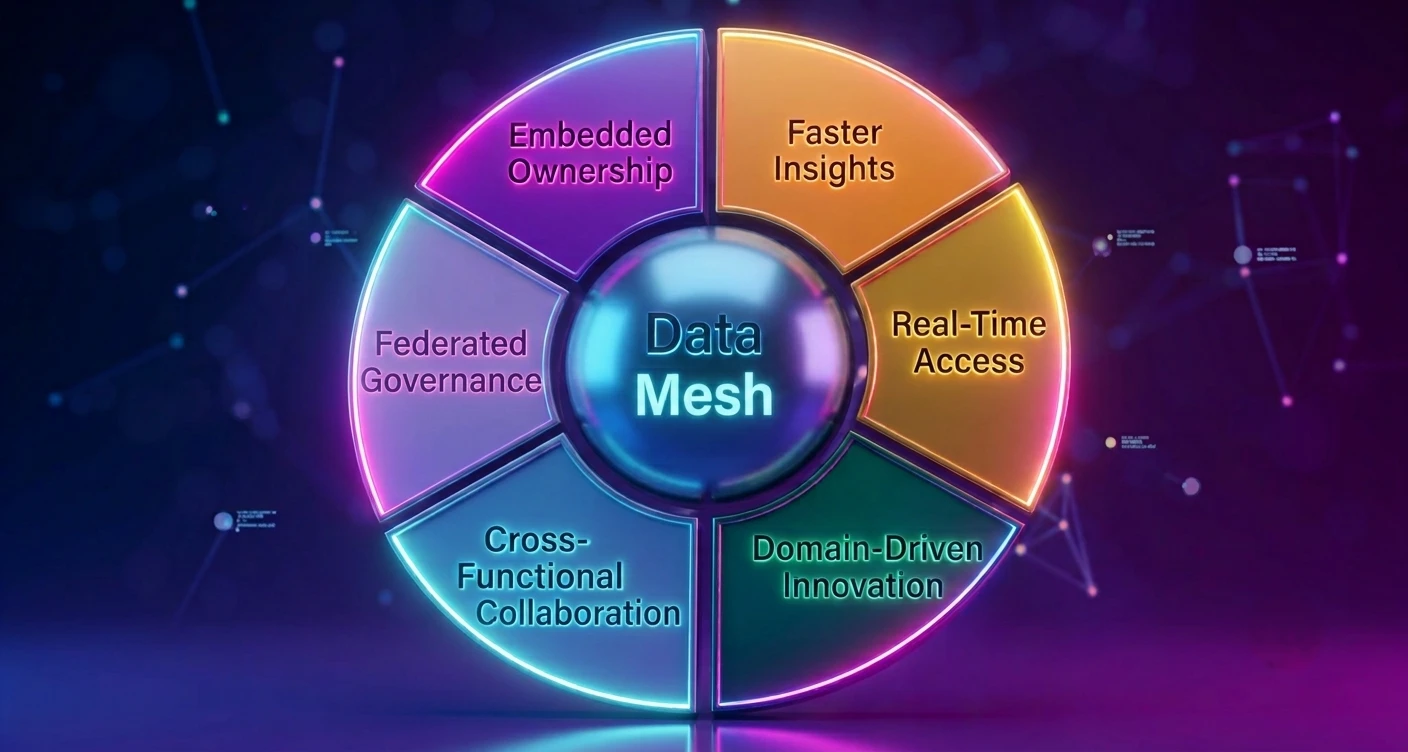
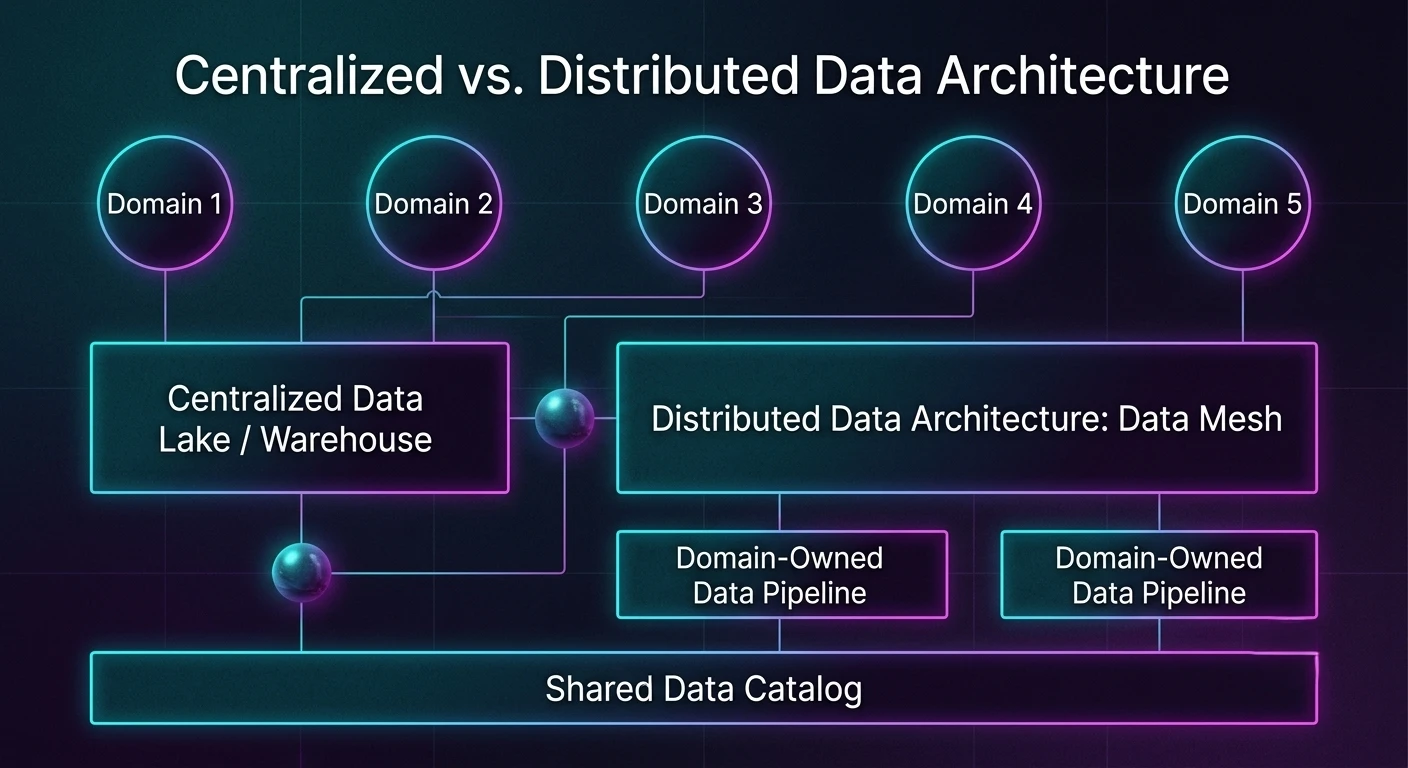
Data Mesh – Distributed Data Architecture

In the era of AI, cloud-native systems, and IoT, the complexity of enterprise data ecosystems has exploded. Traditional centralized data platforms, once effective, are now straining under the pressure of scale, latency, and organizational diversity. Large, centralized data lakes and rigid warehouses often become bottlenecks, limiting speed, agility, and trust in data operations.

This is where Data Mesh emerges, not just as a technological shift, but as a new data architecture paradigm, enabling distributed data ownership, scalability, and self-service across business domains.


What is Data Mesh?

Data Mesh – Distributed Data Architecture

Data Mesh is a decentralized approach to data architecture that emphasizes domain-oriented ownership, data as a product, self-service infrastructure, and federated governance. It was first introduced by Zhamak Dehghani and has since evolved into a leading framework for scalable, modern data platforms.

Unlike traditional centralized models, which rely on a small team managing all data pipelines and assets, data mesh empowers each business domain to own, govern, and serve their data, just like they would manage a software product.

Data Mesh – Distributed Data Architecture

Feature Centralized Data Model Data Mesh
Ownership Central team Domain teams
Data Modeling Generic, one-size-fits-all Domain-specific, contextual
Speed & Agility Slower Faster, parallel
Governance Strict central Federated, aligned
Innovation Bottlenecked Distributed

Core Principles of Data Mesh

  1. Domain-Oriented Ownership
    Data is managed by domain teams who understand its context, quality, and business value. Marketing, Sales, HR, Finance, each becomes a data owner.
  2. Data as a Product
    Each domain is responsible for making their data discoverable, trustworthy, and usable by others, treating it like a product with SLAs and consumer satisfaction in mind.
  3. Self-Service Data Infrastructure
    Data teams are supported by central platform teams that build tooling for ingestion, cataloging, monitoring, and access, enabling domains to operate independently.
  4. Federated Governance
    While domains operate autonomously, a shared framework ensures compliance, interoperability, metadata standards, and lineage visibility across the enterprise.

Together, these principles decentralize data responsibility, improve data agility, and align data systems with organizational structures.


Evolution of Data Architecture: From Warehouses to Mesh

Data Mesh – Distributed Data Architecture

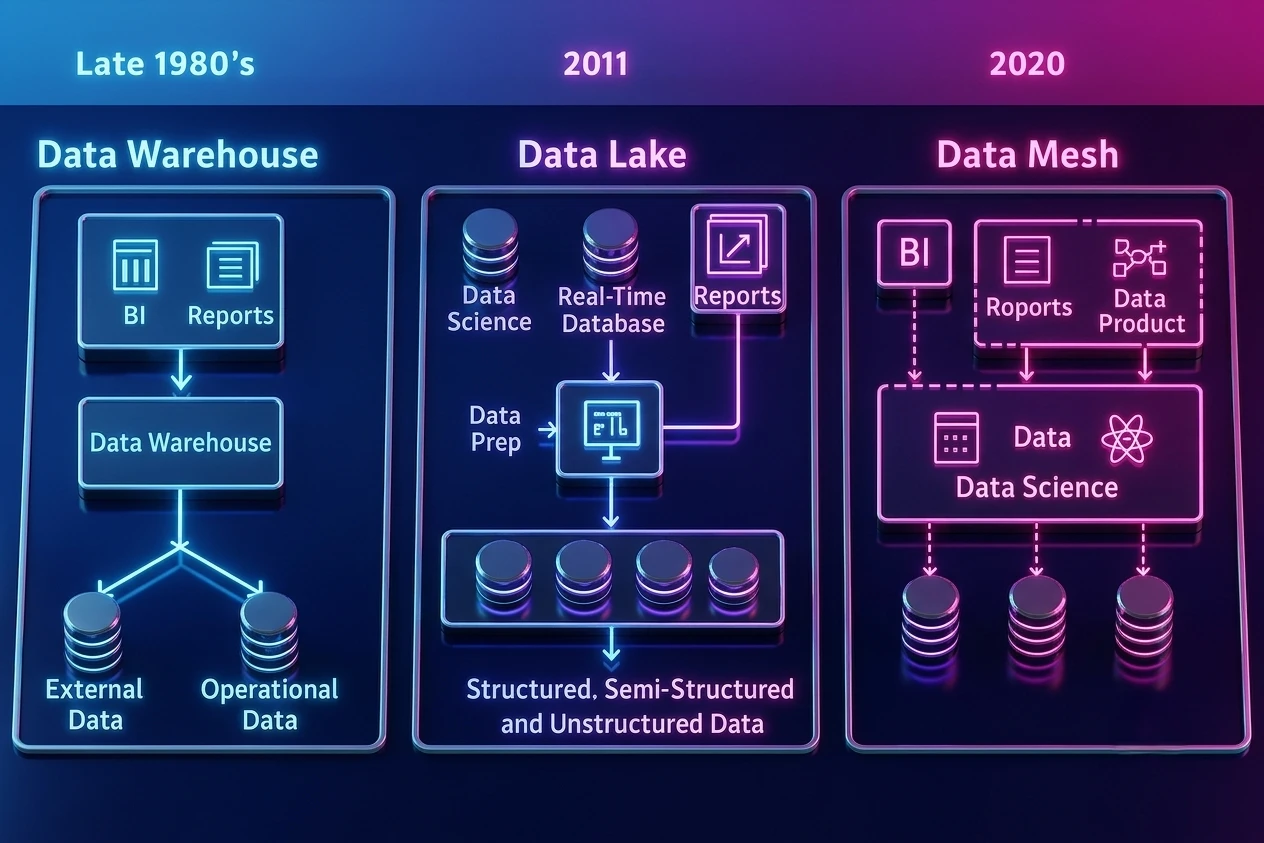
For years, enterprises have structured their data strategies around centralized data warehouses and data lakes, systems that promised a unified source of truth by consolidating data from disparate sources into one platform. While effective in the early stages of digital transformation, these traditional architectures are now struggling to keep pace with the demands of modern, data-intensive organizations.

Limitations of Traditional Centralized Architectures

As businesses grow more complex and data-hungry, the shortcomings of centralization become apparent:

Bottlenecks

Centralized data teams often become overwhelmed as every department, marketing, finance, operations, sales, depends on them for data ingestion, cleaning, modeling, and delivery. This over-reliance creates a bottleneck that slows down project delivery and hinders business agility.

Data Silos

Ironically, even centralized architectures can create silos, particularly when domain-specific knowledge isn’t embedded into the data modeling process. A central team may not fully understand the context or nuances of each department’s data, resulting in misinterpretations, misalignments, or underutilized assets.

Latency

Traditional ETL (Extract, Transform, Load) processes often involve scheduled batch jobs, which introduce time lags. This latency is unacceptable in scenarios requiring real-time analytics, such as fraud detection, dynamic pricing, or operational monitoring, where data freshness directly impacts outcomes.

Low Trust

When users lack visibility into how data is collected, transformed, and validated, they begin to doubt its accuracy. Without domain-level context, it becomes difficult to ensure quality and traceability, leading to hesitation in data-driven decision-making.

The Shift Toward Distributed, Domain-Driven Models

To overcome these limitations, forward-thinking organizations are embracing a new model: Data Mesh, a distributed data architecture that aligns technical systems with business domains.

Unlike traditional models that consolidate data into a single platform, Data Mesh decentralizes both ownership and accountability, assigning responsibility for data to the domain teams that generate and use it. Each team becomes a data product owner, responsible for delivering high-quality, usable, and trusted datasets to the rest of the organization.

Traditional Model Data Mesh Model
Central team supports all data Domains own their data
Long delivery cycles Parallel development
Poor domain context Domain-specific data modeling
Centralized governance Federated policies + autonomy

This domain-driven approach brings several key advantages:

  • Faster Delivery of Insights:
    With data stewardship embedded within each department, changes can be implemented and published without waiting for a central data team.
  • Improved Data Quality and Relevance:
    Domain teams understand their data best. By taking ownership, they can ensure better data modeling, annotation, and maintenance, rooted in business context.
  • Increased Scalability:
    Rather than scaling a single team to support all departments, each domain scales its own capabilities as needed, supported by self-service infrastructure.
  • Empowered Platform Teams:
    Central IT or data platform teams transition from bottlenecks to enablers, focusing on delivering standard tools for observability, access control, lineage tracking, and compliance, freeing up domain teams to innovate independently.


Understanding Data Mesh Architecture

Data Mesh represents a profound shift in how enterprises design, govern, and scale their data ecosystems. It is both a sociotechnical framework, concerned with people, culture, and processes, and a platform strategy that defines how data systems and tools are built to support decentralized, domain-driven practices.

Instead of routing all data through centralized pipelines and teams, data mesh distributes responsibility to individual business domains, empowering them to own and serve their data as products. This transformation requires a rethinking of team roles, infrastructure layers, and governance policies to unlock agility and scalability.

Role Responsibilities
Data Product Owner Own quality, SLAs, usability of domain data
Domain Data Team Build pipelines, enrich & validate data
Platform Team Build self-service tools, not manage data
Governance Group Set standards, monitor compliance, enable traceability

Key Building Blocks of a Data Mesh Architecture

To implement data mesh successfully, organizations must enable several core components. These are not just technologies, but design principles that ensure decentralization does not devolve into data chaos.

  1. Data Product Owners

In the data mesh model, each domain, be it Sales, Marketing, Finance, or Supply Chain, assigns data product owners responsible for the lifecycle of domain-specific datasets.

  • These owners ensure that data is reliable, documented, discoverable, and trustworthy.
  • Their responsibilities include maintaining high standards of quality, ensuring availability and usability, and fulfilling SLAs (service-level agreements).
  • They act as the bridge between producers and consumers, understanding both the source systems and the needs of downstream users.

Example: In a retail company, a data product owner in the inventory domain would manage product availability data, ensuring it’s real-time, accurate, and accessible to analytics, logistics, and merchandising teams.

  1. Domain Data Teams

Supporting the product owners are domain data teams, composed of data engineers, analysts, and subject matter experts embedded within each functional area.

  • These teams handle data ingestion, transformation, validation, enrichment, and publication.
  • Their deep understanding of domain context ensures more accurate and relevant modeling of data.
  • They collaborate directly with stakeholders within their business unit, reducing communication lag and dependency on central teams.

This cross-functional model brings data operations closer to the source, enhancing quality and relevance while enabling faster iteration.

  1. Self-Service Platform

To empower domain teams without overwhelming them with infrastructure concerns, a central platform team builds and maintains a shared self-service data platform.

This platform typically includes:

  • Data cataloging tools for discovery and metadata tagging (e.g., Alation, Collibra).
  • Data lineage and version control to trace changes and ensure reproducibility.
  • Pipeline orchestration tools (e.g., Airflow, Dagster) for automating ETL/ELT processes.
  • Security and access controls (e.g., Immuta) to ensure compliance.
  • Monitoring and observability dashboards to track data freshness, usage, and quality.

The platform team doesn’t manage data itself but provides enablement tools to allow domains to build and operate data products independently, safely and at scale.

  1. Governance and Observability

A hallmark of the data mesh approach is federated governance, striking a balance between domain autonomy and enterprise-wide consistency.

  • Federated governance means that each domain enforces local policies, while also adhering to global standards for security, privacy, lineage, and interoperability.
  • Common elements include data contracts, standardized schemas, access policies, audit logs, and metadata definitions.
  • Observability ensures that both data producers and consumers have transparency into data pipelines, lineage, anomalies, and quality metrics.

This model avoids the rigidity of central governance and the fragmentation of no governance by introducing guardrails, not gates.”

How Data Mesh Promotes Agility and Business-Aligned Ownership

The primary strength of data mesh lies in its ability to align data operations with business domains, accelerating time to insight and reducing systemic friction.

Encourages Cross-Functional Collaboration Within Domains

By embedding data responsibilities within domain teams, data mesh promotes tight collaboration between technical experts and business users. Teams work closer to their data sources and consumers, enabling:

  • Faster feedback loops
  • More accurate modeling of real-world processes
  • Greater ownership and accountability

Enables Real-Time Data Delivery and Consumption

Because each domain is responsible for its own data pipelines and APIs, data mesh allows for faster ingestion and processing of real-time events. This is crucial for domains like:

  • Fraud detection in financial services
  • Inventory optimization in retail
  • Patient monitoring in healthcare

Data doesn’t have to travel through central bottlenecks—it can be consumed directly at the source.

Aligns Technical Systems with Business Structures and Priorities

In traditional systems, centralized teams often lack the domain expertise to prioritize what matters most to business units. In contrast, data mesh aligns technical capabilities with business goals by giving:

  • Ownership to the teams closest to the data
  • Autonomy to innovate based on evolving needs
  • Clear insight into the usage and value of data.

This tight alignment improves prioritization, accountability, and agility.

Reduces Dependency on Central Teams, Improving Time to Insight

Central data teams are typically overburdened, leading to backlogs, long ticket queues, and frustrated stakeholders. Data mesh eliminates this bottleneck by enabling:

  • Parallel development of data products across domains
  • Faster experimentation without long dependency chains
  • Local control over delivery timelines and resource allocation

The result is a system that scales horizontally with the business.

Visualizing Data Mesh Architecture

Imagine an enterprise where each business domain owns a “data product”:

  • These products are modular, documented, and discoverable via a central catalog.
  • They expose APIs for real-time access, support versioning, and include metadata and SLAs.
  • All products are interconnected through a federated layer of governance and infrastructure, ensuring trust, security, and consistency.

This mesh of interconnected data nodes mimics a modern microservices architecture, but for data. It replaces monolithic pipelines with domain-owned products, stitched together with tooling that ensures control without centralization.


Benefits of Adopting a Data Mesh Approach

The shift to a distributed data architecture brings several enterprise-wide benefits:

  • Scalability Across Functions:
    Each domain can scale its data capabilities independently, removing friction and dependency on central bottlenecks.
  • Faster Access to High-Quality, Domain-Specific Data:
    With data owned and served by the teams that create it, consumers get better accuracy, faster delivery, and deeper context.
  • Encourages Data Ownership and Accountability:
    Domains take pride and responsibility in maintaining the quality and usability of their data products.
  • Reduces Bottlenecks on Central Teams:
    The central data team evolves into an enablement layer, building tools and standards while shifting operational load to the edge.
Benefit Business Impact
Scalability Across Functions Agile domain expansion without friction
Faster Access to Quality Data Improved decision-making, lower latency
Encourages Data Ownership Better quality control and stewardship
Fewer Bottlenecks on Central Teams More innovation and faster experimentation


Challenges and Considerations in Implementing Data Mesh

Despite its promise, transitioning to data mesh architecture presents several challenges that organizations must address carefully.

  • Organizational Change Management:
    Data mesh requires a cultural shift toward shared ownership, cross-functional collaboration, and product thinking. Leaders must support this transformation with clear roles, KPIs, and incentives.
  • Enabling Cross-Domain Governance:
    Without effective governance, decentralization can lead to inconsistency and data chaos. A federated model must balance autonomy with compliance, security, and interoperability.
  • Building Robust Self-Serve Infrastructure:
    A scalable mesh requires robust tooling: data catalogs, pipeline automation, access controls, and monitoring that empower domains while maintaining standards.
  • Ensuring Data Discoverability and Interoperability:
    Data products must be well-documented, versioned, and standardized so that others can easily find, trust, and use them across the organization.
Challenge What to Watch For Mitigation Strategy
Org Change Management Resistance from teams Leadership backing, clear KPIs
Cross-Domain Governance Inconsistent standards Federated policies, shared metadata schema
Lack of Self-Service Platform Overload on central teams Invest in automation, discovery, access tools
Poor Discoverability Data chaos, redundancy Enforce documentation, SLAs, versioning


Data Mesh vs Data Fabric: Key Differences and Use Cases

Both data mesh and data fabric address data complexity and integration, but they differ significantly in their approach and philosophy.

Comparison Data Fabric Data Mesh
Data Volume Medium – High High – Very High
Governance Centralized, Medium-to-High complexity Decentralized, High-to-Very High complexity
Data Maturity Medium – High Low – Medium
Data Complexity Low – Medium High – Very High
Approach Technology-centric, architecture-driven Organization-centric, domain-driven
Cost & TTM Low – Medium Medium – High
Self-Serve Capability Good Best
Skill Level High Medium
Automation Centralized Isolated (needs augmentation)
Use Cases IoT Analytics, Customer 360 CDP (Customer Data Platform), Product 360

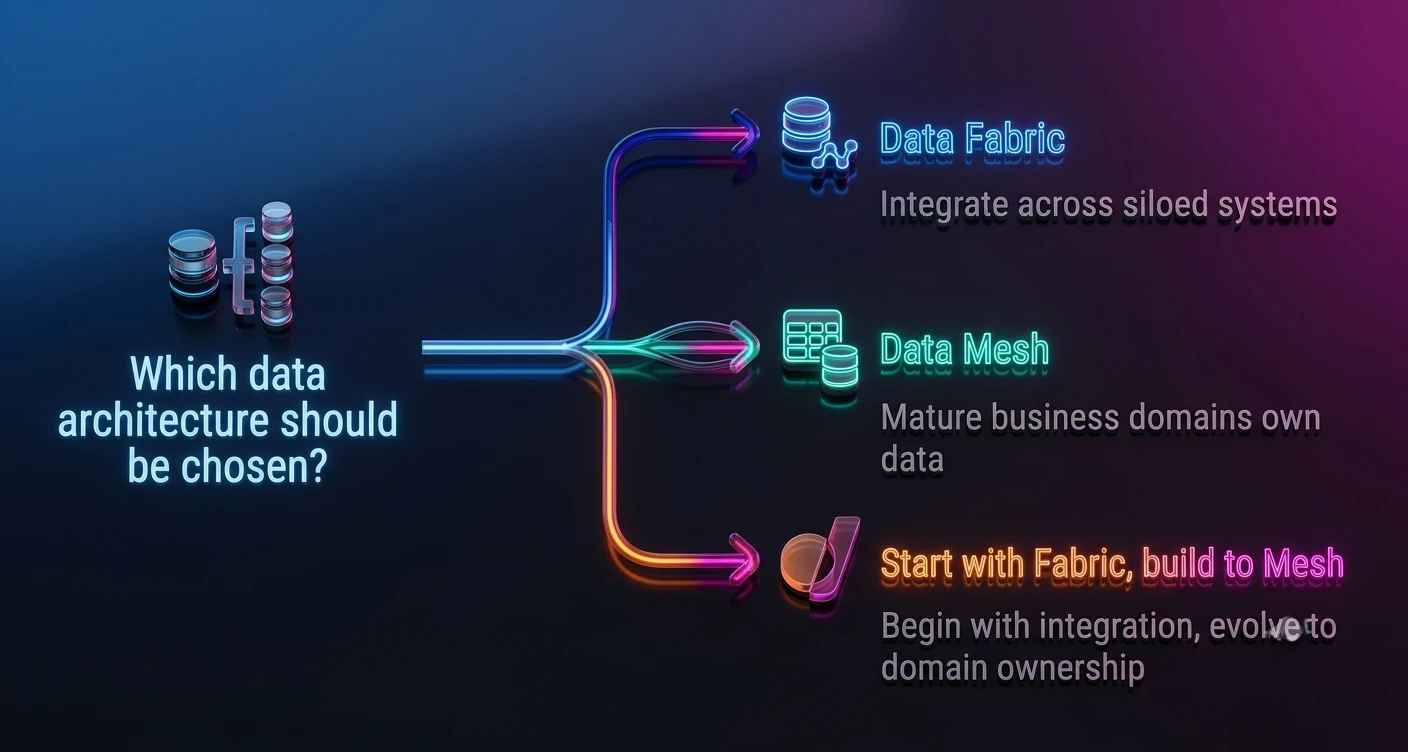
Which to Choose and When?

Data Mesh – Distributed Data Architecture

  • Choose Data Fabric if your priority is technical integration across multiple systems, or you’re building a central data hub for analytics.
  • Choose Data Mesh when your organization has multiple domains, rapid scaling needs, and requires domain-level autonomy for agility and innovation.

At Experion Technologies, we help enterprises choose and implement the right architecture, be it data mesh, data fabric, or a hybrid, based on their specific needs and maturity.


Real-World Use Cases of Data Mesh

  • Retail:
    Local teams manage product and inventory data for their region. With data mesh, regional teams can publish real-time sales, stock, and customer insights, improving pricing and promotions.
  • Financial Services:
    Risk, compliance, and fraud teams in different departments manage their own data products. A data mesh ensures secure, compliant, yet agile data handling, enabling faster decision-making.
  • Healthcare:
    Patient data from labs, clinics, and operations is handled by domain teams. Mesh architecture provides clear ownership, data quality, and interoperability while ensuring privacy and compliance.
  • Technology Companies:
    A shared platform empowers product, marketing, and support teams to build tailored analytics products, fostering experimentation, instant feedback, and quicker innovation.


Tools and Technologies Enabling Data Mesh

Implementing a successful data mesh architecture requires a modern data platform stack that supports discovery, governance, automation, and scalability.

Key Platform Components

  • Data Cataloging:
    Tools like Collibra, Alation help catalog data products, enforce metadata standards, and enhance discoverability.
  • Data Observability:
    Platforms such as Monte Carlo and Databand provide insights into data health, lineage, and anomalies.
  • Data Orchestration:
    Workflow tools like Apache Airflow and Dagster automate pipeline execution and enable data product deployment.
  • Access Control and Lineage:
    Solutions like Immuta and Amundsen help manage permissions, lineage tracking, and audit trails across domains.
  • Cloud-Native Infrastructure:
    Mesh-ready environments are supported by platforms like Databricks, Snowflake, AWS Lake Formation, and Google BigQuery that offer modular, scalable architecture and automation capabilities.


Best Practices for Transitioning to a Data Mesh Model

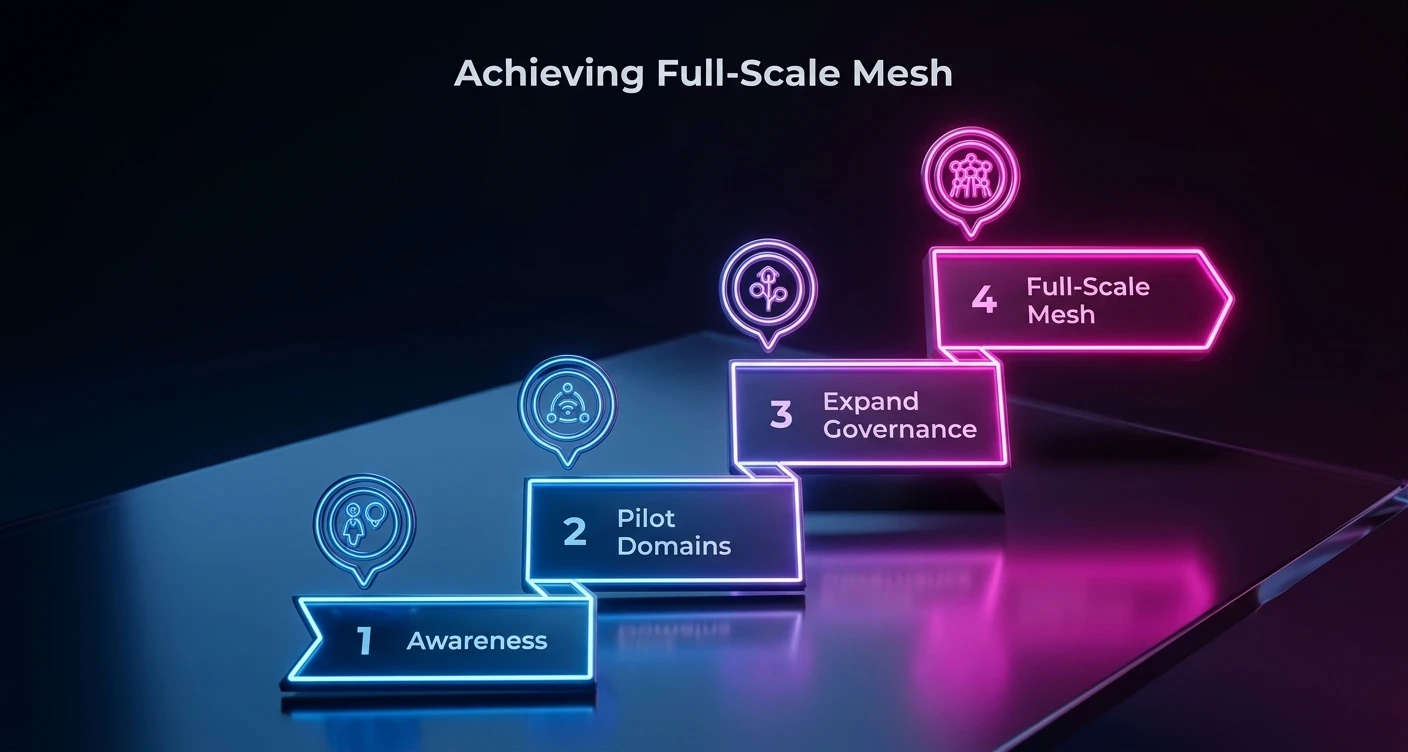
Adopting a data mesh architecture is not a simple plug-and-play switch, it’s a significant organizational and cultural transformation. To ensure success and reduce risk, enterprises should approach this shift incrementally, with structured strategies, aligned teams, and robust platform support.

  1. Start with a Pilot

Transitioning to a data mesh model should begin with a limited, well-defined pilot to test the model’s principles and infrastructure within a controlled scope.

  • Choose one or two domains, preferably with mature teams and clear data pain points.
  • Implement core components: data product ownership, self-service pipelines, and federated governance.
  • Measure success based on delivery speed, data quality improvements, and domain satisfaction.
  • Use the pilot to uncover gaps in tooling, governance, or skills before scaling organization-wide.

Example: Start with the sales and marketing domains, which often already have strong analytics maturity and can showcase quick wins with measurable impact.

  1. Define SLAs and Ownership Clearly

A fundamental tenet of data mesh is treating data as a product. This requires domains to establish and honor clear Service-Level Agreements (SLAs) for every data product.

  • Specify refresh rates, delivery timelines, data availability windows, and quality thresholds.
  • Assign named data product owners with responsibility for maintaining, updating, and supporting their datasets.
  • Promote accountability by tying SLAs to business KPIs and operational objectives.

This clarity builds trust between producers and consumers, reducing misunderstandings and ensuring reliability.

  1. Foster a Product-Thinking Culture

Data mesh is as much about mindset as it is about architecture. Domain teams must evolve from pipeline operators to product managers of data assets.

  • Emphasize consumer empathy, understanding how internal users will access, use, and rely on the data.
  • Encourage documentation, versioning, and intuitive interfaces, just like any good product.
  • Promote continuous feedback loops so teams can iterate and improve data offerings over time.

Adopting product-thinking ensures that data products are maintained, discoverable, and valuable, rather than becoming technical artifacts left unused.

  1. Invest in Platform Enablement

Domain teams can only thrive if supported by a robust self-service platform that abstracts away infrastructure complexity.

  • Build a centralized platform that offers data discovery, lineage, quality checks, access management, and pipeline automation.
  • Prioritize usability, modularity, and extensibility, so that domain teams can innovate without waiting on central IT.
  • Ensure the platform is well-documented, well-supported, and continuously improved in response to domain feedback.

This foundation transforms data from a service bottleneck into an organizational asset, enabling rapid domain-level innovation.


Future of Data Mesh and Distributed Data Architecture

As enterprise data landscapes continue to grow in complexity, data mesh is poised to shape the next generation of data strategies. It aligns perfectly with broader trends in decentralization, composable technologies, and intelligent automation.

  1. Enterprise-Wide Decentralization

In today’s large, global organizations, centralized teams struggle to scale across regions, products, or departments. Data mesh offers an organizational structure that mirrors the complexity of the business.

  • As companies expand, each region or division can manage its own data domains while staying compliant through federated governance.
  • Business agility improves as decisions are driven by domain-specific insights delivered in real time.

Result: Enterprises will become more responsive, resilient, and regionally autonomous without losing standardization.

  1. AI/ML Integration

Data mesh will increasingly become the backbone of AI and machine learning systems.

  • The quality of AI models is determined by the data they’re trained with. Domain-specific data products offer cleaner, richer, and more contextualized inputs.
  • Mesh architecture enables real-time streaming pipelines that feed continuous learning models for fraud detection, recommendation engines, demand forecasting, and more.
  • Federated data governance ensures compliance with evolving data privacy regulations like GDPR and HIPAA.

Result: AI systems become smarter, more ethical, and better aligned with business-specific needs.

  1. Internal Data Marketplaces

As data mesh matures, enterprises will build internal data marketplaces, platforms where domain teams publish, discover, and subscribe to data products.

  • Teams can browse available datasets, assess quality scores, view lineage, and integrate them instantly.
  • Monetization models may emerge internally, where high-value data domains receive budget incentives for delivering widely adopted products.

Result: Data becomes a measurable asset, driving transparency, reuse, and innovation across the enterprise.

  1. Composable Data Stacks

The next evolution of data architecture will be modular and plug-and-play, enabling organizations to adapt quickly to new use cases and technologies.

  • Instead of monolithic platforms, enterprises will adopt interoperable tools across orchestration, observability, cataloging, and access control.
  • Hybrid deployments across data mesh, data fabric, and edge computing will become the norm, allowing flexibility by use case.

Result: Enterprises build composable data stacks that are scalable, agile, and future-proof.

Looking Ahead

Data Mesh – Distributed Data Architecture

The future of data mesh architecture isn’t just technical, it’s transformative. It redefines how organizations think about:

  • Data ownership and stewardship
  • Interdisciplinary collaboration
  • Scalability and real-time intelligence
  • Enterprise-wide enablement and innovation

As data becomes increasingly central to digital transformation and AI-led decision-making, data mesh will serve as a foundation for next-generation data maturity.

Experion Technologies partners with enterprises at every stage of the journey, from strategy and platform design to implementation and scale-out, ensuring a smooth and successful transition into the world of distributed, intelligent, and business-aligned data architecture.


Conclusion

Data Mesh – Distributed Data Architecture

The rise of Data Mesh – Distributed Data Architecture represents a foundational shift in how enterprises think about data. Moving beyond centralization, mesh enables ownership, agility, and innovation at scale, aligning data delivery with business structures and velocity.

Experion Technologies helps organizations unlock the power of data mesh architecture, designing platforms and roadmaps tailored to their growth, compliance, and digital transformation needs.

Key Takeaways

  • Data Mesh enables decentralized, domain-driven data architecture aligned with business agility.
  • Core principles include domain ownership, data-as-a-product, self-service infrastructure, and federated governance.
  • It breaks away from the bottlenecks and rigidity of centralized data lakes and warehouses.
  • Compared to Data Fabric, Data Mesh focuses more on organizational structure than technical integration.
  • Use cases span retail, finance, healthcare, and tech, with strong ROI through scalability and responsiveness.
  • The right tools, cataloging, observability, orchestration, are key to mesh success.
  • Experion Technologies offers strategic, architectural, and platform support to enable scalable data mesh implementation.


Let’s co-create a data foundation that’s scalable, intelligent, and aligned with your business goals.

Insurance CRM Software

Today’s insurance customer doesn’t want to wait on hold, fill out stacks of paperwork, or chase updates across disconnected channels. They expect the same level of speed, personalization, and convenience they experience with ride-hailing apps, food delivery platforms, and online shopping. And if they don’t get it, they won’t think twice about switching providers.

This shift isn’t a trend; it’s a tipping point. For insurers, the challenge is no longer just offering coverage but delivering an experience that feels effortless, responsive, and relevant at every stage of the customer journey.

That’s where insurance CRM software comes in.

Far from being just a database of contacts, a modern CRM acts as the customer intelligence layer of the business, enabling meaningful engagement and proactive service. It connects sales, service, marketing, and claims into one cohesive workflow. It gives teams a full picture of the customer. It automates the follow-ups that often slip through the cracks. And most importantly, it gives insurers the tools to be proactive rather than reactive in a competitive landscape.

In this blog, we’ll explore what makes CRM software for insurance essential, how it differs from traditional systems, and why forward-thinking insurers are already building their future around it.


What is Insurance CRM Software?

Insurance CRM Software

Insurance CRM software is a purpose-built solution tailored specifically to the needs of insurance providers, be it agencies, brokers, or carriers. Unlike generic CRM platforms, this specialized tool is deeply attuned to the intricacies of the insurance landscape, offering features that align with sector-specific requirements.

At its core, an insurance CRM serves as a central hub that manages the full spectrum of customer relationships. From lead generation and policy management to claims tracking and customer support, every interaction is captured and analyzed within a single system. This not only reduces information silos but also empowers teams with real-time insights, making every customer engagement more informed and meaningful.

Some key capabilities of modern insurance CRM platforms include:

  • Policy Lifecycle Tracking: Manage applications, quotes, issuance, and renewals in a unified dashboard.
  • Automated Workflows: Route tasks, send reminders, and trigger communication based on predefined conditions.
  • Customer Segmentation: Group clients based on behaviour, demographics, and policy history to tailor messaging.
  • Claims Management: Track claims efficiently while keeping customers updated.
  • Sales Pipeline Management: Help agents visualize and manage their sales funnels with better forecasting.

Difference Between Insurance CRM Software and Agency Management System (AMS)

In the insurance world, both Insurance CRM software and Agency Management Systems (AMS) play vital roles in improving efficiency and streamlining operations. However, they serve distinctly different functions. While they may sometimes overlap in capabilities, the core focus of each system is what truly sets them apart.

Aspect Insurance CRM Software Agency Management System (AMS)
Primary Focus Managing and enhancing relationships with current and potential clients Managing core agency operations and policy workflows
Main Activities Lead generation, sales, marketing automation, customer engagement, and retention Policy administration, claims processing, compliance, document, and commission management
Contact Management Centralized client and prospect database with communication history Focused on storing client data linked to policy records
Lead Management Tracks leads through sales pipelines Not typically designed for lead nurturing
Sales & Marketing Automates campaigns, email sequences, follow-ups Not a core function
Communication Tools Manages emails, calls, and SMS for client engagement Limited communication tools, mainly operational notifications
Quoting & Proposals Often integrates with quoting tools for quick proposal generation Focuses more on submitted quotes and issued policies
Customer Segmentation Groups clients for targeted outreach Generally lacks advanced segmentation features
Policy Management May track policies, but not the core function Central feature, including renewals, endorsements, and cancellations
Claims Management Might assist with communication during claims Full claims tracking and processing workflows
Commission Tracking May include basic sales tracking Tracks agent commissions in detail
Compliance Limited features, if any Provides compliance tools to meet regulatory standards
Reporting & Analytics Focused on sales performance, customer engagement, and marketing effectiveness Focused on operational metrics, policy data, commissions, and agency productivity
System Analogy Sales and marketing hub—helps you find, win, and keep clients Central operating system—manages policies, operations, and compliance

Why You Might Need Both

Choosing between an Insurance CRM and an AMS isn’t always an either-or decision. They may serve unique roles, but they perfectly complement one another. The CRM software for insurance keeps your customers engaged and your pipeline growing. The agency management system, meanwhile, makes sure those policies are managed effectively behind the scenes. Together, they create a complete ecosystem for success, balancing customer experience with operational excellence.


Why the Insurance Industry Needs CRM Solutions

Insurance CRM Software

The insurance industry has undergone significant transformation. In today’s hyper-connected world, policyholders expect nothing less than fast, personalized, and seamless service, whether they’re buying a new policy, filing a claim, or simply seeking information. This shift has created a need for insurance businesses to rethink how they manage customer relationships.

Insurance CRM software has emerged as a crucial tool in this transformation. It empowers insurers to centralize data, improve communication, automate tasks, and provide the kind of service that builds loyalty and trust. With rising competition and growing regulatory requirements, CRM software for insurance isn’t just a convenience; it’s a strategic necessity.

Challenges Faced Without a CRM

Insurance providers who still rely on outdated systems or manual processes face several operational and customer experience roadblocks. Here’s what goes wrong without a robust insurance CRM:

Disorganized Data

When customer information is scattered across spreadsheets, email threads, and separate platforms, it’s difficult to get a unified view of the client. Agents may struggle to find important data, leading to delays, errors, and missed opportunities. Without insurance CRM software, this fragmented data environment stifles customer insight and decision-making.

Poor Customer Follow-Up

A lack of systemized tracking for customer interactions means agents can easily miss follow-ups or forget to respond promptly. This results in cold leads, frustrated customers, and a decline in sales conversions. In today’s environment, delayed responses can cost more than just a sale; they can cost customer trust.

Inefficiency in Daily Operations

Manual entry, scattered tools, and repetitive tasks slow agents down and reduce overall productivity. Instead of building relationships or closing deals, employees spend time on low-value tasks. Without streamlined workflows and automation, agencies fail to scale their operations or compete with more agile players in the market.


Key Features of a Robust Insurance CRM

A well-implemented CRM software for insurance offers targeted solutions to overcome these challenges and create a foundation for long-term success. Here are the essential features that make a CRM truly effective for the insurance sector:

  1. Lead Management and Nurturing

The CRM should capture leads from multiple sources—such as websites, referrals, and campaigns—and automatically assign, prioritize, and nurture them through personalized messaging and timely follow-ups. Automated workflows can dramatically improve response time and increase conversion rates.

  1. Policy and Claims Tracking

Integrating client profiles with their policy and claims history gives agents full visibility into the customer’s journey. This linkage allows for better service, faster issue resolution, and tailored recommendations, especially when managing renewals or upselling new products.

  1. Customer Communication Tracking

A centralized log of all email, SMS, and phone communications ensures agents are never in the dark. With every interaction documented, anyone accessing the profile knows the full history, allowing for more personalized and contextual engagement—an important hallmark of modern insurance software.

  1. Automated Reminders and Workflows

Setting up automatic alerts for policy renewals, claim status updates, and follow-ups ensures nothing falls through the cracks. Automation frees up agents from routine tasks and improves overall responsiveness and client satisfaction.

  1. Integration with Other Tools

A high-quality insurance CRM should connect effortlessly with policy administration systems, marketing platforms, quoting tools, and more. This ensures a seamless exchange of data across systems, reducing redundancy and enhancing workflow efficiency. Integrating AI into CRM can further elevate this, with predictive analytics and intelligent task prioritization.

  1. Analytics and Reporting

From lead conversion ratios to agent productivity and campaign performance, CRM analytics offer insights that drive smarter decisions. Managers can identify trends, optimize strategies, and keep a close watch on business health with data-rich dashboards.

Experion’s approach is rooted in solving real business challenges through scalable, intelligent technology. With expertise across automation, data integration, and AI-driven product engineering, we can help insurers build systems that streamline lead nurturing, unify scattered data, and bring meaningful insights into daily decision-making.


Benefits of Using CRM Software for Insurance

Insurance CRM Software

Implementing a robust insurance CRM software solution is more than a technological upgrade—it’s a strategic investment that reshapes how insurance agencies engage with clients, manage operations, and grow sustainably. From optimizing workflows to enhancing customer experience, the right CRM can deliver measurable benefits across the board.


  1. Improved Customer Retention and Satisfaction

A CRM helps agents understand each policyholder better by providing a comprehensive, 360-degree view of customer history, preferences, and policies. This allows for personalized communication and proactive service, building deeper relationships that drive loyalty. Satisfied customers are more likely to renew, refer others, and remain with the agency for the long haul.

  1. Enhanced Productivity and Efficiency for Agents

Agents no longer need to juggle between multiple systems or waste time on manual data entry. With CRM software for insurance, routine tasks like sending follow-up emails, scheduling reminders, and updating contact records are automated. Easy access to client information and pre-built workflows frees agents to focus on high-value tasks—like converting leads and offering tailored policy recommendations.

  1. Streamlined Onboarding and Sales Processes

An insurance CRM transforms how new clients are onboarded. From lead capture and qualification to policy issuance, the entire sales journey becomes seamless and efficient. Automating these stages reduces turnaround time, eliminates bottlenecks, and increases the chances of successful conversions. It also ensures consistency in customer experience regardless of the agent handling the process.

  1. Better Data Insights and Decision-Making

With centralized data and powerful analytics tools, businesses can gain a deeper understanding of what’s working and what needs improvement. Whether it’s identifying top-performing agents, analyzing customer demographics, or tracking campaign effectiveness, an insurance software solution with CRM capabilities supports smarter, more informed decision-making.

  1. Compliance with Industry Standards

The insurance sector is heavily regulated, and non-compliance can be costly. Many insurance CRM systems come equipped with features like communication logs, documentation tracking, and secure audit trails that simplify compliance with data privacy laws and industry regulations. This not only reduces risk but also ensures operational transparency.


How to Choose the Right Insurance CRM Software

Insurance CRM Software

Not all CRM solutions are created equal. Selecting the right one for your insurance business involves evaluating several critical aspects to ensure it aligns with your current needs and future goals.

Scalability

Your business is dynamic, and your insurance CRM software should be able to grow with it. Look for platforms that can handle an increasing number of users, expanding datasets, and evolving feature needs without losing performance. Scalable solutions save you from the hassle and cost of frequent system replacements.

Integration Capabilities

The best CRM platforms don’t work in isolation. Ensure the system integrates easily with your existing technology stack, whether it’s a policy administration platform, marketing automation tool, quoting engine, or communication channels like email and SMS. Integrating AI into CRM further enhances capabilities, enabling predictive analytics and intelligent recommendations that boost overall performance.

Ease of Use

Even the most powerful CRM won’t deliver value if it’s too complex to use. Choose a system with a clean, intuitive interface that agents and staff can learn quickly. High usability ensures better adoption, which means more consistent usage and better returns on your investment.

Security and Compliance

Handling sensitive customer data means your CRM must be secure by design. Opt for solutions that offer strong encryption, role-based access control, secure authentication, and compliance with global data protection laws such as GDPR or HIPAA. A trusted CRM software for insurance should help protect against data breaches and support audit readiness.


The Future of Insurance CRM Software

Insurance CRM Software

The future of insurance CRM software is being shaped by cutting-edge technologies that promise smarter, more personalized, and more efficient systems for insurers. These advancements are setting the stage for transformative customer experiences and deeper operational intelligence.


AI and Automation in Insurance CRM

Artificial intelligence and automation are redefining how insurance CRM solutions operate. By eliminating repetitive tasks, personalizing communication at scale, and improving responsiveness, AI is becoming central to the modern CRM experience.

AI-powered chatbots can now manage routine customer queries, enabling round-the-clock support while allowing agents to focus on complex cases. Automation can handle lead nurturing workflows, schedule policy renewal reminders, and even initiate elements of claims processing within the CRM. In addition, AI is enhancing internal efficiency by processing documents and extracting data with high accuracy, reducing human effort and errors.

Predictive Analytics and Customer Behavior Modeling

As CRM software evolves, predictive analytics is playing a larger role. By analyzing historical customer data, demographic insights, and behavioural patterns, modern systems are capable of forecasting future customer actions.

For example, insurers can identify clients at risk of leaving, pinpoint the best timing for upselling additional policies, or predict which services a customer might need based on life events. This helps insurers approach customers proactively, rather than reactively, delivering more timely and relevant engagement. Predictive analytics transforms a traditional CRM into a forward-looking tool that anticipates needs and supports growth.

Integration with Telematics and IoT for Insurers

The integration of telematics and Internet of Things (IoT) devices with insurance CRM software opens up new opportunities for personalized risk assessment and customer engagement.

Telematics devices, such as those in cars, provide driving behaviour data that insurers can use to offer usage-based insurance plans. Similarly, IoT sensors in homes can give insurers early warnings about risks such as water leaks and fires. When this data feeds into a CRM system, it allows for proactive communication, personalized policy adjustments, and tailored risk mitigation advice. This not only enhances the customer experience but also leads to more accurate pricing and reduced losses for insurers.


Conclusion

Choosing the right insurance CRM software is not just a matter of operational convenience. It has become a strategic priority for insurance businesses aiming to thrive in a customer-first, digital-first world. A good CRM system enhances customer satisfaction, boosts agent productivity, ensures compliance, and delivers valuable insights through centralized data and analytics.

As technology continues to evolve, the integration of AI, predictive analytics, and connected devices will unlock even greater potential. CRM platforms will not just store information but act as intelligent systems that guide engagement, anticipate needs, and streamline decision-making.

To remain competitive and responsive, insurance organizations must look beyond traditional tools and embrace CRM solutions that are scalable, secure, and future-ready. The insurers who make the right investments today are the ones who will lead tomorrow’s market with stronger relationships and smarter operations.

Key Takeaways

  • Insurance CRMs unify sales, service, and claims into one workflow.
  • Customers expect digital-first, fast, and personalized service.
  • Purpose-built CRMs outperform generic platforms in insurance use.
  • CRMs focus on engagement; AMS handles core policy operations.
  • Using both CRM and AMS delivers complete operational synergy.
  • Disorganized data leads to missed follow-ups and lost sales.
  • Automation boosts agent efficiency and improves response time.
  • AI-driven CRMs enable predictive service and proactive outreach.
  • CRM analytics support smarter, real-time decision-making.
  • Scalable, secure CRMs are key to staying competitive.

AI Agent Development

Artificial Intelligence (AI) has evolved from narrow machine learning models and rule-based systems into intelligent agent-based ecosystems that can perceive, decide, and act with autonomy. These AI agents are transforming how businesses operate, enabling faster decision-making, smarter automation, and better customer engagement across industries.

In today’s enterprise landscape, AI agents development is no longer just about automation; it’s about creating adaptive, collaborative systems that work seamlessly alongside humans to drive value.


What Are AI Agents?

AI Agent Development

At its core, an AI agent is a software entity that autonomously performs tasks, makes decisions, or solves problems by perceiving its environment, analyzing data, and executing actions, often without human intervention.

Unlike traditional bots or scripts, AI agents are built to handle dynamic and unpredictable scenarios, learning from experience and continuously improving their performance.

Core Capabilities of AI Agents

AI agents are not just tools that follow instructions; they are intelligent systems that combine perception, reasoning, and action to deliver business value. Their core capabilities form the foundation of their versatility and power in enterprise environments.

  • Context Analysis:
    AI agents are designed to interpret and make sense of a wide range of inputs. They can process text-based information such as emails, chat messages, or documents to understand intent, extract key insights, and determine sentiment. They can also analyze voice inputs by recognizing speech patterns, tone, and emotion, and interpret image and video data to detect objects, monitor environments, or identify anomalies. Furthermore, they handle structured data such as transactions, sensor readings, or logs to uncover trends, detect risks, and surface actionable insights. This ability to work across multiple data types makes AI agents highly adaptable to diverse industries and use cases.
  • Decision-Making:
    AI agents are built to evaluate options and make evidence-based decisions. They can assess multiple variables simultaneously, such as cost, time, risk, and resource availability to determine the most effective course of action. Whether prioritizing tasks, resolving customer issues, or optimizing logistics, agents use sophisticated algorithms to weigh trade-offs and align their decisions with business objectives. Importantly, they are not static; they can adjust decisions dynamically as new data comes in, making them resilient in fast-changing environments. By incorporating predictive analytics, AI agents not only react to current conditions but also anticipate future needs and proactively recommend or initiate actions.
  • Task Automation:
    In addition to analysis and decision-making, AI agents are highly effective at automating workflows across systems, departments, and touchpoints. They can trigger alerts, generate reports, update records, and execute transactions with precision and speed. For example, an AI agent can automatically process an insurance claim, notify a customer, update a CRM system, and escalate issues to human agents if needed, all without manual intervention. By handling both simple and complex workflows, AI agents help businesses reduce operational costs, improve accuracy, and free human teams to focus on higher-value work.

Modular Components of AI Agents

AI agents are often architected as modular systems, with specialized components that work together to deliver sophisticated capabilities. Understanding these components helps enterprises design agents that are tailored to specific needs.

  • Execution Agent:
    The Execution Agent is responsible for carrying out actions based on the decisions made by the AI system. This includes tasks such as sending notifications, updating records in enterprise databases, making API calls to other systems, processing transactions, or controlling hardware devices. It serves as the hands of the AI agent, ensuring that intended outcomes are reliably achieved in the real world.
  • Prioritization Agent:
    This component focuses on determining the relative importance and urgency of tasks, requests, or events. The Prioritization Agent evaluates factors like deadlines, impact, risk, and customer expectations to rank tasks accordingly. For example, in a customer support center, it can escalate high-priority complaints, ensure service-level agreements (SLAs) are met, and allocate resources efficiently. By intelligently sorting and ranking activities, it helps businesses manage workload and optimize performance.
  • Task Agent:
    The Task Agent is responsible for breaking down large or complex objectives into smaller, actionable subtasks. This modular approach improves efficiency and makes it easier to track progress, handle dependencies, and adapt to changes. For instance, in a manufacturing environment, a Task Agent can decompose a production order into individual steps—such as material preparation, assembly, and quality checks—and coordinate their execution across teams or machines.
  • Goal Agent:
    The Goal Agent keeps the AI system aligned with broader business or operational objectives. It monitors outcomes, adjusts strategies, and ensures that the agent’s actions stay aligned with predefined goals. For example, in logistics, a Goal Agent might focus on minimizing delivery times while controlling costs, adapting routing strategies as conditions change. This component enables long-term optimization beyond short-term task execution.
  • Reflex Agent:
    The Reflex Agent is designed for rapid, rule-based responses to specific triggers or events. It operates on predefined conditions and reacts without needing complex analysis or learning. Examples include instantly blocking suspicious transactions, sending alerts when critical thresholds are breached, or activating backup systems during outages. The Reflex Agent enhances system safety, security, and responsiveness in high-stakes environments.


When and Where to Use AI Agents

AI agents shine in scenarios where repetition, scale, and complexity intersect.

Ideal Use Cases

  • Repetitive, rule-based tasks
  • Multi-step workflows spanning departments or systems
  • Real-time data analysis and rapid decision-making
  • Personalized customer interactions

High-Value Domains for AI Agents

AI agents are reshaping industries by automating and optimizing critical workflows across a wide range of domains. Their adaptability, scalability, and intelligence make them indispensable in sectors where efficiency, precision, and real-time decision-making are crucial.

Predictive Analytics
AI agents leverage advanced algorithms to process raw data and generate context-rich, actionable intelligence. By continuously analyzing historical data, real-time streams, and external factors, predictive agents can forecast future outcomes, identify emerging trends, and detect anomalies.

  • In healthcare, predictive agents forecast patient readmission risks or disease outbreaks.
  • In finance, they anticipate market shifts, customer churn, or loan defaults.
  • In manufacturing, they utilize predictive analytics to anticipate equipment failures, facilitating condition-based maintenance strategies.

These predictive insights enable businesses to make better decisions, reduce risks, and seize opportunities before competitors do.

Customer Service
Virtual agents are transforming customer experience by providing instant, 24/7 support across multiple channels, web, mobile, social media, and voice.

  • They efficiently manage standard inquiries, resolve customer complaints, escalate intricate issues when necessary, and provide guidance throughout the transaction process.
  • With sentiment analysis and personalization, they can tailor responses to each customer, improving satisfaction and loyalty.

This leads to reduced call center costs, faster resolution times, and improved customer retention.

ESG Compliance
As companies face growing pressure to meet environmental, social, and governance (ESG) requirements, AI agents play a critical role in:

  • Monitoring carbon emissions, energy use, and supply chain sustainability
  • Examining social indicators like workforce diversity and labor practices
  • Ensuring compliance with regulations and producing transparent reports for stakeholders

By automating ESG tracking and reporting, agents help organizations reduce risk, build trust, and align with sustainability goals.

Fraud Detection
Reflex agents are highly effective at spotting and responding to fraudulent activities in real time.

  • In financial services, they analyze transaction patterns, flag anomalies, and instantly block suspicious transactions.
  • In e-commerce, they detect account takeovers, promo abuse, or fake reviews.
  • In cybersecurity, they monitor network activity, identifying breaches or malware intrusions.

These agents enhance security by minimizing manual oversight while maintaining rapid incident response.

Logistics Optimization
Goal agents streamline the increasingly complex logistics landscape by optimizing routes, managing inventories, and improving delivery accuracy.

  • They integrate data from traffic, weather, supply chains, and customer demands to make dynamic routing decisions.
  • They automate warehouse operations, ensuring just-in-time inventory management.
  • They balance cost, speed, and sustainability goals, helping businesses meet customer expectations while controlling expenses.

By automating logistical operations, goal agents reduce delays, optimize resource use, and boost overall operational efficiency.

Example Use Cases of AI Agents

To illustrate how these agents work in real-world settings, here are concrete examples across industries.

Reflex Agent: Instantly Blocks a Suspicious Payment Transaction
In banking, a Reflex Agent monitors millions of transactions in real time.

  • When it detects unusual activity, such as a sudden large withdrawal or a foreign login attempt, it immediately freezes the transaction, alerts the customer, and notifies the fraud team.
  • This fast, automated response prevents financial losses and protects customer accounts.

In cybersecurity, reflex agents trigger firewalls or access shutdowns when detecting intrusions, minimizing breach impact.

Goal Agent: Optimizes Delivery Routes Based on Traffic, Weather, and Cost Constraints
In logistics, a Goal Agent pulls data from GPS systems, weather services, and internal delivery systems.

  • It adjusts delivery routes dynamically, balancing speed, fuel consumption, and delivery time windows.
  • If a sudden traffic jam or storm emerges, the agent reroutes vehicles to minimize delays and costs.

Retailers and e-commerce companies benefit from goal agents that improve on-time delivery rates and reduce customer complaints.

Triaging Agent: Prioritizes IT Support Tickets for Critical System Issues
In IT service management, a Triaging Agent monitors incoming help desk tickets.

  • It analyzes urgency, business impact, and affected users, automatically assigning top priority to critical system outages or high-profile clients.
  • Low-priority tickets, such as password resets, are routed to self-service bots or junior support staff.

By intelligently triaging requests, the agent ensures rapid response to mission-critical incidents while improving overall support efficiency.

AI agents are transforming industries by combining automation, intelligence, and adaptability across predictive analytics, customer engagement, compliance, security, and logistics. Through carefully designed use cases such as reflex agents for fraud prevention, goal agents for supply chain optimization, and triaging agents for IT operations, businesses can streamline processes, improve outcomes, and deliver greater value to customers and stakeholders.


AI Agents Development: Core Concepts and Frameworks

The journey from simple automation to advanced AI agents development is marked by technological milestones.

From Rule-Based Systems to Autonomous Agents

Early automation relied on static rules and decision trees. Modern AI agents integrate machine learning, natural language processing (NLP), and reinforcement learning, enabling them to:

  • Learn from experience
  • Adapt to new data
  • Optimize outcomes over time

Frameworks, Libraries, and Platforms

AI agent development uses a combination of:

  • Frameworks: LangChain, Auto-GPT, BabyAGI
  • Libraries: TensorFlow, PyTorch, Hugging Face, Scikit-learn
  • Platforms: Azure AI, AWS SageMaker, Google Vertex AI

These tools allow developers to orchestrate workflows, integrate large language models (LLMs), and connect to enterprise systems.

The Shift to End-to-End Workflows

Modern AI agents no longer handle isolated tasks; they manage entire workflows, collaborating with other agents or systems to deliver end-to-end automation.

Example:
A customer support agent triages inquiries → routes to a domain expert → sends automated follow-ups → updates CRM records.

Integration with LLMs, Cloud APIs, RAG Systems, and Databases

  • LLMs: Enhance natural language understanding and generation.
  • Cloud APIs: Extend functionality with real-time data sources.
  • Retrieval-Augmented Generation (RAG): Combine LLMs with structured knowledge bases.
  • Enterprise Databases: Provide secure access to transactional and historical data.


Delivering Intelligence at Scale: AI Agent Development Services

AI Agent Development

For enterprises aiming to harness the full potential of AI agents, success hinges not just on the technology itself, but on selecting the right AI agent development services partner— one with expert knowledge, cutting-edge tools, and a strategic approach to deliver scalable, reliable, and transformative solutions that align with business objectives.

What Enterprises Should Look For

When evaluating a development partner for AI agents development, enterprises should focus on several critical capabilities that ensure a smooth journey from strategy to deployment.

Industry Expertise
Every industry has unique operational challenges, regulatory requirements, and domain-specific data. A development partner with deep industry experience can design agents that align with sector-specific needs, whether it’s healthcare compliance, financial risk management, or manufacturing optimization.

Full-Stack AI Capabilities (NLP, CV, ML)
AI agents often require the integration of multiple AI techniques:

  1. Natural Language Processing (NLP) for text and speech understanding
  2. Computer Vision (CV) for image and video interpretation
  3. Machine Learning (ML) for pattern recognition, prediction, and continuous improvement
    A strong partner offers expertise across these areas and knows how to combine them effectively for enterprise applications.

Security, Compliance, and Governance Frameworks
As AI agents interact with sensitive data, enterprises must prioritize partners who understand:

    1. Data privacy laws and compliance requirements
    2. Robust cybersecurity practices
    3. Transparent governance models for AI decision-making
      This ensures agents operate ethically, securely, and within legal frameworks.

Proven Track Record of Delivering Scalable Solutions
Enterprises should look for partners with a history of deploying AI solutions at scale, supported by case studies, references, and measurable outcomes. This indicates their ability to handle complex integrations, large datasets, and evolving enterprise needs.

Key Phases of AI Agents Development

Building enterprise-grade AI agents requires a structured, multi-phase development lifecycle. Each phase ensures alignment with business objectives and lays the groundwork for reliable, long-term success.

  1. Strategy and Data Consulting
    This initial phase focuses on understanding the enterprise’s unique goals, challenges, and opportunities.
  • Define the use cases and business value drivers for AI agents (e.g., cost reduction, speed, customer experience).
  • Evaluate data accessibility, quality, and preparedness, pinpointing gaps or potential risks.
  • Create a value roadmap that prioritizes initiatives based on impact, feasibility, and ROI.

A successful consulting phase ensures that development efforts are laser-focused on high-value outcomes.

  1. Design and System Architecture
    In this phase, the development team designs a modular, scalable architecture that can support the AI agents’ lifecycle, from pilot projects to full-scale deployment.
  • Define system requirements, agent roles, data pipelines, and integration points.
  • Design flexible architectures that allow agents to communicate, collaborate, and evolve over time.
  • Ensure the design supports enterprise scalability, with attention to failover, redundancy, and performance optimization.

Good architecture enables smooth interoperability between AI agents, legacy systems, cloud environments, and third-party platforms.

  1. Model Development (NLP, CV, ML)
    Here, the team focuses on developing the core intelligence of the AI agents.
  • Train custom models tailored to domain-specific tasks (e.g., medical imaging, legal document analysis).
  • Fine-tune prebuilt models like GPT, BERT, or computer vision APIs for industry use cases.
  • Implement continuous learning pipelines so agents can improve with time and feedback.

Model development is where the agents acquire the ability to perceive, reason, and act autonomously.

  1. Deployment and Orchestration
    Finally, the AI agents are moved from the lab to live production environments.
  • Implement the agents across workflows, systems, and channels.
  • Establish orchestration layers to manage agent collaboration, task assignment, and conflict resolution.
  • Deploy monitoring tools to track performance, user interactions, and business impact.
  • Set up feedback loops for continuous retraining and optimization.

Deployment is not the end, but the start of a cycle of improvement where AI agents deliver increasing value over time.

Experion Technologies provides end-to-end AI Agent Development Services, combining deep domain expertise with advanced AI engineering to deliver solutions that scale across industries like finance, healthcare, logistics, and manufacturing.


Use Case Spotlight: AI Agents in Action

AI Agent Development

Predictive Claims Management (Insurance)

  • Predictive Agent: Forecasts claim risk.
  • Triaging Agent: Assigns cases by complexity and urgency.
  • Claim Processing Agent: Automates document review and approval.

Conversational Tech Debt Assistant (Automotive)

  • SQL Agent: Queries legacy databases.
  • RAG Agent: Provides contextual insights.
  • Chart Agent: Visualizes trends and patterns.

All integrated via Microsoft Teams, enabling seamless collaboration.

AI for Quality Engineering (Embedded Systems)

  • UT Gen Agent: Auto-generates unit tests.
  • Doc AI Agent: Extracts insights from technical documentation.

AI for ESG Compliance & Hardship Management (Finance)

  • Detects risk patterns
  • Analyzes customer sentiment
  • Delivers personalized outreach and solutions


Challenges and Considerations in AI Agent Development

While AI agents offer enormous potential for automation, optimization, and innovation, enterprises must navigate several challenges to ensure responsible and effective deployment.

  1. Balancing Autonomy with Compliance and Risk

With increasing autonomy, AI agents are required to operate within a framework of legal, ethical, and organizational constraints, presenting significant governance challenges.

  • Regulatory Frameworks: AI agents deployed in sectors like healthcare, finance, and insurance must comply with strict regulations (e.g., HIPAA, GDPR, SOX). Failing to do so can lead to fines, reputational damage, or loss of customer trust.
  • Guardrails and Oversight: Enterprises must define clear operational boundaries and set thresholds where human intervention is required. For example, a claims processing agent may handle low-value, routine cases autonomously but escalate high-value or suspicious claims to human supervisors.
  • Example: In a banking environment, a loan approval agent must adhere to credit regulations and fairness principles, avoiding bias or discrimination in decision-making.
  1. Data Governance and Privacy

AI agents process extensive datasets that frequently include sensitive information, making robust data security essential.

  • Responsible Data Management: Organizations must ensure that AI agents access, process, and store data securely. This includes compliance with data protection laws and internal governance policies.
  • Encryption and Access Controls: Data transmitted between agents, systems, and databases should be encrypted both in transit and at rest. With role-based access in place, your sensitive data stays secure—only approved users and AI agents can view or make changes.
  • Audit Trails: Detailed logs must track every action and decision taken by AI agents, enabling traceability and accountability for audits, investigations, or error resolution.
  • Example: A healthcare chatbot assisting patients must protect personal health data under HIPAA guidelines, using secure communication and strict access permissions.
  1. Continuous Retraining and Feedback Loops

AI agents operate in dynamic environments where data, regulations, and business needs change constantly.

  • Maintaining Accuracy: Without regular updates, AI models can degrade in performance, leading to biased decisions or outdated recommendations.
  • Active Learning: AI agents should be integrated with systems that provide real-time feedback, error signals, and user corrections, allowing them to retrain and adapt on the fly.
  • Monitoring Systems: Enterprises should use AI observability platforms to track agent performance, detect drift, and trigger retraining when needed.
  • Example: A predictive maintenance agent in manufacturing must continually update its models as new equipment is introduced or as operational patterns shift.
  1. Managing Agent Collaboration at Scale

Deploying one or two agents is manageable, but coordinating dozens or hundreds of agents across departments, processes, or geographies creates new complexities.

  • Orchestration and Coordination: Enterprises must implement orchestration layers that manage task assignment, prevent conflicts, and ensure smooth handoffs between agents and humans.
  • Avoiding Redundancy: Without careful design, multiple agents may duplicate efforts or work at cross-purposes, reducing efficiency or creating confusion.
  • Example: In a smart factory, task agents may handle equipment monitoring, while goal agents optimize production schedules. An orchestration layer ensures they work together rather than interfering with each other.


Future Trends in AI Agent Development

AI Agent Development

The future of AI agent development is accelerating rapidly, bringing innovations that will redefine industries and reshape enterprise operations.

Human-Like Multi-Agent Systems

Next-generation agents will move beyond task execution to reasoning, negotiation, and collaborative decision-making.

  • Agents will debate priorities, resolve conflicts, and coordinate joint tasks without human oversight.
  • In customer service, multiple agents may coordinate to provide seamless, multi-channel support for complex cases.

This human-like teamwork will increase system resilience and flexibility.

Fusion of Generative AI and Agentic Systems

Combining generative AI (text, image, and code creation) with agentic frameworks unlocks hyper-automation and creativity.

  • Generative agents can draft proposals, generate reports, design products, or write code on demand.
  • Agents will not only execute tasks but create new knowledge, content, and solutions.

Example: In marketing, generative agents could create campaign copy, design visuals, and optimize performance in real time.

AI in the Metaverse, Robotics, and Virtual Operations

AI agents will increasingly power immersive and physical experiences.

  • Agents in the metaverse will function as virtual support, offering guidance and companionship.
  • In robotics, they will control physical devices—whether cleaning robots, delivery drones, or surgical machines.
  • In digital twins, agents will simulate and optimize operations across virtual representations of factories, supply chains, or cities.

This convergence of virtual and physical systems will transform industries from retail to healthcare to manufacturing.

Vision of Fully Autonomous Enterprises

The ultimate ambition is an enterprise where autonomous agents handle end-to-end operations with minimal human intervention.

  • Sales agents negotiate deals and onboard clients.
  • Supply chain agents coordinate procurement, manufacturing, and delivery.
  • Finance agents manage payments, compliance, and reporting.

While still aspirational, the rise of such enterprises will reshape competition, efficiency, and business models across industries.


How Experion Can Offer Support in AI Agent Development

Experion’s AI Agent Development services have delivered proven results, including a 30% faster claims processing rate and 20% cost savings for clients in the insurance sector.

We help enterprises:

  • Identify high-impact use cases
  • Design and build modular AI agent systems
  • Integrate AI agents into existing digital ecosystems
  • Provide ongoing optimization, monitoring, and governance

With Experion, you gain a trusted partner who can translate cutting-edge AI into meaningful business outcomes.


Conclusion

AI agents are more than just bots, they’re intelligent, autonomous collaborators that redefine how work gets done. With the right AI agents development services and a sound strategy, enterprises can achieve radical transformation, unlocking new levels of efficiency, accuracy, and innovation.

Key Takeaways

  • AI Agent Development enables autonomous systems that analyze, decide, and act in complex environments.
  • Core capabilities include context analysis, decision-making, and task automation.
  • Key components such as Execution Agents, Prioritization Agents, and Task Agents power sophisticated workflows.
  • AI agents excel in predictive analytics, customer service, ESG compliance, and logistics optimization.
  • Success depends on balancing autonomy with risk, ensuring data governance, and managing continuous improvement.
  • Future trends include human-like multi-agent systems, generative AI fusion, and autonomous enterprises.

Data Driven Decision Making in Healthcare

Across the industry, there’s a clear shift toward using data not just for documentation but to guide clinical and operational choices. Whether it’s identifying conditions earlier or managing hospital workflows more efficiently, data is reshaping how care is delivered. In this environment, data-driven decision making is no longer optional. It’s becoming essential to achieving better outcomes and smarter planning.

This evolution reflects more than just the use of digital tools. It marks a shift in how healthcare professionals think, act, and solve problems. With access to real-time analytics, predictive models, and patient-specific information, decisions are now more precise, timely, and effective. In this blog, we dive into what makes data-driven healthcare a game-changer and why it is shaping the future of modern medicine.


What is Data Driven Decision Making in Healthcare?

Data Driven Decision Making in Healthcare

Data driven decision making in healthcare refers to the practice of using collected, processed, and analyzed data to make informed decisions that impact both clinical and operational outcomes. It is about replacing guesswork, isolated expertise, or tradition with evidence-based insights that come from structured analysis.

Instead of relying solely on intuition, clinicians and administrators now have access to thousands of data points that provide clarity and direction. Whether it’s designing a treatment plan, improving patient flow, or planning resource allocation, data-driven healthcare solutions enable choices that are smarter, faster, and more consistent.

Traditional vs. Data-Driven Decision Models

Aspect Traditional Decision-Making Data-Driven Decision Making
Basis for Decisions Personal expertise, intuition, and recent memory Structured datasets, predictive models, and real-time dashboards
Risk of Bias Higher risk due to subjective judgment and limited experience Reduced bias through evidence-based insights and comprehensive data analysis
Visibility into Trends Limited to individual experience and anecdotal evidence Enables identification of patterns and correlations across large patient populations
Example Scenario A physician chooses a treatment based on a few memorable cases A treatment plan is selected based on data from thousands of similar cases
Operational Use Case Staffing decisions may rely on static schedules or assumptions Historical data helps forecast ER demand and optimize staffing in advance
Outcome Consistency May vary across providers and situations More standardized and optimized outcomes across departments
Overall Benefit Relies on valuable experience but lacks scalability and consistency Promotes objective, scalable, and proactive decision-making


The Importance of Data Analytics and Data-Driven Strategy in Healthcare

Data Driven Decision Making in Healthcare

As healthcare systems become more complex, the need for precision, personalization, and operational efficiency grows. Data analytics and data-driven strategies are at the heart of this transformation, creating a smarter, more responsive ecosystem.

Real-Time Insights for Clinical Decision Support

  • Clinicians now have access to integrated datasets from Electronic Health Records (EHRs), lab systems, and wearable devices, allowing for faster and more informed decisions.
  • Machine learning models and clinical decision support systems analyze real-time data to surface alerts and recommendations.
  • Examples include early warnings for drug interactions or sepsis, which help clinicians take immediate, life-saving actions.
  • These tools support the development of personalized treatment plans and improve diagnostic accuracy.
  • Real-time analytics lead to timely interventions, reduced complications, and a shift from reactive to proactive healthcare.

Enhancing Hospital Operations, Patient Engagement, and Care Coordination

  • Administrators use real-time and historical data to:
  1. Monitor patient flow
  2. Manage bed occupancy
  3. Predict peak periods
  4. Adjust staffing levels
  • These operational improvements reduce wait times, optimize resource use, and cut costs.
  • Data-driven healthcare solutions also enable:
    1. Personalized communication
    2. Medication reminders
    3. Tailored health education for patients
  • Improved patient engagement builds stronger relationships and supports better health outcomes.
  • Data analytics allows for seamless tracking of a patient’s journey across different care settings, minimizing:
    1. Redundant testing
    2. Missed follow-ups
    3. Communication breakdowns
  • As a result, patients receive consistent care and better support through transitions, such as discharge or referrals.

Predictive Analytics for Readmissions and Chronic Disease Management

Reducing Readmissions:

  • Predictive models analyze factors such as:
  1. Prior hospital admissions
  2. Existing comorbidities
  3. Discharge instructions
  4. Socioeconomic conditions
  • Patients at high risk of readmission are flagged early.
  • Targeted interventions include:
    1. Follow-up care plans
    2. Medication reviews
    3. Home health visits or remote monitoring
  • These efforts reduce unnecessary readmissions and lower associated costs.

Managing Chronic Diseases:

  • Data analysis in health care supports better control of chronic illnesses like diabetes, asthma, and heart disease.
  • Wearables and remote monitoring devices provide real-time physiological data (e.g., glucose, BP, oxygen levels).
  • Predictive insights allow:
  1. Early detection of disease flare-ups
  2. Lifestyle coaching
  3. Adjustments in medication or therapy
  • This proactive model improves long-term health outcomes and reduces the burden on healthcare resources.


Data Analysis in Health Care: Sources and Types of Data

Data Driven Decision Making in Healthcare

Effective data-driven decision making in healthcare relies on analyzing data that is both diverse and rich in detail. From clinical notes to wearable device metrics, the types of healthcare data available today are varied, complex, and incredibly powerful when integrated and interpreted correctly.


  1. Electronic Health Records (EHRs)

Electronic Health Records are a cornerstone of data analytics in healthcare. These digital systems capture a vast range of patient information, including demographics, medical histories, diagnoses, medications, allergies, immunizations, lab results, treatment plans, and discharge summaries. By analyzing data from EHRs, healthcare providers can identify patterns across populations, monitor treatment effectiveness, and recognize trends in public health. These insights serve as the foundation for more accurate diagnoses and informed clinical decision-making.

  1. Medical Imaging, Lab Reports, and Genomics

Diagnostic data provides another layer of essential information. Medical imaging includes X-rays, MRIs, CT scans, and ultrasounds, all of which offer visual clues that support clinical assessments. Lab reports, on the other hand, quantify a patient’s physiological condition through tests on blood, urine, and tissue samples. Genomic data introduces a new dimension of personalized care by offering insights into an individual’s genetic predisposition to diseases. These data types are vital to building data driven healthcare solutions that support early detection, tailored treatments, and predictive diagnostics.

  1. Wearable Device Data and Remote Monitoring Systems

With the rise of health tech, wearable devices and remote monitoring systems have emerged as key contributors to data analysis in health care. These tools provide real-time data on heart rate, activity levels, sleep patterns, blood oxygen, and glucose levels. This stream of continuous physiological data allows providers to monitor patients outside of clinical settings and intervene early in case of anomalies. For chronic conditions, this proactive approach enables better disease management and helps reduce emergency visits and hospitalizations.

  1. Claims, Billing, and Insurance Data

Administrative data also plays an important role in data driven healthcare. Claims and billing records reflect healthcare utilization, treatment costs, and reimbursement patterns. Insurance data offers demographic insights, coverage details, and policy-related information. When analyzed strategically, this data helps identify trends in healthcare spending, detect fraudulent claims, streamline revenue cycles, and guide decisions related to healthcare policy and access. These financial and operational insights complement clinical data, making them indispensable to a comprehensive data driven strategy.

Building a Data-Driven Healthcare Ecosystem

Turning raw data into meaningful actions requires more than just collecting information. To truly enable data-driven decision making, healthcare systems must build an ecosystem where data flows smoothly, securely, and intelligently across every level of care.

Essential Infrastructure

A strong digital infrastructure lays the foundation for advanced data-driven healthcare solutions.

  • Cloud Computing
    Cloud platforms offer secure, scalable environments to store and process the enormous volumes of data generated daily. Their flexibility allows healthcare institutions to scale up analytics efforts without the limitations of on-premise storage. Cloud systems also support collaboration and remote access, which are crucial in modern, distributed healthcare networks.
  • EHR Integration
    For data analytics in healthcare to be effective, interoperability is essential. Data should flow seamlessly across systems without barriers or interruptions. Achieving seamless EHR integration means adopting standardized formats, shared protocols, and collaborative data exchange models. Through effective integration, healthcare providers can establish a comprehensive view of a patient’s health, enabling more coordinated and efficient care delivery.
  • Artificial Intelligence and Machine Learning
    AI and machine learning tools empower healthcare systems to uncover patterns that would be invisible to human analysts. These technologies can support early diagnosis, automate administrative processes, predict patient outcomes, and recommend evidence-based interventions. Their role is central to scaling data driven strategies across departments.

Fostering a Data-Centric Culture Through Leadership

Technology alone is not enough. Healthcare leaders must champion a data-driven mindset. This includes setting clear goals for data utilization, investing in tools and training, and embedding data driven decision making into the organization’s core values. Leadership involvement ensures accountability, direction, and sustained progress in adopting data-informed practices.

Training and Upskilling Healthcare Professionals

Healthcare teams need more than clinical expertise to succeed in a data-rich environment. From doctors and nurses to administrative staff and technicians, everyone must develop a degree of data literacy. Training programs that teach how to interpret dashboards, understand predictive models, and use analytical tools are essential. This investment in people ensures that data insights are not just available, but also understood and acted upon with confidence.

Implementing Strong Data Governance and Security Frameworks

Trust is the foundation of data-driven healthcare. Patients must be confident that their sensitive data is protected. Organizations must build governance frameworks that define clear data standards, control access, maintain data quality, and enforce security protocols. Compliance with local and international regulations, such as HIPAA, is non-negotiable. A secure and ethical approach to data management enables the growth of data-driven healthcare solutions while preserving public trust.


Applications of Data-Driven Healthcare Solutions

Data Driven Decision Making in Healthcare

The true power of data-driven healthcare solutions lies in their ability to translate raw information into meaningful action. Across clinical, operational, and public health domains, data analytics in healthcare is reshaping how care is delivered, how resources are used, and how outcomes are improved. Below are some of the most impactful applications of data-driven decision making in healthcare.


Population Health Management

Data-driven healthcare strategies are essential for understanding and managing the health of entire communities. By examining aggregated data from sources like electronic health records (EHRs), insurance claims, and public health databases, healthcare organizations can uncover trends, identify high-risk populations, and detect emerging health threats.
This data-driven approach empowers public health agencies to develop targeted prevention initiatives and allocate resources with greater precision and impact. For example, a spike in diabetes cases in a specific region can prompt community-level education campaigns and increase access to early screenings. With such data-driven strategies, healthcare systems can reduce disparities, improve health equity, and take proactive steps in managing chronic diseases and potential outbreaks.

Early Disease Detection and Personalized Treatment Plans

One of the most promising outcomes of data analytics in healthcare is the ability to detect diseases at earlier stages. Machine learning models can uncover patterns in patient data that may indicate the presence of conditions such as cancer, heart disease, or Alzheimer’s, often before symptoms become visible or detectable through standard diagnostics.

When this data is combined with insights from genomics, lifestyle information, and treatment history, healthcare providers can build highly individualized care plans. This personalized approach ensures that each patient receives treatments tailored to their unique profile, improving effectiveness and reducing unnecessary side effects. It is a key element of precision medicine and a strong example of how data driven decision making can enhance clinical outcomes.

Resource Optimization and Staff Allocation

In today’s healthcare environment, resource efficiency is critical. Hospitals and clinics face constant pressure to deliver high-quality care while managing costs and preventing staff burnout. With the help of data analysis in health care, administrators can gain visibility into patterns of patient flow, bed occupancy, equipment use, and length of stay.

This information allows for smarter planning and better allocation of resources. For example, predictive analytics can forecast peak times in the emergency department, enabling hospitals to adjust staffing and reduce wait times. Similarly, analyzing staff availability and workload data supports better shift planning, ensuring that the right professionals are available when needed, improving both patient care and staff well-being.

Enhancing Patient Safety and Reducing Medical Errors

Data driven healthcare solutions also play a key role in enhancing patient safety. Through the analysis of data related to medication errors, surgical outcomes, and hospital-acquired infections, healthcare providers can identify problem areas and implement corrective measures.

Clinical decision support systems integrated with EHRs offer real-time alerts for potential drug interactions, allergies, or other contraindications. These alerts can prevent common mistakes and ensure that care decisions are supported by the most up-to-date patient data. In addition, continuous monitoring of patient safety metrics allows institutions to track improvements, assess protocol effectiveness, and adjust procedures to create safer clinical environments.

Public Health Tracking and Pandemic Response

Data-driven healthcare solutions are essential for timely public health tracking and effective pandemic response. By analyzing large-scale health data, agencies can monitor disease spread, identify high-risk groups, and implement targeted interventions. During a crisis, data analytics in health care supports demand forecasting, vaccine distribution, contact tracing, and real-time communication with the public. A robust response system relies on strong surveillance, standardized data, advanced analytics, interoperability, and secure data governance.

This is where Experion steps in with platforms and tools designed to unlock the full potential of healthcare data at every touchpoint.


Benefits of Data-Driven Healthcare

The integration of data-driven decision making in healthcare unlocks a wide range of advantages that extend across patient care, hospital management, and regulatory compliance. As organizations embrace data-driven strategies, the benefits are becoming more tangible and far-reaching.

Improved Patient Outcomes and Satisfaction

By applying data analytics in health care, providers can offer more accurate diagnoses and develop treatment plans tailored to individual needs. Predictive analytics allows clinicians to identify high-risk patients early, leading to timely preventive care and better outcomes. Moreover, analyzing patient feedback and satisfaction data enables providers to enhance communication, refine services, and offer a more patient-centric experience.

For example, healthcare teams can use data from post-visit surveys to understand patient concerns and adjust their processes, creating a more empathetic and responsive environment.

Cost Savings Through Efficiency and Waste Reduction

One of the strongest drivers for adopting data driven healthcare solutions is the potential for cost savings. Through the identification of inefficiencies in supply chains, staffing, and workflows, healthcare organizations can reduce unnecessary procedures, minimize readmissions, and better manage resources.

Analyzing inventory and procurement data can highlight opportunities for consolidation and smarter purchasing decisions, while workflow optimization reduces administrative burdens and increases operational efficiency.

Enhanced Provider Collaboration and Transparency

Data driven healthcare fosters improved collaboration between various healthcare professionals by enabling shared access to accurate and up-to-date patient information. When specialists, primary care providers, and support staff all have access to the same patient data, it leads to better-coordinated care and fewer communication gaps.

In addition, transparent access to treatment outcomes and resource use builds trust within care teams and between providers and patients, encouraging openness and mutual accountability.

Better Compliance With Healthcare Regulations

Ensuring regulatory compliance is a persistent challenge in the healthcare sector. Data driven strategies support compliance by enabling automated tracking of required metrics, timely reporting, and early identification of potential issues. For instance, organizations can use analytics tools to monitor clinical documentation, ensuring accuracy and adherence to reporting standards required by laws such as HIPAA.

This not only reduces the administrative workload but also protects healthcare providers from compliance-related risks and penalties.


Challenges in Implementing Data-Driven Decision Making

While the benefits are compelling, the transition to data driven decision making in healthcare is not without obstacles. Addressing these challenges is critical to unlocking the full potential of data-driven healthcare solutions.

Challenge Description Solutions
Data Privacy and Regulatory Compliance Patient data is highly sensitive and must be protected. Regulations like HIPAA require secure handling, storage, and governance of health data. Implement strong data governance frameworks- Invest in cybersecurity solutions- Educate staff on data privacy protocols
Interoperability and Data Silos Data is often scattered across disconnected systems, making it difficult to analyze holistically and derive meaningful insights. Adopt industry-standard data formats (e.g., FHIR)- Upgrade legacy systems– Foster system-level collaboration
Data Quality and Completeness Poor data entry, missing information, and inconsistent coding reduce the reliability of analytics and the effectiveness of decision-making tools. Perform regular data audits, implement standardized data entry protocols, and establish continuous quality control processes.
Resistance to Change in Clinical Workflows Clinicians and staff may be hesitant to adopt new tools or change established practices, slowing the adoption of data-driven strategies. Provide user-friendly tools- Offer hands-on training- Clearly communicate the value and benefits of data-driven approaches


Future Trends: Data-Driven Decision Making in Healthcare

Incorporating Artificial Intelligence and Machine Learning to Enhance Diagnostic Support

AI will continue to support clinicians by analyzing complex data such as medical images, lab results, and patient histories. These tools can detect early signs of disease and provide evidence-based suggestions, enhancing both speed and accuracy in diagnostics.

Use of Natural Language Processing (NLP) for Unstructured Clinical Data

NLP will play a key role in extracting valuable insights from physician notes, discharge summaries, and patient feedback. This enables a better understanding of patient experiences and clinical effectiveness beyond structured datasets.

Real-Time Analytics at the Point of Care

Healthcare providers will increasingly rely on real-time data from wearables, monitoring systems, and EHRs to make timely and informed decisions. This improves responsiveness and allows for proactive interventions during patient care.

Decentralized Data With Blockchain and Federated Learning

Blockchain and federated learning will support secure data sharing and collaboration across organizations. These technologies ensure privacy and ownership while enabling joint research and advanced AI model development.


How Experion Supports Data Driven Decision Making in Healthcare?

Data Driven Decision Making in Healthcare

At Experion, we help healthcare organizations embrace data-driven strategies that improve outcomes, enhance efficiency, and create more resilient systems. Our solutions are tailored to meet the complex needs of modern healthcare while ensuring security, compliance, and ease of use.


Custom Healthcare Analytics Platforms

We build analytics platforms that consolidate clinical, operational, and patient data, providing real-time dashboards and actionable insights for every level of care.

EHR Integration and Interoperability

Experion connects siloed systems into unified environments using standards like HL7 and FHIR. This integration supports a holistic view of patient data and enables seamless data exchange across providers.

AI and Predictive Analytics

Our data science team develops AI models for early diagnosis, patient risk prediction, and chronic disease management. These tools enable faster, evidence-based decisions across the care continuum.

Real-Time Monitoring and Alerts

We develop real-time dashboards and monitoring tools that connect with IoT devices and wearables. These tools help detect anomalies, trigger alerts, and support remote interventions.

NLP Solutions for Unstructured Data

Our NLP-powered tools analyze clinical notes, discharge summaries, and patient narratives to reveal trends, treatment responses, and care gaps that structured data alone can’t expose.

Data Governance and Security Frameworks

We implement HIPAA-compliant frameworks that protect patient data, manage access, and ensure ethical use of analytics.


Conclusion

With a growing need for personalization, efficiency, and accountability in healthcare, data-driven decision making is becoming the new standard. Experion helps healthcare organizations harness the power of data to improve outcomes, reduce costs, and build resilient systems ready for the future.

By combining deep domain knowledge, advanced technology, and a human-centric approach, we deliver data-driven healthcare solutions that truly make a difference.

Beyond the Checklist: Building Secure Software Through Secure SDLC and Threat Modeling

Introduction: Why Security Can’t Be an Afterthought

Beyond the Checklist: Building Secure Software Through Secure SDLC and Threat Modeling

We’ve all heard stories, data breaches that compromise millions of users, companies scrambling to fix vulnerabilities post-deployment, and teams grappling with compliance violations. Too often, these are the consequences of treating security as an add-on rather than a foundational pillar.


At Experion, we take a different path.

Security isn’t an afterthought, it’s something we build in from the start, baked into every phase of the Software Development Lifecycle (SDLC). Our approach combines secure coding practicescontinuous threat modeling, and a DevSecOps mindset to proactively manage risk, ensure compliance, and build software that delivers lasting value.

The Shift Left: From Patchwork to Proactive

In traditional development, security tends to be an afterthought something considered right before a product goes live, or worse, after it’s been breached. We call this a “right-shifted” approach. It’s reactive, expensive, and increasingly unviable in today’s high-stakes digital world.

That’s why we shift security left.

Shifting left means embedding security from the requirement stage. It’s about enabling developers, testers, and architects to think proactively and act early. By introducing security gates in our CI/CD pipelines, equipping teams with secure coding guidelines, and automating code scans, we identify and eliminate vulnerabilities before they reach production.

This approach not only reduces remediation costs, but also significantly increases delivery velocity and stakeholder trust. It’s not about slowing down; it’s about building better.


Threat Modeling: Thinking Like an Attacker, Early and Often

Beyond the Checklist: Building Secure Software Through Secure SDLC and Threat Modeling

One of the most powerful ways to embed security early is through threat modeling.

Before a single line of code is written, we ask:

“What can go wrong?”

Using models like STRIDE, we identify and address six key threat categories, Spoofing, Tampering, Repudiation, Information Disclosure, Denial of Service, and Elevation of Privilege.

This isn’t a theoretical exercise. We generate Data Flow Diagrams (DFDs), simulate attack vectors, and map them to the actual architecture. These models feed into every downstream phase, from secure design and development to automated testing and runtime monitoring.

At Experion, we’ve systematized threat modeling across the SDLC:

  • During Requirements: Identify security expectations
  • During Design: Analyze risk and architecture, identify threats and plan risk mitigation strategies
  • During Development: Apply security measures that directly address identified threats
  • During Testing & Production: Actively try to break the protections built-in, validate mitigations, update models continuously

We use tools like Microsoft Threat Modeling Tool, OWASP Threat Dragon, and ThreatSpec. However,  the real value comes not from the tools but from equipping our associates with the right knowledge and asking the right questions early and often.


Secure Coding in Practice: What It Looks Like Day-to-Day

Beyond the Checklist: Building Secure Software Through Secure SDLC and Threat Modeling

Secure coding isn’t magic. It’s muscle memory reinforced by tools, processes, and culture imbibing security mindset.

Here’s how we make it work in our DevSecOps pipelines:

In Development:

  • Pre-commit hooks run tools like ESLint, Bandit, and SonarQube
  • Secure code guidelines are reinforced using IDE plugins
  • Secrets scanning (GitLeaks, TruffleHog) detects credential leaks before they leave the dev machine

In CI/CD:

  • Automated SAST checks every commit
  • Third-party dependency scanning with Snyk and OWASP tools
  • Infrastructure as Code (IaC) security checks (Checkov, Terrascan)

In Testing:

  • DAST & penetration tests simulate real-world attacks
  • Vulnerability scanning using tools like OWASP ZAP and Burp Suite

In Production:

  • Continuous monitoring with ELK Stack, Prometheus, and open-source CSPM tools
  • Audits aligned with standards like ISO 27001, GDPR, HIPAA

From dev environments to staging to live production we use what we call Gates, each having its own entry and exit criteria, tailored for specific environments and security requirements.

(Note: The tools listed throughout this blog are indicative and not intended for any promotion; we select and customize tools based on the unique requirements of every project.)


Tools Are Good. Gates Are Better.

One of our key realizations was that tools alone aren’t enough. You need gates decisive control points in the SDLC where security decisions are made and enforced.

We combine tools like:

  • SonarQube, AquaSec, Mend.io for static and container analysis
  • Trivy, Snyk for SBOM generation and open-source security
  • Microsoft Defender for Cloud for CSPM and workload protection

But the power comes when these tools are embedded in automated gates that halt risky builds, alert developers, and feed insights into dashboards.

We’ve also evaluated open-source and commercial solutions, balancing cost, feature depth, and support. For cost-sensitive projects, we typically start with robust open-source tools. In regulated environments or for organizations with compliance requirements, we scale up with enterprise-grade solutions.


Experion’s Secure SDLC in the Real World

Here’s how our approach comes together in practice:

  • Integrated Threat Modeling into Agile sprints
  • Automated vulnerability scans triggered by each pull request
  • Secrets detection, SAST, SBOM validation baked into CI/CD
  • Security champions in every product team
  • Collaborative reviews between developers, testers, and security engineers

We’ve invested in building strong in-house security expertise because we believe in proactive, repeatable, and scalable security practices, driven by our domain specialists and security evangelists. Whether it’s fintech, healthcare, retail, or IoT, our clients rely on us not just for speed, but for secure, high-quality code that delivers real business value.


A Real-World Lesson

In mid-2023, a widely used managed file transfer system was breached through a SQL injection flaw, compromising data of over 100 million users. The regulatory fallout was swift, and trust was severely damaged.

What went wrong?

  • Weak input validation
  • Vulnerabilities missed during code reviews
  • Slow patching response
  • No early threat modeling to flag the risk

This type of breach is exactly what Secure SDLC is designed to prevent. With the right controls, automated scanners, SBOM management, and efficient patching routines, such incidents can be mitigated or avoided entirely.

What’s Next in Secure SDLC?

Security is not static. Threats evolve. So do our strategies.

We’re now focused on:

  • Zero Trust Architectures (ZTA): Assume no user or component is inherently trustworthy
  • Cloud Security Posture Management (CSPM): Continuously monitor cloud assets for misconfigurations
  • AI-enhanced scanning tools for smarter, faster vulnerability detection

Our mission: anticipate, prevent, and outpace evolving threats through proactive security.


Final Word: Security is How You Build Trust

Beyond the Checklist: Building Secure Software Through Secure SDLC and Threat Modeling

Secure SDLC isn’t about checking boxes. It’s about building resilient, reliable systems that people can trust.

At Experion, we’ve seen what happens when teams don’t take security seriously. We’ve also seen the transformation when they do. And that’s why we continue to invest, educate, automate and evolve.

Investment Management Software

Gone are the days of juggling spreadsheets, cross-checking paper trails, and waiting for monthly reports. Today’s investors expect real-time updates, personalized insights, and access to their portfolios anytime, anywhere. For financial professionals, that means relying on smarter systems that deliver speed, accuracy, and strategy all in one place.

This shift isn’t just about embracing technology. It’s about meeting rising expectations, adapting to more complex markets, and staying competitive in a landscape that evolves by the minute. Whether you’re an independent advisor, a growing boutique firm, or a global asset manager, the right investment management software can transform how you work and how your clients experience your services.

In this blog, we explore what makes this software so essential. We’ll break down the features to look for, the benefits across roles, and the trends that are shaping the future of investing. If you want to manage wealth more efficiently and with more confidence, this is where it starts.


What is Investment Management Software?

Investment Management Software

Simply put, Investment Management Software is a suite of digital solutions designed to help manage and optimize investment portfolios with precision and control. But its capabilities extend far beyond tracking holdings.

Think of it as a high-performance dashboard for everything from asset allocation to trade execution. Core features of software for investment management typically include:

  • Portfolio Management: Track assets, liabilities, and performance across multiple accounts and asset classes.
  • Trade Execution: Seamlessly place and monitor trades with compliance checks built in.
  • Performance Reporting: Generate insightful, visual-rich reports that clients actually want to read.
  • Analytics and Forecasting: Use historical data, market trends, and predictive models to fine-tune strategies.
  • Client Engagement Tools: Many platforms integrate with or offer built-in CRM-like features to help centralize client interactions, preferences, and communication logs, though full-scale CRM systems may still be used alongside.

With the rise of cloud-based investment management software, accessibility has taken a leap forward. Cloud platforms offer scalable infrastructure, real-time collaboration, and enhanced security, all while reducing the need for in-house IT maintenance.

In essence, whether it’s labeled as investment portfolio management software or a more comprehensive digital wealth platform, this technology is designed to reduce the administrative burden, improve accuracy, and empower decision-makers with real-time intelligence.

Key Benefits of Investment Management Software

Investment Management Software

As the investment landscape evolves, stakeholders at every level, from individual investors to large financial institutions, are discovering the multifaceted value of Investment Management Software. With tools that go beyond just tracking numbers, this technology is empowering smarter decisions, reducing risks, and delivering greater personalization.

For Investors: Clarity, Control, and Confidence

Individual investors are no longer content with generic statements or delayed updates. They seek clarity , not just about where their money is, but how it’s performing and what’s next. That’s where investment portfolio management software steps in.

This software offers:

  • Real-Time Portfolio Views: With dashboards that update dynamically, investors get an up-to-the-minute look at their asset allocation, returns, and diversification.
  • Self-Service Access: Many platforms allow investors to explore performance metrics, run simulations, and visualize growth projections all on their own terms.
  • Improved Decision-Making: With embedded analytics and scenario modeling, investors can make proactive choices rather than reactive ones.

Using the best investment management software, even novice investors can feel more empowered and involved in their financial journey.

For Financial Advisors: Efficiency Meets Expertise

Financial advisors face the dual challenge of managing multiple portfolios and providing tailored advice to each client. Software for investment management eliminates much of the manual overhead, allowing advisors to focus on strategy and client relationships.

Here’s how it helps:

  • Consolidated Client Dashboards: Advisors can view all client portfolios in one place, making it easier to monitor trends and anomalies.
  • Automated Reporting: Reports that used to take hours are now generated in minutes, freeing up time for deeper conversations with clients.
  • Smart Recommendations: Integrated analytics tools suggest optimal rebalancing strategies or highlight risk exposures, helping advisors stay proactive.

More firms are adopting cloud-based investment management software, giving advisors the flexibility to work from anywhere, whether it’s a desktop in the office or a tablet during client meetings.

For Firms: Scalable Growth with Reduced Risk

For investment firms, efficiency is about scale, compliance, and staying competitive. Enterprise-grade investment management software enables firms to handle growing portfolios without growing operational headaches.

Advantages include:

  • Streamlined Operations: By integrating data across trading, compliance, accounting, and CRM, the software minimizes duplication and errors.
  • Regulatory Compliance: Built-in checks and audit trails help ensure all transactions are traceable and adhere to industry regulations.
  • Data-Driven Strategy: Firms can analyze performance across portfolios, markets, and advisors, translating insights into sharper investment strategies.

When deployed as cloud based investment management software, these platforms offer secure, scalable environments — ideal for firms expanding across regions or managing remote teams.


Essential Features of Investment Management Software

Investment Management Software

Choosing the right investment management platform is about aligning functionality with evolving needs. The right solution should empower investors and advisors alike with the tools to make informed, timely, and strategic decisions. Below are the critical features that define the best-in-class when it comes to software for investment management.

Portfolio Management and Asset Allocation

At the heart of any investment portfolio management software lies the ability to construct, monitor, and optimize portfolios across a range of asset classes. Whether managing equities, bonds, commodities, or alternative investments, this feature ensures that users can set clear investment goals and keep asset allocations in check with those objectives.

Take, for example, a financial advisor overseeing dozens of client portfolios, each tailored to different risk appetites. The software should offer rebalancing tools that adjust asset mixes automatically or alert the advisor when a portfolio drifts from its target. This core functionality ensures ongoing alignment between strategy and execution.

Performance Tracking and Analytics

Without precise performance measurement, even the most diversified portfolio is flying blind. Modern investment management software includes deep analytics capabilities, allowing users to slice and dice performance data by time period, asset class, and benchmark.

Essential metrics such as return on investment (ROI), alpha, beta, Sharpe ratio, and Treynor ratio become easy to interpret with dynamic dashboards and visualizations. For instance, an investor looking to evaluate their mutual fund’s performance can instantly compare it against industry benchmarks, revealing both opportunities and shortfalls at a glance.

Risk Assessment and Compliance Management

Risk is inevitable in investing; managing it smartly is what separates successful outcomes from painful missteps. Comprehensive risk profiling and assessment features allow users to simulate market downturns, model best- and worst-case scenarios, and calculate exposure using metrics like volatility and beta.

Beyond this, regulatory compliance is non-negotiable. Especially in environments with evolving guidelines, firms need built-in audit trails, real-time compliance checks, and customizable rule sets to stay on top of legal requirements. A financial firm using investment management software with these capabilities can demonstrate fiduciary responsibility and regulatory alignment with ease.

Automation and AI-Driven Insights

Speed and accuracy are no longer trade-offs. Today’s cloud based investment management software automates routine processes such as transaction reconciliation, reporting, and fee calculations, reducing human error and saving precious hours.

Even more transformative are AI-driven features. These systems analyze massive datasets to uncover patterns, flag anomalies, and offer forward-looking recommendations. Imagine AI-powered tools analyzing market momentum and flagging potential opportunities or unusual activity, giving advisors timely data to make more informed decisions, faster than traditional methods.

Integration with Banking and Financial Systems

Investment management doesn’t exist in a vacuum. Seamless integration with custodians, brokers, banking systems, and real-time market data feeds is crucial for keeping data synchronized and workflows efficient.

For instance, a financial advisor relying on investment management software needs to automatically import trading activity from multiple brokerage accounts to ensure portfolio views remain up to date. Likewise, firms need integrations that allow them to push data to financial planning tools or CRM systems without manual intervention, ensuring a single source of truth across all platforms.

At Experion, we engineer investment software that simplifies complexity, bringing together compliance, analytics, and client engagement under one intelligent digital roof.


How to Choose the Best Investment Management Software for Your Needs

Investment Management Software

Choosing the right investment management software isn’t a one-size-fits-all decision. Whether you’re an independent investor, a boutique advisory firm, or a large financial enterprise, your choice should reflect your current operations as well as future aspirations. A well-matched platform enhances productivity, sharpens decision-making, and offers scalability without compromise.

Factors to Consider

Scalability
One of the most important criteria is the software’s ability to scale. A solution that works today must also support tomorrow’s demands, whether that means more users, expanded data sets, or advanced features. For example, an advisory firm that adds new clients each quarter would benefit from investment portfolio management software that can grow with them, offering seamless user onboarding and portfolio expansion without performance lags.

Security
With cyber threats evolving rapidly, the importance of data security cannot be overstated. Software for investment management must employ bank-grade encryption, multi-factor authentication, and frequent security audits. A firm managing high-net-worth portfolios would require enterprise-level security backed by certifications in data privacy compliance, such as GDPR or SOC 2.

Customization
No two firms operate the same way. The ability to customize dashboards, client reports, workflows, and branding enables firms to offer a more personalized service experience. A boutique wealth firm, for instance, may prioritize flexibility in tailoring the software to match their unique advisory model, from branded report templates to client-specific risk profiling.

User Experience
A clunky interface can derail even the most powerful features. Look for investment management software with an intuitive, modern UI that encourages adoption across teams. Customizable dashboards, drag-and-drop tools, smart search, and access to responsive support make all the difference — especially for individual investors who prefer ease over complexity.

On-Premise vs. Cloud-Based Solutions

Just like many enterprise applications, investment management software comes in two primary deployment models, each catering to different needs and priorities.

On-Premise Solutions
Installed directly on internal servers, these platforms offer maximum control. For institutions with rigorous data policies and a robust IT infrastructure, on-premise systems provide assurance in areas like security and data sovereignty. A global investment bank with sensitive client information and strict internal protocols may choose this model despite the higher upfront and ongoing costs.

Cloud-Based Solutions
Increasingly popular among small to mid-sized firms, cloud based investment management software offers speed, affordability, and convenience. The provider handles updates, server maintenance, and backups, allowing advisory teams to focus purely on financial performance. A solo advisor or a fintech startup may find this model especially attractive due to its cost efficiency and ease of implementation.

The decision between the two often hinges on factors like budget, in-house IT capabilities, regulatory considerations, and desired speed of deployment.

Cost-Benefit Analysis for Small Firms vs. Large Enterprises

The value proposition of investment management software depends heavily on the size and complexity of the user organization.

Small Firms
Independent advisors and small consultancies typically look for affordable, easy-to-use platforms with core capabilities such as portfolio tracking, basic reporting, and CRM integration. Subscription-based cloud platforms offer the best return here, with benefits like improved client communication, faster reporting, and more time to focus on strategy rather than administration.

Large Enterprises
For large asset managers and brokerage firms, the focus shifts to scale, automation, and compliance. They require software that supports multi-asset classes, real-time analytics, and integrations with legacy systems. While these platforms involve greater investments, the payoff includes streamlined operations across departments, real-time regulatory oversight, and data-informed investment strategies.

Conducting a detailed cost-benefit analysis that covers software licensing, customization, implementation, training, and IT overhead is essential. It helps firms of all sizes determine which solution offers the best balance between functionality and value.


The Future of Investment Management Software

Investment Management Software

The future of investment management is not just digital — it’s intelligent, interconnected, and increasingly autonomous. As investor expectations evolve and technology continues its rapid march forward, investment management software is entering a new era marked by innovation, personalization, and accessibility. From AI-powered insights to blockchain-driven transparency, tomorrow’s tools promise to redefine how we engage with investments.

The Role of AI, Blockchain, and Machine Learning

AI and machine learning are no longer fringe technologies, they’re fast becoming central to how investment strategies are built and refined. These systems can digest massive volumes of structured and unstructured data, uncover hidden correlations, and deliver predictive insights that would be impossible to spot manually.

For example, an AI-powered platform might scan thousands of news articles and social media posts in real time, distilling market sentiment into actionable insights. Software for investment management is now capable of not only rebalancing portfolios automatically but also adjusting them based on real-time events and investor behavior. Machine learning models, continuously learning from historical data and ongoing performance, can evolve strategies to better suit individual risk profiles and goals.

Meanwhile, blockchain technology is pushing the boundaries of secure, transparent investment ecosystems. By decentralizing record-keeping and settlement, blockchain has the potential to enhance transparency and reduce counterparty risks in investment ecosystems. While still in early-stage adoption, it opens the door to possibilities like decentralized record-keeping, automated compliance via smart contracts, and eventually even fractional ownership models, particularly in experimental or fintech-driven spaces.

The Shift Toward Robo-Advisors and Automated Investing

Robo-advisors are leading a quiet revolution in democratizing wealth management. These algorithm-driven platforms offer efficient, low-cost access to personalized investing, and they’re getting smarter. The next generation of robo-advisors will blend the efficiency of automation with the insight of human advisors, providing hybrid models that serve both entry-level and high-net-worth clients.

In parallel, automated investing tools are enabling users to establish rule-based strategies — set it, automate it, and forget it. This shift is particularly appealing to digital-native generations who value speed, autonomy, and customization in their financial tools.

Emerging Trends and Innovations

Several innovations are reshaping the capabilities and expectations of the best investment management software:

  • Hyper-Personalized Investment Experiences: Platforms are moving beyond generic advice, tailoring portfolios using granular inputs like ESG preferences, retirement timelines, and even personal values.
  • Advanced Data Visualization: Interactive dashboards and real-time data graphs will allow both investors and advisors to see the bigger picture instantly and act accordingly.
  • Open APIs and System Integration: Modern cloud based investment management software will integrate effortlessly with CRMs, accounting tools, and banking platforms, providing a 360-degree view of the financial landscape.
  • ESG Integration: As ethical investing gains momentum, tools that assess and score companies based on environmental, social, and governance metrics will become essential.
  • Mobile-First Platforms: On-the-go portfolio management isn’t a luxury anymore — it’s a requirement. The mobile experience will continue to evolve, with real-time alerts, advisor chat support, and biometric security becoming standard features.


Conclusion

In an environment that demands agility, intelligence, and transparency, investment management software serves as a powerful enabler of growth. Whether you’re managing your own assets, advising clients, or running an investment firm, the right platform can provide unmatched clarity, efficiency, and strategic edge.

By weighing your requirements against key capabilities, ranging from portfolio management and compliance to AI-powered insights and flexible deployment models, you can choose a solution that grows alongside your goals. As technology advances, so will your ability to navigate the fast-changing world of investments with greater confidence, clarity, and precision. Ultimately, the true value of investment management software lies not just in its features but in the strategic edge it brings to every decision you make.

Key Takeaways

  1. Switch to real-time portfolio tracking to replace outdated spreadsheets and paper trails.
  2. Choose cloud-based platforms for better scalability, security, and low IT overhead.
  3. Look for software with integrated analytics to support data-driven investment strategies.
  4. Enable clients with self-service dashboards for transparency and engagement.
  5. Use AI tools for insights, not decisions, to enhance advisor judgment.
  6. Prioritize compliance features like audit trails and real-time checks.
  7. Select platforms with strong integration with CRMs, brokers, and banks.
  8. Evaluate software for ease of use, especially for investors and advisory teams.
  9. Pick solutions that scale with your firm’s growth and evolving needs.
  10. Watch emerging tech trends like robo-advisors, ESG tools, and mobile-first experiences.

Digital Twin for Smart Manufacturing

Today’s manufacturing landscape is marked by unprecedented complexity and rapid transformation. Modern factories are no longer isolated systems they thrive on interconnected machines, real-time analytics, and autonomous workflows that demand seamless coordination and insight.

Among the most powerful tools driving this evolution is the Digital Twin: a dynamic, data-driven virtual counterpart of a physical asset, process, or entire production ecosystem. As manufacturers pursue continuous improvement and operational excellence, the digital twin in manufacturing has emerged as an indispensable enabler delivering predictive maintenance, optimized workflows, and deep visibility that transform how factories operate.

Rather than just adopting new technologies, forward-thinking manufacturers are weaving Digital Twins into the fabric of their operations, pushing the boundaries of what smart manufacturing can achieve.


Understanding Digital Twin Technology

Digital Twin for Smart Manufacturing

A Digital Twin is a virtual representation of a physical entity, continuously updated with real-time data from sensors, devices, and software systems. This high-fidelity digital replica mirrors the behavior, status, and performance of its physical counterpart, allowing manufacturers to monitor, analyze, and simulate scenarios dynamically.


How Digital Twin Differs from Traditional Simulation and Modeling

Simulation and modeling have long been foundational tools in manufacturing and engineering. Traditional simulations help engineers predict system behavior under various conditions by using mathematical models and static datasets. While incredibly useful, these simulations have significant limitations: they are generally scenario-specific, one-off analyses that do not reflect real-time operational dynamics.

In contrast, digital twin technology represents a revolutionary leap forward. A Digital Twin is not just a one-time simulation, it’s a live, continuously updated digital counterpart of a physical asset, system, or process that evolves along with its real-world counterpart. This real-time adaptability enables manufacturers to monitor, analyze, and optimize performance dynamically, enabling continuous improvement and predictive decision-making.

Key Differences:

Data Flow:

  • Traditional Simulation: Operates using historical or assumed data inputs. The output is limited to specific test cases that are predefined by engineers. Once the scenario has been run, the model must be reconfigured or re-run to test other conditions.
  • Digital Twin: Ingests real-time data from sensors, IoT devices, and control systems embedded within the physical asset. This enables the Digital Twin to update its state continuously and reflect the current reality of the system it mirrors.

Interaction:

  • Traditional Simulation: Offers one-way interaction. Engineers provide input data, and the simulation outputs results. There is no ongoing feedback loop once the simulation has run.
  • Digital Twin: Enables bidirectional interaction not only can engineers and AI algorithms observe system behavior, but they can also send back optimized parameters or control commands to the physical asset, making adjustments in real time. This closes the loop between prediction and action, enabling self-correcting, adaptive systems.

Scope:

  • Traditional Simulation: Typically focuses on specific phases of the asset lifecycle (e.g., design optimization or failure mode analysis). These models are often siloed within departments and discarded after use.
  • Digital Twin: Spans the entire lifecycle of an asset or process from conceptual design, through manufacturing and operational monitoring, to decommissioning and recycling. It acts as a living model, learning from operational data and feeding insights back into design and maintenance processes, enabling continuous optimization.

Core Components of a Digital Twin:

To fully understand what makes digital twin technology in manufacturing so powerful, it’s important to break down its essential building blocks.

  1. Physical Entity:

This refers to the actual physical object or system that the Digital Twin models or mirrors. In manufacturing, this could be:

  • A single machine (e.g., a CNC milling machine)
  • A production line (e.g., an automated assembly process)
  • Or even an entire smart factory ecosystem

These physical entities are equipped with sensors and connected devices that stream operational data to the digital environment.

  1. Virtual Replica:

The virtual twin is a high-fidelity digital model that mirrors the exact behavior, structure, and state of its physical counterpart. It incorporates:

  • Physics-based modeling: To accurately replicate how the asset performs under various stresses and operational conditions.
  • AI and machine learning algorithms: To predict future performance, simulate failure modes, and optimize parameters continuously.
  • Historical data logs: To provide context and improve the accuracy of simulations by learning from past behaviors.

This virtual representation is far more than a static 3D model, it is an intelligent, dynamic system that evolves in tandem with its real-world counterpart.

  1. Data Synchronization:

At the heart of digital twin for smart manufacturing is the continuous flow of data between the physical entity and its virtual counterpart. This enables:

  • Real-Time Monitoring: Operators can visualize current system status, performance metrics, and health indicators live.
  • Predictive Analytics: AI engines within the Digital Twin analyze streaming data to detect anomalies, forecast failures, and recommend preventive measures.
  • Adaptive Control: Insights gained from the Digital Twin can be used to fine-tune operational parameters or initiate automated responses, such as adjusting machine settings to optimize efficiency or sending alerts for maintenance.

This tight loop of data exchange and analysis ensures that the Digital Twin remains relevant, accurate, and actionable at all times.


Impact of Digital Twin for Smart Manufacturing

Digital Twin for Smart Manufacturing

The application of digital twin for manufacturing unlocks transformative benefits, making factories smarter, more responsive, and more sustainable.

  1. Optimizing Manufacturing Operations

Digital Twins provide deep insights into the status of machines, workflows, and materials, allowing operators to identify inefficiencies, balance loads, and fine-tune processes for optimal performance.

  1. Real-Time Monitoring and Predictive Maintenance

By constantly monitoring asset health, digital twin technology in manufacturing predicts wear and tear, enabling condition-based maintenance that reduces unexpected downtime and extends equipment lifespan.

  1. Enhanced Product Lifecycle Management and Quality Control

Digital Twins support end-to-end lifecycle visibility from design validation and manufacturing to customer usage, ensuring continuous improvement and adherence to quality standards.

  1. Improved Operational Efficiency and Reduced Downtime

Manufacturers can simulate production scenarios and stress-test systems virtually before implementing changes, minimizing disruptions and avoiding costly trial-and-error cycles.

  1. Cost Savings Through Predictive Maintenance and Resource Optimization

With insights from digital twin technology, companies optimize energy use, material consumption, and manpower allocation, leading to significant OPEX and CAPEX savings.

  1. Enhanced Decision-Making With Data-Driven Insights

By integrating real-time data with AI, Digital Twins offer actionable insights that help managers make informed decisions quickly, improving responsiveness to market changes and operational risks.


Key Applications of Digital Twin in Manufacturing

Digital Twin for Smart Manufacturing

The transformative potential of the digital twin for manufacturing lies in its versatility. Whether it’s optimizing individual processes or revolutionizing enterprise-wide strategies, Digital Twins bring precision, foresight, and adaptability across diverse operational domains.

  1. Production Process Optimization

Modern manufacturing demands continuous improvement, and digital twin technology provides a powerful virtual testing ground.

  • Real-Time Visualization: Engineers can create high-fidelity digital representations of production lines, allowing for dynamic simulation of workflows, machinery interactions, and production sequences.
  • What-If Scenarios: Teams can simulate layout changes, production rate adjustments, or new equipment integration without halting live operations, minimizing risk and cost.
  • Bottleneck Detection: By analyzing data from both physical and digital twins, manufacturers can swiftly identify inefficiencies, idle times, or unexpected delays, and resolve them proactively.
  • Agile Process Adjustments: Digital Twins empower factories to pivot quickly to demand fluctuations, ensuring optimal throughput and reducing waste.
  1. Supply Chain and Logistics Management

In a globalized market, supply chain resilience is a key competitive advantage. The digital twin in manufacturing extends beyond the factory floor to include logistics, supplier networks, and distribution chains.

  • End-to-End Visibility: Digital Twins provide a real-time overview of inventory levels, warehouse statuses, and in-transit goods, critical for just-in-time (JIT) strategies.
  • Dynamic Routing: By mirroring transportation routes, companies can preempt delays (e.g., weather disruptions, border holds) and reroute deliveries dynamically.
  • Supplier Performance Monitoring: With integrated data, manufacturers can track supplier KPIs, quality metrics, and lead times, enabling data-backed decisions about vendor reliability.
  • Disruption Management: Simulation of disruption scenarios (e.g., factory shutdowns or raw material shortages) helps businesses create robust contingency plans.
  1. Energy Efficiency and Sustainability Initiatives

Sustainability is no longer optional; it’s a mandate. Digital twin technology in manufacturing plays a pivotal role in driving eco-efficiency.

  • Energy Monitoring: Digital Twins track real-time energy consumption of machines, lighting, HVAC systems, and identify opportunities to reduce excess use.
  • Carbon Footprint Tracking: Factories can simulate the environmental impact of different production strategies, making it easier to align with green regulations and sustainability goals.
  • Predictive Maintenance: Timely interventions reduce energy waste caused by inefficient or failing equipment.
  • Compliance Reporting: Automated data collection via Digital Twins simplifies reporting for environmental certifications and audits.
  1. Workforce Safety and Automation Integration

A safer workplace leads to higher morale, lower turnover, and fewer disruptions.

  • Safety Simulations: Digital Twins allow engineers to model hazardous scenarios, enabling them to design safer workflows, escape routes, and emergency protocols.
  • Cobots & Automation: By testing human-robot interactions virtually, factories can ensure that collaborative robots (cobots) operate seamlessly and safely alongside workers.
  • Wearable Tech Integration: Digital Twins connected with wearable sensors can monitor employee fatigue, heat stress, or ergonomic risks in real-time.

At Experion, we tailor Digital Twin solutions to meet unique operational and compliance requirements. Our expertise in IoT, AI, and high-performance simulations ensures that every deployment scales effectively, integrates smoothly, and maximizes ROI.


Challenges and Considerations in Adopting Digital Twin

While digital twin technology offers transformative benefits, implementing it in manufacturing involves a complex and challenging process. Organizations must navigate several critical challenges to unlock its full potential.

  1. Data Security and Privacy Concerns

Digital Twins rely on a constant stream of real-time, and often sensitive, data to function effectively.

  • Cybersecurity Risks: Continuous connectivity between physical assets and their digital counterparts increases exposure to cyberattacks, ransomware, and data breaches.
  • Intellectual Property (IP) Protection: Digital Twins may replicate proprietary processes and technologies, making safeguarding this virtual replica as vital as protecting the physical asset itself.
  • Compliance: Adhering to data privacy regulations (e.g., GDPR, CCPA) becomes complex when dealing with cross-border manufacturing networks.

Mitigation Strategies:

  • Implementing robust encryption, multi-factor authentication, and access controls.
  • Using segmented networks and zero-trust architectures.
  • Regularly auditing security protocols and partnering with cybersecurity experts.
  1. Integration With Existing Manufacturing Systems

Most manufacturing plants operate on a mix of legacy systems, proprietary machinery, and outdated protocols, many of which are not “plug-and-play” compatible with modern digital platforms.

  • Legacy Constraints: Older machines might lack IoT sensors or APIs, making real-time data capture difficult.
  • Data Silos: Existing ERP, MES, and SCM systems might not communicate seamlessly, creating fragmented data.
  • Hardware Retrofitting: Bringing outdated machinery into the digital twin fold may require sensor installation, PLC (Programmable Logic Controller) upgrades, or hardware modifications.

Solutions:

  • Leveraging middleware platforms and API gateways to bridge new and old technologies.
  • Rolling out pilot projects to phase integration gradually.
  • Allocating resources to retrofit vital legacy equipment with IoT enablement kits.
  1. High Implementation Costs and Technological Complexity

Building a robust digital twin for manufacturing environment is capital-intensive and technologically demanding.

  • Upfront Costs: Expenses include IoT infrastructure, simulation software, AI integration, cloud computing resources, and consulting expertise.
  • Talent Shortage: Skilled personnel capable of designing, managing, and evolving Digital Twins such as data scientists, simulation engineers, and IoT architects, are in high demand.
  • Change Management: Shifting organizational culture and workflows to embrace Digital Twin adoption can face resistance.

Approaches to Ease the Burden:

  • Prioritize ROI-centric use cases (e.g., predictive maintenance) for initial implementation to showcase quick wins.
  • Explore public-private partnerships and government incentives for Industry 4.0 initiatives.
  • Begin with modular deployment by targeting critical assets first and gradually scaling up in phases.
  • Invest in training programs to upskill internal teams.


Role of Digital Twins in Industry 4.0

Digital Twins are a cornerstone of Industry 4.0, propelling smart manufacturing into a new dimension of automation and intelligence.

  1. Connecting Digital Twins With Other Industry 4.0 Technologies

When integrated with IoT sensors, AI algorithms, and cloud computing, Digital Twins become part of a powerful cyber-physical ecosystem that bridges real-time operations with predictive and prescriptive analytics.

  1. Enabling Cyber-Physical Systems (CPS)

Digital Twins function as the virtual interface in CPS, allowing seamless coordination between physical assets and digital control systems, paving the way for autonomous operations.

  1. Driving Automation and Autonomous Manufacturing

With Digital Twins, factories can move toward lights-out manufacturing, where processes run autonomously with minimal human intervention, backed by continuous monitoring and AI-driven optimization.

  1. Enhancing Collaboration and Knowledge Sharing

Digital Twins serve as a single source of truth, enabling cross-functional teams to collaborate on design, production, and maintenance from anywhere in the world, fostering innovation and agility.


Digital Twin Case Studies – Real-World Impact Across Various Areas

Digital Twin for Smart Manufacturing

Digital Twin technology is not just a futuristic concept; it’s already delivering tangible benefits across industries. Here’s how digital twin in manufacturing and related sectors are leveraging its transformative potential.

  1. Predicting Electric Vehicle Range Through Digital Twins

Electric vehicle (EV) range anxiety has long been a concern for consumers and manufacturers alike. By deploying digital twin technology, automakers can create dynamic simulations that mirror real-world driving patterns, varying terrains, and battery performance under diverse environmental conditions.

Impact:
Manufacturers can fine-tune battery management systems, optimize energy recovery during braking, and provide accurate range predictions to consumers.

Outcome:
This boosts customer confidence, reduces warranty claims, and ensures compliance with evolving emissions and energy efficiency regulations.

  1. Digital Twin for Thermal Battery Management

Thermal management is critical in EVs and energy storage systems. Using AI-enhanced Digital Twins, automotive engineers simulate temperature gradients, cooling efficiency, and thermal runaway risks across different operating conditions.

Impact:
Real-time monitoring ensures optimal battery temperature, extending battery life and preventing overheating even in extreme climates or high-performance use cases.

Outcome:
This proactive approach reduces maintenance costs and increases vehicle safety, a key selling point in the EV market.

  1. Applying Simulation-Driven Digital Twin Technology to 2-Wheeler Electric Vehicles

For 2-wheeler EVs, where compactness and efficiency are paramount, digital twin for manufacturing solutions help refine design parameters such as aerodynamics, weight balance, and motor efficiency.

Impact:
Engineers can simulate various road conditions, rider behaviors, and mechanical stresses, enabling them to optimize designs before a single prototype is built.

Outcome:
This accelerates time-to-market, cuts R&D costs, and results in vehicles that deliver superior range and durability.

  1. Improving Product Design Across Industries

Industries like aerospace, heavy machinery, and consumer electronics use digital twin technology to conduct virtual stress tests, fatigue simulations, and performance optimization long before physical production begins.

Impact:
By simulating real-world performance scenarios, engineers gain early insights into potential flaws or design inefficiencies.

Outcome:
This shortens development cycles, reduces physical prototyping costs, and improves product quality and compliance.

  1. Windmill Farm Control Tower

Renewable energy operators leverage digital twin in manufacturing and infrastructure to monitor wind turbine performance in real-time.

Impact:
Operators can optimize blade pitch, monitor power output, and forecast maintenance needs with high accuracy.

Outcome:
This results in enhanced energy yield, extended equipment lifespan, and lower operational costs crucial for profitability in the renewable sector.


How Experion Can Offer Support


At Experion Technologies, we bridge the gap between theory and practice, delivering customized Digital Twin solutions that turn visionary concepts into operational reality. Our expertise lies in creating integrated ecosystems where Digital Twins act as live, evolving assets that continuously enhance business outcomes.

Unparalleled Converging Technologies

  • Advanced Physics-Based Simulation and Design:
    We build high-fidelity digital replicas that accurately reflect the physical dynamics and behavior of complex systems.
  • IoT and Embedded System Integration:
    Our team ensures seamless data collection from sensors, devices, and machines creating a real-time feedback loop between the digital and physical worlds.
  • High-Performance Computing (HPC) & Cloud Platforms:
    We deploy large-scale simulations that handle massive data loads, supporting industries like aerospace, automotive, and energy.
  • AI, Synthetic Data Generation, and Automated Testing:
    We enhance predictive power by integrating AI-driven analytics, machine learning pipelines, and virtual test environments that generate actionable insights continuously.

Single Platform Enablement

  • End-to-End IoT Data Ingestion and Real-Time Monitoring:
    Our platforms collect, process, and analyze data streams for real-time visibility and control of manufacturing assets.
  • AI-Powered Modeling, AutoML, and MLOps Pipelines:
    We accelerate predictive analytics through automated modeling and continuous learning systems that adapt as your operations evolve.
  • Governance, Collaboration Tools, and Digital Twin Academies:
    Experion supports change management, knowledge transfer, and capability building through robust frameworks and learning academies that empower your teams to sustain and evolve your Digital Twin strategy.

With Experion as your technology partner, you can confidently adopt, scale, and innovate with Digital Twin solutions that deliver measurable value today and into the future.


Conclusion

The rapid ascent of Digital Twin For Smart Manufacturing is reshaping how manufacturers approach design, production, and operational excellence. By creating a continuous feedback loop between physical assets and their digital replicas, manufacturers unlock unparalleled agility, efficiency, and intelligence across their value chains.

What was once limited to simulation is now a dynamic, real-time engine of optimization, driving everything from predictive maintenance and supply chain agility to sustainability and workforce safety. Digital twin technology in manufacturing is no longer a futuristic idea; it’s a business imperative for those aiming to thrive in a competitive, fast-changing landscape.

In the long term, the adoption of digital twin for manufacturing will redefine entire industries by enabling cost reductions, carbon footprint minimization, and rapid innovation cycles. Organizations that invest in this technology today will be the frontrunners of tomorrow’s industrial revolution.

As your trusted partner, Experion Technologies is committed to helping you harness the full power of Digital Twin technology, turning complexity into clarity, and vision into operational success.

Key Takeaways

  • Digital Twin For Smart Manufacturing bridges the gap between the physical and digital worlds, transforming production operations.
  • Digital twin technology, unlike static simulations, delivers dynamic, real-time models that continuously update and learn from new data.
  • Core components include the physical asset, virtual replica, and real-time data synchronization, forming a feedback loop that drives precision and agility.
  • Benefits include predictive maintenance, enhanced product lifecycle management, and operational efficiency gains that significantly reduce downtime and costs.
  • Applications range from production optimization and supply chain management to energy conservation, sustainability compliance, and workforce safety enhancement.
  • Digital Twins enable scenario planning and virtual testing, helping manufacturers innovate faster and mitigate risks before physical implementation.
  • Challenges such as data security, legacy system integration, and high initial investment require thoughtful planning, phased rollouts, and robust cybersecurity frameworks.
  • Digital Twin technology improves sustainability by tracking energy consumption, reducing waste, and optimizing resource allocation in line with green manufacturing goals.
  • Integration with IoT, AI, and cloud ecosystems transforms Digital Twins into autonomous decision-making systems that continuously improve production outcomes.
  • Incorporating Digital Twins into supply chain management enhances transparency, resilience, and responsiveness to market fluctuations or disruptions.
  • Digital Twins play a pivotal role in enabling Industry 4.0’s vision of cyber-physical systems and smart factories, pushing the boundaries of industrial automation.
  • The technology supports workforce training and safety by simulating high-risk environments and providing real-time hazard detection insights.
  • Manufacturers adopting Digital Twin for manufacturing now are better positioned to achieve long-term competitive advantages in efficiency, sustainability, and innovation.