




LLM Product Development

Large Language Models represent one of the most significant technological breakthroughs of the decade. From automating customer interactions to enabling natural language reasoning, these systems are redefining how enterprises conceptualize, design, and deliver products.

Across industries, organizations are embedding LLMs into their products to achieve competitive differentiation. From personalized customer support assistants to developer copilots and intelligent workflow automation, LLM product development has become a strategic lever for innovation and market leadership.

As generative AI matures, the companies that invest in building LLM-based products today will lead tomorrow’s digital economy.


Understanding Large Language Model (LLM) Based Products

LLM-Product-Development-Software

What is LLM Product Development?

LLM product development refers to the process of designing, developing, deploying, and continuously improving digital products that derive their core intelligence from large language models. These models, trained on massive datasets of text and code, possess the ability to understand context, reason through information, and generate natural language outputs that resemble human communication.

Building an LLM product requires more than plugging in a pre-trained model. It demands a holistic approach that integrates the model with data pipelines, APIs, user experience design, and governance frameworks. The goal is to transform a language model from a general-purpose engine into a domain-specific solution that creates tangible business value.

Whether it’s a chatbot that handles complex customer queries, an internal knowledge assistant for employees, or an AI copilot that augments creative and technical workflows, product development with LLMs involves aligning the technology with business strategy and user expectations.


AI alone doesn’t create impact, intelligent product design does.
Discover how Experion builds LLM-powered digital solutions


Choosing the Right Foundation Model

Selecting the appropriate foundation model is the cornerstone of successful LLM-based product development. The choice affects accuracy, cost, latency, scalability, and compliance.

  1. Proprietary Models : Industry-leading models such as GPT-4, Claude, and Gemini offer cutting-edge performance and reliability. They provide strong natural language understanding, support for multiple languages, and pre-configured safety guardrails. For organizations prioritizing time-to-market and quality assurance, proprietary models can be ideal starting points.
  2. Open-Source Models : Alternatives such as Llama, Mistral, and Falcon have gained traction for their flexibility and transparency. They allow full control over data, customization, and deployment. Enterprises in regulated sectors often prefer these models to ensure data residency and privacy compliance.
  3. Evaluation Criteria : When assessing a foundation model, consider:
    • Performance — linguistic accuracy, reasoning, contextual comprehension
    • Latency — response speed and scalability under load
    • Cost — per-token pricing or infrastructure overhead
    • Privacy and Control — the ability to deploy on-premises or within a secure cloud
  4. Multi-Model and Routing Strategies : Increasingly, LLM systems employ multiple models simultaneously, routing queries to different engines based on complexity or cost constraints. This multi-model strategy enhances reliability and efficiency.

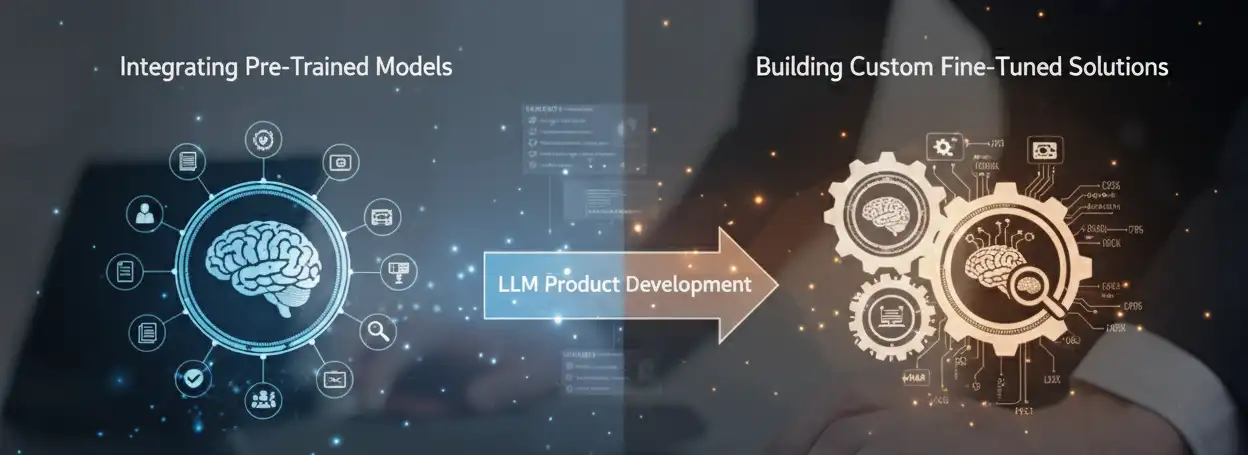
Integrating Pre-Trained Models vs Building Custom Fine-Tuned Solutions
Integrating-Pre-Trained-Models-vs-Building-Custom-Fine-Tuned-Solutions

Many enterprises begin by integrating pre-trained large language models through APIs for rapid prototyping. This offers speed and simplicity but limits customization.

Fine-tuned or custom models, on the other hand, are trained on domain-specific data, such as legal texts, medical records, or company documents, to achieve higher precision. Fine-tuning improves domain alignment, tone consistency, and factual accuracy, enabling products to perform specialized tasks.

In practice, most LLM-based product development initiatives adopt a hybrid approach: start with pre-trained models for validation, then evolve into fine-tuned or retrieval-augmented architectures for production.

Reason for Product Development with LLMs

The strategic rationale behind product development with LLMs extends far beyond novelty. These models deliver tangible benefits that enhance user experience, automate operations, and expand innovation capacity.

  • Natural Language Understanding for Better UX
    LLMs understand human intent, enabling intuitive interfaces. They remove friction from digital experiences by allowing users to interact naturally using conversation or text instead of structured commands.
  • Contextual Intelligence for Personalized Automation
    By analyzing context and history, LLM products adapt dynamically to user needs, providing personalized insights, recommendations, or actions. This creates a more human and meaningful interaction between users and machines.
  • Multimodal Expansion for Enhanced Functionality
    Modern LLMs extend beyond text, they interpret images, code, and speech. This enables new categories of products like visual question-answering tools, AI copilots, and content generation platforms.


Types of LLM Products

The potential of large language models (LLMs) extends far beyond chatbots and text generation. Their ability to understand, reason, and generate contextually accurate content makes them versatile engines of innovation across industries and business functions.

LLM product development enables enterprises to infuse intelligence into every layer of their digital ecosystem, from customer interaction and analytics to automation and creative production. Below are the key categories of LLM-based products shaping the modern enterprise landscape.

Conversational AI
Conversational-AI

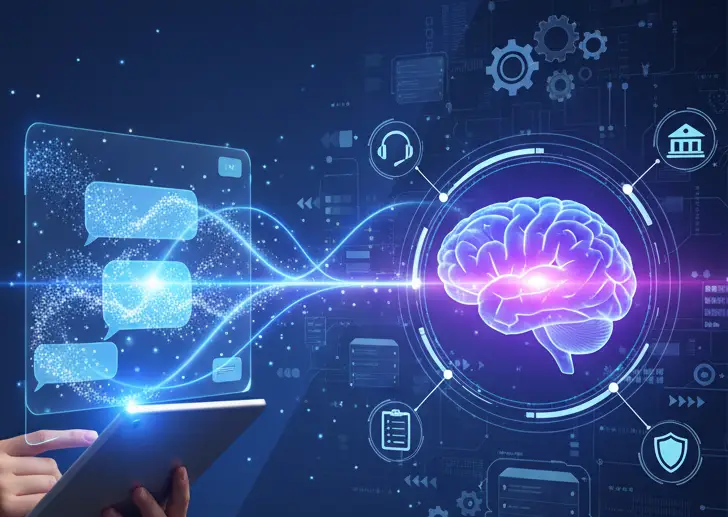
Conversational interfaces powered by LLMs represent the most recognizable and widely adopted form of AI-driven engagement. These include customer service chatbots, intelligent voice assistants, and virtual agents integrated into enterprise helpdesks.

Unlike rule-based bots, LLM systems interpret nuance, emotion, and intent, allowing fluid, natural conversations. They can answer complex queries, escalate issues intelligently, and even mirror the tone and style of human communication.

For example, an insurance company can deploy an LLM-based chatbot to guide customers through policy selection or claims processing, reducing call center workloads while improving satisfaction.


From reactive support to proactive conversation, redefine engagement with intelligent AI assistants.
Explore Experion’s LLM-Powered Conversational AI Solutions


Knowledge Assistants

Knowledge assistants are LLM-based products designed for enterprises managing vast information repositories, such as internal documentation, product manuals, and reports.

Using retrieval-augmented generation (RAG), these assistants combine generative AI with document retrieval, ensuring responses are grounded in company data. Employees can ask natural language questions like “What were our top five revenue drivers last quarter?” and receive concise, sourced answers.

For global enterprises, LLM systems like these enhance productivity, reduce information silos, and accelerate decision-making.

Workflow Automation Tools

In product development with LLMs, automation is one of the most powerful use cases. These tools interpret natural language commands and translate them into executable actions, such as generating reports, drafting emails, creating tickets, or triggering integrations with ERP systems.

For instance, an operations manager could type, “Summarize last week’s logistics delays and notify the warehouse leads,” and the LLM product would compile the relevant data, summarize findings, and automate the communication.

This represents a paradigm shift from manual workflows to AI-driven orchestration.

Data Analytics and Insights Platforms

Large language models are transforming how users interact with data. Traditional BI dashboards require technical skill to navigate, but LLM-based products allow users to query data using natural language.

A sales leader could ask, “Show me regions where revenue declined by more than 10% last quarter,” and the LLM system would parse the query, retrieve data, and visualize the result.

By democratizing access to analytics, LLMs empower non-technical users to make data-driven decisions faster, improving agility across the organization.

AI Copilots

AI copilots are among the most transformative LLM-based products today. Whether for developers, marketers, or analysts, these copilots act as intelligent collaborators, guiding users through tasks, generating suggestions, and reducing cognitive load.

In software engineering, for example, a copilot powered by LLMs can predict code completions, identify bugs, and explain complex code snippets. For marketers, it can draft campaign content, optimize SEO, or analyze engagement metrics.

These copilots represent the future of LLM product development, context-aware assistants that amplify human capability.

Content Generation Platforms

Content generation is one of the most commercially visible use cases of LLMs. From marketing and journalism to e-learning and entertainment, LLM-based products automate the creation of articles, scripts, and educational materials.

The sophistication of large language models allows for tone, style, and context adaptation, ensuring the generated content aligns with brand voice and regulatory standards.

Enterprises use these tools to accelerate production cycles and scale personalized communication without compromising quality.

Code Assistants

LLM systems are revolutionizing software development by serving as intelligent coding partners. These assistants can generate boilerplate code, debug scripts, refactor logic, and create documentation automatically.

By integrating into IDEs like VS Code or JetBrains, LLM-based products enhance developer efficiency, reduce errors, and accelerate delivery timelines.

The result is not a replacement for engineers but an augmentation, humans focusing on architecture and creativity while the LLM handles repetitive tasks.

Domain-Specific AI Applications

Industries with specialized knowledge requirements, like law, medicine, or finance, are adopting LLM-based products tailored to their needs.

For example:

  • Legal firms use LLMs for contract analysis and precedent research.
  • Healthcare providers deploy AI-driven assistants to summarize clinical data and aid diagnosis.
  • Financial institutions rely on LLM systems for compliance automation and risk assessment.

These LLM-based applications demonstrate the versatility of product development with LLMs across regulated domains, where precision and context are paramount.

The Bigger Picture

Taken together, these categories illustrate a fundamental shift in software design. The rise of LLM product development signals the emergence of AI as a collaborator, an active, adaptive partner embedded in every workflow.

Organizations that embrace this transformation position themselves at the forefront of intelligent innovation.


LLMs aren’t just transforming products, they’re redefining how products think.
Learn How Experion Engineers AI-Driven Product Ecosystems


The Core Stages of LLM Product Development

The-Core-Stages-of-LLM-Product-Development


Bringing an LLM product from concept to market involves a series of deliberate, interconnected stages. These stages ensure that the final product is not only technologically sound but strategically aligned, ethical, and scalable.

Ideation and Problem Definition

Every LLM-based product development journey starts with a clear understanding of the business problem to be solved. Enterprises must look beyond hype and focus on value creation, identifying how large language models can drive measurable impact.

  • Identifying Use Cases : The first step is mapping organizational pain points that can benefit from language intelligence. This might include automating customer queries, improving internal knowledge access, or streamlining workflows.For instance, a global logistics firm might explore an LLM system to automate supply chain reporting, while a university might envision a virtual tutor powered by LLMs to personalize learning experiences.
  • Feasibility and Value Assessment : Not every challenge is an ideal fit for LLMs. Feasibility studies help evaluate whether the problem justifies the investment and data availability. Questions like “Is the data accessible and compliant?” or “Does an LLM outperform existing tools?” guide decision-making.
  • Strategic Alignment : Finally, product goals must align with broader organizational strategy. The LLM initiative should support core objectives, whether improving customer satisfaction, reducing operational costs, or enabling new revenue streams.This stage is also where product leaders, AI teams, and business stakeholders converge to define success metrics, timelines, and governance structures.


Great AI products don’t start with code, they start with clarity.
Discover Experion’s Strategic AI Product Consulting Services


Model Selection and Data Strategy

Once the business case is established, attention shifts to the technical foundation—selecting the model and designing the data ecosystem that fuels it. The choices made here determine scalability, accuracy, and compliance in the long run.

  • Model Selection : Selecting an appropriate large language model depends on several factors:
    1. Task Complexity: Simple classification tasks may use smaller models, while reasoning-heavy applications benefit from larger architectures like GPT-4 or Claude.
    1. Privacy Needs: Highly regulated industries may prefer open-source LLMs (e.g., Llama 3, Mistral) deployed on private infrastructure for maximum control.
    2. Cost and Latency: For cost-sensitive use cases, smaller models or model-routing strategies balance performance with budget efficiency.

    Enterprises often begin with pre-trained APIs for experimentation, then migrate to customized or fine-tuned LLM systems for scale.

  • Building the Data Pipeline : Data is the lifeblood of LLM product development. Building a robust pipeline involves:
    1. Data Collection: Aggregating high-quality, representative data from reliable sources.
    1. Data Cleaning: Removing inconsistencies, duplicates, and irrelevant noise.
    2. Labeling and Structuring: Tagging data to improve contextual understanding during fine-tuning.
    3. Integration with Enterprise Systems: Connecting internal knowledge bases, CRMs, and data warehouses.

    Well-structured data pipelines ensure that LLM-based products deliver responses that are not only coherent but contextually grounded and trustworthy.

  • Governance and Compliance : In parallel, enterprises must establish governance frameworks to manage data privacy, security, and ethical use. This includes encryption, anonymization, and audit trails for all model interactions.A strong governance layer ensures that LLM systems comply with evolving regulations like GDPR or HIPAA, safeguarding both data integrity and brand reputation.

Experion’s Data-First Philosophy

At Experion Technologies, we believe that every successful LLM product begins with a data-first strategy.

Our approach emphasizes:

  1. Data quality and integrity over quantity.
  2. Privacy and compliance baked into every data flow.
  3. Architecture scalability to accommodate future model evolution.

By combining deep domain expertise with proven data engineering capabilities, we ensure that each client’s LLM-based product development initiative rests on a foundation of trust, accuracy, and adaptability.

Fine-Tuning and Prompt Engineering

Fine-tuning and prompt engineering are the two most critical levers for tailoring large language models (LLMs) to enterprise needs. While pre-trained models like GPT-4, Claude, or Llama are powerful general-purpose engines, fine-tuning them transforms these models into precise, domain-specific intelligence systems.

  • Fine-Tuning for Domain Precision : Fine-tuning refers to retraining an LLM on domain-specific datasets to refine its understanding of specialized language, terminologies, and contextual nuances. For example, a financial institution may fine-tune a base model on compliance documents and transaction logs, while a healthcare provider may use medical literature to improve diagnostic accuracy.This process enhances contextual relevance and factual reliability, allowing the LLM product to deliver insights that align closely with organizational expertise. Fine-tuned LLM systems can:
    1. Generate accurate, industry-specific responses
    2. Understand proprietary terms and abbreviations
    3. Maintain tone and compliance consistency in outputs

    Fine-tuning also plays a vital role in improving LLM-based product development for regulated sectors, ensuring adherence to privacy, legal, and ethical standards.

  • Prompt Engineering for Dynamic Adaptability : While fine-tuning optimizes model parameters, prompt engineering focuses on guiding model behavior dynamically, without retraining. It involves crafting inputs (prompts) that influence the LLM’s reasoning, tone, and structure of responses.Well-designed prompts can dramatically enhance performance by clarifying intent and providing examples within the query. For instance:“Summarize the customer feedback with focus on negative sentiment and suggestions.”
    is far more effective than simply asking “Summarize the feedback.”Advanced prompt engineering techniques include:

    1. Few-shot prompting: Providing examples within the prompt to establish context
    2. Chain-of-thought prompting: Encouraging the model to reason step-by-step
    3. Context window optimization: Feeding the most relevant prior interactions for continuity

    This balance between fine-tuning and prompt design allows product development with LLMs to remain flexible, cost-effective, and adaptive to real-world demands.

  • Continuous Learning Through Human Feedback : To further refine performance, Reinforcement Learning from Human Feedback (RLHF) is employed. Human evaluators score model responses, and this feedback is used to guide future generations of the model. Over time, this process enables continuous improvement, reducing bias and increasing alignment with enterprise objectives.Together, fine-tuning, prompt engineering, and RLHF ensure that LLM systems remain responsive, reliable, and aligned with both user expectations and business goals.


A model that learns continuously delivers value continuously.
Discover Experion’s Expertise in LLM Training and Optimization


Architecture and Integration

A robust architecture is the backbone of successful LLM-based product development. As enterprises scale from prototypes to production environments, architectural decisions determine how efficiently models perform, how secure they remain, and how easily they can evolve.

  • Designing Scalable, Modular Systems : Modern LLM products require an architecture that is modular, fault-tolerant, and scalable.
  • Microservices architecture : allows each AI component (data ingestion, model inference, monitoring, etc.) to evolve independently.
  • APIs : serve as connective tissue, enabling seamless integration between the model, databases, user interfaces, and third-party systems.
    This modularity ensures rapid iteration and easier maintenance as LLM systems mature over time.
  • Vector Databases and Retrieval-Augmented Generation : Enterprises increasingly combine large language models with vector databases, such as Pinecone, Weaviate, or FAISS, to store and retrieve contextual embeddings. This technique, known as Retrieval-Augmented Generation (RAG), grounds model outputs in trusted enterprise data sources.Instead of generating responses purely from training data, the model references internal documentation, knowledge bases, or policies, significantly reducing hallucinations and improving factual accuracy.
  • Cloud, Hybrid, and On-Premise Deployments : Choosing the right deployment strategy depends on compliance, performance, and cost considerations:
    1. Cloud deployments offer agility and scalability, ideal for rapid experimentation.
    1. Hybrid models combine the cloud’s flexibility with on-prem security for sensitive workloads.
    2. On-premise setups are preferred in industries with strict regulatory constraints.

    Leading cloud-native platforms, including AWS Bedrock, Azure OpenAI, and Google Vertex AI, enable managed deployment of LLMs, offering elasticity, governance, and observability.

Testing, Evaluation, and Optimization

Testing and validation are critical steps in transforming a promising LLM prototype into a reliable enterprise product. Without rigorous evaluation, even the most sophisticated model can produce unpredictable results.

  • Performance and Reliability Testing : Every LLM product must undergo thorough benchmarking across dimensions such as accuracy, latency, interpretability, and scalability. Enterprises measure:
    1. Accuracy: How well outputs align with expected responses
    1. Latency: How fast the model responds under varying load conditions
    2. Interpretability: Whether responses can be traced or explained to end-users

    Consistency across these metrics ensures the LLM system performs reliably in production environments.

  • Bias, Safety, and Ethical Evaluation : Large language models are susceptible to biases inherent in their training data. Testing must include structured bias detection, fairness validation, and content filtering. Safety audits evaluate whether the model inadvertently generates harmful, offensive, or non-compliant outputs.Responsible LLM product development also includes ethical guardrails such as explainability reports, human review checkpoints, and clear accountability protocols. This builds trust among both users and regulators.
  • Optimization for Cost and Efficiency : Operational efficiency is crucial in product development with LLMs. Advanced optimization techniques such as quantization, model pruning, and distillation can reduce computational demands without compromising accuracy.Caching frequently used results, implementing dynamic batching, and using serverless inference layers further optimize costs.By combining engineering discipline with AI lifecycle management, enterprises can scale intelligently while maintaining predictable operational expenses.
  • Continuous Evaluation and Improvement : Evaluation doesn’t stop at launch. Feedback-driven loops ensure ongoing improvements to accuracy and usability. Experiments with alternative prompts, model parameters, or retrieval strategies can drive iterative optimization.

Continuous evaluation transforms LLM development from a one-time project into an evolving capability. At Experion, we architect LLM-based systems with scalability and compliance as first-class principles, ensuring every deployment is both future-ready and secure.


Measure relentlessly. Optimize intelligently. Deliver responsibly.
See How Experion Ensures Enterprise-Grade LLM Reliability


Deployment and Monitoring

Deployment is the moment of transformation, when a concept becomes a living, intelligent product. But for LLM-based products, the real work begins after deployment.

  • Automated CI/CD Pipelines for LLMs

Continuous Integration and Continuous Deployment (CI/CD) are essential for managing rapid iterations. Automated pipelines enable teams to push updates, integrate new datasets, or adjust model parameters safely without downtime.
At Experion, we design pipelines that align with MLOps best practices, ensuring governance, rollback safety, and version traceability across model updates.

  • Real-Time Monitoring and Drift Detection

Once live, LLM systems must be continuously monitored for:

  1. Accuracy drift: Changes in performance over time due to evolving data or usage contexts.
  2. Bias drift: Subtle shifts in fairness or sentiment across responses.
  3. Operational anomalies: Latency spikes, API failures, or scaling bottlenecks.

Automated observability dashboards and alerts help teams proactively detect and mitigate these issues before they affect end-users.

  • Retraining and Lifecycle Management

Data ecosystems evolve, and so must your LLM product. Scheduled retraining ensures that the model remains current, particularly in fast-moving industries such as finance or healthcare. Feedback from real-world usage fuels continuous fine-tuning, keeping performance sharp and relevant.

  • Measuring ROI and User Satisfaction

Ultimately, the success of LLM-based product development lies in measurable outcomes. Enterprises should define KPIs such as customer engagement rates, resolution times, cost savings, and user satisfaction.
Analytics dashboards provide real-time visibility into how the LLM system impacts business metrics, turning AI performance into quantifiable business value.

Experion’s Continuous Support Model

At Experion Technologies, our work doesn’t end at deployment. We offer LLM monitoring frameworks, retraining pipelines, and compliance audits that ensure long-term model stability, transparency, and ethical alignment.
By combining deep AI engineering with enterprise-grade DevOps, we help clients operationalize LLMs safely and sustainably.

These four stages, fine-tuning, architectural design, testing, and deployment, define the technical core of LLM-based product development. Together, they ensure that products powered by large language models are not just functional, but reliable, compliant, and aligned with business goals.

With the right expertise, tooling, and governance, LLM product development becomes more than a technology investment, it becomes a pathway to continuous innovation.


Your model’s lifecycle begins at launch, not ends there.
Talk to Experion About Operationalizing LLM Systems at Scale


Challenges in LLM-Based Product Development

Building scalable, enterprise-ready LLM based products goes far beyond training a large language model. It requires balancing innovation with responsibility, speed with reliability, and intelligence with ethics. As organizations accelerate their LLM product development journey, several challenges emerge that must be addressed strategically:

  1. High Computational and Operational Costs:
    Training and fine-tuning large language models (LLMs) demand significant processing power and cloud infrastructure. The financial and environmental costs of maintaining these models at scale can quickly become prohibitive without optimization and MLOps automation.
  2. Data Privacy and Ethical Implications:
    As LLM systems rely on vast datasets, ensuring compliance with privacy laws (such as GDPR and HIPAA) is critical. Ethical concerns, including data ownership, consent, and responsible AI usage, must be addressed through robust governance frameworks.
  3. Maintaining Contextual Relevance and Accuracy:
    One of the biggest challenges in product development with LLMs is maintaining accuracy across diverse contexts. Without proper fine-tuning and feedback loops, models may generate contextually irrelevant or misleading information.
  4. Scaling Infrastructure for Enterprise-Grade Performance:
    Deploying LLM based products across global enterprise environments requires elastic infrastructure, distributed processing, and latency optimization. Achieving this balance is vital for consistent, high-performance results.
  5. Managing Model Hallucination and Bias:
    Even the best LLMs can occasionally “hallucinate”, generating confident but inaccurate responses. In sensitive industries like healthcare or finance, this can have serious consequences. Continuous monitoring, human validation, and ethical AI frameworks are essential to minimize these risks.

These challenges underscore why LLM product development is not just a technical endeavor, but a multidisciplinary process requiring collaboration, governance, and continuous learning.


Best Practices for Successful LLM Systems

Enterprises aiming to build reliable, secure, and scalable LLM systems must combine innovation with accountability. The following best practices form the foundation of sustainable LLM based product development:

  • Adopt a Human-in-the-Loop Approach:
    Combining human expertise with machine intelligence ensures better accuracy, contextual understanding, and ethical oversight, especially in decision-critical domains.
  • Focus on Explainability and Transparency:
    As large language models become embedded in products, explainable AI is essential. Users and regulators need visibility into how outputs are generated and validated.
  • Use Modular Architecture:
    Designing LLM products with modular frameworks allows for faster updates, easy fine-tuning, and seamless integration with other enterprise systems.
  • Invest in Continuous Learning and MLOps Integration:
    Incorporating feedback loops and automated pipelines enables ongoing improvement in LLM systems, keeping them relevant as data and user needs evolve.
  • Collaborate Across Disciplines Early:
    Effective product development with LLMs requires tight collaboration between AI engineers, domain experts, and UX designers from the outset. This ensures the system is not only intelligent but also intuitive and user-centric.

These practices elevate LLM product development from experimental to enterprise-grade, blending performance, compliance, and innovation into one cohesive framework.


Use Cases Across Industries

LLM based products are reshaping industries by bringing intelligence, automation, and personalization into core operations. Here’s how enterprises across sectors are leveraging large language models to gain a competitive edge:

  • Healthcare:
    LLM systems assist clinicians with decision support, automate documentation, and enhance patient interactions through conversational AI, driving efficiency and better outcomes.
  • Finance:
    From risk analysis and fraud detection to compliance automation, LLMs help financial institutions manage complex data with speed, accuracy, and transparency.
  • Retail:
    LLM based products enable hyper-personalized recommendations, intelligent customer service automation, and demand forecasting that adapts to real-time market signals.
  • Education:
    Adaptive learning assistants powered by large language models personalize content delivery, assist educators, and support multilingual learning experiences.
  • Manufacturing:
    Intelligent chatbots and knowledge documentation tools streamline operations, while predictive maintenance systems use LLMs to forecast failures and minimize downtime.

As industries embrace LLM product development, the focus is shifting from experimentation to real-world impact, driving productivity, innovation, and customer engagement at scale.


The Future of LLM Product Development

Future-of-LLM-Product-Development

  • Multimodal Models: LLMs that understand images, video, audio plus text
  • Retrieval-Augmented Generation (RAG) & hybrid memory systems for grounding outputs
  • Agentic AI systems: chains of autonomous agents collaborating
  • Democratization via low-code / no-code LLM tooling
  • Generative AI copilots becoming central in enterprise ecosystems

The future of LLM product development is about building intelligent ecosystems, not just isolated models.


How Businesses Can Get Started?

  • Start with a small, high-impact MVP
  • Define clear metrics for success (accuracy, cost, user satisfaction)
  • Partner with an experienced AI product engineering team (like Experion)
  • Build foundation models or choose open / proprietary models carefully
  • Focus on data strategy, governance, and feedback loops early


From prototype to production, make your LLM journey a value-first path.
Explore Experion’s LLM Product Services


Conclusion

LLM product development is ushering in a new era of intelligent, language-first applications. By leveraging large language models, organizations can build llm based products that understand users, generate insight, and reinvent engagement.

However, success requires more than just models, it requires careful product design, architecture, governance, and continuous evolution. The most successful LLM products are those that integrate feedback, ensure safety, and deliver consistent value.

At Experion Technologies, we help enterprises transform ideas into robust LLM systems, delivering innovation that scales across domains.

Key Takeaways

  • LLM product development redefines how products interact, reason, and learn
  • Choosing the right foundation model (open or proprietary) is foundational
  • Core stages span ideation, data strategy, tuning, architecture, deployment, and monitoring
  • Challenges include cost, privacy, drift, hallucinations, and scaling
  • Best practices emphasize human oversight, modular design, continuous learning
  • Tools like LangChain, Vertex AI, and MLOps stacks accelerate development

The future includes multimodal systems, agentic AI, and low-code LLM democratization

AI for IT Operations (AIOps)

AI-for-IT-Operations-AIOps-1

In a hyperconnected business landscape, where digital experiences define customer loyalty and operational resilience dictates competitiveness, IT operations stand at the core of enterprise success. Modern organizations depend on intricate technology ecosystems,  spanning cloud, hybrid, and on-premise environments, to deliver uninterrupted services, data insights, and innovation velocity. Yet, these systems are more complex than ever before.

Traditional IT monitoring and management approaches often fail to keep pace. As enterprises generate millions of logs, alerts, and metrics daily, human oversight alone cannot ensure optimal performance or rapid incident resolution. This is where AI for IT Operations (AIOps), also referred to as aiops, ai for it, ai driven it operations, or ai for information technology, becomes transformative.

AIOps uses artificial intelligence in IT operations to enable proactive monitoring, predictive maintenance, and automated problem resolution. It marks a strategic shift from reactive IT management toward autonomous, business-aligned operations, creating intelligent systems that sense, learn, and adapt continuously.


Understanding AI for IT Operations (AIOps)

Understanding-AI

AI for IT Operations (AIOps) is the fusion of artificial intelligence, machine learning, and big data analytics applied to IT systems to automate and enhance operational workflows. Introduced by Gartner, the concept encapsulates the vision of IT that is self-healing, data-driven, and continuously optimizing.

AIOps systems collect massive streams of operational data, logs, events, telemetry, metrics, tickets, and more, and process them in real-time to detect anomalies, correlate events, and trigger automated actions. This is far beyond simple rule-based automation; AIOps learns dynamically from every interaction, improving its accuracy and insight over time.

In essence, AIOps transforms IT operations from a cost center to a strategic advantage, ensuring uptime, agility, and innovation readiness for the digital enterprise.

The acceleration of digital transformation has redefined IT’s role in organizations. Multi-cloud adoption, DevOps pipelines, edge computing, and containerized environments generate unprecedented data complexity. Manual management simply cannot scale.

According to Gartner, over 50% of large enterprises will deploy AIOps platforms by 2026 to enhance observability and automation. This surge is driven by three primary forces:

  • The need for real-time visibility across hybrid environments.
  • The demand for predictive insights to prevent disruptions.
  • The pressure to optimize costs and resource utilization amid growing infrastructure sprawl.

In this context, AIOps and AI-driven IT operations are no longer futuristic, they are the operational foundation of digital-first enterprises.

Difference Between Traditional ITOM and AIOps

Aspect Traditional ITOM AIOps
Approach Reactive problem-solving after failures Proactive, predictive intelligence preventing incidents
Data Handling Siloed monitoring tools and manual dashboards Unified, cross-domain analytics powered by AI
Scalability Limited by human capacity Infinitely scalable through ML and automation
Decision-Making Human-dependent and slow AI-assisted and real-time
Outcomes Reactive firefighting Autonomous, optimized IT performance


Key Goals of AIOps

AIO

The ultimate purpose of AI for IT Operations (AIOps) is not simply to automate tasks but to redefine how IT functions align with business outcomes. Traditional IT management often focuses on maintaining system health and service availability; AIOps elevates this role by introducing intelligence, agility, and predictability into every layer of the digital ecosystem. The following goals represent the core value AIOps brings to modern enterprises.

  1. Efficiency

At its core, AIOps aims to make IT operations smarter and more efficient. Through AI-driven analytics, AIOps identifies redundant processes, optimizes resource allocation, and automates repetitive workflows. This streamlined approach not only enhances performance but also reduces operational costs.

In large-scale environments, AIOps helps teams handle millions of data points automatically, allowing IT staff to shift focus from manual monitoring to innovation. By eliminating inefficiencies and improving system orchestration, organizations achieve higher productivity with the same or fewer resources.

  1. Automation

A defining feature of AI in IT operations is intelligent automation. AIOps platforms can autonomously handle common operational tasks, such as restarting failed services, adjusting configurations, or initiating failover protocols, without human intervention.

This automation is not merely reactive; it is context-aware and adaptive. Machine learning enables the system to learn from past actions, improving decision accuracy over time. As a result, human experts can devote their attention to strategic initiatives like architecture optimization, cybersecurity enhancements, and business innovation rather than repetitive maintenance.

  1. Predictive Insights

Unlike traditional IT systems that respond to incidents after they occur, AIOps provides predictive visibility into potential disruptions. By analyzing historical trends and real-time data streams, AIOps forecasts performance bottlenecks, capacity shortages, or application slowdowns before they impact users.

This predictive intelligence allows enterprises to adopt a “prevention over cure” mindset. For instance, AIOps can alert teams when system performance begins to deviate from normal parameters, enabling proactive resolution before service degradation occurs. The outcome is a more reliable, stable, and agile IT environment.

  1. Incident Reduction

One of the most measurable outcomes of implementing AI-driven IT operations is a significant reduction in incidents and downtime. AIOps platforms automatically correlate data across systems, identify recurring failure patterns, and recommend permanent fixes rather than temporary workarounds.

By filtering out redundant alerts and prioritizing critical events, AIOps reduces “noise fatigue” among IT teams. This ensures that support resources are focused on resolving high-impact issues quickly and effectively. Fewer incidents mean improved service-level agreements (SLAs), higher customer satisfaction, and better alignment with business goals.


“Don’t just manage your IT, make it think for itself.”
Discover AI-Driven IT Operations with Experion


Key Components of AIOps

The effectiveness of AIOps lies in its ability to integrate data, intelligence, and automation into a cohesive operational framework. These components work in synergy to create a system that continuously learns, adapts, and optimizes IT operations at scale.

  1. Data Collection and Integration

Modern enterprises operate across complex technology landscapes that include on-premises infrastructure, cloud platforms, microservices, and distributed applications. Each layer generates massive volumes of data, from performance logs and system metrics to event alerts and API calls.

AIOps serves as a unifying data fabric that consolidates this information across disparate systems and tools. It collects and normalizes data from various sources, ensuring consistency and context. This integrated data foundation enables IT teams to gain end-to-end observability, making it easier to detect anomalies, identify dependencies, and understand how different components influence each other.

High-quality data integration is essential for ensuring that AIOps delivers accurate and actionable insights. Without it, even the most advanced AI algorithms can produce misleading results.

  1. Event Correlation

In large IT ecosystems, thousands of alerts are generated every hour, many overlapping, repetitive, or irrelevant. Event correlation, a cornerstone of AI in IT operations, uses pattern recognition and contextual mapping to transform this overwhelming alert volume into actionable intelligence.

AIOps platforms automatically group related events, identify patterns, and correlate alerts that share common causes. For example, if several application errors stem from a single database latency issue, AIOps will recognize this relationship and generate one consolidated incident for investigation.

By significantly reducing alert noise, event correlation improves both Mean Time to Detect (MTTD) and Mean Time to Resolve (MTTR), two of the most critical metrics in IT service management. The outcome is faster incident resolution and improved operational clarity.

  1. Machine Learning Models

Machine learning (ML) is the analytical brain behind AIOps and AI-driven IT operations. ML models continuously learn from data—analyzing past behavior, identifying deviations from normal patterns, and predicting future incidents.

For example, a model might learn that CPU spikes during month-end financial processing are normal, but similar spikes at other times are anomalies that warrant attention. Over time, these models become more sophisticated, adjusting to changes in workloads, software updates, and user behavior.

The application of supervised and unsupervised learning techniques allows AIOps to detect previously unseen patterns and proactively identify potential failures. This predictive and adaptive capability ensures that IT operations evolve alongside the business, maintaining high performance and resilience.

  1. Automation and Remediation

The defining promise of AIOps lies in automation—particularly in achieving self-healing systems that can resolve issues with minimal human input. Once AIOps identifies a problem, it can automatically execute corrective actions such as restarting a failing service, reallocating resources, or rolling back a recent code deployment.

This capability dramatically improves uptime and operational efficiency. Automation also ensures consistency and compliance, as predefined rules and policies guide every automated response. Importantly, this does not eliminate the human role; rather, it augments human intelligence by handling repetitive tasks, allowing engineers to focus on innovation, system design, and optimization.

AIOps-driven remediation shortens incident cycles and helps organizations meet or exceed SLA commitments while improving end-user experience.

  1. Visualization and Insights

Even the most advanced analytics are only as valuable as the insights they deliver. AIOps visualization tools convert complex data into intuitive, interactive dashboards that provide a unified view of system health, risk areas, and performance trends.

These dashboards empower IT teams, business leaders, and executives to make data-driven decisions that align operational outcomes with strategic objectives. Whether it’s predicting server failures, optimizing cloud costs, or forecasting future workloads, AIOps visualization offers real-time intelligence that bridges the gap between technology and business.

Through AI-powered analytics and reporting, enterprises gain actionable visibility that supports smarter investments, improved service delivery, and faster innovation cycles.

Together, these components form the foundation of a modern AI for IT operations ecosystem, one that is intelligent, adaptive, and capable of continuous learning. Organizations that successfully integrate these pillars experience measurable improvements in operational efficiency, service reliability, and business agility.


“Transform data noise into meaningful insight.”
See How Experion’s AIOps Framework Makes It Possible


Core Benefits of AI in IT Operations

automation-benefits

The adoption of AI for IT operations (AIOps) marks a paradigm shift in how enterprises manage digital infrastructure. Beyond automation, AIOps brings foresight, intelligence, and agility to the core of IT management. It enables organizations to move from reactive troubleshooting to predictive control, ensuring business continuity and efficiency at scale.

  • Improved System Uptime and Availability : In the digital economy, downtime is not just an inconvenience—it is a direct hit to revenue, reputation, and customer trust. Even a few minutes of service disruption can translate to millions in losses for global enterprises. AIOps ensures continuous system availability by identifying potential risks before they materialize and triggering proactive mitigation.For example, when CPU utilization or memory thresholds approach critical levels, AIOps platforms can automatically scale resources, rebalance workloads, or alert relevant teams before performance degradation impacts users. By combining machine learning with predictive analytics, AIOps delivers a level of operational resilience previously unattainable through traditional IT monitoring.
  • Noise Reduction and Alert Optimization : Modern IT environments generate an overwhelming volume of alerts daily—many of which are redundant, irrelevant, or false positives. This “alert fatigue” prevents IT teams from focusing on critical incidents. AIOps solves this challenge through intelligent event correlation, clustering related alerts, identifying patterns, and filtering noise to highlight genuine threats.As a result, teams spend less time sifting through log data and more time resolving real issues. The outcome is a more efficient and less stressful IT environment, where human effort is focused where it matters most.
  • Faster Root Cause Analysis : When issues arise, every second counts. Traditional troubleshooting involves manually piecing together logs, metrics, and system data—a process that can take hours or even days. AIOps accelerates root cause analysis by correlating data across domains such as servers, networks, databases, and applications. Machine learning algorithms identify the precise source of failure by comparing current anomalies with historical behavior. This drastically reduces mean time to resolve (MTTR), allowing teams to restore normal operations faster and minimize business impact.
  • Predictive Issue Detection : AI in IT operations transforms IT from reactive to predictive. Instead of waiting for alerts or user complaints, AIOps continuously analyzes telemetry and behavior patterns to forecast potential failures. Through anomaly detection, it identifies deviations that precede incidents—whether it’s a slow database query, a memory leak, or an impending disk failure. This predictive capability enables IT teams to address vulnerabilities before they escalate, improving service reliability and enhancing user experience.
  • Resource Optimization and Cost Control : Enterprises face increasing pressure to optimize infrastructure costs, particularly in complex cloud and hybrid environments. AI-driven IT operations use machine learning to understand usage trends, detect inefficiencies, and right-size cloud resources in real time.By automating capacity adjustments and identifying underutilized assets, AIOps helps organizations maintain cost efficiency without sacrificing performance. This proactive management of resources supports both financial discipline and environmental sustainability through reduced energy consumption.
  • Resource Optimization and Cost Control : AIOps serves as a unifying intelligence layer that bridges the traditional silos between IT operations, DevOps, and SecOps teams. By integrating data from diverse sources into a centralized platform, it provides a shared, consistent view of system health and performance.
    This fosters better communication, faster decision-making, and a culture of collaboration. Business leaders, developers, and security professionals can align their objectives around a single source of truth, ultimately improving the organization’s overall agility and service quality.


Real-World Use Cases of Artificial Intelligence in IT Operations

The practical applications of AIOps span across industries and IT functions. From reducing incident response time to optimizing cloud spending, the real-world impact of artificial intelligence in IT operations is measurable and transformative. Below are some of the most compelling use cases shaping the modern enterprise.

Incident Management and Resolution

Incident management is one of the most mature and impactful applications of AIOps. Through automated anomaly detection, prioritization, and correlation, AIOps platforms can identify the underlying cause of recurring issues and trigger corrective actions autonomously.

Organizations implementing AIOps have reported reductions of up to 60% in incident volume and significant improvements in service availability. This not only enhances IT efficiency but also strengthens the enterprise’s ability to deliver seamless digital experiences to its customers.

Predictive Maintenance

Predictive maintenance powered by AI in IT operations transforms how enterprises manage physical and virtual assets. By analyzing historical sensor data, system logs, and environmental conditions, AIOps can predict hardware or software failures before they occur.

For example, in a data center, AIOps might detect subtle fluctuations in server temperature or power usage that indicate an impending hardware fault. Early detection allows for proactive replacement or repair, preventing downtime and optimizing asset utilization.

Performance Monitoring

In today’s multi-cloud and hybrid IT landscapes, performance monitoring has grown increasingly complex. AIOps simplifies this by correlating performance metrics across diverse environments, including on-premise systems, private clouds, and public cloud providers.

It provides a unified, real-time view of system health and automatically alerts teams when anomalies arise. By ensuring consistent performance across the ecosystem, AIOps enhances end-user satisfaction and business continuity.

Cybersecurity Operations

Security operations are no longer isolated from IT performance. With growing cyber threats and increasing data volume, traditional security monitoring tools are insufficient. Integrating AIOps with security analytics allows enterprises to detect abnormal patterns, privilege escalations, or unauthorized data access faster and more accurately.

Machine learning models continuously learn from new threat data, enabling adaptive, real-time security intelligence. This proactive approach significantly reduces detection time and strengthens the organization’s overall cybersecurity posture.

Capacity Planning and Optimization

In dynamic IT environments, predicting demand and managing capacity effectively are key to maintaining performance and avoiding cost overruns. AIOps provides intelligent forecasting capabilities that analyze workload trends, user behavior, and historical utilization patterns.

This enables enterprises to anticipate resource demands and make informed decisions about scaling infrastructure. The result is an IT environment that remains efficient, flexible, and responsive to business needs.

Cloud and Hybrid Infrastructure Management

As organizations increasingly adopt multi-cloud strategies, visibility and control across platforms become critical. AIOps acts as the central nervous system for cloud and hybrid IT operations, unifying monitoring, automation, and cost optimization across diverse ecosystems.

It ensures that workloads are distributed efficiently, compliance is maintained, and system reliability is maximized. AIOps empowers IT leaders to make informed, data-driven decisions while simplifying management complexity.


At Experion Technologies, we enable global enterprises to harness the full power of AIOps for intelligent monitoring, predictive analytics, and automated remediation. Our solutions ensure seamless performance across multi-cloud and hybrid infrastructures, helping organizations achieve greater reliability, agility, and scalability in their digital operations.


Challenges and Considerations in Implementing AI for Information Technology

Implementing AI for IT Operations (AIOps) is not simply a matter of deploying new technology. It requires strategic alignment, organizational readiness, and a long-term vision for transforming IT into an intelligent, data-driven function. Many enterprises underestimate the cultural and operational shifts required to make AIOps successful. The following challenges are among the most critical to address during the journey toward AI-driven IT operations.

  • Data Quality and Integration : AIOps is only as intelligent as the data it consumes. Fragmented, incomplete, or poor-quality data severely limits the accuracy and reliability of AI-driven insights. Enterprises often have data dispersed across multiple systems, tools, and vendors, which creates silos and inconsistencies. To unlock the full potential of AIOps, organizations must invest in clean, normalized, and integrated data pipelines that unify logs, metrics, and events across their IT landscape. High-quality data serves as the foundation for effective automation and predictive analytics.
  • Change Management and Cultural Adoption : Transitioning from traditional IT operations to an AI-enabled model requires more than technical upgrades. It demands a cultural mindset shift across teams. Resistance often stems from concerns over automation replacing human expertise or altering established workflows. Successful AIOps adoption involves transparent communication, role redefinition, and leadership commitment to continuous learning and collaboration. Change management strategies should focus on empowering IT professionals with AI tools that enhance, rather than replace, their capabilities.
  • Over-Automation Risks : Automation is one of the strongest advantages of AIOps, but it also introduces potential risks when not balanced with human oversight. Over-automation can lead to unintended actions, cascading errors, or overlooked anomalies in critical systems. Enterprises must define clear governance frameworks and control policies that ensure human validation for high-impact decisions. The goal of AIOps should be augmented intelligence, where AI supports human expertise through intelligent recommendations and automated responses within safe boundaries.
  • Skill Gaps and Workforce Readiness : The success of AIOps depends heavily on the skills of the people managing it. IT teams must be equipped with expertise in machine learning, data science, and domain-specific IT knowledge to interpret insights accurately and refine automation models. Upskilling initiatives, partnerships with AI specialists, and knowledge-sharing programs are vital to bridge this talent gap. AIOps is not just about algorithms; it is about empowering people to work effectively with intelligent systems.
  • Vendor Lock-In and Tool Compatibility : With a wide array of AIOps platforms available, enterprises must be cautious of vendor dependency. Proprietary ecosystems can restrict flexibility, increase long-term costs, and limit integration with emerging technologies. Organizations should prioritize open, interoperable, and API-driven AIOps platforms that align with their evolving IT architecture. Flexibility ensures that the AIOps implementation remains scalable, future-proof, and adaptable to business needs.


“Traditional monitoring reacts. AIOps anticipates. Which one powers your business?”
Explore the AIOps Difference with Experion


Best Practices for Successful Adoption of AI for IT Operations

While AIOps offers immense potential, its successful implementation relies on a well-structured and phased approach. Organizations must treat AIOps as a strategic transformation initiative rather than a one-time deployment. The following best practices have proven effective in ensuring that AI for IT operations delivers measurable, sustainable outcomes.

  1. Start with a Pilot Project

Begin with a focused pilot to validate AIOps capabilities in a specific domain such as incident management, performance monitoring, or capacity planning. A controlled environment allows IT teams to test algorithms, analyze results, and understand the system’s impact before expanding across the enterprise. Early wins from pilot projects help build confidence and stakeholder buy-in for larger rollouts.

  1. Ensure Data Hygiene and Integrity

AIOps depends on the quality of data it ingests. Establish strong data governance practices that ensure consistency, accuracy, and timeliness of operational data. Build unified data pipelines that consolidate information from disparate sources such as network devices, servers, applications, and security systems. Clean data enables more accurate anomaly detection, event correlation, and predictive insights—turning raw information into actionable intelligence.

  1. Combine Human and Machine Intelligence

The true power of AI in IT operations lies in the collaboration between human expertise and machine intelligence. Encourage IT professionals to use AI-driven recommendations as decision support tools. Human judgment remains essential for contextual understanding, prioritization, and ethical oversight. This hybrid approach ensures that automation amplifies human efficiency without compromising critical decision-making.

  1. Promote Cross-Functional Alignment

AIOps is most effective when it bridges silos between IT, DevOps, and SecOps teams. Cross-functional collaboration ensures that insights generated by AIOps are relevant to multiple operational areas, from performance monitoring to security and compliance. Building shared ownership and unified metrics enables faster response times and improved service reliability. Executive sponsorship is key to maintaining alignment and accountability across teams.

  1. Embrace Continuous Learning and Model Refinement

AI systems are dynamic and must evolve as the enterprise grows. Establish a process of continuous feedback and model retraining to ensure that AIOps algorithms adapt to changing workloads, technologies, and business objectives. Regularly reviewing the outcomes of automated decisions improves the accuracy and reliability of predictive analytics. Treat AIOps as a living ecosystem that learns, adjusts, and matures over time.

  1. Prioritize Platform Scalability and Interoperability

As the IT environment expands, AIOps platforms must scale accordingly. Choose solutions that are modular, cloud-ready, and integration-friendly with your existing tools and systems. Interoperability allows organizations to incorporate emerging technologies, including generative AI for IT operations, without major architectural disruptions. Scalable AIOps frameworks ensure that automation and intelligence can grow alongside business ambitions.


AIOps Market Trends and Future Outlook

The global AIOps market is expanding rapidly, projected to exceed $25 billion by 2030. The growth trajectory reflects enterprises’ shift toward predictive, autonomous operations.

  • Growing Industry Adoption : Sectors such as finance, healthcare, retail, and manufacturing are using AI in information technology to improve uptime and compliance.
  • Convergence of IT Disciplines : AIOps is merging with DevOps, CloudOps, and SecOps — creating unified, intelligent operational ecosystems.
  • The Rise of Generative AI for IT Operations : Generative AI is revolutionizing IT support — enabling conversational troubleshooting, automated documentation, and contextual incident guidance.
  • Predictive and Autonomous Systems : Future IT environments will rely on predictive analytics and autonomous orchestration, where systems self-optimize based on business objectives.
  • The AIOps Future : In the next decade, AIOps will evolve into the backbone of digital enterprise infrastructure, enabling resilience, adaptability, and real-time business insight.


“The future of IT is predictive, autonomous, and intelligent,  powered by Experion.”
Connect with Our AIOps Specialists Today


Experion’s Take on AI for IT

At Experion Technologies, we view AI for IT Operations (AIOps) not merely as a technology solution, but as a strategic enabler of enterprise transformation. For us, AIOps represents the convergence of innovation, intelligence, and operational excellence. It is the foundation upon which future-ready enterprises build resilience, agility, and business continuity in an increasingly digital and unpredictable world.

Experion’s AIOps approach is centered on three key dimensions: observability, analytics, and automation.

  • Observability allows IT teams to see across complex, hybrid environments with real-time precision. Our solutions capture and unify logs, events, and metrics to provide a single, transparent view of operational health.
  • Analytics transforms this raw data into insight. Through advanced AI and machine learning algorithms, we help organizations detect anomalies, anticipate performance degradation, and identify root causes faster than ever before.
  • Automation is where intelligence meets action. Experion’s frameworks integrate AI-driven automation across workflows, empowering systems to respond autonomously to incidents and continuously optimize performance.

These three pillars together create a self-learning ecosystem that improves with every data point and every decision.

We also integrate generative AI capabilities into IT management, enabling faster, more intuitive decision-making. By using conversational interfaces, context-aware assistants, and AI-guided diagnostics, Experion helps IT teams work smarter, reduce cognitive load, and accelerate root cause analysis. This is not simply about operational efficiency—it is about enabling human potential through intelligent augmentation.

Our ultimate goal is to help organizations deliver proactive service reliability at scale. We enable IT operations that not only detect problems but prevent them. With Experion, enterprises gain a partner that combines deep domain expertise, AI innovation, and digital engineering excellence to architect intelligent IT ecosystems that drive measurable business outcomes.

In a rapidly evolving digital economy, Experion stands at the intersection of technology and transformation, helping global enterprises navigate the complexity of IT operations with confidence, intelligence, and foresight.


Conclusion

In today’s digital economy, AI for IT Operations (AIOps) has moved from being a forward-looking concept to an operational necessity. The sheer scale, speed, and complexity of modern IT environments demand intelligence that human teams alone cannot provide. AIOps fills this gap by combining artificial intelligence, machine learning, and data analytics to monitor, predict, and optimize IT performance in real time.

By adopting AIOps, enterprises can transform their IT operations from a reactive service function into a strategic, predictive, and intelligent capability. Instead of reacting to incidents after they occur, organizations can foresee potential disruptions, automate resolutions, and ensure seamless digital experiences for customers and employees alike.

AIOps is not merely about technology; it is about elevating IT to a leadership role in business transformation. When implemented effectively, it becomes the catalyst for digital maturity, enabling continuous improvement, faster innovation, and better alignment between IT and business objectives.

The future of enterprise success depends on the ability to anticipate change, act decisively, and operate intelligently. AIOps provides this capability, turning complex IT ecosystems into adaptive, self-optimizing engines of growth.

At Experion Technologies, we believe that AIOps is the bridge between technology performance and business success. Our mission is to help organizations embrace this evolution, empowering IT teams with the intelligence, automation, and agility they need to lead confidently into the digital future.

Key Takeaways

  • AIOps transforms IT into a proactive, data-driven function.
  • It integrates AI, ML, and analytics for predictive operations.
  • Generative AI adds conversational intelligence and decision automation.
  • Experion’s AIOps expertise helps enterprises achieve intelligent, self-healing IT ecosystems.

Data Platform Modernization

Modernization is at the heart of every digital transformation journey. As organizations strive to become data-driven, their ability to harness, process, and act on information in real time becomes a strategic differentiator. However, many enterprises are still reliant on legacy data systems, monolithic architectures designed for a different era of computing.

These legacy systems were once reliable workhorses, but today they have become bottlenecks. They struggle to manage the velocity, variety, and volume of modern data, hindering agility and innovation. This is why forward-looking businesses are embracing data platform modernization, a comprehensive approach to reengineering their data platforms for the cloud era.

Browse the Sections:

  1. Understanding a Data Platform
  2. Differences Between Traditional and Modern Data Platforms
  3. What is Data Platform Modernization?
  4. Platform Modernization vs Migration
  5. The Pain Points: Why Legacy Systems Are Holding You Back
  6. Why Modernize Data Platforms?
  7. Key Components of Data Platform Modernization
  8. Steps in Data Platform Modernization 
  9. Benefits of Modernizing Your Data Platform
  10. Challenges in Data Platform Modernization
  11. Modernization Trends and Technologies
  12. Choosing the Right Partner for Data Platform Modernization
  13. How Experion Can Offer Support in Data Platform Modernization?
  14. Case Study
  15. Conclusion


Understanding a Data Platform

Data Platform Modernization

A data platform is the foundational system that enables organizations to collect, store, manage, process, and analyze data from various sources. It serves as the central nervous system for digital enterprises, connecting applications, analytics, and decision-making processes.

A modern data platform typically includes the following core components:

  • Data Storage: Secure and scalable repositories that house structured, semi-structured, and unstructured data.
  • Data Processing: Frameworks and engines that transform raw data into meaningful information.
  • Data Analytics: Tools and technologies that empower users to visualize insights, identify trends, and drive business outcomes.

When designed and implemented effectively, a modern data platform becomes the backbone of a data-driven enterprise, supporting everything from operational efficiency to advanced AI/ML applications.

Differences Between Traditional and Modern Data Platforms

Aspect Traditional Data Platform Modern Data Platform
Architecture Monolithic, on-premise systems Cloud-native, modular, and distributed
Scalability Limited and resource-intensive Elastic and virtually unlimited
Data Handling Structured data only Handles structured, semi-structured, and unstructured data
Processing Batch-oriented Real-time and event-driven
Integration Manual and siloed Automated and API-driven
Analytics Retrospective reporting Predictive and prescriptive insights
Maintenance High operational overhead Automated, self-optimizing systems

Traditional systems were not designed for the era of AI, IoT, or real-time analytics. In contrast, a modern data platform leverages cloud-native platforms and modern data management frameworks to deliver flexibility, scalability, and intelligence at speed.


What is Data Platform Modernization?

Data Platform Modernization

Data Platform Modernization refers to the strategic transformation of an organization’s data infrastructure, processes, and tools to align with modern business requirements. It involves re-architecting or migrating legacy systems to cloud-native, scalable, and AI-ready platforms that enable real-time analytics, automation, and innovation.

Modernization goes beyond technology upgrades, it is about data platform transformation, aligning infrastructure with business goals and empowering organizations to leverage data as a strategic asset.

Platform Modernization vs. Migration

While often used interchangeably, platform modernization and migration are distinct concepts.

  • Migration involves moving existing data and applications from one environment (often on-premise) to another (like the cloud).
  • Modernization, however, is transformational. It reimagines data architecture, governance, and operations for scalability, agility, and intelligence.

In other words, migration is a step within modernization, but modernization itself represents a broader shift toward data driven platform modernization that supports AI, analytics, and continuous innovation.


The Pain Points: Why Legacy Systems Are Holding You Back

Architectural Roadblocks

  1. Rigidity and Inflexibility

Legacy data systems are inherently rigid. They rely on tightly coupled components, making it difficult to introduce new tools or technologies. This rigidity limits innovation and slows time-to-market for new data initiatives.

  1. Data Silos and Fragmentation

Older platforms often lead to fragmented data storage and siloed operations. Teams struggle to access or integrate data across departments, leading to inconsistencies, duplication, and governance issues.

  1. Inability to Handle Scale

As data volume grows exponentially, legacy architectures fail to scale efficiently. Traditional storage and processing systems cannot manage today’s demands for real-time analytics and global data accessibility.

Operational and Financial Drain

  1. High Operational Costs

Maintaining on-premise legacy systems is resource-intensive. Continuous hardware upgrades, licensing costs, and manual management inflate operational expenditure (OpEx).

  1. Performance Bottlenecks

Outdated platforms cannot keep up with the speed of modern applications. Long processing times, limited automation, and system latency create bottlenecks that impede data availability and responsiveness.

The Failure to Future-Proof

  1. Lack of AI/ML Readiness

Modern businesses rely on predictive and prescriptive analytics powered by AI and machine learning. Legacy data platforms lack the processing power, flexibility, and data structures necessary to support these workloads.

  1. Governance and Security Gaps

Traditional systems often fall short of today’s stringent data protection and compliance requirements. Without modern governance frameworks, organizations risk non-compliance and data breaches.


Why Modernize Data Platforms?

Data Platform Modernization

The journey toward data platform modernization is no longer a matter of if—it’s a matter of when. As organizations accelerate their digital transformation initiatives, data has emerged as the most valuable enterprise asset. However, the infrastructure that manages this data often lags behind modern expectations. Legacy systems, while once reliable, now struggle to meet the demands of real-time analytics, scalability, and automation that define today’s digital economy.

Modernizing the data platform is about more than upgrading technology, it’s about empowering the enterprise to be truly data-driven. It’s a strategic investment in agility, resilience, and intelligence. Let’s explore why modernization is not just beneficial, but essential.

Challenges with Legacy Systems

Legacy data systems were built for a different era, one defined by structured data, batch processing, and limited connectivity. In contrast, the modern enterprise operates in a world of streaming data, multi-cloud ecosystems, and AI-driven insights. These older platforms present several challenges that hinder innovation and scalability.

  1. Scalability Limitations

Traditional on-premises data warehouses often require manual scaling, which is both time-consuming and costly. As data volumes surge exponentially, these systems cannot elastically adjust to fluctuating demands. This results in bottlenecks during peak usage periods and underutilization during off-peak hours. In contrast, modern data platforms built on cloud-native architectures scale seamlessly and automatically, ensuring consistent performance and cost efficiency.

  1. High Maintenance Costs

Maintaining legacy systems involves heavy infrastructure management, licensing fees, and manual interventions. Each upgrade or integration introduces new complexities and costs. These expenses accumulate into a high Total Cost of Ownership (TCO), diverting resources away from innovation. By adopting platform modernization, enterprises can transition to cloud-based data platforms with automated maintenance, significantly reducing operational overheads.

  1. Lack of Real-Time Analytics

Legacy systems typically operate on batch data processing cycles, producing delayed insights. In a world where real-time decision-making drives competitive advantage, this delay can be detrimental. Modern data platforms enable continuous data ingestion and instant analytics, empowering business leaders with up-to-the-minute visibility into operations, customer behavior, and market dynamics.

  1. Security and Compliance Risks

Outdated systems are more vulnerable to breaches and often lack compliance capabilities aligned with modern regulations such as GDPR and HIPAA. A data modernization initiative introduces robust security protocols, encryption, and governance frameworks embedded natively into cloud-native platforms, ensuring both compliance and trust.

  1. Limited Flexibility and Integration

Legacy data platforms typically rely on rigid architectures that make integrating new tools, applications, or AI/ML models a complex task. They hinder innovation by isolating data and preventing interoperability across systems. In contrast, a modern data platform leverages APIs, microservices, and modular design for effortless integration and adaptability to emerging technologies.

Business Drivers for Modernization

Organizations embarking on data platform transformation are motivated by clear, measurable business imperatives that align directly with growth, efficiency, and innovation.

  1. Accelerate Decision-Making

In fast-moving markets, decisions must be driven by data, not instinct. Modern data platforms unify diverse data sources and deliver real-time, actionable insights to business leaders. With integrated analytics and AI-driven dashboards, enterprises can identify opportunities, mitigate risks, and make informed decisions faster than competitors.

This data-driven platform modernization ensures that decision-making is no longer hindered by latency or siloed data, but is powered by an always-on, intelligent ecosystem.

  1. Reduce Costs

Cost optimization is one of the strongest financial drivers for platform modernization. Cloud-native infrastructures eliminate the need for expensive on-premises hardware, while automation minimizes human intervention. Scalable architectures allow businesses to pay only for what they use, driving down infrastructure and operational expenses. Over time, the ROI of data modernization manifests through lower maintenance costs, faster deployment cycles, and improved operational efficiency.

  1. Enhance Customer Experience

Customer expectations are evolving rapidly. Delivering personalized, real-time experiences requires instant access to accurate, unified data. Modernizing the data platform allows organizations to integrate data from multiple touchpoints, CRM systems, digital channels, and IoT devices, to create a 360-degree customer view.

This unified data approach empowers enterprises to predict customer needs, tailor interactions, and strengthen engagement through data-driven insights. The result is a superior, consistent, and personalized customer experience.

  1. Drive Innovation

A modern data platform lays the foundation for innovation by supporting AI/ML integration, predictive analytics, and automation. These capabilities enable enterprises to transform data into foresight, uncover new revenue opportunities, and accelerate digital agility.

For example, AI models can predict market trends, optimize supply chains, or automate decision-making in real time, but only if supported by a scalable, intelligent data infrastructure. Thus, data platform modernization becomes a catalyst for enterprise innovation and continuous transformation.

  1. The Strategic Imperative

In essence, modernizing the data platform is not a technical upgrade—it’s a strategic imperative for sustainable growth. It allows enterprises to evolve from reactive, siloed operations to data-driven, intelligent ecosystems that anticipate change and respond dynamically.

By investing in data platform modernization, organizations can reduce inefficiencies, unlock new insights, and accelerate their journey toward digital maturity. The result is a future-ready enterprise, resilient, innovative, and equipped to compete in an increasingly data-centric world.


Modernization is not about replacing technology; it’s about empowering the business to think, act, and grow intelligently.
Explore Experion’s Modern Data Platform Solutions Today


Key Components of Data Platform Modernization

Data Platform Modernization

Cloud Adoption

The cloud is the cornerstone of platform modernization. Migrating to public, private, or hybrid cloud environments offers elasticity, scalability, and cost-effectiveness.

  • Public Cloud: Offers on-demand scalability and managed services.
  • Private Cloud: Provides enhanced security and control for sensitive data.
  • Hybrid Cloud: Combines both to deliver flexibility and compliance.

Cloud adoption also enables cloud-native platforms that support modern data management and continuous deployment at scale.

Data Architecture Modernization

Legacy monolithic architectures are being replaced by modular and distributed designs that enable agility. Modern architectures leverage:

  • Data Lakes: Centralized repositories for raw, diverse data.
  • Data Warehouses: Structured storage for analytics-ready datasets.
  • Lakehouses: Hybrid architectures that unify the best of both worlds.

This data modernization journey allows enterprises to seamlessly handle structured and unstructured data, improve accessibility, and accelerate analytical performance.

Data Integration and ETL/ELT Modernization

Traditional ETL pipelines struggle with modern data velocity. Today’s data platform transformation embraces real-time data streaming and modern ETL/ELT tools that automate ingestion and processing.

Real-time integration ensures that analytics reflect the current state of the business, enabling faster and more informed decisions.

Advanced Analytics and AI Readiness

A modern data platform must be built for the future. By integrating AI and machine learning capabilities, organizations can move from reactive to predictive decision-making.

Data platform modernization enables AI-readiness, allowing enterprises to run complex models, automate analytics, and support advanced workloads seamlessly.

Security, Compliance, and Governance

Modern data governance frameworks are essential to maintain trust and regulatory compliance. From GDPR to HIPAA, enterprises must ensure data protection, traceability, and ethical use.

A cloud-native, modern data platform integrates security by design, embedding identity management, access controls, and encryption at every layer.

At Experion Technologies, we help enterprises modernize their data ecosystems by combining cloud-native engineering, modern governance frameworks, and AI-readiness to build scalable, secure, and intelligent data platforms.


Steps in Data Platform Modernization

  1. Assessment and Audit

The modernization journey begins with a deep evaluation of current systems. This involves analyzing architecture, identifying bottlenecks, and assessing data maturity to determine readiness.

  1. Strategy and Roadmap Development

Modernization should align with business goals, not just IT objectives. Defining a roadmap involves choosing the right architecture, cloud strategy, and data management approach that aligns with the organization’s vision.

  1. Migration Execution

Migration can take different forms:

  • Lift-and-Shift: Moving existing workloads to the cloud with minimal changes.
  • Re-Architecture: Redesigning systems to fully leverage modern capabilities.

Best practices include minimizing downtime, ensuring data integrity, and adopting phased rollouts for risk mitigation.

  1. Testing and Optimization

Comprehensive performance testing validates that the new platform meets business expectations. Data quality checks, latency testing, and failover simulations ensure operational readiness.

  1. Monitoring and Continuous Improvement

Modernization is not a one-time initiative. Continuous monitoring, observability, and iterative optimization ensure that the modern data platform evolves alongside business needs and emerging technologies.


Benefits of Modernizing Your Data Platform

  • Scalability and Performance: Adapt instantly to changing workloads and data volumes.
  • Operational Efficiency: Reduce maintenance overhead through automation and managed services.
  • Real-Time Decision-Making: Enable analytics that empower leaders with instant, actionable insights.
  • Enhanced Security and Compliance: Protect sensitive data with modern security frameworks.
  • AI and ML Enablement: Prepare your data environment for predictive intelligence and next-gen analytics.


Challenges in Data Platform Modernization

While the advantages of data platform modernization are substantial, ranging from agility and scalability to advanced analytics, organizations must navigate a set of strategic and operational challenges during implementation. Recognizing these obstacles early helps enterprises design mitigation strategies and ensure a smoother data platform transformation journey.

  • High Upfront Investment

Modernizing a data platform is a transformative initiative that often requires significant upfront investment. The transition involves costs related to infrastructure upgrades, cloud adoption, licensing, and reskilling employees. Additionally, aligning modernization with business goals demands executive sponsorship and long-term vision.
However, this investment should be viewed not as an expense but as a strategic enabler. Organizations that modernize successfully often realize long-term savings through reduced operational overhead, improved performance, and faster innovation cycles. A clearly defined business case and ROI framework are essential to secure leadership buy-in and maintain momentum throughout the modernization process.

  • Legacy Dependencies

Legacy systems rarely exist in isolation, they are embedded within a web of enterprise applications, data warehouses, and operational tools. This interdependence can make integration with new, modern data platforms highly complex. Migrating data while ensuring compatibility with legacy interfaces, workflows, and user expectations demands meticulous planning.
Many organizations adopt a phased modernization approach, running hybrid environments temporarily while gradually shifting workloads to modern, cloud-native architectures. The goal is to minimize disruption while ensuring continuity of critical business functions.

  • Data Migration Risks

Data migration is one of the most technically challenging components of data modernization. The risks include data loss, corruption, quality degradation, and downtime. Inconsistent data formats or incomplete mapping between old and new schemas can lead to integrity issues that affect analytics accuracy.
To mitigate these risks, enterprises should invest in robust migration tools, rigorous testing frameworks, and backup strategies. Employing automated ETL/ELT pipelines and validation scripts ensures smoother transitions and consistent data quality. Expert oversight is critical to ensure that no vital data is lost in translation during the migration process.

  • Change Management

Technology modernization is only part of the equation; people and processes play an equally vital role. Moving from legacy systems to a modern data platform introduces new workflows, tools, and responsibilities. Teams accustomed to traditional systems may resist change or lack the skills required to manage new architectures.
Successful modernization requires a structured change management framework, focusing on training, communication, and culture building. Upskilling employees in areas such as cloud engineering, data governance, and modern data management ensures a confident, capable workforce that can harness the potential of modernized systems.


True modernization requires more than new technology, it requires vision, alignment, and expertise.
Partner with Experion for a Seamless Data Platform Modernization Journey


Modernization Trends and Technologies

Data Platform Modernization

The landscape of data platform modernization is evolving rapidly. As enterprises adapt to new market realities and digital transformation imperatives, several key trends are defining how organizations modernize their data ecosystems. These trends underscore a fundamental shift toward cloud-native platforms, intelligent automation, and decentralized data ownership.

Cloud-Native Data Platforms

The adoption of cloud-native data platforms represents one of the most significant transformations in enterprise IT. By leveraging the elasticity and on-demand scalability of the cloud, organizations can dynamically manage workloads, reduce infrastructure costs, and deploy updates faster.
Cloud-native architectures also enable containerization, microservices, and serverless computing, offering flexibility unmatched by legacy environments. These platforms empower enterprises to build resilient, adaptive, and globally scalable data ecosystems that evolve alongside business needs.
Whether through AWS, Azure, or Google Cloud, cloud-native modernization provides a foundation for data driven platform modernization that supports real-time analytics, AI workloads, and continuous innovation.

AI-Powered Data Management

Artificial intelligence is redefining how data is governed, processed, and secured. AI-powered data management introduces automation at every stage of the data lifecycle—from data curation and cleansing to anomaly detection and compliance auditing.
Machine learning algorithms can automatically identify patterns in data flows, detect irregularities, and even predict potential failures or breaches. This not only improves data quality but also accelerates decision-making.
AI-driven tools in modern data management streamline metadata tagging, lineage tracking, and predictive governance, ensuring that organizations maintain transparency, compliance, and trust in their data assets.

Multi-Cloud and Hybrid Cloud Strategies

Enterprises are increasingly moving toward multi-cloud and hybrid cloud architectures to achieve flexibility, redundancy, and compliance across geographies. Relying on a single cloud vendor can introduce risks related to cost, performance, and regulatory constraints.
A multi-cloud approach enables businesses to select the best tools and services from multiple providers, optimizing performance and reducing vendor lock-in. Meanwhile, hybrid cloud environments allow organizations to maintain sensitive data on-premise while leveraging cloud resources for scalability and analytics.
Together, these strategies provide the ideal balance between control, compliance, and innovation, aligning perfectly with modern enterprise data needs.

Data Mesh and Decentralized Architectures

The data mesh paradigm represents a radical shift in how enterprises manage and share data. Instead of treating data as a centralized asset controlled by a single IT function, a data mesh decentralizes ownership—giving each business domain responsibility for its own data products.
This approach enhances agility, encourages accountability, and promotes cross-functional data collaboration. It aligns well with organizations adopting modern data platform strategies that prioritize autonomy and scalability.
By implementing decentralized architectures, enterprises can achieve faster innovation cycles and better align data insights with business objectives.

Automation in Data Operations

As data environments grow more complex, automation is becoming indispensable. Automation in data operations (DataOps) ensures efficiency, consistency, and reliability throughout the data lifecycle.
Tasks like pipeline orchestration, data validation, monitoring, and remediation can be fully automated, reducing human error and improving response times. Automated workflows enhance observability, enforce governance standards, and allow teams to focus on strategic, value-driven activities rather than routine maintenance.
When combined with AI and analytics, automation transforms data operations into self-optimizing ecosystems, paving the way for continuous improvement and innovation.


Modernization is not a destination,it’s a continuous evolution toward smarter, faster, and more intelligent data ecosystems.
Discover How Experion Accelerates Modern Data Platform Transformation


Choosing the Right Partner for Data Platform Modernization

Selecting the right partner is critical to achieving successful outcomes. Consider the following:

  • Expertise and Experience: Look for proven success in large-scale modernization initiatives.
  • Technology Stack: Ensure compatibility with your cloud and data ecosystems.
  • Strategic Approach: Partners should align with your long-term business goals, not just technical objectives.

The right partner accelerates modernization by combining deep domain expertise, best practices, and automation frameworks.

The Importance of Choosing the Right Partner

Data Platform Modernization

Given these challenges, selecting the right technology partner becomes pivotal to success. A partner with expertise in platform modernization can help assess readiness, architect the right solutions, and manage complex transitions with minimal disruption. Their experience ensures that modernization is not just a technical exercise but a strategic transformation that aligns with the organization’s business goals and growth trajectory.


How Experion Can Offer Support in Data Platform Modernization?

Data Platform Modernization

At Experion Technologies, we collaborate with enterprises to drive data-driven platform modernization that aligns technology with strategic growth.

Our teams specialize in:

  • Designing cloud-native architectures that enhance scalability and flexibility.
  • Implementing modern data lakes, warehouses, and lakehouses for unified analytics.
  • Integrating governance and compliance frameworks to safeguard data integrity.
  • Enabling AI and machine learning capabilities to maximize business intelligence.

Case Study: Transforming Legacy Data Infrastructure with Informatica Cloud Integrtion

Client Background & Challenge

A leading global enterprise (name withheld for confidentiality) was operating on a legacy on-premises data platform that struggled to support modern analytics, real-time decision-making, and scalability. Their data warehouse architecture was rigid, siloed, and lacking native support for AI/ML workloads.

As business demands increased, the system showed signs of strain: long batch processing windows, costly maintenance, and limited ability to modernize. The organization recognized that platform modernization was no longer optional but essential. They embarked on a journey toward data platform modernization and a modern data platform infrastructure to support their long-term digital transformation vision.

Objectives

  • Transition from legacy systems to a cloud-native, modern data platform
  • Enable real-time data integration and processing
  • Reduce operational costs and accelerate analytics
  • Lay groundwork for AI/ML readiness and data-driven platform modernization

Solution: Informatica Cloud Data Integration with Experion

Experion Technologies led the modernization project by adopting Informatica Cloud Data Integration as a foundational element in the data modernization strategy. This approach allowed seamless, secure connectivity across on-prem, cloud, and hybrid environments.

Key elements of the solution:

  1. Cloud-first Integration Architecture
    We restructured the data ingestion pipelines using Informatica’s cloud-native connectors and integration patterns, supporting both real-time streaming and batch modes. This shift accelerated data platform transformation by enabling timely data flow across systems.
  2. Modern ETL/ELT Processes
    Legacy ETL scripts were replaced with scalable, flexible ETL/ELT frameworks leveraging Informatica’s data mapping, transformation, and orchestration capabilities. This modernization reduced latency and simplified pipeline maintenance.
  3. Data Governance and Quality Controls
    To support modern data management, Experion incorporated comprehensive data quality checks, lineage tracking, and governance rules within the Informatica pipelines. This ensured reliability, compliance, and data trust across the enterprise.
  4. Hybrid & Multi-Cloud Compatibility
    The solution supported connectivity across public cloud, private cloud, and on-prem systems, creating a hybrid architecture that matched the organization’s risk, compliance, and performance requirements.

Results & Benefits

  • Reduced Processing Time by 60%
    Near-instant ingestion and transformation replaced overnight batch loads, accelerating analytics availability.
  • Cost Efficiency Improvement
    Infrastructure and licensing optimizations drove a 30% reduction in operational expenses.
  • Scalable & Future-Ready Platform
    The architecture now supports dynamic workloads and AI/ML integration seamlessly.
  • Stronger Governance & Compliance
    Built-in data lineage and validation improved auditability and regulatory readiness.
  • Unified, Modern Data Platform
    The enterprise achieved a cohesive, cloud-native data ecosystem, fulfilling their vision of data platform modernization and data-driven platform modernization.

Final Summary

By leveraging Informatica Cloud Data Integration in partnership with Experion, the client transcended legacy limitations and embraced a platform modernization path aligned with modern data strategy. The newly built modern data platform equips the business to deliver real-time insights, support AI initiatives, and remain agile in a data-first world.

Experion Technologies continues to support the client in optimizing data operations, evolving architecture, and driving continuous data platform transformation.


Conclusion

Data Platform Modernization is no longer a technical upgrade—it is a business imperative. As the pace of innovation accelerates, organizations that continue to rely on legacy systems risk falling behind more agile competitors.

By embracing data modernization, enterprises gain the scalability, intelligence, and agility needed to compete in a data-first world.

The future belongs to organizations that see data not just as an asset, but as a strategic enabler of growth and innovation.

Conversational AI in Banking

In today’s digital-first world, more and more banking interactions are moving online, whether through mobile apps, web portals, or messaging platforms. Customers now expect instant responses, round-the-clock availability, and proactive support for a variety of financial tasks such as checking balances, managing transactions, or receiving personalized financial advice. Conversational banking powered by AI is no longer just an enhancement; it is becoming an essential part of modern financial services, allowing banks to build stronger relationships, improve efficiency, and stay ahead in a highly competitive market.


Understanding Conversational AI

Banking-Interactions-AI

Conversational AI refers to advanced AI in banking and financial services that allows computers to understand, interpret, and respond to human language in a natural and interactive manner. In the context of banking, this encompasses conversational AI in banking services such as chatbots, voice assistants, and virtual assistants that manage routine queries, facilitate transactions, and deliver personalized guidance. By leveraging conversational banking tools, banks can engage customers efficiently, reduce response times, and provide a seamless digital experience.

The Technology Stack: Components That Power Conversational AI

  • Natural Language Processing (NLP): Core to conversational AI technology, NLP interprets customer intent and extracts meaning from text or speech, enabling AI-driven banking interactions to feel human-like and intuitive.
  • Machine Learning & AI Models: These models continually learn from past interactions, enhancing the accuracy and relevance of responses, which is critical for conversational AI in banking and fintech.
  • Integration (APIs): APIs connect AI solutions to core banking systems, CRMs, and mobile applications, ensuring conversational AI in financial services works seamlessly across multiple channels.
  • Voice Recognition & Speech-to-Text: Enables natural voice interactions through phones or smart devices, enhancing accessibility and convenience in conversational banking.
  • The Generative AI (Gen AI) Leap: Adds context-aware, human-like conversational capabilities, allowing banks to offer richer, more engaging customer experiences through conversational AI technology.

Types of Conversational AI

Conversational-AI-in-Banking

Financial institutions leverage different types of conversational AI in banking services to meet diverse customer needs and provide seamless interactions across multiple channels.

  • Chatbots (text-based): These AI-driven agents manage messaging platforms, web chats, and in-app queries efficiently. Chatbots are a fundamental part of conversational AI technology in banking, providing instant responses, handling routine questions, and guiding customers through transactions while reducing the workload on human support teams.
  • Voice Assistants: Voice-enabled AI solutions respond to phone calls or smart device prompts with natural speech. By supporting AI in banking interactions, voice assistants allow customers to complete tasks such as checking balances, initiating payments, or receiving financial guidance using simple voice commands, enhancing accessibility and convenience.
  • Hybrid Models: Combining text and voice capabilities, hybrid models offer the best of both worlds for conversational banking. They allow customers to interact in the way that suits them best, ensuring accessibility, convenience, and high engagement while delivering consistent and accurate service across multiple touchpoints.


What is Conversational AI in Banking?

Conversational AI in banking refers to the use of advanced AI in banking technologies to provide real-time, automated, and highly personalized interactions between banks and their customers. This includes everything from answering routine account queries to assisting customers with complex financial decisions such as loan applications or investment planning. By implementing conversational AI in banking services, traditional banking transforms into conversational banking, delivering experiences that are not only efficient and scalable but also customer-centric. These AI-driven interactions enable banks to offer consistent support across multiple channels, including mobile apps, web platforms, and voice-enabled devices.


From queries to insights, make every interaction count with Experion.
Connect with us


Evolution of AI in Banking: The Banking Landscape Driving AI Adoption

Conversational-AI-in-Financial-Services

  • Changing Consumer Expectations: Modern banking customers expect always-on service, mobile-first accessibility, and instant support for every interaction. Conversational AI technology allows banks to meet these rising expectations by providing intelligent, context-aware assistance at any time of day.
  • Regulatory Pressures & Security Needs: Banks face increasing compliance requirements and the critical need for secure transactions. Conversational AI in financial services supports fraud detection, authentication, and adherence to regulatory standards while maintaining seamless customer experiences.
  • Competitive Market Forces: The rapid growth of FinTechs has heightened competition, pushing traditional banks to adopt conversational AI in banking and fintech solutions to stay relevant, improve customer engagement, and innovate service delivery.


The Core Value Proposition / Key Use Cases: Why Banks Need Conversational AI

Conversational AI in banking services offers a range of practical applications that transform how banks engage with customers and streamline internal operations.

  • Customer Support & 24/7 Service: Conversational AI technology enables banks to handle FAQs, balance inquiries, and routine transactions around the clock, ensuring conversational banking that is responsive and reliable.
  • Personalized Financial Guidance: By leveraging AI in banking, institutions can provide customers with tailored advice on savings, loans, investments, and wealth management, enhancing the overall financial experience.
  • Fraud Detection & Security Alerts: Conversational AI in financial services can deliver real-time fraud alerts, assist with authentication, and help maintain secure transactions, building trust and safety for customers.
  • Loan & Credit Processing: Automation of pre-screening, document collection, and status updates through conversational AI in banking and fintech improves efficiency and reduces turnaround times.
  • Onboarding & KYC: Simplified account opening and verification processes enhance customer experience while maintaining regulatory compliance.
  • Internal Employee Assistance: Banks can deploy conversational AI technology internally to support HR, IT, and operational queries, boosting productivity and staff efficiency.


Benefits of Conversational AI in Banking

Implementing conversational AI in banking services provides significant and measurable advantages for both customers and financial institutions, transforming the way banks operate and engage with their clients.

  • Enhanced Customer Experience: With conversational AI technology, banks can provide faster response times, 24/7 support, and multilingual capabilities. Customers enjoy consistent service quality across all channels, whether interacting via mobile apps, web portals, or voice assistants. This results in higher satisfaction, stronger engagement, and more meaningful conversational banking interactions.
  • Operational Efficiency and Cost Reduction: By automating routine tasks and standard inquiries, banks can reduce reliance on large call center teams and optimize staff allocation. AI in banking allows human employees to focus on higher-value tasks, improving productivity while lowering operational costs.
  • Revenue Opportunities: Intelligent recommendations generated through conversational AI in banking and fintech help banks upsell and cross-sell products such as loans, investment plans, or savings accounts. These AI-driven insights create new revenue streams while enhancing customer personalization and engagement.
  • Data-Driven Insights: Conversational AI in financial services captures and analyzes customer interactions in real time. This provides banks with actionable insights to predict behavior, anticipate customer needs, and make informed strategic decisions. It also allows for continuous improvement of AI models, ensuring that recommendations and interactions become smarter over time.

By leveraging conversational AI technology, banks can not only meet modern customer expectations but also drive efficiency, profitability, and innovation, creating a more competitive and future-ready financial institution.


Empower your customers with next-generation conversational AI.
Connect with us


Implementation Roadmap for Conversational AI in Banking and Financial Services

Deploying conversational AI in banking services requires a structured approach to ensure successful adoption, operational efficiency, and superior customer experience.

  • Assess Business Goals & Use Cases: Identify high-impact areas where conversational AI technology can deliver the most value, such as customer service, fraud monitoring, or personalized financial guidance.
  • Select the Right Technology Stack: Decide between building an in-house solution or leveraging third-party vendors. Evaluate cloud versus on-premise deployment to ensure scalability, security, and optimal performance for AI in banking.
  • Integration with Core Banking Systems: Seamlessly connect AI solutions with CRM platforms, payment systems, mobile apps, and other banking infrastructure to enable conversational banking across all channels.
  • Training & Continuous Improvement: Continuously refine AI accuracy and natural language understanding by leveraging feedback loops, customer interactions, and performance analytics for conversational AI in financial services.
  • Compliance & Security Measures: Ensure adherence to GDPR, PCI DSS, and other data privacy frameworks to protect sensitive financial information while maintaining regulatory compliance.

At Experion, we help banks and financial institutions deploy conversational AI in banking and fintech with precision, enabling them to provide intelligent, secure, and seamless customer experiences while staying fully compliant.


Challenges and Risks of Conversational Banking

While conversational AI in banking services offers transformative benefits, financial institutions must address several challenges to ensure that solutions are secure, effective, and widely adopted:

  • Data Privacy and Security Concerns: Protecting sensitive financial information is a critical priority. Banks must ensure that all AI-driven interactions comply with data privacy regulations, secure transactions, and safeguard personal information from potential breaches.
  • Customer Trust and Adoption: For conversational banking to be successful, customers must feel confident interacting with AI systems. Transparent communication, reliable responses, and seamless escalation to human agents when needed are key to fostering trust.
  • Language and Context Complexity: Understanding regional accents, slang, and nuanced queries requires advanced conversational AI technology. Accurate interpretation and context-aware responses are essential to deliver a natural and satisfying customer experience.
  • Maintenance Costs and Scalability: As AI adoption grows, banks must ensure that systems continue to perform efficiently while scaling to handle increasing volumes of interactions. Ongoing monitoring, model updates, and resource planning are critical to maintain performance and cost-effectiveness.


The Future of Conversational AI in Banking

Future-of-Conversational-AI-in-Banking

Emerging Trends

  • Hyper Personalization: Conversational AI technology allows banks to deliver interactions tailored to each individual’s behavior, preferences, and financial history, resulting in more meaningful and engaging customer experiences.
  • AI-Powered Financial Planning and Robo Advisors: Automated and intelligent guidance helps customers make informed decisions about savings, loans, and investments, enhancing both engagement and confidence in AI in banking solutions.
  • Generative AI: Advanced generative models in conversational AI in banking and fintech enable richer, context-aware, and human-like conversations that feel natural and intuitive, taking customer interactions to the next level.
  • Voice Biometrics: Using voice as a secure authentication method improves transaction safety while providing a seamless and frictionless user experience in conversational banking.

Integration with Other Technologies

Modern conversational AI in financial services is no longer limited to standalone applications. It can seamlessly integrate with advanced technologies such as blockchain, IoT devices, and open banking APIs. This integration enhances transparency by providing secure and traceable transaction records, improves security through real-time monitoring and authentication, and enables banks to deliver a truly connected and cohesive experience across all customer touchpoints. By combining conversational banking with these technologies, financial institutions can streamline operations, reduce risks, and offer customers more intelligent and proactive services that respond to their evolving needs.


Turn conversations into connections with Experion’s AI solutions.
Connect with us


The Role of Generative AI in Next-Gen Banking Conversations

Generative AI is transforming conversational banking by enabling richer, more human-like interactions. Unlike traditional chatbots, generative AI models understand context, remember past interactions, and generate personalized responses in real time. This allows banks to provide highly engaging experiences across multiple channels, from messaging apps to voice assistants. With conversational AI technology powered by generative models, customers can receive tailored financial guidance, complex transaction support, and proactive recommendations that feel natural and intuitive.

For instance, generative AI can assist with personalized investment advice, simulate financial planning scenarios, and even draft customer communications, making AI in banking interactions more intelligent and customer-centric. This evolution of conversational AI in banking and fintech is a critical step toward building the next generation of conversational AI in financial services, where every interaction is meaningful, contextual, and seamless.


Best Practices: Conversational Banking

To successfully implement conversational AI in banking services, financial institutions must adopt a strategic approach that balances technology, compliance, and customer experience. Following these best practices ensures a smooth rollout, high adoption rates, and long-term success:

  • Start with a pilot program and scale gradually: Launching a focused pilot in a high-impact area, such as customer support, loan processing, or onboarding, allows banks to test the effectiveness of conversational AI technology. Gathering feedback from real interactions during the pilot helps refine AI models, identify gaps, and optimize performance before expanding across multiple channels or business units.
  • Maintain transparency in AI-human handoffs: Clearly communicating to customers when they are interacting with AI versus a human agent builds trust and confidence in conversational banking solutions. Providing seamless escalation options for complex queries ensures a smooth experience and enhances customer satisfaction.
  • Audit AI decisions regularly: Regular reviews of AI-driven recommendations and interactions are critical to prevent bias, ensure fairness, and comply with regulatory standards. By continuously monitoring and updating AI models, banks can maintain the accuracy, reliability, and ethical integrity of their conversational AI in financial services.
  • Foster collaboration across teams: Successful deployment of AI in banking requires close coordination between IT, compliance, customer service, and business teams. Aligning technical capabilities with organizational goals ensures that conversational AI in banking and fintech delivers consistent, high-quality experiences while meeting operational, security, and regulatory requirements.

By following these best practices, financial institutions can implement conversational AI technology that not only enhances customer engagement but also drives operational efficiency, regulatory compliance, and business growth.


Partnering with Conversational AI Solution Providers

Implementing conversational AI in banking services successfully often requires collaboration with experienced solution providers. Banks can leverage the expertise of partners who understand the intricacies of AI in banking, compliance, and system integration. These providers can help design, deploy, and optimize conversational AI technology that aligns with specific business goals, whether it’s enhancing customer support, automating loan processing, or providing internal employee assistance.

By partnering with a trusted conversational AI in banking and fintech provider, financial institutions can reduce implementation risks, accelerate time-to-market, and ensure that AI systems are scalable, secure, and continuously improved. Such partnerships also allow banks to focus on delivering value to their customers while relying on specialized teams to manage AI development, integration, and performance monitoring.


Conclusion

Conversational AI in banking services is reshaping customer interactions, driving operational efficiency, and enabling banks to deliver instant, personalized support. By implementing conversational AI technology across multiple channels, financial institutions can enhance customer satisfaction, reduce operational costs, uncover new revenue streams, and remain competitive in a rapidly evolving market.


Key Takeaways

  1. Conversational AI improves customer engagement by providing 24/7 support and personalized guidance.
  2. Operational efficiency is enhanced through automation of routine tasks and employee support.
  3. Revenue opportunities expand via intelligent recommendations and cross-selling.
  4. Fraud detection and secure authentication are strengthened with AI-driven insights.
  5. Generative AI and hyper-personalization are shaping the next generation of conversational banking experiences.
  6. Integration with blockchain, IoT, and open banking APIs enhances transparency, security, and interoperability.
  7. Continuous improvement and feedback loops ensure that AI solutions evolve with customer needs.


Ready to transform your banking experience with AI?
Connect with Experion today