




AI Data Integration

Modern enterprises are sitting on an unprecedented volume of data. Cloud platforms, SaaS applications, IoT devices, data lakes, legacy systems, and partner ecosystems are generating information at scale and speed. While data availability has increased, data usability has not kept pace.

Traditional data integration approaches, largely built on rigid ETL pipelines and manual rule configuration, struggle to keep up with today’s dynamic environments. Schema changes, real-time data needs, unstructured formats, and distributed ownership have exposed the limits of legacy integration tools.

This is where AI data integration becomes transformative. By applying artificial intelligence to how data is ingested, mapped, cleansed, and orchestrated, organizations move from brittle pipelines to adaptive, self-learning systems. The result is faster insights, higher data trust, lower operational cost, and the foundation for advanced analytics, automation, and AI initiatives.


What is AI Data Integration?
What-is-AI-Data-Integration

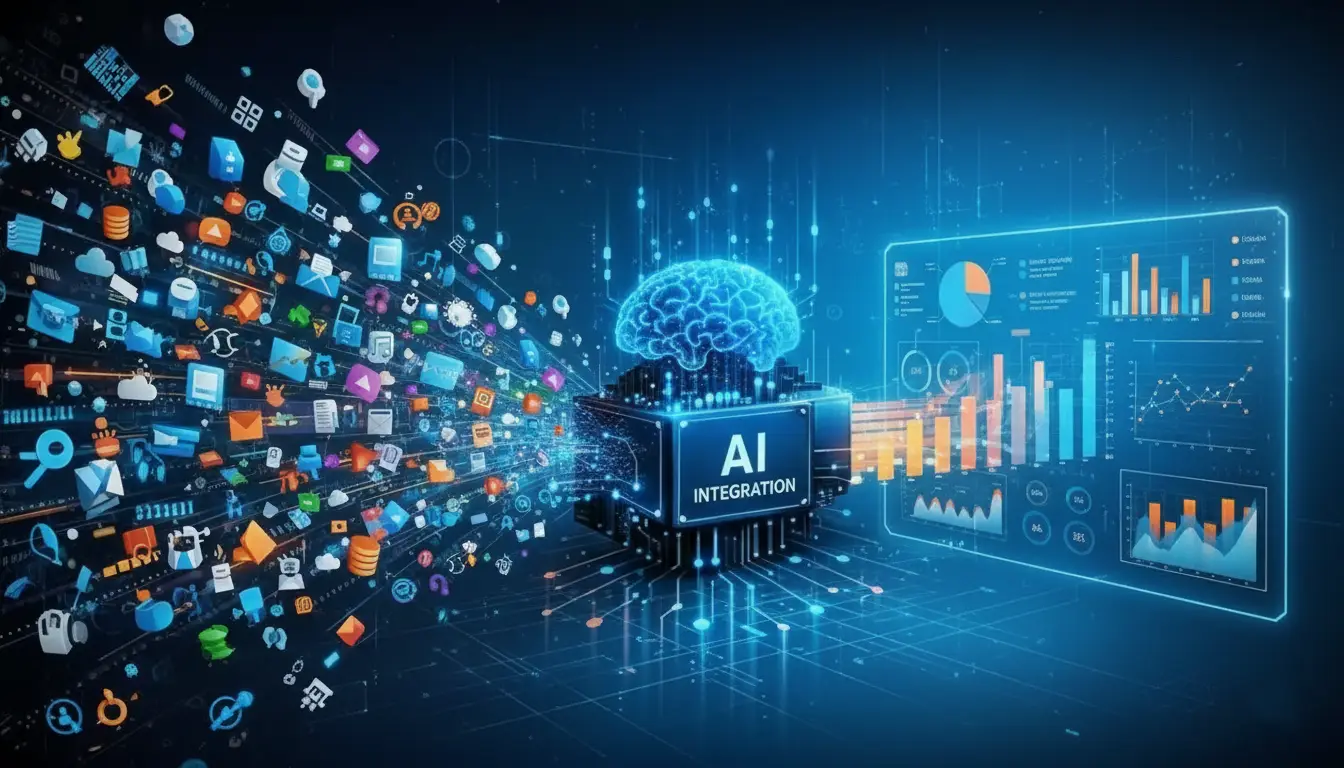
AI data integration refers to the use of artificial intelligence to automate, optimize, and continuously improve the way data is connected, transformed, and managed across diverse sources and systems. These sources may include cloud platforms, SaaS applications, on-prem databases, IoT devices, partner systems, and legacy infrastructure.

For business leaders, AI data integration represents a shift from rigid, manually configured pipelines to intelligent systems that can understand data patterns, adapt to change, and scale with business growth. Unlike traditional data integration tools that rely on predefined rules and fixed schemas, artificial intelligence data integration uses learning-based techniques to handle complexity and variability in modern data environments.

By embedding intelligence into the integration layer, organizations gain resilient data pipelines that evolve as data sources, formats, and business requirements change. This makes AI-driven data integration a foundational capability for analytics, automation, and enterprise-wide AI initiatives.

Role of Machine Learning, NLP, and Automation in Integration

Machine learning plays a central role in AI data integration by learning relationships between data fields across different systems. Instead of requiring manual mapping, ML models automatically identify similarities, recommend mappings, and refine transformations over time as more data is processed.

Natural language processing enhances integration by interpreting metadata such as column names, descriptions, logs, and documentation. NLP allows systems to understand the intent and context of data elements, making integration more accurate even when naming conventions differ across systems.

Automation ties these capabilities together by orchestrating end-to-end workflows. Automated pipelines handle ingestion, transformation, validation, and delivery while continuously monitoring performance. When failures or anomalies occur, automation triggers corrective actions, reducing downtime and manual intervention.

Together, machine learning, NLP, and automation turn data integration into a self-improving system rather than a maintenance-heavy technical task.

AI Data Integration vs AI-Powered Analytics

AI data integration and AI-powered analytics serve distinct but complementary roles within an enterprise data ecosystem.

AI data integration focuses on making data usable, reliable, and connected. It ensures that data from multiple sources is accurately ingested, standardized, enriched, and delivered in a form that analytics and AI systems can trust.

AI-powered analytics, on the other hand, focuses on extracting insights, predictions, and recommendations from that data. Advanced analytics models, dashboards, and decision-support systems depend on high-quality, well-integrated data to perform effectively.

In practice, AI-powered analytics cannot succeed without intelligent data integration. Poor data quality, inconsistent definitions, and fragmented pipelines constrain the value of even the most advanced AI models. AI data integration provides the stable, intelligent foundation that enables analytics and AI initiatives to scale and deliver business impact.


Why is Artificial Intelligence Data Integration Now a Business Priority?

Artificial-Intelligence-Data-Integration

Organizations across industries are becoming increasingly data-driven, yet many struggle to turn data into timely action. Data fragmentation across cloud services, SaaS tools, and legacy systems slows decision-making and creates blind spots.

As business intelligence, real-time analytics, and enterprise AI become central to competitive advantage, data integration must evolve alongside them. Artificial intelligence data integration enables organizations to support real-time operations, predictive analytics, and AI-driven automation without constantly reengineering pipelines.

AI-driven data integration reduces reliance on highly specialized engineering teams by automating complex integration tasks. It shortens time to insight by accelerating data onboarding and transformation. It also enables scalable data operations across cloud, hybrid, and on-prem environments, supporting global growth and digital transformation.

As companies adopt AI across functions such as finance, operations, customer experience, and supply chain, data integration becomes the critical backbone that determines whether these initiatives succeed or stall. Intelligent data integration ensures that AI investments are built on trusted, accessible, and continuously optimized data foundations.


Move from brittle ETL to intelligent data integration with Experion


How AI in Data Integration Works: Step-by-Step Architecture

Intelligent Data Ingestion

AI-powered data integration platforms connect structured, semi-structured, and unstructured data from databases, APIs, SaaS tools, IoT streams, and files. Automated source profiling and schema detection eliminate manual configuration. Organizations can support both real-time and batch ingestion with minimal setup.

AI-Driven Data Mapping and Transformation

Machine learning models automate field mapping across systems, even when naming conventions differ. When schema drift or format changes occur, the system adapts without breaking pipelines. Transformation logic becomes self-learning rather than rule-bound.

Data Quality, Cleansing, and Enrichment

AI detects anomalies, duplicates, and inconsistencies automatically. Validation and normalization rules evolve over time. Contextual enrichment pulls in reference data to improve accuracy and usability.

Metadata Management and Lineage Tracking

AI generates metadata automatically and maintains end-to-end data lineage. This enables trust, compliance, and impact analysis across downstream systems.

Continuous Monitoring and Optimization

AI monitors pipeline health, predicts failures, and applies self-healing actions. Performance tuning becomes adaptive, reducing downtime and maintenance overhead.


AI Data Integration vs Traditional Data Integration

Traditional data integration was designed for a more predictable world. It relies heavily on manually defined rules, static ETL pipelines, and scheduled batch processing. While this approach worked when data sources were limited and change was infrequent, it struggles in today’s dynamic environments where cloud platforms, SaaS tools, APIs, and streaming data constantly evolve.

AI-powered data integration introduces intelligence into the integration layer itself. Instead of rigid mappings, self-learning models recognize patterns across datasets and automatically adapt to schema changes. Adaptive workflows adjust to data volume, velocity, and variety without manual reconfiguration. Automation reduces operational overhead by detecting failures early and applying corrective actions in real time.

The differences become most visible as organizations scale. AI-driven data integration delivers higher accuracy by continuously improving data mappings, faster onboarding of new data sources, and significantly lower maintenance effort. Legacy ETL tools often fail when data velocity increases or when environments change frequently. Intelligent data integration platforms are designed to absorb change, not resist it, making them essential for modern digital enterprises.


Key Technologies in AI Data Integration


AI data integration is powered by a combination of advanced technologies working together as a unified ecosystem. Machine learning enables automated data mapping, classification, and anomaly detection. Automation orchestrates complex workflows and ensures reliability at scale.

Metadata intelligence plays a critical role by automatically generating and managing metadata, improving transparency and trust in data pipelines. Cloud-native architectures provide elasticity and global scalability, while API-driven connectivity allows seamless integration across SaaS applications, on-prem systems, and partner platforms.

Orchestration engines coordinate ingestion, transformation, validation, and delivery processes end to end. Together, these technologies create resilient, scalable, and self-optimizing integration environments that support both real-time and batch data use cases.


Key Business Benefits of AI Data Integration

AI-powered data integration delivers tangible business value across the organization. Faster time to insight allows leaders to respond quickly to market shifts and operational signals. Improved data accuracy increases confidence in analytics, reporting, and AI initiatives.

Organizations benefit from reduced integration and maintenance costs as self-learning systems replace manual rule management. Scalability across cloud and hybrid environments ensures that data integration keeps pace with business growth. Support for real-time and predictive analytics enables proactive decision-making rather than reactive reporting.

At Experion, we help enterprises move beyond fragmented data landscapes by building reliable, intelligent data foundations. These foundations power analytics, automation, and AI initiatives that scale with business ambition.


AI-Driven Data Integration Across Industries

Financial Services

In financial services, AI data integration unifies transactional systems, customer interactions, and external data sources to enable real-time risk analysis and fraud detection. By creating a single, trusted customer view, institutions improve compliance, personalize offerings, and enhance operational resilience.

Healthcare and Life Sciences

Healthcare organizations rely on AI-driven data integration to connect EHRs, medical devices, laboratory systems, and operational platforms. This unified data foundation supports predictive care models, improves clinical outcomes, and strengthens regulatory compliance across complex ecosystems.

Manufacturing and Supply Chain

In manufacturing and supply chain operations, AI integration connects IoT sensor data with ERP and MES systems. This enables predictive maintenance, accurate demand forecasting, and end-to-end operational visibility. Manufacturers gain the ability to optimize performance while reducing downtime and waste.

Retail and E-commerce

Retailers use AI-powered data integration to unify omnichannel customer data, inventory systems, and pricing engines. This supports personalized customer experiences, optimized inventory management, and data-driven pricing strategies that respond to demand in real time.

Enterprise SaaS and IT Operations

For enterprise SaaS providers and IT operations teams, AI-driven data integration delivers unified operational intelligence. By correlating events across systems, organizations automate incident detection, reduce mean time to resolution, and improve service reliability.


Transform data integration into a strategic advantage today


AI-Powered Data Integration for Real-Time and Streaming Data

Modern enterprises operate in environments where decisions must be made in seconds rather than hours. Customer interactions, IoT signals, transactions, and operational events generate continuous streams of data that lose value if not processed immediately. AI-powered data integration enables organizations to act on this information in real time.

Event-driven architectures form the foundation of real-time integration by capturing and responding to events as they occur. AI-driven stream processing adds intelligence on top of these architectures, allowing systems to filter noise, detect patterns, and correlate events across multiple data sources. This ensures that only meaningful, actionable data flows into analytics platforms and operational systems.

Artificial intelligence enhances streaming data integration by adapting to changing data patterns and volumes. Machine learning models identify anomalies, predict trends, and adjust processing rules dynamically without manual intervention. Contextual enrichment further improves decision quality by combining streaming data with historical records, reference datasets, and external signals.

By using AI-powered data integration for real-time and streaming data, organizations gain immediate visibility into operations, improve responsiveness, and enable predictive and automated actions. This capability is critical for use cases such as fraud detection, predictive maintenance, personalized customer engagement, and real-time operational monitoring, where speed and accuracy directly impact business outcomes.


Role of AI and Data Integration in Modern Data Architectures

Modern data architectures are no longer built around a single centralized system. Enterprises today operate cloud-native ecosystems that include data lakes for raw data storage, data warehouses for structured analytics, and lakehouses that combine the strengths of both. AI data integration is the connective tissue that makes these architectures usable, reliable, and scalable.

By intelligently connecting data across cloud platforms, SaaS applications, and on-prem systems, AI-driven data integration ensures that data flows seamlessly into BI tools, AI and machine learning models, and advanced analytics platforms. It removes friction between data producers and data consumers, allowing insights to travel faster across the organization.

AI data integration also plays a foundational role in enabling modern strategies such as Data Mesh and Data Fabric. In a Data Mesh approach, intelligent integration supports decentralized ownership while maintaining governance and interoperability. In a Data Fabric model, AI continuously discovers, connects, and contextualizes data assets across the enterprise. In both cases, AI transforms integration from a technical dependency into a strategic enabler of enterprise intelligence.


Data Governance, Security, and Compliance in AI Data Integration

As data volumes grow and regulations tighten, governance and security can no longer be manual or reactive. AI-powered data integration embeds governance directly into data pipelines, ensuring policies are enforced automatically as data moves across systems.

Role-based access controls restrict data usage based on identity and context. AI-driven data masking and anonymization protect sensitive information while preserving analytical value. Continuous monitoring detects policy violations, unusual access patterns, and compliance risks in real time.

Audit readiness becomes a built-in capability rather than a last-minute effort. End-to-end lineage tracking, automated documentation, and AI-assisted compliance reporting provide transparency and trust for regulators, partners, and internal stakeholders. This shift allows organizations to scale data usage without increasing risk exposure.


Challenges in AI Data Integration and How to Overcome Them

Despite its benefits, implementing AI data integration comes with challenges. Data silos remain a major obstacle when ownership is fragmented across teams and systems. AI helps by automatically discovering and connecting data assets, but organizational alignment is equally critical.

Data quality issues can undermine trust in AI-driven pipelines. These are addressed through automated validation, anomaly detection, and continuous feedback loops that improve accuracy over time. Model transparency is another concern, especially in regulated environments. Explainable AI techniques ensure integration decisions are auditable and understandable.

Legacy system integration often requires careful planning. Phased adoption, API enablement, and hybrid architectures help modernize integration without disrupting operations. Change management is essential to ensure teams trust and adopt intelligent data integration rather than reverting to manual workarounds.


AI Data Integration Implementation Best Practices

Successful AI data integration initiatives begin with clearly defined, high-impact use cases. Organizations should focus first on data flows that directly support business outcomes such as analytics, automation, or customer insights.

Building reusable integration components accelerates scaling and reduces duplication. Governance should be established early to define ownership, access rules, and quality standards. Success must be measured using clear KPIs related to data reliability, speed, and business impact.

Continuous improvement is critical. AI-driven pipelines should learn from errors, usage patterns, and performance metrics, enabling integration systems to evolve alongside business needs rather than requiring constant redesign.


Measuring ROI of AI Data Integration

The ROI of AI data integration is both immediate and long-term. In the short term, organizations see reduced integration and maintenance costs as automation replaces manual effort. Analytics delivery becomes faster, enabling quicker decision-making and operational response.

Over time, improved decision speed and data reliability translate into greater business agility. Teams spend less time aligning data and more time putting insights into action. The strategic value lies in building scalable, future-ready data foundations that support advanced analytics, AI initiatives, and digital transformation at enterprise scale.

AI data integration ultimately turns data from a fragmented resource into a continuously optimized asset that fuels innovation and competitive advantage.


How to Choose the Right AI Data Integration Platform?

Selecting the right AI data integration platform is a strategic decision that directly impacts scalability, agility, and long-term return on investment. Organizations should begin by assessing whether the platform can scale across growing data volumes, new sources, and expanding business units without introducing performance bottlenecks.

Cloud and hybrid support are essential, as most enterprises operate across a mix of cloud-native applications, on-prem systems, and third-party platforms. Ease of use matters not only for data engineers but also for analytics teams and business users who rely on timely, reliable data.

Strong governance capabilities should be built into the platform, including data lineage, access control, and compliance monitoring. Finally, organizations must evaluate the total cost of ownership rather than just licensing fees, factoring in implementation effort, ongoing maintenance, and operational efficiency.

The best data integration platforms with AI capabilities strike the right balance between intelligence and simplicity. They deliver advanced automation and adaptability while remaining manageable, transparent, and cost-effective at enterprise scale.


Accelerate insights and reduce integration complexity with Experion


How Can Experion Help in AI Data Integration?

Experion partners with enterprises to design and implement AI-powered data integration solutions that align with business goals, data maturity, and technology landscapes. Our approach begins with strategy and architecture, ensuring data integration supports analytics, automation, and AI initiatives from day one.

We build intelligent data pipelines that connect cloud platforms, SaaS applications, legacy systems, and real-time data streams. By embedding AI-driven automation, governance, and monitoring into integration workflows, we help organizations reduce complexity while improving reliability and performance.

From implementation and optimization to continuous improvement, Experion enables organizations to unlock the full value of their data and build integration foundations that scale with future innovation.


Future Trends in AI Data Integration

AI data integration continues to evolve rapidly as enterprises demand greater autonomy, speed, and intelligence from their data platforms.

Autonomous data pipelines

Autonomous data pipelines will increasingly self-configure, self-heal, and self-optimize with minimal human intervention. Generative

Generative AI for integration logic

AI for integration logic will simplify complex transformations by generating mappings and workflows dynamically.

Natural language-driven data orchestration

Natural language-driven data orchestration will allow users to define integration requirements using conversational interfaces rather than technical configurations.

Integration as a service

Integration as a Service will evolve into more intelligent, modular platforms that combine integration, governance, and analytics capabilities.

Increased convergence of integration, analytics, and AI

Most importantly, there will be deeper convergence between data integration, analytics, and AI, creating unified intelligence platforms that support real-time decision-making and continuous learning across the enterprise.


Conclusion: Why AI Data Integration Is the Foundation of Intelligent Enterprises

AI data integration is no longer optional for organizations seeking to compete in a data-driven economy. It is the foundation that enables analytics, automation, and enterprise AI to operate at scale and speed.

By transforming rigid data pipelines into intelligent, adaptive systems, organizations gain faster access to insights, higher trust in data, and the agility to respond to constant change. AI-driven data integration shifts data from a technical burden to a strategic asset that fuels innovation and growth.

Key Takeaways

  • AI data integration replaces brittle, rule-based pipelines with adaptive, self-learning intelligence that evolves with changing data environments
  • Intelligent data integration accelerates analytics, automation, and enterprise AI initiatives by ensuring trusted, connected data
  • AI-driven data integration significantly lowers operational and maintenance costs by reducing manual intervention and rework
  • Real-time and streaming data integration enables faster, more accurate decision-making across business functions
  • Built-in governance, lineage, and security make compliance continuous rather than reactive
  • AI-powered platforms scale seamlessly across cloud, hybrid, and legacy environments
  • Modern data architectures such as Data Mesh and Data Fabric depend on intelligent data integration as a core foundation
  • Enterprises that invest in AI data integration gain agility, resilience, and long-term competitive advantage
  • Experion helps enterprises design and implement scalable, secure, and future-ready AI data integration ecosystems that unlock the full value of data


Quality Management Software

Quality has evolved from a back-office compliance function into a core driver of trust, efficiency, and competitive advantage. In today’s hyper-regulated and customer-centric environment, organizations are expected to deliver consistent quality across products, services, suppliers, and experiences. This expectation spans industries, geographies, and digital channels, making traditional manual quality approaches increasingly unsustainable.

For decades, quality management relied on spreadsheets, paper trails, and siloed documentation. While these methods supported basic compliance, they struggled to scale, adapt, or provide real-time visibility. As operations became more complex and global, organizations began facing recurring challenges such as audit delays, inconsistent processes, limited traceability, and reactive issue management.

This shift has accelerated the adoption of quality management software and modern quality management system software platforms. These digital solutions transform quality from a static checklist into a living system that continuously monitors performance, mitigates risk, and drives improvement. Today’s quality management software solutions integrate automation, analytics, and collaboration to support proactive, enterprise-wide quality governance.


What is Quality Management Software?

What-is-Quality-Management-Software

Quality management software is a digital platform designed to manage, automate, and optimize quality processes across an organization. It acts as the backbone of a modern quality management system by centralizing documentation, workflows, controls, and reporting within a single, governed environment.

A robust QMS software platform enables organizations to define quality standards, monitor adherence, detect deviations, and implement corrective actions in real time. Unlike fragmented tools or manual systems, digital quality management systems provide end-to-end visibility into how quality is planned, executed, measured, and improved across teams and locations. Choosing the best quality management software helps organizations streamline compliance, improve product consistency, and drive continuous improvement across all operations.

Core Objectives of a Quality Management System (QMS)

At its foundation, a QMS is designed to ensure consistency, compliance, and continuous improvement. Modern quality management system software supports these objectives by embedding quality into daily operations rather than treating it as a periodic audit activity.

A well-implemented QMS helps organizations:

  • Establish standardized processes and quality benchmarks
  • Reduce operational and compliance risks
  • Improve traceability across products, services, and suppliers
  • Enable data-driven quality decision-making
  • Strengthen governance and accountability

By digitizing these capabilities, organizations can move beyond reactive quality control and adopt a preventive, performance-orientated approach.

Difference Between Traditional QMS and Digital QMS Platforms

Traditional QMS approaches rely heavily on static documentation, email approvals, and manual tracking. These methods are often difficult to maintain, prone to version control issues, and limited in their ability to provide real-time insights.

In contrast, digital quality management software solutions automate workflows, enforce standardization, and provide continuous visibility into quality performance. Modern QMS software supports role-based access, automated audit trails, and seamless integration with operational systems, enabling quality teams to operate with speed, accuracy, and confidence.


How Does a Quality Management System Work?

How-Quality-Management-System-Works

A digital quality management system operates across the full quality lifecycle, from planning and execution to monitoring and improvement. At its core, quality management software acts as a centralized hub that connects people, processes, and data.

The system captures quality data at every stage, routes it through predefined workflows, and maintains a complete audit trail. Approvals, escalations, and corrective actions are automated, reducing delays and manual errors. Role-based access ensures that each stakeholder sees relevant information while maintaining governance and data security.

Modern quality management software for manufacturing, healthcare, supply chain, and services integrates seamlessly with enterprise platforms such as ERP, MES, PLM, and CRM systems. This integration enables quality data to flow across the organization, eliminating silos and improving traceability from source to outcome.

Key Challenges in Quality Management Without Software

Organizations that rely on manual or fragmented quality processes often face persistent challenges that limit growth and resilience.

Manual documentation leads to version control issues and inconsistent records. Audit preparation becomes time-consuming and stressful due to missing evidence or outdated files. Without centralized systems, traceability across departments and suppliers is limited, making root cause analysis difficult.

Reactive issue handling further compounds the problem. Quality issues are often addressed only after failures occur, increasing risk, rework, and customer dissatisfaction. Siloed quality data prevents leadership from gaining a holistic view of performance, delaying strategic decisions.

These challenges highlight why many organizations are transitioning toward quality management software solutions as a foundational component of their digital transformation strategy.


How Does Quality Management System Software Solve These Challenges?

Modern quality management system software is designed to eliminate the inefficiencies, risks, and blind spots created by manual quality processes. Instead of managing quality in isolation, organizations gain a connected, automated, and transparent quality ecosystem.

At the core of quality management software solutions is centralized data management. All quality-related documentation, records, audits, and corrective actions are stored in a single, governed system. This eliminates duplication, version conflicts, and dependency on individual teams or spreadsheets.

Automation is another key differentiator. Quality workflows such as issue reporting, approvals, audits, and CAPA processes are automated using configurable rules. This reduces human error, speeds up resolution cycles, and ensures consistency across locations and departments.

Real-time dashboards and analytics provide visibility into quality metrics as they happen. Leadership teams can monitor trends, risks, and compliance status without waiting for periodic reports. This shift enables proactive decision-making instead of reactive firefighting.

Standardization across teams is also critical. A digital quality management system enforces common processes, templates, and controls across business units, whether operating locally or globally. This is particularly valuable for organizations managing distributed operations, suppliers, and partners.

Most importantly, modern QMS software improves collaboration. Quality teams, operations, suppliers, and leadership work from the same system, ensuring faster communication, better accountability, and shared ownership of quality outcomes.


Move beyond compliance and drive performance with Experion’s QMS expertise


Core Modules and Features of Quality Management Software

A comprehensive quality management software platform is modular by design. Organizations can adopt capabilities based on maturity, regulatory needs, and operational complexity.

Document Control and Version Management

Document control is the foundation of any quality management system software. This module manages policies, standard operating procedures, work instructions, and records with complete version history.

Approval workflows ensure documents are reviewed and authorized before use. Role-based access control restricts visibility and editing rights, ensuring compliance and data integrity. Automated notifications alert users when documents are updated or require review.

Non-Conformance Management (NCM)

Non-conformance management enables organizations to identify, log, and track quality deviations across processes, products, and suppliers. Issues can be reported manually or triggered automatically through integrations with production or service systems.

Structured workflows guide teams through investigation and root cause analysis, ensuring that issues are addressed systematically rather than ad hoc. This capability is critical for quality management software for manufacturing and regulated industries.

Corrective and Preventive Actions (CAPA)

CAPA management ensures that quality issues are not only corrected but prevented from recurring. The CAPA lifecycle includes investigation, action planning, implementation, verification, and closure.

Modern QMS software links CAPA records directly to non-conformances, audits, and risk assessments. This traceability strengthens accountability and supports continuous improvement initiatives.

Audit Management

Audit management supports internal, supplier, and regulatory audits within a single system. Teams can plan audits, assign auditors, manage checklists, and collect evidence digitally.

Automated audit trails ensure that findings, actions, and outcomes are documented and accessible. This capability is essential for organizations subject to frequent inspections and compliance requirements.

Risk Management

Risk management modules help organizations identify, assess, and mitigate operational and quality risks. Risks can be scored based on likelihood and impact, with mitigation plans tracked over time.

By integrating risk management into daily operations, quality management systems shift quality from reactive correction to proactive prevention.

Training and Competency Management

Training management ensures employees are qualified for their roles. The system tracks training records, certifications, and competency requirements aligned with specific processes or regulations.

Automated alerts notify teams of expiring certifications or mandatory retraining, supporting audit readiness and workforce compliance.

Supplier Quality Management

Supplier quality management extends quality governance beyond organizational boundaries. Organizations can evaluate suppliers, track performance metrics, and manage supplier non-conformances.

This capability is especially important for supply chain quality management software, where supplier reliability directly impacts customer satisfaction and compliance.


Quality Management Software Solutions Across Industries

Quality-Management-Software-Solutions-Across-Industries

Quality challenges vary by industry, but the need for structured, scalable quality systems is universal.

Manufacturing and Industrial Operations

In manufacturing, quality management software for manufacturing supports defect tracking, process control, and compliance with industry standards. Real-time visibility into quality metrics helps reduce scrap, rework, and downtime.

Healthcare and Life Sciences

Healthcare organizations use quality management solutions to support regulatory compliance, patient safety, and clinical governance. Digital audit trails and controlled documentation are critical for maintaining trust and accreditation.

Automotive and Aerospace

Automotive and aerospace organizations rely on QMS platforms to meet stringent safety, traceability, and supplier quality requirements. Integrated CAPA and risk management reduce recall risks and improve product reliability.

Food and Beverage

Food and beverage companies use QMS platforms to manage hygiene standards, inspections, and regulatory audits. Automated workflows improve responsiveness and reduce compliance risks.

Construction and Infrastructure

In construction and infrastructure projects, quality management systems ensure consistency across projects, contractors, and assets. Digital records support accountability and long-term asset performance.

Experion Technologies works closely with organizations across these industries to design quality management software solutions that align with regulatory demands, operational realities, and long-term growth strategies.


Quality Management System vs ERP and Other Business Systems

Organizations often question whether a quality management system can be replaced by ERP modules, shared drives, or manual tools. While ERP systems manage transactions such as finance, procurement, and inventory, they are not designed to handle the depth and governance required for quality processes.

Dedicated quality management system software focuses on controlling documents, managing audits, tracking non-conformances, enforcing CAPA workflows, and maintaining compliance evidence. ERP systems may capture outcomes, but QMS software governs how quality decisions are made and enforced.

In a modern enterprise architecture, QMS sits alongside ERP, MES, PLM, and CRM systems rather than replacing them. Integrations allow quality events to flow seamlessly across production, supply chain, and customer service processes. This is why relying on spreadsheets or shared drives is no longer viable for organizations aiming for scale, compliance, and risk reduction.


Cloud-Based vs On-Premise Quality Management Software

Choosing between cloud-based and on-premise quality management software solutions depends on organizational size, regulatory environment, and IT strategy.

Cloud-based QMS platforms offer faster deployment, automatic updates, scalability, and lower infrastructure overhead. They are well suited for mid-size and global organizations managing distributed teams and suppliers.

On-premise QMS deployments provide greater control over data and infrastructure, often preferred by organizations with strict data residency or legacy integration requirements.

Hybrid approaches are also common, combining cloud accessibility with on-premise data control. Selecting the right deployment model ensures security, performance, and long-term adaptability.


Ready to modernize quality at scale?

Talk to our experts today


Benefits of Implementing Quality Management Software

  • Implementing top quality management software delivers measurable business impact across operations and leadership.
  • Organizations experience improved regulatory compliance through standardized processes and audit-ready documentation. Operational risks are reduced as issues are detected earlier and resolved systematically.
  • Audit preparation time drops significantly due to automated evidence collection and traceability. Customer satisfaction improves as product quality, service consistency, and response times increase.
  • Over time, digital quality systems drive long-term cost savings by reducing the cost of poor quality, minimizing rework, and preventing recurring issues.


How Does Quality Management Software Support Compliance Standards?

Robust quality management system software supports compliance with multiple global and industry standards.

  • ISO 9001
    ISO 9001 frameworks are supported through document control, risk-based thinking, and continuous improvement tracking.
  • ISO 14001 and ISO 45001
    Environmental and occupational safety standards such as ISO 14001 and ISO 45001 are managed through integrated risk and audit workflows.
  • FDA 21 CFR Part 11
    For regulated industries, FDA 21 CFR Part 11 compliance is enabled through electronic signatures, audit trails, and secure data controls.
  • IATF 16949
    Automotive organizations rely on QMS platforms to meet IATF 16949 requirements and maintain supplier traceability.
  • Industry-specific regulatory frameworks
    Industry-specific frameworks are supported through configurable workflows and reporting, ensuring compliance without excessive customization.


AI and Automation in Modern Quality Management Solutions

AI is transforming quality management software solutions from compliance tools into intelligence platforms.

  • Predictive quality analytics
    Predictive quality analytics identify patterns in defects and deviations before they escalate.
  • Automated root cause identification
    Automated root cause identification reduces investigation time and improves accuracy.
  • Intelligent audit preparation
    AI-driven audit preparation ensures teams are always inspection-ready.
  • Real-time alerts and anomaly detection
    Real-time alerts and anomaly detection surface risks as they occur rather than after the fact.
  • The future of AI-driven quality management
    The future of AI-driven quality management lies in continuous learning systems that adapt to changing processes, suppliers, and regulations.


Key Metrics and KPIs Tracked Using Quality Management Software

  • Effective QMS software enables organizations to monitor quality performance using consistent metrics.
  • Common KPIs include defect rates, non-conformance frequency, CAPA closure times, and audit findings.
  • Supplier quality performance is tracked through scorecards and compliance metrics.
  • Training effectiveness is measured through certification completion and competency alignment. These insights allow leadership to make data-driven decisions and prioritize improvement initiatives.


Implementation Best Practices for Quality Management Systems

  • Successful QMS implementation begins with preparing teams for digital transformation. Clear communication, leadership support, and role-based training drive adoption.
  • Data migration and system configuration must be planned carefully to preserve data integrity.
  • Change management ensures users understand how the system improves daily work, not just compliance.
  • Post-implementation success is measured through adoption rates, reduced audit findings, and improved operational performance.


Common Mistakes to Avoid During QMS Implementation

  • Over-customization often leads to complexity and reduced usability.
  • Ignoring user experience results in low adoption and workarounds.
  • Treating QMS as a compliance-only tool limits its strategic value. Lack of leadership involvement reduces accountability and momentum.
  • Avoiding these pitfalls ensures quality management becomes an enabler rather than a burden.


ROI and Business Impact of Quality Management Software

  • Cost of poor quality
    Investing in quality management software solutions delivers both immediate and long-term business value. One of the most measurable outcomes is the reduction in the Cost of Poor Quality (COPQ). By preventing defects, minimizing rework, and eliminating recurring issues, organizations significantly lower operational waste.
  • Improved operational efficiency
    Operational efficiency improves as automated workflows replace manual interventions. Teams spend less time chasing approvals or compiling audit evidence and more time improving processes and outcomes.
  • Faster time to compliance
    Time to compliance is reduced because audit readiness becomes continuous rather than event-driven. This resilience strengthens business continuity and reduces regulatory exposure.
  • Long-term business resilience
    Over the long term, digital quality systems build organizational maturity. Quality becomes embedded in daily operations, supporting sustainable growth, customer trust, and brand reputation.


Improve product quality, reduce risk, and accelerate audits with Experion


How to Choose the Right Quality Management Software?

Selecting the right quality management system software requires aligning technology with business context.

  • Business size and industry requirements play a critical role. Manufacturing organizations may prioritize defect tracking and supplier quality, while healthcare and life sciences require strict audit trails and regulatory compliance.
  • Organizations must evaluate customization needs versus out-of-the-box functionality. Highly configurable platforms reduce implementation risk while allowing future expansion.
  • Integration capability is essential. The chosen QMS software should connect seamlessly with ERP, MES, PLM, CRM, and service platforms to ensure end-to-end quality governance.
  • Usability and adoption are equally important. Intuitive interfaces, role-based dashboards, and mobile accessibility improve engagement across teams.
  • Finally, vendor support, scalability, and long-term roadmap alignment determine whether the platform can grow with the organization.


How Can Experion Offer Help in Developing Quality Management Software?

Experion Technologies brings deep expertise in designing and engineering quality management software solutions tailored to enterprise and regulated environments.

Our approach combines domain knowledge, modern architecture, and user-first design to build scalable quality management systems that go beyond compliance. We help organizations modernize legacy QMS platforms, integrate quality workflows into core business systems, and embed AI-driven insights into quality operations.

From quality management software for manufacturing to supply chain quality management software and call centre quality management software, Experion delivers flexible platforms that adapt to industry-specific needs while maintaining governance and security.


Future Trends in QMS Software

AI-Powered Quality Forecasting

AI-driven analytics will predict defects, compliance risks, and supplier issues before they impact operations.

Integrated ESG and Sustainability Reporting

Quality management systems will increasingly support ESG metrics, linking quality performance with sustainability and social responsibility.

Mobile-First Quality Management

Field teams and frontline workers will rely on mobile-enabled QMS platforms for inspections, reporting, and corrective actions.

Quality as a Strategic Business Function

Quality will evolve from a compliance requirement to a strategic differentiator influencing customer experience, innovation, and resilience.


Conclusion

Quality has evolved into a competitive advantage. Modern organizations are moving beyond compliance-driven quality toward performance-driven excellence.

By adopting digital quality management software, businesses gain visibility, consistency, and intelligence across processes, suppliers, and teams. This transformation enables proactive risk management, faster audits, and continuous improvement.

As regulatory demands grow and operational complexity increases, investing in scalable QMS software prepares organizations for future challenges while strengthening trust and performance.

Experion Technologies partners with enterprises to design future-ready quality management systems that turn compliance into confidence and quality into long-term value.

Key Takeaways

  • Quality management software centralizes data, workflows, and governance across organizations
  • Digital QMS platforms replace reactive quality practices with preventive, data-driven control
  • AI and automation are transforming quality from compliance-focused to insight-driven
  • Integrated quality systems reduce risk, improve audits, and enhance customer trust

Experion builds scalable, secure, and industry-ready quality management software solutions

Infrastructure Asset Management Software

Infrastructure today is more complex and interconnected than ever. Public works, utilities, transportation networks, smart cities, logistics hubs, and industrial facilities all depend on thousands of physical assets that must be monitored, maintained, and managed across long lifecycles. As cities expand, regulations tighten, and sustainability goals accelerate, organizations are turning to smarter, more automated solutions to oversee their infrastructure.

Differences in global infrastructure maturity also shape technology adoption.

  • North America prioritizes modernization of aging utilities, highways, and public works.
  • Europe and the UK emphasize compliance, sustainability, and climate resilience.
  • The Middle East accelerates mega-projects, futuristic cities, and high-value assets requiring advanced monitoring.
  • India and APAC focus on scalability, cost efficiency, and digitization of rapidly growing infrastructure networks.

Amid these variations, one common truth emerges: organizations everywhere need robust infrastructure asset management software to optimize maintenance, reduce lifecycle costs, improve public safety, and make smarter, data-driven decisions.


What Is Infrastructure Asset Management?

What-is-Infrastructure-Asset-Management-Software

Infrastructure asset management refers to the strategic and data-driven process of maintaining, operating, and optimizing physical infrastructure assets across their entire lifecycle. While the concept sounds simple, the diversity of infrastructure makes it highly complex.

Every asset category behaves differently:

  • Roads and highways degrade due to traffic load, weather, and structural stress.
  • Bridges require monitoring for corrosion, vibration, and structural fatigue.
  • Railways demand continuous inspection of tracks, switches, and rolling stock.
  • Water networks face leak risks, pressure imbalances, and contamination threats.
  • Electric grids must withstand fluctuating loads, storms, and equipment aging.
  • Ports and airports rely on the efficiency of runways, cranes, conveyors, and logistics machinery.

Without a modern infrastructure management system, organizations are left reacting to failures rather than preventing them. Infrastructure asset management allows teams to plan maintenance proactively, allocate budgets effectively, and ensure safety and service reliability over decades.


Transform your infrastructure with data driven intelligence. Talk to Experion today.


The Shift from Manual Systems to Intelligent Digital Asset Platforms

For decades, infrastructure management relied on spreadsheets, paper logs, field notebooks, and siloed systems operated independently by maintenance, engineering, and finance teams. These traditional approaches created inconsistencies, blind spots, and delays.

Pain Points With Legacy Tools and Siloed Processes

Most organizations face similar issues:

  • Disconnected data stored across spreadsheets, emails, and local servers
  • No real-time visibility into asset condition
  • Reactive maintenance triggered only after failures
  • Difficulty prioritizing which assets need investment
  • Inability to track historical maintenance or total lifecycle cost
  • Manual reporting and compliance audits that consume valuable time

Such limitations lead to poor asset performance, budget overruns, and service disruptions.

Why Governments, Municipalities, and Enterprises Are Migrating to Digital-First Platforms?

Digitization is no longer an optional upgrade. It is now an operational necessity.

Modern infrastructure asset management software delivers:

  • Real-time condition monitoring
  • AI driven insights
  • Predictive maintenance planning
  • Mobile apps for field inspections
  • Integration with GIS, ERP, IoT, and SCADA
  • Automated reporting for compliance and audits
  • Higher asset lifespan and improved cost predictability

Governments adopt these platforms to provide better public services.
Utilities adopt them to minimize outages and improve grid reliability.
Enterprises adopt them to eliminate inefficiencies and gain operational control.

Geographical Trends Shaping the Evolution of Infrastructure Asset Management

Every region is investing in digital infrastructure, but motivations differ.

  • United States and Canada: Smart City Upgrades
    Cities across North America are modernizing transportation networks, replacing aging pipelines, and adopting IoT sensors for bridges, roads, and water systems.
  • UK and European Union: Compliance and Sustainability
    Stringent regulations around environmental impact, carbon reduction, and safety drive the adoption of infrastructure asset management solutions.
  • Middle East: Mega-Projects and Rapid Expansion
    Countries like UAE and Saudi Arabia are building smart mega-cities that depend heavily on digital twins, IoT networks, and intelligent maintenance systems.
  • India and APAC: Scalability and Cost Efficiency
    With rapid urban growth, APAC nations need scalable asset management software for roads, water supply, railways, and energy networks.

These global shifts demonstrate a universal need for a modern infrastructure asset management system capable of scaling with regional demands and long-term infrastructure visions.


Understanding Infrastructure Asset Management Software

Understanding-Infrastructure-Asset-Management-Software

Infrastructure asset management software is a digital platform that centralizes asset data, monitors asset condition, automates maintenance workflows, and uses analytics to optimize lifecycle performance. It acts as the operational backbone for teams managing thousands of physical assets dispersed across cities, campuses, or industrial facilities.

Why it matters today:

  • Infrastructure is deteriorating more quickly than it is being repaired..
  • Regulatory expectations are rising.
  • Citizens expect better service reliability.
  • Climate risks demand stronger resilience.
  • Budgets are tighter and need data-supported justification.

A modern infrastructure asset management solution brings intelligence, foresight, and operational efficiency to these challenges.


Core Capabilities of Infrastructure Asset Management Solutions

A modern infrastructure asset management software platform must go beyond simple asset tracking. It should deliver a unified, intelligent ecosystem that connects field operations, engineering, finance, and leadership teams while supporting long-term infrastructure strategies. The best infrastructure asset management solutions combine advanced analytics, digital workflows, mobility, and integrations to deliver operational, financial, and regulatory excellence.

Below are the essential capabilities that define a next-generation infrastructure asset management system.

Asset Lifecycle Tracking

Track every asset from acquisition to retirement.
Organizations can maintain a complete record of:

  • Installation details
  • Condition history
  • Maintenance logs
  • Repair costs
  • Utilization metrics
  • Replacement planning

Lifecycle visibility allows accurate budgeting and prevents premature asset failure.

Predictive Maintenance

AI powered predictive insights help teams shift from reactive fixes to proactive maintenance planning. Real-time condition data enables:

  • Detection of early performance anomalies
  • Prediction of degradation patterns
  • Scheduling maintenance at optimal intervals

Predictive maintenance optimizes cost, safety, and uptime across all infrastructure categories.

Condition Monitoring

Continuous monitoring through IoT sensors provides real-time updates on:

  • Structural load
  • Vibration
  • Temperature
  • Leakage
  • Pressure
  • Electrical irregularities

Condition data supports automated alerts and risk prioritization.

GIS and Digital Twins

Geospatial intelligence is critical for infrastructure.
GIS mapping allows organizations to visualize assets across cities, campuses, and distributed networks.

Digital twins provide virtual replicas of bridges, pumps, substations, rail lines, and HVAC systems, enabling:

  • Simulation
  • Scenario planning
  • Emergency response modeling
  • Climate-resilience assessments

Digital twins are becoming central to the future of infrastructure asset management.

Inventory and Workforce Management

An integrated infrastructure management system coordinates materials, tools, and human resources. It ensures:

  • Accurate inventory counts
  • Optimized workforce scheduling
  • Reduced operational delays
  • Quicker response workflows

This is crucial for utilities, municipalities, and logistics operators.

Work Order Automation

Instead of relying on manual instructions or paperwork, intelligent platforms automatically:

  • Generate work orders
  • Assign tasks
  • Schedule maintenance
  • Track completion in real time

This digital workflow improves transparency and reduces administrative time.

Performance Analytics

Data-driven insights help teams analyze performance trends, budget needs, and failure patterns.

Analytics dashboards enable:

  • Cost forecasting
  • Condition trend analysis
  • Priority scoring
  • Capital planning

This transforms raw data into actionable strategy for long-term asset health.

Compliance Reporting

Infrastructure teams must meet national, regional, and industry-specific regulatory standards.

Software simplifies compliance with:

  • Automated reporting
  • Documented work histories
  • Condition audits
  • Inspection proof and timestamps
  • Risk scoring

This supports government agencies, utilities, and regulated private entities.

Mobility and Field Apps

Field teams use mobile devices to:

  • Conduct inspections
  • Update asset condition
  • Upload photos and videos
  • Complete digital checklists
  • Receive work orders
  • Access manuals and SOPs

Mobile functionality bridges the gap between field execution and office planning.

Integration with ERP, SCADA, IoT, and BIM Systems

Seamless integrations are essential for large-scale digital ecosystems.
Modern asset management platforms integrate with:

  • ERP systems for financial governance
  • SCADA systems for control and supervision
  • IoT sensors for automation
  • BIM for building and infrastructure design data
  • CMMS for maintenance execution

This makes the entire infrastructure ecosystem intelligent and connected.


Build a smarter, safer, future ready infrastructure ecosystem with Experion.


How Infrastructure Asset Management Software Works Across Key Sectors?

Infrastructure spans multiple sectors, each with unique operational challenges. Below are detailed real-world applications of asset management software for infrastructure.

  1. Transportation: Roads, Highways, Bridges, Railways

Transportation networks support millions of users daily and demand continuous monitoring.

Common issues:

  • Cracks, potholes, or asphalt fatigue
  • Structural corrosion in bridges
  • Track misalignment on railways
  • Wear on signaling and electrical systems
  • Weather-induced damage

Software applications:

  • IoT sensors for bridge vibration analysis
  • Drones for roadway inspections
  • Track condition monitoring for rail systems
  • Automated defect scoring
  • Predictive maintenance planning

This reduces accidents, improves public safety, and extends infrastructure lifespan.

  1. Utilities: Electricity, Water, Gas

Utilities require real-time intelligence to ensure uninterrupted service.

Key use cases:

  • Smart meter integration
  • Leak detection in water networks
  • Grid performance monitoring
  • Pressure and temperature monitoring
  • Pipeline corrosion detection

An intelligent infrastructure asset management solution improves reliability, reduces environmental risk, and supports sustainable energy strategies.

  1. Municipalities and Smart Cities

Cities rely on thousands of public assets.
Software helps manage:

  • Streetlights
  • Traffic signals
  • Public parks
  • Waste collection systems
  • Urban drainage systems

Smart cities use IoT sensors and digital twins to enhance planning, safety, and service delivery.

  1. Ports and Airports

Critical logistic hubs depend on asset reliability to maintain safety and operational flow.

Use cases:

  • Tracking cargo handling equipment
  • Monitoring cranes and conveyors
  • Runway condition assessment
  • Terminal facility maintenance
  • Regulatory compliance

Software helps ports and airports boost throughput and reduce operational disruptions.

  1. Real Estate and Industrial Facilities

Buildings and facilities need continuous maintenance to ensure safety and energy efficiency.

Examples:

  • HVAC system monitoring
  • Elevator lifecycle management
  • Asset tracking across campuses
  • Fire safety and alarm systems
  • Water and power system monitoring

Facilities benefit from improved energy management, reduced maintenance costs, and safer environments.


Why Organizations Worldwide Are Adopting These Asset Management Software?

The global shift toward digital infrastructure management is driven by:

  • Aging assets requiring smarter oversight
  • Rising urban populations
  • Climate risks demanding resilience
  • Budget limitations requiring smarter planning
  • Increased regulatory requirements
  • Push for sustainability and carbon reduction

Whether for utilities in the US, rail networks in Europe, smart cities in the Middle East, or public works in APAC, the need for powerful infrastructure asset management software has become universal.


Benefits of Infrastructure Asset Management Software

Benefits-of-Infrastructure-Asset-Management-Software

Infrastructure owners and operators face rising pressure to reduce lifecycle costs, maintain reliability, improve safety, and justify budgets with data. A modern infrastructure asset management software platform delivers significant improvements across financial planning, operational efficiency, public service delivery, and compliance readiness.

Below is a detailed breakdown of the key benefits organizations experience after adopting infrastructure asset management solutions.

  1. Financial Optimization and Cost Savings

Shift from Reactive to Proactive Maintenance

Most organizations still rely on reactive fixes or rigid preventive schedules. These approaches lead to costly emergency repairs, downtime, and premature asset failure.
AI powered predictive maintenance within an infrastructure asset management system helps organizations:

  • Identify early warning signs
  • Prevent expensive breakdowns
  • Extend asset lifespan
  • Reduce spare parts consumption
  • Minimize overtime labour

This dramatically lowers operational and maintenance expenses.

Extended Asset Lifespan

By tracking degradation patterns and condition history, the software helps teams choose the best time to repair or replace assets, ensuring maximum return on investment.

Optimized Resource Allocation

Asset management software improves planning for:

  • Workforce scheduling
  • Equipment deployment
  • Material procurement

Organizations gain more predictable budgets and fewer cost overruns.

  1. Improved Service Delivery and Public Safety

Consistent Level of Service (LOS)

Whether managing roads, pipelines, grids, or public utilities, software ensures infrastructure meets performance standards demanded by citizens and regulators.

Faster Response Times

Real-time asset condition data helps teams respond immediately to:

  • Failures
  • Outages
  • Safety risks
  • Environmental threats

Mobile apps and IoT sensors shorten the time it takes to detect and resolve issues.

Mitigation of Risk

Risk scoring helps identify high-risk assets so organizations can prioritize repairs, preventing major incidents such as bridge collapses, pipeline leaks, machinery breakdowns, or city-wide outages.

  1. Enhanced Compliance and Transparency

Infrastructure industries operate under strict regulations.
Asset management software simplifies compliance by offering:

  • Automated documentation
  • Maintenance history logs
  • Inspection reports
  • Activity timestamps
  • Failure analysis reports

These audit ready records improve transparency for government bodies, regulators, and stakeholders.

Justifying Capital Investments

Performance data helps organizations create strong business cases for funding requests.
Cities, utilities, and enterprises can demonstrate:

  • Why upgrades are needed
  • Which assets pose the greatest risk
  • The financial benefit of replacement vs. continued maintenance
  1. Data-Driven Decision Making

Siloed information has historically hindered decision-making.
Infrastructure asset management platforms break these silos by centralizing:

  • Asset inventories
  • IoT data
  • GIS data
  • Work order histories
  • Financial insights
  • Performance dashboards

This empowers leadership to plan long-term capital improvement strategies with full visibility.


Upgrade from spreadsheets to intelligent infrastructure management. Let’s get started.


Benefits Across Different Teams

One of the strengths of a modern infrastructure management system is that it supports every team involved in asset operations, planning, and maintenance.

For Operations Teams

  • Reduced firefighting
  • More efficient work order management
  • Better visibility into asset health
  • Data backed maintenance decisions

For Finance and Strategy Leaders

  • Accurate forecasting of lifecycle costs
  • Improved ROI on infrastructure investments
  • Stronger justification for capital budgets
  • Better alignment of maintenance planning with financial planning

For Field Technicians

  • Digital work orders
  • Real-time updates
  • GPS-based task assignment
  • Mobile documentation with photos and videos
  • Reduced paperwork

For Citizens and End Users (Indirect Benefit)

  • Fewer outages
  • Safer transport routes
  • More reliable public services
  • Improved overall quality of life


Challenges and Solutions in Infrastructure Asset Management Adoption

Despite the long-term benefits, some organizations face hurdles when adopting digital asset management technologies. Below are common challenges and proven solutions.

  1. High Upfront Costs

Some municipalities or utilities hesitate due to initial investment.

Solution:
Phased implementation, starter modules, or government grants provide smaller entry points before large scale rollout.

  1. Data Quality Issues

Incomplete or inaccurate asset inventories reduce software effectiveness.

Solution:

  • Asset digitization
  • Field surveys
  • AI based cleansing tools
  • Standardized data governance policies
  1. Skill Gaps

Teams may lack training in digital platforms, IoT, or predictive analytics.

Solution:
Partner with implementation experts, conduct staff training programs, and build a competency roadmap.

  1. Interoperability With Legacy Systems

Older ERP, SCADA, or GIS systems may not integrate easily.

Solution:
Adopt open API frameworks, use middleware layers, and follow global standards such as CoBie, BIM levels, and FIATECH guidelines.

  1. Cybersecurity Concerns

Infrastructure is a prime target for cyberattacks.

Solution:
Zero trust security models, encryption, network segmentation, and regular vulnerability assessments.


The Future of Infrastructure Management: AI, IoT, and Digital Twins

The next decade will redefine how organizations manage infrastructure.

Predictive and Prescriptive Maintenance

AI and machine learning will go beyond prediction to recommend:

  • Optimal repair schedules
  • Replacement timelines
  • Cost saving strategies

This turns infrastructure into a self-optimizing ecosystem.

IoT Sensor Networks

Sensors for vibration, corrosion, pressure, load, temperature, and energy consumption will deliver real-time intelligence across entire cities, utility grids, and industrial facilities.

Digital Twins for Entire Cities

Digital twins will become foundational for:

  • Emergency response modeling
  • Climate resilience planning
  • Damage simulation
  • Flood risk assessment
  • Traffic and mobility optimization

Cities like Singapore, Dubai, Helsinki, and Orlando already use digital twins for city-wide planning.

Autonomous Workflows

AI will help automate:

  • Work order assignment
  • Risk analysis
  • Asset scoring
  • Condition forecasting

This dramatically reduces manual workload and speeds up maintenance cycles.


How to Choose the Right Infrastructure Asset Management Software Development Provider?

Right-Infrastructure-Asset-Management

Choosing the right partner to build or customize an infrastructure asset management software platform is critical for long-term success. Infrastructure projects require deep domain understanding, scalable architecture design, strong integration capabilities, and a commitment to continuous improvement.

Below are essential questions and evaluation factors organizations should consider.

What Questions Should Buyers Ask?

  1. Will this platform work for city-wide or multi-location assets?

The solution must support thousands of assets across large geographies, including remote sites, campuses, and distributed networks.

  1. Can it integrate with existing GIS systems?

Most public works and utilities rely on GIS mapping. The software must synchronize geospatial data without manual workarounds.

  1. Does the system support regional regulations and compliance needs?

Infrastructure requirements vary across the US, UK, EU, Middle East, India, and APAC. Compliance alignment ensures smoother audits and reporting.

  1. How easily can the system scale?

Infrastructure needs expand over time. Scalability should support new asset types, new locations, and additional users.

  1. Is the system cloud ready?

Cloud based deployment improves agility, accessibility, security, and disaster readiness.

  1. Does the vendor support mobile-first field operations?

Technicians require mobile apps for inspections, photos, GPS tracking, and digital checklists.

Key Evaluation Factors

When selecting a partner for custom infrastructure asset management solutions, evaluate:

  • Scalability – Ability to support thousands of assets and multi-region deployments.
  • Deployment Flexibility – Cloud, hybrid, or on-premise based on regulatory and operational needs.
  • Integration Ecosystem – Open APIs to connect with ERP, SCADA, IoT, BIM, GIS, and CMMS.
  • AI Readiness – Predictive maintenance, risk scoring, and autonomous workflows must be part of the roadmap.
  • Security and Compliance – Zero trust architecture, encryption, role-based access, and adherence to regional compliance mandates.
  • Multi-Region Adaptability – Support for multiple languages, regulations, and operational models across global infrastructure markets.

Infrastructure Asset Management System Implementation Roadmap for Organizations

A successful implementation requires a phased, structured approach. Below is a proven roadmap for deploying a modern infrastructure management system.

  1. Asset Inventory Digitization

Create a complete digital inventory of all physical assets with standardized attributes, condition scores, and geospatial mapping.

  1. Data Integration

Unify data from spreadsheets, legacy systems, SCADA, ERP, GIS, and IoT sensors into a centralized platform.

  1. IoT Enablement

Deploy vibration, pressure, temperature, acoustic, and load sensors for real-time monitoring.

  1. Staff Onboarding

Train operational teams, engineers, and technicians on digital workflows, dashboards, and mobile tools.

  1. Predictive Analytics Deployment

Activate AI based predictive maintenance models to forecast failures, prioritize repairs, and extend asset lifespan.

  1. Continuous Optimization

Use performance dashboards and risk scoring to refine asset strategies and capital planning.


How Experion Can Help in Developing Infrastructure Asset Management Software?

Experion Technologies helps global enterprises, smart cities, utilities, and infrastructure operators modernize asset ecosystems with intelligent, scalable, and future ready solutions.

Our capabilities include:

  • Custom infrastructure asset management software development
  • Digital twins for infrastructure planning and simulation
  • IoT integrations for real-time monitoring
  • GIS enablement and geospatial analytics
  • Mobile-first field inspection tools
  • Predictive maintenance and AI powered risk scoring
  • Cloud-native platforms built for multi-region deployment

With deep engineering expertise and a people-first delivery model, Experion ensures organizations gain full visibility, control, and predictive intelligence across their infrastructure networks.

Case Study

Road-Asset-Management-Software

Experion modernized iROADS, a comprehensive road asset management system that digitizes 31,000 km of roads and enables data-driven maintenance at scale. The upgraded platform unifies workflows, improves real-time issue reporting through a citizen mobile app, accelerates resolutions by 83%, and supports large datasets, GIS layers, and multi-asset planning. With enhanced performance, AI-powered inspections, and strong data governance, iROADS now delivers smarter, faster, and more transparent infrastructure management for a major public-sector road authority, built to scale globally.


Conclusion: The Global Mandate for Intelligent Infrastructure Management

As infrastructure expands and ages simultaneously, the need for accurate data, predictive intelligence, and unified management becomes unavoidable. Governments, utilities, and enterprises are increasingly relying on infrastructure asset management software to extend the life of critical assets, reduce operational risk, and improve service delivery.

Digital transformation in infrastructure is no longer a future goal. It is a global priority today. The integration of AI, IoT, geospatial intelligence, and digital twins is reshaping how infrastructure is maintained, governed, and improved.

Experion supports this global evolution by delivering engineering-driven, innovative, and scalable digital solutions that help organizations manage infrastructure smarter, safer, and more sustainably.

Key Takeaways

  • Infrastructure asset management helps organizations maximize asset life, reduce downtime, and improve service delivery.
  • Intelligent platforms unify data across transportation, utilities, smart cities, industrial facilities, ports, and airports.
  • Predictive maintenance and IoT sensors enable proactive risk reduction.
  • Digital twins support planning, climate resilience, and emergency management.
  • Modern systems offer strong compliance support and audit readiness.
  • Benefits extend across management teams, field technicians, finance leaders, and citizens.
  • Future trends include AI automation, digital twins, and autonomous maintenance.

AI Predictive Maintenance

Organizations across industries are shifting from traditional maintenance approaches toward intelligent prediction and automation. AI predictive maintenance has emerged as one of the most impactful applications of artificial intelligence in operations-heavy sectors, enabling companies to detect failures early, prevent costly breakdowns, and optimize asset performance. As businesses seek more predictable, efficient, and data-driven operations, AI predictive maintenance software is becoming the strategic backbone of modern digital transformation.

Conventional maintenance methods, whether reactive or preventive, often result in unplanned downtime, excessive repairs, unnecessary maintenance cycles, and rising operational costs. AI predictive maintenance changes this entirely. By combining machine learning, AI prediction algorithms, IoT sensors, and real-time analytics, businesses gain the ability to continuously assess equipment health, identify anomalies, predict failures before they occur, and take timely action.

This shift toward AI-based predictive maintenance is accelerating across manufacturing, energy, oil and gas, logistics, transportation, healthcare, and smart infrastructure. As organizations adopt AI predictive models and intelligent monitoring systems, the future of maintenance is moving toward autonomous decision-making, self-healing assets, and AI-powered predictive maintenance workflows.


What is AI Predictive Maintenance?

What-is-AI-Predictive-Maintenance

AI predictive maintenance refers to the use of artificial intelligence, machine learning, and sensor-driven data to forecast equipment failures before they happen. Instead of relying on fixed schedules or waiting for machines to break, AI for predictive maintenance continuously analyzes data patterns, assesses asset degradation, and provides early warnings so maintenance can be planned at the optimal time.

AI in predictive maintenance differs significantly from older approaches because it does not rely solely on historical averages or manual inspections. Instead, it uses AI prediction models and advanced algorithms to understand real-time asset behavior, detect anomalies instantly, and estimate remaining useful life (RUL). This capability makes AI predictive maintenance software far more accurate, cost-efficient, and scalable than traditional condition monitoring.

Why Predictive Maintenance Matters Today?

Rising Equipment Complexity and Downtime Costs

Modern industrial equipment is more complex, interconnected, and software-driven than ever. Unplanned breakdowns can halt production lines, delay shipments, disrupt energy distribution, or cause safety hazards. Downtime costs have surged across industries, making AI predictive insights critical for uninterrupted operations.

Need for Real-Time Visibility into Asset Health

Organizations want a live view of machine performance, stress levels, and degradation patterns. AI-based predictive maintenance enables continuous monitoring using IoT sensors that measure temperature, vibration, acoustics, torque, pressure, and more. Real-time dashboards alert teams to issues before they escalate.

Impact on Profitability, Customer Experience, and Safety

A single unplanned failure can trigger product delays, missed SLAs, shipment penalties, customer dissatisfaction, or safety risks. AI predictive maintenance software reduces this risk and ensures consistent output quality and performance reliability.

Industries Relying Heavily on Predictive Intelligence

Artificial intelligence in predictive maintenance is now essential in the following:

  • Manufacturing for robotics, CNC machines, and assembly lines
  • Oil and gas for pumps, compressors, and pipelines
  • Energy utilities for wind turbines, grids, transformers, and solar assets
  • Transportation and logistics for fleets, aircraft engines, and rail systems
  • Healthcare for imaging systems, lab instruments, and diagnostic machines
  • Smart buildings for HVAC systems, elevators, and electrical units

These sectors operate high-value, mission-critical assets where even minor disruptions can create significant financial or operational impact. AI predictive maintenance provides the intelligence required to run these environments efficiently.


How Does AI-Based Predictive Maintenance Work?

AI predictive maintenance solutions combine multiple advanced technologies to detect failure patterns, perform predictive diagnostics, and guide maintenance teams with data-driven actions.

Core Technologies Enabling AI Predictive Maintenance

Machine Learning Models

ML models identify anomaly patterns, detect abnormal machine behavior, and predict failures before they occur.

IoT Sensors

Sensors capture critical data such as vibration, temperature, rotation, noise, pressure, humidity, and electrical signatures. These real-time indicators help AI predictive algorithms assess equipment health continuously.

Big Data Analytics

AI prediction relies on processing millions of data points from historical logs, SCADA systems, IoT devices, and operational data lakes.

Cloud and Edge Computing

Cloud platforms scale predictive models across facilities, while edge computing ensures instant, low-latency analysis for sensitive environments.

Digital Twins

Virtual models simulate machine behavior, stress conditions, and life cycles to predict deterioration and optimize performance.

Data Flow Architecture for AI Predictive Maintenance

AI predictive maintenance software typically follows a multi-stage data pipeline:

Sensor Data Ingestion

IoT devices transmit data streams to edge nodes or cloud platforms.

Data Normalization and Feature Extraction

Raw signals are cleaned, structured, and converted into meaningful features for AI algorithms.

Model Training and Continuous Learning

AI models learn from operating patterns, label outcomes, and refine predictions through feedback loops.

Notifications, Alerts, and Automated Workflows

When anomalies are detected, the system generates alerts, assigns tasks, or triggers automated maintenance processes through CMMS or enterprise systems.


Unlock predictive intelligence for your assets.

Partner with Experion to get started

Key Benefits of AI Prediction

Key-Benefits-of-AI-Prediction

AI for predictive maintenance delivers measurable impact across equipment-heavy industries. By combining machine learning, IoT data, and real-time analytics, organizations gain a powerful ability to foresee failures, optimize maintenance schedules, reduce costs, and protect critical assets.

Below are the core benefits of adopting AI predictive maintenance software.

Reduced Unplanned Downtime

Unplanned downtime disrupts production, delays deliveries, impacts customer commitments, and increases labor costs. AI predictive maintenance detects early warning signs such as vibration spikes, thermal anomalies, and irregular acoustic patterns that humans may miss.

AI prediction models enable organizations to:

  • Forecast failures days or weeks before breakdown
  • Schedule repairs at optimal times
  • Prevent cascading equipment damage
  • Maintain production stability and performance

This shift from reactive firefighting to predictive planning is one of the biggest reasons industries are adopting AI-based predictive maintenance at scale.

Lower Maintenance Costs

AI predictive maintenance helps organizations move away from unnecessary routine servicing toward smarter, condition-based interventions.

Cost reductions come from:

  • Fewer emergency repair calls
  • Reduced overtime and labor waste
  • Optimized spare parts usage
  • Improved maintenance planning
  • Lower machine failure risk

AI-powered predictive maintenance ensures that maintenance teams focus on the right tasks at the right time, which reduces overhead and eliminates wasteful spending.

Increased Equipment Lifespan

Artificial intelligence in predictive maintenance makes it possible to understand machine deterioration patterns and structural fatigue long before visual signs of wear appear.

AI predictive systems identify:

  • Progressive degradation
  • Hidden inconsistencies
  • Micro-failures
  • Load impact trends

This enables organizations to adopt targeted, preventive actions that slow down asset wear, significantly extending machine life.

Enhanced Safety and Compliance

Equipment failures can pose safety risks to workers or customers. AI predictive maintenance software acts as an intelligent watchdog, spotting safety-critical issues in advance.

Benefits include:

  • Early detection of dangerous anomalies
  • Automated compliance documentation
  • Improved safety audit readiness
  • Lower risk of workplace incidents

For industries like energy, transportation, logistics, and oil and gas, AI predictive maintenance helps meet strict regulatory requirements while protecting operations.

Higher Operational Efficiency

AI-powered predictive maintenance simplifies decision-making and improves plant-wide visibility. Real-time dashboards allow teams to monitor asset health, track performance trends, and take action instantly.

Integration with ERP, EAM, and CMMS systems provides the following:

  • Automated task assignment
  • Optimized repair cycles
  • Faster approvals
  • Complete traceability

This results in streamlined workflows across maintenance operations.


AI Predictive Maintenance vs Traditional Maintenance Approaches

AI-Predictive-Maintenance-vs-Traditional-Maintenance-Approaches

Maintenance strategies have evolved significantly, and the shift toward AI-based predictive maintenance is reshaping operational models across industries.

Here is a breakdown of the three major approaches:

Reactive Maintenance

Fix equipment only after it breaks.

Characteristics:

  • High downtime
  • Unpredictable failures
  • Expensive emergency repairs

Works for:
Non-critical, low-cost assets only.

Preventive Maintenance

Scheduled maintenance at fixed intervals regardless of actual machine health.

Characteristics:

  • Often unnecessary servicing
  • Higher labor and part replacement costs
  • Still no guarantee of preventing failure

Works for:
Medium-value assets with stable degradation patterns.

AI Predictive Maintenance

Uses artificial intelligence to monitor real-time conditions and predict issues proactively.

Characteristics:

  • Minimum downtime
  • Maximum accuracy
  • Optimal maintenance timing
  • Resource and cost efficiency

Works for:
High-value, mission-critical assets that demand uninterrupted operations.

Comparison Table

Maintenance Approach Cost Efficiency Downtime Accuracy Resource Usage
Reactive Low High Low High
Preventive Medium Medium Medium Medium
AI Predictive Maintenance High Very Low High Optimized

AI predictive maintenance clearly surpasses traditional models by combining accuracy, efficiency, and automation.


Industry Applications of Artificial Intelligence in Predictive Maintenance

AI predictive maintenance software is transforming operations across diverse industries. Any sector that relies on machinery, fleets, or high-value assets benefits from predictive intelligence.

Below are the major applications across industries.

Manufacturing

Manufacturing uses AI for predictive maintenance to protect complex machinery such as the following:

  • CNC machines
  • Industrial robots
  • Conveyor systems
  • Compressors
  • Motors and production lines

Benefits include reduced downtime, minimized production disruptions, and higher throughput.

Oil and Gas

AI in predictive maintenance supports:

  • Pipeline corrosion monitoring
  • Offshore drilling equipment
  • Pumps and compressors
  • Valve and flow monitoring systems

This improves safety, reduces environmental risks, and enhances operational continuity.

Energy and Utilities

AI-based predictive maintenance strengthens reliability for power systems:

  • Wind turbines
  • Solar inverters
  • Substation transformers
  • Grid equipment

Predicting failure in advance helps avoid energy outages and service disruptions.

Transportation and Logistics

AI predictive maintenance helps fleet operators keep assets running smoothly:

  • Trucks and delivery fleets
  • Rail systems
  • Aircraft engines
  • Heavy shipping equipment

This enhances safety, delivery accuracy, and asset utilization.

Healthcare

AI-powered predictive maintenance ensures the reliability of critical medical systems:

  • MRI and CT scanners
  • X-ray machines
  • Laboratory analyzers

Preventing equipment downtime directly impacts patient care quality.

Smart Buildings and Facilities

Facilities use AI predictive maintenance for:

  • HVAC systems
  • Elevators and escalators
  • Power distribution panels

This supports energy efficiency and a safer building environment.


Ready to build a future-ready predictive maintenance strategy?

Talk to Experion today

Core Features of an Effective AI Predictive Maintenance System

AI predictive maintenance systems combine real-time monitoring, anomaly detection, machine learning insights, and seamless enterprise integration. For organizations evaluating predictive maintenance software, the following capabilities define a robust, scalable, and future-ready solution.

Real-Time Monitoring and Alerting

AI predictive systems continuously track asset conditions through IoT sensors that measure the following:

  • Temperature
  • Vibration
  • Electrical currents
  • Pressure
  • Noise levels
  • Humidity

This real-time monitoring enables early detection of anomalies and informs rapid decision-making.

Automated Diagnostics

AI-based predictive maintenance automates root cause identification. Instead of manual troubleshooting, the software analyzes data patterns, identifies potential points of failure, and provides a probable cause map.

Automated diagnostics reduce inspection time and support quicker maintenance planning.

Root Cause Analysis

AI-powered predictive maintenance systems understand not just what failed but why it is likely to fail. This helps maintenance engineers:

  • Analyze recurring failures
  • Identify deeper systemic issues
  • Improve maintenance strategies

Root cause intelligence increases long-term asset reliability.

Predictive Scoring and Remaining Useful Life (RUL)

AI prediction models calculate health scores and estimate RUL for each asset. This allows teams to:

  • Prioritize high-risk equipment
  • Delay unnecessary maintenance
  • Avoid sudden failures

Predictive scoring is central to AI in predictive maintenance.

Visualization Dashboards

AI predictive maintenance software includes interactive dashboards showing the following:

  • Live machine status
  • Failure probability graphs
  • Trend analytics
  • Maintenance recommendations

These dashboards improve collaboration across maintenance, operations, and engineering teams.

Integration with ERP, IoT Platforms, and CMMS

AI predictive maintenance must integrate seamlessly with:

  • ERP systems like SAP, Oracle, Microsoft Dynamics
  • CMMS platforms for work orders
  • IoT platforms such as AWS IoT, Azure IoT, Google Cloud IoT
  • SCADA systems

Integration enables automated task assignments, asset histories, compliance tracking, and closed-loop workflows.

Scalability Across Fleets, Plants, or Locations

Enterprise-grade predictive maintenance must support:

  • Thousands of sensors
  • Multiple plants
  • Distributed fleets
  • Remote operations

Scalability is essential for organizations expanding production capacity or operating globally.


Step-by-Step Process to Implement AI Predictive Maintenance

Implementing AI predictive maintenance requires a systematic plan combining sensors, data engineering, machine learning, and enterprise integration.

Below is a clear, structured roadmap.

Step 1: Identify Critical Assets

Begin by selecting machines that:

  • Cause the most downtime
  • Have high maintenance costs
  • Affect production output
  • Require continuous operation

This ensures maximum ROI during early implementation.

Step 2: Install IoT Sensors

Sensors measure asset performance in real time. Common sensor types include:

  • Vibration sensors for mechanical systems
  • Thermal sensors for overheating detection
  • Acoustic sensors for noise analysis
  • Pressure sensors for hydraulic systems
  • Electrical current sensors for motors and pumps

The right sensors create the foundation of AI-based predictive maintenance.

Step 3: Centralize Data Collection

Companies must establish a secure, scalable data platform using:

  • Cloud storage
  • On-premise data lakes
  • Edge computing devices

This ensures high-quality, continuous data flow for AI prediction.

Step 4: Build and Train Predictive Models

Data scientists build AI models that analyze:

  • Operational patterns
  • Failure signatures
  • Stress indicators
  • Degradation timelines

Models include:

  • Anomaly detection
  • Failure classification
  • Remaining Useful Life (RUL) prediction
  • Regression forecasts

This is the core of AI for predictive maintenance.

Step 5: Integrate with Existing Systems

AI predictive maintenance becomes powerful when integrated with enterprise systems such as the following:

  • ERP
  • CMMS
  • SCADA
  • IoT platforms

Integration automates work orders, maintenance schedules, and reporting.

Step 6: Pilot, Measure, Scale

Begin with one asset or a single production line.

Pilot results will show the following:

  • Downtime reduction
  • Accuracy of predictions
  • Maintenance cost savings
  • Operator acceptance

Once validated, scale the solution plant-wide or across global operations.


Challenges in Deploying AI-Driven Predictive Maintenance and Ways to Address Them

Challenges-in-Deploying-AI-Driven-Predictive-Maintenance

Implementing AI predictive maintenance can involve technical and organizational challenges. Understanding these early helps companies plan better.

  1. Data Quality Issues

Poor sensor data or incomplete historical data reduces AI accuracy.

Solution:
Introduce better sensors, consistent data collection practices, and automated cleaning pipelines.

  1. Lack of Skilled Personnel

AI, IoT, and data analytics require specialized skills not always available in-house.

Solution:
Partner with experienced AI predictive maintenance software providers or upskill teams with targeted training.

  1. Integration Complexity

Legacy machines may lack IoT connectivity or digital interfaces.

Solution:
Use retrofitted sensors, edge gateways, and modular integration layers.

  1. Model Drift and Continuous Optimization

AI models lose accuracy if machines age or conditions change.

Solution:
Enable continuous retraining and periodic validation procedures.

  1. Upfront Investment vs ROI Concerns

Organizations fear high initial costs.

Solution:
Show ROI through pilot programs, progressive scaling, and performance dashboards.


ROI of AI Predictive Maintenance Software

AI predictive maintenance creates strong and measurable ROI across industries. Companies typically experience financial returns within months.

Key ROI Drivers

  • Reduction in unplanned downtime
  • Increased equipment availability
  • Reduced labor and maintenance expenses
  • Optimized spare part inventory
  • Minimized production loss

Typical ROI Timeline

Most medium to large enterprises see:

  • 20 percent to 40 percent reduction in maintenance costs
  • 30 percent to 50 percent reduction in downtime
  • 2x to 10x ROI within the first year

AI predictive maintenance is not a cost but an investment with rapid and compounding returns.


Reduce downtime, cut costs, and boost reliability with AI predictive maintenance.

Start now

Future Trends in AI Predictive Maintenance

AI predictive maintenance continues to evolve rapidly as technologies mature, sensors become more intelligent, and enterprises adopt automation at scale. The next generation of AI prediction systems will reshape how industries manage assets and reliability.

Below are the top trends defining the future of AI predictive maintenance.

Self-Healing Machines

Equipment will soon be able to detect issues and automatically initiate corrective actions using robotics or closed-loop automation. AI-powered predictive maintenance will not only diagnose problems but also trigger automated repairs, recalibration, or adjustments without human intervention.

Autonomous Maintenance Using Robotics

Robotic arms and mobile robots will perform the following:

  • Physical inspections
  • Lubrication
  • Component replacement
  • Cleaning
  • Calibration

These capabilities will transform maintenance into an autonomous workflow supported by AI-based predictive maintenance and automated decision-making.

Generative AI for Failure Interpretation

Generative AI models can analyze complex patterns and generate the following:

  • Diagnostic reports
  • Maintenance recommendations
  • Technician instructions
  • Failure narratives

This enhances the speed and accuracy of insights, especially for industries that require clear traceability and compliance.

5G-Enabled Edge AI

Predictive maintenance requires near real-time insights, especially for remote industrial sites, smart factories, fleets, and offshore systems.

5G combined with edge AI enables:

  • Ultra-low latency monitoring
  • Faster AI prediction
  • High-frequency sensor sampling
  • Improved data transfer reliability

This makes AI predictive maintenance software more responsive and effective.

Cross-Asset Intelligence for Multi-Location Facilities

AI predictive maintenance will unify data from global manufacturing plants, power stations, logistics fleets, and smart buildings to create:

  • Centralized health dashboards
  • Standardized maintenance rules
  • Global anomaly models

This allows organizations to scale predictive maintenance efficiently across all their operations.


Build a smarter, safer, and more efficient maintenance ecosystem with Experion’s AI expertise


Conclusion

AI predictive maintenance is transforming how industries manage equipment, reliability, and operational efficiency. Instead of reacting to failures or relying on fixed schedules, organizations can now use artificial intelligence in predictive maintenance to anticipate issues with precision, optimize resources, and maintain continuous operations.

Whether in manufacturing, logistics, oil and gas, smart facilities, or healthcare, AI-powered predictive maintenance gives organizations the ability to operate with confidence, reduce costs, and improve safety. As machine learning models mature, IoT sensors become more advanced, and automation expands, predictive maintenance will evolve into an autonomous maintenance ecosystem supported by AI-based predictive maintenance and intelligent workflows.

Organizations that embrace AI predictive solutions today position themselves at the forefront of efficiency, reliability, and competitive advantage. Experion brings deep engineering expertise, domain knowledge, and AI capabilities to help enterprises build scalable predictive maintenance software and future-ready reliability strategies.

Key Takeaways

  • AI predictive maintenance enables early failure detection and reduces unplanned downtime.
  • AI for predictive maintenance delivers higher accuracy than traditional preventive methods.
  • Machine learning, IoT sensors, analytics, and edge computing drive predictive intelligence.
  • AI predictive maintenance software improves safety, asset lifespan, and cost efficiency.
  • Industries such as manufacturing, oil and gas, energy, logistics, healthcare, and smart buildings rely heavily on predictive insights.
  • AI-based predictive maintenance provides real-time monitoring, diagnostics, and root cause analysis.
  • Continuous model training and integration with ERP, EAM, and CMMS systems are essential.
  • ROI is strong, with many enterprises reducing downtime by up to 50 percent.
  • Future trends include self-healing machinery, generative AI diagnostics, and autonomous maintenance systems.
  • Experion supports enterprises in deploying scalable, AI-powered predictive maintenance solutions tailored to operational needs.

How Can Organizations Develop the Best eProcurement Software?

Digital procurement has moved from a back-office function to a strategic growth enabler. Organizations across the US, UK, Europe, and APAC are transforming how they source, manage vendors, run purchasing cycles, and monitor financial compliance. The shift toward digital supply chain ecosystems means that the best procurement software is no longer just a tool for managing purchase orders. It has become a platform for cost savings, risk reduction, spend transparency, and stronger supplier partnerships.

As procurement teams face rising expectations, manual processes, fragmented systems, and inconsistent data create bottlenecks. The question for many organizations today is no longer whether to adopt e procurement software, but how to develop a system that fits their specific workflows, compliance needs, and long-term strategy.
This guide walks through how enterprises can build, not just buy, a powerful eprocurement platform that fits their business and scales over time.


Why Developing the Best eProcurement Software Matters?

Digital procurement directly influences profitability, operational efficiency, and supplier trust.
Organizations that adopt modern eprocurement software solutions benefit from:

  • Reduced manual work
  • Faster purchasing cycles
  • Improved vendor accountability
  • Streamlined approvals
  • Real-time spend visibility
  • Better contract compliance
  • Higher savings through smarter sourcing

developing-eProcurement-Software

Enterprises that invest in a custom-built e-procurement software gain an additional advantage. They get a system that reflects their unique policies, supply chain processes, compliance mandates, and global scale. This is why more US-based organizations are choosing custom e procurement management software instead of relying entirely on off-the-shelf tools.

This guide explains everything leaders need to know: features, development steps, costs, integrations, AI enhancements, industry use cases, and future roadmap elements.


What Is an eProcurement Software?

eProcurement-Software-About

eProcurement Software is a digital system that automates, centralizes, and manages the complete procurement lifecycle including requisitioning, approvals, ordering, vendor engagement, contract management, invoicing, and spend analytics.

In simpler terms, procurement software helps organizations buy smarter, faster, and more compliantly.
It eliminates paper-based and email-driven processes and replaces them with a structured procurement software solution that integrates with ERP, finance tools, inventory management systems, and vendor networks.

How eProcurement fits into the digital supply chain ecosystem?

A modern eprocurement platform acts as the connective tissue between:

  • Finance teams
  • Operations and warehouses
  • Vendors and suppliers
  • Accounts payable
  • Contract management
  • Inventory systems
  • ERP systems
  • Compliance stakeholders

The result is a more intelligent, transparent, and measurable supply chain.

Why U.S. Organizations Increasingly Prefer Custom-Built Solutions?

Enterprises in the United States face unique procurement needs:

  • Strict compliance requirements (SOC 2, FAR, ITAR, HIPAA for healthcare)
  • Multi-location and multi-entity purchasing
  • Complex vendor qualification rules
  • Large legacy ERP ecosystems
  • Industry-specific purchasing workflows

Off-the-shelf eprocurement platforms offer generic features, but lack the flexibility needed for industries like manufacturing, public sector procurement, healthcare purchasing, energy, and construction.
Custom e procurement software allows US enterprises to design a system fully aligned with:

  • Their sourcing policies
  • Regulatory obligations
  • Integration needs
  • User roles and approval chains
  • Multi-site procurement operations

This gives organizations significantly more control over performance and scalability.

Common Misconceptions About eProcurement Software

Many decision-makers assume:

  1. Procurement only needs digital purchase orders
  2. Any procurement software will fit their workflow
  3. eprocurement platforms are too complex to build
  4. Off-the-shelf solutions are always cheaper
  5. Automation only benefits large enterprises

In reality, modern eprocurement software solutions can be built modularly, integrate easily with existing systems, and scale from mid-market companies to global enterprises.
The biggest misconception is that buying a tool solves procurement challenges.
The real value lies in redesigning procurement workflows and developing software that matches those processes precisely.


Types of eProcurement Software

Organizations typically adopt one of the following:

  1. Requisition and Purchase Order Automation Tools
    Digitize requests, approvals, and order placement.
  1. Vendor and Supplier Management Systems
    Track performance, compliance, onboarding, and communication.
  1. Sourcing and RFQ/RFP Management Tools
    Manage bidding, evaluation, negotiation, and award processes.
  1. Spend Analytics and Budgeting Platforms
    Analyze spend categories, leakage, and cost-saving opportunities.
  1. Contract Lifecycle Management
    Automate terms, renewals, obligations, and compliance.
  1. Full eProcurement Software Solutions
    End-to-end systems covering requisition to invoicing.
  1. AI procurement software solution and GenAI procurement software solution
    Next-generation platforms offering predictive insights, vendor recommendations, anomaly detection, and conversational procurement support.

Most enterprises eventually move toward unified eprocurement platforms that integrate all modules under one ecosystem.


Key Questions Organizations Ask Before Developing eProcurement Software

Before moving forward with development, procurement leaders, CFOs, CTOs, CPOs, and digital transformation teams typically seek clarity on several strategic questions.

  1. How do we know what features we truly need?
    The right features depend on procurement maturity, industry-specific workflows, compliance obligations, and integration needs. A detailed assessment helps organizations decide whether they need basic requisition tools or a full-scale eprocurement platform.
  1. How much should development cost?
    Costs vary based on scope, level of customization, cloud infrastructure, integrations, security requirements, and whether the team is in-house or offshore. We will break this down later in the cost section.
  1. Should we build in-house or outsource development?
    Enterprises often outsource to experts who specialize in procurement software development, workflow automation, integrations, and AI enhancements. Outsourcing accelerates time-to-market and ensures technical reliability.
  1. How long does it take to develop an eProcurement solution?
    Typical timelines range from 12 to 24 weeks for an MVP and 6 to 12 months for a complete procurement software solution depending on features and integrations.
  1. How do we ensure the system integrates with ERP, accounting, and vendor portals?
    Integration planning must be built into the architecture from day one. Secure APIs, middleware, and cloud-native services help connect ERP, finance, inventory, and supplier systems seamlessly.

Organizations that address these questions early on set themselves up for smoother development cycles and higher long-term ROI.


Key Features of eProcurement Software

eProcurement-Software-Key-Features

The best procurement software includes modular and advanced features that support the entire purchasing lifecycle:

Core foundational features

  • Purchase requisition creation
  • Automated purchase order management
  • Digital approval workflows
  • Vendor and supplier management
  • Document storage and audit logs
  • Catalog and item master management
  • Budget control and spend visibility
  • Multi-location procurement views
  • Reporting and analytics

Advanced and value-driving features

  • Digital RFQs and RFPs
  • Automated bid evaluation
  • Contract lifecycle management
  • Invoice matching and payment workflows
  • Supplier performance scoring
  • Mobile-first procurement
  • Role-based dashboards

Intelligent features using AI procurement software solutions

  • AI-driven supplier recommendations
  • Predictive demand forecasting
  • Anomaly detection for fraud prevention
  • AI-based approval routing
  • GenAI procurement software solution for conversational sourcing and automatic summary generation

A powerful eprocurement software solution blends these features into a unified and intuitive workflow that procurement teams can adopt quickly.


Step-by-Step Roadmap: How to Develop the Best eProcurement Software

This section provides a complete end-to-end development roadmap used by successful enterprises to build customized eprocurement platforms.

Define Procurement Challenges and Business Goals

Every development journey begins with clarity. Organizations must identify:

  • Compliance or audit gaps
  • Manual processes slowing down procurement
  • Vendor communication problems
  • Lack of spend visibility
  • Approval bottlenecks
  • Issues with multi-site purchasing
  • Data inconsistencies

Procurement maturity assessments help classify the organization as beginner, intermediate, or advanced, guiding design choices.

A well-defined vision ensures the software aligns with realistic goals such as reduced cycle time, improved governance, better vendor relationships, or measurable cost savings.

Identify Must-Have Core Features

These features form the backbone of the eprocurement platform.

  • Intelligent Purchase Requisitioning
    Users create requests with pre-built catalog items, budgeting guidance, and rule-based validation.
  • Real-Time Purchase Order Management
    Track PO creation, supplier confirmations, delivery updates, and change requests.
  • Automated Approval Workflows
    Define rules based on amount, department, location, or category to ensure efficiency and control.
  • Vendor Management and Performance Tracking
    Monitor onboarding, contract terms, delivery timelines, and supplier risk indicators.
  • Digital RFQs, RFPs, and Bid Evaluation
    Streamline sourcing cycles and eliminate manual comparison spreadsheets.
  • Budgeting and Spending Analytics
    Real-time dashboards help teams control overspending and forecast purchasing needs.
  • Mobile Access for Field and On-Site Teams
    Essential for manufacturing, logistics, construction, and energy sectors where approvals need mobility.

These foundational features ensure the e procurement management software delivers immediate value from day one.

Add Next-Gen Features for Competitive Advantage

To build the best procurement software, organizations should incorporate advanced capabilities.

  • Predictive Analytics for Demand Forecasting
    AI models predict purchasing patterns based on seasonality, project pipelines, and vendor trends.
  • AI-Driven Recommendations for Vendors and Pricing
    AI procurement software solutions evaluate supplier history, pricing performance, and market data to recommend optimal vendors or negotiation strategies.
  • Contract Lifecycle Automation
    Track renewals, expiry dates, compliance rules, and obligations.
  • Fraud Detection and Anomaly Alerts
    Machine learning detects duplicate invoices, abnormal price movements, or unusual order patterns.
  • Self-Service Vendor Onboarding
    Suppliers upload certifications, product catalogs, compliance documents, and bank details, reducing procurement workload.
  • Integration with Smart Payments and E-Invoicing
    Streamline AP workflows with automated matching, electronic invoicing, and digital payment confirmations.

These next-gen features distinguish modern eprocurement software solutions from legacy systems.


Move beyond manual workflows. Discover how Experion can modernize your procurement.


Choose the Right Technology Stack

eProcurement-Software-technology

The technology foundation determines system scalability and security.

  • Cloud-Native Architecture
    Supports multi-location deployments and high performance.
  • Microservices-Based Structure
    Allows modular feature releases without disrupting the entire system.
  • Secure APIs for Integrations
    Ensure interoperability across ERP, finance, inventory, logistics, and vendor systems.
  • U.S.-Preferred Compliance Frameworks
    Depending on industry, e procurement software must support SOC 2, GDPR, HIPAA, FAR, ITAR, or PCI requirements.

Choosing the right stack ensures your eprocurement platform remains future-ready.

Build Integration Layers

A procurement software solution must connect seamlessly with surrounding systems:

  • ERP platforms such as SAP, Oracle, Microsoft Dynamics
  • Inventory management systems
  • Finance and accounting tools
  • Supplier networks and B2B marketplaces
  • Contract systems
  • Payment gateways

Strong integrations ensure data accuracy and eliminate double entry.

UI/UX Development for High Adoption

Even the best procurement software fails if users don’t adopt it.

Key design principles:

  • Simple, intuitive dashboards
  • Role-based interfaces for buyers, approvers, finance, and suppliers
  • Clean navigation with minimal clicks
  • Mobile-first screens
  • Easy onboarding and guided workflows

Great UI reduces training time and encourages organization-wide adoption.

Testing, Security, and Compliance Validation

Before launch, the system must undergo:

  • Functional testing
  • API and integration testing
  • Security audits
  • Load and performance testing
  • Data privacy assessment
  • Compliance validation for sector-specific rules

This ensures the eprocurement platform is reliable, secure, and audit-ready.

Deployment, Maintenance, and Continuous Improvement

Deployment must follow CI/CD pipelines for seamless updates.
Post-launch, continuous improvement includes:

  • Quarterly feature updates
  • Security patches
  • AI-driven optimization for buying patterns
  • Feedback-driven UI enhancements


Experion Technologies supports enterprises across this entire development lifecycle to ensure that their custom e procurement software evolves as their business grows.


Build vs Buy: Making the Right Decision for Custom eProcurement Software

Organizations often debate whether to build a custom eprocurement platform or purchase an off-the-shelf procurement software solution. The right choice depends on workflow complexity, integration needs, industry regulations, and long-term growth plans.

When Building Is the Better Choice

Building custom e procurement software makes sense when an organization has:

  1. Unique Procurement Workflows
    Industries such as construction, energy, healthcare, and manufacturing have complex approval paths, category-specific rules, and compliance-heavy processes that generic platforms cannot support.
  1. Multi-Location or Multi-Entity Procurement Needs
    Enterprises operating across several states or countries often require local compliance rules, currency management, region-specific catalogs, and customized vendor processes.
  1. Strict Audit and Compliance Requirements
    Public sector procurement, healthcare purchasing, and heavily regulated industries benefit from custom audit trails, configurable reporting, and adherence to legal frameworks.
  1. Deep Integration With Legacy Systems
    If procurement is tightly interwoven with ERP, finance, inventory, or supply chain systems, custom integrations offer far better long-term stability.

A custom eprocurement platform delivers high control, flexibility, and future scalability.

When Buying Is the Better Choice

Buying an off-the-shelf eprocurement platform is suitable for organizations with:

  1. Standardized Procurement Functions
    Companies with simple requisitioning and purchasing needs benefit from ready-to-use features.
  1. Limited Budgets
    Subscription tools reduce upfront costs, although long-term expenses may increase.
  1. Low Customization Needs
    If procurement workflows are not highly specialized, a standard system may suffice.

Buying offers speed, but lacks strategic differentiation.

The Hybrid Approach: Customizing on Top of a Ready-Made Platform

Many organizations adopt a hybrid approach by:

  • Using a ready-made e-procurement software as the foundation
  • Adding custom modules to address workflow gaps
  • Integrating AI procurement software solution capabilities for advanced intelligence
  • Building GenAI procurement software solution layers for conversational insights and automation

This approach balances speed of adoption with tailor-made value.


Cost Breakdown: Is It Cheaper to Build e Procurement Software with Offshore Developers?

Cost is a major factor in digital procurement decision-making. Understanding the components involved helps organizations budget accurately.

Cost Components

Total development cost depends on:

  • Feature complexity
  • Number of modules
  • Cloud infrastructure
  • API integrations
  • Security and compliance requirements
  • UI/UX sophistication
  • Team size and expertise
  • Ongoing maintenance and AI model training

Hidden Expenses in Procurement Software

Both custom and off-the-shelf systems have hidden costs.
For off-the-shelf systems, hidden fees may include:

  • Per-user licensing charges
  • API usage fees
  • Vendor onboarding costs
  • Integration add-ons
  • Restrictions around customization

For custom development, hidden costs usually relate to:

Experienced development partners help anticipate these and reduce long-term risks.

Cost Ranges

Below is a typical range across three company sizes:

Small businesses:
USD 60,000 to 120,000 for a focused set of features

Mid-size companies:
USD 150,000 to 300,000 for a full workflow automation system

Enterprise-grade eprocurement software solutions:
USD 400,000 to 1 million depending on scale, AI features, and global deployment

Offshore Development Cost Advantages

Offshore engineering teams significantly reduce costs without compromising quality.
Benefits include:

  • Lower hourly rates
  • Faster team ramp-up
  • Access to specialized procurement technology experts
  • 24×7 development cycles
  • Higher resource flexibility

Offshoring accelerates development while improving ROI.


Security, Compliance, and Risk Management Essentials

A modern procurement software solution must adhere to strict security frameworks, especially when dealing with financial data, vendor records, and audit-sensitive documents.

  1. Protecting Financial and Vendor Information

The eprocurement platform should employ:

  • End-to-end encryption
  • Multi-factor authentication
  • Secure cloud environments
  • Role-based permissions
  • Data loss prevention controls
  1. Ensuring Auditability for Public and Private Sector Buyers

Features include:

  • Tamper-proof digital logs
  • Automated compliance reports
  • Document traceability
  • Time-stamped transactions
  1. Role-Based Permissions and Access Control

Segregated access ensures that procurement teams only view relevant data, reducing internal risk.

  1. Disaster Recovery and Cloud Security

Organizations should deploy:

  • Redundant cloud systems
  • Automated backups
  • Regional failover clusters
  • SOC 2, ISO 27001 aligned procedures

Security and compliance are core foundations of any reliable e procurement management software.


How AI Enhances the Development and Functionality of eProcurement Software?

AI-eProcurement-Software

AI has become essential in building the next generation of eprocurement platforms. AI procurement software solutions deliver predictive intelligence, better decision-making, and stronger risk management.

AI in Spend Analysis

AI clusters spending data into categories, identifies supplier trends, flags wasteful spending, and helps procurement teams make smarter purchasing decisions.

Predictive Demand and Budgeting

Machine learning models forecast future procurement needs based on historical trends, project pipelines, and supplier performance.

AI-Driven Approval Routing

AI analyzes patterns in past approvals to suggest optimal routing paths and reduce long wait times.

Real-Time Fraud Detection

Algorithms detect patterns that indicate fraud such as:

  • Duplicate invoices
  • Suspicious price changes
  • Vendor conflicts
  • Abnormal order volumes

Conversational Agents for Procurement Queries

GenAI procurement software solution capabilities bring natural language interaction to procurement teams.
Users can ask questions such as:

  • Show me all pending POs
  • What is our spend with Supplier X
  • Which vendors offer better pricing

These insights enhance accessibility and decision speed.

AI transforms an eprocurement platform from a digital tool into an intelligent procurement ecosystem.


Transform purchasing with a custom eprocurement platform. Let’s start your roadmap.


eProcurement Systems Across Industries

Industries adopt e procurement software differently based on their operational needs and compliance environments.

Private Sector

Retail, manufacturing, finance, and energy companies rely on eprocurement software solutions to automate spend, minimize delays, optimize working capital, and improve supplier management.

Public Sector and Municipal Procurement

Government procurement demands transparency, auditability, vendor diversity reporting, and compliance with regional laws.
A custom procurement software solution ensures fairness, traceability, and accountability.

Manufacturing and Multi-Site Procurement

Manufacturers require:

  • Real-time inventory visibility
  • Multi-location purchasing governance
  • Integration with warehouse systems
  • Supplier quality management

Procurement automation reduces downtime and ensures accurate replenishment.

Healthcare Procurement Automation

Hospitals and healthcare networks require:

  • HIPAA-compliant procurement workflows
  • Medical equipment traceability
  • Multi-tier approvals
  • Contract and vendor credentialing

An e procurement management software tailored to healthcare ensures reliability and compliance.


KPIs to Measure the Success of Your eProcurement Software

Once an eprocurement platform is deployed, organizations must track measurable indicators to validate its impact and identify optimization opportunities.
The most effective procurement teams use KPIs that reflect efficiency, cost control, compliance, and supplier performance.

  1. Reduction in Manual Tasks

Measure how many hours previously spent on data entry, email approvals, vendor communication, and document uploads are now automated.
Automation should reduce manual work by 40 to 70 percent depending on process maturity.

  1. Purchase Order Cycle Time Improvements

Track the time from requisition creation to PO approval and issuance.
The best procurement software significantly shortens cycle times, enabling faster purchasing decisions and reducing operational delays.

  1. Cost Savings vs Baseline

Savings can come from:

  • Better negotiation through analytics
  • Avoiding maverick spending
  • Consolidating vendors
  • Reducing invoice errors
  • Early-payment discounts
  • Eliminating subscription fees from multiple older tools

A strong eprocurement software solution should show measurable savings within the first year.

  1. Vendor Performance Improvements

Monitor metrics such as:

  • Delivery timeliness
  • Product or service quality
  • Compliance with contract terms
  • Response times
  • Pricing consistency

Vendor performance dashboards inside the e procurement management software help teams make strategic sourcing decisions.

  1. User Adoption Metrics

Low adoption can undermine even the best procurement software.
Track usage frequency, task completion rates, mobile adoption, and satisfaction scores across procurement teams, finance teams, and suppliers.

Monitoring KPIs ensures the eprocurement platform remains relevant and continues delivering operational and financial value.


Build procurement intelligence that fits your business. Speak with Experion today.


Future of eProcurement Software Development

The future of procurement is intelligent, autonomous, and fully connected. Organizations building eprocurement platforms today must prepare for advancements that will redefine the next decade.

Autonomous Procurement

AI procurement software solution capabilities will evolve into systems that not only recommend actions but perform them autonomously.
Examples include:

  • Automatic reordering based on predictive demand
  • Autonomous vendor selection
  • Exception handling
  • Policy-driven purchasing decisions

Autonomous procurement will become a competitive differentiator.

AI Procurement Co-Pilots

GenAI procurement software solution models will act as intelligent co-pilots for procurement teams.
They will:

  • Summarize vendor risks
  • Generate negotiation strategies
  • Draft RFQ documents
  • Suggest cost-saving insights
  • Explain policy violations

These co-pilots enhance efficiency and support faster decisions.

Blockchain-Based Secure Contracts

Smart contracts will enable tamper-proof agreements and automated compliance.
Blockchain also enhances supplier verification, multi-party approval, and transparent sourcing audits.

Predictive Supplier Risk Analytics

Machine learning will monitor global data sources to identify disruptions related to:

  • Geopolitical events
  • Logistics bottlenecks
  • Financial instability
  • ESG failures
  • Compliance risks

Proactive supplier risk management will become central to sustainable supply chain operations.

Integrated ESG and Sustainability Scoring

Procurement teams will evaluate suppliers based on:

  • Carbon footprint
  • Ethical sourcing
  • Labor practices
  • Environmental impact

eprocurement platforms will embed automated sustainability scoring to align with global ESG regulations.

The future is a unified, intelligent, and sustainable procurement ecosystem.


Conclusion: Roadmap to Creating the Best eProcurement Software

Developing the best eprocurement software requires deep understanding of procurement workflows, strong integration capabilities, secure architecture, and long-term scalability.
Organizations that thoughtfully design their systems, invest in intelligent automation, and align technology with business goals achieve far greater value than those who rely entirely on off-the-shelf tools.

Custom-built e procurement management software supports:

  • Precise workflow alignment
  • Strong audit and compliance control
  • Seamless cross-system integration
  • Enterprise-wide automation
  • Higher long-term ROI
  • Competitive advantage in supply chain digitalization

Digital procurement is no longer optional. Mid-size and enterprise organizations across the United States and globally are modernizing their procurement processes to stay competitive, resilient, and scalable.

Top Takeaways From Adobe Summit 2025

Where AI, Creativity, and Customer Experience Converge

Top Takeaways From Adobe Summit 2025 og

Adobe Summit 2025 made one thing abundantly clear: the future of digital experience will be built at the intersection of AI intelligence, creative automation, and data-driven personalization. With breakthroughs across Adobe Experience Cloud, Firefly, and emerging agentic AI capabilities, the event set a new benchmark for how organizations can create, manage, and scale content for millions of users.

Here’s a concise look at the major themes shaping this year’s Summit.


AI That Orchestrates, Not Just Assists

Adobe’s evolution from AI “helpers” to fully agentic AI systems took center stage. These agents can now automate workflows, manage cross-platform journeys, and intelligently coordinate tasks across marketing, creative, and customer experience functions.
The message was clear: AI isn’t just producing content, it’s running the engine behind the experience ecosystem.


The Content Supply Chain Gets Reinvented

With generative AI now embedded deeply into asset creation, metadata generation, tagging, approvals, and delivery, Adobe introduced a more connected and automated content supply chain.
Enterprises stand to benefit from shorter cycle times, brand consistency, and greater operational clarity across global teams.


Personalization at Scale. Powered by Real-Time Data

Adobe continued its push toward real-time experience orchestration, enabling hyper-personalized journeys across channels without the manual overhead of segmentation or rule-based targeting.
From Experience Platform enhancements to new predictive insights, the goal is clear: deliver relevance at scale, supported by dynamic data pipelines.


Creative Intelligence + Enterprise Data: A New Unified Model

One of the strongest themes of Summit 2025 was the merging of creative workflows with enterprise data.
Firefly innovations paired with Experience Cloud tools showcased how organizations can produce high-quality creative assets that are both brand-aligned and data-driven, enabling faster experimentation and more impactful storytelling.


Experimentation, Learning, and Skills Acceleration

With hundreds of sessions, hands-on labs, certifications, and specializations, Adobe Summit reinforced its position as a learning platform as much as a product showcase.
Technical teams, marketers, analysts, and leaders had access to deep-dive tracks designed to help them translate ideas into implementable strategies.


A Glimpse Into the Future Through Adobe Sneaks

The beloved Sneaks segment returned with previews of upcoming capabilities — from generative layout automation to AI-powered content optimization and new collaborative models for marketing teams.
While experimental, these concepts highlight Adobe’s direction for the next 12–24 months: AI-accelerated creativity, seamless collaboration, and intelligent automation.


A Hybrid, Accessible Summit for Global Teams

With its combined in-person and online formats, Adobe Summit continues to democratize access to world-class insights.
Remote teams and distributed organizations can easily participate, ensuring innovation isn’t limited by geography.


Where Experion Fits In

As Adobe accelerates toward a world where AI, creativity, and customer experience operate as one system, enterprises need partners who can translate these capabilities into actionable, scalable solutions. Experion’s expertise in AI engineering, digital experience platforms, content system modernization, workflow automation, and data-driven personalization aligns closely with the direction set at Adobe Summit 2025. We help organizations build intelligent, connected experience ecosystems that deliver measurable impact, from content velocity to customer engagement to operational efficiency.

Still AI,.. But Refreshingly More on DATA!

Our professors at International Institute of Information Technology Bangalore used to tell us stories about how they had to wait for hours just to run and test their code on those big mainframe computers. We thought we were truly cutting-edge and blessed when we were walking around with Desknotes (a mix of desktop and notebook… and yes, they were a thing!) and Nokia 7650 that boasted 4MB memory and the ability to send MMS. Now, try explaining that to your kids and you’ll sound monolithic. That’s exactly what conferences successfully make you feel these days – seasoned! (see how I didn’t say old?)

A couple of weeks ago at Ignite 2025, Microsoft made it clear that AI is no longer a copilot sitting at the edges of enterprise workflows. The “Frontier Firm” model outlined in Microsoft’s 2025 Work Trend Index – which describes organisations combining human ambition with AI agents to unlock scale, efficiency and creativity – is no longer theoretical. It has become real!

Still AI,.. but refreshingly more on DATA og

The focus this year has clearly been on the building blocks needed to make this transition work: data foundations and governance.
If you haven’t caught up on Ignite yet, Microsoft has done a great job publishing session replays and blogs (Thank you Microsoft!). Here are three themes that stood out for me:

1. From “Copilots” to “Digital Coworkers”

Most of us now accept that Copilot can help write emails, summarise meetings and create slides. The case studies from Mercedes-Benz USA having 52 teams building agents, LSEG unlocking 33 petabytes of data with AI showed how Microsoft is pushing much further – establishing AI agents’ role as Digital Employees.

Identity, access control, security, and monitoring are no longer optional. They are now part of the AI stack itself through Microsoft EntraDefender and Purview, making governance native – not bolted on. Trust is no longer a “nice to have”. It is what determines whether AI scales in the enterprise.

2. Quiet Hero: Data

We’ve been talking about it for years – and Microsoft doubled down again. Agentic AI is only as good as the data behind it.

Microsoft FabricOneLake and the semantic model layer were highlighted not as analytics tools, but as the foundation for intelligent systems. Without clean data, ownership, governance and interoperability, agents will simply accelerate confusion.

3. Work IQ: Context is Everything

This was probably one of the mis-sold items from the agenda – unfortunately a lot of the audience seem to have left without clarity on what is live, what was roadmap and how much was vision versus deployment-ready reality.

When working with AI, remember that context is King. Without context, whilst AI can respond, it cannot reason well because it does not understand intent, priority or relevance. Work IQ is about helping AI understand your workflows, habits and your business environments (emails, meetings, documents, collaboration) so that it can be more effective. When combined with Fabric IQ and Foundry IQ, this context is extended from personal work patterns to enterprise data and organisational knowledge – giving AI agents the grounding they need to make sound, business-aware decisions.

Clearly Microsoft Ignite 2025 wasn’t about tooling. It seemed to be more about operating models. It was great to see organisations working on embedding AI well into the day to day operations and starting to reap the benefits out of it.

If you haven’t had a chance to look at the content, do check them out here: https://ignite.microsoft.com/en-US/home

7 Game-Changing Takeaways From AWS re:Invent 2025

AWS re:Invent isn’t just a tech event.
It’s where enterprises go to understand what’s next, and this year’s message was loud and clear:
AI is moving from ‘cool demos’ to ‘real business impact.’

Here’s your short, punchy, scroll-stopping roundup ⬇️

  1. Bedrock Everywhere: Enterprise GenAI Goes Operational

AWS reinforced Amazon Bedrock as the core platform for building enterprise GenAI solutions. With enhanced guardrails, improved orchestration, multimodal capabilities, and streamlined RAG pipelines, Bedrock has matured into a production-grade foundation for scalable AI, far beyond the proof-of-concept phase.

  1. RAG Got an Upgrade, Welcome to “Production-Ready Retrieval” 

This year brought major advancements in vector indexing, knowledge stores, and observability frameworks for Retrieval-Augmented Generation. These updates strengthen retrieval accuracy, reduce hallucinations, and improve trustworthiness, positioning RAG as a more dependable architecture for enterprise knowledge systems.

  1. Serverless 2.0 Is Here: Faster, Cheaper, Simpler

AWS introduced several upgrades to Lambda, including shorter cold starts, expanded memory allocation, and more adaptive autoscaling. The result is a next-generation serverless environment capable of handling enterprise-scale workloads with greater efficiency and significantly reduced operational overhead.

  1. Data Mesh & Lakehouse Architectures Took Center Stage

A recurring theme across re:Invent was the movement toward decentralized data ownership combined with centralized governance. With innovations in Glue, Redshift, and emerging Zero-ETL patterns, AWS emphasized architectures that make data more accessible, connected, and analytics-ready, without introducing chaos.

  1. Cloud Security Got Smarter (Not Louder)

AWS shifted the conversation from adding security tools to embedding security intelligence across the cloud stack. Key updates included automated threat detection, zero-trust enforcement, policy-based governance, and deeper identity integrations, reflecting a “secure-by-design” philosophy rather than reactive defense.

  1. AI Agents Moved From Concept to Capability

AWS unveiled new agentic AI capabilities that can autonomously execute workflows, integrate with enterprise systems, manage multi-step logic, and take action based on real-time context. This marks a major leap toward intelligent automation, with applications spanning supply chains, operations, customer service, and IT ecosystems.

  1. Sustainability Cloud Tools Became Non-Negotiable

With ESG pressures rising, AWS introduced stronger sustainability insights, carbon footprint tracking, and architecture optimization recommendations. The narrative is shifting: cloud cost optimization and carbon optimization are now intertwined, not independent conversations.


How Experion Creates Impact From These Trends

7 Game-Changing Takeaways From AWS reInvent 2025 og

As these trends signal a shift from experimentation to enterprise-scale adoption, organizations now need partners who can help translate them into practical, resilient solutions. At Experion, our strengths in GenAI engineering, RAG architectures, cloud modernization, Data Mesh, and secure-by-design product development align directly with the capabilities showcased at re:Invent, enabling businesses to build systems that are scalable, grounded, and ready for real-world impact.


Final Thoughts

If your enterprise is asking:
“How do we turn these breakthroughs into real outcomes?”
you’re already on the right path. The opportunity now lies in translating these innovations into tangible value, with the right engineering partners, the right architecture, and the right guardrails.

At Experion, we help organizations bridge that gap, turning the promise of cloud + GenAI into systems that are trusted, scalable, and business-ready.

The future isn’t just arriving.
It’s ready to be built

How Does AI in Wealth Management Give Better Investment Decisions?

The wealth management landscape is undergoing its most significant transformation in decades. Investors today expect personalized guidance, real-time insights, and seamless digital experiences. Traditional advisory models, dependent on manual research and periodic reviews, can no longer keep pace with volatile markets, regulatory pressures, and client expectations for transparency. This shift has fueled the rapid rise of AI in wealth management, where artificial intelligence strengthens the advisor’s judgment with deeper analysis, faster insights, and unbiased decision support.

From portfolio optimization and predictive analytics to behavioral profiling and automated reporting, digital wealth management platforms powered by AI are redefining how advisors deliver value. Wealth managers who once depended on spreadsheets and manual research now leverage real-time intelligence engines that monitor global markets, analyze data patterns, identify risks, and surface opportunities. This evolution is not just about efficiency. It is about empowering advisors to make better, faster, and more personalized investment decisions for every client segment.


Why AI in Wealth Management Matters Today?

why-AI-in-Wealth-Management

Artificial intelligence in wealth management has moved from an emerging trend to a strategic necessity. Several market forces are accelerating its adoption.

Growth of Digital Wealth Management Platforms

Global digital adoption is reshaping investor expectations. Mobile-first banking, robo-advisors, and self-service investment apps have created a new standard for accessibility and speed. Wealth managers now operate in a hybrid environment where physical advisory and digital engagement coexist. AI helps them deliver personalized recommendations at scale, matching the speed of digital interactions with the depth of human expertise.

Shift From Manual Advisory to Artificial Intelligence in Wealth Management

Traditional advisory models rely heavily on human interpretation of market data, research reports, and client conversation notes. These methods are often reactive and limited by time.
In contrast, AI-powered engines analyze millions of data points in real time, uncover patterns not visible to humans, and recommend optimized strategies. This advance allows wealth managers to take proactive action in volatile market conditions.

Importance of Data-Driven, Hyper-Personalized Investment Decisions

Modern investors demand strategies tailored to their precise goals, risk appetites, life events, tax considerations, and regional exposure. AI brings precision to personalization by combining behavioral analytics, financial data, macro-economic indicators, and client preferences into uniquely crafted recommendations. This creates a new era of intelligent, dynamic, and highly customized investing.

Global and Regional Trends

  • North America leads the adoption of AI for wealth management, especially in hybrid advisory platforms and tax optimization.
  • Europe focuses on AI-driven ESG analytics and compliance-ready advisory models.
  • APAC is experiencing rapid growth in mobile-first digital wealth management solutions.
  • The Middle East is investing in sophisticated AI tools for high-net-worth and ultra-high-net-worth client advisory.

Across these regions, one trend is clear. Wealth managers who leverage AI outperform those who rely solely on historical methods.


What Is AI in Wealth Management?

What-is-AI-in-Wealth-Management

AI in wealth management refers to the use of artificial intelligence, machine learning, predictive analytics, NLP, and agentic AI to support, enhance, and automate decision-making across the wealth lifecycle. These technologies analyze financial markets, investor behavior, portfolio performance, risk indicators, and global events to create actionable insights that empower advisors and investors.

AI and wealth management strategies combine the best of human judgment with machine-driven intelligence. While humans excel at empathy, trust-building, and strategic vision, AI excels at processing massive datasets quickly and accurately. Together, they create a powerful model for delivering precise, informed investment decisions.

How Generative AI in Wealth Management Is Creating Conversational, Advisor-Like Interactions

Generative AI in wealth management enables natural, human-like communication between platforms and clients. Investors can ask questions, request summaries, or seek personalized insights through conversational interfaces. These AI systems provide instant responses, generate investment rationales, create portfolio summaries, and convert complex analytics into simple language that clients understand. This improves both transparency and engagement.

The Rise of Agentic AI in Wealth Management for Autonomous Decision-Making Assistance

Agentic AI in wealth management introduces autonomous intelligence. These AI agents continuously monitor markets, track portfolio health, identify threats, and surface opportunities without waiting for human prompts. They can execute simulations, filter investment ideas, perform compliance checks, and alert advisors to high-priority risks or anomalies. This autonomous capability elevates productivity and strengthens proactive portfolio management.

Traditional vs Digital Wealth Advisory Models

  • Traditional wealth advisory relies on periodic reviews, manual research, delayed communication, and static recommendations.
  • Digital wealth management uses real-time data, AI-driven analysis, automated portfolio insights, and always-on monitoring.
  • The combination of AI and digital platforms allows advisors to deliver superior value through intelligent automation, enhanced accuracy, and hyper-personalized recommendations.


Why Investors Trust AI: Core Benefits for Wealth Managers

Artificial intelligence in wealth management has advanced from a supporting tool to a core driver of investment performance. Investors today trust AI because it offers consistency, real-time insights, and precision that human-only advisory models cannot match on their own.

Precision Forecasting and Reduced Human Bias

Traditional decision-making often depends on personal experience, gut feelings, or limited data. This creates blind spots and emotional biases.
AI in wealth management eliminates subjective decision-making by analyzing historical patterns, market volatility, macroeconomic signals, behavioral indicators, and sentiment data.
This produces risk-adjusted forecasts and unbiased portfolio strategies that outperform purely manual approaches.

Faster Investment Decision Cycles Through Automated Intelligence

Artificial intelligence accelerates research cycles that typically take hours for advisors to process. AI systems gather data, summarize trends, detect anomalies, and generate actionable insights within seconds.
This speed is essential in volatile markets, where every minute matters. With AI for wealth management, advisors can make timely decisions that protect client portfolios and capitalize on sudden opportunities.

Geo-Specific Personalization Based on Regional Markets

AI analyzes data across multiple regions, allowing wealth managers to tailor strategies for investors in North America, Europe, APAC, and the Middle East.
Factors like currency risks, political events, economic cycles, and regional asset performance shape investment outcomes.
This geo-specific intelligence enhances personalization and improves risk management.

Improving Client Communication and Transparency

Clients increasingly demand transparency and clarity regarding investment decisions.
AI in wealth management examples include:

  • Real-time performance updates
  • Automated investment rationales
  • Risk explanations
  • Scenario simulations
  • Personalized reports

This improves client trust and strengthens advisor-client relationships.


The Human-AI Collaboration Model in Wealth Management

AI is powerful, but it does not replace the human role in wealth management. Instead, the future belongs to hybrid models where AI and human advisors work together to deliver superior investment outcomes.

Why AI Won’t Replace Human Wealth Managers

Artificial intelligence can analyze data at massive scale, but several core responsibilities remain uniquely human.

Emotional Intelligence and Empathy

Clients need advisors who understand personal goals, fears, life events, and emotional triggers. AI cannot replicate empathy or relationship-driven trust.

Complex Decision-Making Requiring Human Judgment

Not all decisions are based solely on numbers.
Family dynamics, business priorities, multigenerational wealth planning, and estate management require nuanced judgment.

Building Long-Term Client Relationships

Trust is built over years of conversations, shared experiences, and consistent guidance. AI assists, but it cannot cultivate interpersonal rapport.

Ethical Considerations and Fiduciary Responsibilities

Wealth managers ensure investments align with client ethics, compliance mandates, and long-term interests. Human oversight remains essential.

The Optimal Human-AI Partnership

The most successful digital wealth management strategies combine human intuition with machine intelligence.

AI Handles Data Analysis and Routine Tasks

AI for wealth management automatically:

  • Monitors markets
  • Filters investment opportunities
  • Detects portfolio risks
  • Generates research summaries
  • Creates optimization scenarios

This frees advisors to focus on strategy and personal interaction.

Humans Provide Strategic Thinking and Relationships

Advisors interpret insights within the client’s personal, financial, and emotional context.
They turn data into meaningful decisions that support life goals.

When to Override AI Recommendations

AI may misinterpret anomalies or market sentiment. Wealth managers remain accountable for reviewing recommendations and applying strategic judgment.

Creating Governance Frameworks for AI-Assisted Decisions

Advisors must implement review cycles, compliance checkpoints, and transparent communication to ensure safe and effective use of AI.

Skills Wealth Managers Need in the AI Era

AI is creating a new breed of advisor: one who is both tech-enabled and client-centric.

Data Literacy and AI Comprehension

Advisors must understand how algorithms interpret inputs and generate outputs.

Interpreting AI-Generated Insights

Advisors should be able to translate insights into clear client explanations.

Critical Evaluation of Algorithm Recommendations

Human oversight prevents over-reliance on automated intelligence.

Enhanced Soft Skills For Differentiation

Empathy, communication, and trust-building become even more critical in an AI-augmented world.


Major AI Use Cases in Wealth Management That Transform Client Investing

AI is not theoretical anymore. It is actively reshaping advisory workflows across the entire wealth lifecycle.

Below are the most impactful AI use cases in wealth management.

Risk Profiling

AI evaluates risk appetite using behavioral signals, financial history, market preferences, and sentiment indicators.

AI-Based Portfolio Construction

Algorithms construct diversified portfolios personalized for the client’s goals, timeline, and risk tolerance.

Predictive Investment Insights

AI predicts asset performance, identifies trend shifts, and simulates future market conditions.

Automated Periodic Rebalancing

AI systems adjust allocations automatically to maintain ideal risk-return ratios.

Market Anomaly Detection

Machine learning models identify unusual market behavior before human advisors see it.

How the Use of AI in Wealth Management Reduces Risk and Improves Returns

The use of AI in wealth management strengthens portfolio performance by identifying risks earlier, uncovering hidden correlations, and optimizing allocations with deeper analytical precision. Traditional methods rely heavily on manual research and historical assumptions, which often overlook fast-moving market signals. AI for wealth management processes real-time data from global markets, geopolitical events, sentiment indicators, commodities, and macroeconomic trends to highlight threats before they escalate.

Machine learning models analyze volatility patterns, liquidity shifts, and sector-level movements to predict downside risk with greater accuracy. Advisors can adjust strategies proactively, rather than reactively, protecting client portfolios from avoidable losses. At the same time, AI identifies high-probability opportunities that may be missed by human analysts, improving overall return potential. This balance of risk reduction and opportunity enhancement makes artificial intelligence in wealth management a powerful driver of long-term performance and resilience.

Using AI for Scenario Simulation and Stress Testing

Scenario simulation and stress testing are essential components of modern digital wealth management. AI-driven engines model thousands of market conditions, testing how client portfolios might respond to interest rate hikes, inflation spikes, geopolitical shocks, recession cycles, or changes in asset correlations.

Unlike traditional stress tests that rely on static datasets, AI simulations use dynamic, multi-factor models that evolve with new information. Wealth managers gain an immediate view of potential vulnerabilities and can adjust allocations strategically to improve portfolio resilience. These simulations allow advisors to evaluate best-case, worst-case, and most-likely scenarios with deeper clarity.

Generative AI in wealth management adds another layer by producing narrative explanations, risk summaries, and insights that help clients understand how their investments behave under stress. This strengthens transparency and supports more informed decision-making. By integrating scenario simulation and stress testing within AI use cases in wealth management, advisors can validate strategies, ensure compliance, and build portfolios that perform well even under extreme uncertainty.


How AI Helps Wealth Managers Make Better Investment Decisions

How-AI-Helps-Wealth-Managers-Make-Better-Investment-Decisions

Artificial intelligence in wealth management gives advisors a level of insight and analytical depth that was previously impossible. Markets shift rapidly, global events affect portfolios in seconds, and clients expect personalized guidance instantly. AI for wealth management bridges these challenges by offering high-speed intelligence that enhances every stage of decision-making.

AI-Powered Market Forecasting and Real-Time Insights

Machine learning models continuously monitor global financial signals, news sentiment, economic shifts, and market microstructure.
AI systems can identify emerging trends, forecast probable price movements, and surface opportunities before humans notice them.
By providing real-time alerts and digestible analytics, AI empowers wealth managers to act early, protect portfolios, and capture upside potential.

Predictive Modeling for Equities, Bonds, and Alternatives

AI models simulate market behavior using historical data, volatility patterns, correlation structures, and macroeconomic variables.
These simulations help wealth managers compare investment choices, evaluate downside risks, and understand the probability of future returns across asset classes.

Predictive modeling improves:

  • Equity selection
  • Bond duration strategies
  • Commodity signals
  • Alternative investments such as hedge funds and private markets

Portfolio Optimization Using Machine Learning

Machine learning optimizes portfolios by balancing risk, return, liquidity, and diversification.
AI adjusts allocations based on the investor’s risk profile, timeline, goals, and market conditions.
It also performs multi-scenario analysis to determine the most resilient strategy in volatile markets.

Behavioral Analysis to Anticipate Client Decisions

Behavioral biases influence investment decisions.
AI in wealth management examples include analyzing communication patterns, trading tendencies, and reaction to market swings.
This helps advisors anticipate client fears or overconfidence and offer guidance that aligns with long-term goals.

AI-Driven Tax Optimization and Strategy Alignment

AI engines scan tax regulations, transaction histories, and portfolio structures to recommend:

  • Tax-loss harvesting opportunities
  • Optimal asset location
  • Capital gains timing strategies
  • Region-specific tax efficiencies

This ensures investment decisions maximize after-tax returns, a critical factor in wealth preservation.


Generative AI in Wealth Management: The New Frontier

Generative AI in wealth management is redefining advisor productivity and client engagement. It brings natural language intelligence, automation, and content generation capabilities that dramatically reduce administrative tasks.

How Generative AI Enhances Advisor Productivity

Generative AI automatically processes large financial documents, identifies insights, creates summaries, and extracts key points.
It frees advisors from hours of manual research and allows them to focus on client interaction and strategic planning.

Experion Technologies builds custom AI platforms, including generative, predictive, and autonomous intelligence layers, to help wealth managers deliver faster, data-backed decisions with hyper-personalized client experiences.


Agentic AI in Wealth Management: Autonomous Intelligence for Advisors

Agentic AI in wealth management represents the next evolution of advisory intelligence. Unlike traditional AI, which responds to prompts, agentic AI proactively monitors data, identifies opportunities, and performs tasks independently.

What Is Agentic AI in Wealth Management?

Agentic AI behaves like an autonomous digital analyst. It continuously scans:

  • Market shifts
  • Portfolio performance
  • Compliance thresholds
  • Client preferences
  • Global risk indicators

These AI agents can perform deep research, detect anomalies, and generate recommendations without human intervention.

Capabilities include:

  • Autonomous data monitoring
  • Opportunity spotting during market fluctuations
  • AI-driven due diligence
  • Filtering investment opportunities based on customized mandates
  • Compliance checks and risk alerts

Use Cases for Discretionary vs Non-Discretionary Portfolios

Agentic AI supports both advisory models.

Discretionary Portfolio Management

AI agents can:

  • Recommend allocation changes
  • Identify underperforming assets
  • Surface diversification opportunities
  • Run simulations for immediate advisor review

Non-Discretionary Portfolio Management

AI provides:

  • Evidence-backed insights
  • Personalized recommendations
  • Behavioral risk prompts
  • Client-specific alerts

Human advisors always retain final control, but agentic intelligence strengthens decision accuracy and speed.


Real-World Examples of AI for Wealth Management (Global and Regional)

AI in wealth management is shaping advisory models worldwide. Institutions are implementing predictive analytics, automated portfolio engines, and conversational intelligence to deliver superior client outcomes.

North America

North America leads global adoption. Large wealth firms use AI-driven robo-advisors, tax optimization algorithms, and autonomous research assistants. Advisors rely on AI to identify opportunities in volatile markets, personalize recommendations for mass affluent and HNW clients, and strengthen compliance oversight.

Europe

European wealth managers focus on sustainability-driven intelligence. Artificial intelligence in wealth management is used for ESG scoring, green investment filtering, and regulatory reporting. Firms integrate AI with MiFID II frameworks to strengthen transparency and suitability requirements.

APAC

APAC markets are rapidly scaling digital wealth management platforms. AI helps support mobile-first investors, enabling real-time portfolio monitoring, risk profiling, and multi-language advisory experiences. AI adoption is especially strong in Singapore, Hong Kong, India, and Australia.

Middle East

High-net-worth and ultra-high-net-worth clients in the Middle East expect premium, data-backed advisory. AI-driven tools support Shariah-compliant investment screening, global diversification strategies, and intelligent family office insights.

Across all regions, the trend is clear. AI for wealth management is becoming a global standard for investment intelligence, personalization, and advisory scale.


Challenges Wealth Managers Face When Implementing AI

Despite the opportunities, firms face several obstacles when deploying artificial intelligence in wealth management.

Data Privacy and Compliance Restrictions

Financial institutions must protect sensitive information, meet regulatory standards, and ensure ethical use of AI. Implementing data governance frameworks is essential.

Bias Detection in AI Algorithms

AI models trained on biased datasets may produce skewed recommendations. Firms must validate algorithms continuously to uphold fairness.

Integrating Legacy Wealth Systems with Modern AI Engines

Older systems were not built for real-time intelligence. Institutions must modernize infrastructure or build APIs to ensure smooth AI integration.

Talent Gaps and Advisor Training Challenges

Advisors must learn how to interpret AI models, communicate insights to clients, and apply human judgment when evaluating algorithm outputs.

Client Trust and Adoption

Investors need transparency regarding how AI recommendations are generated. Clear communication and explainable AI are essential for long-term trust.


How to Choose Software Development Partners for AI-Powered Wealth Management Solutions

Choosing the right technology partner determines how effectively AI supports your advisory model.

Firms should evaluate partners based on:

  • Proven expertise in building AI in wealth management platforms
  • Strong understanding of financial regulations, compliance, and security
  • Advanced capabilities in machine learning, NLP, agentic AI, and generative AI
  • Experience in developing digital wealth management systems
  • Ability to integrate AI with CRMs, core banking systems, trading platforms, and data lakes
  • Domain knowledge in retail wealth, private banking, and family office operations
  • End-to-end support covering product strategy, engineering, deployment, and maintenance

A strong partner ensures alignment between AI technology, advisor workflows, and business goals.


The Future of AI and Wealth Management: What the Next 5 Years Look Like

AI adoption in wealth management will accelerate dramatically. The next five years will reshape advisory intelligence across all client segments.

Predictive Hyper-Personalization

AI will analyze life events, spending patterns, global risk factors, and behavioral data to craft highly individualized investment journeys.

Fully Autonomous Digital Wealth Bots

Agentic AI in wealth management will evolve into autonomous portfolio co-managers that run simulations, monitor markets, surface opportunities, and help advisors act faster.

AI-Generated Investment Frameworks

Generative AI in wealth management will draft investment strategies, evaluate tradeoffs, explain risks, and support advisors with comprehensive narratives.

AI-Driven ESG Scoring and Impact Analytics

Sustainability becomes integral. AI will provide advanced ESG screening, climate risk modeling, and impact scoring for responsible investing.

AI and wealth management will blend deeper than ever, enabling advisors to deliver unmatched precision, speed, and personalization.


Conclusion

AI is now central to smarter client decision-making. Wealth managers who harness artificial intelligence in wealth management gain a competitive edge through faster research, data-backed recommendations, and hyper-personalized investment strategies.
AI-powered investing is becoming the global baseline as clients demand transparency, real-time insights, and proactive advisory.

The use of AI in wealth management strengthens portfolio resilience, reduces risk, and enhances the advisor-client relationship through better communication and deeper market intelligence.

Experion Technologies helps financial institutions build advanced AI, generative AI, and agentic AI wealth platforms that elevate advisory intelligence and unlock the future of digital wealth management.

Key Takeaways

  • AI in wealth management improves accuracy, reduces bias, and accelerates investment decisions.
  • Generative AI in wealth management strengthens advisor productivity with summaries, insights, and communication.
  • Agentic AI monitors markets and portfolios continuously, surfacing opportunities in real time.
  • AI use cases in wealth management include risk profiling, optimization, rebalancing, and anomaly detection.
  • The use of AI in wealth management enhances personalization across regions and client segments.
  • Implementing AI requires clear governance, advisor training, and strong compliance frameworks.
  • Digital wealth management powered by AI is becoming the new global standard.
  • Experion Technologies builds end-to-end AI platforms tailored for wealth, private banking, and family office ecosystems.