




Field Workforce Management Software

Why Managing a Field Workforce is Getting Harder?

How do you know which field worker is available, where they are, what job they are handling, and whether they can reach the next customer on time?

That sounds like a simple scheduling question. In practice, it rarely is.

Field teams work in an environment where the plan changes throughout the day. A customer cancels. Traffic slows a technician down. An emergency request comes in. Someone finishes a job much earlier than expected. Another assignment requires a skill or certification that only a few workers have.

For a small operation, experienced dispatchers may manage much of this through phone calls, spreadsheets, and local knowledge. As the team grows across cities, shifts, territories, or service categories, those methods become harder to rely on.

Manual timesheets arrive late. Dispatchers spend time asking for status updates. Managers know how many jobs were scheduled but may not know why some technicians completed six while others completed three. Customers, meanwhile, expect narrower appointment windows and better communication.

This is the problem field workforce management software is designed to address: bringing workers, jobs, schedules, location, communication, and operational information into a more connected workflow.


Key Takeaways

  • Field workforce management connects people, jobs, schedules, locations, and operational data.
  • Mobile access is central because the work takes place away from the office.
  • Scheduling and route optimization solve related but different problems.
  • Real-time information reduces dependence on calls, spreadsheets, and delayed paperwork.
  • Integration matters as much as individual features.
  • AI can assist dispatch and scheduling, but operational judgment still matters.
  • The right platform depends on how the field organization actually works.


What is Field Workforce Management Software?
Field Workforce Management

Field workforce management software is used to organize and support employees or contractors who carry out work away from a fixed workplace.

That may include technicians repairing equipment, healthcare workers visiting patients, utility crews inspecting infrastructure, engineers working at customer sites, or service professionals travelling between homes and businesses.

A traditional workforce management software platform may concentrate on staffing, attendance, shifts, and capacity. Field operations introduce another set of variables: location, travel, job priority, customer appointments, skills, equipment, and changes happening during the working day.

That is where field workforce software becomes more specialized.

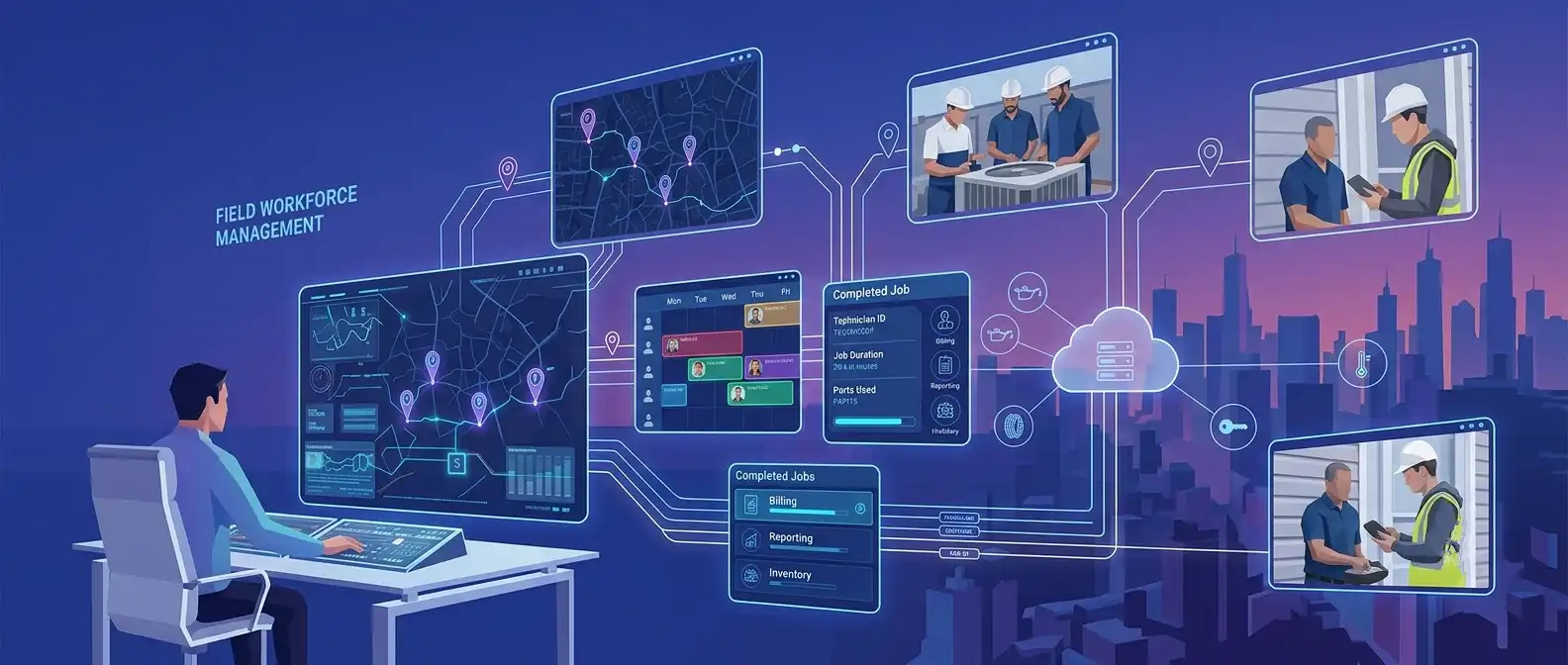
Mobile devices connect field employees with the office. Location intelligence helps determine who is nearby. Scheduling and dispatch tools connect available capacity with incoming work. Completed-job information can then move back into billing, reporting, inventory, or other enterprise systems.

What does field workforce management software do?

A field workforce management system helps answer the questions that dispatchers and managers deal with every day.

Who is available? Which employee has the right skill? Where is that person now? How long will the current job take? Can an urgent request be added without disrupting several other appointments?

The software does not eliminate those decisions. It gives people a better operational picture from which to make them.


How Does Field Workforce Management Software Work?

Step 1: Work request is created

A request may come from a customer, employee, connected asset, call center, portal, or another enterprise system.

Step 2: Job requirements are identified

The system captures information such as location, priority, skills, expected duration, SLA, equipment, and appointment preferences.

Step 3: Available field workers are evaluated

Workers can be evaluated according to availability, current workload, location, qualifications, shifts, leave, and existing assignments.

Step 4: Best worker is selected

The most appropriate employee is identified based on the rules of the business. The closest person is not always the right person.

Step 5: Job is scheduled and dispatched

The assignment is added to the schedule and made visible to dispatch and field teams.

Step 6: Worker receives job details through mobile app

The employee receives relevant customer information, instructions, forms, asset history, documents, and location details.

Step 7: Worker travels to location

Navigation and route information help the employee plan the journey.

Step 8: Work is completed and information is captured

Notes, photographs, signatures, parts used, time spent, and completion details can be captured digitally.

Step 9: Manager receives real-time status

Managers can follow progress without repeatedly calling workers for updates.

Step 10: Data feeds reporting, billing, analytics and optimization

Completed information can update billing, inventory, CRM, payroll, analytics, or future workforce planning.


What are the Core Features of Field Workforce Management Software?

  • Workforce Scheduling: Scheduling brings together jobs, workers, shifts, availability, leave, and appointment windows.
  • Intelligent Job Assignment: Assignment can consider skill, location, priority, qualification, customer requirement, and workload instead of relying on one factor.
  • Dispatch Management: Dispatchers need a live view of what has been assigned, what is delayed, and what can be moved when plans change.
  • GPS and Real-Time Location Tracking: Location data can help managers understand worker proximity and job progress where its use is operationally justified and handled with appropriate privacy controls.
  • Route Optimization: Route optimization focuses on travel between jobs. Workforce scheduling looks across the wider team and decides who should perform which work. They are connected capabilities, but they are not the same thing.
  • Mobile Workforce App: Field employees need an easy way to see assignments, receive updates, access information, and complete work without returning to the office.
  • Work Order Management: A work order keeps the job history together, from request and assignment through to completion.
  • Time and Attendance Tracking: Time spent on work, travel, and shifts can be recorded where required.
  • Field Communication: Messages and operational alerts help keep office and field teams working from the same information.
  • Digital Forms and Checklists: Inspections, safety checks, completion reports, and other documents can be captured digitally rather than on paper.
  • Asset and Equipment Management: Jobs can be connected to the equipment or asset being inspected, installed, repaired, or maintained.
  • Customer Management: Workers can access relevant customer, location, service-history, and appointment information.
  • Analytics and Reporting: Managers can examine utilization, response time, SLA performance, travel, and job completion.
  • AI-Powered Workforce Optimization: AI can help recommend assignments, forecast workload, or identify scheduling conflicts.
  • Inventory and Asset Management: Field workers can see available parts or equipment and record what they consume during a job.


Types of Field Workforce Management Solutions

There are several ways to approach field technology.

Standalone field workforce management solutions concentrate specifically on scheduling, dispatch, mobility, and workforce visibility. They can be useful when field operations require deeper functionality than a general business system provides.

ERP platforms sometimes offer field-service modules alongside finance, supply chain, and inventory. Integration may be easier, although the field features may not be as specialized.

Industry-specific solutions build workflows around areas such as utilities, healthcare, construction, or home services.

The other option is custom field workforce management software, created around an organization’s own scheduling rules, user roles, systems, and operating model.

Buying usually makes sense when established workflows are sufficient. Custom development becomes more relevant when the way field work is delivered is itself distinctive.


What are the Benefits of Field Workforce Management Software?

The immediate benefit is not necessarily automation. It is clarity.

Dispatchers can see what work exists and what capacity is available. Technicians have better access to information before arriving at a job. Managers can understand whether a delay is caused by travel, workload, job complexity, or poor scheduling.

Smarter routing can reduce avoidable travel. Better job matching can improve technician utilization and, in some situations, first-time-fix performance.

Customers benefit when appointment information is clearer and changes can be communicated sooner.

Digital forms reduce the amount of information that has to be re-entered later.

Over time, the data produced by field management software also becomes useful for workforce planning, service-demand analysis, territory design, and process improvement.


Who Needs Field Workforce Software?

Any organization managing people who regularly travel to perform work can potentially benefit.

Utilities coordinate crews across infrastructure. Telecom companies manage installations and repairs. Healthcare organizations send professionals to patient locations. Construction companies move workers and specialists between sites.

Facilities providers, manufacturers, logistics companies, insurers, public agencies, home-service businesses, and equipment providers face similar coordination problems in different forms.

The need usually becomes clearer when managers can no longer understand the day’s operation without talking to several people first.


How Does Field Workforce Management Software Help Different Industries?

Field Workforce Management for Utilities

Utility teams deal with inspections, meter work, repairs, maintenance, outages, and infrastructure spread across large areas. Safety, qualification, location, and urgency can all affect assignment.

Field Workforce Management for Healthcare

Homecare and community healthcare require careful coordination of professionals, appointments, travel, qualifications, patient information, and privacy.

Field Workforce Management for Construction

Construction businesses can coordinate inspections, field engineers, trades, timesheets, site activities, and equipment across changing projects.

Field Workforce Management for Telecommunications

Telecom providers manage technicians handling installations, repairs, network work, and customer appointments across broad territories.

Field Workforce Management for Logistics

Mobile workforce capabilities can support drivers, collections, deliveries, field operations, route activity, and status updates.

Field Workforce Management for Facilities Management

Facilities providers need to manage scheduled and reactive maintenance across multiple buildings while keeping track of technicians, priorities, assets, and service commitments.

Field Workforce Management for HVAC & Home Services

Home-service operations are highly sensitive to travel time, customer availability, technician skill, spare parts, and last-minute schedule changes.


Experion’s broader mobility portfolio includes mobile field service, mobile asset management & logistics, IoT, mobile applications, and digital platform engineering.


Field Workforce Management Software vs. Field Service Management Software: What’s the Difference?

Area Field Workforce Management Field Service Management
Primary focus People and workforce End-to-end service operations
Scheduling Core Core
Dispatch Core Core
GPS tracking Common Common
Employee management Strong Varies
Work orders Usually supported Core
Customer management May be included Core
Asset management Limited/varies Often core
Inventory May be integrated Often included
Billing/invoicing Usually integrated Often supported
Mobile workforce Core Core
Service lifecycle Partial/full Comprehensive

A field service management software platform generally covers a wider service lifecycle, including customers, work orders, equipment, inventory, contracts, and sometimes billing.

Field workforce management places more attention on how people are scheduled, deployed, and supported.

The boundaries are not rigid. Vendors use the terminology differently, so buyers comparing field services management software should look at actual workflows rather than labels.


Field Workforce Management Software vs. Mobile Workforce Management Software

Is field workforce management the same as mobile workforce management?

The terms overlap, but they are not always identical.

Mobile workforce management software can describe technology used by any workforce operating away from a fixed office. That may include drivers, sales teams, inspectors, community workers, and technicians.

Field workforce management is more commonly associated with location-based jobs, dispatch, scheduling, and service execution.

Organizations managing field service and mobile workforce management often need elements of both.


Manual Field Workforce Management vs. Automated Workforce Management

Manual approach Software-driven approach
Phone calls Real-time communication
Spreadsheets Centralized dashboard
Manual scheduling Automated scheduling
Static routes Dynamic routing
Paper forms Digital forms
Delayed updates Real-time status
Manual reporting Automated analytics
Limited visibility GPS/location visibility

Automation should not be confused with removing people from decision-making.

Experienced dispatchers understand customers, technicians, territories, and exceptions that may not exist neatly in a database. Software is most useful when it removes repetitive coordination and gives those people better information.


What Problems Does Field Workforce Management Software Solve?

Scheduling conflicts become easier to spot when availability, shifts, skills, and existing work are visible together.

Travel time can be considered while assigning jobs instead of after the schedule has already been created.

Managers gain a clearer picture of field status. A customer cancellation can create a new available slot. An urgent request can be inserted without manually rebuilding an entire spreadsheet.

Digital communication reduces the gap between what dispatch believes is happening and what is actually happening.

Electronic forms also remove the familiar problem of completed paperwork arriving at the office hours or days after the work itself.


How Can AI Improve Field Workforce Management?
Field Workforce Management Software

AI is particularly useful where field scheduling contains too many variables for simple fixed rules.

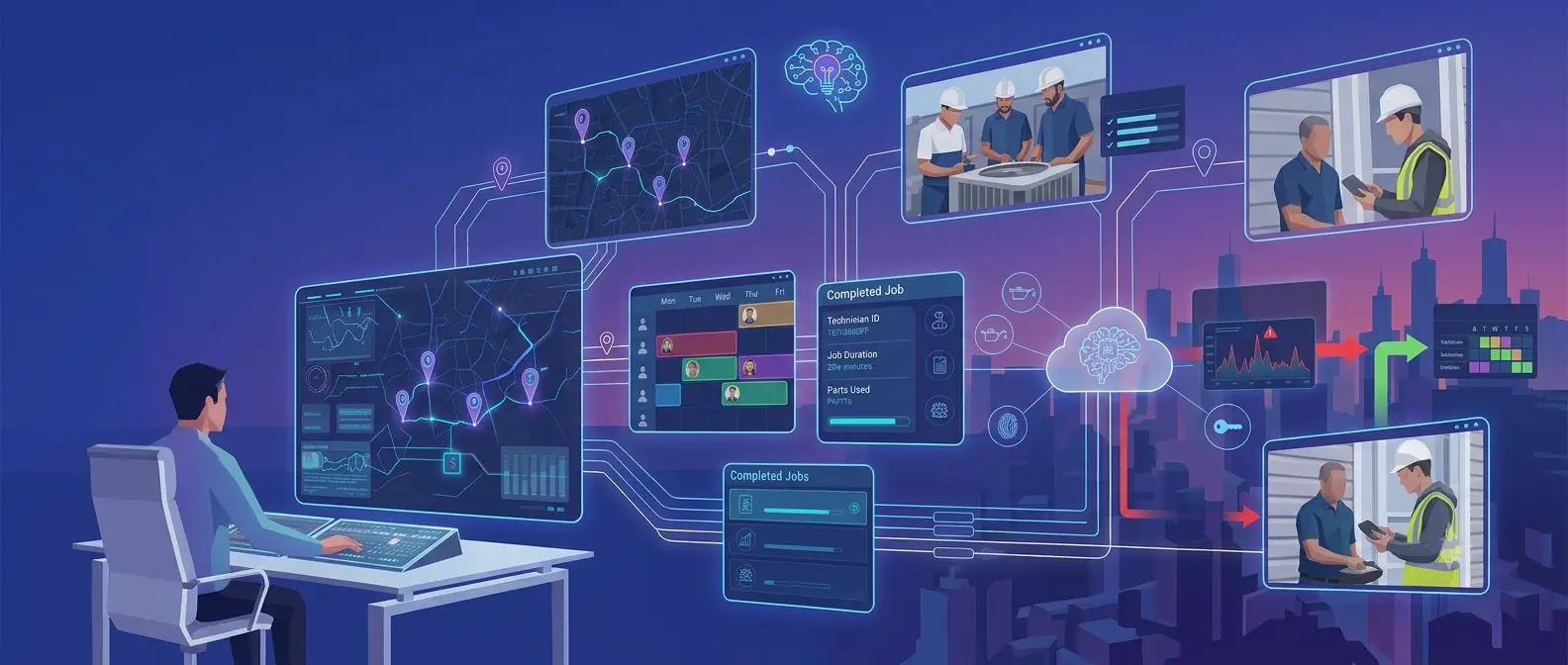
It can support intelligent scheduling, predictive workload forecasting, automated dispatch, dynamic route optimization, technician-job matching, predictive maintenance, demand forecasting, customer communication, field-worker assistance, performance analysis, anomaly detection, and generative AI work-order summaries.

Imagine that a customer cancels a two-hour appointment in the middle of the day.

Instead of leaving the gap unused, an AI-assisted scheduling engine can check nearby pending work, technician skills, travel time, customer appointment windows, and priority. It can then recommend another assignment.

That recommendation still needs context. A dispatcher may know that a customer cannot accept an earlier visit or that a technician is carrying specialized equipment for the next job.

AI works best here when it supports operational judgment rather than pretending that field work contains no exceptions.


What Integrations Should Workforce Management Software Support?

Field operations touch many other parts of the business.

CRM can provide customer information. ERP can connect finance, procurement, and wider operations. HR and payroll systems maintain workforce information. Inventory platforms track parts and equipment.

GIS and mapping services support location. Billing platforms receive completed-work information. IoT platforms can create maintenance events. Asset-management systems maintain equipment history.

A workforce management software implementation should establish which system owns each type of information. Connecting several systems without that clarity can simply spread inconsistent data more efficiently.


What is the Role of Mobile Workforce Management Software?

A desktop-first product makes little sense for someone who spends most of the day away from a desk.

Field employees should be able to view assigned jobs, access customer information, navigate to a location, change job status, capture photographs, complete forms, collect signatures, record time, and communicate with dispatch.

Offline working also matters.

Basements, rural areas, industrial sites, construction locations, and large facilities do not always provide reliable connectivity. A well-designed mobile experience should allow appropriate work to continue and synchronize safely later.


How Does Real-Time Tracking Work in Field Workforce Management?

Real-time tracking generally combines authorized location information from a device or vehicle with mapping and current job status.

Managers may use it to understand proximity, route progress, estimated arrival, or available capacity.

There is an important boundary here.

Operational visibility should not become continuous employee surveillance simply because the technology makes it possible. Organizations need clear policies around when tracking operates, what information is collected, who can see it, and how long it is retained.


How Much Does Field Workforce Management Software Cost?

There is no meaningful universal price.

Commercial platforms may charge per technician, user, module, month, or enterprise license. Advanced scheduling, mapping, AI, integrations, implementation, and support can increase the overall cost.

Custom development is different again. It may include discovery, UX, architecture, mobile and backend engineering, integrations, testing, cloud infrastructure, security, and ongoing support.

The better comparison is total cost of ownership rather than licence price alone.

A low-cost system that creates heavy manual work around integration may eventually prove more expensive than a better-connected option.


How Do You Choose the Right and Best Field Workforce Management Software?

Searching for the best field workforce management software, best workforce management software, or best field service management software is useful for building a shortlist. It cannot tell you which platform fits the way your organization operates.

Step 1: Define business requirements

Identify the problems worth solving before comparing features.

Step 2: Map the current field workflow

Follow a real job from request through scheduling, field work, completion, and billing.

Step 3: Identify workforce size

Think beyond today’s headcount and consider future territories and teams.

Step 4: Identify scheduling complexity

Understand skills, qualifications, appointment windows, priorities, shifts, and emergency work.

Step 5: Evaluate mobile capabilities

Give the mobile application to actual field users and see how it feels.

Step 6: Check GPS and route optimization

Understand the practical value as well as privacy implications.

Step 7: Evaluate integration capabilities

Check the systems that really need to exchange data.

Step 8: Check scalability

Look at users, jobs, locations, and transaction volumes.

Step 9: Review security and compliance

Assess identity, permissions, encryption, APIs, auditability, and data privacy.

Step 10: Evaluate analytics

Managers should be able to answer operational questions without rebuilding reports manually.

Step 11: Test usability

A technically capable system can still fail if people dislike using it.

Step 12: Calculate total cost of ownership

Include licensing, implementation, integration, training, customization, and support.

Step 13: Run a proof of concept

Test the difficult cases, not only the clean demonstration workflow.

Step 14: Check vendor support

Understand ownership after implementation and what happens when the product itself causes a problem.


How Do You Implement Field Workforce Management Software Successfully?

Phase 1: Discovery: Clarify business goals, operational constraints, users, and measures of success.

Phase 2: Process mapping: Document what really happens today, including exceptions.

Phase 3: Solution selection: Choose between commercial, custom, and hybrid approaches.

Phase 4: Integration: Connect the required enterprise platforms and establish data ownership.

Phase 5: Pilot implementation: Start where the operational scope is manageable enough to learn.

Phase 6: Training: Training should reflect different roles rather than giving everyone the same generic session.

Phase 7: Rollout: Expand gradually and address problems before they become organization-wide habits.

Phase 8: Measure performance: Compare results with the baseline established before implementation.

Phase 9: Optimize: Adjust workflows, rules, interfaces, and reports after seeing how people actually use the system.


What are the Challenges of Implementing Field Workforce Management Software Solution?

The software may be new, but the biggest problems are often old.

Employees may resist it because previous tools created additional administration. GPS can create understandable privacy concerns. Existing CRM or ERP data may be incomplete. Legacy integrations can be difficult. Some field locations have unreliable connectivity.

Business processes may also contain dozens of exceptions that nobody documented because experienced employees simply knew what to do.

Implementation therefore needs change management as much as configuration.

If dispatchers continue using shadow spreadsheets after launch, that is usually a sign that the new workflow has not solved something important.


Why Businesses Build Custom Field Workforce Management Software?

Off-the-shelf software makes sense when the operating model is reasonably common.

Custom field workforce management software becomes more relevant when an organization has specialized scheduling rules, distinctive mobile workflows, complex integrations, unusual compliance requirements, or field operations that directly differentiate its service.

Customization does not automatically make the result better.

Building software also means taking responsibility for its maintenance, security, upgrades, and future evolution. The business case should justify that responsibility.


What is the ROI of Field Workforce Management Software?

ROI should begin with the problem that justified the project.

If travel is excessive, measure travel. If dispatchers spend hours scheduling manually, measure scheduling effort. If customers complain about missed appointments, track missed appointments and response times.

Other useful indicators include technician utilization, jobs completed, first-time-fix rate, SLA compliance, overtime, paperwork, and customer satisfaction.

Software installation itself produces no meaningful return.

The return appears when people use the information to operate differently.


What Are the Future Trends in Field Workforce Management?

Field operations are moving from basic digitization towards more responsive decision-making.

AI-native scheduling can adapt plans as conditions change. Autonomous dispatch may eventually handle straightforward assignments while people concentrate on exceptions.

Predictive workforce planning can identify likely capacity shortages. Generative AI assistants may help technicians understand previous work, locate information, or summarize completed tasks.

IoT-connected equipment can create work requests directly. Predictive maintenance may help teams intervene before an asset fails.

Computer vision can support inspections. Augmented reality may give technicians contextual instructions while they work. Digital twins can provide richer information about complex assets.

At the same time, privacy-aware location intelligence will become more important. More sophisticated technology should not mean less thoughtful treatment of employees.

Offline-first mobile applications will remain relevant, and workforce analytics will increasingly move from describing yesterday’s performance towards helping teams decide what to do today.


Conclusion

Field work does not become complicated because companies fail to make schedules.

It becomes complicated because reality refuses to follow them.

A technician runs late. A repair needs another part. A customer changes the appointment. An emergency appears. Someone with the required expertise is already working on the opposite side of the city.

Field workforce management software provides a way to respond to those changes without rebuilding the operation manually each time.

Scheduling, dispatch, mobility, location intelligence, communication, digital forms, integrations, and analytics bring the office and the field closer to the same picture.

The best system will not necessarily be the one with the longest list of features. It will be the one that field employees can use without fighting it and that managers can rely on when the day stops going according to plan.

Expense Management Software

Companies that scale smoothly are always the ones that automate expense management from the start. Finance teams face considerable administrative and financial pressure when managing large volumes of receipts, fixing spreadsheet errors during month-end close, or identifying fraudulent reimbursement claims only after significant delays. These challenges are why expense management software is an essential tool for many organizations.

This blog provides an overview of what expense management software does, how it works, the key capabilities businesses should consider, and the factors to evaluate when selecting a platform. It is designed to enable organizations to choose an expense management solution that aligns with their specific business requirements.


Key Takeaways

  • Expense management software automates the expense lifecycle, from receipt capture to reimbursement, so users don’t have to retype numbers into a spreadsheet.
  • Ever wondered how expense management software prevents fraud unauthorized spending. They do so using OCR, AI categorization, and policy rules, rather than during an audit.
  • The right expense management platform depends on company size. Small businesses want simplicity and low cost; enterprises require ERP depth and compliance controls.
  • Expense management software and spend management software overlap but aren’t the same. Spend management is the bigger umbrella that also covers procurement and vendor payments.
  • Employee adoption is critical, as effectiveness depends on consistent employee usage. Adoption and policy setup usually decide whether an implementation works.


What is Expense Management Software?

Expense Management Software

Expense management software automates tracking, submission, approval, and reimbursement of business expenses. Instead of an employee filling out a spreadsheet and emailing a photo of a receipt, an expense management system captures the spend automatically, often at the point of purchase, sorts it into a category, checks it against policy, and sends it for approval without anyone doing arithmetic by hand.

There are three problems this kind of software solves:

  • Manual processes break down at scale, and paper receipts get lost easily. Spreadsheet formulas often get overwritten, and a hundred small data-entry mistakes a month add up to real reconciliation issues.
  • Finance teams often don’t know what’s being spent until weeks after it happens, which means budget overruns are already locked in by the time anyone sees the number.
  • Without real-time checks, duplicate claims, padded mileage, and out-of-policy purchases slide through unnoticed until someone happens to catch them.


How Does Expense Report and Management Software Work?

Most expense management software solutions follow a similar path, even if the interface and level of automation differ: capture, categorize, approve, reimburse, report.

Receipt Capture & OCR

It starts the moment money changes hands, usually a corporate card swipe, a photo of a receipt from the mobile app, or a forwarded email. Optical character recognition reads the receipt and pulls out the vendor, date, amount, and line items automatically. A decent expenses management system does this in seconds.

Approval Workflows

Once it’s captured, the expense gets sorted into categories such as travel, meals, software, and office supplies. It gets checked against policy. If it’s within limits, it might get auto-approved. If it exceeds a threshold, it routes to a manager or finance approver. Larger organizations often need multi-level approval—a direct manager, then a department head, then finance—before reimbursement happens.

Integration with Accounting/ERP Systems

Finally, approved expenses sync to the company’s accounting or ERP system: QuickBooks, Xero, NetSuite, SAP, or similar, so nobody on the finance team has to re-key anything. This is what separates real expense management accounting software from a glorified receipt scanner. The data lands in the general ledger already coded, ready to reconcile.


Key Features to Look for in Expense Management Software Solutions

  • Mobile app & receipt scanning: Employees should be able to capture and submit expenses quickly from their mobile devices. A simple, intuitive experience can encourage adoption and reduce administrative effort.
  • Policy enforcement & spend limits: Flags or blocks out-of-policy spending as it happens.
  • Multi-currency support: This is where many cheaper tools quietly fall apart. If you have international teams or frequent overseas travel, you need native currency conversion and reporting, not a workaround.
  • Real-time reporting/analytics: Finance leaders need to see spend by department and category today, not in a static report someone generates once a month.
  • Integration capabilities (accounting, HR, payroll): This goes beyond accounting. The better expense management systems also integrate with HR tools (for onboarding and offboarding) and payroll.
  • Automated Expense Reimbursement Software Workflows: Reimbursement should be automatic once a workflow is approved—direct deposit or payroll. The best automated expense management software syncs both ways with your books, so a fix made on either side stays in sync everywhere else.
  • Seamless Integration with Expense Management Accounting Software: The platform should keep expense data accurate across expense management and accounting systems. Two-way synchronization ensures that updates or corrections made in one system are reflected in the other.


 Explore how Experion can streamline your expense workflows


What are the Benefits of Using Expenses Management Software?

How Expense Management Software Reduces Bookkeeping Costs?

The clearest ROI argument here is direct: less bookkeeping overhead.

OCR and auto-categorization mean no one has to type receipt details into a spreadsheet manually. Reconciliation time drops because expenses sync straight to the general ledger — for a lot of finance teams, month-end close shrinks from days to hours. Machine learning models pick up spend patterns over time and assign account codes correctly instead of leaving it to guesswork. Fewer errors up front mean fewer hours spent tracking down and fixing miscoded transactions later.

How Expense Management Software Prevents Fraud & Unauthorized Spending?

Fraud prevention doesn’t get talked about as much as the time savings, but it’s often the bigger win.

Policy checks catch violations the moment a purchase happens and not during a quarterly audit. Duplicate receipt detection matches images and data to catch someone submitting the same receipt twice, whether on purpose or by accident. Approval hierarchies create a paper trail that makes unauthorized spending much harder to hide. And spend alerts flag anything over a threshold immediately.

Time Savings & Employee Experience

Employees get reimbursed faster instead of floating the company money for weeks while paperwork works its way through approvals, and finance teams get to spend less time chasing receipts and more time on work that requires judgment.


Types of Expense Management Software

Not every business needs the same tool, and it’s worth being honest about which category you actually fall into.

Travel and Expense Management Software

Travel expense management software is specifically built for companies with real travel spend. It usually bundles in booking tools, per diem calculations, and mileage tracking, and it’s meant to handle multi-leg trips, currency conversion, and travel policy in one place.

Corporate Expense Management Software

Corporate Expense Management Software is for bigger teams: multiple departments, layered approval chains, stricter compliance. These platforms tend to offer granular, role-based permissions and detailed audit trails suited to enterprise governance.

Cloud-Based Expense Management Software

Cloud-Based Software is hosted by the vendor, so you get automatic updates and easier scaling without anyone in IT maintaining a server. It also makes the tool accessible to remote teams working from anywhere. Most expense management software companies default to this now; on-premise is increasingly rare.

Expense Reimbursement Software

Expense Reimbursement is narrower and focused on the employee side: submit a claim, get paid back. These tend to be lighter and faster to roll out than a full corporate suite, which makes them a reasonable fit for smaller teams that don’t need everything else.


Experion can enable businesses modernize expense management with scalable and  integrated digital solutions designed around their operational needs.


Expense Management Software vs. Spend Management Software

People use these two terms interchangeably, but they’re not quite the same.

Spend management software is the bigger category. It usually covers procurement, vendor payments, budgeting, and purchase orders on top of expenses. It is meant to give finance control over all outgoing money and not just what employees spend directly.

Expense management software is narrower and involves employee-initiated spend specifically — travel, meals, mileage, reimbursable purchases.

Dimension Expense Management Software Spend Management Software
Scope Employee expenses and reimbursements All company spend, including procurement and vendor payments
Primary users Employees, managers, finance Finance, procurement, leadership
Use cases Travel, meals, mileage, reimbursements Budgeting, vendor contracts, purchase orders, corporate cards
Complexity Moderate Higher, often spanning multiple business functions

If the pain point is employees submitting receipts and waiting on reimbursement, a dedicated expense management solution is usually enough, and it’s faster to get up and running. If you need control over vendor contracts and purchasing budgets across the whole company, you want the broader spend management platform instead.


Expense Management Accounting Software: Integration With Your Books

However good the front end looks, an expense management accounting software platform lives or dies on how well it integrates with your organization’s accounting systems.

Most established platforms sync natively, in both directions. Once an expense is approved, it should land in the right general ledger account, tagged to the right department or project, without requiring manual re-entry.

Why does this matter so much? Every manual re-entry point increases the risk of errors, miscoding, or a financial close getting pushed a day later than it needs to be. Strong accounting integration also supports accurate, timely reporting by ensuring expense data transfers between systems without relying on manual exports or updates. When you are evaluating an expense management tool, ask for a live demo of the sync with your specific accounting stack rather than relying solely on a list of supported integrations.


What is the Best Expense Management Software?

Best Expense Management Software

No single expense management solution is best for every organization. The right choice depends on company size, travel requirements, and future growth plans.

When evaluating business expense management software, organizations need to consider ease of use, scalability, reporting, and customer support. The following comparison provides a general framework.

Type of Software Best For Typical Pricing Key Strengths
Entry-Level Expense Management Software Small businesses and small teams Free or low-cost plans; paid plans typically charge per user Basic expense tracking, receipt capture, approvals, and reporting
Mid-Market Expense Management Platforms Growing businesses and mid-sized organizations Typically priced per user or based on usage Automation, corporate card controls, policy enforcement, integrations, and advanced reporting
Enterprise Expense Management Software Large organizations with complex requirements Usually quote-based Advanced compliance, extensive integrations, global expense management, scalability, and configurable workflows
Travel and Expense Management Platforms Organizations with frequent business travel Per-user, usage-based, or custom pricing Travel booking, expense management, travel policies, and reimbursement in one platform
Global Expense Management Platforms Businesses with international operations Typically per-user or custom pricing Multi-currency support, global payments, international cards, and consolidated reporting
Integrated Finance and HR Platforms Organizations seeking unified employee and financial processes Usually modular or per-user pricing Expense management combined with accounting, payroll, HR, approvals, and employee lifecycle management

Best for Small Business

Small businesses benefit from affordable, straightforward expense management software. Essential capabilities such as receipt capture, expense tracking, approval workflows, basic reporting, and accounting integration are often sufficient for smaller teams.

Best for Enterprise

Large organizations typically require more advanced capabilities, including comprehensive policy controls, complex approval workflows, extensive accounting and ERP integrations, global expense management, compliance features, and detailed reporting.

Best for Travel-Heavy Teams

Organizations with frequent business travel may benefit from platforms that combine travel management with expense management. Bringing travel policies, expense reporting, approvals, and reimbursement into a connected system can improve visibility and reduce administrative work.

Best Free/Budget Option

For businesses with limited budgets, lower-cost expense management solutions can provide a practical starting point. These platforms typically offer core capabilities such as expense tracking, receipt management, and accounting synchronization. As spending volumes and organizational requirements increase, businesses can evaluate whether they need more advanced automation.


How to Choose the Right Expense Management Platform?

Ask vendors direct questions. Does the platform integrate natively with your accounting system, or does it need a third-party connector to make it work? How does pricing scale as headcount grows? What does onboarding and data migration really involve, and how long does it take in practice, not in the sales deck? Can policy rules flex by department, role, or region? And what does support look like after you’ve signed — a real account manager, or a ticket queue?

Watch for red flags too. Vague answers about integration depth (“we support most platforms,” without naming which ones) are a bad sign. So is pricing that stays hidden until late in the sales process, or no clear way to export your data if you decide to leave later. Bad reviews of the mobile app are also worth taking seriously, since that’s usually where adoption succeeds or fails.


Take your expense management further with Experion’s deep fintech and technology expertise


What are the Common Challenges When Implementing an Expense Management System?

Even a good platform runs into friction during rollout, and it’s worth knowing where in advance.

Employee Adoption

Employee adoption suffers when the mobile app is clunky, or the rules feel arbitrary. Explaining clearly why the change is happening- faster reimbursement, less paperwork- goes further than people expect.

Integrating With Existing Systems

Integrating with existing systems can get complicated fast if you’re running an older accounting version or something heavily customized. Vendor sales materials tend not to mention this part.

Migrating Historical Expense Data

Migrating historical expense data usually takes longer than anyone plans for, especially if records live across a handful of disconnected spreadsheets nobody’s touched in a year.

Configuring Expense Policies

Configuring expense policies means translating whatever informal rules your company has actually been following into a rule engine. Too strict and people get frustrated. Too loose and you’ve lost the point of automating it in the first place.

Managing Complex Approval Workflows

Managing complex approval workflows is its own project for multi-department or multi-region companies, since approval chains often need to vary by team or spend category rather than following one default setup.

Ensuring Data Security

Data security deserves real attention, not a checkbox. Expense data includes sensitive financial and personal information, so check for SOC 2 or ISO 27001 certification and ask about data residency before rollout, especially if you’re operating across borders.


Common Use Cases for Expense Management Software

Following are the use cases in Expense management software for business:

Employee Expense Reimbursement

Employees can submit expenses and receipts digitally. Managers can review and approve these employee claims through structured workflows.

Corporate Card Management

Finance teams can easily monitor corporate card spending and set proper employee limits. They can also maintain centralized spending controls.

Business Travel Expenses

Accommodation, meals, mileage, and per diem are expenses incurred during business travel. These can be managed and tracked through a single workflow.

Remote and Distributed Teams

Cloud-based platforms allow employees to submit expenses and manage reimbursements from anywhere.

Project-Based Expense Tracking

Project-wise, client-wise, and cost center-based expense assignment improves cost tracking and profitability analysis.

Departmental Budget Monitoring

Managers can monitor spending against departmental budgets and identify variances before they become larger issues.

Multi-Location Businesses

Organizations can consolidate expense data across locations while supporting local currencies, taxes, and reporting requirements.

Enterprise Expense Control

Larger organizations can establish spending policies, approval hierarchies, limits, and audit trails to strengthen financial governance.


If you’re weighing expense management software solutions and want a second opinion on what will genuinely fit your systems and grow with you, our team at Experion is happy to talk it through


Conclusion: Choosing the Right Expense Management Solution

Manual expense processes cost more than time. They create blind spots in what finance can actually see; they leave room for fraud, and they take up hours that could go toward better work. Expense management software fixes that: receipts are captured instantly, policy is enforced as it happens, and books are reconciled without anyone retyping anything.

The most suitable expense management solution depends on the organization’s individual needs. A small team is best served by an affordable solution that has expense tracking and reporting features. If your business is fast-growing, it may require stronger corporate card controls and real-time visibility. Global organizations will prioritize compliance, multi-currency support, and flexible approval workflows. The bottom line is selecting a platform that matches your actual strengths, integration depth, and approval flexibility to your spend patterns and roadmap.

Cybersecurity in Fintech

FinTech has changed the everyday mechanics of money. Opening an account no longer requires a branch visit. Payments happen in seconds. Lending decisions can begin on a mobile screen. Investing, insurance, wallets, and business banking are increasingly delivered through digital products.

That convenience creates a difficult security equation.

The easier a financial service becomes to access, the more carefully the systems behind it need to establish identity, protect data, authorize transactions, and recognize suspicious behavior. A modern FinTech application can depend on cloud infrastructure, APIs, payment processors, identity providers, banking platforms, analytics services, and dozens of software dependencies. Attackers do not necessarily need to breach the core product if they can find a weaker route around it.

That is why cybersecurity in fintech has to begin at product design. Authentication, encryption, access controls, API protection, monitoring, fraud prevention, and recovery planning cannot wait until an application is nearly ready for release.

This article looks at those practical concerns: what needs protecting, where common vulnerabilities appear, how AI is changing detection, which controls matter, and how security can be built into the software lifecycle without making every customer interaction unnecessarily difficult.


Key Takeaways

  • FinTech security begins with architecture, identity, and data protection.
  • APIs, cloud environments, mobile apps, and third parties expand the attack surface.
  • Security and customer experience need to be designed together.
  • AI can improve detection, but AI systems introduce risks of their own.
  • Compliance is important, but compliance alone does not make a platform secure.
  • Continuous monitoring and testing matter as much as pre-launch security reviews.


What is Cybersecurity in Fintech?

Cybersecurity and Fintech

Fintech cybersecurity covers the practices, technologies, and operating processes used to protect financial applications, infrastructure, data, identities, and transactions from misuse, disruption, unauthorized access, and fraud.

Put more simply, cyber security in fintech is about protecting both the money moving through a platform and the digital systems that make that movement possible.

That includes obvious areas such as login security and encryption, but also API authorization, cloud configuration, software dependencies, employee access, third-party connections, transaction monitoring, logging, and incident response.

Security, therefore, follows the product throughout its lifecycle rather than sitting around its perimeter.

What Does Fintech Cybersecurity Protect?

Asset What needs protection?
Customer data Personal and financial information
Payment data Card and transaction information
Accounts Credentials and account access
Applications Mobile, web and backend systems
APIs Data and system-to-system communication
Cloud infrastructure Applications, databases and workloads
Transactions Payment and financial activity
Identity Customers, employees and administrators
Devices Mobile devices, endpoints and servers
Third-party integrations Connected platforms and vendors

A vulnerability in any one of these areas can affect several others. An exposed API, for example, may become a route to customer data or transaction functionality even when the application interface itself is well protected.

Why is Cybersecurity Critical for Fintech Companies?

The attraction for attackers is easy to understand. FinTech products can combine high-value financial information with personally identifiable data and real-time access to money.

Their technology environments are also highly connected. APIs link banks, card networks, payment providers, credit bureaus, identity services, Open Banking platforms, and other systems. Mobile applications introduce another access point. Cloud infrastructure distributes workloads beyond a conventional data center.

At the same time, financial organizations operate under regulatory expectations around privacy, operational resilience, payment security, and customer protection.

An incident can therefore become more than a technical failure. It may affect customers, financial partners, regulators, and the reputation of the company at once.

Cybersecurity vs. Traditional Financial Security

Traditional Financial Systems Fintech Ecosystems
Centralized infrastructure Distributed/cloud infrastructure
Physical branches Digital-first platforms
More controlled access points APIs, mobile apps, web apps and integrations
Established legacy systems Rapidly evolving technology stacks
Primarily institution-controlled Multiple third-party integrations

Traditional banks certainly face cyber threats too. The difference is often the pace and architecture of the environment.

The relationship between fintech and cybersecurity is especially close because many FinTech products are continuously releasing features, connecting new services, and expanding through APIs.


Why is Cybersecurity Important in Fintech?

Customers trust financial applications with unusually sensitive things: their identity, savings, cards, financial history, and permission to move money.

Protecting customer data is therefore the first responsibility, but it is not the only one.

Security controls help prevent unauthorized transactions and financial fraud. They protect service availability when attacks attempt to disrupt operations. They also give organizations a stronger basis for meeting applicable regulatory requirements.

There is a commercial dimension as well. A confusing feature can usually be redesigned. Lost confidence after a serious breach is harder to repair.

Good fintech security should therefore protect customers without turning normal transactions into an obstacle course. The security model needs to understand risk well enough to apply more friction where it is justified and less where it is not.


Core Pillars of a Robust Fintech Security Architecture

Zero Trust Architecture (ZTA) Implementation

Zero Trust starts with a useful assumption: being inside a network does not automatically make a request trustworthy.

Users, devices, applications, and services should receive only the access they require, with important requests verified according to identity, context, and risk.

For a FinTech platform, that can reduce the damage caused by a stolen account or compromised internal credential.

Data Protection: Encryption in Transit and at Rest

Financial information should be protected while it travels and while it is stored.

Encryption is only part of the answer. Key management, tokenization, retention policies, database permissions, backups, and decisions about what data genuinely needs to be stored are equally important.

Keeping unnecessary sensitive information creates unnecessary risk.

Secure Software Development Lifecycle (SSDLC) & DevSecOps

Security works better when developers encounter it every day rather than during one large audit before launch.

DevSecOps can integrate dependency checks, static analysis, secrets scanning, infrastructure validation, security tests, and policy controls into the same pipelines teams already use for development.

The aim is not to make developers security specialists. It is to make secure engineering part of normal engineering.

Resilient Cloud Security Posture Management (CSPM)

Cloud risk often comes from configuration rather than dramatic software vulnerabilities.

An over-permissive account, accidentally exposed storage resource, or poorly configured service can create a serious problem.

CSPM helps teams continuously identify these configuration gaps across changing cloud environments.


Major Cybersecurity Threats in Fintech

  • Phishing remains effective because attackers often find it easier to deceive a person than defeat a security system.
  • Account takeover attacks use stolen credentials, compromised sessions, or social engineering to gain access to legitimate customer accounts.
  • Ransomware can interrupt operations while attackers demand payment. Malware may steal credentials or create persistent access to devices.
  • API attacks are especially relevant to FinTech because APIs often expose valuable business functions. Weak authorization can sometimes be more dangerous than a conventional software flaw.
  • DDoS attacks target availability. Insider threats may involve deliberate behavior or ordinary human mistakes.
  • Identity theft and synthetic identity fraud exploit stolen, fabricated, or combined identity information.
  • Payment fraud targets transactions directly.
  • Supply-chain attacks exploit software suppliers and other trusted partners, while cloud threats frequently involve credentials, permissions, or configuration.
  • Mobile vulnerabilities add another concern because financial products increasingly live on devices outside the organization’s direct control.


Common Cybersecurity Vulnerabilities in Fintech Applications

Many vulnerabilities begin with surprisingly ordinary weaknesses.

  • Passwords remain over-relied upon. Multi-factor authentication may not cover sensitive actions. Permissions can become broader than intended as teams and systems change.
  • APIs sometimes authenticate a user correctly but fail to check whether that user should access a particular account or record.
  • Sensitive information may be exposed through logs or poorly protected storage. Old libraries remain in production after vulnerabilities are publicly known.
  • Secrets occasionally find their way into source repositories or configuration files.
  • And logging is often treated as an operational detail until an incident occurs and investigators discover that important events were never recorded.
  • Security maturity often comes from fixing these less glamorous weaknesses consistently.


Essential Security Measures Used in Fintech

FinTech companies usually need several overlapping layers of protection rather than one security product.

  1. Multi-Factor Authentication adds protection when credentials are compromised.
  2. Encryption protects sensitive data in storage and transit.
  3. Identity and Access Management controls accounts, roles, and permissions.
  4. Zero Trust Security limits automatic trust within the environment.
  5. API Security protects endpoints, authorization, and exposed business functions.
  6. Endpoint Security monitors supported devices and employee systems.
  7. Network Security controls traffic and limits unnecessary movement.
  8. Cloud Security protects identities, configurations, workloads, and cloud data.
  9. Security Information and Event Management brings logs together for monitoring and investigation.
  10. Security Operations Center capabilities support alert triage and incident response.
  11. Vulnerability Management identifies, prioritizes, and tracks weaknesses through remediation.

The value comes from how these controls work together rather than how many security tools the company owns.


The Role of AI and Machine Learning in Fintech Cybersecurity

A useful answer to how artificial intelligence is used in fintech cybersecurity starts with scale.

A large digital financial platform can produce more transaction activity and security telemetry than a team of analysts could reasonably review manually.

That creates a practical role for AI in cybersecurity for fintech.

Real-Time Fraud Detection

Machine-learning models can assess transaction amount, location, device, account history, behavior, and other signals while a payment or transfer is happening.

The output is usually a risk signal rather than a simple declaration that someone is committing fraud.

Behavioral Analytics

Behavioral systems build a picture of how an account normally behaves.

A sudden change in device, geography, login pattern, transaction value, or navigation behavior can justify additional scrutiny.

Anomaly Detection

Anomaly detection looks for unusual activity even when there is no known attack signature.

This is useful for API traffic, account behavior, payments, infrastructure, and cloud events.

Automated Threat Detection

AI can connect alerts that might appear unrelated when reviewed individually.

This can reduce the time analysts spend sorting through repetitive security events.

AI-Powered Cyber Threat Intelligence

AI can assist with reviewing threat reports, vulnerabilities, attacker techniques, and malicious indicators.

For organizations asking how can generative AI be used in cybersecurity, practical applications include summarizing incidents, querying security data, helping analysts understand alerts, reviewing code, and drafting initial investigation notes.

Security Risks Associated With AI

AI systems need protection too.

Sensitive data may accidentally reach external models. AI-enabled applications can be exposed to prompt manipulation or excessive permissions. Model output may also be wrong while sounding convincing.

For that reason, fintech cyber security teams should treat AI as another part of the technology estate that requires controls, monitoring, and governance.


Cybersecurity Best Practices for Fintech Companies

  • Start with identity. Use strong authentication and apply least privilege to customers, employees, administrators, and services.
  • Encrypt sensitive information and manage encryption keys carefully.
  • Secure APIs as products in their own right rather than treating them merely as plumbing between applications.
  • Test software regularly. Vulnerability assessments, penetration testing, code analysis, dependency scanning, and security reviews each reveal different problems.
  • Keep systems updated, but prioritize remediation according to actual business risk.
  • Maintain protected backups and test whether restoration works.
  • Train employees to recognize phishing, unusual access requests, and social engineering.
  • Assess vendors before they become deeply embedded in critical workflows.
  • Most importantly, rehearse incident response. A plan that nobody has tested is still largely theoretical.

Cybersecurity Architecture for a Fintech Platform

A practical architecture normally includes identity, API protection, application security, encryption, cloud controls, network segmentation, fraud monitoring, secrets management, centralized logging, threat detection, and recovery capabilities.

There is no universal blueprint. The risks around a lending platform differ from those around a cryptocurrency exchange or payment processor.

Architecture should follow the financial activity being performed.


Secure Software Development Lifecycle for Fintech

The safest vulnerability is still the one that does not reach production.

An SSDLC brings security decisions into the engineering process rather than placing the entire burden on the security team at release time.

  • Security Requirements: Teams first identify sensitive information, high-risk functions, user roles, compliance needs, and likely abuse scenarios.
  • Secure Architecture and Design: Threat modeling helps engineers ask how a system might be misused before the architecture becomes difficult to change.
  • Secure Coding: Development standards should address authentication, authorization, input handling, secrets, errors, dependencies, and other common sources of vulnerabilities.
  • Security Testing: Static analysis, API testing, dynamic testing, dependency scanning, penetration testing, and manual review can each find different weaknesses
  • Deployment Security: Production needs controlled permissions, secure secrets, hardened infrastructure, and safe release processes.
  • Continuous Monitoring: Once live, the product should generate enough useful telemetry to identify unusual activity and investigate incidents.
  • Incident Response and Maintenance: Security continues for as long as the product exists. Vulnerabilities appear, integrations evolve, infrastructure changes, and attackers adapt.


Experion’s financial-services quality engineering capabilities include security and regulatory-compliance testing alongside functional, performance, mobile, and broader financial-platform testing.


Fintech Cybersecurity Compliance and Regulations

The requirements affecting a FinTech company depend on its geography, product, licensing position, data, customers, and role in financial transactions.

  • PCI DSS is relevant where organizations store, process, or transmit payment-card information.
  • GDPR applies to personal-data processing within its scope and introduces obligations around privacy and protection.
  • SOC 2 is an assurance framework commonly used by service organizations rather than a government regulation.
  • ISO/IEC 27001 provides a framework for establishing and operating an information security management system.
  • Regional Financial Regulations may introduce additional cybersecurity, operational-resilience, outsourcing, reporting, or consumer-protection obligations.
  • The final point matters: Compliance vs. Security is not a choice between two equivalent things. Compliance defines obligations. Security is the continuing work required to understand and reduce actual risk.


Cybersecurity Challenges Faced by Fintech Companies

Cybersecurity in Fintech

FinTech teams usually operate under pressure to ship quickly.

Security teams are trying to make sure that speed does not introduce invisible weaknesses.

Cloud services, APIs, mobile applications, external platforms, and third-party vendors make the environment harder to understand as one system.

Legacy technology creates another problem. It may contain important financial logic while being difficult to patch or integrate safely.

Cyberattacks are also becoming more sophisticated, and experienced security talent remains difficult to scale.

Then there is usability. If every low-risk activity requires several authentication steps, customers will resist the product.

Security engineering therefore involves judgment, not simply adding more controls.


How to Build a Cybersecurity Strategy for a Fintech Company?

Step 1: Identify Critical Assets – Know which data, systems, identities, and transactions would cause the greatest damage if compromised.

Step 2: Map the Attack Surface – Include APIs, cloud services, mobile apps, employees, vendors, external systems, and internet-facing infrastructure.

Step 3: Conduct Risk Assessment – Consider both the likelihood of attack and the consequences.

Step 4: Prioritize Security Controls – Spend effort where the potential damage is greatest.

Step 5: Implement Security Technologies – Deploy identity, monitoring, API, cloud, endpoint, and data controls appropriate to those risks.

Step 6: Establish Security Governance – Define responsibilities, escalation, policies, and decision-making authority.

Step 7: Test and Monitor – Controls should be challenged regularly rather than assumed to work.

Step 8: Continuously Improve – Products and attackers both change. The security strategy has to change with them.


Cybersecurity in Different Areas of Fintech

Cybersecurity in Digital Payments

Payment security concentrates on transaction integrity, authentication, fraud, card or account data, APIs, and availability.

Cybersecurity in Digital Banking

Digital banks need to protect accounts, customer identity, mobile applications, core-system integrations, and customer information.

Cybersecurity in Insurtech

InsurTech platforms bring together policy, claims, personal, and financial information, making access and integration security particularly important.

Cybersecurity in Lending and Fintech

Digital lending introduces risk around borrower identity, financial information, credit data, decision systems, APIs, and repayments.

Cybersecurity in Wealthtech

Wealth platforms need to protect investor identities, portfolios, transactions, market integrations, and sensitive financial data.

Cybersecurity in Cryptocurrency and Digital Assets

Digital assets add concerns around custody, private keys, wallets, smart contracts, exchanges, and transactions that may be difficult or impossible to reverse.

This is why cybersecurity and fintech cannot be treated as one generic use case.


How Can Fintech Companies Respond to a Cybersecurity Incident?

  • Start by Detecting what has happened.
  • Contain affected accounts, systems, or access before the incident spreads.
  • Investigate using preserved logs and evidence.
  • Eradicate malicious software, unauthorized access, exposed credentials, or vulnerable components.
  • Recover carefully, verifying systems before restoring normal service.
  • Notify Relevant Stakeholders where legal, regulatory, contractual, or customer obligations require it.
  • Finally, Learn and Improve. An incident should result in a better control, process, architecture, or detection capability.


Cybersecurity in Fintech: Key Benefits of a Proactive Approach

Proactive security reduces the likelihood that known weaknesses sit unnoticed until somebody exploits them.

It strengthens fraud prevention, protects sensitive information, improves resilience, and supports regulatory readiness.

It can also reduce operational disruption because the organization already knows how to respond when something unusual occurs.

For customers, the benefit is less visible but more important: safer digital experiences.

For the business, stronger fintech cybersecurity creates a better foundation for launching new services without constantly accumulating unmanaged risk.


Future of Cybersecurity in Fintech

AI-driven security will play a larger role in detection, investigation, and fraud management.

Passwordless authentication and passkeys may reduce reliance on reusable passwords.

Behavioral biometrics can add risk signals based on how users interact with devices.

Continuous authentication will reassess trust throughout a session.

Zero Trust will remain relevant as technology estates become increasingly distributed.

Privacy-enhancing technologies may allow organizations to work with sensitive data while limiting exposure.

Cloud-native security and automated security operations will continue moving controls closer to applications and infrastructure.

API-first security will become more important as financial ecosystems depend on more external connections.

Quantum-resistant cryptography is a longer-term concern, but financial organizations are beginning to consider how existing cryptographic dependencies might eventually need to change.


How to Choose a Fintech Cybersecurity Partner?

Start with financial-services experience.

A security provider should understand the technology and business consequences of protecting payment, lending, banking, investment, or insurance platforms.

Assess application security, cloud, API, identity, testing, DevSecOps, and incident capabilities.

Compliance knowledge matters, but it should not become the entire security proposition.

When evaluating fintech cybersecurity companies, ask how the team works with engineers. Security that exists separately from product development often arrives too late.

Continuous support also matters because the platform will keep changing after implementation.


Cybersecurity in Fintech: A Practical Checklist

  1. Sensitive data is encrypted.
  2. MFA is implemented for critical accounts.
  3. Access follows least-privilege principles.
  4. APIs are authenticated and authorized.
  5. Vulnerabilities are regularly identified and remediated.
  6. Security logs are continuously monitored.
  7. Third-party vendors are assessed.
  8. Employees receive security awareness training.
  9. Backups are protected and tested.
  10. Incident response procedures are documented.
  11. Security testing is integrated into software development.
  12. Compliance requirements are regularly reviewed.


How Does Experion Help With Fintech Cybersecurity Services?

Security in financial technology is closely connected with how a product is engineered.

Experion can support FinTech organizations through product engineering, quality engineering, cloud and API integration, modernization, and security-focused testing.

Our documented financial-services capabilities include security and regulatory-compliance testing for payment platforms, mobile banking, core banking, and other financial systems, as well as integrations across payment rails, banking platforms, card schemes, and Open Banking services.

This does not mean promising that any platform can be made completely secure. A more practical approach is to identify relevant risks, build suitable controls into engineering, test them continuously, and strengthen the product as its technology and threat environment change.


Conclusion

FinTech is built around removing friction from finance.

Cybersecurity has to protect that experience without quietly putting all the friction back.

That balance is what makes cybersecurity in fintech different from adding a few security products around an application. Identity, APIs, infrastructure, software development, transactions, third parties, and customer behavior all form part of the same security picture.

AI will help teams process that complexity, particularly in fraud detection, anomaly identification, and security operations. It will not remove the need for skilled judgment. In some areas, it will create entirely new questions about data, access, and reliability.

The stronger approach is therefore not to think of fintech and cybersecurity as separate workstreams. Security should mature with the financial product itself.

Construction Project Management Software

Managing multiple construction projects involves fragmented information across numerous spreadsheets, emails, reports, and other disconnected systems. Teams managing construction projects often struggle to get a real-time view of progress and documentation. Custom construction project management software connects field and office operations while centralizing critical project information.


Key Takeaways

  • In the construction industry, a single project involves around 15-30+ contractors, lenders, owners, etc. Many are coordinated through contracts rather than directly. Weather, subsurface conditions, and material lead times make even well-planned schedules subject to change.
  • Build vs. Buy depends on the gap. Off-the-shelf software is the better choice when most requirements can be met through configuration. A custom solution is used for highly differentiated workflows when integration costs make customization viable.
  • Critical-path scheduling, cost-code budget tracking, and drawing/RFI/submittal version control are non-negotiable features. Offline-capable mobile access for field crews is, too.
  • Generic project management tools cannot be leveraged, as they treat tasks as simple cards. Construction tasks, by contrast, carry crew dependencies and material lead times. A single delay can cascade through multiple trades.
  • Fragmented data erodes the end profit margin. Spreadsheets, emails, and paper-based field reports can hide delays and unbilled change orders. In the end, this creates administrative overhead that quietly affects construction margins.


What is Construction Project Management Software?

Construction Project Management

Construction project management software plans, tracks, and documents a project from preconstruction through closeout. It brings scheduling, budgets, drawings, submittals, RFIs, daily logs, subcontractor coordination, and reporting into one system where every record ties to a project, a cost code, and a person accountable for it.

The distinction from generic project management tools like Asana, Trello, and Monday is their ability to address key construction project requirements.  A construction task comprises factors such as quantities, a crew size, the material delivery it depends on, an inspection that must pass before the next trade can start, and a contractual consequence. Building construction project management software encodes those relationships natively.

Three differences are worth being concrete about:

  • Document control: Generic tools store attachments. Construction and project management software manages drawing revisions, marks superseded sheets, links RFIs to drawing locations, and maintains the audit trail you will need if a dispute becomes a claim.
  • Cost structure: Generic tools have no concept of a schedule of values, retainage, committed versus actual cost, or a pending change order. A construction project management system treats these as first-class objects.
  • Field reality: Site teams work in gloves, in glare, often with poor connectivity. Construction work management software is built for offline capture, photo-heavy documentation, and interfaces a foreman can use in thirty seconds without training.


Why the Construction Industry Needs Dedicated Project Management Software?

The construction industry faces numerous industry-specific challenges.

  • Fragmented stakeholders: A single mid-sized commercial project can involve an owner, developer, architect, engineers, a general contractor, subcontractors, suppliers, inspectors, a lender, and an insurer.
  • Compliance and documentation burden: Permits, inspections, safety records, lien waivers, and certified payroll all generate paperwork with legal weight. Missing records delay payment and create liability.
  • Conditions that change constantly: Weather, subsurface surprises, late design decisions, and material lead times move independently of your plan.
  • Subcontractor dependency: Most work is performed by companies you do not employ, coordinated through contracts rather than management authority. Visibility into their progress is indirect by default.

Poor coordination in construction has a significant impact. McKinsey has reported that large projects typically run around 20 percent longer than scheduled and up to 80 percent over budget, with sector labor productivity growing roughly 1 percent annually over two decades. A 2018 FMI and Autodesk study put the cost of rework driven by poor project data and miscommunication at around $31 billion in the US in a single year.

How software solves what spreadsheets and email cannot?

Spreadsheets and email fail at one specific thing: maintaining a single, current, shared version of the truth across many people. A spreadsheet has no record of who changed what or why; email has no structure, so information lives only in the inboxes of whoever was copied. Neither links schedule to budget, so a delay’s cost implication has to be worked out by hand, usually too late. Construction project management software replaces that with one record set.

Reducing administrative work

The clearest return is time recovered from low-value work. Project engineers typically spend much of the week chasing status, retyping field notes, assembling reports, and hunting for current drawings. Daily reports generate themselves from field entries, submittal logs update when a status changes, and monthly owner reports assemble from live data.


Key Features to Look for in Construction Project Management Software

Feature lists are long and mostly similar. What separates real capability from a checkbox is depth, and the project management software construction teams actually adopt tends to win on depth rather than count.

Scheduling & Gantt Charts

Look for critical path calculation, dependencies with lead and lag, baseline-versus-actual comparison, and resource-loaded activities. Two-week lookahead (short term) planning deserves attention too: master schedules are for the owner and the lender, but lookaheads are what superintendents manage from.

Budget & Cost Tracking

Cost control needs original budget, approved changes, committed costs, actual costs, and forecast to complete, all against the same cost code structure. Check for support for schedules of values, progress billing, and retainage.

Document & Drawing Management (RFIs, submittals)

This is where construction-specific platforms earn their keep:

  • Drawing version control with automatic superseding and clear current-set identification
  • Sheet-level markup that carries forward across revisions
  • RFIs tied to a drawing location, with ball-in-court tracking and response deadlines
  • Submittal logs with review cycles, approval status, and lead time tracking
  • Searchable, timestamped, exportable records suitable for a dispute

The audit trail is the point: when a claim arrives eighteen months after closeout, showing who knew what and when decides the outcome.

Team Collaboration & Communication

Communication should attach to the work rather than float free: a comment belongs on the task, the RFI, or the drawing it concerns. Role-based permissions matter more than teams expect. An owner should see progress without seeing buyout margins; a subcontractor should see their own scope, not the full cost picture.

Mobile/Field Access

Field usability decides whether the system succeeds. The non-negotiables are offline capture with reliable sync, photos attached directly to tasks or drawing locations, daily logs and timesheets completable in a few taps, drawing markup on a tablet, and an interface a foreman can learn without training.

Reporting & Analytics

Reporting serves three audiences: Supervisors needing daily status, managers needing variance and forecast, and executives that require portfolio health. Look for configurable dashboards, scheduled distribution, and drill-down from any summary figure to the underlying records.

Integrations (accounting, BIM, estimating tools)

The most critical integrations are accounting and ERP for job costing and payroll; estimating so the winning bid becomes the budget without re-entry; BIM for model-based coordination and quantities; and an open API. Confirm whether each integration has genuine bidirectional sync.

Risk and Issue Management

Manage risks and issues through registers that capture ownership, severity, mitigation plans, and review dates. Look for the ability to link a risk to the activities and cost codes it threatens, so you can quantify its impact rather than describe it. Safety incidents, inspections, and non-conformance reports belong in the same system.


Turn your construction workflows into a smarter digital system.
Connect with Experion’s construction technology team to discuss your requirements


Construction Project Management Software for Different Users

Construction Project Management Software

The right construction project management solution depends heavily on who uses it and what they are accountable for.

Project Management Software for Builders

  • Scenario: Independent/small residential builders managing 1-5 active jobs

The owner is often an estimator, project manager, and client liaison at once, so enterprise platforms with a three-month implementation are the wrong answer. What matters in project management software for builders is fast setup, client-facing photo updates and selection tracking, simple allowance management, subcontractor scheduling that works by text or a light app, job costing tied to accounting, and pricing that scales with jobs rather than seats.

Project Management Software for Construction Companies (mid-large firms)

  • Scenario: Companies running multiple concurrent projects across sites/teams

At this scale, the problem shifts from managing a project to managing a portfolio. Leadership needs to know which of twelve active jobs are at risk, where labor is over-committed next month, and whether portfolio cash flow holds. Requirements for project management software for construction companies include portfolio dashboards with cross-project resource visibility, standardized templates, granular permissions across departments and external parties, deep ERP integration, compliance and safety documentation.

Software for General Contractors vs Subcontractors

  • Scenario A — General Contractors (GC):

The GC coordinates many trades, holds the master schedule, owns RFI and submittal processes, and answers to the owner. Priorities are multi-trade sequencing, subcontractor performance tracking, RFI and submittal throughput, buyout and commitment management, and owner-facing reporting that is clear without exposing internal cost detail.

  • Scenario B — Subcontractors:

A subcontractor needs visibility into the GC’s schedule to staff correctly, plus simple tracking of their own scope: change alerts, crew scheduling across multiple GCs and sites, scope tracking against contract, change order documentation to protect against unbilled extra work, invoicing tied to milestones, and lien waiver management. The specific pain is being pulled into several GC platforms while still needing one internal view of the business.


How to Choose the Right Construction Project Management System?

Factor in this checklist:

  • Team size and project complexity: How many concurrent projects, what contract values, how many internal users, how many external collaborators?
  • Budget: Account for licensing, implementation, migration, integration development, training, and internal time, then weigh the total against the cost of the status quo.
  • Integration needs: List every system that must connect, the data that moves, the direction, and the frequency, then bring that list to every demo.
  • Ease of adoption for field crews: Put the real interface in front of a real foreman, on a phone, with gloves on, and ask how long a daily report takes.
  • Scalability: Check what happens to pricing at scale and whether workflows can be adjusted without vendor involvement.


At Experion, we build construction project management software around how your crews, contracts, and cost codes actually work, rather than forcing your teams to adapt to a vendor’s product roadmap.


How Does Construction Project Management Software Work?

The stages of Construction Project Management (CPM) and how software can support each stage of CPM

Step 1: Set Up the Project

Define scope, contract value, budget with its cost code structure, the master schedule, and the stakeholder list with roles and permissions. The software’s purpose is to make this reusable: templates carry your cost codes, folder hierarchy, and approval workflows from one project to the next.

Step 2: Create Tasks and Milestones

Decompose work into phases, activities, and tasks small enough to assign and measure. The system calculates the critical path, identifies float, and flags milestones tied to payment applications or liquidated damages.

Step 3: Assign Resources

Crews, equipment, and materials are allocated against activities, which is where over-commitment surfaces: the same crew promised to two activities in one week, or a machine scheduled across two sites.

Step 4: Track Site Progress

Field teams update completion, quantities installed, hours worked, deliveries, and site conditions from mobile devices, with photos attached to the task or location. This step decides whether the implementation succeeds.

Step 5: Manage Issues and Changes

Log delays, design changes, unforeseen conditions, RFIs, and quality non-conformances with the owner, date, impact, and required action. Change orders move through a documented workflow from identified to priced, submitted, approved, and incorporated into budget and schedule.

Step 6: Monitor Costs and Performance

Planned versus actual is compared continuously across schedule and cost, with earned value and forecast-to-complete updating as data arrives. The value lies in the early warning.

Step 7: Generate Reports

Dashboards serve each audience: daily field summaries, weekly variance reports, monthly owner and lender reports, and executive portfolio views. Because data is captured once at source, reports assemble automatically on a schedule.


How Much Does Construction Project Management Software Cost?

There is no single answer, and any vendor giving you one before understanding your operation is guessing. What is useful is knowing the variables:

  • Number of users: Most pricing scales with seats. Some platforms charge for subcontractor access, while others include unlimited collaborators; above 100 users, that distinction alone can change the total by a factor of two.
  • Number of projects: Pricing per project or by annual construction volume can favor or penalize high-volume, small-job firms, depending on the model.
  • Feature set: Tiered editions are standard, with cost management, BIM, analytics, and safety modules above the base tier. One required feature can push you up a level.
  • Cloud versus on-premise: Cloud is a subscription with infrastructure and security included; on-premise means upfront licensing plus your own servers, IT staff, and upgrade cycles.
  • Customization: Configuration is usually included. Genuine customization is billed as professional services, and each vendor upgrade may require revalidation.
  • Integrations: A mainstream accounting connector may be included. A custom integration to a legacy ERP is a development project with its own budget.
  • Implementation: Migration, configuration, and training frequently cost between half and twice the first year’s licensing. Under-budgeting is the most common reason rollouts disappoint.
  • Support and maintenance: Response guarantees and a named account manager are often paid add-ons priced as a percentage of license value.

Subscription-Based Software

Billed monthly or annually, with infrastructure and updates as the vendor’s responsibility. Lower upfront cost, faster deployment, predictable operating expense. The trade-off is a perpetual cost that never becomes an owned asset, and pricing is controlled by the vendor at renewal.

Per-User Pricing

The most common structure, ranging from modest rates for lightweight tools to substantial pricing for enterprise platforms. Transparent and easy to forecast, but per-seat cost discourages giving access to everyone who would benefit, quietly undermining the single-source-of-truth premise.

Custom Enterprise Solutions

Purpose-built or heavily tailored platforms involving significant development investment. The rationale is fit rather than features: workflows that match your operating model exactly, integrations no vendor supports, ownership of the platform and data, and no per-seat cost growth. You own the maintenance and roadmap.

Open-Source Options

Platforms such as ERPNext and Odoo modules can be adapted for construction use, with minimal license cost and full control of the code. The real costs are hosting, configuration, construction-specific development, and maintenance, with community support rather than a vendor accountable to you.


Not sure whether to buy, configure, or build?
Experion can model the total cost of each path against your requirements before you commit. Book a discovery session


Types of Construction Project Management Software Solutions

Cloud-based / Web-based platforms

Web-based construction project management software is now the default: access from any browser or device, no server infrastructure, automatic updates, and native support for collaboration across companies and locations. Key considerations include internet dependency (largely mitigated by strong offline mobile capability), data residency in regulated jurisdictions, and reliance on the vendor’s uptime.

On-Premise Systems

Software on your own infrastructure gives complete data control, deep customization, and upgrades on your schedule, which suits defense, government, or critical infrastructure work with strict data requirements.

Industry-specific vs General-Purpose Tools

Industry-specific construction software project management platforms include RFIs, submittals, drawing management, cost codes, and progress billing as native concepts. You configure rather than construct, and the vendor understands your domain.

General-purpose tools are affordable and more flexible but lack construction concepts entirely, so every requirement becomes a custom field or a workaround. Once you are managing submittals, drawing revisions, and multi-trade coordination, purpose-built project management construction software pays for itself.

Software for Different Project Sizes

Residential builders need selections and allowance management, client photo sharing, warranty tracking, simple job costing, and light subcontractor scheduling. Projects are shorter, and the client relationship is central, so complexity is the enemy.

Commercial contractors need heavy document control, formal RFI and submittal workflows, certified payroll where applicable, multi-trade critical path scheduling, schedule-of-values billing with retainage, and BIM coordination.

Buying commercial-grade software for residential work produces an unused system. Using residential software on commercial work produces gaps that surface as claims.


Construction Project Management Software: Build vs. Buy

When to Choose Off-the-Shelf Software for Construction Project Management?

  • Standardized requirements: If your processes broadly resemble industry norms, established construction project management softwares already encodes practices refined across thousands of projects.
  • Faster deployment: Weeks to a few months, against six to eighteen months for a substantial custom build.
  • Lower upfront development effort: No engineering team, no product management, no QA cycle. Security patching, compliance certifications, and maintenance remain the vendor’s problem.

For most small and mid-sized firms, this is the right starting answer. The honest test: can you meet 80 percent of your requirements through configuration alone?

When to Choose Custom Software for Construction Projects?

  • Unique workflows: If your approach to a core process is genuinely different and commercially advantageous, forcing it into a standard product erodes the advantage.
  • Complex integrations: Legacy ERP systems, proprietary equipment telemetry, or in-house estimating tools no vendor supports.
  • Enterprise-scale requirements: At several hundred or several thousand users, per-seat subscriptions compound to figures that fund development outright.
  • Need for greater control: Over roadmap, data, release schedule, and security model, with no vendor deprecating a feature you depend on.
  • Specialized business processes: Firms in unusual delivery models or specific regulatory environments frequently find no adequate product exists.

A middle path is often best: A commercial platform as a system of record, with custom applications around it handling the workflows that make you distinct.

Questions to Ask Before Building a Custom Construction Process Management Software

  • What workflows need customization?
    Document them as they are, then mark which are genuinely differentiated and which are merely habitual. Build only the first category.
  • Which systems need integration?
    For each system, document the data that must move, the direction, the frequency, and whether an API exists. Undiscovered integration complexity is the most common cause of build overruns.
  • Who will use the platform?
    Every role, their technical comfort, their device, their working conditions. Field users are the hardest and most important audience.
  • What data needs to be centralized?
    The source of truth for each domain, and where existing data lives and in what condition. Data quality problems do not disappear during migration; they get inherited.
  • What mobile functionality is required?
    Which tasks must work offline, on which devices, in what conditions. Mobile requirements drive much of the architecture and cost.
  • What scalability and security requirements exist?
    Projected users and data volume in five years, access control granularity, audit needs, and data residency.


Benefits of Using Project Management Software in Construction

  • Improved timeline accuracy: Baselines, critical path visibility, and real-time field updates turn schedules from optimistic documents into managed forecasts. Slippage becomes visible in days rather than at month-end, which is the difference between recovery and explanation.
  • Reduced cost overruns: Commitment tracking, live cost-to-complete forecasting, and enforced change order documentation catch problems while intervention is still possible.
  • Better subcontractor/vendor coordination: Shared schedules, clear scope, and automated alerts when sequences change reduce the standing-around and rework that come from trades working off different information.
  • Real-time visibility for stakeholders: Owners, lenders, and executives get current status through dashboards instead of requesting reports, cutting administrative load and building the trust that wins repeat work.
  • Risk & compliance management: Risk registers with owners and mitigation plans, safety and inspection records, and complete audit trails, so when a dispute arises, the documentation already exists in a searchable form.


Future Trends in Construction Project Management Software

  • AI-driven scheduling & predictive analytics: Models trained on historical project data are beginning to flag delay risk before it materializes, suggest resequencing, and sharpen duration estimates. The direction is from reporting what happened toward anticipating what will.
  • Drone/IoT data integration: Drone surveys now produce progress measurement and quantity verification with far less manual effort, while sensors on equipment and materials feed utilization and condition data straight into project systems.
  • Increased mobile-first, web-based adoption: The field is becoming the primary interface, with capture-by-default workflows, voice input, and computer vision that reads progress and safety conditions from site photographs.
  • BIM integration deepening: Schedule activities are bound to model elements, quantities flow from the model into cost and procurement, and coordination happens in the model rather than alongside it.
  • Digital Twins and Advanced Visualization: Live digital representations updated from site and sensor data extend project management into operations. At the same time, augmented reality for on-site layout verification is moving from pilot to practical use.


Conclusion

Project management software construction involves intricate data and coordination. The right information needs to reach the right person, at the right moment.

When information flows reliably, changes are captured and priced accurately, field teams and office teams work from a single source of truth, and problems become visible when you still have time to act. The right platform brings planning, field execution, communication, cost control, documentation, and reporting into one connected workflow. Information is captured once, at source, by the person closest to it, and everything else updates from that. Reports assemble themselves, meetings shift from establishing status to making decisions, and the audit trail builds itself as a by-product of the work. Whether that means a configured commercial platform, a custom build, or a hybrid depends on your scale, workflows, and integration landscape.


Let’s talk about what fits your operation.
Experion can design  construction project management software for builders, contractors, and developers, from platform selection and integration through full custom development. Start the conversation